
Albanian
Albanian handwriting, print and signage turned into text, whatever alphabet it was written in
Until the 1908 Congress of Manastir settled on a single Latin alphabet, Albanian had been written in Greek and Arabic letters and in at least three invented alphabets of its own, so a page from before that date can turn up in a script no other Albanian document uses. Modern Albanian solves the same problem the other way round, spelling sounds Latin never had with digraphs such as sh, zh, nj and rr and with the extra letters ë and ç. Evidano reads both ends of that range and sets the transcription beside the image so every unfamiliar letter or digraph can be checked.
Sample pages
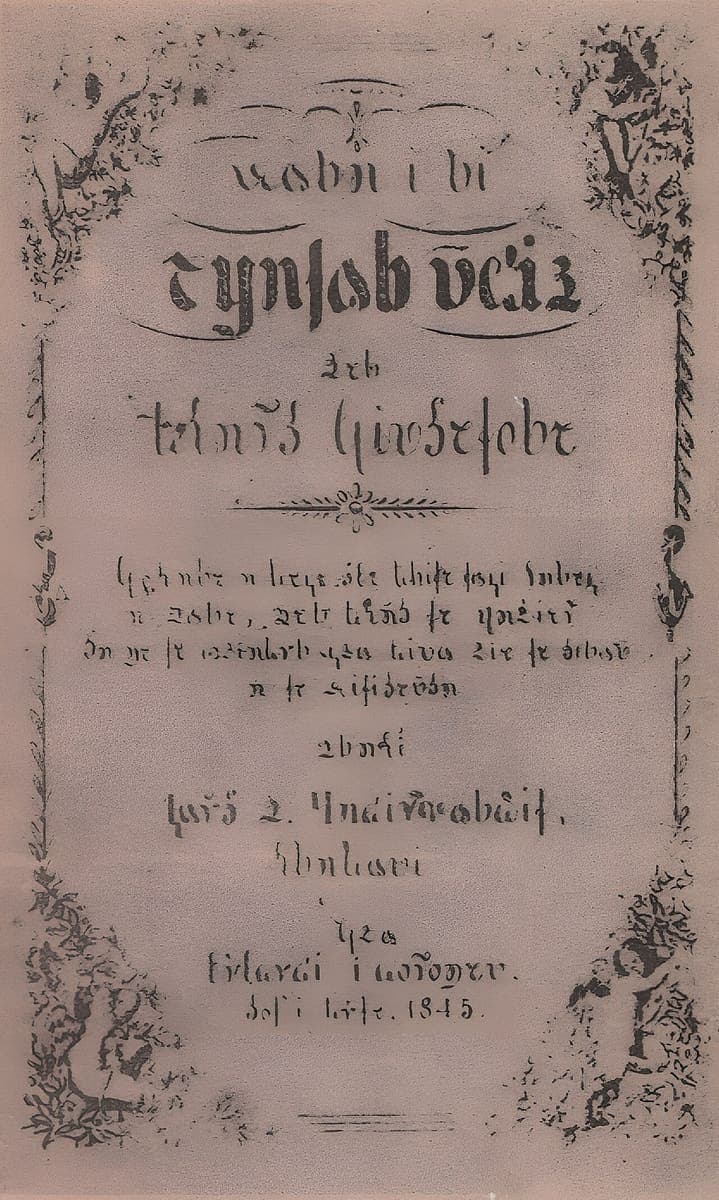
Source · Public domain · Naum Veqilharxhi
Evidano Transcription
The whole title page in Unicode Vithkuqi as transcribed on Wikisource (Latin reading: fare i ri / ëvetar shqip / për / Djelm Nismëtore … prej Naum P. Veqilharxhit, Bredhasi, nga Bythkuqi i Kolonjës, mot' i dytë 1845); the ornamental borders are not represented, and the text needs a Vithkuqi font to display.
𐖠𐖗𐖱𐖞 𐖥 𐖱𐖥
**𐖟𐖸𐖞𐖵𐖗𐖱 𐖴𐖰𐖥𐖯**

𐖯𐖟𐖱
**𐕵𐖧𐖞𐖩𐖫 𐖅𐖥𐖳𐖫𐖟𐖵𐖮𐖱𐖟**

𐖅𐖹𐖧𐖞𐖱𐖟 𐖞 𐖝𐖟𐖬𐖟 𐖫𐖙𐖟 𐖜𐖱𐖥𐖵𐖟 𐖵𐖗𐖬𐖥 𐖣𐖞𐖱𐖟𐖬
𐖞 𐖯𐖗𐖱𐖟, 𐖯𐖟𐖱 𐖜𐖧𐖞𐖫 𐖵𐖟 𐖸𐖞𐖡𐖦𐖟𐖩
𐖄𐖞 𐖭𐖟 𐖵𐖟 𐖼𐖡𐖦𐖞𐖝𐖷𐖱 𐖬𐖡𐖗 𐖜𐖥𐖳𐖗 𐖡𐖦𐖟 𐖵𐖟 𐖫𐖥𐖱𐖗𐖴
𐖞 𐖵𐖟 𐖠𐖥𐖵𐖥𐖫𐖟𐖴𐖫𐖞.

𐖯𐖱𐖞𐖧𐖦
𐖅𐖗𐖷𐖫 𐖈. 𐖑𐖞𐖰𐖥𐖩𐖤𐖗𐖱𐖛𐖥𐖵,
𐕱𐖱𐖞𐖝𐖗𐖳𐖥

𐖬𐖡𐖗
𐕲𐖻𐖶𐖨𐖷𐖰𐖥 𐖥 𐖨𐖮𐖩𐖮𐖭𐖟𐖳.
𐖄𐖮𐖵’ 𐖥 𐖜𐖻𐖵𐖟. 1845.
Source: Naum Veqilharxhi, Fare i ri ëvetar shqip (1845), Kopertinë — Wikisource (Public domain (1845 text); Wikisource transcription CC BY-SA 4.0).
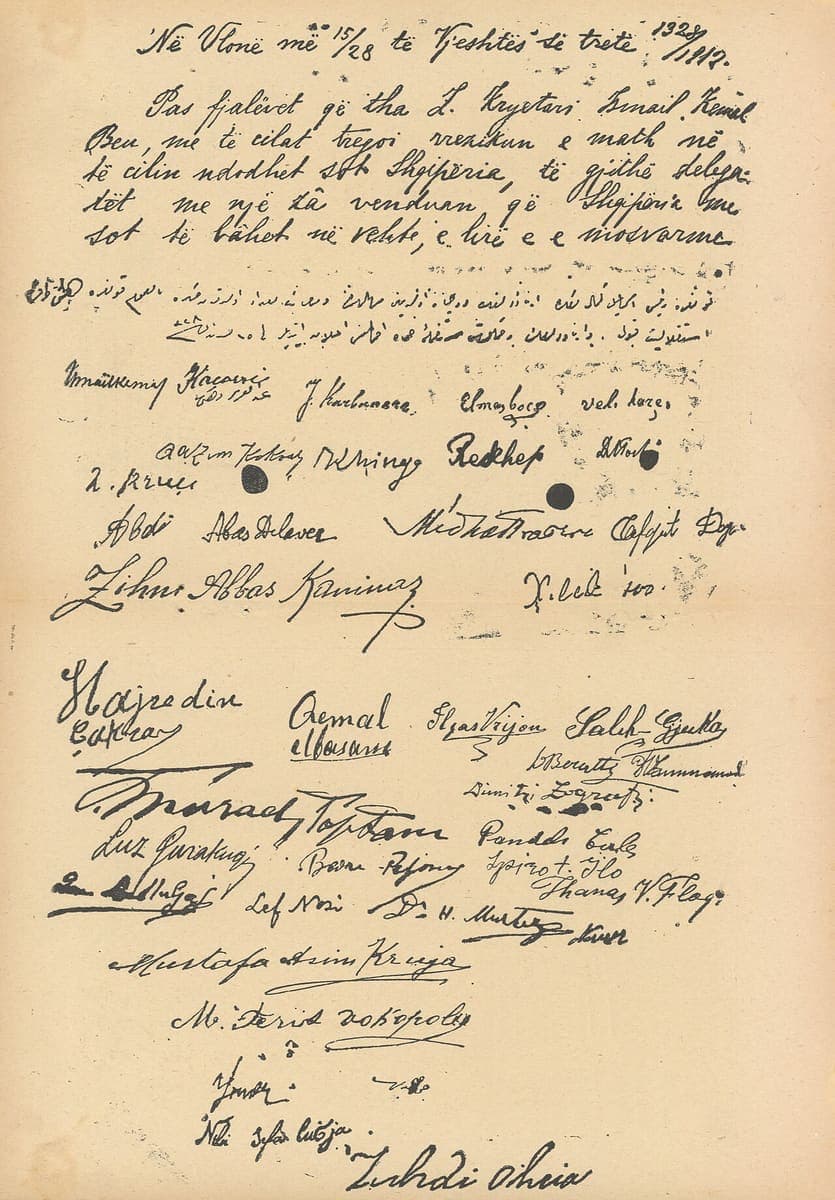
Source · CC BY-SA 3.0 · AceDouble
Evidano Transcription
Në Vlonë më 15/28 të Vjeshtës së tretë 1328/1912.
Pas fjalëvet që tha Z. Kryetari Ismail Kemal
Beu, me të cilat tregoi rrezikun e math në
të cilin ndodhet sot Shqipëria, të gjithë delega-
tët me një zâ venduan, që Shqipëria me
sot të bâhet në vehte, e lirë e e mosvarme.
[illegible]
Ismail Kemal [illegible]
J. Karbunara
Elmas Boce
Veli Harçi
Qazim Kokoshi
[illegible]
Rexhep
[illegible]
Abdi
Abas [illegible]
Midhat Frashëri
[illegible]
Zihni
Abbas Kaminaz
[illegible]
Hajredin Cakrani
Qemal [illegible]
Iljaz Vrioni
Salih Gjuka
[illegible]
Dimitri Zografi
Murad Toptani
Pandeli Cale
Luz Gurakuqi
Spiro T. Ilo
Thanas V. Floqi
Lef Nosi
Dr. H. Myrteza
Mustafa Asim Kruja
M. Ferid Vokopola
[illegible]
Zuhdi Ohria
Generated by Evidano’s advanced model; not yet checked against a published edition.
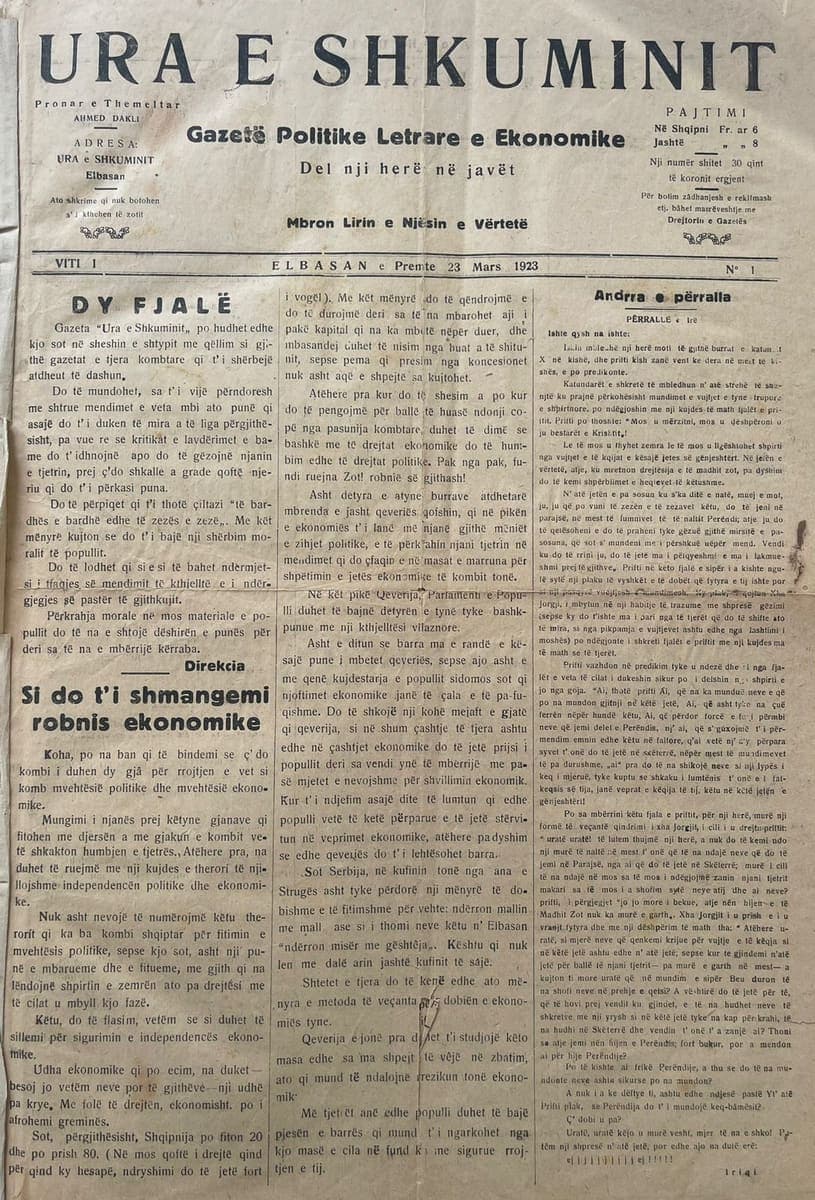
Qemal Baholli Public Library, Elbasan, 23 March 1923 · Source · CC BY 4.0 · Buona1, Wikipedian in Residence
Evidano Transcription
URA E SHKUMINIT
Pronar e Themeltar
AHMED DAKLI
ADRESA:
URA e SHKUMINIT
Elbasan
Ato shkrime qi nuk botohen
s'i kthehen të zotit
Gazetë Politike Letrare e Ekonomike
Del nji herë në javët
Mbron Lirin e Njësin e Vërtetë
PAJTIMI
Në Shqipni Fr. ar 6
Jashtë ,, ,, 8
Nji numër shitet 30 qint
të koronit ergjent
Për botim zâdhanjesh e reklâmash
etj. bâhet marrëveshtje me
Drejtorin e Gazetës
VITI I ELBASAN e Premte 23 Mars 1923 N° 1
DY FJALË
Gazeta "Ura e Shkuminit,, po hudhet edhe
kjo sot në sheshin e shtypit me qëllim si gji-
thë gazetat e tjera kombtare qi t'i shërbejë
atdheut të dashun.
Do të mundohet, sa t'i vijë përndoresh
me shtrue mendimet e veta mbi ato punë qi
asajë do t'i duken të mira a të liga përgjithë-
sisht, pa vue re se kritikât e lavdërimet e ba-
me do t'idhnojnë apo do të gëzojnë njanin
e tjetrin, prej ç'do shkalle a grade qoftë nje-
riu qi do t'i përkasi puna.
Do të përpiqet qi t'i thotë çiltazi "të bar-
dhës e bardhë edhe të zezës e zezë,,. Me kët
mënyrë kujton se do t'i bajë nji shërbim mo-
ralit të popullit.
Do të lodhet qi si e si të bahet ndërmjet-
si i tfaqjes së mendimit të kthjelltë e i ndër-
gjegjes së pastër të gjithkujit.
Përkrahja morale ne mos materiale e po-
pullit do të na e shtojë dëshirën e punës për
deri sa të na e mbërrijë kërraba.
Direkcia
Si do t'i shmangemi
robnis ekonomike
Koha, po na ban qi të bindemi se ç'do
kombi i duhen dy gjâ për rrojtjen e vet si
komb mvehtësie politike dhe mvehtësie ekono-
mike.
Mungimi i njanës prej këtyne gjanave qi
fitohen me djersën a me gjakun e kombit ve-
të shkakton humbjen e tjetrës. Atëhere pra, na
duhet të ruejmë me nji kujdes e therori të nji-
llojshme independencën politike dhe ekonomi-
ke.
Nuk asht nevojë të numërojmë këtu the-
rorít qi ka ba kombi shqiptar për fitimin e
mvehtësis politike, sepse kjo sot, asht nji pu-
në e mbarueme dhe e fitueme, me gjith qi na
lëndojnë shpirtin e zemrën ato pa drejtësi me
të cilat u mbyll kjo fazë.
Këtu, do të flasim, vetëm se si duhet të
sillemi për sigurimin e independencës ekono-
mike.
Udha ekonomike qi po ecim, na duket -
besoj jo vetëm neve por të gjithëve - nji udhë
pa krye. Me folë të drejtën, ekonomisht po i
afrohemi greminës.
Sot, përgjithësisht, Shqipnia po fiton 20
dhe po prish 80. (Ne mos qoftë i drejtë qind
për qind ky hesapë, ndryshimi do të jetë fort
i vogël). Me kët mënyrë do të qëndrojmë e
do të durojmë deri sa të na mbarohet aji i
pakë kapital qi na ka mbetë nëpër duer, dhe
mbasandej duhet të nisim nga huat a të shitu-
nit, sepse pema qi presim nga koncesionet
nuk asht aqë e shpejtë sa kujtohet.
Atëhere pra kur do të shesim a po kur
do të pengojmë për ballë të huasë ndonji co-
pë nga pasunija kombtare, duhet të dimë se
bashkë me të drejtat ekonomike do të hum-
bim edhe të drejtat politike. Pak nga pak, fu-
ndi ruejna Zot! robnie së gjithash!
Asht detyra e atyne burrave atdhetarë
mbrenda e jasht qeveriës qofshin, qi në pikën
e ekonomiës t'i lanë më njanë gjithë mënitë
e zihjet politike, e të përkrahin njani tjetrin në
mendimet qi do çfaqin e në masat e marruna për
shpëtimin e jetës ekonomike të kombit tonë.
Në kët pikë Qeverija, Parlamenti e Popu-
lli duhet të bajnë detyrën e tynë tyke bashk-
punue me nji kthjelltësi vllaznore.
Asht e ditun se barra ma e randë e kë-
sajë pune i mbetet qeveriës, sepse ajo asht e
me qenë kujdestarja e popullit sidomos sot qi
njoftimet ekonomike janë të çala e të pa-fu-
qishme. Do të shkojë nji kohë mejaft e gjatë
qi qeverija, si në shum çashtje të tjera ashtu
edhe në çashtjet ekonomike do të jetë prijsi i
popullit deri sa vendi ynë të mbërrijë me pa-
së mjetet e nevojshme për shvillimin ekonomik.
Kur t'i ndjefim asajë dite të lumtun qi edhe
populli vetë të ketë përparue e të jetë stërvi-
tun në veprimet ekonomike, atëhere padyshim
se edhe qeveriës do t'i lehtësohet barra.
Sot Serbija, në kufinin tonë nga ana e
Strugës asht tyke përdorë nji mënyrë të do-
bishme e të fitimshme për vehte: ndërron mallin
me mall, ase si i thomi neve këtu n'Elbasan
"ndërron misër me gështêja,,. Kështu qi nuk
len me dalë arin jashtë kufinit të sâjë.
Shtetet e tjera do të kenë edhe ato më-
nyra e metoda të veçanta për dobiën e ekono-
miës tyne.
Qeverija e jonë pra duhet t'i studjojë këto
masa edhe sa ma shpejt të vëjë në zbatim,
ato qi mund të ndalojnë rrezikun tonë ekono-
mik.
Më tjetrët anë edhe populli duhet të bajë
pjesën e barrës qi mund t'i ngarkohet nga
kjo masë e cila në fund ka me sigurue rroj-
tjen e tij.
Andrra e përralla
PËRRALLE e Irë
Ishte qysh na ishte:
Ishin mbledhë nji herë moti të gjithë burrat e katundit
X në kishë, dhe prifti kish zanë vent ke dera në mest të ki-
shës, e po predikonte.
Katundarët e shkretë të mbledhun n'atë strehë të shë-
njtë ku prajnë përkohësisht mundimet e vujtjet e tyne trupore
e shpirtnore, po ndëgjoshin me nji kujdes të math fjalët e pri-
ftit. Prifti po thoshte: "Mos u mërzitni, mos u dëshpëroni o
ju bestarët e Krishtit,!
Le të mos u thyhet zemra le të mos u ligështohet shpirti
nga vujtjet e të kqijat e kësajë jetes së gënjeshtërt. Në jetën e
vërtetë, atje, ku mretnon drejtësija e të madhit zot, pa dyshim
do të keni shpërblimet e heqjevet të këtushme.
N'atë jetën e pa sosun ku s'ka ditë e natë, muej e mot,
ju, ju që po vuni të zezën e të zezavet këtu, do të jeni në
parajsë, në mest të lumnivet të të naltit Perëndi; atje ju do
të qetësoheni e do të praheni tyke gëzuë gjithë mirsitë e pa-
sosuna, që sot s'mundeni me i përshkuë nëpër mend. Vendi
ku do të rrini ju, do të jetë ma i pëlqyeshmi e ma i lakmue-
shmi prej të gjithve,, Prifti në këto fjalë e sipër i a kishte ngu-
lë sytë nji plaku të vyshkët e të dobët që fytyra e tij ishte por
[line obscured by a fold] Xha
Jorgji, i mbytun në nji habitje të trazume me shpresë gëzimi
(sepse ky do t'ishte ma i pari nga të tjerët që do të shifte ato
të mira, si nga pikpamja e vujtjevet ashtu edhe nga lashtimi i
moshës) po ndëgjonte i shkreti fjalët e priftit me nji kujdes ma
të math se të tjerët.
Prifti vazhdon në predikim tyke u ndezë dhe si nga fja-
lët e veta të cilat i dukeshin sikur po i delshin nga shpirti e
jo nga goja. "Ai, thotë prifti Ai, që na ka munduë neve e që
po na mundon gjithji në këtë jetë, Ai, që asht tyke na çuë
ferrën nëpër hundë këtu, Ai, që përdor forcë e fuqi përmbi
neve që jemi delet e Perëndis, nj'ai, që s'guxojmë t'i për-
mendim emnin edhe këtu në faltore, q'ai vetë nj'aty përpara
syvet t'onë do të jetë në skëterrë, nëpër mest të mundimevet
të pa durushme, "ai" pra do të na shikojë neve si nji lypës i
keq i mjeruë, tyke kuptu se shkaku i lumtënis t'onë e i fat-
keqsis së tija, janë veprat e këqija të tij, këtu në këtë jetën e
gënjeshtërt!
Po sa mbërrini këtu fjala e priftit, për nji herë, murë nji
formë të veçantë qindrimi i xha Jorgjit, i cili i u drejtu priftit:
"uratë uratë! të lutem thujmë nji herë, a nuk do të kemi ndo
nji murë të naltë në mest t'onë që të na ndajë neve që do të
jemi në Parajsë, nga ai që do të jetë në Skëterrë; murë i cili
të na ndajë në mos sa të mos i ndëgjojmë zanin njani tjetrit
makari sa të mos i a shofim sytë neve atij dhe ai neve?
prifti, i përgjegjet "jo jo more i bekuë, atje nën hijen e të
Madhit Zot nuk ka murë e garth,,. Xha Jorgjit i u prish e i u
vranjt fytyra dhe me nji dëshpërim të math tha: "Atëhere u-
ratë, si mjerë neve që qenkemi krijuë për vujtje e të këqja si
në këtë jetë ashtu edhe n'atë jetë; sepse kur të gjindemi n'atë
jetë për ballë të njani tjetrit - pa murë e garth në mest - a
kujton ti more uratë që në mundim e sipër Beu duron të
na shofi neve në prehje e qetsi? A vë-htirë do të jetë për të,
që të hovi prej vendit ku gjindet, e të na hudhet neve të
shkretve me nji yrysh si në këtë jetë tyke na kap për krahi, të
na hudhi në Skëterrë dhe vendin t'onë t'a zanjë ai? Thoni
sa atje jemi nën hijen e Perëndis; fort bukur, por a mendon
ai për hije Perëndije?
Po të kishte ai frikë Perëndije, a thu se do të na mu-
ndonte neve ashtu sikurse po na mundon?
A nuk i a ke dëftye ti, ashtu edhe ndjesë pastë Yt' atë
Prifti plak, se Perëndija do t'i mundojë keq-bâmësit?
Ç'dobi u pa?
Uratë, uratë këjo u murë vesht, mjër të na e shko! Pa-
tëm nji shpresë n'atë jetë, por edhe ajo na dulë erë.
[illegible]!!!!!
Iriqi
Generated by Evidano’s advanced model; not yet checked against a published edition.
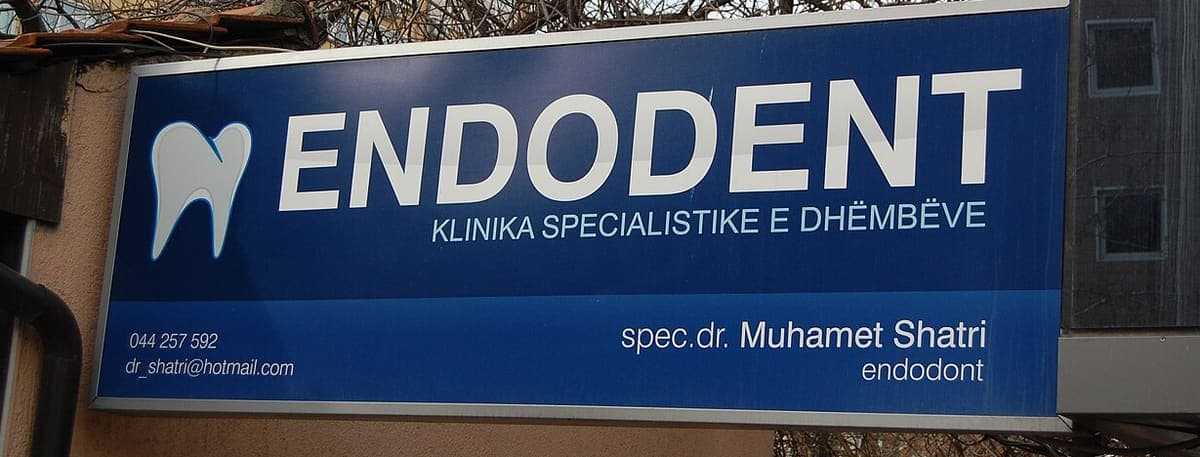
Evidano Transcription
ENDODENT
KLINIKA SPECIALISTIKE E DHËMBËVE
044 257 592 spec.dr. Muhamet Shatri
dr_shatri@hotmail.com endodont
Generated by Evidano’s advanced model; not yet checked against a published edition.
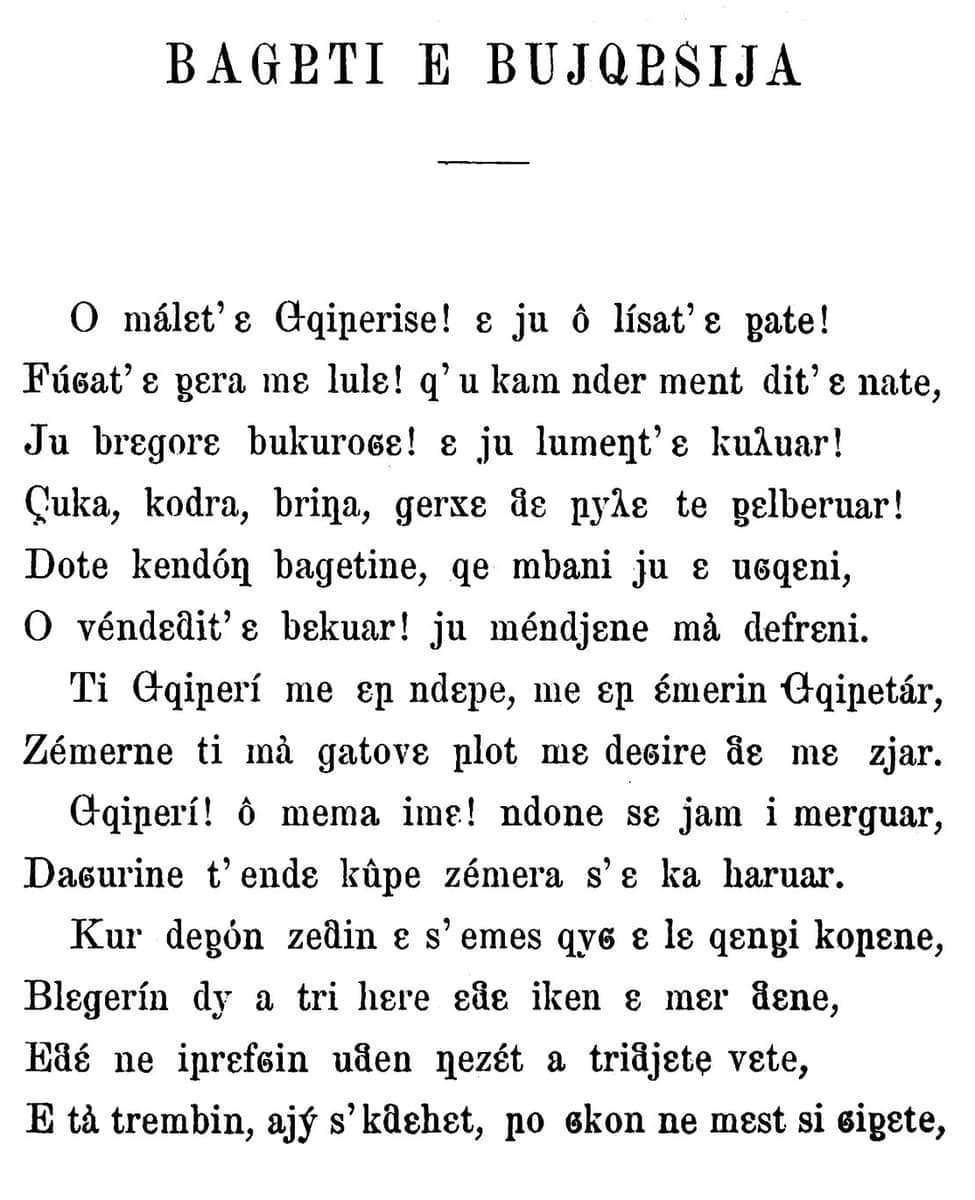
Source · Public domain · Published by the Drita society; scanned by Google Books
Evidano Transcription
The title and all fourteen lines of verse on the page. The Wikisource text is a proofread transliteration into the modern Albanian alphabet rather than a diplomatic copy of the Istanbul-alphabet letterforms, and it carries the printed acute and grave accents; the line numbers Wikisource prints beside lines 5 and 10 are editorial, are not on the page itself, and are left out here.
BAGËTI E BUJQËSIJA
O málet' e Shqipërisë! e ju ô lísat' e gjatë!
Fúshat e gjera me lule! q' u kam ndër mënt dit' e natë,
Ju bregore bukuroshe! e ju lumënjt' e kulluar!
Çuka, kodra, brinja, gërxhe dhe pylle të gjelbëruar!
Dotë këndónj bagëtinë që mbani ju e ushqeni,
O vë́ndëthit' e bekuar! ju më́ndjenë ma dëfreni.
Ti Shqipërí, më ep nderrë, më ep emërin Shqipëtár,
Zë́mërnë ti mả gatove plot me dëshirë dhe me zjar.
Shqipërí! ô mëma ime! ndonë se jam i mërguar,
Dashurinë t' ënde kûrrë zë́mëra s' e ka haruar.
Kur dëgjón zëthin e s' ëmës qysh e le qengji kopenë,
Blegërín dy a tri herë edhe ikën e mer dhenë,
Edhé në iprefshin udhën njëzét a tridhjetë vetë,
E tả trëmbin, ajý s' kthehet, po shkon në mest si shigjetë,
Source: Bagëti e Bujqësija (Bucharest, 1886), page 3, proofread text via Wikisource (CC BY-SA 4.0).
What Albanian text looks like on the page
Centuries of Ottoman rule left Albanian without an official alphabet, so where it was written down at all before the twentieth century, a writer typically reached for whichever script their own religious and educational tradition used: Greek letters among Orthodox Albanians in the south, the Arabic script among Muslim Albanians and in dealings with Ottoman administration, and Latin letters, in a range of competing spelling systems, among Catholic Albanians in the north and the Italian-facing diaspora. Alongside these borrowed alphabets, Albanians also invented scripts built for the language itself: Elbasan, known from an anonymous eighteenth-century gospel manuscript; Todhri, devised in the early nineteenth century by Todhri Haxhifilipi of Elbasan; and Vithkuqi, designed in the 1840s by Naum Veqilharxhi specifically to give Albanian letters owing nothing to Greek, Turkish or Slavic tradition.
The Congress of Manastir, held in November 1908, ended the competition by adopting a Latin alphabet for Albanian, essentially the one still in use, and every one of the older scripts fell out of use within a generation. That alphabet solves the mismatch between Albanian’s sounds and the Latin letter set with nine two-letter digraphs — dh, gj, ll, nj, rr, sh, th, xh and zh — each standing for one sound and each alphabetised as a single letter, plus two additional letters of its own, ë for the central vowel and ç for a sound close to English ch.
Everyday modern material is printed or written in that standard orthography, but reading it still means recognising the digraphs and the two extra letters reliably: a worn photocopy, a strict ASCII keyboard or a foreign typesetter can drop ë and ç first, and a document from the transitional years around independence can still mix Albanian Latin script with Ottoman Turkish in Arabic script on the same page, a reminder that the 1908 standard took time to reach every kind of document.
Why ordinary OCR struggles here
A pre-1908 page could be in almost any script
Older Albanian material cannot be assumed to be in Latin letters at all: a document might be in Greek-lettered Albanian, Arabic-lettered Albanian, or one of the invented Elbasan, Todhri or Vithkuqi alphabets, none of which share letterforms with each other or with the modern alphabet.
Digraphs that are really one letter
Sh, zh, nj, rr, dh, gj, ll, th and xh each spell a single sound and are alphabetised as one letter, but a system reading letter by letter can split them at the wrong point or fail to treat them as the units they are.
Ë and ç easily lost or swapped
The two letters Albanian added to the Latin alphabet are often the first casualties of a worn scan, a keyboard without the right key, or a system that quietly falls back to plain e and c, and losing either one changes the spelling and often the meaning of a word.
Mixed scripts on one official page
A document from the transition years, such as the 1912 Vlorë declaration, can carry Albanian in Latin letters, a line of Ottoman Turkish in Arabic script, and signatures in either script side by side, so a transcription has to keep each block in its own script rather than merge them into one.
Who works with this material
Albanian genealogists and local historians
Church, school and land records survive in Greek-lettered, Arabic-lettered, Latin-lettered and invented-alphabet Albanian depending on the region and religion of the writer, so working out which alphabet a record uses is often the first step in reading it at all.
Historians of Albanian nationalism and the Rilindja
The movement to give Albanian a single national alphabet is documented in exactly the kind of primers, pamphlets and congress records this page draws its earliest sample from, and reading them means recognising scripts that fell out of use within a generation.
Archivists of early twentieth-century Albanian institutions
Newspapers, gazette notices and official correspondence from the years around independence often mix scripts and spelling conventions within a single archive, and cataloguing them accurately depends on transcribing each block in the script it was actually written in.
Diaspora and community organisations
Shop signs, notices and correspondence in Albanian communities abroad need ë, ç and the digraphs read correctly before they can be translated, indexed or searched.
Getting the best transcription
Identify the alphabet before transcribing
Say whether a page is in Latin, Greek, Arabic script, or one of the invented Elbasan, Todhri or Vithkuqi alphabets, since none of them share a letter set with any of the others.
Ask for digraphs to be kept as single units
Specify that dh, gj, ll, nj, rr, sh, th, xh and zh should be transcribed and, where relevant, alphabetised as the single letters they represent rather than as two separate ones.
Confirm ë and ç are preserved
Tell the model that ë and ç are distinct letters in modern Albanian, not accented variants that can be dropped or replaced with plain e and c when a font or keyboard makes that easier.
Flag documents that mix scripts
On a transitional document, ask for each script to be transcribed as its own block, so an Albanian Latin passage, a line of Ottoman Arabic script and a set of signatures are not run together as if they were one continuous text.
Frequently asked questions
- Can it read Albanian written in Greek or Arabic letters, or in an invented alphabet like Vithkuqi?
- Yes, when you say which script the page uses. Greek-lettered and Arabic-lettered Albanian, and the Elbasan, Todhri and Vithkuqi alphabets, are each read on their own terms rather than assumed to be the modern Latin alphabet.
- How does it handle Albanian’s digraphs?
- Dh, gj, ll, nj, rr, sh, th, xh and zh are recognised as single letters, each standing for one sound, rather than read and alphabetised as two separate letters.
- What happens with ë and ç?
- They are kept as the distinct letters they are rather than dropped or replaced with plain e and c, which matters because the difference changes both spelling and meaning.
- Can it transcribe a document that mixes scripts, like the 1912 Declaration of Independence?
- Yes. Albanian Latin script, Ottoman Turkish in Arabic script, and signatures in either script are transcribed as separate blocks in the order they appear, rather than merged into one passage.
- Does it know the difference between pre- and post-1908 Albanian spelling?
- Yes, when you flag the material as pre-standardisation. Older spelling conventions and script choices are read as period-correct rather than corrected to the alphabet fixed at the Congress of Manastir in 1908.
Related scripts and pages
Transcribe your Albanian documents
Upload a document, a newspaper page or a sign, in Latin, Greek, Arabic or an older Albanian alphabet, and check the transcription line by line before you export it.