
Macedonian
Macedonian read from its 1945 alphabet to today
Macedonian’s standard alphabet is barely eighty years old, fixed by an official decision in May 1945 that settled a working orthography already in informal use, and its four distinctive letters — ѓ, ќ, ѕ and џ — mark sounds that older Church Slavonic manuscripts from the same region never had to write down. Because the written record is comparatively young, most of what needs transcribing is administrative, printed and everyday material rather than centuries of literary manuscripts. Evidano reads Macedonian from that 1945 codification through modern print, handwriting and signage, keeping the source image beside every line.
Sample pages
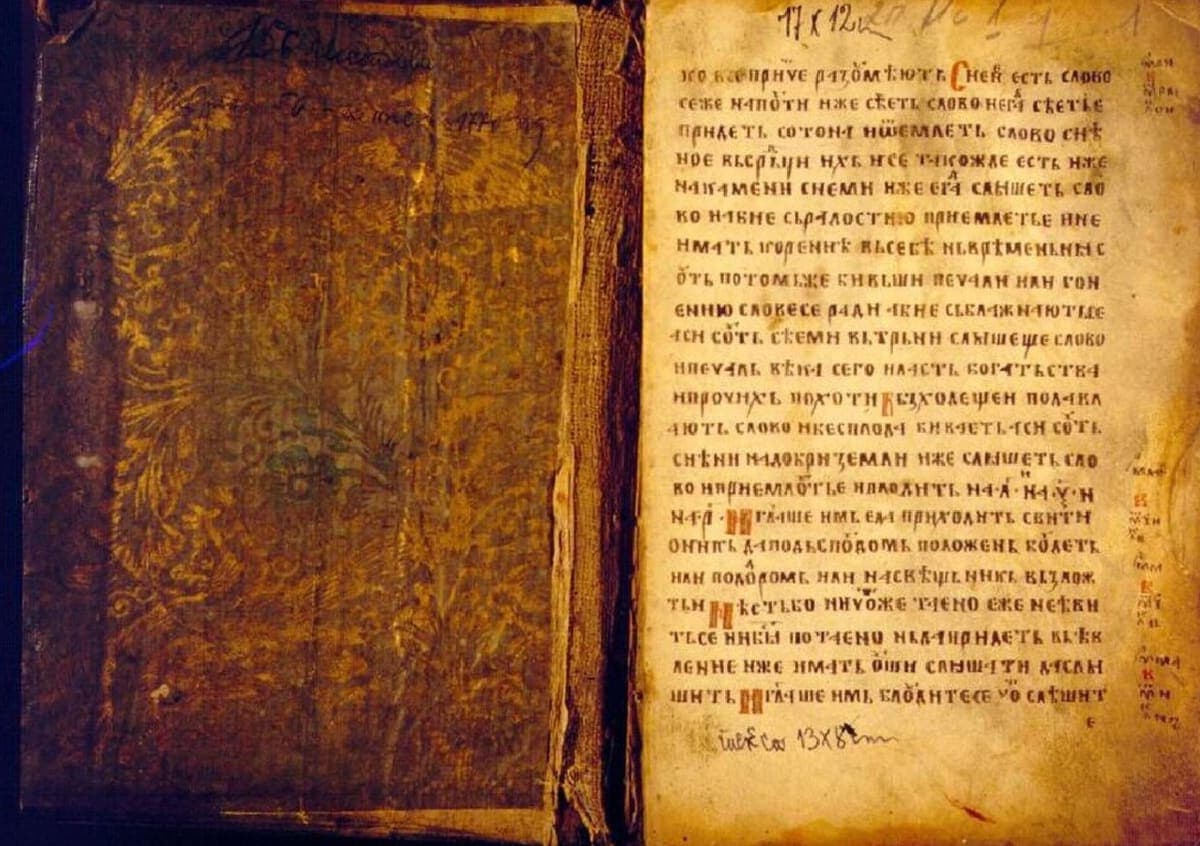
National and University Library "St. Kliment of Ohrid", Skopje, 13th–14th century · Source · Public domain
Evidano Transcription
17 x 12 [illegible]
[ꙗ]ко вьсе[?] притче разоумѣють · Сиеи[?] есть слово
сеже на поути иже сѣеть слово и ег[д]а сѣет[?]
придеть сотона и ѡемлеть слово сѣ
ное вь ср[д]ци ихь и се такожде есть иже
на камени сѣеми иже ег[д]а слышеть сло
во и абие сь радостию приемлеть е и не
имать корение вь себѣ нь врѣменьни с
оуть потомьже бывьши печали или гон
енню словесе ради абие сьблажнають се
аси соуть сѣеми вь трьни слышеще слово
и печаль вѣка сего и лѣсть богатьства
и прочихь похоти вьходещеи подавла
ють слово и бесплода бываеть · аси соуть
сѣени на добри земли иже слышеть сло
во и приемлють е и плодить на ·л[?]· на ·ѯ· и
на ·р· Иглаше имь еда приходить свѣти
льникь да подь сподомь положень боудеть
или подь одромь или на свѣщьникь вьзлож
тьи · Нѣсть бо ничоже таено еже не ꙗви
тьсе ни бы потаено нь да придеть вь ꙗв
ление иже имать оуши слышати да слы
шить · Иглаше имь блюдитесе ч[то] слышит
е
[illegible] 13 x 8 cm
[marginal notes illegible]
Generated by Evidano’s advanced model; not yet checked against a published edition.
Evidano Transcription
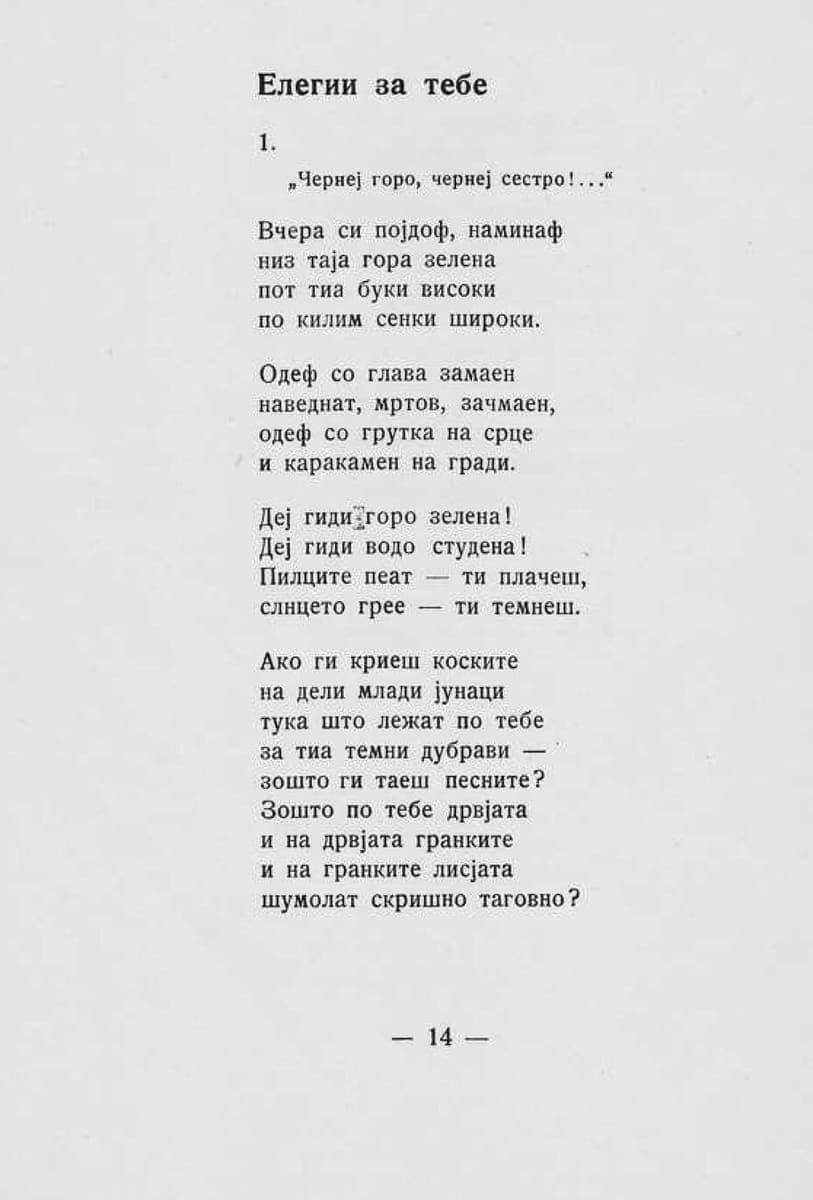
The heading and the first poem of "Елегии за тебе", transcribed from the validated proofread text of this exact page on Macedonian Wikisource. Spelling is kept exactly as printed in 1939, several years before the alphabet was formally fixed.
Елегии за тебе
1.
„Чернеј горо, чернеј сестро!...“
Вчера си појдоф, наминаф
низ таја гора зелена
пот тиа буки високи
по килим сенки широки.
Одеф со глава замаен
наведнат, мртов, зачмаен,
одеф со грутка на срце
и каракамен на гради.
Деј гиди горо зелена!
Деј гиди водо студена!
Пилците пеат — ти плачеш,
слнцето грее — ти темнеш.
Ако ги криеш коските
на дели млади јунаци
тука што лежат по тебе
за тиа темни дубрави —
зошти ги таеш песните?
Зошто по тебе дрвјата
и на дрвјата гранките
и на гранките лисјата
шумолат скришно таговно?
Source: Page:Бели мугри-Кочо Рацин.pdf/16, via Macedonian Wikisource (Public domain).
Evidano Transcription
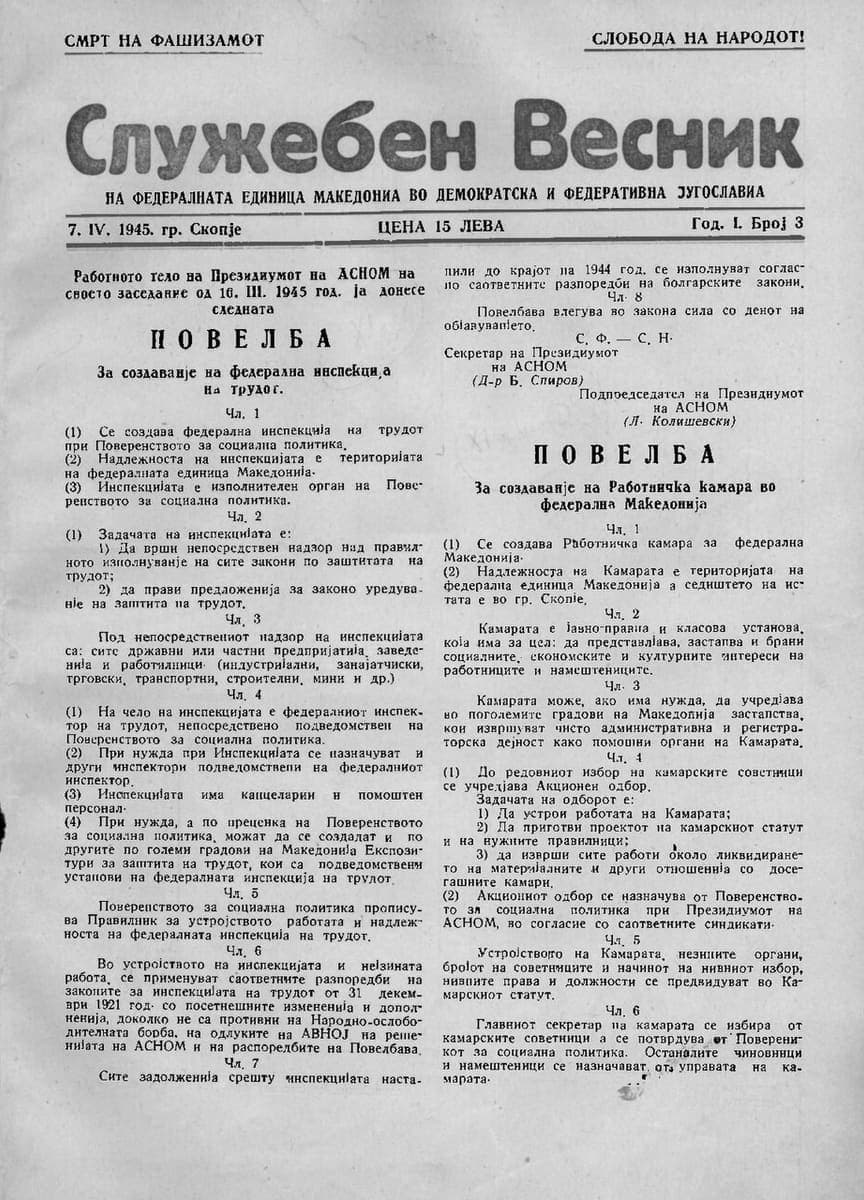
СМРТ НА ФАШИЗАМОТ
СЛОБОДА НА НАРОДОТ!
Служебен Весник
НА ФЕДЕРАЛНАТА ЕДИНИЦА МАКЕДОНИА ВО ДЕМОКРАТСКА И ФЕДЕРАТИВНА ЈУГОСЛАВИА
7. IV. 1945. гр. Скопје
ЦЕНА 15 ЛЕВА
Год. I. Број 3
Работното тело на Президиумот на АСНОМ на
своето заседание од 16. III. 1945 год. ја донесе
следната
П О В Е Л Б А
За создавање на федерална инспекција
на трудот.
Чл. 1
(1) Се создава федерална инспекција на трудот
при Поверенството за социјална политика.
(2) Надлежноста на инспекцијата е територијата
на федералната единица Македонија.
(3) Инспекцијата е исполнителен орган на Пове-
ренството за социјална политика.
Чл. 2
(1) Задачата на инспекцијата е:
- Да врши непосредствен надзор над правил-
ното исполнување на сите закони по заштитата на
трудот; - да прави предложенија за законо уредува-
ње на заштита на трудот.
Чл. 3
Под непосредствениот надзор на инспекцијата
са: сите државни или частни предпријатија, заведе-
нија и работилници (индустријални, занајатчиски,
трговски, транспортни, строителни, мини и др.)
Чл. 4
(1) На чело на инспекцијата е федералниот инспек-
тор на трудот, непосредствено подведомствен на
Поверенството за социјална политика.
(2) При нужда при Инспекцијата се назначуват и
други инспектори подведомствени на федералниот
инспектор.
(3) Инспекцијата има канцеларии и помоштен
персонал.
(4) При нужда, а по преценка на Поверенството
за социјална политика, можат да се создадат и по
другите по големи градови на Македонија Експози-
тури за заштита на трудот, кои са подведомствени
установи на федералната инспекција на трудот.
Чл. 5
Поверенството за социјална политика пропису-
ва Правилник за устројството работата и надлеж-
носта на федералната инспекција на трудот.
Чл. 6
Во устројството на инспекцијата и нејзината
работа, се применуват саответните разпоредби на
законите за инспекцијата на трудот от 31 декем-
ври 1921 год. со посетнешните измененија и допол-
ненија, доколко не са противни на Народно-ослобо-
дителната борба, на одлуките на АВНОЈ на реше-
нијата на АСНОМ и на распоредбите на Повелбава.
Чл. 7
Сите задолженија срешту инспекцијата наста-
пили до крајот на 1944 год. се исполнуват соглас-
но саответните разпоредби на болгарските закони.
Чл. 8
Повелбава влегува во закона сила со денот на
објавувањето.
С. Ф. — С. Н.
Секретар на Президиумот
на АСНОМ
(Д-р Б. Спиров)
Подпоедседател на Президиумот
на АСНОМ
(Л. Колишевски)
П О В Е Л Б А
За создавање на Работничка камара во
федерална Македонија
Чл. 1
(1) Се создава Работничка камара за федерална
Македонија.
(2) Надлежноста на Камарата е територијата на
федерална единица Македонија а седиштето на ис-
тата е во гр. Скопје.
Чл. 2
Камарата е јавно-правна и класова установа,
која има за цел: да представлјава, застапва и брани
социјалните, економските и културните интереси на
работниците и намештениците.
Чл. 3
Камарата може, ако има нужда, да учреждава
во поголемите градови на Македонија застапства,
кои извршуват чисто административна и регистра-
торска дејност како помошни органи на Камарата.
Чл. 4
(1) До редовниот избор на камарските советници
се учреждава Акционен одбор.
Задачата на одборот е:
- Да устрои работата на Камарата;
- Да приготви проектот на камарскиот статут
и на нужните правилници; - да изврши сите работи около ликвидиране-
то на материјалните и други отношенија со досе-
гашните камари.
(2) Акциониот одбор се назначува от Поверенство-
то за социјална политика при Президиумот на
АСНОМ, во согласие со саответните синдикати.
Чл. 5
Устројството на Камарата, незините органи,
бројот на советниците и начинот на нивниот избор,
нивните права и должности се предвидуват во Ка-
марскиот статут.
Чл. 6
Главниот секретар на камарата се избира от
камарските советници а се потврдува от Поверени-
кот за социјална политика. Останалите чиновници
и намештеници се назначават от управата на ка-
марата.
Generated by Evidano’s advanced model; not yet checked against a published edition.

Evidano Transcription
LCW
HOME
КАСА
ARKA
ГАРДЕРОБИ
DHOMË PROVE
Generated by Evidano’s advanced model; not yet checked against a published edition.
What Macedonian writing looks like
The region’s Church Slavonic manuscript tradition long predates any modern national language: Gospel books, psalters and liturgical collections were copied in monasteries across the area in a formal Cyrillic book hand shared with the wider Orthodox Slavic world, using abbreviation marks, red rubrics and decorated initials in the same conventions as comparable Bulgarian and Serbian church manuscripts of the period. The National and University Library "St. Kliment of Ohrid" in Skopje holds a substantial collection of these older manuscripts and fragments, describing the script and its conventions rather than the modern national boundaries that came centuries later.
A literary Macedonian close to the later standard existed before that decision, most famously in Kočo Racin’s 1939 poetry collection Бели мугри ("White Dawns"), printed in Zagreb in a dialect-based spelling of his own rather than any officially fixed orthography. Standard Macedonian itself was codified by an official commission during 1944 and 1945, and its alphabet was fixed by government decision on 1 May 1945: thirty-one letters, built on a Cyrillic base close to Serbian, with four added or adapted letters that mark sounds the surrounding languages either lack or spell differently — ѓ and ќ for palatal consonants close to a soft "gy" and "ky" sound, ѕ for a "dz" sound, and џ for "dzh". Because the written standard is so recent, almost everything else that needs transcribing is twentieth- and twenty-first-century material: the official gazettes and administrative print that followed codification within weeks, newspapers and books from the decades since, and today’s ordinary signage, forms and handwriting, much of it produced alongside Albanian, Turkish or other minority-language text in a multilingual country.
Why ordinary OCR struggles here
Four letters with no exact counterpart nearby
ѓ, ќ, ѕ and џ are shaped like, or built from, letters used differently in neighbouring Cyrillic alphabets, so a system trained mainly on Serbian or Bulgarian text tends to map them onto the nearest familiar letter rather than recognising them as their own distinct sounds.
A short standardised record makes every early document count
Because standard Macedonian only dates from 1945, the handful of surviving early gazettes, newspapers and administrative circulars from that transition are disproportionately important as evidence of how the new orthography was actually applied, and small inconsistencies in spelling from those first months should be preserved rather than corrected to later norms.
Older Church Slavonic material needs its own conventions
Regional manuscripts predating the modern standard use abbreviation marks, obsolete letters and a formal book hand that have nothing to do with the 1945 alphabet, and reading them as if they were modern Macedonian misses both the letterforms and the ways scribes shortened common words.
Routine multilingual signage and paperwork
Shop signs, public notices and official forms are frequently set in Macedonian alongside Albanian, Turkish or English, and an engine that is not told to separate the languages tends to merge adjacent lines into one unreadable mixture rather than returning each language as its own block.
Who works with this material
Slavic manuscript and library collections
Regional Church Slavonic manuscripts and fragments held in Macedonian, Bulgarian and Serbian collections are still being catalogued and digitised. A working transcription of a Gospel or liturgical folio, with rubrics and abbreviations flagged, gives a librarian or scholar a starting text before deeper codicological work begins.
Historians of the 1944–45 codification
The alphabet decision, the ASNOM proceedings and the first official gazettes are primary sources for how standard Macedonian orthography was actually fixed and applied in its opening months. Accurate transcriptions of this small, closely studied body of material matter disproportionately given how little exists before it.
Government and legal archives
Decades of official gazettes, court records and administrative circulars sit in North Macedonia’s state and municipal archives, mostly undigitised as searchable text. Batch transcription turns scanned legal pages into text that can be searched, cited and cross-referenced.
Multilingual signage and public communication projects
Businesses, institutions and municipalities routinely publish material in Macedonian alongside Albanian, Turkish or English. Projects auditing or archiving this signage need each language read and labelled separately rather than folded into one another.
Getting the best transcription
Say whether the source is pre- or post-1945
For older Church Slavonic manuscripts, note that ѓ, ќ, ѕ and џ will not appear and that abbreviation marks and formal book-hand letterforms should be read as written; for modern material, expect the standard thirty-one-letter alphabet throughout.
Flag ѓ, ќ, ѕ and џ for explicit attention
Ask for these four letters to be read as their own distinct characters rather than normalised toward similar-looking Serbian or Bulgarian letters, which is the most common way Macedonian-specific spelling gets lost.
Separate multilingual signage by language
For a sign or document mixing Macedonian with Albanian, Turkish or English, ask for each language to come back as its own labelled block in its original layout order, rather than merged line by line.
Test on the earliest material in a batch first
Where a collection spans the 1945 transition, start with the earliest gazettes or circulars rather than later, more standardised print; catching any inconsistency in how the new letters were first used sets expectations for the rest of the run.
Frequently asked questions
- Can it read ѓ, ќ, ѕ and џ correctly?
- Yes, all four are recognised as the distinct letters of the Macedonian alphabet rather than mapped onto similar-looking Serbian or Bulgarian letters, which is the error generic Cyrillic recognition most often makes with Macedonian text.
- Can it read Church Slavonic manuscripts from the region alongside modern Macedonian?
- Yes, older manuscripts are read as the historical Cyrillic book hand they are, with their own abbreviation conventions and letterforms, rather than being expected to match the modern 1945 alphabet.
- How does it handle the 1945 alphabet decision and early official documents?
- Typewritten and early printed material from the codification period is transcribed as written, preserving any inconsistency in how the new letters were applied in those first months rather than correcting it toward later, more settled spelling.
- Can it separate Macedonian from Albanian or Turkish on the same sign or document?
- Yes, each language is identified and can be returned as its own labelled section, so a trilingual sign or a bilingual official form does not come back as one merged, unreadable line.
- Does it handle modern Macedonian handwriting as well as print?
- Yes, everyday cursive handwriting is read using the standard thirty-one-letter alphabet, with uncertain letters, including the four added consonants, flagged rather than guessed when a fast hand makes them ambiguous.
Related scripts and pages
Turn your Macedonian sources into text
Upload a manuscript, an official document, a modern sign or a scanned form, and check the Macedonian reading line by line against the image.