
Bengali
Bangla pages read as they were set and written
Bengali writes hundreds of conjunct letters, several of which give no hint of the consonants inside them, and wraps some of its vowel signs around the letter so that one sound is printed on both sides of it. Add a head line that binds a word into a single band and a page whose reverse shows through the paper, and generic OCR returns a plausible-looking string that is not what the page says. Evidano transcribes Bangla with the image beside the text so you can check each reading yourself.
Sample pages
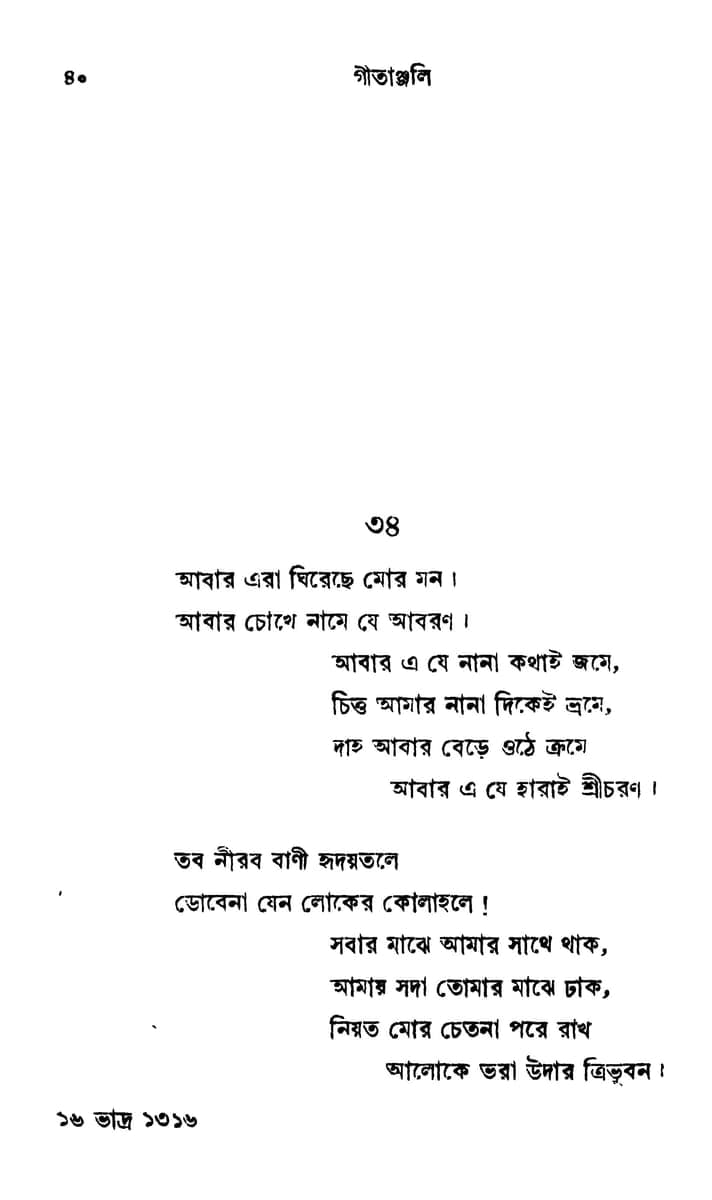
Digital Library of India, via Wikimedia Commons, Collection first published 1910; this printing 1913 · Source · Public domain
Evidano Transcription
The whole poem as proofread on Bengali Wikisource against this scan, one manuscript line per line, with the poem number kept at the head and the date line at the foot. The running head (৪০ · গীতাঞ্জলি) is omitted and the printed indentation is not reproduced.
৩৪
আবার এরা ঘিরেছে মোর মন।
আবার চোখে নামে যে আবরণ।
আবার এ যে নানা কথাই জমে,
চিত্ত আমার নানা দিকেই ভ্রমে,
দাহ আবার বেড়ে ওঠে ক্রমে
আবার এ যে হারাই শ্রীচরণ।
তব নীরব বাণী হৃদয়তলে
ডোবেনা যেন লোকের কোলাহলে!
সবার মাঝে আমার সাথে থাক,
আমায় সদা তোমার মাঝে ঢাক,
নিয়ত মোর চেতনা পরে রাখ
আলোকে ভরা উদার ত্রিভুবন।
১৬ ভাদ্র ১৩১৬
Source: পাতা:গীতাঞ্জলি - রবীন্দ্রনাথ ঠাকুর.djvu/৫২, proofread text on Bengali Wikisource (CC BY-SA 4.0).
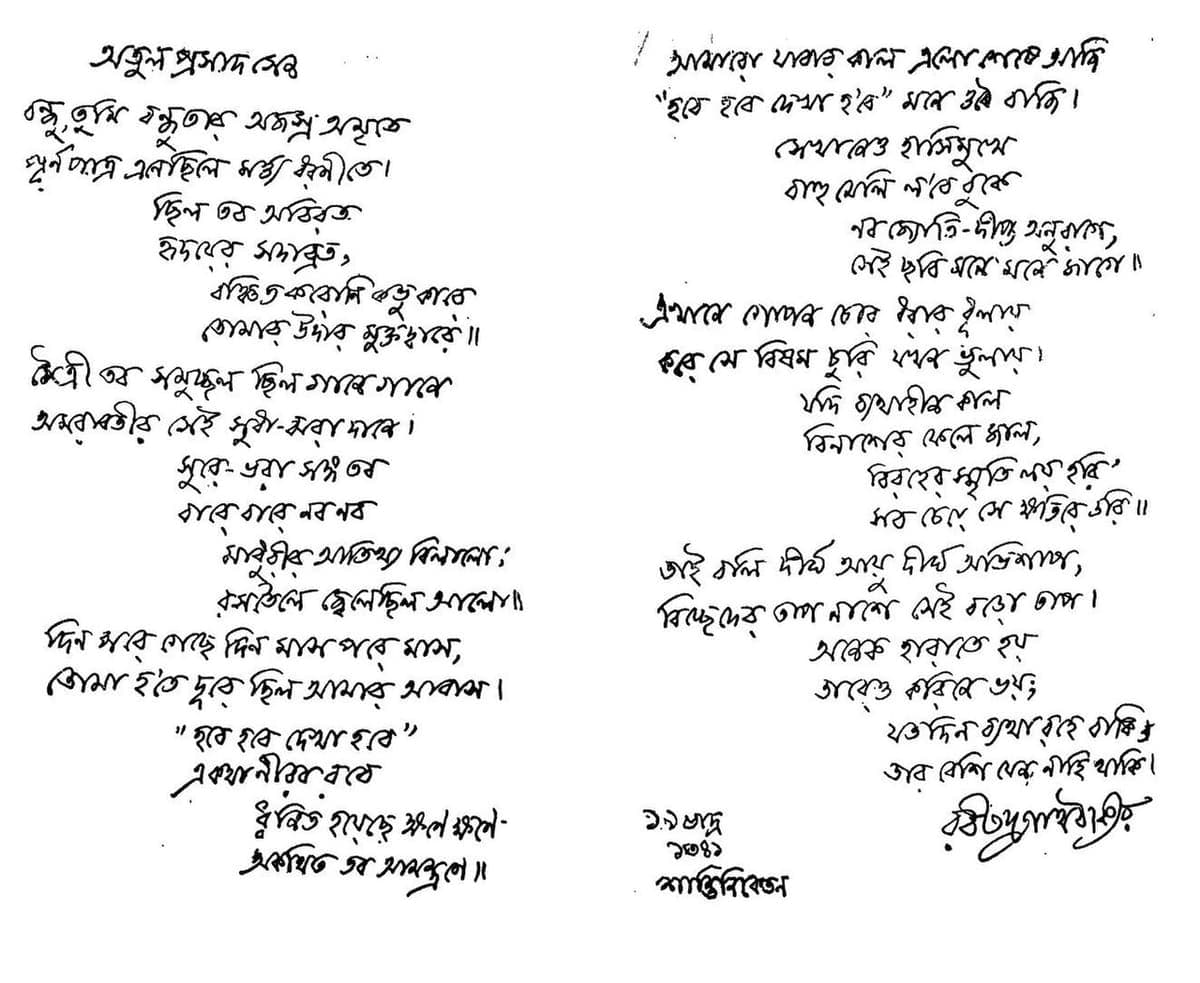
Evidano Transcription
অতুলপ্রসাদ সেন
বন্ধু, তুমি বন্ধুতার অজস্র অমৃতে
পূর্ণপাত্র এনেছিলে মর্ত্য ধরণীতে।
ছিল তব অবিরত
হৃদয়ের সদাব্রত,
বঞ্চিত করোনি কভু কারে
তোমার উদার মুক্তদ্বারে॥
মৈত্রী তব সমুজ্জ্বল ছিল গানে গানে
অমরাবতীর সেই সুধা-ঝরা দানে।
সুরে-ভরা সঙ্গ তব
বারে বারে নব নব
মাধুরীর আতিথ্য বিলালো;
রসতলে জ্বেলেছিল আলো॥
দিন সরে [?] গেছে দিন মাস পরে মাস,
তোমা হ'তে দূরে ছিল আমার আবাস।
"হবে হবে দেখা হবে"
একথা নীরব রবে
ধ্বনিত হয়েছে ক্ষণে ক্ষণে-
অকথিত তব আমন্ত্রণে॥
আমারো যাবার কাল এলো কাছে [?] আজি
"হবে হবে দেখা হ'বে" মনে ওঠে বাজি।
সেখানেও হাসিমুখে
বাহু মেলি ল'বে বুকে
নব জ্যোতি-দীপ্ত অনুরাগে,
সেই ছবি মনে মনে জাগে॥
এখানে গোপন চোর ধরার ধূলায়
করে সে বিষম চুরি যখন ভুলায়।
যদি দয়াহীন কাল
বিনাশের ফেলে জাল,
বিরহের স্মৃতি লয় হরি'
সব চেয়ে সে ক্ষতিরে ডরি॥
তাই বলি দীর্ঘ আয়ু দীর্ঘ অভিশাপ,
বিচ্ছেদের তাপ নাশে সেই বড়ো তাপ।
অনেক হারাতে হয়
তারেও করিনে ভয়;
যতদিন ব্যথা রহে বাকি
তার বেশি যেন নাহি থাকি।
রবীন্দ্রনাথ ঠাকুর
১৭ [?] ভাদ্র
১৩৪১
শান্তিনিকেতন
Generated by Evidano’s advanced model; not yet checked against a published edition.
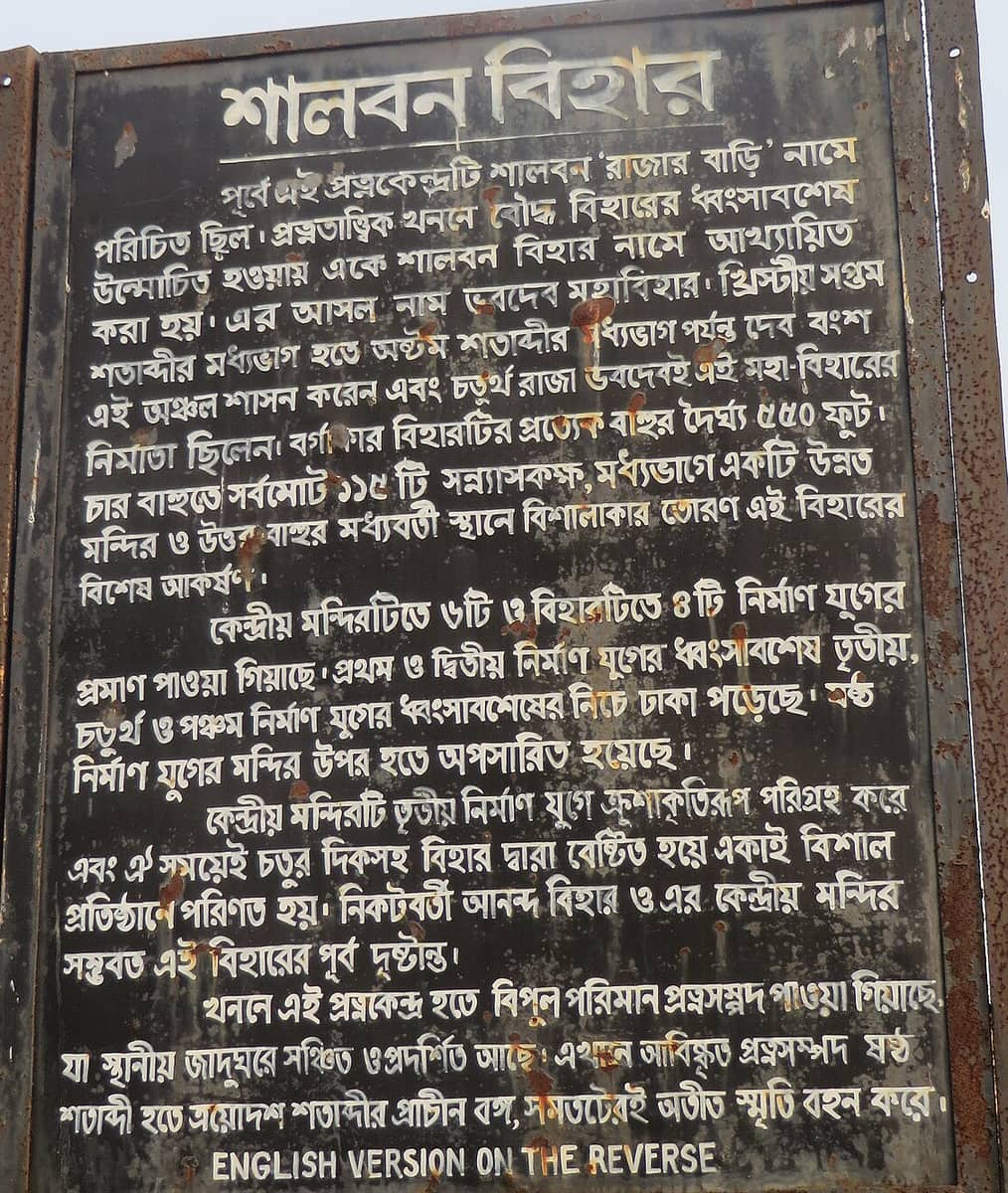
Shalban Vihara, Comilla, Bangladesh, 20 February 2016 · Source · CC BY-SA 3.0 · Photograph by Sakib Ahmed Nasim, via Wikimedia Commons
Evidano Transcription
শালবন বিহার
পূর্বে এই প্রত্নকেন্দ্রটি শালবন 'রাজার বাড়ি' নামে
পরিচিত ছিল। প্রত্নতাত্ত্বিক খননে বৌদ্ধ বিহারের ধ্বংসাবশেষ
উন্মোচিত হওয়ায় একে শালবন বিহার নামে আখ্যায়িত
করা হয়। এর আসল নাম ভবদেব মহাবিহার। খ্রিষ্টীয় সপ্তম
শতাব্দীর মধ্যভাগ হতে অষ্টম শতাব্দীর মধ্যভাগ পর্যন্ত দেব বংশ
এই অঞ্চল শাসন করেন এবং চতুর্থ রাজা ভবদেবই এই মহা-বিহারের
নির্মাতা ছিলেন। বর্গাকার বিহারটির প্রত্যেক বাহুর দৈর্ঘ্য ৫৫০ ফুট।
চার বাহুতে সর্বমোট ১১৫ টি সন্ন্যাসকক্ষ, মধ্যভাগে একটি উন্নত
মন্দির ও উত্তর বাহুর মধ্যবর্তী স্থানে বিশালাকার তোরণ এই বিহারের
বিশেষ আকর্ষণ।
কেন্দ্রীয় মন্দিরটিতে ৬টি ও বিহারটিতে ৪টি নির্মাণ যুগের
প্রমাণ পাওয়া গিয়াছে। প্রথম ও দ্বিতীয় নির্মাণ যুগের ধ্বংসাবশেষ তৃতীয়,
চতুর্থ ও পঞ্চম নির্মাণ যুগের ধ্বংসাবশেষের নিচে ঢাকা পড়েছে। ষষ্ঠ
নির্মাণ যুগের মন্দির উপর হতে অপসারিত হয়েছে।
কেন্দ্রীয় মন্দিরটি তৃতীয় নির্মাণ যুগে ক্রুশাকৃতিরূপ পরিগ্রহ করে
এবং ঐ সময়েই চতুর দিকসহ বিহার দ্বারা বেষ্টিত হয়ে একাই বিশাল
প্রতিষ্ঠানে পরিণত হয়। নিকটবর্তী আনন্দ বিহার ও এর কেন্দ্রীয় মন্দির
সম্ভবত এই বিহারের পূর্ব দৃষ্টান্ত।
খননে এই প্রত্নকেন্দ্র হতে বিপুল পরিমান প্রত্নসম্পদ পাওয়া গিয়াছে,
যা স্থানীয় জাদুঘরে সঞ্চিত ও প্রদর্শিত আছে। এখানে আবিষ্কৃত প্রত্নসম্পদ ষষ্ঠ
শতাব্দী হতে ত্রয়োদশ শতাব্দীর প্রাচীন বঙ্গ, সমতটেরই অতীত স্মৃতি বহন করে।
ENGLISH VERSION ON THE REVERSE
Generated by Evidano’s advanced model; not yet checked against a published edition.
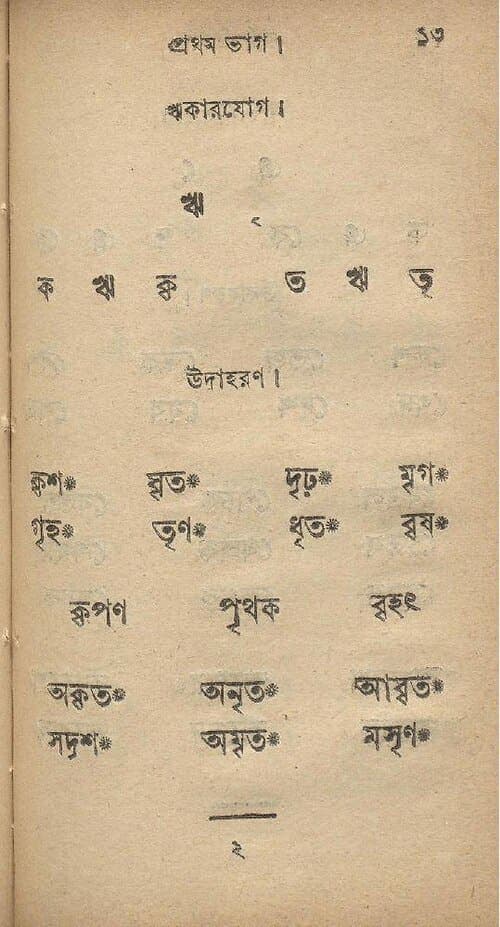
British Library, Two Centuries of Indian Print, First published 1855; this reprint the 62nd edition · Source · Public domain
Evidano Transcription
The text of the page as proofread on Bengali Wikisource, with the tables flattened to one row per line and the columns separated by spaces. The running head (প্রথম ভাগ। ১৩) and the signature mark ২ at the foot are omitted; the asterisks after the example words are on the page.
ঋকারযোগ।
ঋ ৃ
ক ঋ কৃ    ত ঋ তৃ
উদাহরণ।
কৃশ* ঘৃত* দৃঢ়* মৃগ*
গৃহ* তৃণ* ধৃত* বৃষ*
কৃপণ পৃথক বৃহৎ
অকৃত* অনৃত* আবৃত*
সদৃশ* অমৃত* মসৃণ*
Source: পাতা:বর্ণপরিচয় - প্রথম ভাগ - ঈশ্বরচন্দ্র বিদ্যাসাগর (৬২তম সংস্করণ).pdf/১৫, proofread text on Bengali Wikisource (CC BY-SA 4.0).
How Bengali sits on the page
The Bengali script, sometimes called Eastern Nagari, descends from the same Brahmi stock as Devanagari and shares the horizontal head line, the matra, that ties the letters of a word together. Its letterforms are its own: rounded bowls and hooks rather than straight verticals, with several letters — ঞ, ঋ, ঙ — that have no close counterpart in the north-western scripts. The same script serves Bengali and Assamese, which differ in only a couple of letters: Assamese writes ৰ where Bengali writes র, and uses ৱ for a sound Bengali writes with ব. A page in the script therefore does not tell you which language it is until you read the words.
Consonant clusters are written as yukta-akshar. Some are transparent stacks, such as ন্ত or স্ত; others are fused shapes you cannot decompose by eye, such as ক্ষ from ক and ষ, জ্ঞ from জ and ঞ, or হ্ম. Two clusters are so common that they have their own subscript signs: the ya-phala (্য), a hook attached to the right of the letter, and the ra-phala (্র), a small tail underneath, with the reph (র্) riding above the head line for a preceding r. Vowel signs are written before the consonant (ি, ে, ৈ), after it (া, ী), below it (ু, ূ, ৃ), and in the case of ো and ৌ on both sides at once, so a single vowel is split across two positions.
Everything else on a Bengali page follows from its printing and writing history. Nineteenth-century Calcutta and Serampore founts set conjuncts as tall stacked sorts, and cheap paper lets the reverse of the leaf show through as a ghost image behind the text. Sentences end with a daṛi (।), digits are ০১২৩৪৫৬৭৮৯, and dates in literary and official material are frequently given in the Bengali era — ১৬ ভাদ্র ১৩১৬ rather than 1909 — beside or instead of the Gregorian one. Handwriting draws the matra as one continuous stroke across several letters and often leans the whole word to the right.
Why ordinary OCR struggles here
Conjuncts that hide their parts
A recogniser has to map several hundred cluster shapes back to the letters they encode. Fused forms such as ক্ষ and জ্ঞ look nothing like the letters they are built from, and a model that guesses by shape alone will return a common word that is not on the page. The transcription has to output the underlying sequence, not the nearest lookalike.
Vowel signs written on both sides at once
The ো sign puts one half of the vowel to the left of the consonant and the other half to the right, so the visual order and the spoken order do not agree. Cut a line into characters from left to right and you get the halves attached to the wrong letters, which is how a clean scan still produces gibberish.
A dot is the whole difference
ড় ঢ় and য় differ from ড ঢ and য only by a dot below the letter, and in Assamese ৰ and ৱ differ from র and ব by a single stroke. On absorbent paper the dot fills in, and on a weathered sign it flakes off, so the transcription must weigh what the word can be as well as what the shape looks like.
Show-through, weathering and perspective
Real Bengali material is a thin primer page with the next leaf visible behind it, a rusted heritage board photographed at an angle, or a letter in a fast personal hand. Each of these leaves marks that are not text and text that is partly missing, and the transcription has to say which is which rather than filling the gaps.
Who works with this material
Library and print-history digitisation
Programmes such as the British Library’s survey of two centuries of Indian print have produced thousands of Bengali page images with no searchable text behind them. Turning those scans into transcriptions is what makes a nineteenth-century primer or almanac findable at all.
Literary editors and translators
Anyone collating an early edition against a later one needs the page as printed, including the older spellings and the Bengali-era dates. A transcription that silently modernises removes exactly the evidence the collation depends on.
Family papers and local history
Letters, diaries and land papers in Bengali sit in family trunks on both sides of the border. Readers usually want names, dates and place names first, with uncertain words marked so a relative who knows the hand can settle them.
Heritage and signage surveys
Museum labels and archaeological interpretation boards carry text that exists nowhere else. Photographing and transcribing them preserves the wording before rust and repainting take it away.
Getting the best transcription
Say how conjuncts and phalas should come out
Ask for clusters as their underlying Unicode sequence with the hasanta, so ক্ষ is searchable as ক + ষ, and state whether ya-phala and ra-phala should be written as attached signs or expanded. Fix this once and a whole batch stays consistent.
Name the digits and the calendar
Decide whether ০১২৩ should stay in Bengali figures and whether a date in the Bengali era should be left as printed with the Gregorian year added in brackets. Dates are the field most often silently converted, and the conversion is hard to undo later.
Warn it about show-through and damage
Tell the model that the faint mirrored letters behind the text belong to the other side of the leaf, and that rust spots and flaked paint on a sign are not marks of punctuation. Ask for illegible stretches to be flagged rather than completed.
Start with the hardest page in the batch
Run a weathered board or a closely written letter before the clean book pages. If the conjuncts and the dotted letters survive that, the rest of the material needs little more than a skim.
Frequently asked questions
- Does it tell Bengali and Assamese apart?
- It transcribes the letters actually written, so Assamese ৰ and ৱ are kept as themselves rather than normalised to র and ব. If you are working through a mixed collection, ask for each page to be labelled by language and the vocabulary and endings will settle it.
- How are yukta-akshar conjuncts represented in the output?
- As the sequence of consonants joined by the hasanta, which is what makes the text searchable: ক্ষ comes out as ক + ষ with the virama between them, not as a single decorative glyph. Where a stacked cluster in old type is genuinely ambiguous, the reading is flagged instead of guessed.
- Will Bengali digits and Bengali-era dates be preserved?
- Yes by default. ১৬ ভাদ্র ১৩১৬ stays exactly as printed, and a price or a page number in Bengali figures is not converted. Ask in the prompt if you want Gregorian equivalents added, and they are supplied alongside the original rather than replacing it.
- Can it handle pages where the reverse shows through?
- Thin paper is normal in Bengali printing of the nineteenth and early twentieth centuries. The mirrored ghost letters are treated as background rather than as text, and where show-through genuinely obscures a word the transcription marks it as doubtful.
- What about handwriting where the matra runs unbroken across a word?
- A continuous head line is the normal shape of Bengali handwriting, not a defect. The letters are read from their bodies and their vowel signs, and joined or looped forms are resolved from context, with anything that stays unclear marked for you to check against the image.
Related scripts and pages
Transcribe your Bengali material
Upload a book page, a letter in a family hand or a photograph of a Bangla sign and check the transcription line by line.