
Marathi
Marathi in two hands: Balbodh print and Modi cursive
Modern Marathi is set in Balbodh, the careful, fully formed Devanagari of books, forms and signs, but for centuries its administration ran on Modi, a fast connected cursive whose letters merge into their neighbours and change shape as they go, unreadable today to anyone who has not studied it separately. Evidano reads both: Balbodh print, everyday handwriting and signage, and Modi sanads, letters and ledgers, setting the transcription beside the image so a specialist can check every loop and every conjunct.
Sample pages
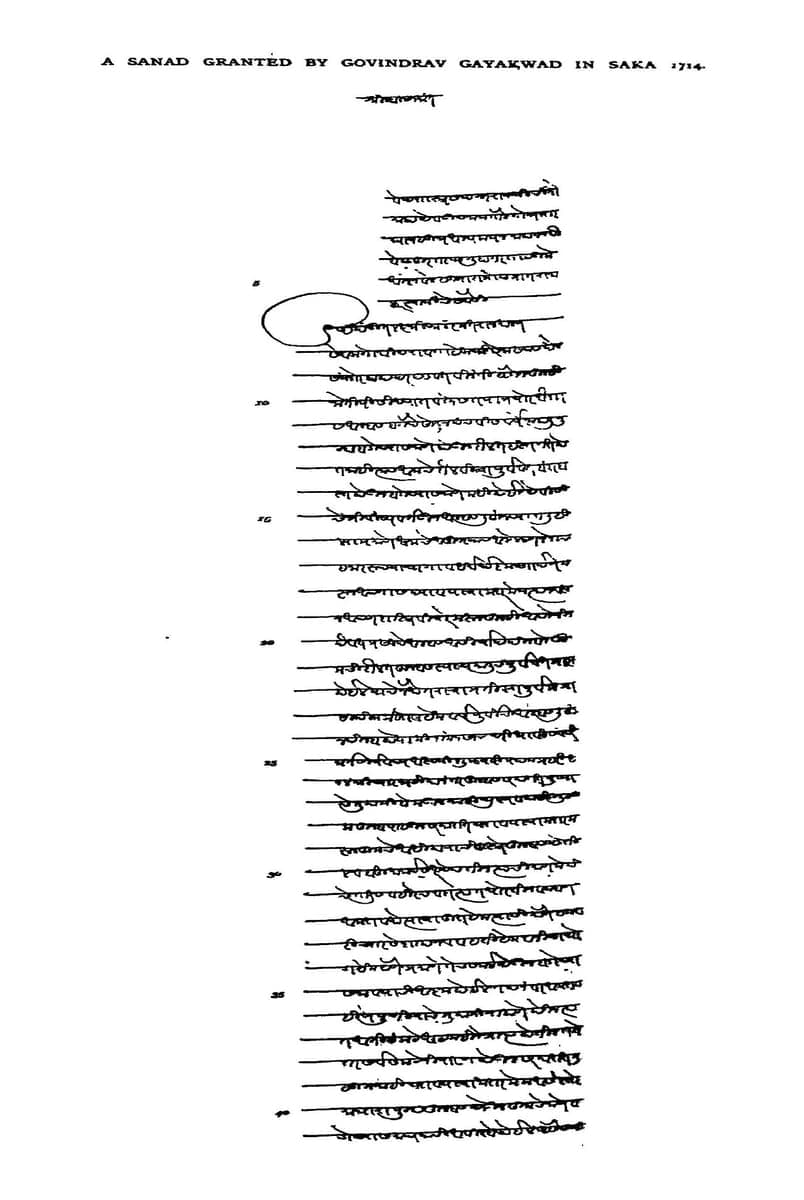
Evidano Transcription
The opening address of the sanad (the lines numbered 1–10 on the facsimile), from the English translation R. C. Temple published alongside the facsimile and a Devanagari transliteration; this is a translation of the Modi text, not a letter-for-letter transcription of it, and a small number of obvious scanning errors in the 1887 typeset diacritics have been corrected against the surrounding sentences.
Glory to Mhalsakant!
To the versed in the Vedas, Rajashri Chinta Mahadev, surnamed Gale, (Brahman of the) gotra Bharadvaja,
(A follower of the) Ashvalayana-Sutras, Mahajan, of the village of Veltur, taraf Guhagar, taluka Anjanvel, in the subha of Dabhol, prant Rajapur,
Humble greeting.
I, your servant, possessed of immense wealth, Rajmanya Govindrav Gayakwad, Senae Khaskhel, Samsher Bahadur, knowing you (to be) well versed in astrological lore and pious and great,
Source: Captain R. C. Temple, "An Astrological Sanad Granted by Govindrav Gaikwad", The Indian Antiquary, vol. 16 (November 1887), pp. 317–320, via Internet Archive (Public domain).
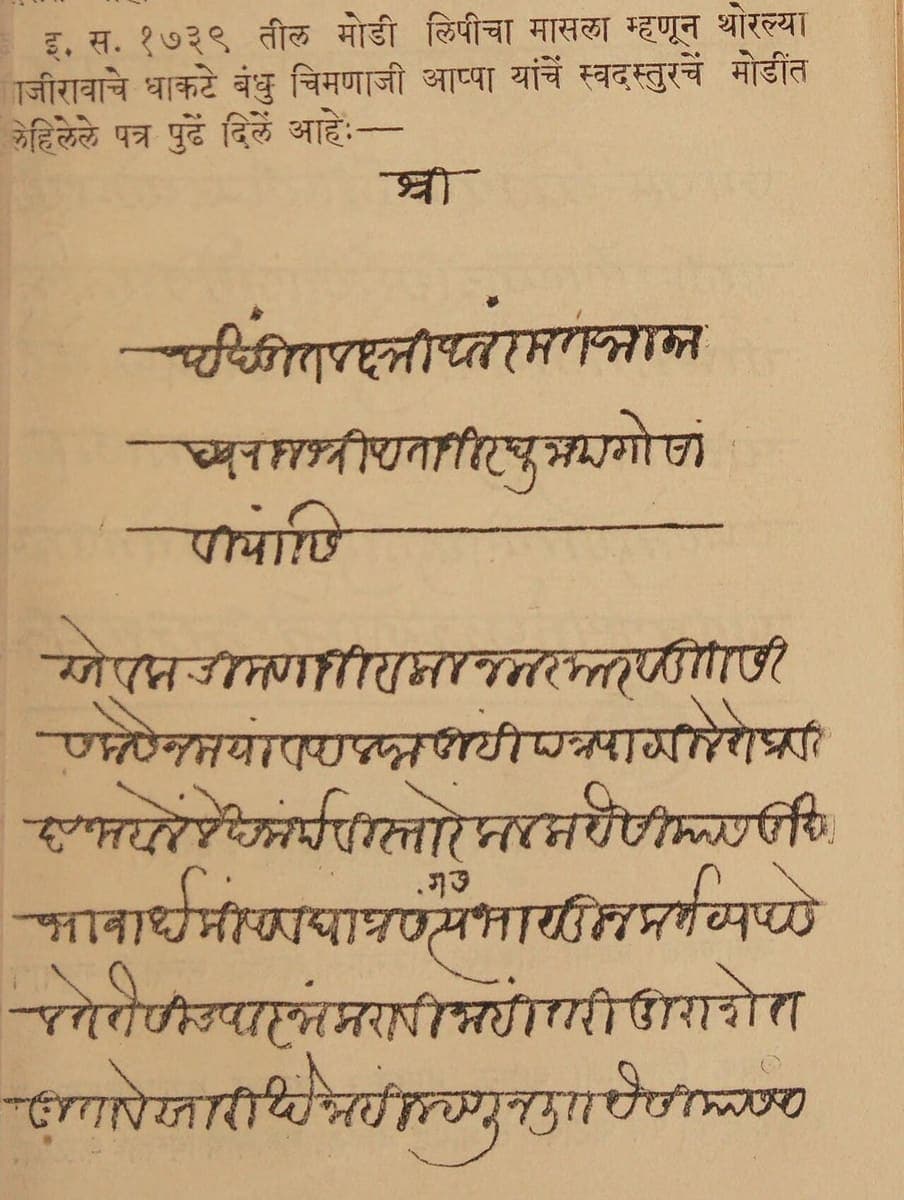
Evidano Transcription
इ. स. १७३९ तील मोडी लिपीचा मासला म्हणून थोरल्या
बाजीरावाचे धाकटे बंधु चिमणाजी आप्पा यांचें स्वदस्तुरचें मोडींत
लिहिलेले पत्र पुढें दिलें आहे:—
श्री
[Modi letter in cursive hand, 9 lines, illegible at this resolution]
Generated by Evidano’s advanced model; not yet checked against a published edition.
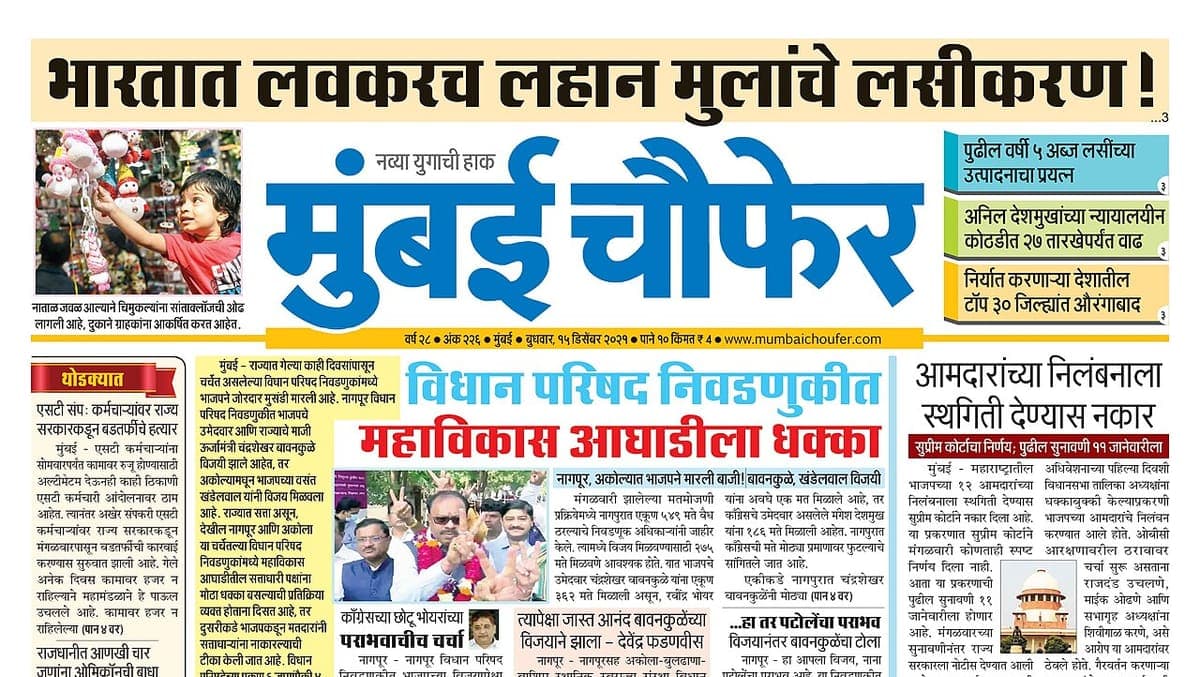
Source · CC BY-SA 4.0 · ShreeAmbika
Evidano Transcription
भारतात लवकरच लहान मुलांचे लसीकरण !
...३
Masthead Left
नाताळ जवळ आल्याने चिमुकल्यांना सांताक्लॉजची ओढ
लागली आहे. दुकाने ग्राहकांना आकर्षित करत आहेत.
Masthead Center
नव्या युगाची हाक
मुंबई चौफेर
Masthead Right
पुढील वर्षी ५ अब्ज लसींच्या
उत्पादनाचा प्रयत्न
३
अनिल देशमुखांच्या न्यायालयीन
कोठडीत २७ तारखेपर्यंत वाढ
३
निर्यात करणाऱ्या देशातील
टॉप ३० जिल्ह्यांत औरंगाबाद
३
Dateline
वर्ष २८ • अंक २२६ • मुंबई • बुधवार, १५ डिसेंबर २०२१ • पाने १० किंमत ₹ ४ • www.mumbaichoufer.com
थोडक्यात
एसटी संप: कर्मचाऱ्यांवर राज्य
सरकारकडून बडतर्फीचे हत्यार
मुंबई - एसटी कर्मचाऱ्यांना
सोमवारपर्यंत कामावर रुजू होण्यासाठी
अल्टीमेटम देऊनही काही ठिकाणी
एसटी कर्मचारी आंदोलनावर ठाम
आहेत. त्यानंतर अखेर संपकरी एसटी
कर्मचाऱ्यांवर राज्य सरकारकडून
मंगळवारपासून बडतर्फीची कारवाई
करण्यास सुरुवात झाली आहे. गेले
अनेक दिवस कामावर हजर न
राहिल्याने महामंडळाने हे पाऊल
उचलले आहे. कामावर हजर न
राहिलेल्या (पान ४ वर)
राजधानीत आणखी चार
जणांना ओमिक्रॉनची बाधा
मुंबई - राज्यात गेल्या काही दिवसांपासून
चर्चेत असलेल्या विधान परिषद निवडणुकांमध्ये
भाजपने जोरदार मुसंडी मारली आहे. नागपूर विधान
परिषद निवडणुकीत भाजपचे
उमेदवार आणि राज्याचे माजी
ऊर्जामंत्री चंद्रशेखर बावनकुळे
विजयी झाले आहेत, तर
अकोल्यामधून भाजपच्या वसंत
खंडेलवाल यांनी विजय मिळवला
आहे. राज्यात सत्ता असून,
देखील नागपूर आणि अकोला
या चर्चेतल्या विधान परिषद
निवडणुकांमध्ये महाविकास
आघाडीतील सत्ताधारी पक्षांना
मोठा धक्का बसल्याची प्रतिक्रिया
व्यक्त होताना दिसत आहे, तर
दुसरीकडे भाजपकडून मतदारांनी
सत्ताधाऱ्यांना नाकारल्याची
टीका केली जात आहे. विधान
परिषदेच्या एकूण ६ जागांपैकी ४
विधान परिषद निवडणुकीत
महाविकास आघाडीला धक्का
नागपूर, अकोल्यात भाजपने मारली बाजी! बावनकुळे, खंडेलवाल विजयी
Center Column Left
मंगळवारी झालेल्या मतमोजणी
प्रक्रियेमध्ये नागपुरात एकूण ५४९ मते वैध
ठरल्याचे निवडणूक अधिकाऱ्यांनी जाहीर
केले. त्यामध्ये विजय मिळवण्यासाठी २७५
मते मिळवणे आवश्यक होते. यात भाजपचे
उमेदवार चंद्रशेखर बावनकुळे यांना एकूण
३६२ मते मिळाली असून, रवींद्र भोयर
Center Column Right
यांना अवघे एक मत मिळाले आहे, तर
काँग्रेसचे उमेदवार असलेले मंगेश देशमुख
यांना १८६ मते मिळाली आहेत. नागपुरात
काँग्रेसची मते मोठ्या प्रमाणावर फुटल्याचे
सांगितले जात आहे.
एकीकडे नागपुरात चंद्रशेखर
बावनकुळेंनी मोठ्या (पान ४ वर)
Center Column Bottom Left
काँग्रेसच्या छोटू भोयरांच्या
पराभवाचीच चर्चा
नागपूर - नागपूर विधान परिषद
निवडणुकीत भाजपच्या विजयापेक्षा
Center Column Bottom Center
त्यापेक्षा जास्त आनंद बावनकुळेंच्या
विजयाने झाला - देवेंद्र फडणवीस
नागपूर - नागपूरसह अकोला-बुलढाणा-
वाशिम स्थानिक स्वराज्य संस्था विधान
Center Column Bottom Right
...हा तर पटोलेंचा पराभव
विजयानंतर बावनकुळेंचा टोला
नागपूर - हा आपला विजय, नाना
पटोलेंचा पराभव आहे. या निवडणुकीत
आमदारांच्या निलंबनाला
स्थगिती देण्यास नकार
सुप्रीम कोर्टाचा निर्णय; पुढील सुनावणी ११ जानेवारीला
Right Column Left
मुंबई - महाराष्ट्रातील
भाजपच्या १२ आमदारांच्या
निलंबनाला स्थगिती देण्यास
सुप्रीम कोर्टाने नकार दिला आहे.
या प्रकरणात सुप्रीम कोर्टाने
मंगळवारी कोणताही स्पष्ट
निर्णय दिला नाही.
आता या प्रकरणाची
पुढील सुनावणी ११
जानेवारीला होणार
आहे. मंगळवारच्या
सुनावणीनंतर राज्य
सरकारला नोटीस देण्यात आली
Right Column Right
अधिवेशनाच्या पहिल्या दिवशी
विधानसभा तालिका अध्यक्षांना
धक्काबुक्की केल्याप्रकरणी
भाजपच्या आमदारांचे निलंबन
करण्यात आले होते. ओबीसी
आरक्षणावरील ठरावावर
चर्चा सुरु असताना
राजदंड उचलणे,
माईक ओढणे आणि
सभागृह अध्यक्षांना
शिवीगाळ करणे, असे
आरोप या आमदारांवर
ठेवले होते. गैरवर्तन करणाऱ्या
Generated by Evidano’s advanced model; not yet checked against a published edition.
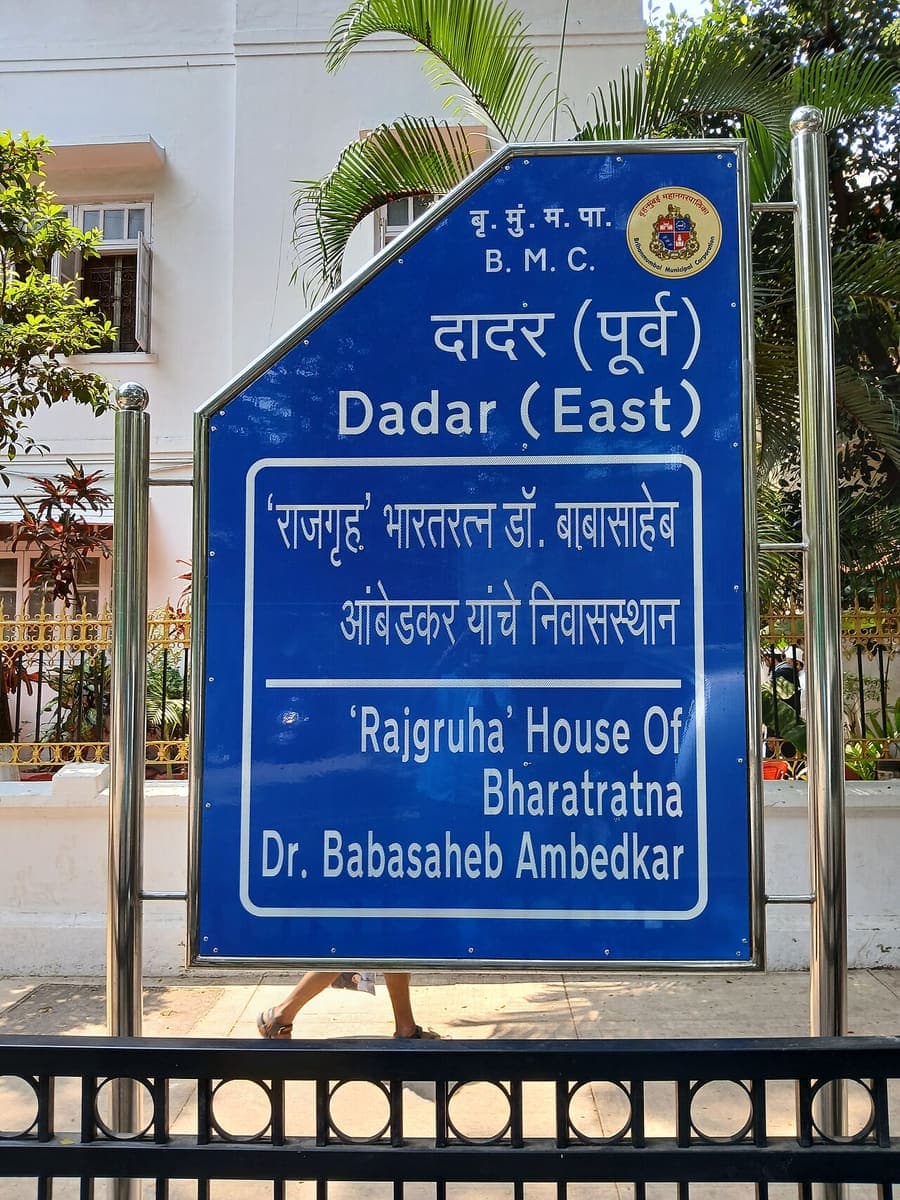
Source · CC BY-SA 4.0 · Shishirdasika
Evidano Transcription
बृ. मुं. म. पा.
B. M. C.
दादर (पूर्व)
Dadar (East)
'राजगृह' भारतरत्न डॉ. बाबासाहेब
आंबेडकर यांचे निवासस्थान
'Rajgruha' House Of
Bharatratna
Dr. Babasaheb Ambedkar
Generated by Evidano’s advanced model; not yet checked against a published edition.
What Marathi text looks like on the page
Balbodh — literally “taught to children” — is the formal, disconnected Devanagari most Marathi print and modern handwriting uses: a continuous head line ties each word together, vowel signs attach above, below, before or after the consonant, and conjuncts stack or combine into half-forms exactly as in Hindi. Marathi keeps a couple of letters Hindi does not use in ordinary writing, most visibly ळ, a retroflex l found in everyday words, and a distinct eyelash ra (ऱ) in some spellings; otherwise its numerals, punctuation and layout in print match the wider Devanagari tradition.
Modi is a different matter altogether: a cursive administrative hand, not simply a fast version of Devanagari, in which almost every letter joins the next in one running stroke and takes a different outline depending on what comes before and after it, much as connected Latin cursive does. It served as the working script of Marathi record-keeping for centuries, above all under the Maratha Empire and its Peshwa ministers, when land grants, revenue registers, treaties and personal letters were drafted by professional scribes, or karkuns, in Modi rather than Devanagari. Maharashtra’s government replaced Modi with Balbodh Devanagari for official use in 1950, and within a generation the script had passed out of ordinary literacy; enormous archives of Maratha-era paper, including much of the Peshwe Daftar, remain in Modi and need someone trained specifically in it to read.
Maratha chancery documents add their own habits on top of the script itself: a sanad or letter typically opens with a one-word invocation such as “श्री”, follows fixed forms of address and titles, and uses abbreviations a scribe of the period would have recognised at a glance. Everyday Marathi today, by contrast, is printed and signed in Balbodh, frequently alongside English on government boards, forms and newspaper advertisements, with acronyms and English proper names sitting inside an otherwise Marathi sentence.
Why ordinary OCR struggles here
A cursive that is not just fast Devanagari
Modi joins nearly every letter to the next and reshapes each one by what surrounds it, closer to connected Latin cursive than to Devanagari with the corners rounded off. A model trained on Balbodh has effectively never seen the script and cannot fall back on Devanagari letterforms to guess at it.
Marathi-specific letters inside Balbodh
ळ and the eyelash ऱ do real work in ordinary Marathi words but are rare or absent in Hindi text, so a model tuned mostly on Hindi print can misread or drop them, especially in a fast handwritten note where the retroflex loop is easy to lose.
Chancery formulas and scribal abbreviations
A Maratha-era sanad or letter opens with a fixed invocation, uses formal titles and closes with conventions a period scribe would expect a reader to supply, and can abbreviate common words in ways that only make sense once the formula is recognised as a formula.
English wedged into a Marathi line
A municipal sign or a newspaper page routinely drops an English acronym, a proper name or a full English caption into an otherwise Marathi line. A transcription needs to keep each script as its own run rather than merging or transliterating one into the other.
Who works with this material
Maratha history and archival research
State and university archives in Maharashtra hold vast quantities of Peshwa-era correspondence, revenue registers and land grants in Modi that have never been read in full. A transcription that a specialist can check against the page turns an unread bundle into searchable material.
Family and land-record genealogists
Sanads, danpatras and other deeds passed down through Maharashtrian families are frequently in Modi, and a household may hold documents no living member can read. A checked transcription recovers names, dates and boundaries that would otherwise stay locked in the script.
Marathi newspaper and periodical archives
Digitisation projects working through decades of Marathi print need a transcription that keeps headlines, boxed items and captions distinct, so a scanned front page becomes several searchable articles rather than one undivided block.
Municipal and government records teams
Bilingual signage, forms and notices in Maharashtra pair Marathi with English on the same board or page, and a transcription needs to keep the two scripts apart and correctly ordered to remain useful as a record.
Getting the best transcription
Say whether the page is Modi or Balbodh
Treat the two as different scripts rather than variants of one another. Telling the model which one it is looking at up front avoids it trying to read Modi cursive as if it were unusually messy Devanagari.
Flag chancery formulas in Maratha documents
For a sanad, letter or register, mention that the opening invocation, titles and closing conventions follow a fixed pattern, so the model treats them as recognisable formulas rather than as ordinary prose to be guessed at word by word.
Watch for ळ and other Marathi-specific letters
If a prompt or workflow was built around Hindi text, say explicitly that Marathi uses ळ and the eyelash ऱ, so a fast handwritten note does not get its retroflex letters silently replaced with their nearest Hindi look-alikes.
Start with the most cursive Modi page
Within a batch of Modi material, test the fastest and most looped handwriting first. If the model separates its lines and holds its own against the hardest page, the more careful chancery hands that follow need only a light check.
Frequently asked questions
- Can Evidano read Modi script, not just modern Devanagari?
- Yes. Tell it the page is in Modi and it reads the connected cursive letterforms directly rather than trying to match them to Balbodh Devanagari, which is a different, though related, script.
- How does it tell Modi and Balbodh apart on the same page?
- By the letterforms themselves — Modi’s continuous joined strokes look nothing like Balbodh’s disconnected letters under a head line — so a document that mixes a Modi body with a later Devanagari annotation can have each part read correctly in its own script.
- Does it recognise ळ and the eyelash ऱ in ordinary Marathi text?
- Yes, both are read as the distinct Marathi letters they are rather than folded into their nearest Hindi equivalents, in print and in handwriting.
- What happens with the invocation and formal titles in a Maratha-era letter?
- They are transcribed as written. If you tell the model the document follows a chancery formula, it can flag the invocation, titles and closing separately from the body of the message, which makes the substantive content easier to find.
- Can it handle a sign or form that mixes Marathi and English?
- Yes, each script is kept as its own run in the order it appears, so a bilingual municipal board or a form with an English acronym inside a Marathi sentence comes back with both languages intact rather than merged or transliterated.
Related scripts and pages
Transcribe your Marathi pages
Upload a Modi sanad, a Balbodh newspaper page, or a bilingual sign and check the transcription against the image before you export it.