
Sanskrit · c. 900–1700
Śāradā is not Devanagari with a different accent
A scholar who reads Devanagari fluently opens a Śāradā folio and recognises perhaps a tenth of it. The letters are angular where Devanagari is round, the vowel signs sit in different places, and the head-line is broken instead of continuous. Evidano reads the Kashmiri hand as its own script, on birch bark and on paper, and shows you the line it is reading.
Sample pages
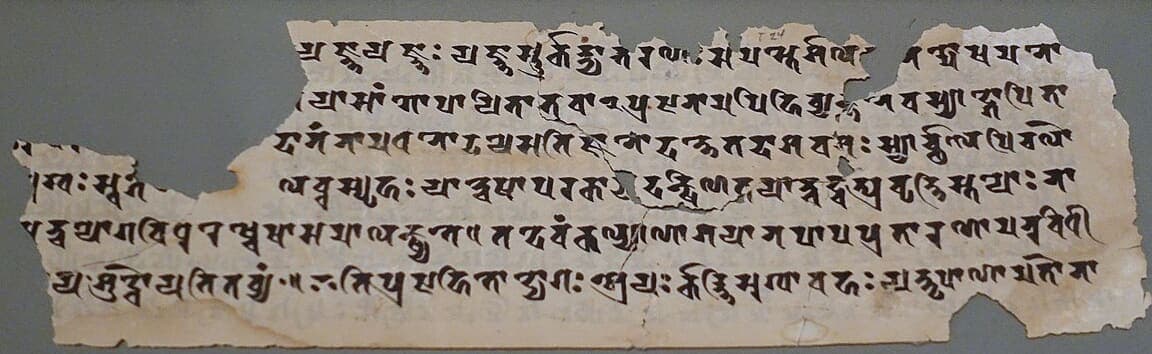
Ethnologisches Museum, Berlin, c. 8th–9th century · Source · CC0 1.0 · Photograph by Daderot
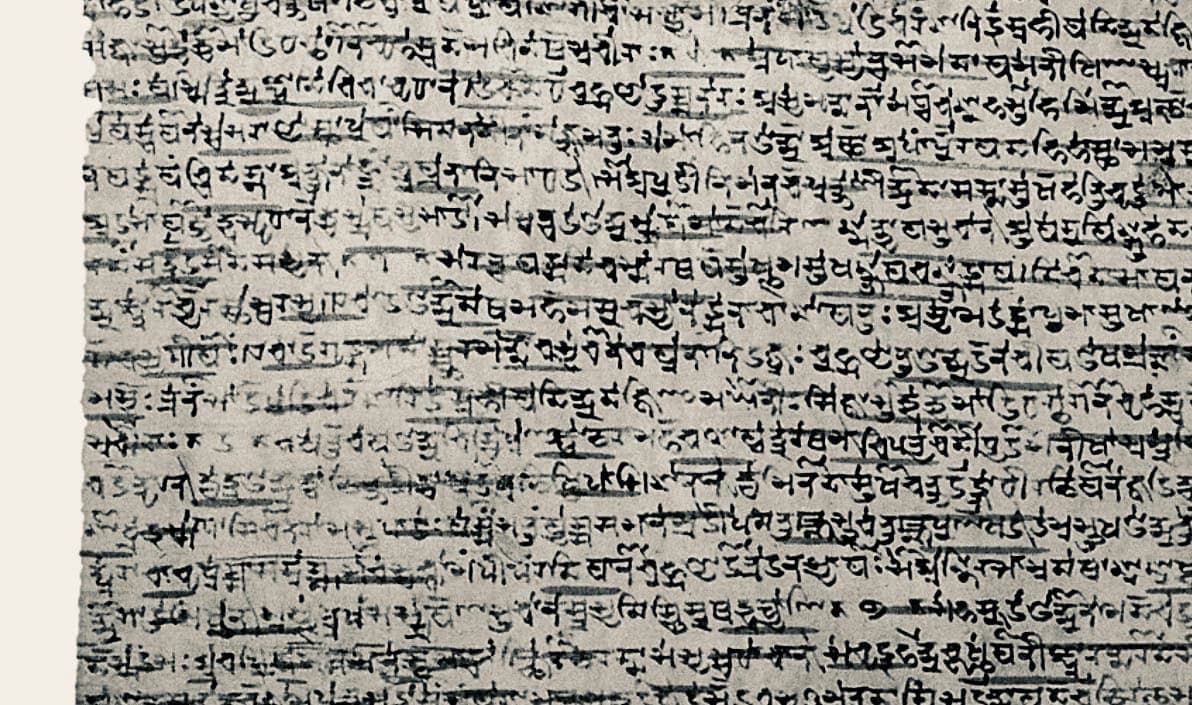
Bhandarkar Oriental Research Institute, Pune, before the 14th century · Source · CC0 1.0 · Photograph by Ms Sarah Welch
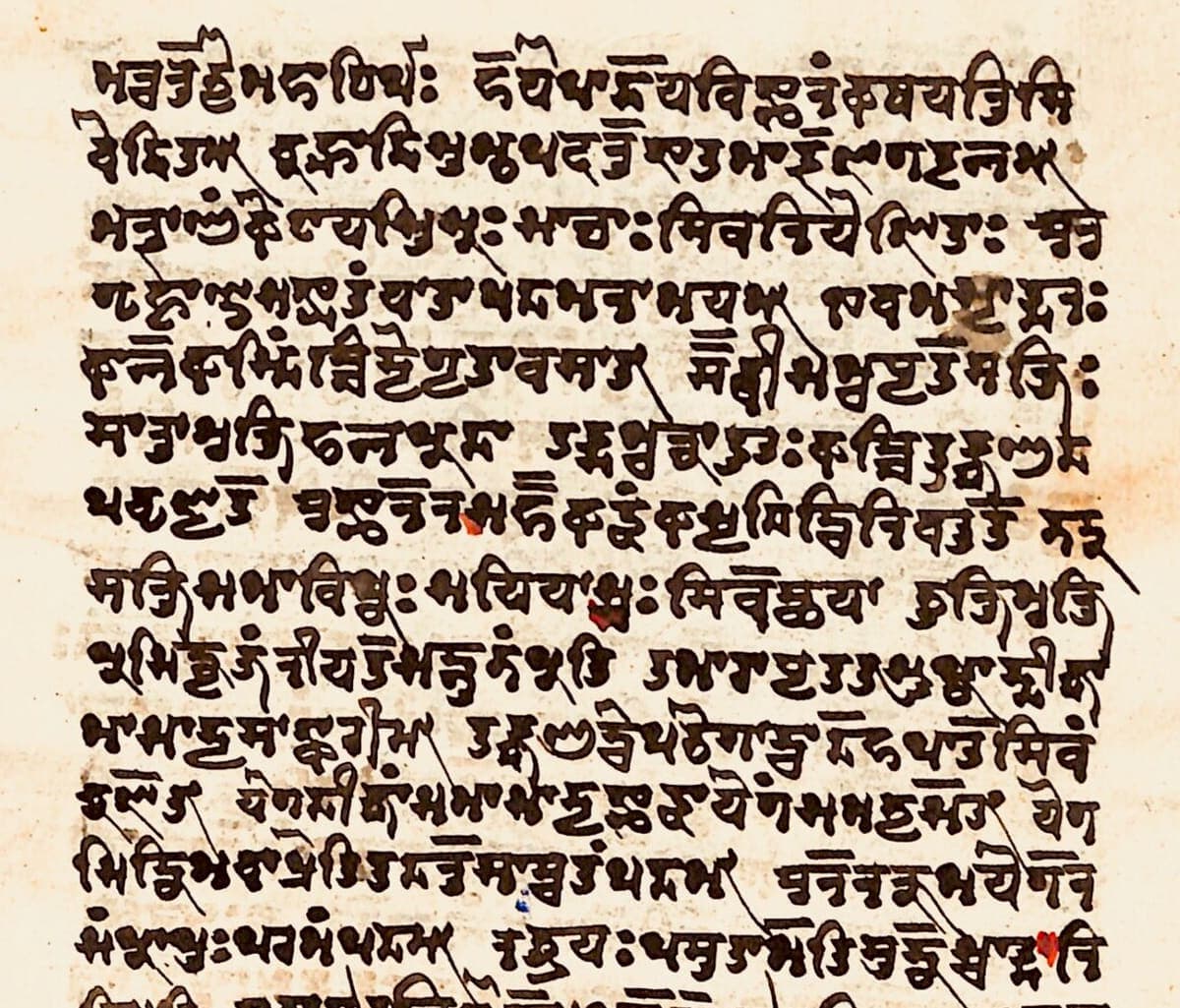
Source · CC BY-SA 4.0 · Photograph by Ms Sarah Welch
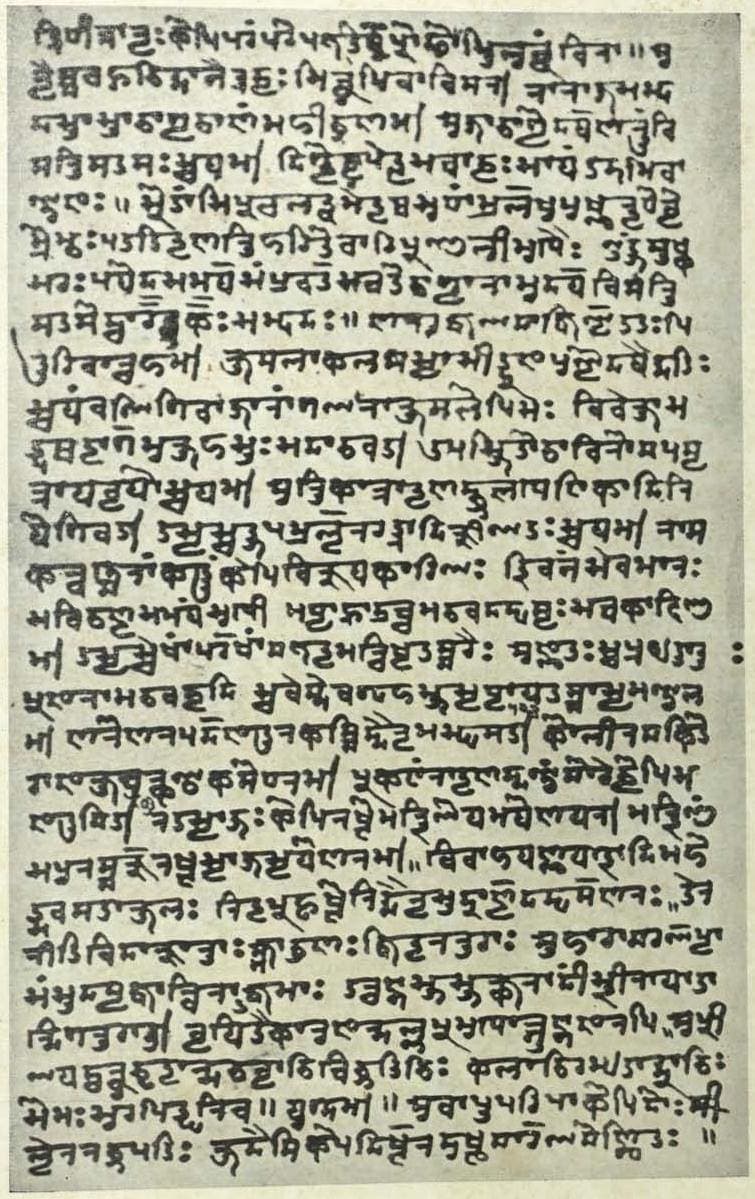
Source · Public domain · Plate from R. S. Pandit, River of Kings (The Indian Press, Allahabad, 1935)
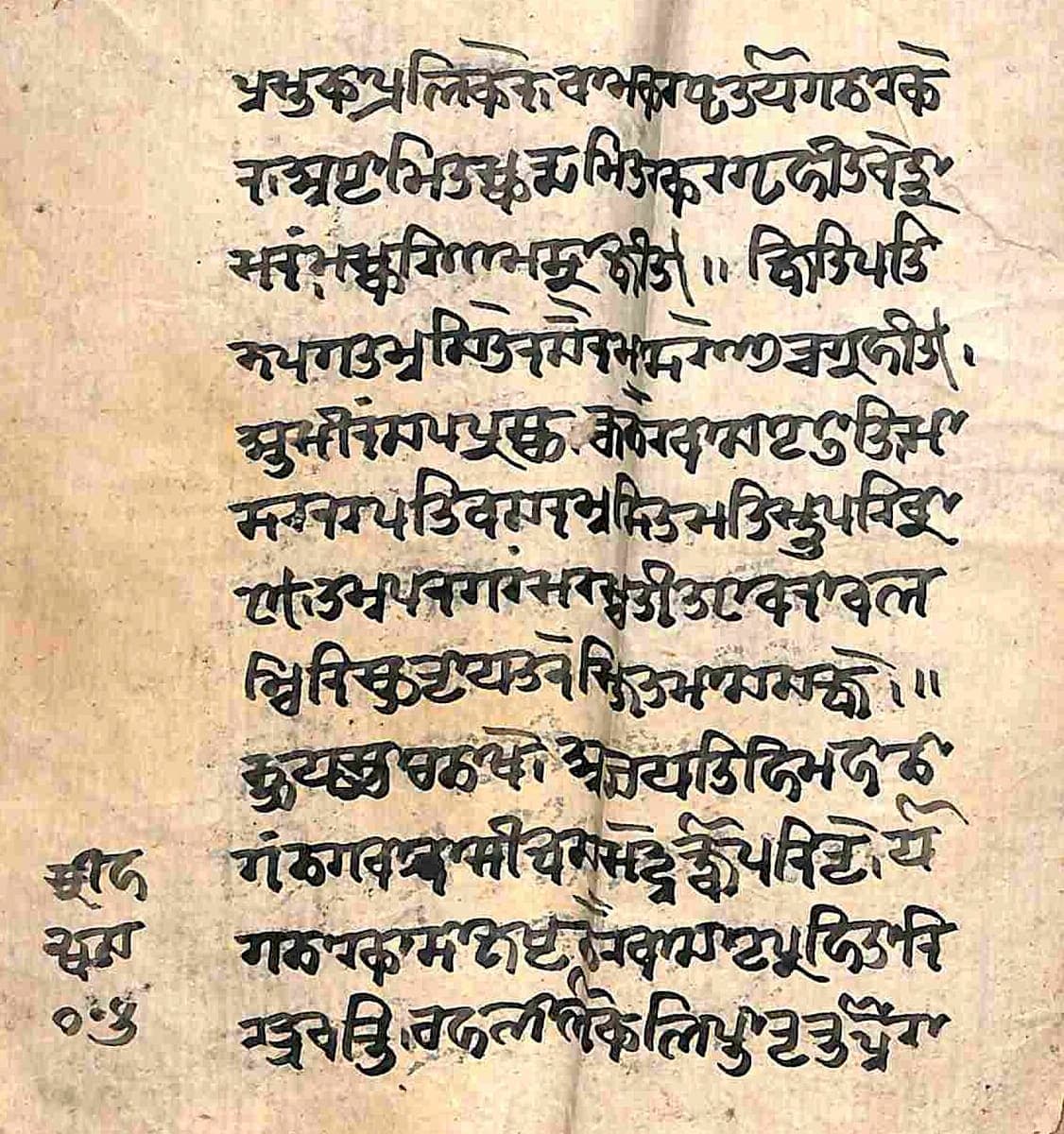
Source · Public domain · Digitised by eGangotri Digital Preservation Trust
The Kashmiri book hand
Śāradā grew out of the proto-Śāradā of the northwest, the hand of the Gilgit birch-bark manuscripts and of Sanskrit fragments found as far east as Turfan, and settled into a recognisable book script around the tenth century. For seven hundred years it was the writing of Kashmir and the neighbouring hill country: the Kashmiri Śaiva philosophers, the Kashmirian recensions of the Ṛgveda and the Atharvaveda, Kalhaṇa’s chronicle of the kings, Sanskrit poetics and grammar. Devanagari displaced it for books from the seventeenth century onward, but Kashmiri Pandits went on using a cursive descendant for horoscopes, letters and ritual formulae into living memory, and Gurmukhi and the Laṇḍā merchant scripts of the Punjab grew from the same root.
Its letters are built from straight strokes and sharp corners. The head-line runs over each akṣara separately rather than joining a whole word, so a Śāradā line looks like a row of hooked flags rather than the ruled bar of Devanagari. Several signs are close cousins that differ by one short stroke or the angle of a terminal, and many of the medial vowels are attached quite differently from their Devanagari equivalents: the ā mark curls, the ī and u marks hang below or wrap round. Conjuncts stack tightly, sometimes three deep, and are held together by the same rule as everywhere in Sanskrit writing, that a consonant without a vowel must either join the next one or take a virāma.
What a folio carries besides the text matters as much. Vedic manuscripts add accent marks: a stroke beneath the akṣara for anudātta, a vertical above it for svarita, which a recogniser can easily read as underlining or as part of the letter. Folio numbers stand in the left margin, sometimes as digits and sometimes in an older letter-numeral system. Kashmiri scribes corrected between the lines, added glosses in the margins in a smaller hand, and marked insertions with a caret. Birch bark, the classic Kashmiri writing surface, delaminates into layers and splits along horizontal grain lines, so a good folio still comes with cracks running through the middle of words.
Why ordinary OCR struggles here
Letters that look like Devanagari and are not
Enough shapes overlap that a Devanagari model does not refuse the page: it returns fluent-looking Sanskrit that is simply wrong. That is worse than a failure, because the output has to be checked syllable by syllable before anyone can trust a word of it.
Distinctions of a single short stroke
Several Śāradā consonants are separated by a tick inside the body of the letter or by whether a limb closes. In a fast hand on absorbent bark the tick blurs. A model has to weigh the shape against what Sanskrit morphology allows in that position instead of choosing the commoner letter every time.
Bark that splits through the text
Birch bark ages by separating into sheets and cracking along the grain, and Kashmiri folios were often repaired with paste and paper strips. Horizontal cracks run through the middle of a line of writing and are easily read as a head-line, an underline or an accent mark.
Accents, glosses and second hands
A Vedic folio carries accent marks that belong to the text; a scholastic folio carries marginal glosses, interlinear corrections and later readers’ notes that do not. Keeping the four apart is an editorial decision that has to be made explicitly, not left to whatever the recogniser happens to pick up.
Who works with this material
Editors of Kashmiri Śaiva and poetic texts
The philosophical and aesthetic literature of Kashmir survives mainly in Śāradā copies scattered between Srinagar, Jammu, Pune and European libraries. An editor comparing witnesses needs each folio read as written, with its marginal glosses kept separate from the text they gloss.
Vedic philologists
The Kashmirian recensions of the Ṛgveda and the Atharvaveda are preserved in Śāradā and are valuable precisely because they differ from the vulgate. Their accent marks are evidence, so a transcription that drops or mangles them is useless for the purpose.
Digitisation and cataloguing projects
Trusts and archives photographing Kashmiri collections produce thousands of folio images faster than anyone can describe them. Even a rough transliteration of the first and last lines of each folio turns an unsorted image set into something a cataloguer can order and identify.
Historians of Kashmir and the northwest
Chronicles, land grants and colophons in Śāradā carry dates in the Laukika era, place names and personal names that appear nowhere else. Getting them out of the manuscripts and into searchable text is the first step in any regional history.
Getting the best transcription
Name the script, not just the language
Start the prompt by saying the folio is Śāradā and that Devanagari readings must not be substituted. Without that, a page of Sanskrit invites the most familiar script as the default and the output looks convincing while being wrong throughout.
Decide what happens to accents and glosses
Say whether Vedic accent marks should be reproduced, transliterated as diacritics, or ignored, and whether marginal and interlinear material should be transcribed in a separate block. Fixing this once keeps a long manuscript internally consistent.
Describe the damage before you complain about it
Tell the model that horizontal cracks are splits in the writing surface and not part of the letters, and that a repaired patch may hide part of a line. Ask for illegible stretches to be marked with their approximate length rather than filled in.
Start with a folio you can already read
Test on a leaf whose text is known, ideally one with a colophon or a well-known opening, and compare the output against the printed edition. That calibrates the prompt before it is turned loose on the folios nobody has read yet.
Further reading on this hand
The palaeography guides the in-app selector points to for this domain, if you want to check a transcription against the standard references.
- Proposal to Encode the Sharada Script in ISO/IEC 10646
This Unicode proposal was prepared for the International Organization for Standardization and International Electrotechnical Commission (ISO/IEC) encoding process. It documents Śāradā as a historical script of Kashmir and neighboring regions used extensively for Sanskrit manuscripts. The proposal inventories vowels, consonants, dependent signs, virama, conjunct behavior, numerals, punctuation, and manuscript symbols with glyph evidence. It is directly useful for identifying the distinct characters and combining sequences found in Śāradā codices.
Frequently asked questions
- Can it really tell Śāradā from Devanagari?
- Yes, and it matters more than any other setting on this material. The two scripts share ancestry and a handful of shapes, so a page misidentified as Devanagari produces smooth nonsense. Naming Śāradā in the prompt keeps the letterforms of the right script in play.
- How are Vedic accent marks handled?
- They can be kept as marks, converted to the diacritics used in printed Vedic editions, or left out. What they are not is decoration: the underline below an akṣara is anudātta and the stroke above is svarita, and the transcription treats them as characters rather than as artefacts of the scan.
- What about birch bark that has cracked or delaminated?
- Cracks are treated as damage rather than as writing, and letters lost in a split are marked as missing. Where a fragment has been mounted or repaired, the added paper is described rather than transcribed.
- Can the output come back in Devanagari or in transliteration?
- Either. Most editors want IAST because it is unambiguous and searchable; Devanagari is convenient for comparison with printed editions of the same text. The Śāradā block in Unicode is also available where the encoding itself is the deliverable.
- Are the folio numbers and colophons read as well?
- Yes, and they are worth asking for separately. Marginal numbers, letter-numerals and the scribe’s closing formula are what let a scattered stack of leaves be put back in order and dated, so they can be returned as their own field rather than buried in the running text.
Related scripts and pages
Transcribe your Śāradā folios
Upload a birch-bark or paper leaf, choose Śāradā Manuscripts of Kashmir and the Northwest, and compare the first folio against a printed edition.