
Arabic · c. 640–900
Read Arabic documents from the first two centuries of Islam
A tax receipt written in Egypt in 643 gives you letter skeletons with almost no dots on them and a Greek column sharing the same sheet. Evidano reads these as documents: it follows the rasm, marks where a dot is present and where it is not, and keeps the Arabic, the Greek and the numerals in the order they sit on the papyrus.
Sample pages
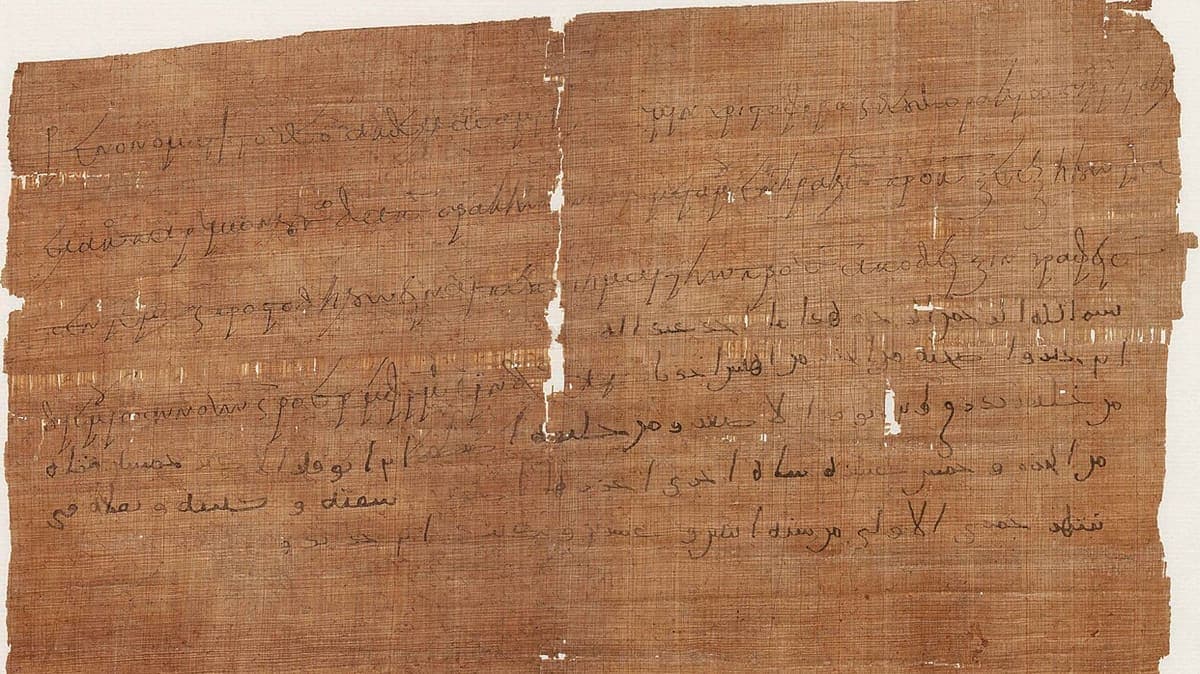
Österreichische Nationalbibliothek, Papyrussammlung, PERF 558 (G 39726), 25 April 643 · Source · Public domain
Evidano Transcription
The five lines of Arabic on the recto; the Greek blocks are not included. The consonantal dots and hamzas are supplied editorially and the spelling of the papyrus is otherwise left uncorrected, so forms such as عبد اله and ابن ابو قير stand as the scribe wrote them.
بسم الله الرحمن الرحيم هذا ما اخذ عبد اله
ابن جبر واصحبه من الجزر من اهنس
من خليفة تدراق ابن ابو قير الاصغر ومن خليفة اصطفر ابن ابو قير الاكبر خمسين شاة
من الجزر وخمس عشرة شاة اخرى اجزرها اصحاب سفنه وكتئبه وثقلاءه في
شهر جمدى الاولى من سنة اثنين وعشرين وكتبه ابن حديدو
Source: PERF 558, “Text”, English Wikipedia (CC BY-SA 4.0).
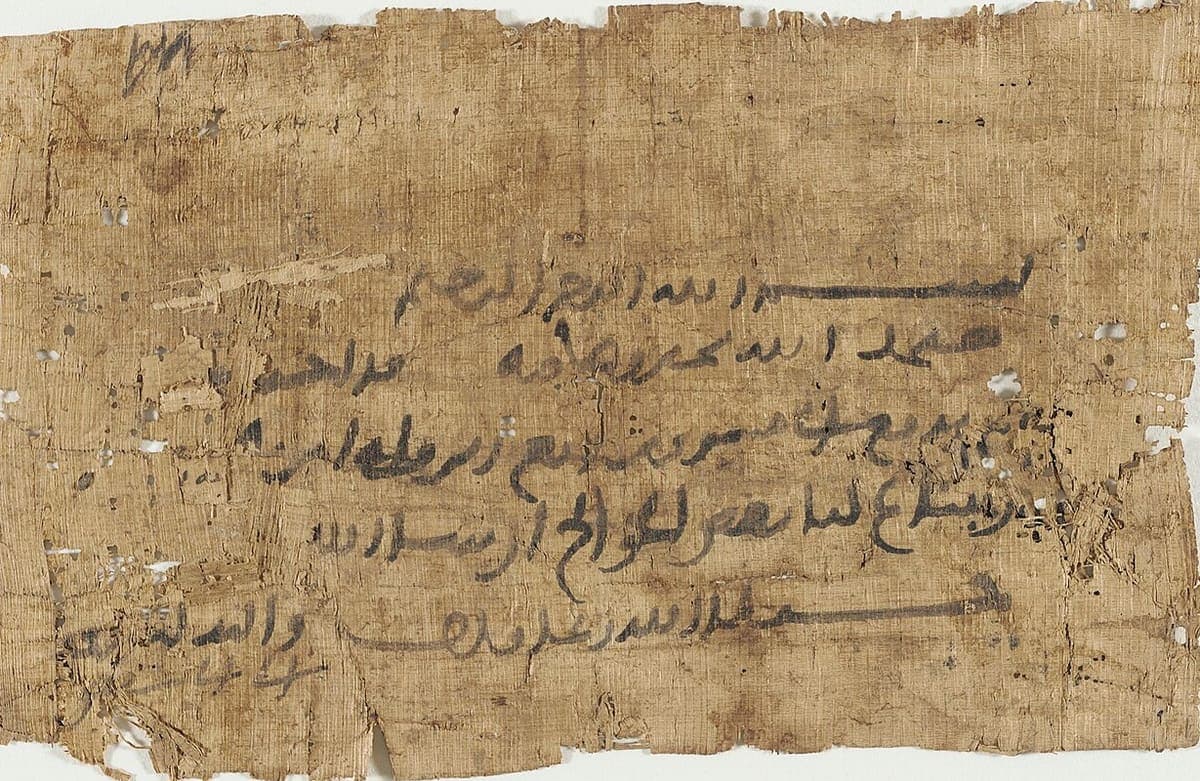
Los Angeles County Museum of Art, M.2002.1.366, 7th–9th century · Source · Public domain
Evidano Transcription
بسم الله الرحمن الرحيم
[remaining lines illegible]
Generated by Evidano’s advanced model; not yet checked against a published edition.
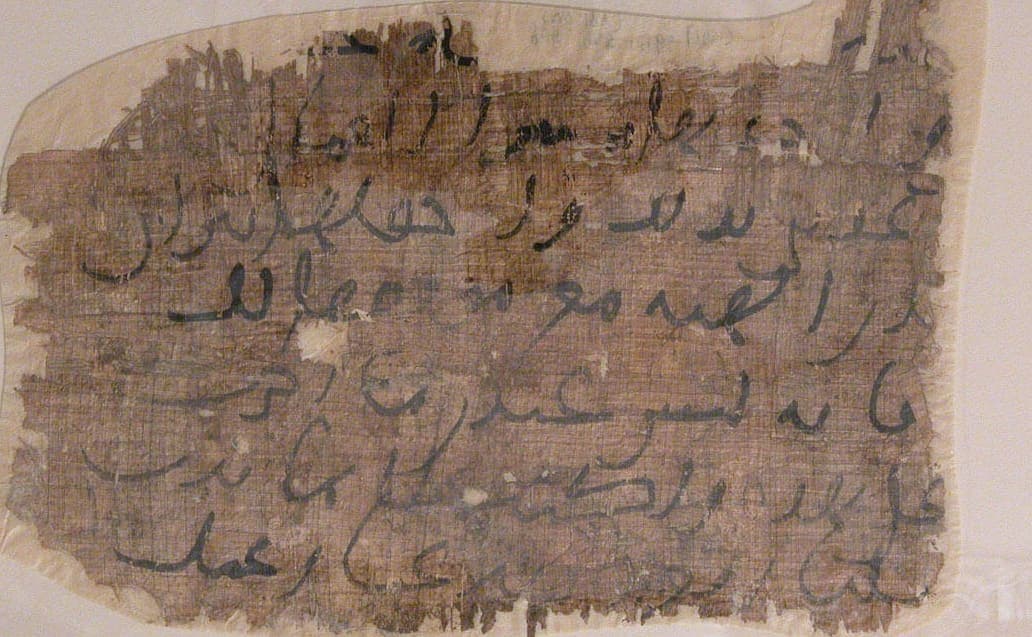
Metropolitan Museum of Art, 90.5.966, 8th–10th century · Source · CC0 1.0
Evidano Transcription
[illegible]
[illegible]
[illegible]
[illegible] مالك [?]
فانه ليس عند[illegible]
[illegible]
[illegible] عملك
Generated by Evidano’s advanced model; not yet checked against a published edition.
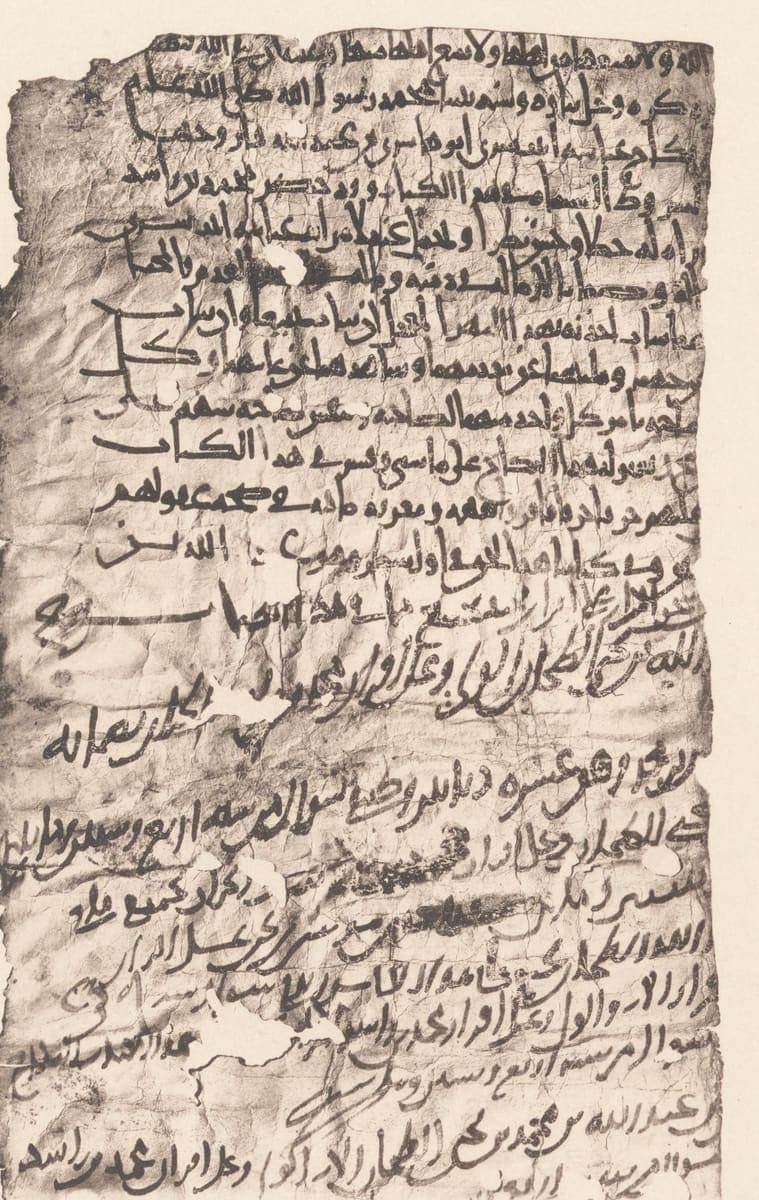
Khedivial Library, Cairo (now Dār al-Kutub), Moritz, Arabic Palaeography, pl. 114, 878 (facsimile 1905) · Source · Public domain
Evidano Transcription
[illegible]
[illegible] محمد رسول الله صلى الله عليه
[illegible]
[illegible] الكتاب [illegible] محمد بن راشد
[several lines illegible]
[illegible] كل واحد منهما لصاحبه [illegible]
[illegible] على ما سمى [illegible] الكتاب
[several lines illegible]
[illegible] عشره دنانير [illegible] شوال [illegible]
[illegible] سنه اربع وستين ومايتين
[several lines illegible]
[illegible] سنه اربع وستين [illegible]
[illegible] عبد الله بن محمد [illegible] النجار [illegible]
[illegible] اقرار محمد بن راشد
Generated by Evidano’s advanced model; not yet checked against a published edition.
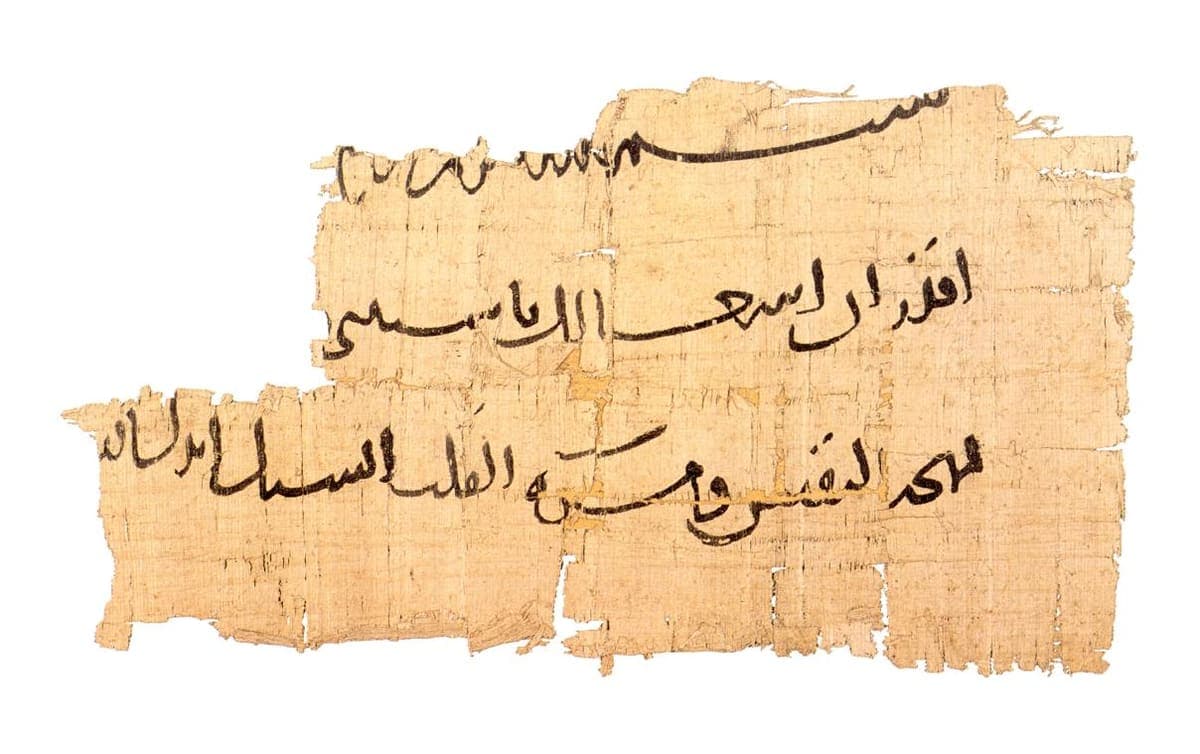
Reproduced in Islamic Calligraphy (Geneva, 1988), p. 55, 9th–10th century · Source · Public domain
Evidano Transcription
بسم الله الرحمن الرحيم
اقرار اسعد الراسبي[?]
لمحمد القشيري وسهمه[?] الثلث[?] السدس [illegible] الدار
Generated by Evidano’s advanced model; not yet checked against a published edition.
What an early Arabic document looks like
The Arabic written on papyrus in Egypt, Palestine and Khurasan between the conquests and the late ninth century is a working hand, not a calligraphic one. Words are strung along a strong horizontal baseline, the connecting strokes are stretched to fill a line, and a scribe in a hurry will let an entire word collapse into a wave with one or two teeth. The alphabet at this stage is still a set of consonantal skeletons: ب, ت, ث, ن and medial ي share a single tooth, ج, ح and خ share one hook, and د/ذ, ر/ز and س/ش are told apart only by dots that a documentary scribe often did not bother to write. Where the dots do appear they are frequently short oblique dashes rather than round points, and they may sit high above the letter they belong to.
Documents are laid out in zones rather than as continuous prose. A letter opens with the basmala across the full width, then a narrower address and greeting block, then the body, whose lines crowd together at the foot as the writer runs out of sheet. Fiscal papers carry their own furniture: a heading naming the district and the tax year, an amount written out in words and sometimes repeated in Greek letter-numerals, a validation stroke, and a date by the hijrī month and year. Contracts end with a column of witness signatures, each in its own hand and often at an angle to the main text, and bilingual documents keep Greek and Arabic on one sheet, the Greek running from the left and the Arabic from the right.
The material behaves as badly as the script. Papyrus splits along its fibres, so a vertical crack can amputate the descender of a nūn; sheets were reused and pasted, leaving text from an unrelated document on the same fragment; and ink that was carbon-black on the day of writing has often faded to the brown of the support itself.
Why ordinary OCR struggles here
A script that withholds its dots
Generic OCR is trained on printed Arabic, where every ب, ت and ث is unambiguous. On a seventh-century papyrus the same shape can be any of five letters, and the correct one is fixed by the formula, the personal name or the fiscal vocabulary around it. A recogniser that guesses from shape alone produces a plausible-looking word that is simply not there.
Numbers written three ways at once
An amount may be spelled out in Arabic words, repeated as a Greek alphabetic numeral and totalled with a Coptic figure on one sheet. Fractions have their own signs, and a unit of measure may be abbreviated to a single hook. Reading order then becomes the problem: the Arabic runs right to left, the numeral left to right.
Two languages on one sheet
Bilingual receipts and protocols put Greek and Arabic side by side, and a Coptic docket may be added on the verso later. Layout analysis built for a single script tends to sort these lines into one column and interleave them, so the resulting text alternates between languages line by line and neither half can be read.
Fibres, folds and later hands
A crack along the fibres removes a stroke without leaving an obvious gap; a fold darkens a line; a note added years later crosses the original at right angles. Deciding what is damage, what is a later addition and what the scribe wrote is part of transcribing the document, not a later step.
Who works with this material
Papyrologists and editors of documentary corpora
Anyone preparing an edition needs a first reading that separates certain letters from restored ones and records where a dot is actually on the sheet. What the model produces is a draft to argue with, fragment by fragment, not a finished text.
Historians of the early caliphate
Tax registers, requisition orders and safe-conducts are the only direct evidence for how the conquest administration worked. Historians want the names, place names, sums and dates out of hundreds of fragments in a consistent form so that a district or an official can be traced across collections.
Museum and library cataloguers
Collections hold Arabic papyri catalogued as “fragment, Arabic, undated”. A reading of even the first two lines usually yields a document type, a formula and often a name — enough to give the piece a proper record.
Teachers of Arabic palaeography
Beginners have to be broken of the habit of reading dots. Putting a transcription beside an undotted document, with the ambiguous skeletons flagged, shows exactly where context rather than the letter shape decided the reading.
Getting the best transcription
Tell the model what to do about the dots
Decide whether you want the text as written, with dots only where the scribe put them, or normalised into modern spelling with all pointing supplied. For an edition, ask for the diplomatic version plus a marker on every skeleton that could be read another way; for a name index, ask for the normalised one.
Name the document type before you start
Say whether the sheet is a letter, a receipt, a contract or a protocol. The formulae are fixed enough that the opening of a tax receipt can be predicted, and naming the class resolves a great many ambiguous skeletons at once.
Handle the zones separately
Ask for the basmala, the address block, the body, the date and the witness column to be labelled, and for Greek or Coptic passages to be transcribed in their own script and kept in their own block rather than merged into the Arabic. That keeps the reading order honest on a bilingual sheet.
Start with a dated piece you already know
Test the prompt on a document whose text is published, so you can see how the model treats a fibre crack, a stretched connector and a Greek numeral. Once that comes back as you want it, run the same instructions over an uncatalogued box.
Further reading on this hand
The palaeography guides the in-app selector points to for this domain, if you want to check a transcription against the standard references.
- Arabic Papyrology Database: Implementation Details
These Ludwig Maximilian University of Munich guidelines explain the transcription and encoding practices used by the Arabic Papyrology Database. They address documentary Arabic, including the treatment of dotless letter readings, uncertain points, numerals, fractions, and passages in other languages or scripts. The instructions are designed for papyri and related early Islamic documentary materials rather than later literary manuscripts. They are therefore especially useful for administrative texts in which consonantal pointing and numerical notation are incomplete or irregular.
Frequently asked questions
- Can the text be transcribed without adding dots that are not on the papyrus?
- Yes. A diplomatic mode reproduces the rasm and reproduces only the pointing the scribe wrote, which for many seventh-century documents means almost none. Restored dots can be requested as a separate, clearly marked layer so an editor can see at a glance which readings depend on context.
- How are the Greek or Coptic parts of a bilingual document treated?
- They are transcribed in their own script and kept as a separate block, with a note of where they sit on the sheet. That matters because the Greek runs left to right and the Arabic right to left, and one merged sequence would put the halves of a receipt in an order that never existed.
- What happens to amounts, fractions and dates?
- Sums spelled out in words are transcribed as words; Greek alphabetic numerals and Coptic figures are kept in the form they take on the document, with the value noted. Hijrī dates are transcribed as written rather than silently converted, since the conversion depends on which month reading you accept.
- Is it any use on a fragment with only two or three lines?
- Often, yes. Short fragments usually preserve part of a formula, and the formula is what identifies the document. Even an opening basmala and half an address line can place a fragment in a document class and sometimes give a name.
- Can the witness signatures at the foot of a contract be kept apart from the main text?
- They can be transcribed as a separate list, in the order they appear, with a note where the hand changes or a subscription is written at an angle. Keeping them apart matters because the notary’s hand and the witnesses’ hands differ, and so does their vocabulary.
Related scripts and pages
Transcribe your Arabic papyri
Upload a document image, choose Early Islamic Arabic Papyri and Administrative Hands, and test the prompt on one dated piece first.