
Greek · c. 300 BCE–400 CE
From a papyrus column to an editable Greek text
A reed pen moving quickly over fibre gives up the shapes taught in a grammar: alpha closes into a loop, epsilon and sigma become open curves, and a final iota is swallowed by the letter before it. Add words cut short by suspension with the last letter lifted above the line, symbols for drachmas and artabas, and gaps where the surface has gone, and an ordinary OCR pass returns a string no papyrologist can use. Evidano reads the column as the scribe wrote it and shows where the reading stops and the restoration begins.
Sample pages
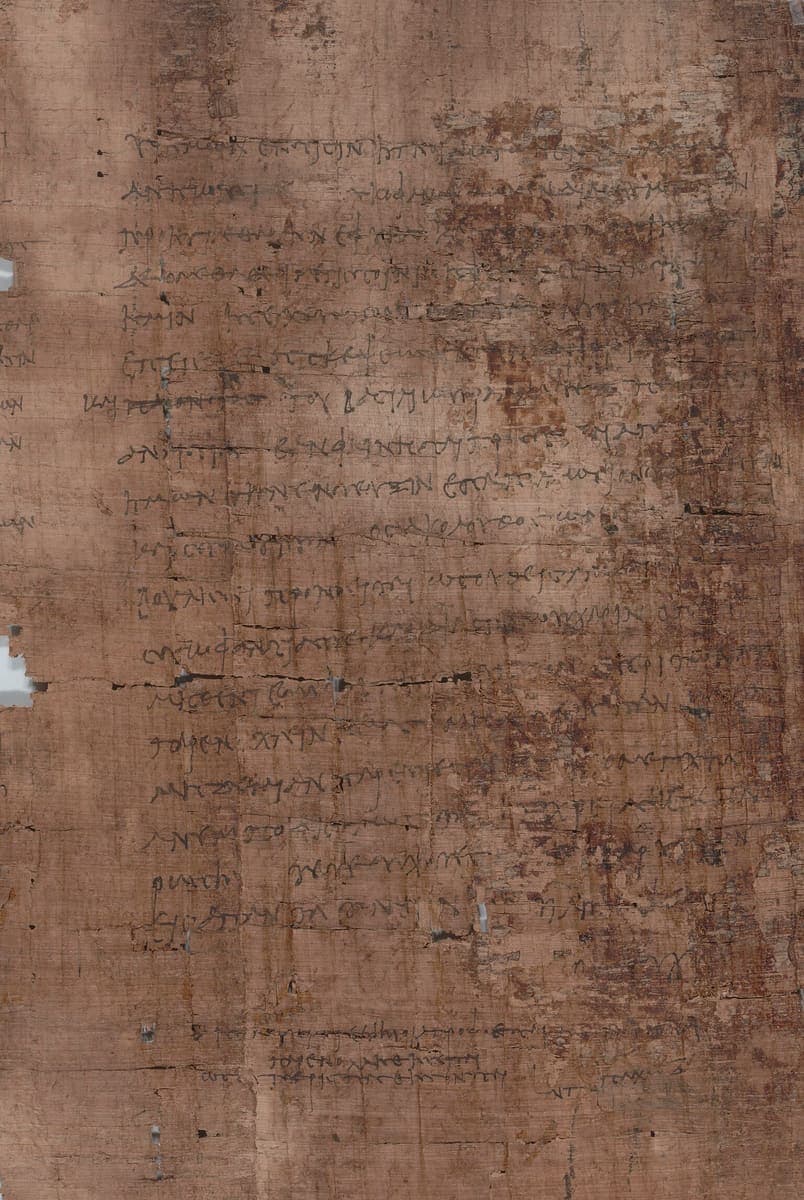
The Bancroft Library, University of California, Berkeley, P.Tebt. 43, 22 May 117 BCE · Source · Public domain · Center for the Tebtunis Papyri, via Wikimedia Commons
Evidano Transcription
Column ii, lines 25–45 in the Duke Databank text, which is the part reproduced here. The edition prints what the scribe actually wrote, so uncorrected spellings stand in the text (εὐτυχῖτε for εὐτυχεῖτε, προφεται for προφέρεται) and the corrections are given in an apparatus that is not reproduced here. Square brackets mark lost letters, dots below letters mark uncertain ones, double brackets a deletion by the scribe, and text between a backslash and a slash was added above the line.
ὑφʼ ἡμῶν ἔν τισιν ἠγνοηκότων ἐν τοῖς ὑμῖν
ἀνήκουσι συκοφαντηθῶμεν διασεισμένω̣ν
προήγμεθα τὴν ἐφʼ ὑμᾶς καταφ ̣υ̣γὴν ποιήσασθαι,
δεόμεθα, θεοὶ μέγιστοι νικηφόροι, μερίσαντας καὶ
ἡμῖν ἧς ἔχετε πρὸς πάντας ἀντιλήμψεως,
ἐπεὶ ἐξ ἐπισκέψεως ἐν συνεδρίαι παρόντος
καὶ ⟦παρόντος⟧ τοῦ βασιλικοῦ γραμματέως πεφήναμεν
ἀναίτιοι̣ (?) ἐὰν φαίνηται προστάξαι ἀποσ̣[τ]ε[ῖ]λαι
ἡμῶν τὴν ἔντευξιν ἐπʼ Ἀπολλώνιον τὸν συγγενεῖ
καὶ στρατηγὸν ὃς ἀκόλουθος ὢν τῆ[ι ὑ]μετέρᾳ
βουλήσει προνοεῖται ὡς οὐθεὶς ἀναδική[σει ̣ ̣ ̣ ̣]
συκοφαντίας τε καὶ διασισμοῦ χάριν ὅπως
μηθενὶ ἐπιτρέπητ[αι] ὕ̣σ̣τ̣[ερ]ον περὶ τῶν αὐτῶν
παρενοχλεῖν ἡμᾶς μηδὲ περισπᾶν κατὰ
μηδεμίαν παρεύρεσιν, ὅπως ὁ Μεγχῆς
ἀνεμποδίστως τὰ [τ]ῆς χρείας οι ἐκπλη-
ρώσηι, τετευχότες [τ]ῆς παρʼ ὑμῶν
εἰς ἅπαντα τὸν βίον ἀντιλήμψεως.
εὐτυχῖτε.
(hand 2) Ἀπολλωνίωι. ἐὰν ἦι οἷα προφεται προνοηθῆναι
ὡς οὐ \παρενοχληθήσεται/ (ἔτους) νγ Παχὼν δ
Source: DDbDP transcription p.tebt.1.43, Duke Databank of Documentary Papyri, via Papyri.info (CC BY 3.0).
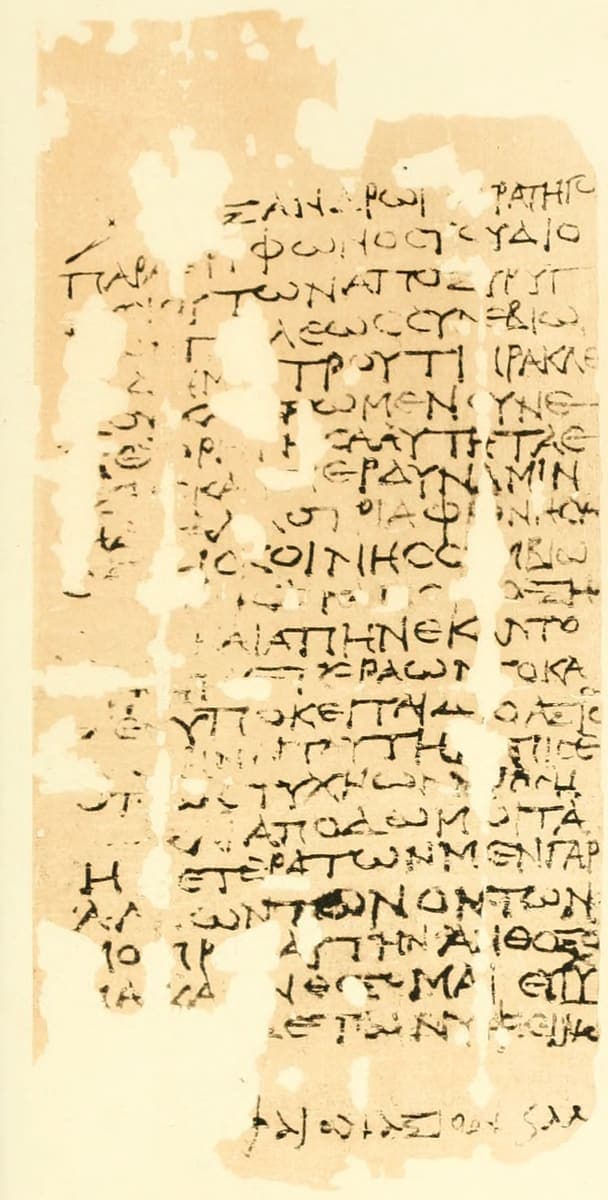
P.Oxy. II 282, c. 29–37 CE · Source · Public domain · Plate from B. P. Grenfell and A. S. Hunt, The Oxyrhynchus Papyri II (Egypt Exploration Fund, 1899), via Wikimedia Commons
Evidano Transcription
The whole of the surviving petition, lines 1–23 in the Duke Databank text; the list of stolen property announced in the last two lines is lost. Round brackets expand an abbreviation, square brackets enclose letters supplied where the papyrus is damaged, a dot below a letter marks an uncertain reading, and text between a backslash and a slash was written above the line by the scribe.
Ἀ[λε]ξάνδρωι στρατηγῷ
παρὰ Τρύφωνος τοῦ Διο-
νυσίου τῶν ἀπʼ Ὀξυρύγ-
[χ]ων π[ό]λεως. συνεβίω-
[σα] Δημ[η]τροῦτι Ἡρακλε\ί/-
δου, κα[ὶ ἐ]γὼ μὲν οὖν ἐ-
πεχορήγησα αὐτῇ τὰ ἑ-
ξῆς καὶ ὑπὲρ δύναμιν.
ἡ δὲ ἀλλότρια φρονήσα-
σα τῆς κοινῆς συμβιώ-
[σεως] κατὰ πέρ[α]ς ἐξῆ-
[λθε] καὶ ἀπηνέκαντο
τ̣ὰ̣ ἡμέτερα ὧν τὸ κα-
θʼ ἓν ὑπόκειται. διὸ ἀξι\ῶ/
ἀχ[θ]ῆναι ταύτην [ἐ]πὶ σὲ
ὅπως τύχῃ ὧν προσή-
[κει] καὶ ἀποδῷ μοι τὰ
ἡμέτερα. τῶν μὲν γὰρ
ἄλλων τῶν ὄντων
μο[ι] πρ[ὸς] αὐτὴν ἀνθόξο-
μα[ι] κα[ὶ ἀ]νθέ̣ξομαι. εὐτύχ(ει).
[ἔστι] δὲ τῶν ὑφιειρη(μένων)
[ ̣ ̣ ̣ ̣ ̣]φαιον ἄξιον (δραχμῶν) μ
Source: DDbDP transcription p.oxy.2.282, Duke Databank of Documentary Papyri, via Papyri.info (CC BY 3.0).
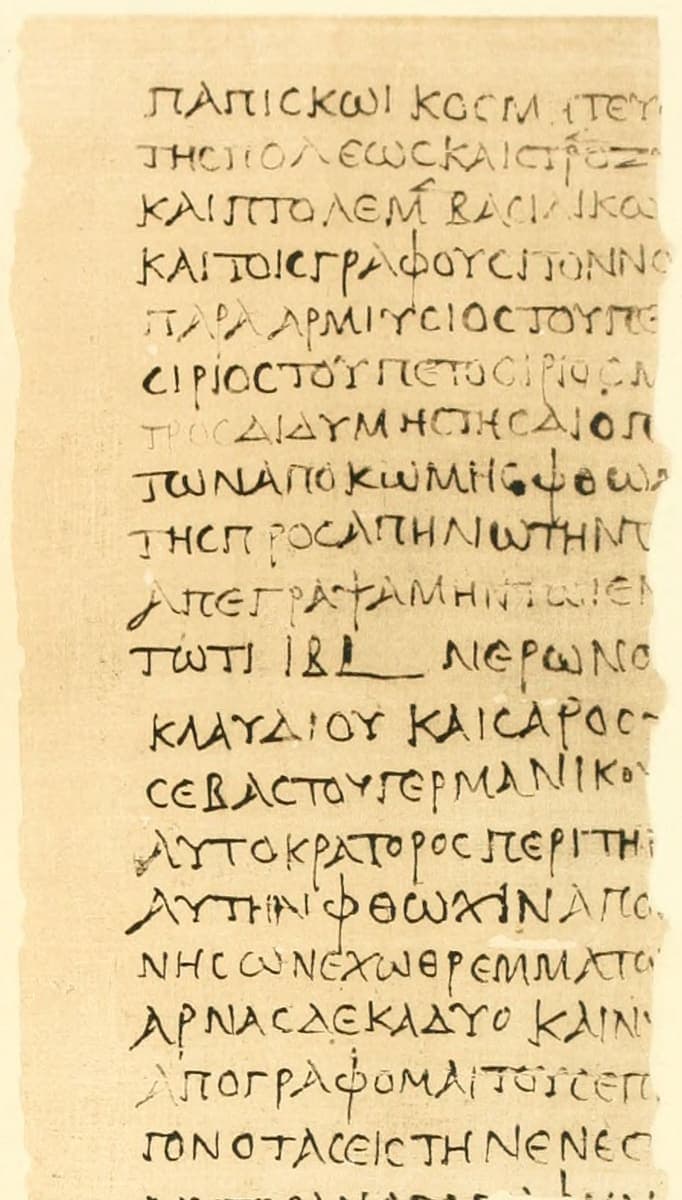
Cambridge University Library, Add. MS 4052 (P.Oxy. II 246), 24 July 66 CE · Source · Public domain · Plate from B. P. Grenfell and A. S. Hunt, The Oxyrhynchus Papyri II (Egypt Exploration Fund, 1899), via Wikimedia Commons
Evidano Transcription
Lines 1–19 of the declaration, the part shown in this crop; the oath, the farewell and the three subscriptions occupy lines 20–38 further down the sheet. Round brackets give the expansion of a suspended abbreviation, square brackets the letters lost at the broken right edge, and a dot below a letter marks a doubtful reading.
Παπίσκωι κοσμητεύσ̣[α(ντι)]
τῆς πόλεως καὶ στρα(τηγῷ) Ὀξυ[ρυγχ(ίτου)]
καὶ Πτολεμα(ίῳ) βασιλικῶ[ι γρα(μματεῖ)]
καὶ τοῖς γράφουσι τὸν νο[μὸν]
παρὰ Ἁρμιύσιος τοῦ Πε[το-]
σίριος τοῦ Πετοσίριος μ[η-]
τρὸς Διδύμης τῆς Διογέ[νους]
τῶν ἀπὸ κώμης Φθώχ[ιος]
τῆς πρὸς ἀπηλιώτην το̣[π(αρχίας)].
ἀπεγραψάμην τῶι ἐν[εσ-]
τῶτι ιβ (ἔτει) Νέρωνο[ς]
Κλαυδίου Καίσαρος
Σεβαστοῦ Γερμανικοῦ
Αὐτοκράτορος περὶ τὴν
αὐτὴν Φθῶχιν, ἀπὸ γ̣[ο-]
νῆς ὧν ἔχω θρεμμάτω[ν]
ἄρνας δέκα δύο , καὶ νῦ[ν]
ἀπογράφομαι τοὺς ἐπ[ιγε-]
γονότας εἰς τὴν ἐνεστ[ῶσαν]
Source: DDbDP transcription p.oxy.2.246, Duke Databank of Documentary Papyri, via Papyri.info (CC BY 3.0).
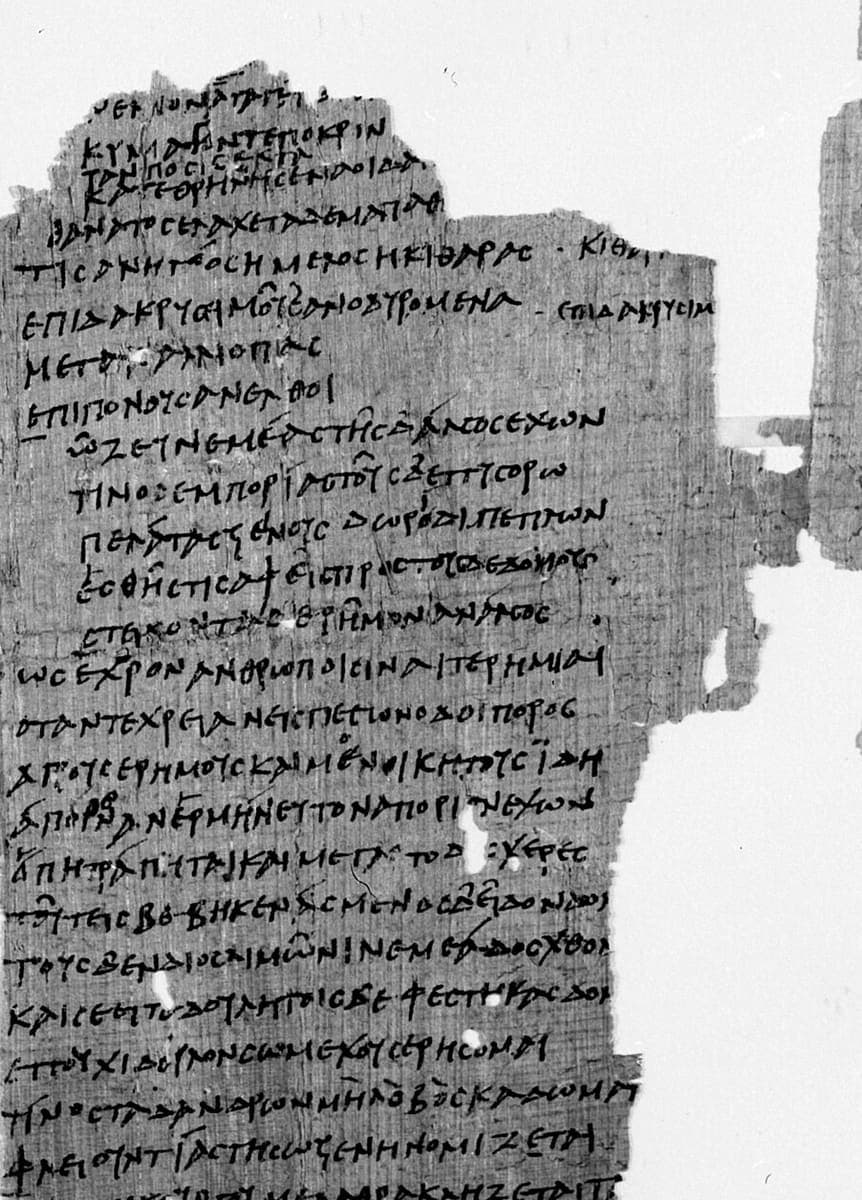
Bodleian Library, University of Oxford, MS. Gr. class. b. 13 (P), 2nd–3rd century CE · Source · Public domain · Imaging Papyri Project, University of Oxford, via Wikimedia Commons
Evidano Transcription
[illegible]
[illegible]
[illegible]
[illegible]
[illegible]
ΤΙΣΑΝΗΓΟΟΣΗΜΕΛΟΣΗΚΙΘΑΡΑΣ · ΚΙΘ[cut off]
ΕΠΙΔΑΚΡΥΣΙΜΟΥΣΑΝΟΔΥΡΟΜΕΝΑ · ΕΠΙΔΑΚΡΥΣΙΜ[cut off]
[illegible]
ΕΠΙΠΟΝΟΥΣ[illegible]
[illegible]
ΤΙΝΟΣΕΜΠΟΡΙΑ[illegible]
[illegible]
[illegible]
[illegible]
ΩΣΕΧΘΡΟΝΑΝΘΡΩΠΟΙΣΙΝΑΙΤΕΡΗΜΙΑΙ
ΟΤΑΝΤΕΧΡΕΙΑ[illegible]ΟΔΟΙΠΟΡΟΣ
ΑΓΡΟΥΣΕΡΗΜΟΥΣ[illegible]
[remaining lines illegible]
Generated by Evidano’s advanced model; not yet checked against a published edition.
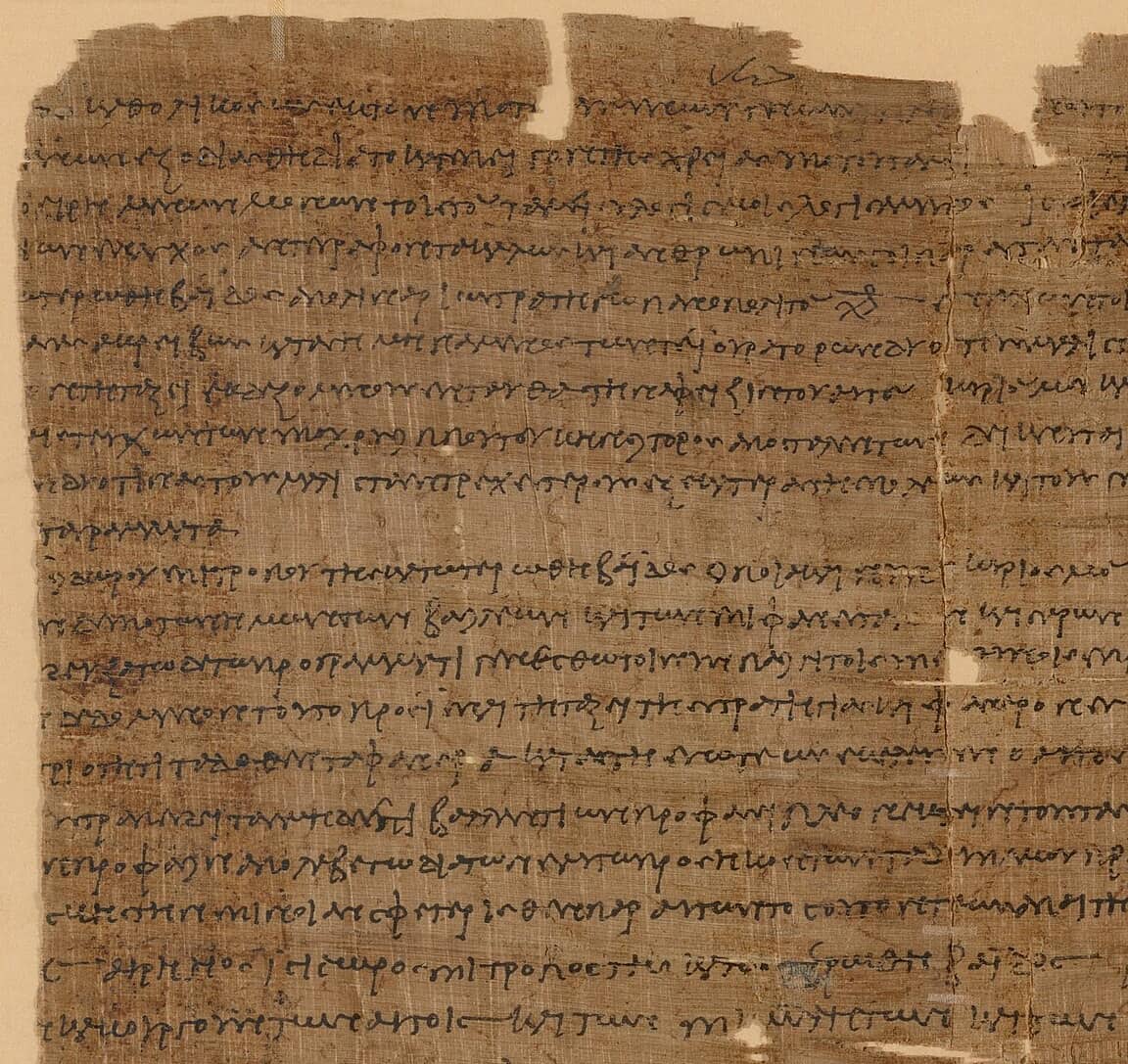
Chester Beatty Library, Dublin, Pap. Pan. II.4, 300 CE · Source · Public domain · Chester Beatty Library via Google Arts & Culture, on Wikimedia Commons
What survives on Greek papyrus, and how it is written
Almost all of this material comes from Egypt, where dry sand kept what the rest of the Mediterranean lost: rolls from the rubbish mounds of Oxyrhynchus, sheets stripped from mummy cartonnage in the Fayum, village archives, tax rolls, contracts, private letters, school exercises and copies of Homer and Euripides. Two families of hand cover most of it. Book hands are written slowly, the letters separate and held between two notional lines, from the round majuscule to the sloping “severe style”; documentary hands run from the deliberate script of a chancery clerk to a cursive that carries a whole word without lifting the pen. Ptolemaic cursive is narrow and angular, Roman documentary writing rounder and more heavily joined, and by c. 300 CE the hands of the offices are large, looped and full of exaggerated finials.
The text runs on without gaps between words and, in documents, with almost no punctuation. Lunate sigma (ϲ) is normal beside the four-bar form, alpha may be a loop or a triangle depending on speed, and epsilon, theta and omicron shrink to small circles that fill with ink. Lectional signs are sparse: a diaeresis over an initial iota or upsilon, an apostrophe at elision, breathings and accents only in some literary copies. Structure is marked rather than spaced, by a paragraphos under the start of a line, a coronis at the end of a piece and stichometric letters counting lines for the copyist’s pay. Documents abbreviate by suspension, writing the first letters and raising the last, so that στρα( ) stands for στρατηγῷ, with symbols for ἔτους, δραχμαί and ἀρτάβη and quantities in letter numerals under a stroke.
A document also has a shape. A petition opens with the addressee in the dative and the petitioner after παρά, ends with a date by regnal year and Egyptian month, and carries subscriptions added below it by officials in their own faster hands, while the back takes a one-line endorsement so that the roll could be found again. The material intervenes as well: sheets are pasted into a roll at overlapping joins, ink flakes, insects eat through several layers at once, and an older text often lies on the back, sometimes upside down.
Why ordinary OCR struggles here
Letters that change with the speed of the pen
In a cursive documentary hand the same scribe writes alpha three ways within a line, joins epsilon and iota into a single wave, and reduces omicron, theta and sigma to dots. Engines trained on printed Greek match these against modern type and return plausible but wrong words, above all in the personal and village names that no dictionary can correct.
Suspensions, symbols and letter numerals
A tax receipt is mostly abbreviation: a raised letter, a curl through a descender, the symbol for an artaba, a numeral written as a letter under a stroke. Generic recognition drops these marks or turns them into punctuation, which destroys the figures. A usable text keeps the abbreviated form and reports a numeral both as written and as a value.
Holes, offsets and fibre that looks like ink
Papyrus damage is never a clean rectangle. Fibres lift, worm tracks cut across letters, a dark vertical fibre reads as an iota, and ink transferred from the opposite layer leaves mirrored ghosts. The model has to tell a lost stretch from an abraded one, mark doubtful letters instead of smoothing them, and leave the ghosts out.
Several hands, insertions and the verso
Official documents accumulate: a clerk writes the body, another signs below it, a third adds a date, a word goes in above the line and another is struck out, and the endorsement on the back runs at right angles to the rest. One undifferentiated block loses the difference between the petition and the order written on it.
Who works with this material
Papyrologists preparing editions
An editor working towards a publication or a Duke Databank record starts from a diplomatic reading with dots, brackets and changes of hand in place. What saves time is a first pass that never normalises a spelling silently and never invents a letter the fibres do not carry.
Historians of taxation, land and the household
Land surveys, tax rolls and census returns are the evidence for how Egypt was governed and farmed. Historians need names, villages, dates and quantities pulled out as fields, each numeral beside its value, so that thousands of entries can be compared rather than read one by one.
Collections and cataloguing projects
University and museum collections hold boxes of unpublished fragments with nothing but an inventory number. An honest transcription of even six broken lines lets a curator identify the genre, recognise a formula or a literary text, and decide what deserves conservation and full publication.
Classicists working on literary papyri
New fragments of drama, lyric and lost prose are read against the indirect tradition. That work needs the lectional signs, the paragraphoi, the corrections between the lines and the marginal notes recorded, because they show how the text was read in antiquity.
Getting the best transcription
Say what kind of papyrus it is
Open with the genre, the approximate date and the provenance: a Ptolemaic petition from the Fayum, a Roman tax receipt, a literary roll. Ask for a diplomatic reading of the Greek as written, and say whether you also want a normalised version below it.
Set the rules for abbreviations and figures
Ask for suspended forms to be kept with the expansion in brackets, for symbols to be named rather than dropped, and for letter numerals to be given as written with their value beside them. In an account, ask for one entry per line with the sum in its own field.
Fix the geometry before the reading
Say how many columns there are and in what order to read them, ask for one papyrus line per output line, and ask for a flag at every change of hand, insertion above the line and deletion. Submit the back as a separate image and say which way up it runs.
Test on the best-preserved column first
Run a column whose formulae are predictable, such as the address and date clause of a petition, and check the names and figures against the neighbouring lines. If the model marks the damaged patches instead of filling them, the broken columns are worth attempting.
Further reading on this hand
The palaeography guides the in-app selector points to for this domain, if you want to check a transcription against the standard references.
- Leiden+ Documentation
This documentation explains the Leiden+ notation used by Papyri.info for editions of Greek, Latin, Coptic, and related documentary texts. It covers lineation, gaps, uncertain readings, corrections, additions, abbreviations, symbols, numerals, and editorial apparatus in papyrological records. The system is designed for texts whose physical fibers, fragmentary edges, and layered interventions materially affect transcription. It is useful for Greek papyri because it provides a precise vocabulary for representing documentary phenomena alongside the read letterforms.
Frequently asked questions
- Does it cope with rapid documentary cursive as well as book hands?
- Both work, with different instructions. For a book hand it helps to say that the letters stand apart and are roughly bilinear; for a cursive it helps to name the period and the office, since a Ptolemaic village scribe and a fourth-century clerk form their ligatures quite differently.
- How are abbreviations and symbols represented?
- The abbreviated form is kept and its expansion follows in round brackets, as papyrological editions do, so that στρα( ) is not quietly turned into στρατηγῷ. Symbols for years, drachmas and measures are transcribed as symbols and described in a note rather than converted into letters.
- Can it tell a lacuna from an abraded surface?
- It can be asked to separate the two: a hole or a lost edge is bracketed, with an estimate of the missing letters where the line length supports one, while a rubbed surface that still carries traces is reported as dotted letters.
- What about the second hands and the endorsement on the back?
- Subscriptions, signatures and added dates are marked as separate hands, in the order they stand on the sheet. The endorsement on the back is best submitted as its own image with a note on its orientation, because it usually runs against the direction of the main text.
- Can it be used on carbonised or multispectral images?
- Yes, on processed images rather than raw ones. Infrared photographs of darkened papyri and of carbonised Herculaneum rolls work best when the contrast has been adjusted, and the prompt should say that the image is infrared or false-colour so that shadows are not read as ink.
Related scripts and pages
Transcribe your Greek papyri
Upload a column or a whole sheet, choose Hellenistic and Roman Greek Papyri as the domain, and check one well-preserved document before you queue an archive.