
Arabic · c. 700–1000
Separate the rasm from everything added to it later
On an early Qurʾan folio the black consonantal skeleton, the red vowel dots and the gold verse markers were often put there by three people a century or more apart. A transcription is only useful if it says which layer each mark belongs to, and if it can follow a word stretched halfway across the line to fill it.
Sample pages
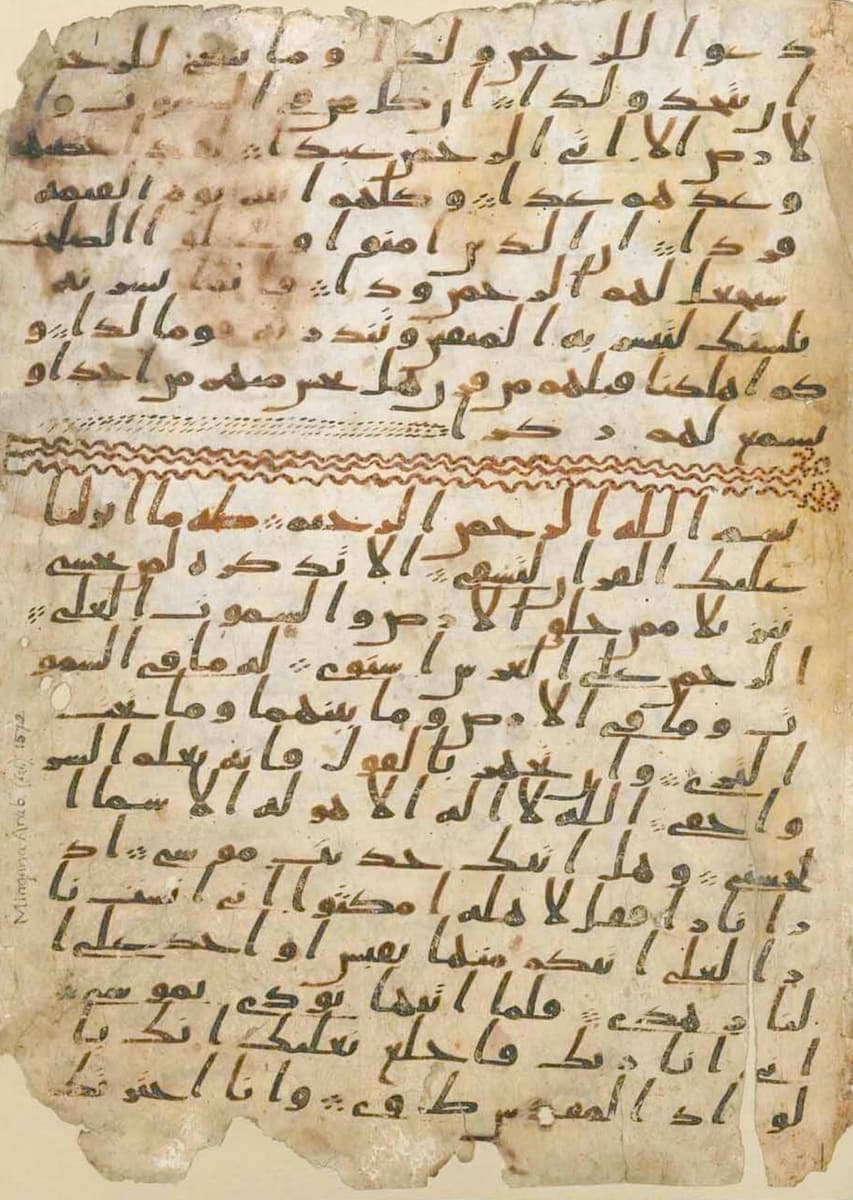
University of Birmingham, Cadbury Research Library, Mingana Islamic Arabic 1572a, f. 2r, parchment dated 568–645 · Source · Public domain
Evidano Transcription
The eight lines above the ornamental band: sūrat Maryam 19:91–98, the passage the University of Birmingham’s catalogue records for this leaf. Printed here in the modern imlāʾī spelling of the Ḥafṣ text, fully vowelled and fully pointed, none of which the folio itself has; the opening of sūrat Ṭā Hā below the band is not included.
أَنْ دَعَوْا لِلرَّحْمَنِ وَلَدًا
وَمَا يَنْبَغِي لِلرَّحْمَنِ أَنْ يَتَّخِذَ وَلَدًا
إِنْ كُلُّ مَنْ فِي السَّمَاوَاتِ وَالْأَرْضِ إِلَّا آتِي الرَّحْمَنِ عَبْدًا
لَقَدْ أَحْصَاهُمْ وَعَدَّهُمْ عَدًّا
وَكُلُّهُمْ آتِيهِ يَوْمَ الْقِيَامَةِ فَرْدًا
إِنَّ الَّذِينَ آمَنُوا وَعَمِلُوا الصَّالِحَاتِ سَيَجْعَلُ لَهُمُ الرَّحْمَنُ وُدًّا
فَإِنَّمَا يَسَّرْنَاهُ بِلِسَانِكَ لِتُبَشِّرَ بِهِ الْمُتَّقِينَ وَتُنْذِرَ بِهِ قَوْمًا لُدًّا
وَكَمْ أَهْلَكْنَا قَبْلَهُمْ مِنْ قَرْنٍ هَلْ تُحِسُّ مِنْهُمْ مِنْ أَحَدٍ أَوْ تَسْمَعُ لَهُمْ رِكْزًا
Source: القرآن الكريم (بالرسم الإملائي)/سورة مريم, Arabic Wikisource (Public domain).
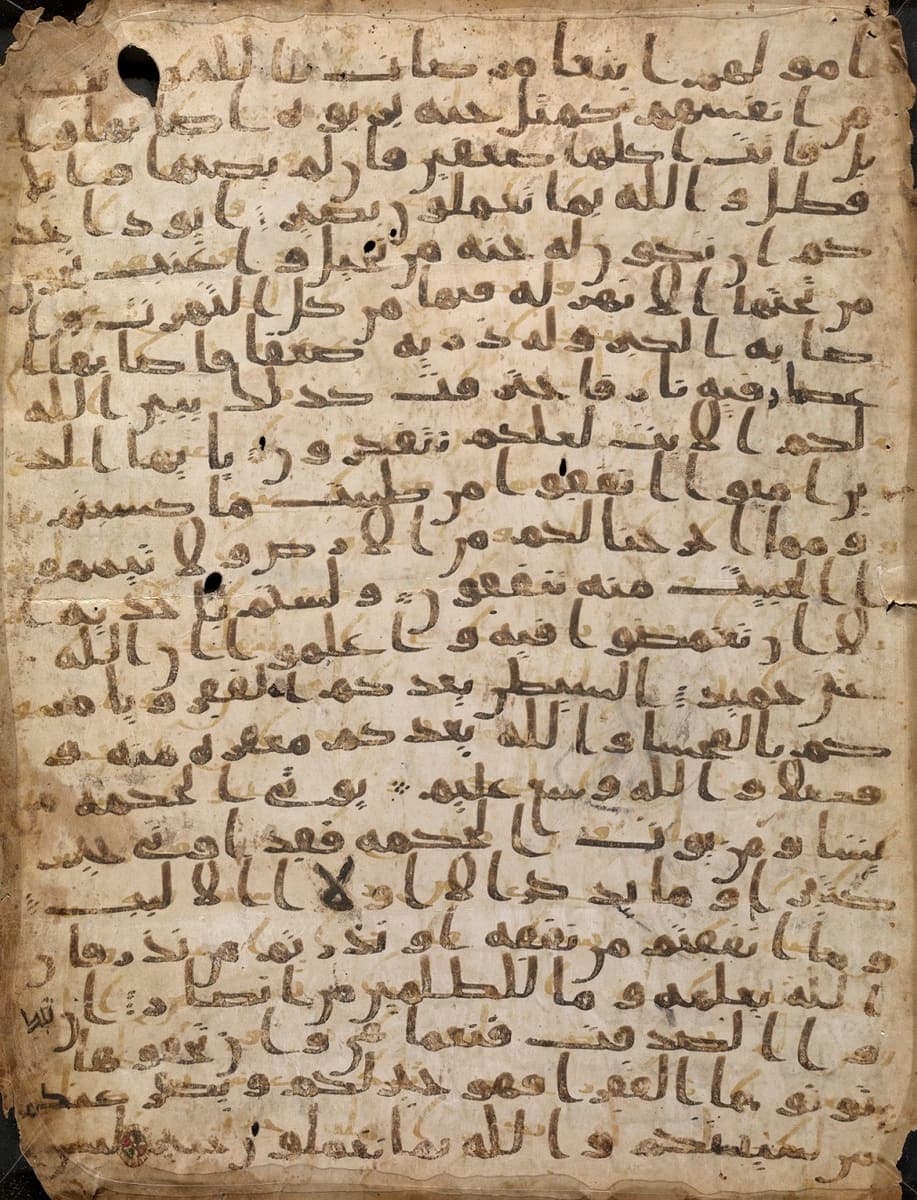
Private collection (formerly Dār al-Makhṭūṭāt, Sanaa), Stanford ’07 folio, recto, parchment dated before 671 · Source · Public domain
Evidano Transcription
The upper text of the recto only: sūrat al-Baqara 2:265–271, the range recorded for this folio in the published study of the palimpsest. The erased lower text, which covers 2:191–196 and differs from the standard wording in several places, is not included. Given in modern imlāʾī spelling with the vowels the folio does not carry.
وَمَثَلُ الَّذِينَ يُنْفِقُونَ أَمْوَالَهُمُ ابْتِغَاءَ مَرْضَاتِ اللَّهِ وَتَثْبِيتًا مِنْ أَنْفُسِهِمْ كَمَثَلِ جَنَّةٍ بِرَبْوَةٍ أَصَابَهَا وَابِلٌ فَآتَتْ أُكُلَهَا ضِعْفَيْنِ فَإِنْ لَمْ يُصِبْهَا وَابِلٌ فَطَلٌّ وَاللَّهُ بِمَا تَعْمَلُونَ بَصِيرٌ
أَيَوَدُّ أَحَدُكُمْ أَنْ تَكُونَ لَهُ جَنَّةٌ مِنْ نَخِيلٍ وَأَعْنَابٍ تَجْرِي مِنْ تَحْتِهَا الْأَنْهَارُ لَهُ فِيهَا مِنْ كُلِّ الثَّمَرَاتِ وَأَصَابَهُ الْكِبَرُ وَلَهُ ذُرِّيَّةٌ ضُعَفَاءُ فَأَصَابَهَا إِعْصَارٌ فِيهِ نَارٌ فَاحْتَرَقَتْ كَذَلِكَ يُبَيِّنُ اللَّهُ لَكُمُ الْآيَاتِ لَعَلَّكُمْ تَتَفَكَّرُونَ
يَا أَيُّهَا الَّذِينَ آمَنُوا أَنْفِقُوا مِنْ طَيِّبَاتِ مَا كَسَبْتُمْ وَمِمَّا أَخْرَجْنَا لَكُمْ مِنَ الْأَرْضِ وَلَا تَيَمَّمُوا الْخَبِيثَ مِنْهُ تُنْفِقُونَ وَلَسْتُمْ بِآخِذِيهِ إِلَّا أَنْ تُغْمِضُوا فِيهِ وَاعْلَمُوا أَنَّ اللَّهَ غَنِيٌّ حَمِيدٌ
الشَّيْطَانُ يَعِدُكُمُ الْفَقْرَ وَيَأْمُرُكُمْ بِالْفَحْشَاءِ وَاللَّهُ يَعِدُكُمْ مَغْفِرَةً مِنْهُ وَفَضْلًا وَاللَّهُ وَاسِعٌ عَلِيمٌ
يُؤْتِي الْحِكْمَةَ مَنْ يَشَاءُ وَمَنْ يُؤْتَ الْحِكْمَةَ فَقَدْ أُوتِيَ خَيْرًا كَثِيرًا وَمَا يَذَّكَّرُ إِلَّا أُولُو الْأَلْبَابِ
وَمَا أَنْفَقْتُمْ مِنْ نَفَقَةٍ أَوْ نَذَرْتُمْ مِنْ نَذْرٍ فَإِنَّ اللَّهَ يَعْلَمُهُ وَمَا لِلظَّالِمِينَ مِنْ أَنْصَارٍ
إِنْ تُبْدُوا الصَّدَقَاتِ فَنِعِمَّا هِيَ وَإِنْ تُخْفُوهَا وَتُؤْتُوهَا الْفُقَرَاءَ فَهُوَ خَيْرٌ لَكُمْ وَيُكَفِّرُ عَنْكُمْ مِنْ سَيِّئَاتِكُمْ وَاللَّهُ بِمَا تَعْمَلُونَ خَبِيرٌ
Source: القرآن الكريم (بالرسم الإملائي)/سورة البقرة, Arabic Wikisource (Public domain).
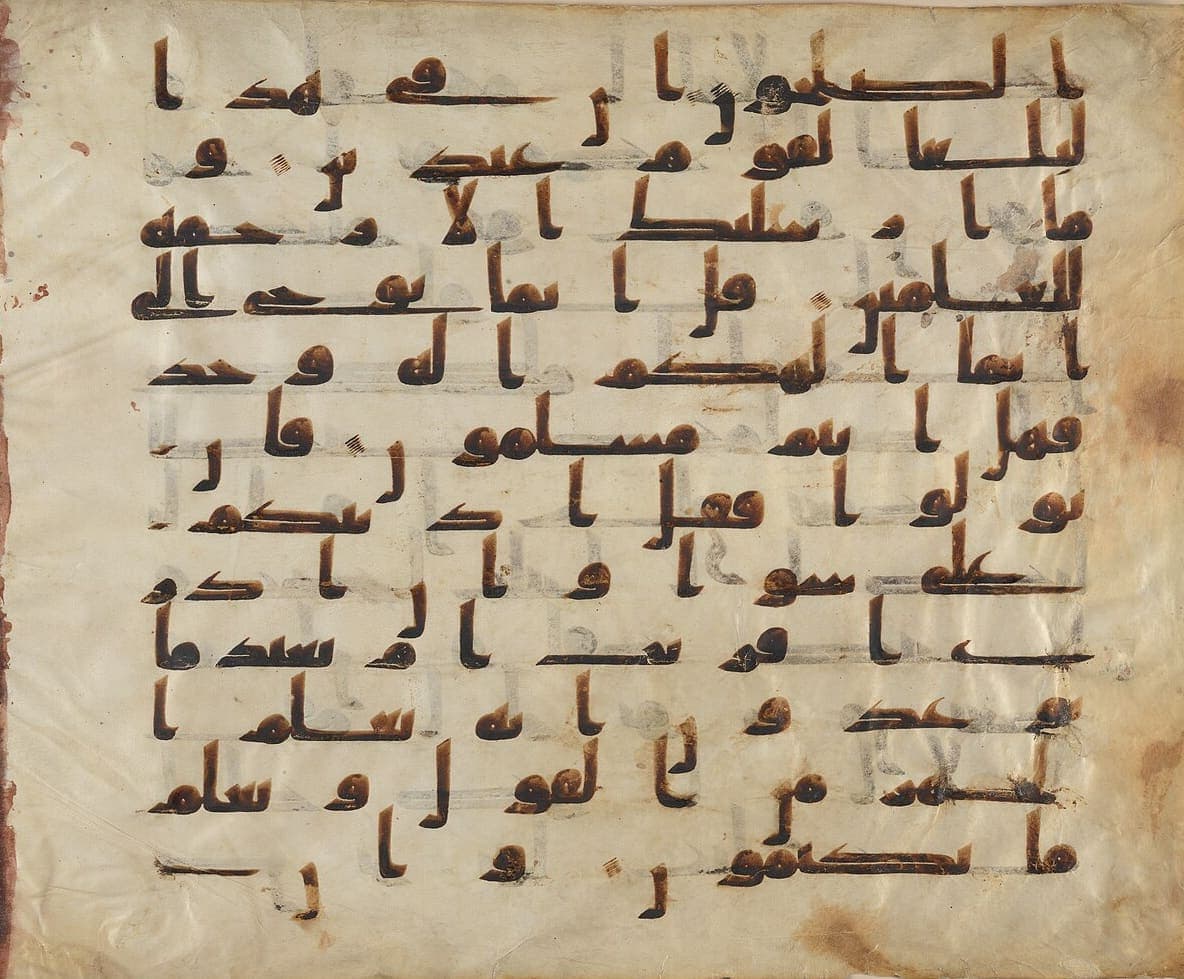
Metropolitan Museum of Art, 2004.87, late 8th–early 9th century · Source · CC0 1.0
Evidano Transcription
الصلحون ان في هذا
لبلغا لقوم عبدين و
ما ارسلنك الا رحمه
للعلمين قل انما يوحى الى
انما الهكم اله وحد
فهل انتم مسلمون فان
تولوا فقل اذنتكم
على سوا وان ادرى اقر[?]
يب ام بعيد ما
توعدون انه يعلم ا
لجهر من القول ويعلم
ما تكتمون وان ادر
[illegible]
Generated by Evidano’s advanced model; not yet checked against a published edition.
Cleveland Museum of Art, 1933.493.b, 9th century · Source · CC0 1.0
Evidano Transcription
All seven lines of the verso: Surat Sad 38:77 to the first letters of 38:80, in the standard Cairo text spelling (hamzas and the final ya written, which the bare rasm lacks); the word الدين is split across lines 4-5 as on the page, and the last word breaks off overleaf.
قال فاخرج منها
فإنك رجيم ﴿٧٧﴾
وإن عليك لعنتي
إلى يوم الد
ين ﴿٧٨﴾ قال رب
فأنظرني إلى
يوم يبعثون ﴿٧٩﴾ قال فـ[ـإنك …]
Source: Tanzil Quran Text (Simple Clean), Surat Sad 38:77-80 (Tanzil Quran text: verbatim copying and distribution permitted with attribution (CC BY 3.0 per Tanzil terms)).
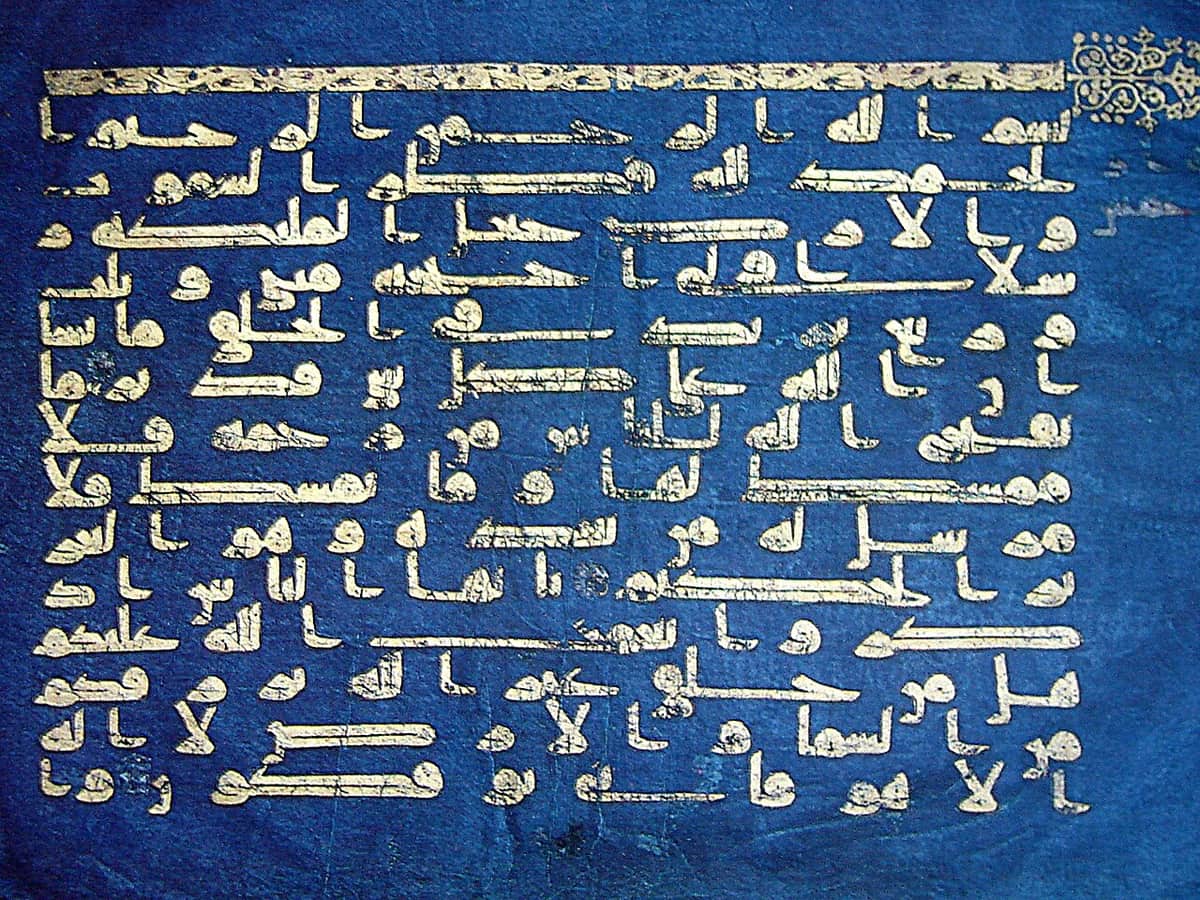
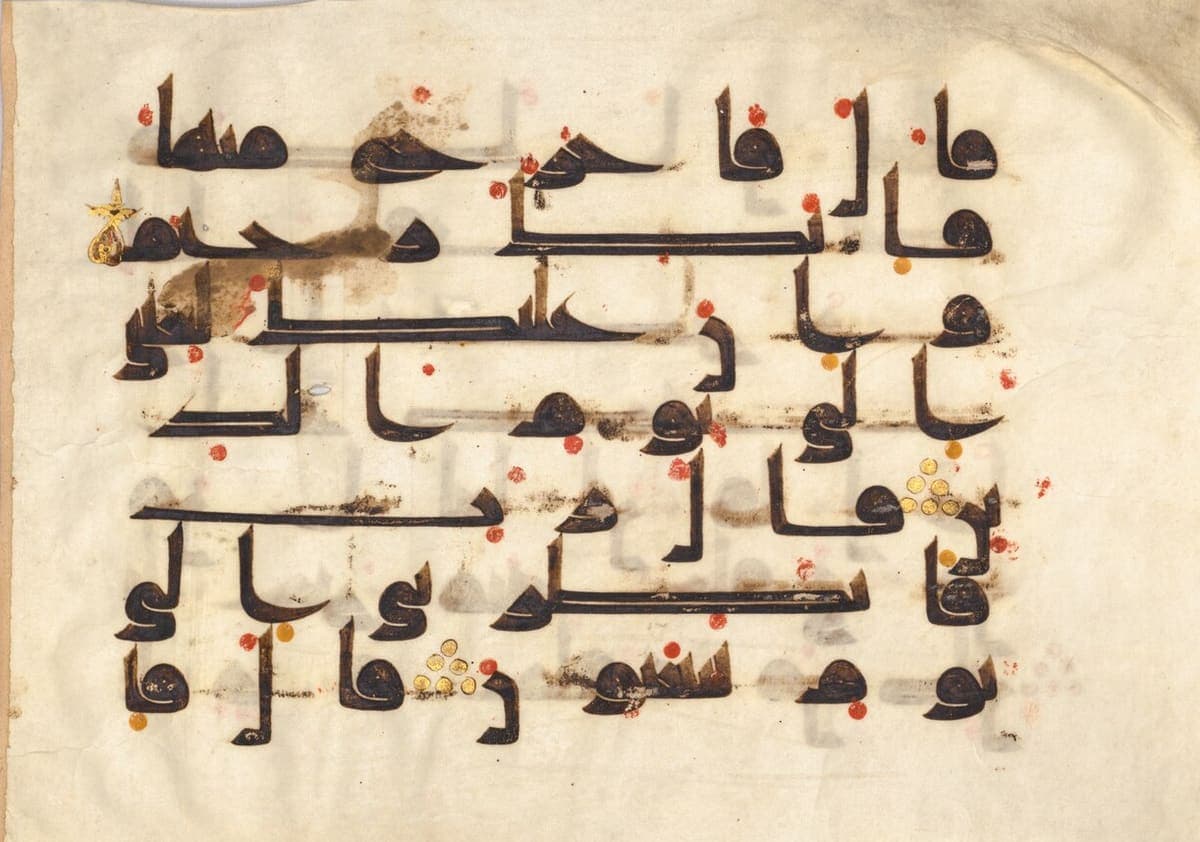
National Museum of Islamic Art, Raqqada, Rutbi 196, 10th century · Source · Public domain
Evidano Transcription
The whole text block below the ornamental heading: the opening three verses of sūrat Fāṭir (35:1–3), the passage recorded for this folio on the source file page. The basmala that opens the sura is included; the modern imlāʾī spelling supplies the vowels and the pointing, which the gold Kufic does not have.
بِسْمِ اللَّهِ الرَّحْمَنِ الرَّحِيمِ
الْحَمْدُ لِلَّهِ فَاطِرِ السَّمَاوَاتِ وَالْأَرْضِ جَاعِلِ الْمَلَائِكَةِ رُسُلًا أُولِي أَجْنِحَةٍ مَثْنَى وَثُلَاثَ وَرُبَاعَ يَزِيدُ فِي الْخَلْقِ مَا يَشَاءُ إِنَّ اللَّهَ عَلَى كُلِّ شَيْءٍ قَدِيرٌ
مَا يَفْتَحِ اللَّهُ لِلنَّاسِ مِنْ رَحْمَةٍ فَلَا مُمْسِكَ لَهَا وَمَا يُمْسِكْ فَلَا مُرْسِلَ لَهُ مِنْ بَعْدِهِ وَهُوَ الْعَزِيزُ الْحَكِيمُ
يَا أَيُّهَا النَّاسُ اذْكُرُوا نِعْمَتَ اللَّهِ عَلَيْكُمْ هَلْ مِنْ خَالِقٍ غَيْرُ اللَّهِ يَرْزُقُكُمْ مِنَ السَّمَاءِ وَالْأَرْضِ لَا إِلَهَ إِلَّا هُوَ فَأَنَّى تُؤْفَكُونَ
Source: القرآن الكريم (بالرسم الإملائي)/سورة فاطر, Arabic Wikisource (Public domain).
What an early Qurʾan folio looks like
The oldest Qurʾan codices, from the second half of the seventh century, are written in the sloping, irregular hands grouped as ḥijāzī: tall alifs leaning to the right, letters of uneven size, a page filled edge to edge with no ruling. During the eighth century these give way to the family of angular, deliberately proportioned hands conventionally called Kufic, in which a few large words fill a broad landscape page, sometimes only three to seven lines of it. Letters sit on a heavy baseline, verticals are short and blunt, and horizontal strokes are lengthened at will, so a single word can be pulled across half the width of the page to make the line come out even. There is no word division to speak of, and a word will simply continue on the next line where the sheet runs out.
What the pen wrote first is the rasm, the consonantal skeleton, and in the earliest codices it is nearly all there is. Consonantal pointing, when present, takes the form of small oblique dashes rather than the round dots of print. Vowels came later and in another colour: from about the eighth century a system of red dots placed above, beside or below a letter marks a, i or u, with a green or yellow dot for hamza in some traditions, and these were regularly added to a codex generations after it was copied. Verse ends are marked by clusters of small strokes, rosettes or teardrops; every fifth and tenth verse may get a larger gold medallion or a letter used as a numeral. Sura headings are written in a display hand inside an ornamental band, often with the verse count.
The orthography is not modern orthography. Long ā is frequently not written, so what a printed Qurʾan spells with an alif appears on the parchment without one; hamza is absent as a sign; and the pointing that a modern reader relies on to distinguish يقولون from تقولون may simply not be there. Some manuscripts are palimpsests: the parchment was scraped and rewritten, and the erased text shows through as a brown ghost between the lines of the new one. Others carry corrections, later collation marks, or a reader’s note in the margin in a hand three hundred years younger than the page.
Why ordinary OCR struggles here
Three layers of ink, three different dates
Black rasm, red or yellow vocalisation and gold verse markers were often applied by different hands at different times. Software that reads a page as one flat image merges them, and the resulting text silently claims that a seventh-century scribe wrote vowels he never wrote. Colour has to be part of what is recorded.
Words stretched to justify the line
A calligrapher lengthens a connecting stroke, called mashq, until the line reaches the margin. The same word therefore has a different width on every page, and a segmentation model trained on even spacing treats one stretched word as two. Words also break across lines without any mark, so the last letters of a line and the first of the next belong together.
Spelling that predates the standard text
A folio may write the same word without its silent alif, or run two words together, or omit the pointing that would settle a verb’s person. Matching such a page against a printed Qurʾan is not string matching: the transcription has to record what is on the parchment and leave the comparison with the standard text as a separate step.
Under-text, damage and gold
On a palimpsest an erased earlier copy shows through the new writing; on a gilded folio the metal reflects the light and drops out of a photograph; and parchment cockles, holes and stains break letters in half. Each of these produces marks that look like script and script that looks like a mark.
Who works with this material
Qurʾanic manuscript studies
Projects collating early codices against the standard text need the rasm exactly as written, with the added diacritical layers separated out. A first pass that gets the skeleton right and flags every uncertain point turns a box of unplaced folios into a set of located passages.
Curators and auction cataloguers
A detached leaf is worth describing properly only once its passage is known. Reading three lines is usually enough to place a folio in a sura, and from there its parent codex can sometimes be identified from the line count, the page proportions and the style of the verse markers.
Conservators and imaging teams
People working with multispectral images of palimpsests and gilded pages need a way to check whether a processing pass has actually made the under-text more readable. Transcribing the same folio before and after gives a concrete answer rather than an impression.
Students learning to read early scripts
Kufic looks impenetrable until someone points out that the same letter is drawn five different widths on the same page. Reading a transcription against the folio, with the stretched words marked, is how that habit is learned.
Getting the best transcription
Ask for the rasm first
Request the consonantal skeleton alone, then a second version with the vocalisation the manuscript actually carries, then, if you want it, the modern standard text. Three separate outputs are far easier to check against the page than one blended reading.
Record the colours
Tell the model to note whether a mark is black, red, yellow, green or gold, and where it sits relative to the letter. That is what distinguishes an original consonantal dash from a vowel dot added a century later, and it is the information an editor most often has to reconstruct by hand.
Give it the line count, not the word count
Transcribe line by line as the folio is ruled, and say that words may break across lines without a mark. Ask for the verse dividers, rosettes and marginal medallions to be recorded in place, since they are what let a folio be matched to a parent codex.
Test on a leaf whose passage you know
Start with a folio you can already locate in the text. Comparing the output with the printed Qurʾan shows immediately whether the model is reading the parchment or quietly reciting a remembered verse, which is the failure that matters most here.
Further reading on this hand
The palaeography guides the in-app selector points to for this domain, if you want to check a transcription against the standard references.
- Arabic Paleography
This Hill Museum & Manuscript Library (HMML) course introduces Arabic manuscript scripts through dated examples and guided reading exercises. It begins with early materials and demonstrates how letter skeletons, consonantal points, vowel signs, ligatures, and positional forms change across time. The course also draws attention to layout, decoration, punctuation-like signs, and differences between formal and informal writing. Its early-script instruction supports analysis of Qurʾanic codices in which rasm and later diacritical layers must be distinguished.
Frequently asked questions
- Will it invent the vowels a printed Qurʾan has?
- That is the risk with any model that knows the text well, which is why the transcription is asked for as rasm plus a separate record of the marks actually present. Where the two disagree, the disagreement is visible instead of being smoothed away.
- Can it read a word that has been stretched across half a line?
- Yes, provided the prompt says the manuscript uses mashq. The connecting stroke carries no meaning, so an elongated word is transcribed as the word it is, with the stretching noted only if you want the line layout preserved.
- What about a palimpsest, where an older text shows through?
- The upper text can be transcribed on its own and the visible traces of the lower text flagged as such. Recovering the under-text properly needs multispectral imaging; what a transcription can do is mark where it interferes with the upper reading.
- Are verse markers and sura headings kept?
- They are recorded in place: clustered strokes, rosettes, gold medallions and the ornamented band with its verse count. For a detached leaf these are often the most diagnostic features on the page, so they should not be discarded as decoration.
- Does the old orthography cause problems?
- It is handled as a feature rather than an error. A missing silent alif or an unexpected spelling is transcribed as written, and the comparison against the modern standard text is made afterwards, so that genuine variants are not corrected out of existence.
Related scripts and pages
Transcribe your early Qurʾan folios
Upload a folio, choose Early Qurʾanic and Kufic Codices, and ask for the rasm and the added marks as separate layers.