
Arabic · c. 1000–1800
Read the western hand on its own terms
In the Maghrib and al-Andalus a single dot under a letter means fāʾ and a single dot above it means qāf, the exact opposite of what a model trained on eastern Arabic expects. Add descenders that swing under the following word, vowels in three colours and a margin packed with glosses, and an ordinary recogniser produces confident nonsense.
Sample pages
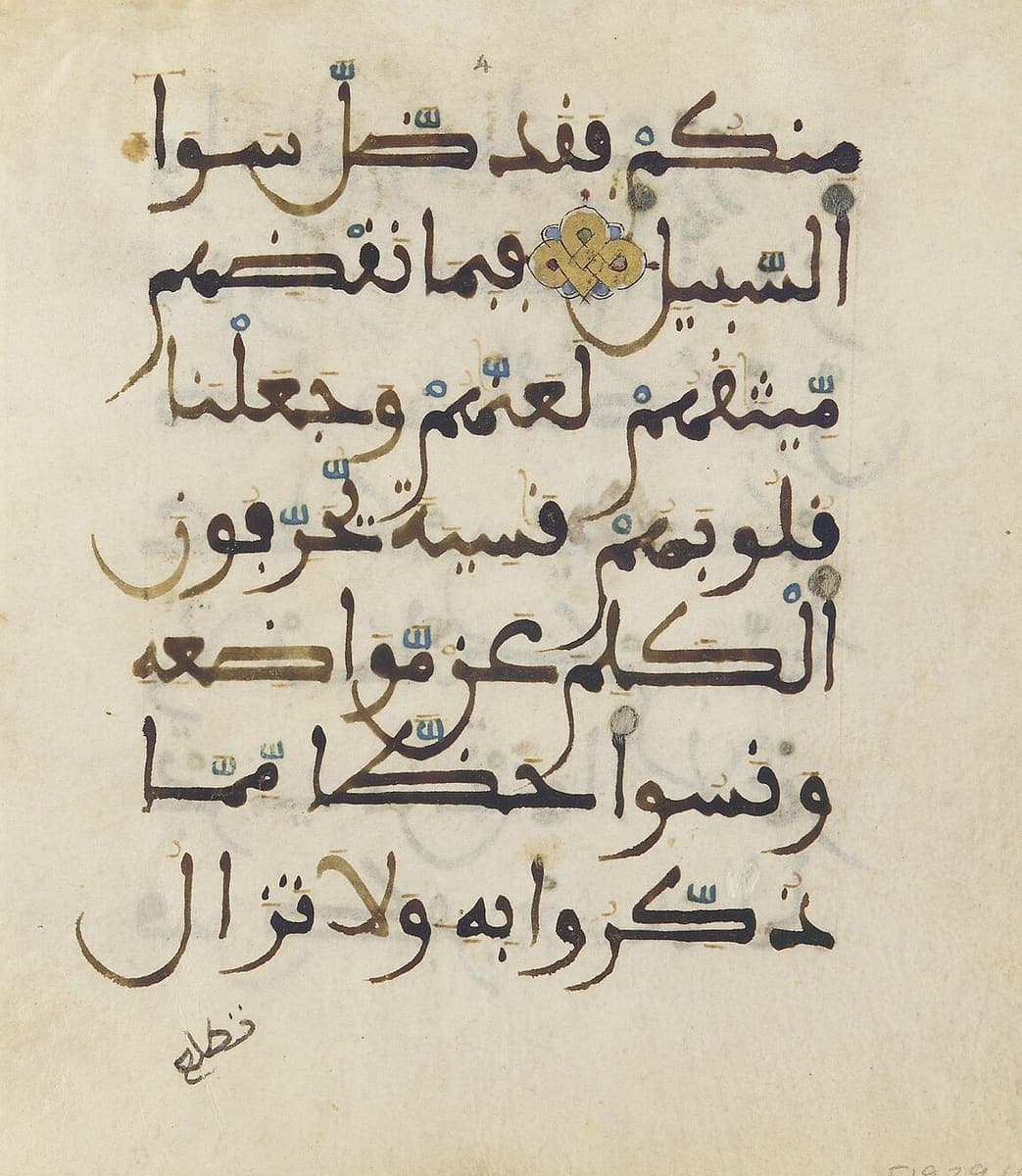
Freer Gallery of Art, Smithsonian Institution, F1929.69, 13th century · Source · Public domain
Evidano Transcription
The seven lines shown, identified as sūrat al-Māʾida 5:12–13 in the museum’s record. The page begins in the middle of 5:12, at minkum fa-qad ḍalla sawāʾa al-sabīl, and breaks off in the middle of 5:13, at wa-lā tazālu; the two verses are printed here in full in the modern imlāʾī spelling of the Ḥafṣ text, while the manuscript follows the western tradition.
وَلَقَدْ أَخَذَ اللَّهُ مِيثَاقَ بَنِي إِسْرَائِيلَ وَبَعَثْنَا مِنْهُمُ اثْنَيْ عَشَرَ نَقِيبًا وَقَالَ اللَّهُ إِنِّي مَعَكُمْ لَئِنْ أَقَمْتُمُ الصَّلَاةَ وَآتَيْتُمُ الزَّكَاةَ وَآمَنْتُمْ بِرُسُلِي وَعَزَّرْتُمُوهُمْ وَأَقْرَضْتُمُ اللَّهَ قَرْضًا حَسَنًا لَأُكَفِّرَنَّ عَنْكُمْ سَيِّئَاتِكُمْ وَلَأُدْخِلَنَّكُمْ جَنَّاتٍ تَجْرِي مِنْ تَحْتِهَا الْأَنْهَارُ فَمَنْ كَفَرَ بَعْدَ ذَلِكَ مِنْكُمْ فَقَدْ ضَلَّ سَوَاءَ السَّبِيلِ
فَبِمَا نَقْضِهِمْ مِيثَاقَهُمْ لَعَنَّاهُمْ وَجَعَلْنَا قُلُوبَهُمْ قَاسِيَةً يُحَرِّفُونَ الْكَلِمَ عَنْ مَوَاضِعِهِ وَنَسُوا حَظًّا مِمَّا ذُكِّرُوا بِهِ وَلَا تَزَالُ تَطَّلِعُ عَلَى خَائِنَةٍ مِنْهُمْ إِلَّا قَلِيلًا مِنْهُمْ فَاعْفُ عَنْهُمْ وَاصْفَحْ إِنَّ اللَّهَ يُحِبُّ الْمُحْسِنِينَ
Source: القرآن الكريم (بالرسم الإملائي)/سورة المائدة, Arabic Wikisource (Public domain).
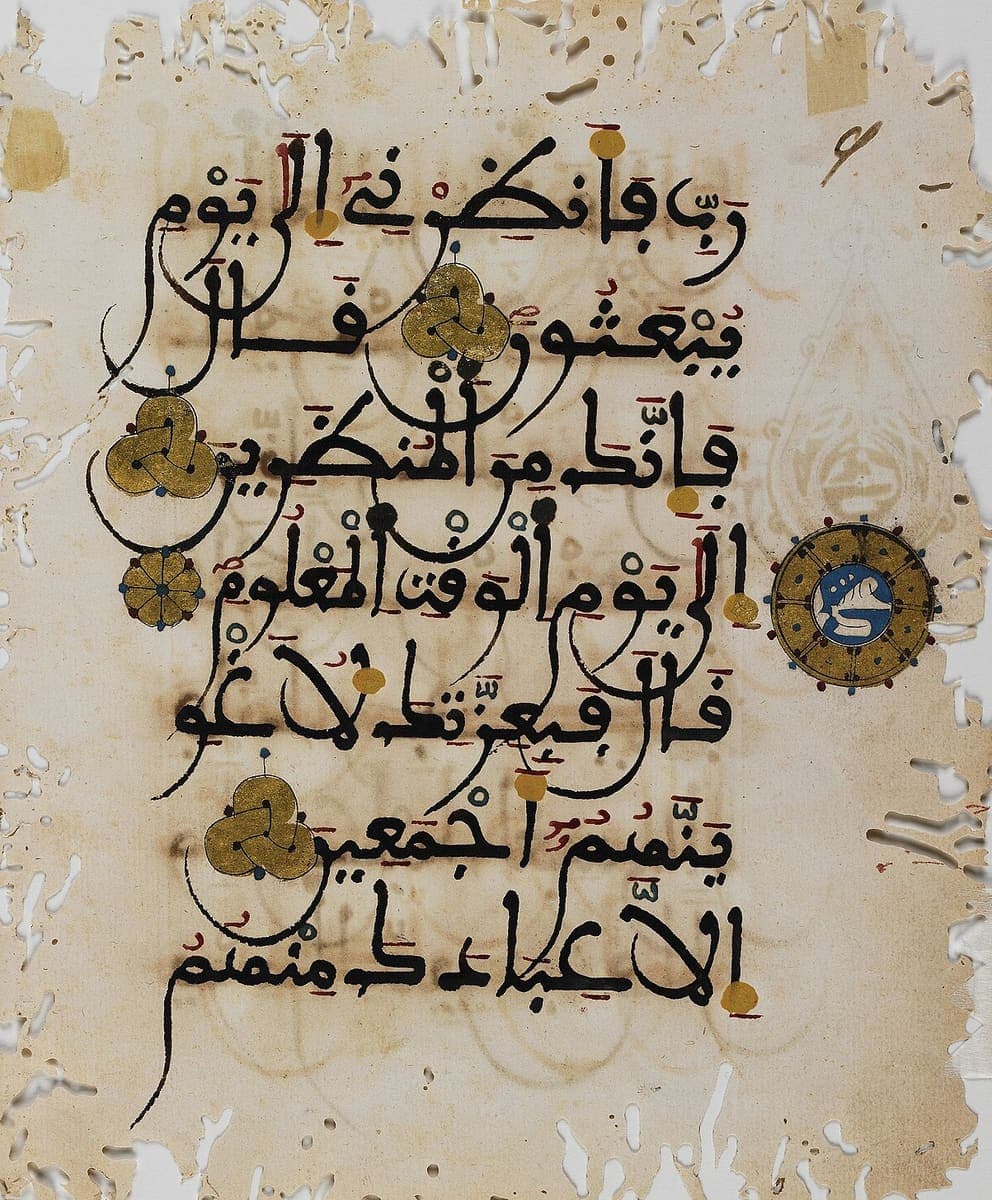
Arthur M. Sackler Gallery, Smithsonian Institution, S1997.105, 15th–16th century · Source · Public domain
Evidano Transcription
The museum records sura 38:75–83 for the leaf as a whole. The lines visible on this side run from the middle of 38:79, at rabbi anẓirnī, to the middle of 38:83, at illā ʿibādaka minhum; verses 79 to 83 are printed here in full in modern imlāʾī spelling.
قَالَ رَبِّ فَأَنْظِرْنِي إِلَى يَوْمِ يُبْعَثُونَ
قَالَ فَإِنَّكَ مِنَ الْمُنْظَرِينَ
إِلَى يَوْمِ الْوَقْتِ الْمَعْلُومِ
قَالَ فَبِعِزَّتِكَ لَأُغْوِيَنَّهُمْ أَجْمَعِينَ
إِلَّا عِبَادَكَ مِنْهُمُ الْمُخْلَصِينَ
Source: القرآن الكريم (بالرسم الإملائي)/سورة ص, Arabic Wikisource (Public domain).
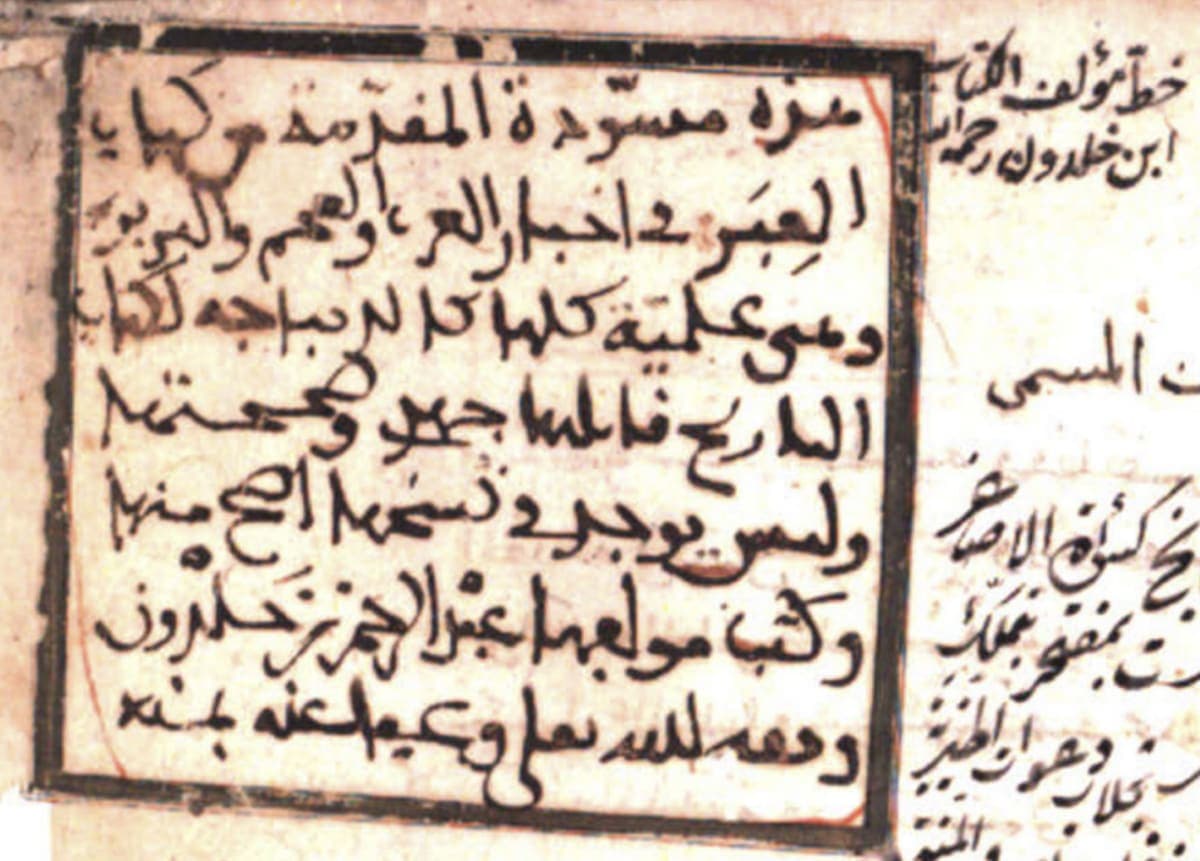
Süleymaniye Kütüphanesi, Istanbul, Atıf Efendi 1936, f. 7a, 14th century · Source · Public domain
Evidano Transcription
هذه مسودة المقدمة وكتاب
العبر في اخبار العرب والعجم والبربر
وهي عملية كلها كالديباجة لكتاب
التاريخ [illegible] جيد وصححته[?]
وليس يوجد نسخة اصح منها
وكتب مؤلفها عبد الرحمن بن خلدون
وفقه الله تعالى وعفا عنه بمنه
خط مؤلف الكتا[cut off]
ابن خلدون رحمه [cut off]
[cut off]ت المسمى
[cut off]خ كشف الاصـ[?]
[cut off]ت بمقر[?] بملك
[cut off] دعوات الخير
[cut off] بخلاف
[cut off] المنو[cut off]
Generated by Evidano’s advanced model; not yet checked against a published edition.
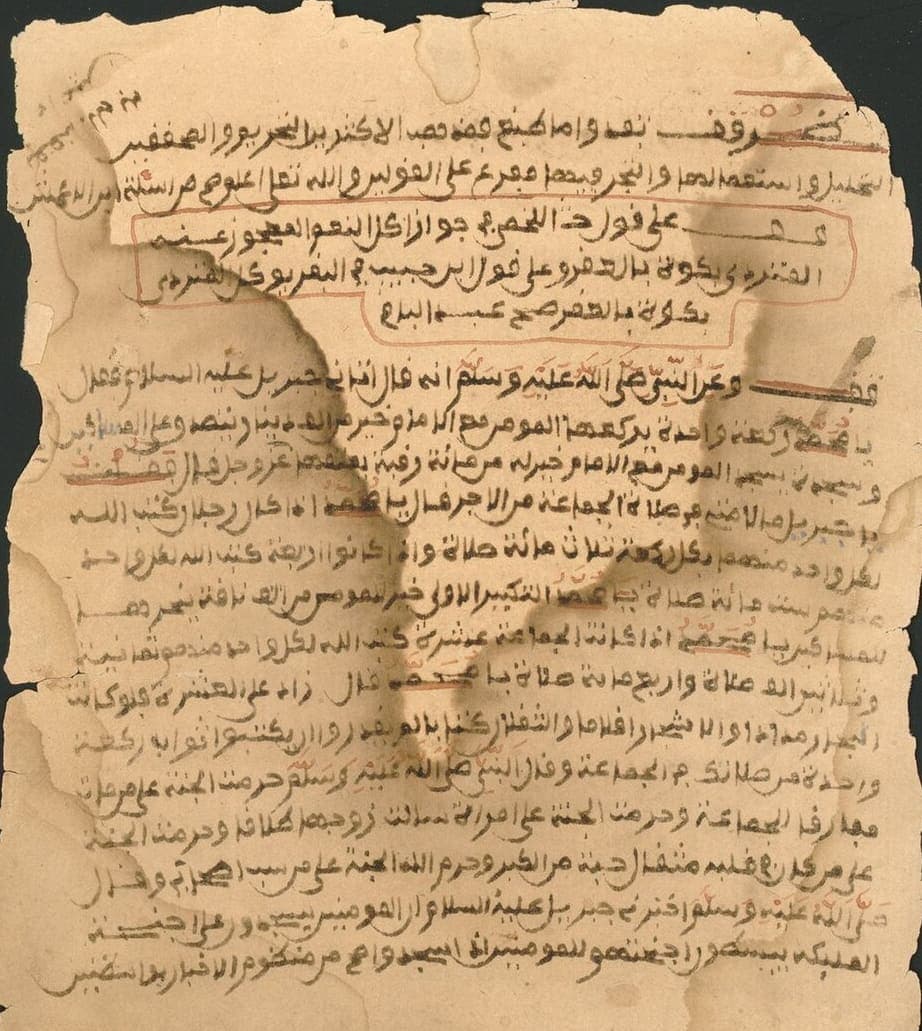
Mamma Haidara Memorial Library, Timbuktu, between 1450 and 1504 · Source · Public domain
Evidano Transcription
[upper lines, boxed note and margins illegible]
قف وعن النبي صلى الله عليه وسلم انه قال اتاني جبريل عليه السلام فقال
يا محمد ركعة واحدة يركعها المومن مع الامام خير من الف دينار يتصدق[?] على المساكين
وسجدة يسجدها المومن مع الامام خير له من مائة رقبة يعتقها[?] [illegible] فقلت
يا جبريل ما لامتي في صلاة الجماعة من الاجر فقال يا محمد اذا كان رجلان كتب الله
لكل واحد منهما بكل ركعة ثلاث مائة صلاة وان كانوا اربعة كتب الله لكل واحد
منهم ست مائة صلاة يا محمد التكبيرة الاولى خير للمومن من الف [illegible]
[illegible] يا محمد اذا كانت الجماعة عشرة كتب الله لكل واحد منهم [illegible]
وقيل الف صلاة واربع مائة صلاة يا محمد فان زاد على العشرة فلو كانت
البحار مدادا والاشجار اقلاما والثقلان كتابا لم يقدروا ان يكتبوا ثواب ركعة
واحدة من صلاتك في الجماعة وقال النبي صلى الله عليه وسلم حرمت الجنة على من مات
مفارقا الجماعة وحرمت الجنة على امراة ماتت زوجها [illegible] وحرمت الجنة
على من كان في قلبه مثقال حبة من الكبر وحرم الله الجنة على من سب اصحابي وقال
صلى الله عليه وسلم اخبرني جبريل عليه السلام ان المومنين [illegible] وعلى اجنحة
الملايكة [illegible] واجنحتهم للمومنين بساط [illegible] من مكتوم الاخبار [illegible]
Generated by Evidano’s advanced model; not yet checked against a published edition.
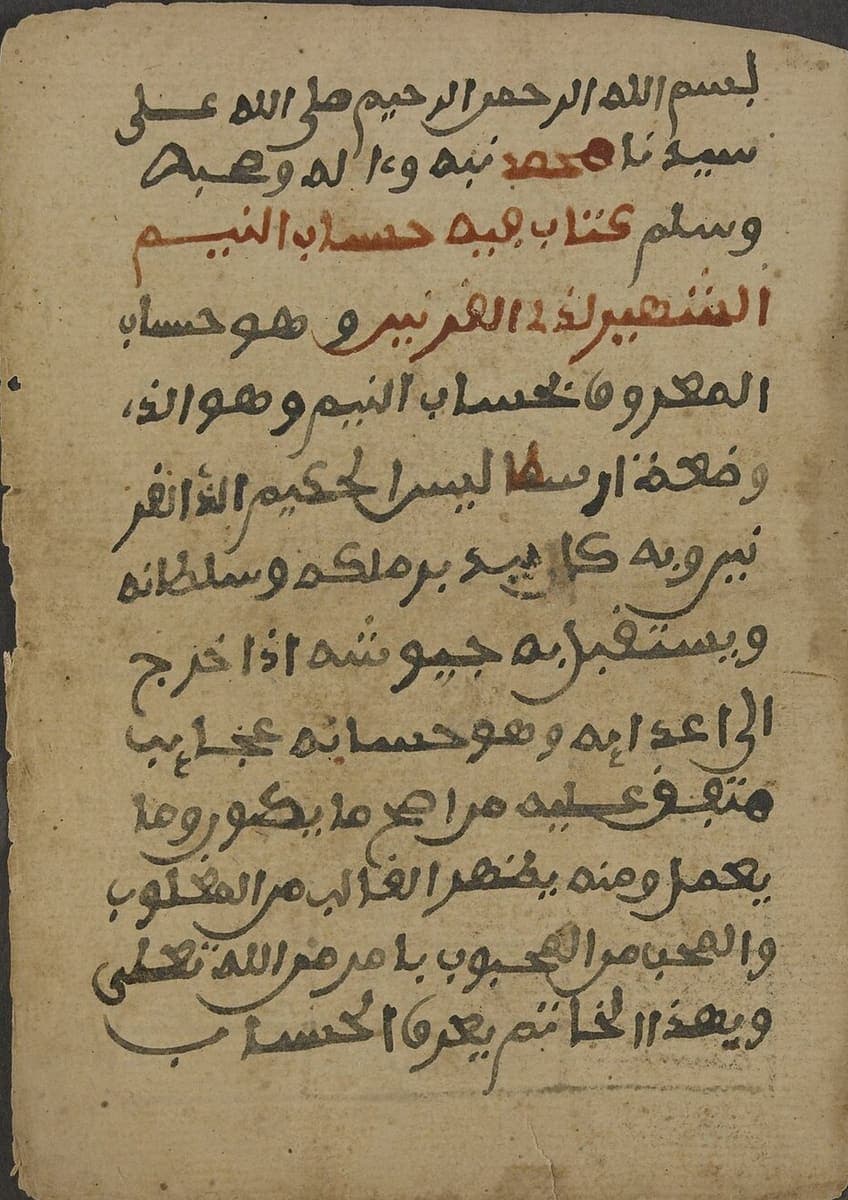
Mamma Haidara Memorial Library, Timbuktu, 18th century · Source · Public domain
Evidano Transcription
بسم الله الرحمن الرحيم صلى الله على
سيدنا محمد نبيه وءاله وصحبه
وسلم كتاب فيه حساب النيم
الشهير لذي القرنين وهو حساب
المعروف بحساب النيم وهو الذي
وضعه ارسطاليس الحكيم لذي القر
نين وبه كان يدبر ملكه وسلطانه
ويستقبل به جيوشه اذا خرج
الى اعدايه وهو حسابه[?] عجايب
متفق عليه من اصح ما يكون وما
يعمل ومنه يظهر الغالب من المغلوب
والمحب من المحبوب بامر من الله تعالى
وبهذا الخاتم يعرف الحساب
Generated by Evidano’s advanced model; not yet checked against a published edition.
What a western Arabic page looks like
From the eleventh century the Arabic of Ifrīqiya, the Maghrib, al-Andalus and later of the Sahel developed a family of hands quite distinct from the eastern ones. The line is drawn with a rounded nib and almost no contrast, so thick and thin strokes are nearly equal; the bowls of final nūn, yāʾ, qāf, ṣād and mīm drop into deep semicircles well below the baseline and often sweep under the word that follows; and the whole page has a looping, wiry look rather than the measured squareness of naskh. Within the family, calligraphers distinguished the formal mabsūṭ of Qurʾans, the smaller mujawhar of ordinary books, the display thuluth maghribī of headings, and, south of the Sahara, the West African hands usually grouped as Sūdānī, which have their own angular alif and squared final forms.
Pointing follows western rules. Fāʾ carries one dot below and qāf one dot above, where eastern practice puts one dot above fāʾ and two above qāf; a lone dot therefore has to be read differently depending on where the manuscript was made. Vocalisation is often applied in colour: red for the short vowels, blue or green for hamza, yellow for waṣla, so that a single word may carry three inks. Most Maghribi Qurʾans transmit the reading of Warsh rather than Ḥafṣ, which changes both the pronunciation marks and some of the spelling, and they use their own repertoire of pause and prostration signs. Numbers, where they appear, are often in the western ghubār forms rather than the eastern ones.
The page is built around a fixed text block with everything else pressed up against it. Glosses run up the outer margin, along the head and into the corner; a Qurʾan carries an ornamented sura heading, a marginal medallion for the tenth verse and interlaced knots between the verses; a scholarly copy carries rubricated headings, a catchword at the foot, and abbreviated devotional formulae written as a single letter or two. Later owners add purchase notes and endowment statements. In the Saharan libraries manuscripts were kept unbound in loose gatherings, so leaves are often stained, worm-eaten or torn along a fold, and the outer lines of a block may be lost entirely.
Why ordinary OCR struggles here
The dots mean the opposite of what they usually mean
A model that has learned modern printed Arabic reads a dot under a letter as bāʾ and a dot above it as nūn or fāʾ. On a Maghribi page that produces a word that is not merely misspelled but a different word entirely, and because the result is well-formed Arabic the error is easy to miss on a quick check.
Descenders that cross the line below
The long sublinear curve of a final qāf or nūn can run under two or three words of the next line. Line-finding routines cut it in half, assign the tail to the wrong line, or read it as part of a neighbouring letter, so the damage shows up as errors on a line the scribe wrote perfectly.
Three colours of vocalisation, and a different reading
Red vowels, blue hamzas and yellow waṣla signs sit around a black skeleton, and a photograph flattens them into similar greys. In a Warsh Qurʾan the marks also stand for a different recitation from the one most digital Qurʾan texts encode, so an automatic comparison against a printed Ḥafṣ text reports variants that are not variants at all.
Margins, damp and worm holes
Glosses frame the block on three sides and change direction at the corner; water stains have washed out whole passages in the Saharan collections; and worm tracks eat a letter out of the middle of a word. What is missing has to be marked as missing rather than guessed at from the surrounding sense.
Who works with this material
Saharan manuscript preservation projects
The libraries of Timbuktu, Chinguetti and the Mauritanian oases hold tens of thousands of volumes that have been photographed but never read through. Getting a searchable text out of the first page of each one is what turns a photographic archive into a catalogue.
Historians of al-Andalus and the Maghrib
Mālikī fatwā collections, land records and biographical dictionaries survive in western hands and are quoted far more often than they are read. A transcription that keeps names and place names accurate is the difference between a citable text and an image file.
Qurʾanic manuscript specialists working on Warsh
The western transmission has its own orthography, its own vowel signs and its own verse counts. Anyone comparing Maghribi copies needs a transcription that records what is written rather than silently aligning the page to an eastern printed text.
Teachers of western Arabic palaeography
The fāʾ and qāf rule is the first thing a student has to unlearn. Setting a transcription beside a Maghribi page, with those two letters marked, makes the point faster than any amount of explanation.
Getting the best transcription
State the regional convention first
Tell the model that the manuscript is Maghribi, Andalusi or Sūdānī and that fāʾ takes a dot below and qāf a dot above. This single instruction removes a whole class of errors that would otherwise appear as real but wrong words throughout the text.
Say which Qurʾanic reading you expect
For a Qurʾan, specify Warsh rather than Ḥafṣ so that the orthography and the vowel signs are interpreted correctly, and ask for the verse markers and the marginal medallions to be recorded where they fall.
Ask for the block and the margins apart
Request the ruled text first, then each marginal gloss with its position and the line it belongs to. Say explicitly that a descender may pass under the following line so that stray tails are not read as separate letters.
Decide what to do about damage
On a Saharan leaf, whole passages may be washed out. Ask for illegible stretches to be marked with their approximate length rather than reconstructed, and check the first badly damaged page before running a whole collection.
Further reading on this hand
The palaeography guides the in-app selector points to for this domain, if you want to check a transcription against the standard references.
- Scripts
This University of Pennsylvania guide surveys major Islamic manuscript scripts and includes a dedicated description of Maghribi writing. It associates the script with North Africa, al-Andalus, and parts of West Africa and describes its curvilinear forms and relatively uniform strokes. The resource contrasts Maghribi with Naskh, Nastaʿliq, and the Six Pens, helping readers recognize regional rather than merely individual variation. It is directly useful for manuscripts whose letter shapes and pointing conventions differ from eastern Arabic norms.
Frequently asked questions
- How does it avoid confusing fāʾ and qāf?
- By being told which convention the manuscript follows. Western dotting is applied consistently across a page, so once the rule is set the two letters are read correctly throughout; the same instruction also keeps a Maghribi copy from being read as though it were eastern.
- Can it handle a Warsh Qurʾan?
- Yes. The Warsh orthography and its pause and vowel signs are transcribed as written, and the output can be kept separate from any comparison with a printed Ḥafṣ text so that genuine differences between manuscripts are not buried under differences between the two readings.
- Is Sūdānī script from West Africa treated as Maghribi?
- It shares the western dotting and much of the letter repertoire, but the West African hands have their own angular forms and their own abbreviations. Saying where a manuscript comes from lets those local habits be taken into account.
- What happens to the coloured vowel marks?
- They can be transcribed with a note of their colour, which matters because red, blue, green and yellow do different jobs in a western Qurʾan. If you only want the consonantal text, the colour layer can be dropped instead.
- Can the marginal glosses be linked to the words they explain?
- Where the scribe used a reference mark or wrote the gloss beside its line, the link is recorded. Notes that turn the corner of the page are kept as single continuous texts rather than being split at the point where the writing changes direction.
Related scripts and pages
Transcribe your Maghribi and Andalusi pages
Upload a leaf, choose Maghribi and Andalusi Manuscripts, and tell the model which regional dotting convention the copy follows.