
Arabic · c. 1000–1500
Read the book hand, the margins and the notes at the end
A medieval Arabic codex rarely holds still. The main text sits in a ruled block in naskh; glosses circle it at three different angles, a corrector has squeezed a word above the line, and the last page carries a colophon, a reading certificate and two ownership notes in hands two centuries apart. Evidano transcribes each of those as its own text, in its own place on the page.
Sample pages
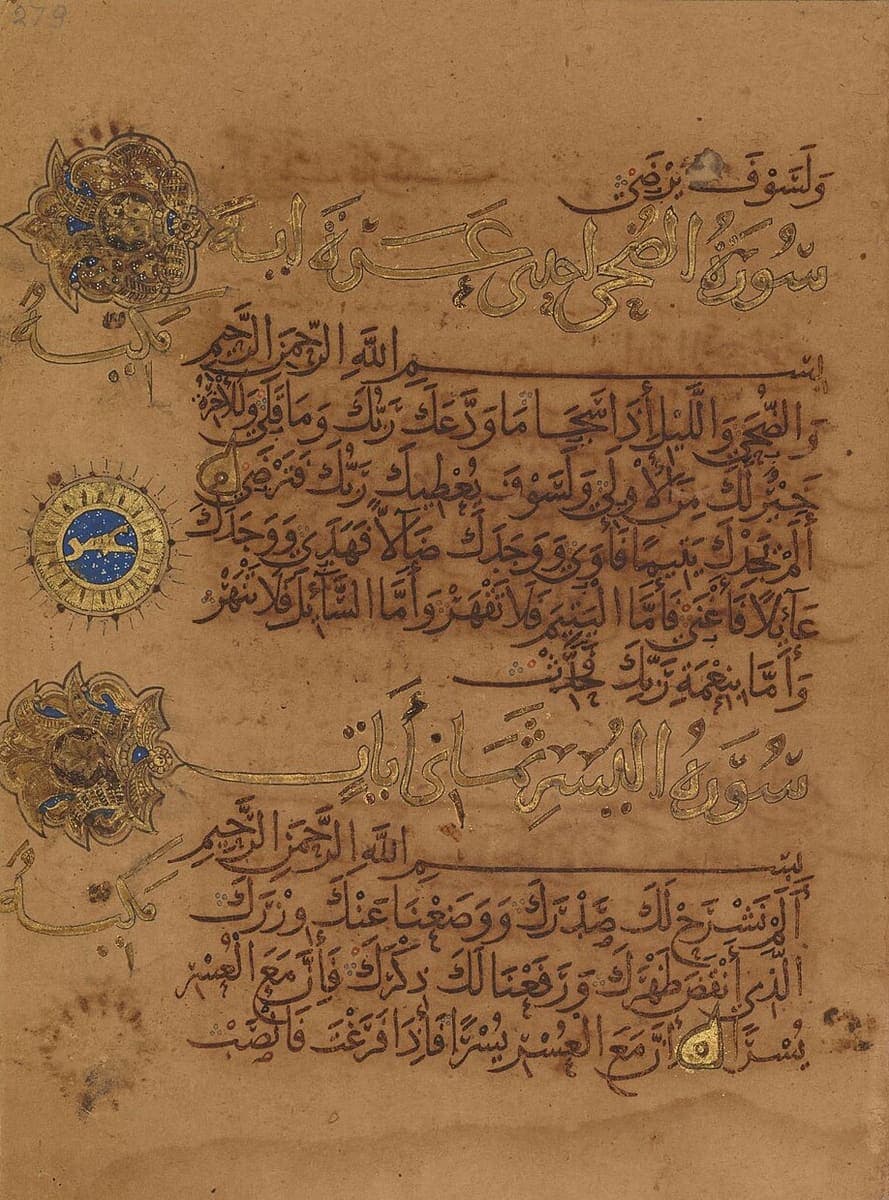
Chester Beatty Library, Dublin, Is 1431, f. 279r, A.H. 391 / A.D. 1000–1001 · Source · Public domain
Evidano Transcription
The left-hand page of the opening as reproduced here: the last verse of sūrat al-Layl (92:21) on the first line, then the whole of sūrat al-Ḍuḥā (93:1–11) under its gold heading, then sūrat al-Sharḥ as far as verse 7, where the page ends. The suras shown are those named in the two gold headings; the text is given in the modern imlāʾī spelling.
وَلَسَوْفَ يَرْضَى
وَالضُّحَى
وَاللَّيْلِ إِذَا سَجَى
مَا وَدَّعَكَ رَبُّكَ وَمَا قَلَى
وَلَلْآخِرَةُ خَيْرٌ لَكَ مِنَ الْأُولَى
وَلَسَوْفَ يُعْطِيكَ رَبُّكَ فَتَرْضَى
أَلَمْ يَجِدْكَ يَتِيمًا فَآوَى
وَوَجَدَكَ ضَالًّا فَهَدَى
وَوَجَدَكَ عَائِلًا فَأَغْنَى
فَأَمَّا الْيَتِيمَ فَلَا تَقْهَرْ
وَأَمَّا السَّائِلَ فَلَا تَنْهَرْ
وَأَمَّا بِنِعْمَةِ رَبِّكَ فَحَدِّثْ
أَلَمْ نَشْرَحْ لَكَ صَدْرَكَ
وَوَضَعْنَا عَنْكَ وِزْرَكَ
الَّذِي أَنْقَضَ ظَهْرَكَ
وَرَفَعْنَا لَكَ ذِكْرَكَ
فَإِنَّ مَعَ الْعُسْرِ يُسْرًا
إِنَّ مَعَ الْعُسْرِ يُسْرًا
فَإِذَا فَرَغْتَ فَانْصَبْ
Source: القرآن الكريم (بالرسم الإملائي), سور الليل والضحى والشرح, Arabic Wikisource (Public domain).
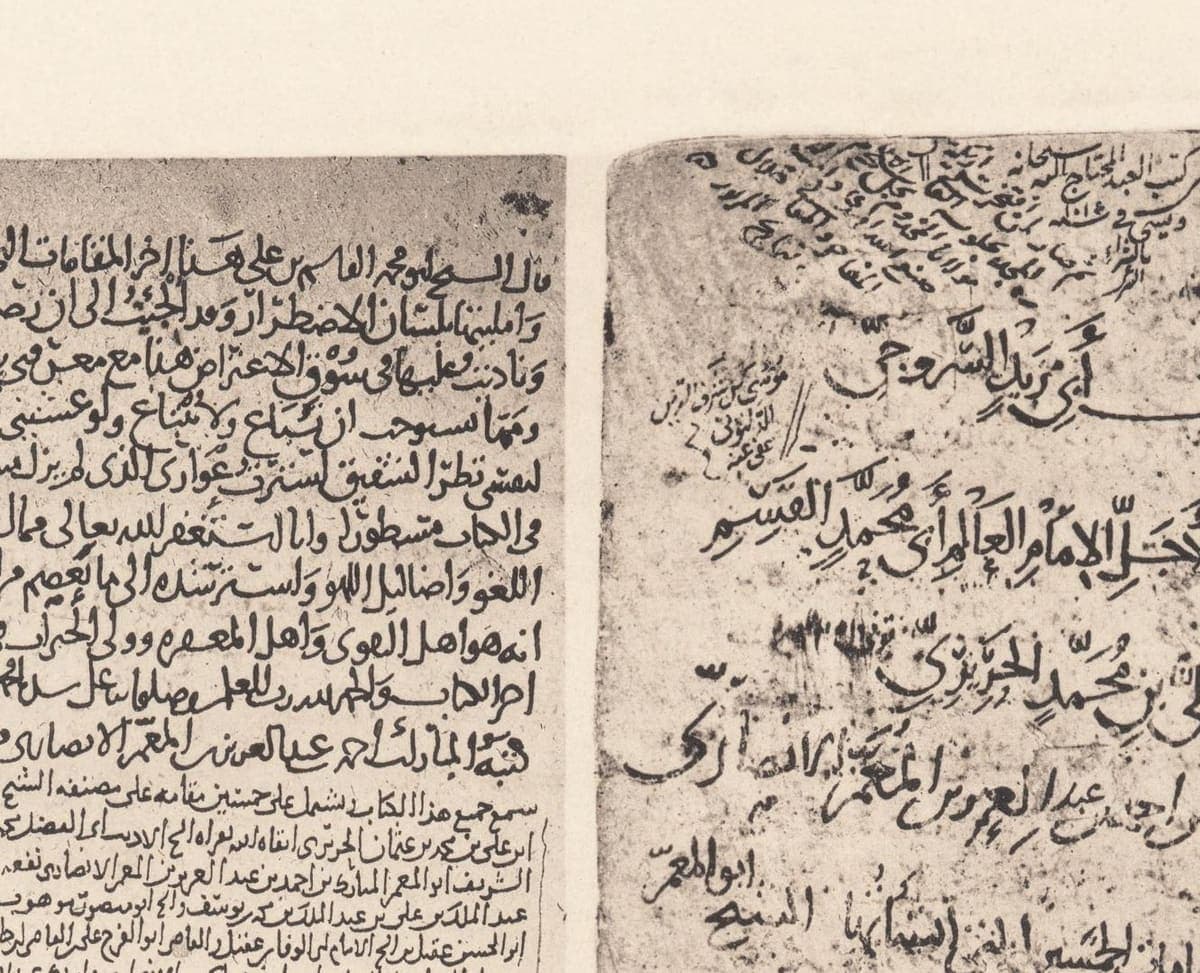
Khedivial Library, Cairo (now Dār al-Kutub), Moritz, Arabic Palaeography, pl. 165, A.H. 504 / A.D. 1111 (facsimile 1905) · Source · Public domain
Evidano Transcription
كتب العبد المحتاج الى رحمة ربه سبحانه [remaining lines of the note illegible]
[cut off] ابي زيد السروجي
موسى بن شرف الزين[?]
[illegible]
عفي عنه
[cut off] الاجل الامام العالم ابي محمد القسم
[cut off] علي بن محمد الحريري
[cut off] احمد بن عبد العزيز بن المعمر [illegible]
ابو المعمر
[cut off] الجسم[?] الذي انشاها الشيخ
قال الشيخ ابو محمد القاسم بن علي هذا اخر المقامات ال[cut off]
وامليتها بلسان الاضطرار وقد الجئت الى ان ر[cut off]
وناديت عليها في سوق الاعتراض[?] هذا مع معرفتي [cut off]
ومما استوجب ان يباع ولا يبتاع ولو عسفني [cut off]
لمشى نظر الشفيق لستر عواري الذي لم يزل [cut off]
في الكتاب مسطورا وانا استغفر الله تعالى مما [cut off]
اللغو واضاليل اللهو واسترشده الى ما يعصم من [cut off]
انه هو اهل التقوى واهل المغفرة وولي الخيرات [cut off]
اخر الكتاب والحمد لله رب العالمين وصلواته على سيدنا [cut off]
كتبه المبارك احمد بن عبد العزيز بن المعمر الانصاري [cut off]
سمع جميع هذا الكتاب يشتمل على خمسين مقامه على مصنفه الشيخ [cut off]
ابن علي بن محمد بن عثمان الحريري ابقاه الله بقراه الاخ الاديب ابي الفضل [cut off]
الشريف ابو المعمر المبارك بن احمد بن عبد العزيز بن المعمر الانصاري نفعه [cut off]
عبد الملك بن علي بن عبد الملك بن يوسف والاخ ابو منصور موهوب [cut off]
ابو الحسن عقيل بن الامام ابي الوفا بن عقيل [illegible] ابو الفرج علي بن [illegible] [cut off]
[remaining lines illegible]
Generated by Evidano’s advanced model; not yet checked against a published edition.
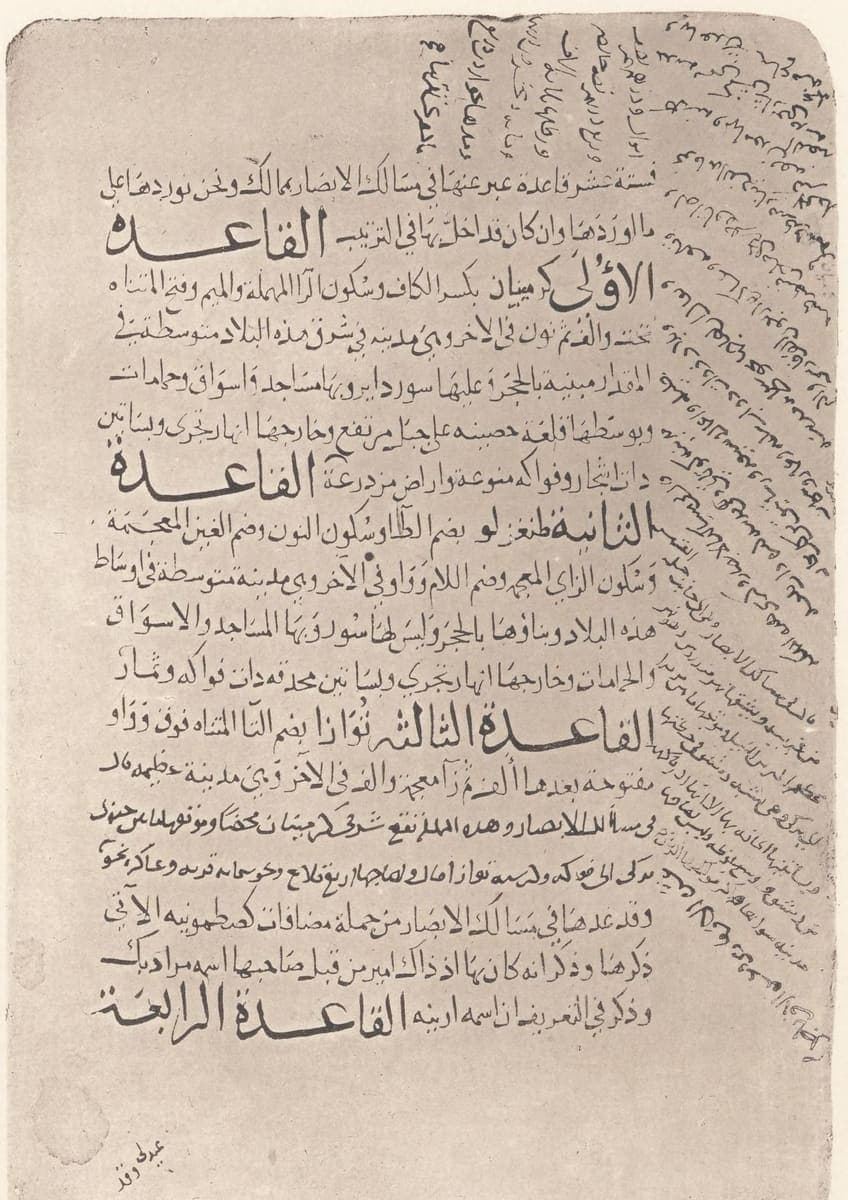
al-Azhar Library, Cairo, Moritz, Arabic Palaeography, pl. 171, A.H. 799 / A.D. 1397 (facsimile 1905) · Source · Public domain
Evidano Transcription
[marginal notes illegible]
فستة عشر قاعدة عبر عنها في مسالك الابصار بمالك ونحن نوردها على
ما اوردها وان كان قد اخل بها في الترتيب القاعدة
الاولى كرميان بكسر الكاف وسكون الرا المهملة والميم وفتح المثناه
تحت والضم[?] نون في الاخر وهي مدينة في شرق هذه البلاد متوسطة في
المقدار مبنية بالحجر عليها سور داير وبها مساجد واسواق وحمامات
وبوسطها قلعة حصينه على جبل مرتفع وخارجها انهار تجرى وبساتين
ذات اشجار وفواكه منوعة واراض مزدرعة القاعدة
الثانية طنغزلو بضم الطا وسكون النون وضم الغين المعجمة
وسكون الزاي المعجمه وضم اللام وواو في الاخر وهي مدينة متوسطة في اوساط
هذه البلاد وبناؤها بالحجر وليس لها سور وبها المساجد والاسواق
والحمامات وخارجها انهار تجري وبساتين محدقه ذات فواكه وثمار
القاعدة الثالثة توازا بضم التا المثناه فوق وواو
مفتوحة بعدها الف ثم زا معجمه والف في الاخر وهي مدينة عظيمه قال
في مسالك الابصار وهذه المملكة تقع شرقي كرميان محققا وموقعها [?]
بحر كلي الى [illegible] توازا [illegible] ولصاحبها اربع[?] قلاع ونحو ستمايه[?] قريه وعساكر نحو
وقد عدها في مسالك الابصار من جملة مضافات قصطمونيه[?] الاتي
ذكرها وذكر انه كان بها اذ ذاك امير من قبل صاحبها اسمه مراد بك
وذكر في التعريف ان اسمه ارينه القاعدة الرابعة
[illegible]
Generated by Evidano’s advanced model; not yet checked against a published edition.
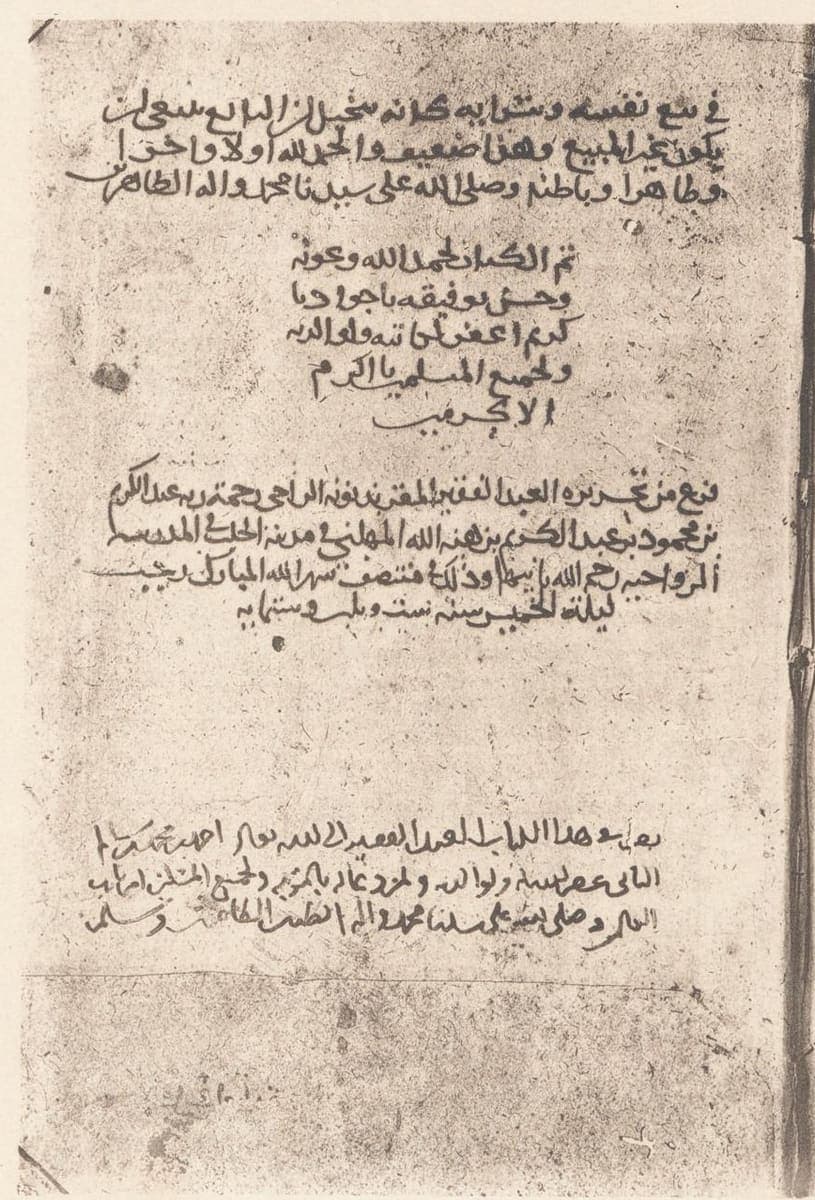
Khedivial Library, Cairo (now Dār al-Kutub), Moritz, Arabic Palaeography, pl. 140, A.H. 636 / A.D. 1239 (facsimile 1905) · Source · Public domain
Evidano Transcription
في بيع نفسه وشرايه كانه يتخيل ان البايع ينبغي ان
يكون غير المبيع وهذا ضعيف والحمد لله اولا واخرا
وظاهرا وباطنا وصلى الله على سيدنا محمد واله الطاهرين
تم الكتاب بحمد الله وعونه
وحسن توفيقه يا جواد يا
كريم اغفر لكاتبه ولوالديه
ولجميع المسلمين يا اكرم
الاكرمين
فرغ من تحريره العبد الفقير المعترف بذنوبه الراجي رحمة ربه عبد الكريم
بن محمود بن عبد الكريم بن هبة الله المهلبي في مدينة حلب[?] المدرسة
الرواحيه رحم الله بانيها وذلك في منتصف شهر الله المبارك رجب
ليلة الخميس سنة ست وثلثين وستمايه
[?] هذا الكتاب العبد الفقير الى الله تعالى احمد بن محمد [illegible]
الثاني[?] عفى الله عنه[?] ولوالديه ولمن دعا له بالتوبة[?] ولجميع المسلمين امين رب
العالمين[?] وصلى الله على سيدنا محمد واله الطيبين الطاهرين وسلم
[illegible]
Generated by Evidano’s advanced model; not yet checked against a published edition.
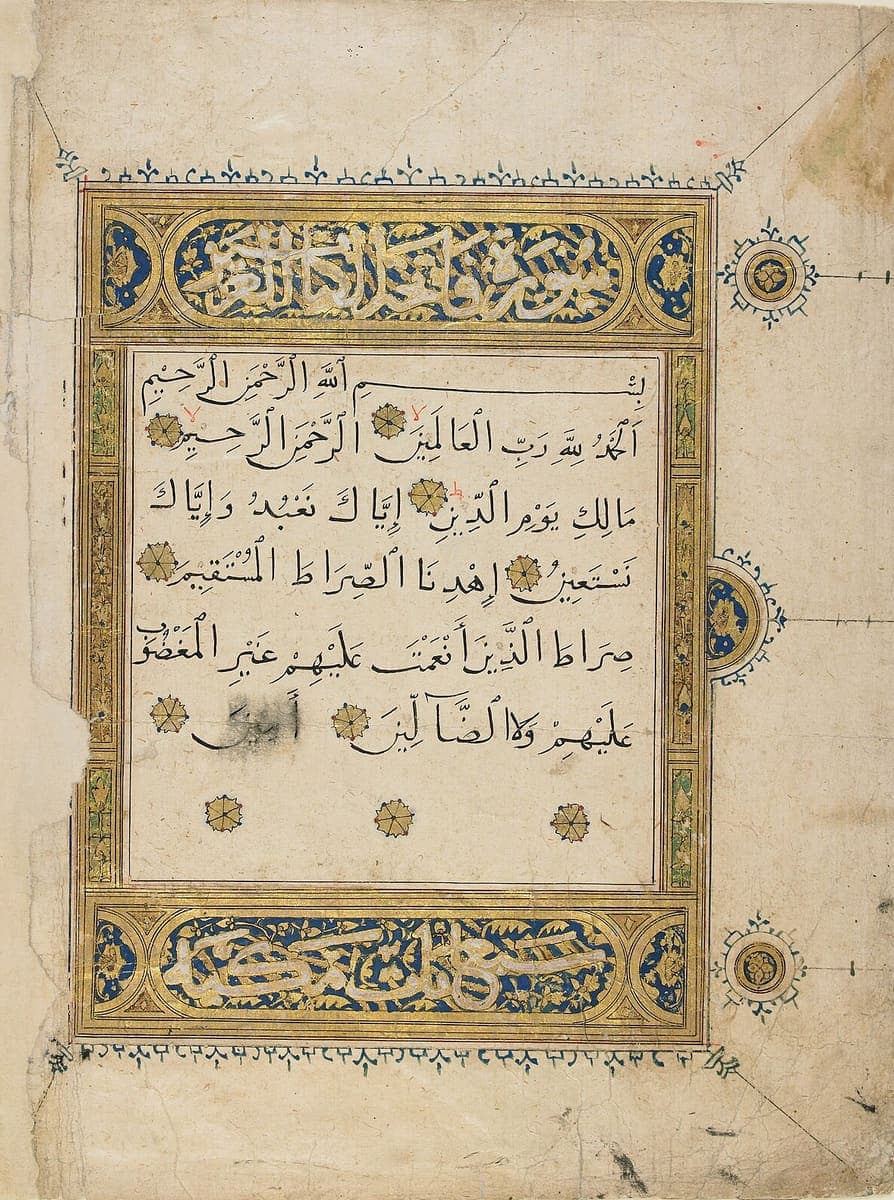
Library of Congress, African and Middle Eastern Division, 14th–15th century · Source · Public domain
Evidano Transcription
The seven lines of the text block: the whole of sūrat al-Fātiḥa (1:1–7), identified in the Library of Congress record for the fragment. The manuscript is fully vocalised, so the printed text here matches it closely; the gold cartouches, the red recitation mark and the misplaced verse markers are not included.
بِسْمِ اللَّهِ الرَّحْمَنِ الرَّحِيمِ
الْحَمْدُ لِلَّهِ رَبِّ الْعَالَمِينَ
الرَّحْمَنِ الرَّحِيمِ
مَالِكِ يَوْمِ الدِّينِ
إِيَّاكَ نَعْبُدُ وَإِيَّاكَ نَسْتَعِينُ
اهْدِنَا الصِّرَاطَ الْمُسْتَقِيمَ
صِرَاطَ الَّذِينَ أَنْعَمْتَ عَلَيْهِمْ غَيْرِ الْمَغْضُوبِ عَلَيْهِمْ وَلَا الضَّالِّينَ
Source: القرآن الكريم (بالرسم الإملائي)/سورة الفاتحة, Arabic Wikisource (Public domain).
What a Mashriqi codex page looks like
From the tenth century onwards the scripts used for books in the eastern Islamic world were codified as a set of proportioned hands, of which naskh became the ordinary book hand: a rounded, fully cursive script with clear positional forms, a firm baseline and a modest contrast between thick and thin. Around it sit its relatives — the taller, more elegant rayḥān, the heavy muḥaqqaq and thuluth used for headings and grand Qurʾans, and the small, quick taʿlīq of the scholar’s working copy. Pages are ruled with a misṭara and written in a block whose width is fixed; a catchword at the foot of the verso gives the first word of the next page so that the quires can be assembled in order.
Pointing is standard by this period, but it moves. Dots are placed high, low or squashed into the space above a neighbouring letter, and two dots often become a single stroke. Undotted letters may be marked as such with a tiny sublinear version of themselves or with a small caret, which is easy to mistake for a vowel. Vocalisation is partial: a Qurʾan or a poem is normally fully pointed, a legal or historical work is not, and a scribe will vocalise a rare word or a proper name in an otherwise bare paragraph. Above the line sit shadda, sukūn and the superscript alif; below it, the kasra. The lām-alif ligature and the tighter combinations that stack a letter above another change the order the strokes are made in, so the reading order of a compressed word is not the order the eye first sees.
The apparatus around the text matters as much as the text. Section headings are written in red, gold or a larger hand; the words qāla and faṣl are often rubricated; a triangle of dots or the word ṣaḥḥa marks a checked reading, and balagha shows how far a collation reached. Glosses run up the outer margin and turn the corner, and a long note may spiral. At the end come the colophon, giving the copyist, the place and the date; the samāʿ or ijāza certificates recording who heard the book read and when; and later ownership, endowment and purchase notes, each in a different hand and often a different ink.
Why ordinary OCR struggles here
Letters that differ only by their dots
Once a scribe writes quickly, the two dots of tāʾ merge into a dash, the three of thāʾ into a caret, and a dot drifts over the wrong tooth. On a page of unfamiliar proper names there is no vocabulary to fall back on, so the transcription has to be able to say that a skeleton was read as one letter rather than another and that the reading is not certain.
Marginalia at every angle
Glosses are written up the side of the block, along the top, diagonally into the corner and sometimes upside down. Ordinary layout analysis either drops them or splices them into the main text between two lines that have nothing to do with them. Each note has to be recognised as a separate text, with its position and its anchor recorded.
Ligatures that reorder the strokes
In compressed words a letter is written above its neighbour rather than beside it, and the lām-alif and similar combinations are drawn as a single shape. A recogniser working stroke by stroke reads such a cluster in the order it meets the ink, which is not the order of the letters, and produces a word that does not exist.
Everything that is not the work
A catchword at the foot of a page, a collation mark, a colophon, a reading certificate and a nineteenth-century librarian’s stamp all sit on the same folio as the text. Merged into one stream they corrupt the edition; separated and labelled they are some of the most useful evidence the manuscript carries.
Who works with this material
Editors of classical Arabic texts
Preparing a critical edition means collating several witnesses line by line. A transcription that keeps the manuscript’s own spelling, marks its corrections and reproduces the marginal variants gives an apparatus that can be built up rather than reconstructed from memory.
Historians of books and reading
Samāʿ and ijāza notes record who read a book, to whom, where and in what year. Read in bulk they map a teaching network across cities and generations, which is only possible if the notes are transcribed as separate texts with their dates and names intact.
Manuscript catalogers and digital libraries
Catalogue records live or die on the colophon. Pulling the copyist’s name, the place and the date out of the last page of every volume in a collection turns a shelf list into something a researcher can search.
Codicology and palaeography teaching
Students need to see that a page is layered. Showing the block, the glosses and the later notes as three separate transcriptions makes the structure of the page obvious in a way that a photograph alone does not.
Getting the best transcription
Name the work and the discipline
Say that the page is fiqh, ḥadīth, lexicography or poetry. The technical vocabulary, the isnād formulae and the abbreviations differ sharply between them, and knowing which to expect settles many of the ambiguous skeletons before they become errors.
Ask for the margins separately
Request the ruled block first, then each marginal note as its own text with a note of where it sits and which line it comments on. Interlinear glosses should be tied to the word above which they are written rather than dropped into the line.
Set the spelling policy in advance
Decide whether final ة is to be transcribed as written or normalised to ه, whether ى without dots is to be resolved to ي, and whether hamza is to be supplied. Fixing this once keeps a whole codex consistent and makes the output searchable.
Flag the furniture
Ask for catchwords, rubricated headings, collation marks, the colophon and any certificates or ownership notes to be labelled as such. They are what a cataloguer needs and what an editor must keep out of the text.
Further reading on this hand
The palaeography guides the in-app selector points to for this domain, if you want to check a transcription against the standard references.
- Scripts
This University of Pennsylvania resource introduces the principal scripts encountered in Islamic manuscripts. It explains Naskh as a widely used book hand and places it among the Six Pens and other regional or functional styles. The guide compares script angle, proportion, ligaturing, stroke modulation, and typical use in codices or correspondence. It is useful for identifying Mashriqi Naskh and for distinguishing it from more monumental or strongly sloping manuscript scripts.
Frequently asked questions
- Can it tell the main text from a gloss written round the edge of it?
- Yes, when the prompt asks for them separately. Each marginal note is returned as its own block with its position on the page, so a note running up the outer edge does not end up spliced between two lines of the work it comments on.
- How reliable is it on names in an isnād?
- Chains of transmission are the hardest part of any ḥadīth manuscript, because a name gives no context to correct a misplaced dot. Uncertain readings are marked rather than resolved silently, which lets you check the doubtful ones against a biographical dictionary.
- Will vocalisation be reproduced where the scribe wrote it?
- It can be. Many codices are only partly vocalised, and the words the scribe chose to point are often the ones he thought a reader would get wrong, so the pattern is worth keeping. You can also ask for a plain unvocalised text for indexing.
- Are colophons and reading certificates handled differently from the text?
- They are transcribed as separate records and can be returned with the names, places and dates picked out. A single manuscript often carries several certificates in different hands, and each is kept apart rather than run together.
- What happens with a catchword at the bottom of the page?
- It is recognised for what it is and labelled, not appended to the last line of text. Because it repeats the first word of the next page, keeping it also lets you check that a manuscript has been imaged in the right order.
Related scripts and pages
Transcribe your Arabic codices
Upload a folio, choose Mashriqi Naskh and Related Book Hands, and ask for the block, the margins and the colophon as separate texts.