
Azerbaijani
Read Azerbaijani in whichever alphabet it was written
A single Azerbaijani family archive can hold a grandparent’s birth record in Perso-Arabic script, a parent’s Soviet-issued Cyrillic passport, and a child’s modern Latin school certificate. Evidano reads each on the alphabet’s own terms instead of assuming today’s Latin spelling is the only one on the page.
Sample pages
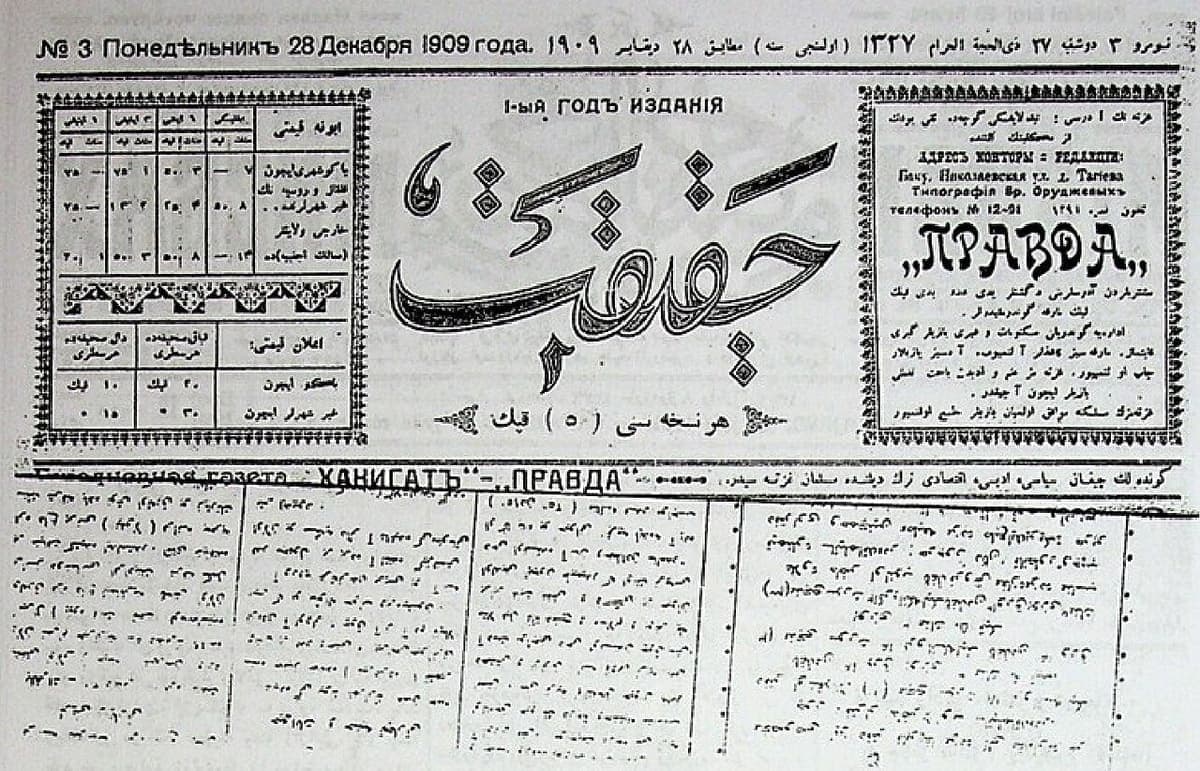
Union catalogue of Persian, Arabic, Ottoman Turkish, Kurdish and Azerbaijani serials, National Parliamentary Library of Georgia, 28 December 1909 · Source · CC BY 4.0
Evidano Transcription
№ 3 Понедѣльникъ 28 Декабря 1909 года. ١٩٠٩ نومرو ٣ دوشنبه ٢٧ ذیالحجة الحرام ١٣٢٧ (اولنجی سنه) مطابق ٢٨ دکابر [?]
| ابونه قیمتی | ایللیك [?] منات | ایللیك [?] قپك | ٦ آیلیق منات | ٦ آیلیق قپك | ٣ آیلیق منات | ٣ آیلیق قپك | ١ آیلیق منات | ١ آیلیق قپك |
|---|---|---|---|---|---|---|---|---|
| باکو شهری ایچون | ٧ | — | ٣ | ٥٠ | ١ | ٧٥ | — | ٧٥ |
| قافقاز و روسیهنك غیر شهرلرنده | ٨ | ٥٠ | ٤ | ٢٥ [?] | [?] | [?] | — | ٧٥ [?] |
| خارجی ولایتلر (ممالك اجنبیه)ده | ١٤ | — | ٨ | ٥٠ | ٣ | ٥٠ | ١ | ٢٠ [?] |
| اعلان قیمتی: | باش صحیفهده هر سطری | دال صحیفهده هر سطری |
|---|---|---|
| باکو ایچون | ٢٠ قپك | ١٠ قپك |
| غیر شهرلر ایچون | ٣٠ " | ١٥ " |
1-ЫЙ ГОДЪ ИЗДАНІЯ
حقیقت
هر نسخه سی (٥) قپك
غزتهنك آدرسی: تیفلیسکی کوچهده تقی یوفك [?]
قز مکتبینك آلتنده
АДРЕСЪ КОНТОРЫ и РЕДАКЦІИ:
Баку, Николаевская ул. д. Тагіева
Типографія Бр. Оруджевыхъ
телефонъ № 12-91 تلفون نمره ١٢٩١
„ПРАВДА„
مشتریلردن آدرسلرینی دگیشدیرنلر یدی عدد یدی قپك
لیك مارقه گوندرملیدرلر.
ادارهیه گوندریلن مکتوبات و غیری یازیلر گیری
قایتماز. مارقهسیز مکتوبلر آلینمیور. آدسیز یازیلار
چاپ اولونمیور. غزته هر علم و فندن باحث [illegible]
یازیلر ایچون آچیقدر.
غزتهمزك مسلکنه موافق اولمیان یازیلر طبع اولونمیور
Ежедневная газета „ХАКИГАТЪ“ – „ПРАВДА“
گوندلك چیقان [?] سیاسی، ادبی، اقتصادی ترك دیلنده مسلمان غزته سیدر.
[body columns illegible at this resolution]
Generated by Evidano’s advanced model; not yet checked against a published edition.
Evidano Transcription
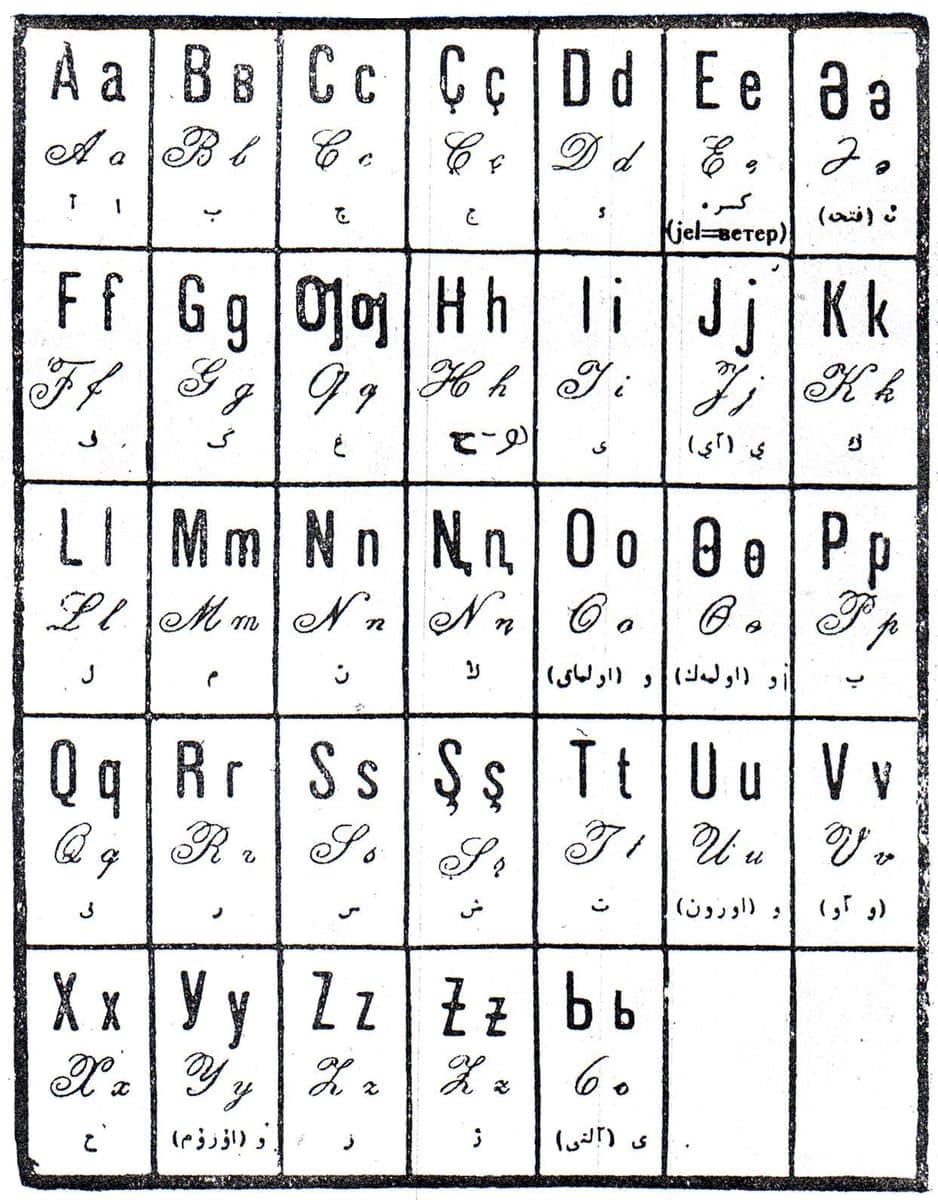
| A a A a ا آ | B ʙ B b ب | C c C c ج | Ç ç Ç ç چ | D d D d د | E e E e کسره (jel=ветер) | Ə ə Ə ə [?] (فتحه) |
|---|---|---|---|---|---|---|
| F f F f ف | G g G g گ | Ƣ ƣ Ƣ ƣ غ | H h H h ح - ه | I i I i ى | J j J j ي (آي) | K k K k ك |
| L l L l ل | M m M m م | N n N n ن | Ꞑ ꞑ Ꞑ ꞑ ڭ | O o O o و (اولماق) | Ɵ ɵ Ɵ ɵ و (اولمك) | P p P p پ |
| Q q Q q ق | R r R r ر | S s S s س | Ş ş Ş ş ش | T t T t ت | U u U u و (اوزون [?]) | V v V v (و آو) |
| X x X x خ | Y y Y y و (اوزوم) | Z z Z z ز | Ƶ ƶ Ƶ ƶ ژ | Ь ь Ь ь ى (آلتى) |
Generated by Evidano’s advanced model; not yet checked against a published edition.
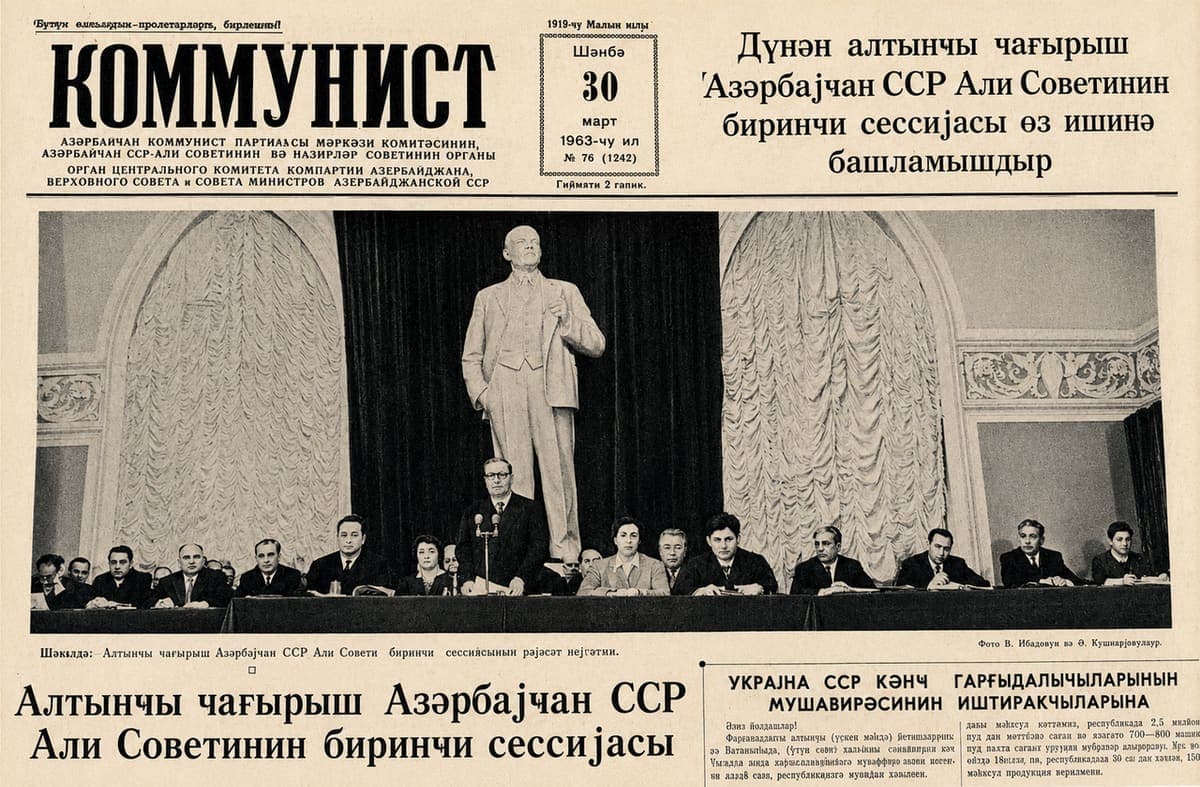
Source · CC BY 3.0 · Family collection digitised by Şəfiqə Məmmədəliyeva
Evidano Transcription
[illegible] пролетарлары [?], бирләшин [?]!
КОММУНИСТ
АЗӘРБАЙЧАН КОММУНИСТ ПАРТИЈАСЫ [?] МӘРКӘЗИ КОМИТӘСИНИН,
АЗӘРБАЙЧАН ССР-АЛИ СОВЕТИНИН ВӘ НАЗИРЛӘР СОВЕТИНИН ОРГАНЫ
ОРГАН ЦЕНТРАЛЬНОГО КОМИТЕТА КОМПАРТИИ АЗЕРБАЙДЖАНА,
ВЕРХОВНОГО СОВЕТА и СОВЕТА МИНИСТРОВ АЗЕРБАЙДЖАНСКОЙ ССР
1919-чу Малын [?] илы [?]
Шәнбә
30
март
1963-чу ил
№ 76 (1242)
Гиймәти 2 гапик.
Дүнән алтынчы чағырыш
Азәрбајчан ССР Али Советинин
биринчи сессијасы өз ишинә
башламышдыр
Шәкилдә: Алтынчы чағырыш Азәрбајчан ССР Али Совети биринчи сессијасынын рәјасәт һеј'әти [?].
Фото В. Ибадовун вә Ә. Кушнарјову[illegible].
Алтынчы чағырыш Азәрбајчан ССР
Али Советинин биринчи сессијасы
УКРАЈНА ССР КӘНЧ ГАРҒЫДАЛЫЧЫЛАРЫНЫН
МУШАВИРӘСИНИН ИШТИРАКЧЫЛАРЫНА
Әзиз йолдашлар!
[remaining body text illegible]
Generated by Evidano’s advanced model; not yet checked against a published edition.
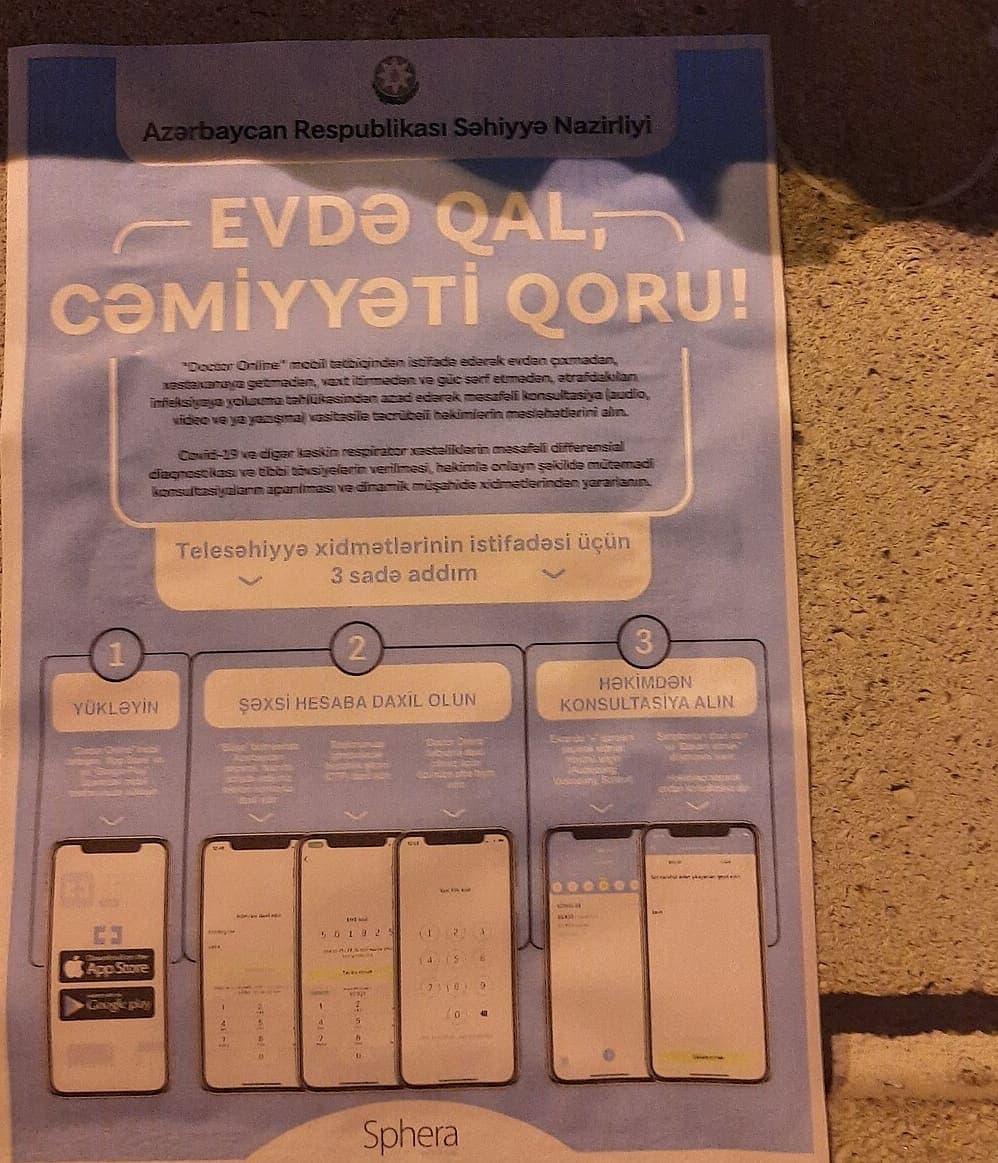
Ministry of Healthcare of the Republic of Azerbaijan, 18 August 2020 · Source · Public domain · Photograph by Aykhan Zayedzadeh
Evidano Transcription
Azərbaycan Respublikası Səhiyyə Nazirliyi
EVDƏ QAL,
CƏMİYYƏTİ QORU!
"Doctor Online" mobil tətbiqindən istifadə edərək evdən çıxmadan,
xəstəxanaya getmədən, vaxt itirmədən və güc sərf etmədən, ətrafdakıları
infeksiyaya yoluxma təhlükəsindən azad edərək məsafəli konsultasiya (audio,
video və ya yazışma) vasitəsilə təcrübəli həkimlərin məsləhətlərini alın.
Covid-19 və digər kəskin respirator xəstəliklərin məsafəli differensial
diaqnostikası və tibbi tövsiyələrin verilməsi, həkimlə onlayn şəkildə mütəmadi
konsultasiyaların aparılması və dinamik müşahidə xidmətlərindən yararlanın.
Telesəhiyyə xidmətlərinin istifadəsi üçün
3 sadə addım
1
YÜKLƏYİN
[step text illegible]
App Store
Google play
2
ŞƏXSİ HESABA DAXİL OLUN
[step text illegible]
3
HƏKİMDƏN
KONSULTASİYA ALIN
[step text illegible]
Sphera
Generated by Evidano’s advanced model; not yet checked against a published edition.
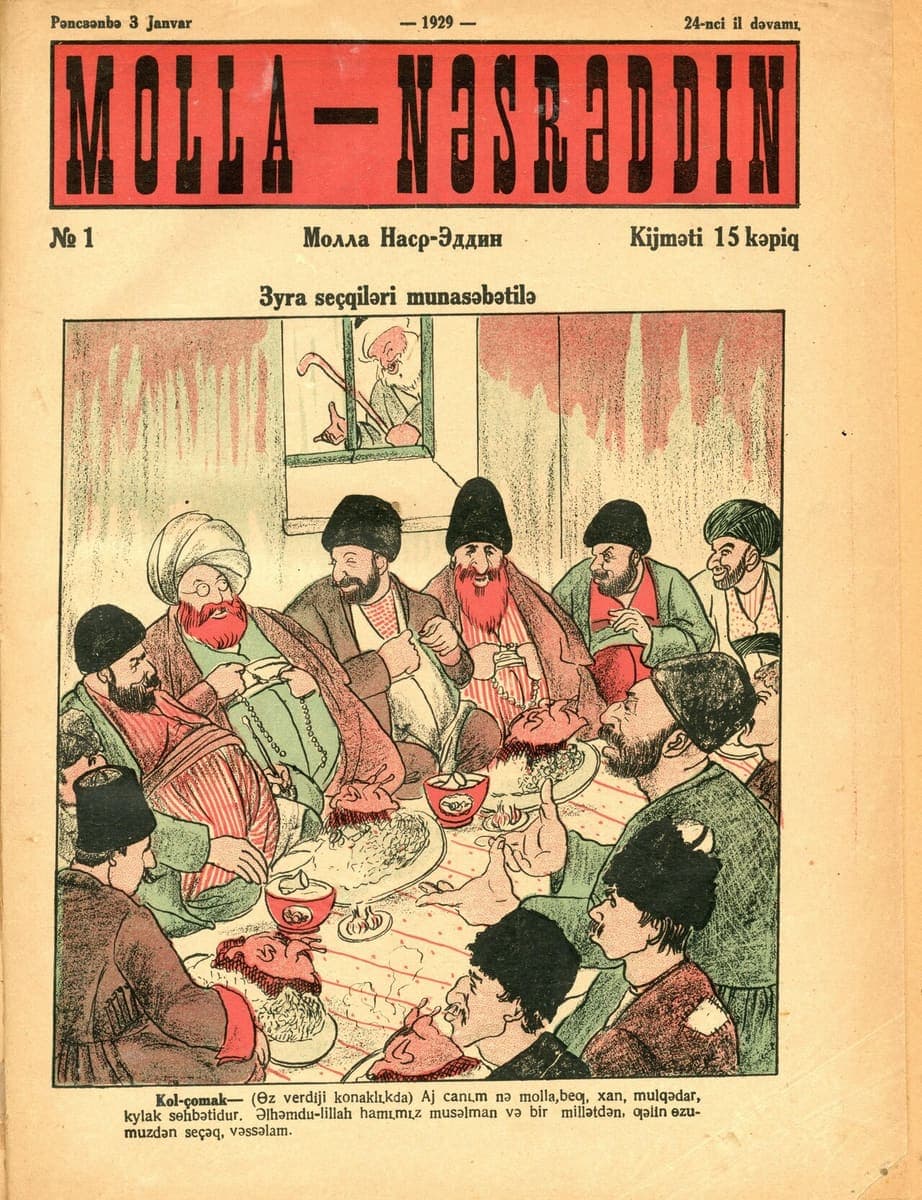
Evidano Transcription
The masthead, price line, section heading and full cartoon caption on the front cover, from Azerbaijani Wikisource’s validated (proofread twice) transcription of this page. The Wikisource text lightly normalises a few of the 1929 print’s spellings (bəy for the cover’s "beq", qulaq for "kylak") rather than reproducing every letter as printed.
Pəncşənbə 3 yanvar — 1929 — 24-cü il (davamı)
MOLLA-NƏSRƏDDİN
№ 1     Молла-Наср-Эддин     Qiyməti 15 qəpik
Şura seçkiləri münasibətilə
Qolçomaq (öz verdiyi qonaqlıqda): Ay canım, nə molla, bəy, xan, mülkədar, qulaq söhbətidir. Əlhəmdülillah, hamımız müsəlman və bir millətdən, gəlin özümüzdən seçək, vəssalam.
Source: Molla Nəsrəddin, 1929, № 1, p. 1, via Azerbaijani Wikisource (Public domain).
One language, four official alphabets since 1900
Until the 1920s, Azerbaijani was written exclusively in Perso-Arabic script, the same letters and Nastaʿliq-influenced print faces used for Ottoman Turkish and Persian, with extra diacritics for sounds neither language has. It served the classical Divan poetry of Füzuli and Nəsimi, and it carried the first modern Azerbaijani press: newspapers such as Əkinçi, Ziya and, from 1909, the short-lived daily Həqiqət, whose masthead paired its Arabic-script title with a Russian one for the colonial-era Baku readership. In Iran, where several million Azerbaijani speakers live, the language is still written this way today.
A Latinisation movement that began among Azerbaijani intellectuals even before Soviet rule culminated in the Birləşdirilmiş Yeni Türk Əlifbası, the Unified New Turkic Alphabet, made official across Soviet Azerbaijan in 1929. Reformers such as Fərhad Ağazadə produced primers and comparison charts setting each new Latin letter beside its Arabic equivalent, since a generation of readers had to learn both the shapes and the sounds at once. The alphabet added letters unfamiliar even to other Latin scripts, among them ə for schwa, ƣ for a voiced uvular fricative, and a barred ө, to cover sounds Ottoman Turkish’s own later Latin alphabet did not need.
Stalin-era policy replaced this Latin alphabet with a Cyrillic one in 1939, in use until independence in 1991. Azerbaijani Cyrillic was never simply Russian Cyrillic with Azerbaijani words: it added Әә, Ғғ, Ҹҹ, Өө, Үү and Һһ, and, distinctively, used a Latin-shaped Јј rather than Й for the sound Russian would render with a semivowel. Independent Azerbaijan returned to Latin script in 1991, briefly wrote schwa as ä, then in 1992 settled on the 32-letter alphabet used today, with ə, ğ, ı, ö, ü, ç and ş restored to something close to the 1929 spelling reform they replace.
Why ordinary OCR struggles here
One lifetime, three unrelated alphabets
A person born in Baku in the 1920s could have learned to read in Arabic script, sat school exams in the 1929 Latin alphabet, filled out Soviet paperwork in Cyrillic, and renewed a passport after 1991 in a third, different Latin alphabet. A recogniser has to identify which of four scripts a given page uses before it can read a single word, and a family archive routinely mixes all of them.
Perso-Arabic print with no short vowels
Pre-1929 newspapers and manuscripts run right to left in a cursive Nastaʿliq-influenced hand where letters change shape by position in the word and short vowels are simply not written. Reading them correctly depends on knowing Azerbaijani vocabulary well enough to supply the missing vowels, not on matching letterforms alone.
Latin letters no ordinary font contains
The 1929 Uniform Turkic Alphabet’s ə, ƣ and barred ө have no reliable place in fonts or training data built around English or French text, so period primers, charts and newsprint in this alphabet are routinely misread as accented versions of ordinary Latin letters, or dropped altogether.
Cyrillic that is not quite Russian
Because Azerbaijani Cyrillic adds letters Russian does not have and reassigns others, a model trained mainly on Russian text either garbles Әә, Ғғ and Ҹҹ or silently substitutes the nearest Russian letter, and can mistake the Azerbaijani Јј for an apostrophe, a stray comma or the digit one.
Who works with this material
Family historians and genealogists
Azerbaijani households often keep Soviet-issued documents beside older Arabic-script papers and newer Latin ones, and a single family tree can need all three read correctly. Getting a birth record or a kolkhoz membership card into text first means recognising which alphabet the year of issue would have used.
Archivists digitising the periodical press
Libraries holding runs of Əkinçi-era Arabic-script papers, 1930s Latin-alphabet gazettes and Soviet Cyrillic dailies like Kommunist need consistent, catalogue-ready text from all three, without treating each script as a separate, incompatible project.
Literary scholars and translators
Editors preparing modern editions of Füzuli or Nəsimi work from Perso-Arabic manuscripts and early printed Divans, and need a diplomatic first pass that keeps the Arabic letterforms and missing vowels visible rather than silently guessing a modern reading.
Land, notarial and legal-record teams
Pre-1991 property, court and civil registers exist in Cyrillic and, further back, in the 1929 Latin alphabet, and making them searchable in a modern database means converting consistently between the historical spelling and today’s orthography.
Getting the best transcription
Say which alphabet the page is in
A single archive can mix Arabic script, two Latin alphabets forty years apart, and Cyrillic. Tell the model which one it is looking at, or ask it to identify the script first, rather than assuming one alphabet across a whole folder.
Decide whether to keep the original spelling or modernise it
Set a rule up front for whether the 1929 alphabet’s ə, ƣ and ө, or the Cyrillic ә, ғ and ј, should be output as written or converted to their modern Latin equivalents, and apply it consistently across a batch.
For Perso-Arabic pages, ask for the missing vowels to be supplied, not guessed silently
Request that any vowel the model has added to make a word readable be marked or noted, since Perso-Arabic Azerbaijani omits short vowels entirely and two different words can share the same unvowelled letters.
Test on the densest column first
Run the small print of a period newspaper or the cramped cells of an alphabet chart before a whole run. If those come back clean, plainer modern typescript and signage will need little further checking.
Frequently asked questions
- Can one tool read Azerbaijani in Arabic script, Latin and Cyrillic without separate setup?
- Yes. Tell it which alphabet the page uses, or let it identify the script itself, and it applies the right letterforms and reading direction rather than assuming the modern Latin alphabet by default.
- How are Azerbaijani Cyrillic letters that don’t exist in Russian, like Әә and Јј, handled?
- They are recognised as their own letters rather than folded into the nearest Russian equivalent. You can ask for them to be kept as written or converted to their modern Latin counterparts, ə and y or j depending on position.
- What about the 1929 alphabet’s unfamiliar letters, such as ƣ and barred ө?
- They are read as the distinct letters they are rather than treated as typos or accented Latin letters. State in the prompt whether you want them preserved for a diplomatic transcription or normalised to today’s spelling.
- Can a Perso-Arabic Azerbaijani manuscript or newspaper be transcribed reliably?
- It can be read and a plausible vowelling supplied, but Nastaʿliq-influenced cursive and the total absence of short vowels make this the hardest of the four alphabets. Treat the output as a first pass for an editor familiar with the text to check, especially for poetry and unfamiliar proper names.
- Will it tell me which historical alphabet a document is likely to be in if I don’t know the date?
- Given a page, it identifies the script it can see. Since each script maps to a known period, Perso-Arabic to before 1929, the Uniform Turkic Alphabet to 1929–1939, Cyrillic to 1939–1991, and the modern alphabet after 1991, that identification usually narrows the document’s date as a side effect.
Related scripts and pages
Transcribe your Azerbaijani documents
Upload a Perso-Arabic newspaper, a Soviet Cyrillic record or a modern Latin form, and check the alphabet the model has chosen before running the rest.