
Belarusian
Belarusian read in whichever script it was written
No other language on this site has been written in three unrelated scripts by its own speakers: Cyrillic for the chancery records of the Grand Duchy of Lithuania and for the modern state, Latin letters for the Łacinka alphabet that ran in parallel for four centuries, and Arabic script for the prayer books Lipka Tatars kept in their adopted Slavic tongue. A document may also use letters no modern keyboard produces, from the ѣ of sixteenth-century print to the ў that marks Belarusian off from Russian today. Evidano reads Belarusian in whichever of these systems a source uses, keeping the original image beside the reading.
Sample pages
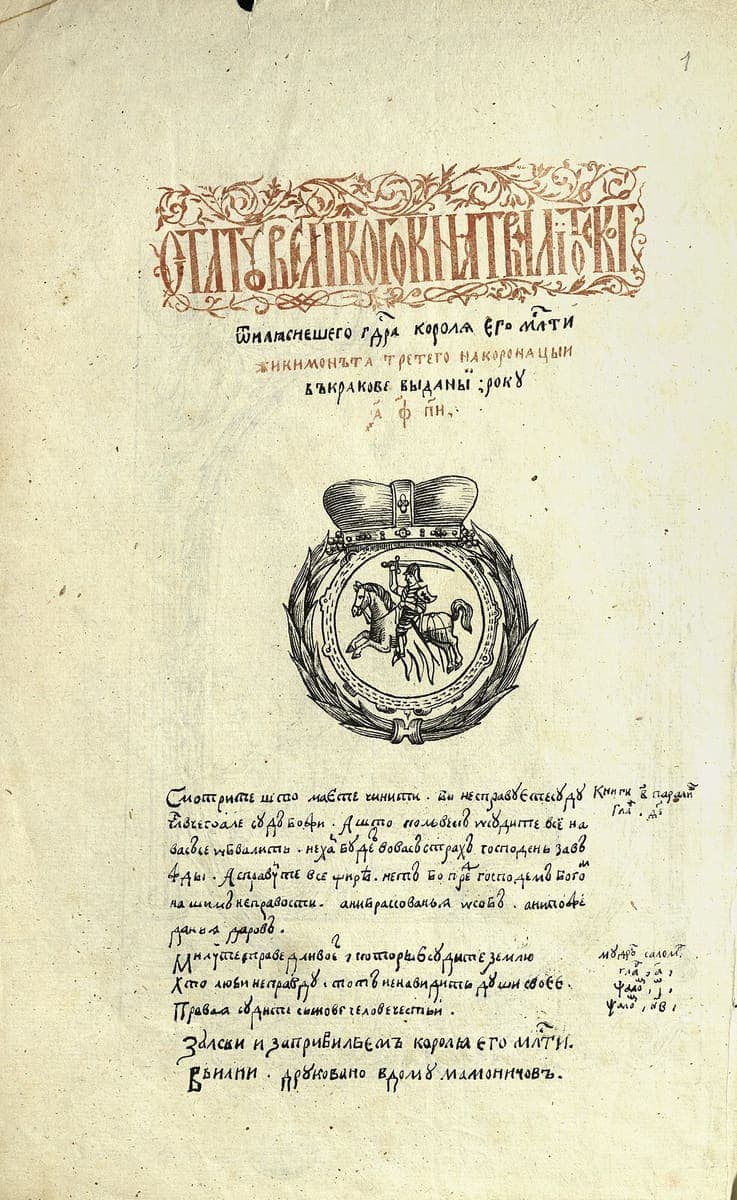
Wróblewski Library of the Lithuanian Academy of Sciences, Vilnius, 1588 · Source · Public domain
Evidano Transcription
1
СТАТУТЪ ВЕЛИКОГО КНЯЗТВА[?] ЛИТОВСКОГО
Ѿ наяснешего г[оспо]д[а]ра короля єго м[и]л[о]сти
жикимонъта третего на коронацыи
въ кракове выданы ; року
҂а ф пн .
Смотрите што маете чинити . вы не справуете судъ
чл[о]вечого[?] але судъ божи . А што кольвекъ ѡсудите все на
вас се ѡбвалить . нехаи буде во вас страхъ господень завъ
жды . А справуите все щире[?] . нетъ бо пре[д] господемъ бого[м]
нашимъ неправости . ани бракованьѧ[?] ѡсобъ . ани поже
даньѧ даровъ .
Милуите справедливость которыи судите землю
Хто люби неправду . тотъ ненавидить души своее .
Правая судите сынове человечестии .
З ласки и за привилемъ короля єго м[и]л[о]сти .
Вьилни . друковано в дому мамоничовъ .
[margin:]
Книги в парали[поменон]
гла[ва] . дї[?]
мудр[ость] салом[она]
гла[ва] , а ,
ѱало[м] , ї ,
ѱало[м] , нв ,
Generated by Evidano’s advanced model; not yet checked against a published edition.
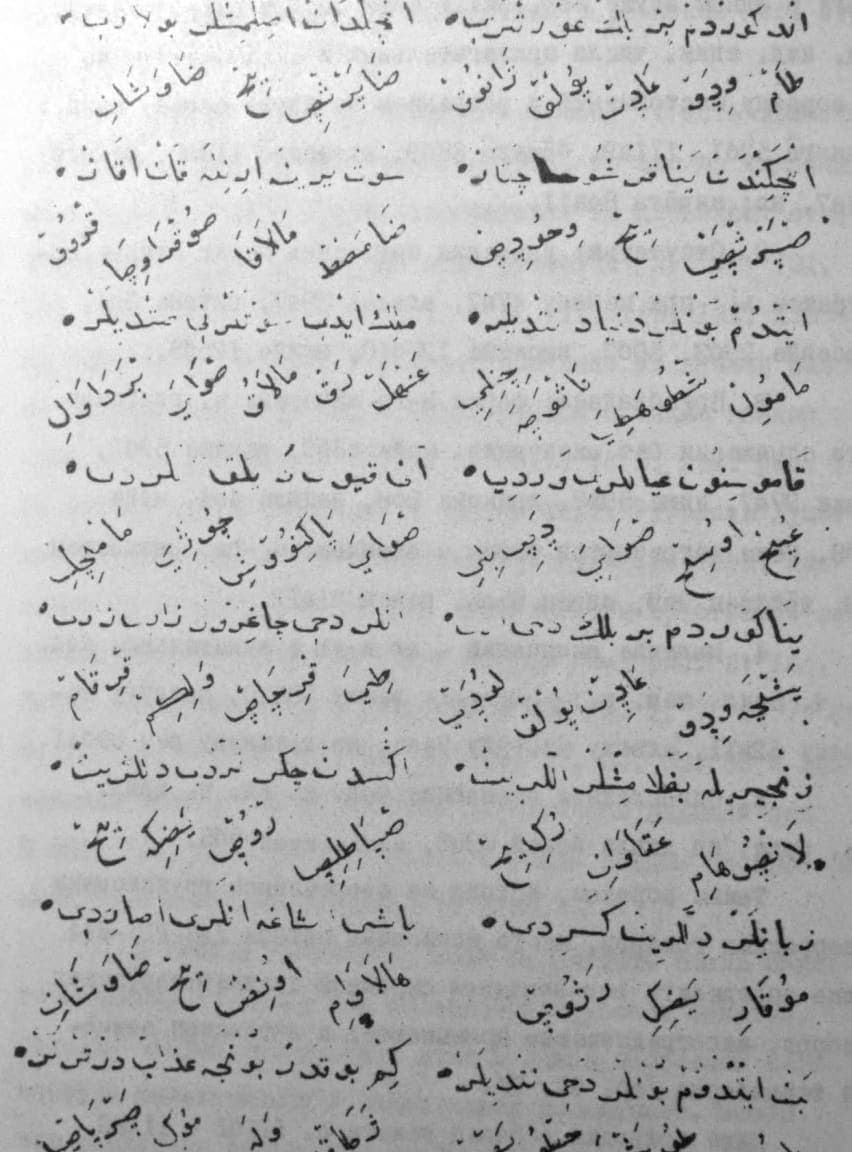
Formerly Ivan Lutskievich Belarusian Museum, Vilnius (archival code F21-814), First half of the 18th century · Source · Public domain · Facsimile as printed in A. K. Antonovich, Белорусские тексты, писанные арабским письмом (Vilnius, 1968), p. 56
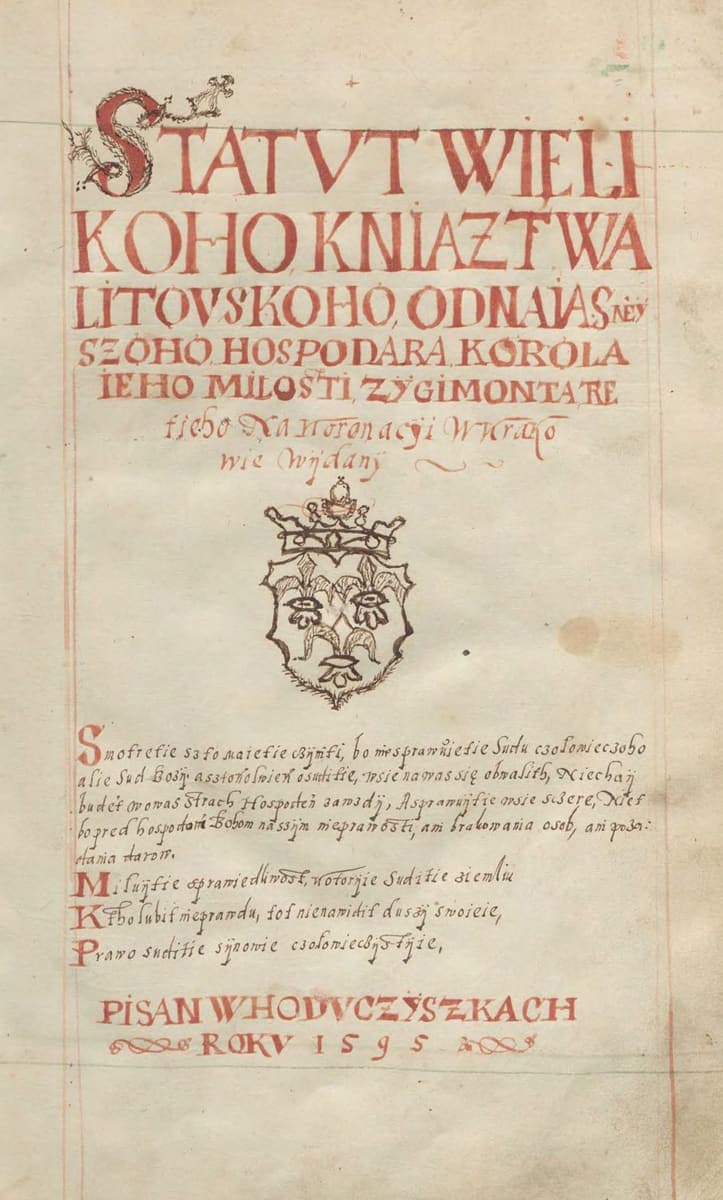
Jagiellonian Library, Kraków (Ms. Berol. Slav. Fol. 7), 1595 · Source · Public domain
Evidano Transcription
STATVT WIELI
KOHO KNIAZTWA
LITOVSKOHO, ODNAIASNEY
SZOHO HOSPODARA KOROLA
IEHO MILOSTI, ZYGIMONTA TRE
tieho Na Koronacyi W Krako
wie Wydany
[coat of arms]
Smotretie szto maietie czynitj, bo niesprawuietie Sudu czolowieczoho
alie Sud Bozy, a szto kolwiek osuditie, wsie na was się obwalith, Niechay
budet wo was Strach Hospoden zawzdy, A sprawuytie wsie szczere[?], Niet
bo pred hospodem Bohom naszym nieprawosti, ani brakowania osob, ani poza:
dania darow.
Miluytie sprawiedliwost, kotoryie Suditie ziemliu
Ktho lubit nieprawdu, tot nienawidit duszy swoieie,
Prawo suditie synowie czolowieczystyie[?],
PISAN W HODVCZYSZKACH
ROKV 1 5 9 5
Generated by Evidano’s advanced model; not yet checked against a published edition.
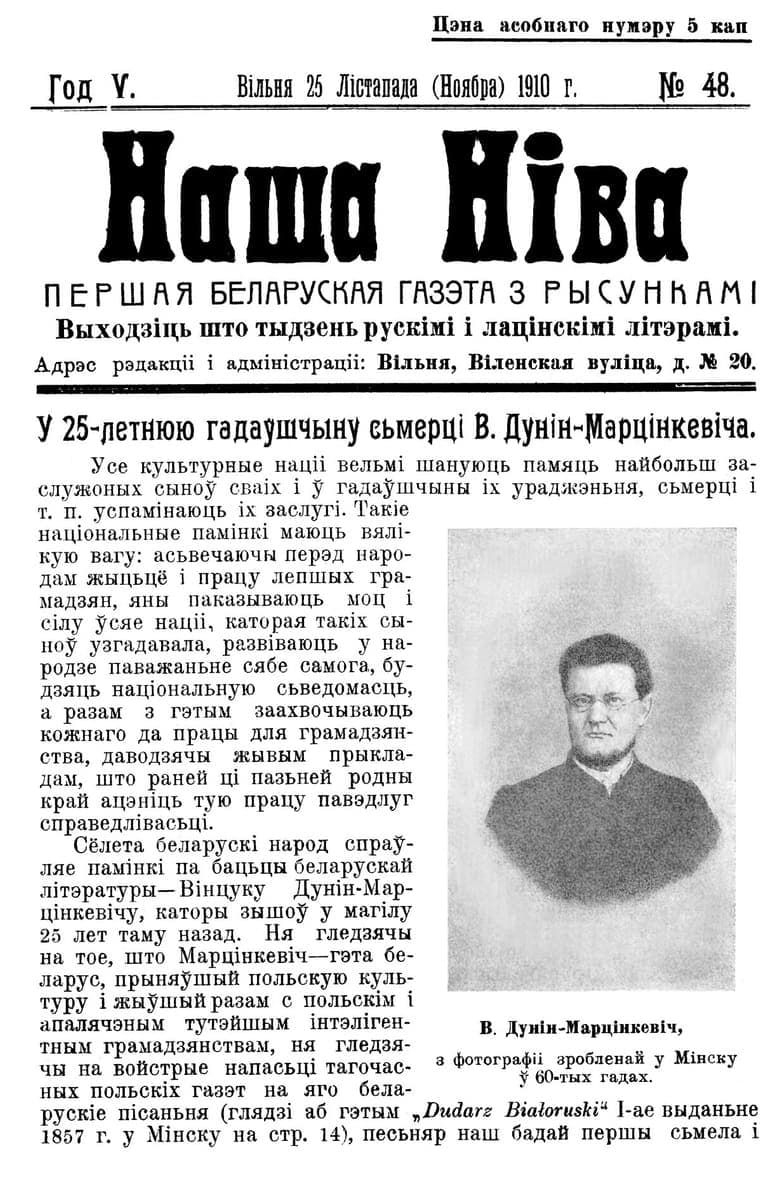
Source · Public domain · knihi.com
Evidano Transcription
The masthead, subtitle and the opening of the lead article on the anniversary of Dunin-Marcinkievich’s death, transcribed from the validated proofread text of this exact page on Belarusian Wikisource. The article continues onto the next page and is quoted here only as far as this page runs; the original pre-reform Taraškievica spelling, with its soft signs and letters no longer in modern use, is kept as proofread.
Цэна асобнаго нумэру 5 кап.
Год V.    Вільня 25 Лістапада (Ноября) 1910 г.    № 48.
Наша Ніва
ПЕРШАЯ БЕЛАРУСКАЯ ГАЗЭТА З РЫСУНКАМІ
Выходзіць што тыдзень рускімі і лацінскімі літэрамі.
Адрэс рэдакцыі і адміністрацыі: Вільня, Віленская вуліца, д. № 20.
У 25-летнюю гадаўшчыну сьмерці В. Дунін-Марцінкевіча.
В. Дунін-Марцінкевіч, з фотографіі зробленай у Мінску ў 1860-тых гадах.
Усе культурные націі вельмі шануюць памяць найбольш заслужоных сыноў сваіх і ў гадаўшчыны іх ураджэньня, сьмерці і т. п. успамінаюць іх заслугі. Такіе національные памінкі маюць вялікую вагу: асьвечаючы перэд народам жыцьцё і працу лепшых грамадзян, яны паказываюць моц і сілу ўсяе націі, каторая такіх сыноў узгадавала, развіваюць у народзе паважаньне сябе самога, будзяць національную сьведомасць, а разам з гэтым заахвочываюць кожнаго да працы для грамадзянства, даводзячы жывым прыкладам, што раней ці пазьней родны край ацэніць тую працу паводлуг справедлівасьці.
Сёлета беларускі народ спраўляе памінкі па бацьцы беларускай літэратуры — Вінцуку Дунін-Марцінкевічу, каторы зышоў у магілу 25 лет таму назад. Ня гледзячы на тое, што Марцінкевіч — гэта беларус, прыняўшый польскую культуру і жыўшый разам с польскім і апалячэным тутэйшым інтэлігентным грамадзянствам, ня гледзячы на войстрые напасьці тагочасных польскіх газэт на яго беларускіе пісаньня (глядзі аб гэтым „Dudarz Bіałoruskі“ І-ае выданьне 1857 г. у Мінску на стр. 14), песьняр наш бадай першы сьмела і…
Source: Старонка:Наша Ніва 1910 48.djvu/1, via Belarusian Wikisource (Public domain).
What Belarusian writing looks like
From the fourteenth century, a written language historians call Ruthenian or Old Belarusian served as the official chancery language of the Grand Duchy of Lithuania, recorded in Cyrillic script close to Church Slavonic in its letterforms but Belarusian and Ukrainian in its vocabulary and grammar. Its high point is the three Statutes of the Grand Duchy — legal codes of 1529, 1566 and 1588 — printed in Vilnius with ornamental woodcut arms, decorative ligatured headings in a style called vyaz, and body text set in an early Cyrillic type; Ruthenian lost its official standing after Polish took over the chancery in the late seventeenth century, and by the nineteenth century Belarusian survived mainly as an unwritten peasant speech. Alongside Cyrillic administrative writing, some sixteenth-century scribes copied Belarusian texts, including manuscript copies of the Statute itself, using Latin letters spelled on Polish lines — an early ancestor of the Łacinka alphabet that would later be standardised with the diacritic marks š, č, ž and ń borrowed from Czech, and used through the nineteenth and early twentieth centuries for underground political writing, religious books and, from 1906, the newspaper Naša Niva, which for several years printed every issue twice over, once in Cyrillic and once in Łacinka, for readers who knew only one.
A third, wholly separate tradition belongs to the Lipka Tatars, Muslim settlers invited into the Grand Duchy from the late fourteenth century who gradually lost their own Turkic language but kept their faith, and from the sixteenth century began writing Belarusian and Polish religious texts in the Arabic script, adding extra dots and marks to represent Slavic sounds Arabic does not have. These manuscript compilations, called kitabs, mix Quranic commentary, prayers, tales and moral instruction in Belarusian written right to left in Arabic letters — a genuinely unusual pairing of a Slavic language with a Middle Eastern script. The modern Belarusian alphabet, codified in the early twentieth century and revised under Soviet rule in 1933, is Cyrillic with thirty-two letters, most distinctively ў, marking a short, non-syllabic "u" sound Russian does not distinguish, and і rather than и for the vowel that looks unremarkable but instantly marks a text as Belarusian rather than Russian; spelling generally follows pronunciation closely enough that unstressed "o" is usually written "a", reflecting the akanye vowel reduction of spoken Belarusian.
Why ordinary OCR struggles here
Sixteenth-century print letterforms and ligatures
The Statute editions use an early Cyrillic type with decorative ligatured headings, letters such as ѣ and omega-shaped forms no longer in use, and abbreviation conventions inherited from Church Slavonic printing, none of which a system trained on modern Belarusian or Russian type recognises correctly.
Łacinka spelling was never fully fixed
Different eras and authors wrote Łacinka with different diacritic conventions — sixteenth-century scribes followed Polish spelling habits, nineteenth-century writers used their own systems, and the standardised Czech-derived diacritics came later still — so an engine expecting one fixed Latin-alphabet convention misreads material from a different period as error-ridden Polish or Czech.
Kitab manuscripts read Belarusian through Arabic letters
A kitab’s text is Belarusian and Polish, not Arabic, but it is written right to left in Arabic letters adapted with extra marks for Slavic consonants and vowels the Arabic alphabet has no signs for. An engine trained on Arabic vocabulary and grammar tries to parse the result as Arabic and fails, since the underlying language it needs to recognise is a completely different one.
ў and і collapse into Russian letters
Generic Cyrillic recognition tuned mainly on Russian text routinely maps ў onto у and treats і as a variant of и, which silently turns a genuinely Belarusian word into a Russian-looking one and defeats any search for the original spelling.
Who works with this material
Legal historians and Grand Duchy of Lithuania archives
The three Statutes and the chancery records that implemented them are the backbone of Lithuanian-Belarusian legal history, held across Lithuanian, Belarusian and Polish archives. A working transcription of a Statute printing or a chancery register, with the vyaz headings and obsolete letters kept rather than modernised, gives historians a text to cite before a critical edition exists.
Lipka Tatar heritage and kitab cataloguing projects
Kitabs are held in small numbers across Belarusian, Lithuanian and Polish museums and private Tatar family collections, many still undescribed in any detail. A transcription that reads the Belarusian text through its Arabic letters, rather than trying to parse it as Arabic, supports both cataloguing and the communities researching their own manuscripts.
Łacinka revival and diaspora publishing
Belarusian-language publishing outside government control, from the nineteenth-century underground press to today’s diaspora and heritage projects, has repeatedly returned to Łacinka. Digitising this material means recognising several generations of differing diacritic conventions rather than one fixed modern standard.
Genealogists working across imperial and Soviet-era records
Uniate and Orthodox parish registers, Polish-partition civil records and Soviet-era Belarusian paperwork span Cyrillic and Latin scripts and more than one spelling reform. Family researchers need names read in the alphabet and spelling the document actually uses, not corrected toward a modern standard that erases the clue to when and where it was written.
Getting the best transcription
Identify the script and the era together
Say whether a source is sixteenth-century Cyrillic print, a Łacinka manuscript or later Łacinka print, Arabic-script kitab writing, or modern Cyrillic, since the letterform and spelling conventions attached to each period differ substantially even within the same script.
State which Łacinka convention to expect
For Latin-letter Belarusian, note roughly when the source was written, since sixteenth-century Polish-style spelling, nineteenth-century usage and the later Czech-derived diacritic system are not interchangeable, and treating one as a misspelling of another loses real information.
Frame kitab material as Belarusian, not Arabic
Tell the prompt explicitly that the underlying language is Belarusian or Polish written in Arabic letters, so it maps the script to Slavic sounds rather than trying to read the page as Arabic vocabulary, and ask for uncertain letters to be flagged rather than corrected toward an Arabic word.
Keep ў and і as their own letters
For modern Cyrillic material, state that ў and і must be preserved rather than normalised to у and и, which is the single most common way Belarusian text gets silently turned into something that reads like Russian.
Frequently asked questions
- Can it read the sixteenth-century printed Statutes of the Grand Duchy of Lithuania?
- Yes, the early Cyrillic type, the decorative vyaz headings and letters such as ѣ that have since dropped out of use are read as the historical forms they are rather than corrected to modern Belarusian or Russian spelling.
- Does it handle Łacinka, and which version of it?
- It reads Łacinka from any period you specify, since the diacritic conventions changed over time; naming the approximate date or source helps it apply the right convention rather than treating an older or newer spelling as an error.
- Can it read Lipka Tatar kitab manuscripts?
- Yes. The Arabic letters are mapped to the Belarusian or Polish sounds the Tatar scribes intended, including the extra marks added for sounds Arabic does not have, rather than being read as Arabic vocabulary.
- Does it keep ў and і distinct from Russian у and и?
- Both letters are preserved as themselves by default. This is the detail most likely to be lost by generic Cyrillic recognition, since it is trained mainly on Russian and tends to correct Belarusian-specific letters toward the nearest Russian one.
- How does it treat differences between Taraškievica and the Soviet-era spelling reform?
- Pre-1933 spelling and the post-1933 Soviet-reformed spelling are both transcribed as printed rather than converted to the other, so the orthography itself still tells you which standard, and roughly which period, the document belongs to.
Related scripts and pages
Turn your Belarusian sources into text
Upload a chancery print, a Łacinka manuscript, a kitab page or a modern document, and check the Belarusian reading against the image in its own script.