
Ukrainian
Ukrainian read as Ukrainian, letter for letter
Four letters decide whether a Ukrainian page has been read at all: і, ї, є and ґ, none of which exists in the Russian alphabet a generic Cyrillic engine is usually tuned for. The apostrophe in п’ять or з’їзд does as much work as any of them, and a cursive hand hides the dots that separate і from и. Evidano reads Ukrainian documents from the seventeenth century to yesterday’s pinned-up notice and keeps the spelling that is actually on the sheet.
Sample pages
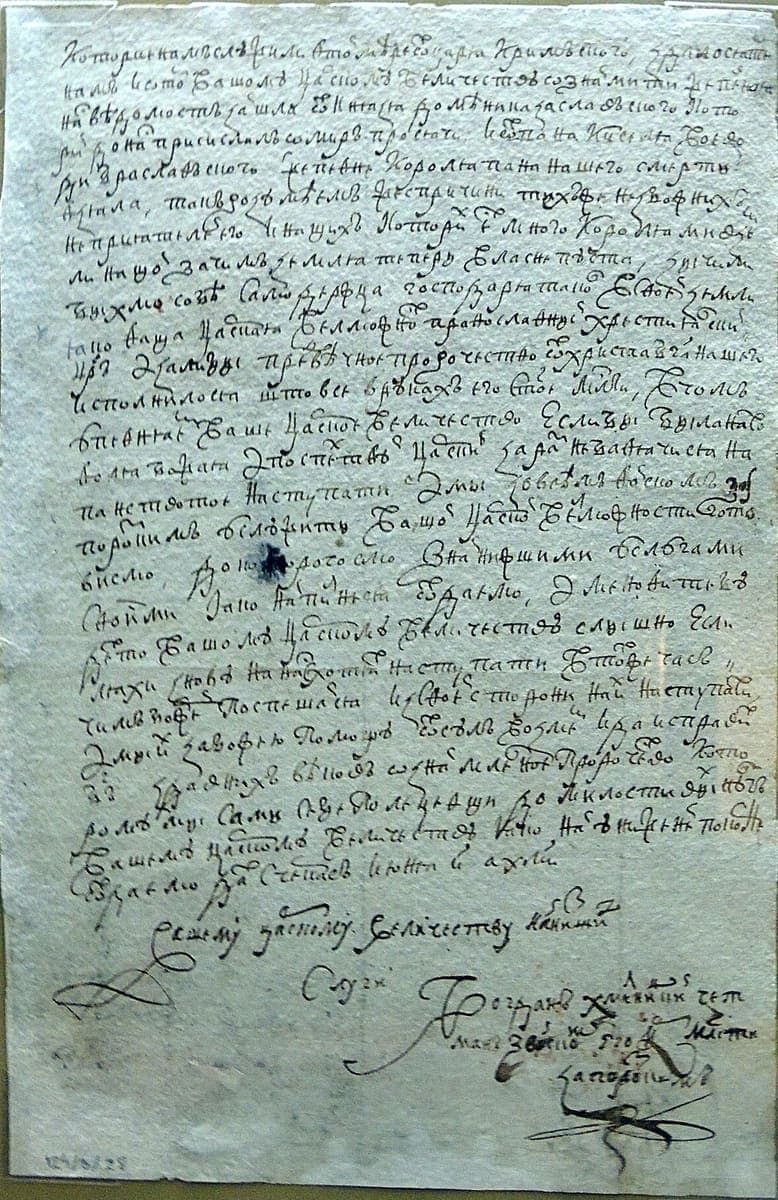
Russian State Archive of Ancient Acts (RGADA), Moscow, 8 June 1648 · Source · CC BY-SA 3.0 · Photograph by Shakko
Evidano Transcription
Которыи намъ служили въ то[м] [illegible] государя криловского[?], [illegible] остати
намъ все то вашому царскому величеству сознаимити[?], же [illegible]
на вѣдомость зашла [illegible] Доминика Заславского Кото
ри[и] она присилалъ со миромъ просити, [illegible] на Княжа[?] Федо
ру Заславского[?] [cancelled: гетман] Короля пана нашого смерти
думала[?], такъ розумѣемъ[?] [illegible] причини тыхъ же [illegible]
неприятелей и нашихъ которыхъ е много Короля [illegible]
ли нищо[?] зачимъ земля[?] теперъ власне [illegible], [illegible]
тыхмо[?] собѣ самодержца господаря такого[?] [illegible]
тако ваша царская Велможность православныи христианскии
царъ [illegible] превѣчное пророчество ѡ Христа Б[о]га нашого
исполнилоси што все в рукахъ его Б[о]жои м[и]л[ости], [illegible]
впевняе ваше царское величество если бы [illegible]
воля ваша з поспѣхомъ царскимъ [illegible] на
панство тое наступати а мы [illegible] Войскомъ За
порожскимъ услужити[?] вашои царскои Велможности гото
висмо, до [illegible] з наинижшими услугами
своими яко наинижшии братия, а [illegible]
бы то вашому царскому величеству слушно если
ляхи знову на [illegible] наступати [illegible] часъ
чимъ [illegible] поспѣшаемъ[?] изъ своеи стороны на[и] наступати
а мы [illegible] помочю [illegible] Б[о]жою[?] врага [illegible]
[illegible] пророчество кото
рому мы сами [illegible] до милости [illegible]
вашому царскому величеству яко на[и]нижшии [illegible]
братию [illegible] Черкасъ[?] [illegible] ахми[?]
вашому царскому величеству наинижшии
слуги
Богданъ Хмелницкии гетманъ
[illegible] милости
Запорозкимъ
Generated by Evidano’s advanced model; not yet checked against a published edition.
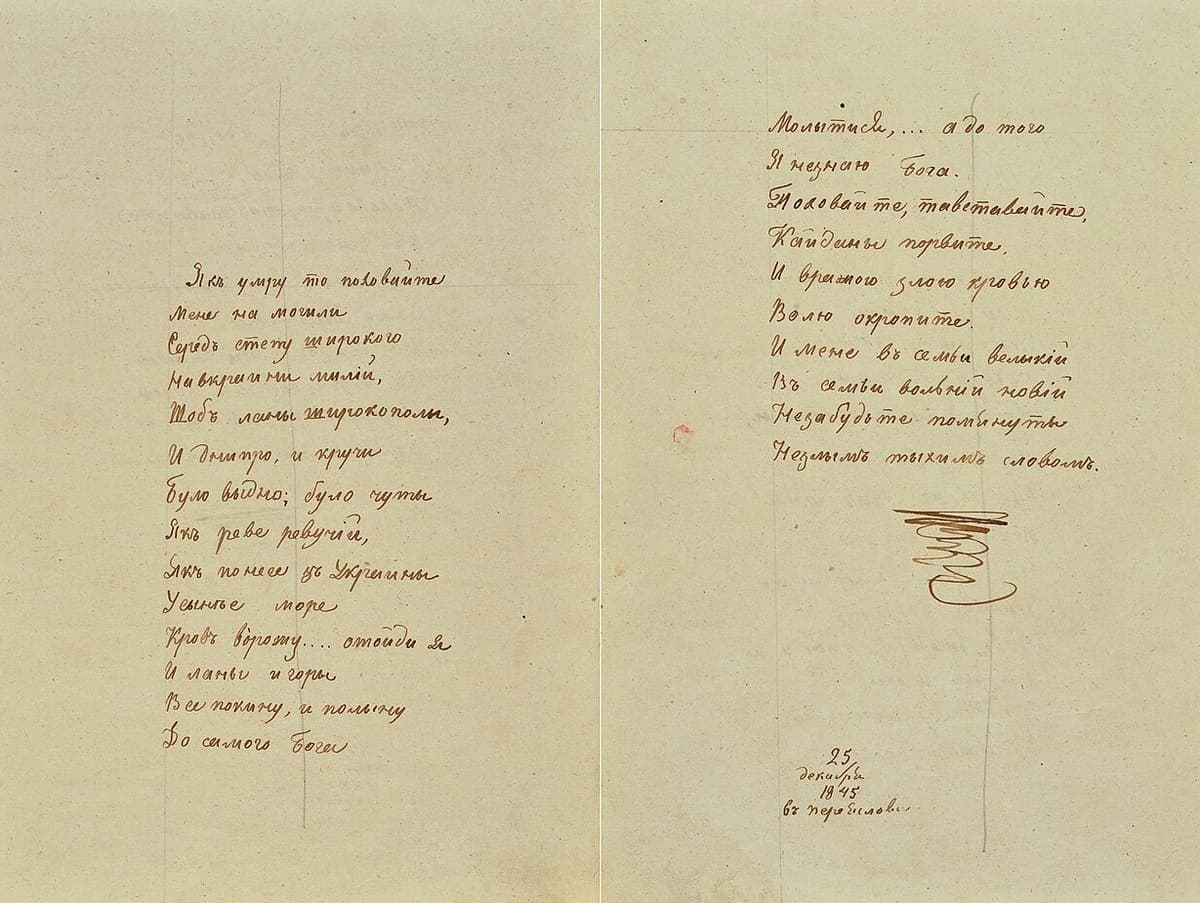
Source · CC BY-SA 4.0 · Reproduced from the Kobzar digital edition, kobzar.ua
Evidano Transcription
All twenty-four lines of the poem, the two pages shown, in its first full printing as «Завіщаннє» in the Lviv journal Мета (1863, no. 4, pp. 273–274), proofread from the scan on Ukrainian Wikisource. That printing keeps the period’s ъ and и but is an edition, not a diplomatic reading of this album: the manuscript spells several words differently. Line division is the same in both.
Якь умру, то поховайте
Мене на могилі
Середъ степу широкого
На Вкраіні милій,
Щобъ лани широкополі,
И Дніпро, и кручи
Були видні, було чути,
Якъ реве ревучий.
Якъ понесе зъ Украіни
У синєє море
Кровъ ворожу… оттоді я
И лани, и гори —
Все покину и полечу
До самого Бога —
Молитися… А до-того
Я не знаю Бога!
Поховайте та вставайте,
Кайдани порвіте,
И вражою злою кровъю
Волю окропіте!
И мене въ семъі великій,
Въ семъі вольній, новій,
Не забудьте помянути
Незлимъ, тихимъ словомъ.
Source: Тарас Шевченко, «Завіщаннє», Мета: литературно-политичний вістник, vol. I (Lviv, 1863), pp. 273–274, via Ukrainian Wikisource (Public domain).
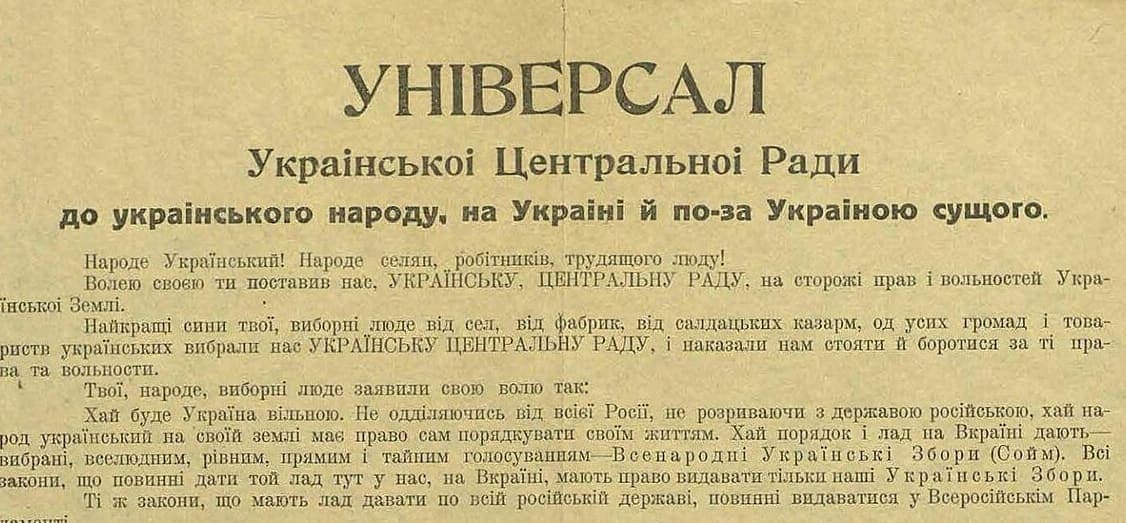
Evidano Transcription
The heading and the first six paragraphs, which is what this crop shows, from the proofread transcription of this very image on Ukrainian Wikisource. The heading keeps the sheet’s spelling, where і stands for modern ї; the transcribers’ inline emphasis markup has been dropped and their paragraph breaks kept.
УНІВЕРСАЛ
Украінськоі Центральноі Ради
до украінського народу, на Украіні й по-за Украіною сущого.
Народе Український! Народе селян, робітників, трудящого люду!
Волею своєю ти поставив нас, УКРАЇНСЬКУ, ЦЕНТРАЛЬНУ РАДУ, на сторожі прав і вольностей Української Землі.
Найкращі сини твої, виборні люде від сел, від фабрик, від салдацьких казарм, од усих громад і товариств українських вибрали нас УКРАЇНСЬКУ ЦЕНТРАЛЬНУ РАДУ, і наказали нам стояти й боротися за ті права та вольности.
Твої, народе, виборні люде заявили свою волю так:
Хай буде Україна вільною. Не одділяючись від всієї Росії, не розриваючи з державою російською, хай народ український на своїй землі має право сам порядкувати своїм життям. Хай порядок і лад на Вкраїні дають — вибрані, вселюдним, рівним, прямим і тайним голосуванням — Всенародні Українські Збори (Сойм). Всі закони, що повинні дати той лад тут у нас, на Вкраїні, мають право видавати тільки наші Українські Збори.
Ті ж закони, що мають лад давати по всій російській державі, повинні видаватися у Всеросійськім Парламенті.
Source: Перший Універсал Української Центральної Ради, proofread page for this image, via Ukrainian Wikisource (Public domain).
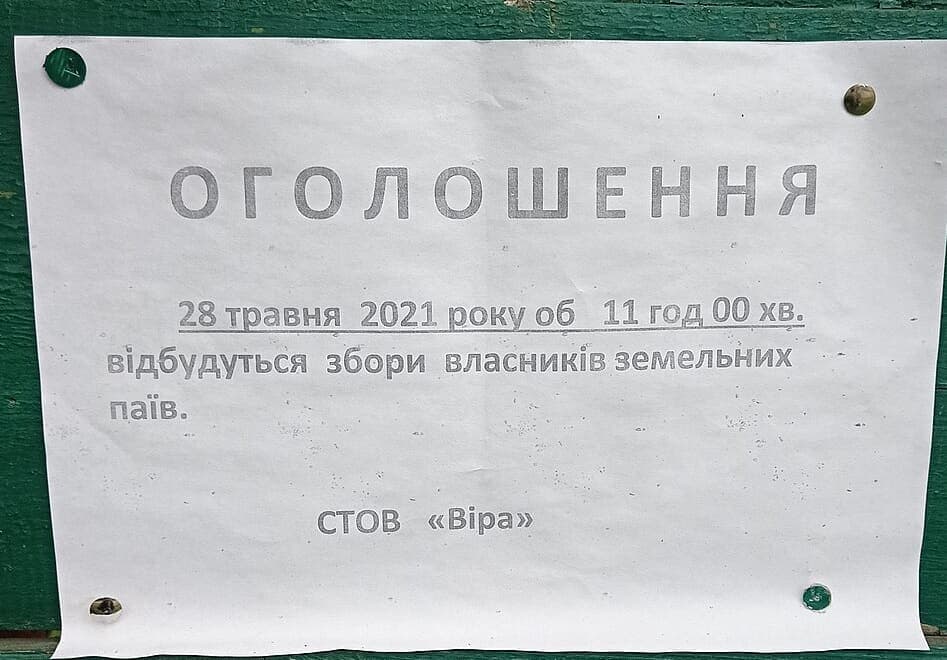
Source · CC BY-SA 4.0 · Nickispeaki
Evidano Transcription
ОГОЛОШЕННЯ
28 травня 2021 року об 11 год 00 хв.
відбудуться збори власників земельних
паїв.
СТОВ «Віра»
Generated by Evidano’s advanced model; not yet checked against a published edition.
What Ukrainian writing looks like
The modern alphabet has thirty-three letters. Four of them mark Ukrainian off from Russian at a glance: і, the dotted vowel; ї, which stands for the sequence yi; є, a reversed є for ye; and ґ, a г with an upturned tail for the hard g in ґанок or ґудзик. Just as telling is what is missing — there is no ы, no э, no ё and no hard sign, and the letter и carries a sound of its own rather than the Russian one. Between a consonant and a following iotated vowel the language writes an apostrophe: об’єкт, п’ять, з’їзд, Дем’ян. It is not decoration and not a quotation mark, and a transcription that drops it produces a word that no Ukrainian dictionary contains.
The documentary record starts long before that alphabet settled. Cossack chancery clerks of the seventeenth and eighteenth centuries wrote skoropys: a fast, looping cursive with letters raised above the line under a curved titlo, ligatures that bind two or three letters into one movement, and a final flourish under the signature that can occupy a quarter of the sheet. Under imperial rule Ukrainian was printed in the Russian civil type, so nineteenth-century writers spelled their own language with ы, ъ and ѣ — the system nicknamed yaryzhka, which is what Shevchenko used in his autograph albums. Alongside it ran Kulish’s system of 1856, Maksymovych’s etymological spelling with circumflexed vowels, and, after the Valuev circular of 1863 and the Ems decree of 1876 pushed printing over the Austrian border, the Galician zhelekhivka of 1886. A common orthography was agreed at Kharkiv in 1928 and revised by Soviet decree in 1933, when ґ was abolished; it came back only in 1990.
Everyday material adds its own habits. Ukrainian cursive is the Cyrillic round hand in which и runs like a Latin u, т like an m, and п like an n, so a word can dissolve into a row of identical arches; the dot on і and the pair on ї are the first things a fast writer loses. Soviet and post-Soviet paperwork means ruled forms filled by typewriter and by hand, purple stamps landing across the answers, carbon copies with the second sheet almost blank, and headings in a spaced-out letterpress capital. Signs, packaging and pinned-up village notices are laser print on curled paper photographed at an angle, often with a Russian or English line beside the Ukrainian one.
Why ordinary OCR struggles here
Silently turned into Russian
An engine set to Cyrillic without being told which language it is reading maps і onto и, ї onto й, є onto е and ґ onto г, because those are the shapes its training data contains. Nothing looks wrong in the output — the words are merely the wrong words, and a search for Київ will never find the page that has been turned into Киев.
The apostrophe and the soft sign
The apostrophe is a letter-level mark, but scanners see a speck of dust, a quotation mark or nothing at all, and typists have written it as a straight quote, a curly quote, a grave accent or a space. The soft sign ь has the opposite problem: it is small, it sits at the end of words, and in a soft scan it merges with the preceding letter.
Raised letters and titla in skoropys
A seventeenth-century clerk lifted letters out of the line to save space, covered them with a curved stroke, and abbreviated the standard formulas of address so heavily that a line of a letter to the tsar is a third shorter than the words it stands for. Reading it means restoring the missing letters from the formula rather than from the shapes, and recording which ones were supplied.
Several spellings of the same language
A single archive box can hold yaryzhka with ы and ѣ, a Galician newspaper in zhelekhivka, a 1928 Kharkiv-norm textbook and a post-1990 form with ґ restored. Correcting any of them to modern orthography destroys the evidence that dates the document, and mixing Ukrainian, Russian, Polish and Church Slavonic on one page is normal rather than exceptional.
Who works with this material
Archives and genealogy
Metrical books, revision lists, land records and personal files fill the Ukrainian state archives and the volunteer indexing projects around them. What an indexer needs first is the names, dates and settlements as the clerk wrote them, with the і and ї intact, because a surname normalised into Russian will never match the rest of the family.
Editors of literary papers
Autograph albums, drafts and letters of nineteenth- and twentieth-century writers are edited from the manuscript, not from later printings. An editor wants the album’s own spelling preserved so that variant readings can be compared with the printed texts, and uncertain letters flagged instead of quietly corrected.
Diaspora newspapers and community collections
Ukrainian-language papers printed in Lviv, Winnipeg and New Jersey run to tens of thousands of pages, mostly in orthographies no longer taught. Community archives digitising them need a text that keeps the etymological spellings so a searchable index can be built without editing the historical record.
Offices working through scanned paperwork
Certificates, contracts, application forms and utility notices arrive as phone photographs, stamped and signed across the print. Here the useful output is the wording with the layout preserved, so a field and its filled-in answer stay together and the stamp is recorded as a stamp.
Getting the best transcription
Name the language before the script
Say Ukrainian, not Cyrillic, and list the letters that must survive: і, ї, є, ґ and the apostrophe. That one line in the prompt is what stops the transcription drifting into Russian spellings on words the two languages share.
Decide what to do with old letters
For anything written before 1918, say whether ѣ, ъ, ы and the old і are to be kept as printed or modernised. Keeping them is the right default for archival work; if you also want a modern-spelling version, ask for it as a second block so the two can be compared rather than conflated.
Set an expansion rule for skoropys
For seventeenth- and eighteenth-century documents, ask for raised letters to be brought down into the word and for abbreviated formulas to be expanded with the supplied letters in brackets. State whether the titlo should be recorded, and the same treatment will be applied across a whole fond.
Test on a stamped, faded page
Start with the worst item in the batch — a carbon copy under a purple stamp, or a fast cursive letter — rather than the cleanest one. If the stamp is separated from the typed text and the illegible stretches are marked instead of guessed there, the rest of the run needs only spot checks.
Frequently asked questions
- Will і, ї, є and ґ come out as themselves?
- Yes. They are treated as the separate letters they are, not as variants of и, й, е and г, and ґ is kept wherever the page shows it. If a document predates 1990 and uses г where a modern text would write ґ, the page is transcribed as it stands rather than corrected.
- What happens to the apostrophe in words like з’їзд?
- It is transcribed as a character in the word. You can choose the typographic apostrophe or the straight one for consistency with an existing database, and where a typist used a grave accent or left a gap the reading is normalised to a single form and the choice recorded.
- Can it read Cossack skoropys from the seventeenth century?
- It reads the hand rather than a font, so raised letters, ligatures and titla are recognised as parts of words. Because expansion is an editorial decision, you say whether abbreviations should be expanded silently, expanded in brackets or left as written, and the flourishes around a signature are described rather than transcribed.
- How are pre-reform spellings such as yaryzhka handled?
- They are preserved. A page printed with ъ, ы and ѣ is transcribed with them, so the orthography still dates the document, and Galician spellings with ї in unfamiliar places are left alone. Modernisation is available on request as a separate pass.
- What about pages that mix Ukrainian with Russian or Polish?
- Mixed pages are normal in imperial and interwar records. Each stretch is transcribed in its own language and can be labelled, so a Russian-language stamp on a Ukrainian form, or a Polish endorsement on a Galician certificate, is not folded into the surrounding text.
Related scripts and pages
Transcribe your Ukrainian documents
Upload a scan, an autograph or a photographed notice, tell the prompt it is Ukrainian, and check the first page before running the batch.