
Polish · c. 1500–1700
Three hands on one sheet of parchment
A Commonwealth privilege usually carries a Gothic display line, a Renaissance italic body and a chancery registration note in a third hand, with Polish, Latin and abbreviated titles moving between them. Add the diacritics that Polish is only beginning to use consistently, and a single sheet asks a reader for several skills at once. Evidano labels the hands and languages separately so a transcription can be checked stretch by stretch.
Sample pages
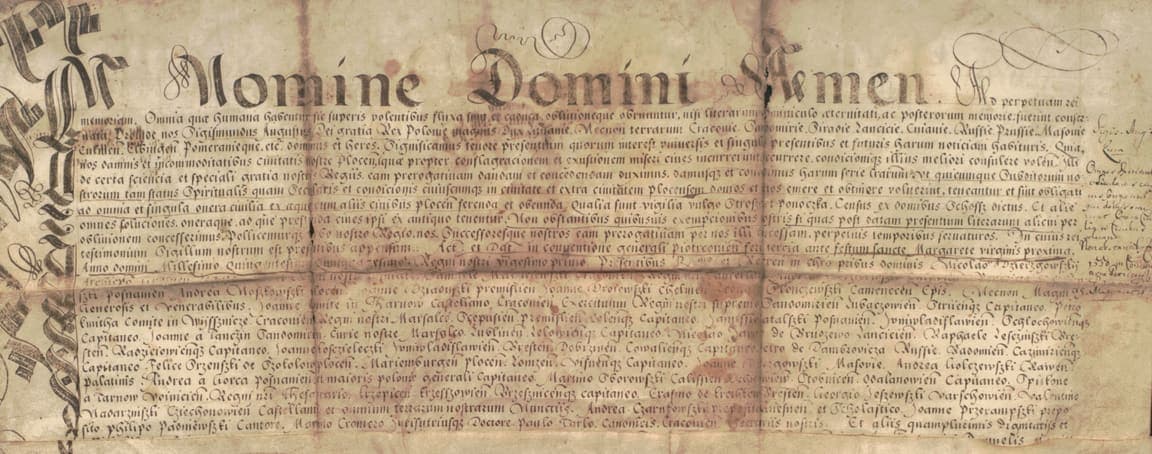
Archiwum Główne Akt Dawnych, Warsaw, Zbiór Dokumentów Pergaminowych 2048, 8 July 1550 · Source · Public domain · Archiwum Główne Akt Dawnych / Wikimedia Polska partnership
Evidano Transcription
In Nomine Domini Amen. Ad perpetuam rei
memoriam. Omnia que humana habentur sic superis volentibus fluxa sunt et caduca, obliuioneque obruuntur, nisi literarum adminiculo eternitati, ac posterorum memorie, fuerint conser=
uata. Proinde nos Sigismundus Augustus Dei gratia Rex Polonie magnus Dux Lithuanie. Necnon terrarum Cracouie. Sandomirie. Siradie. Lancicie. Cuiauie. Russie. Prussie. Masouie
Culmen. Elbingen. Pomeranieque. etc. dominus et heres. Significamus tenore presentium quorum interest vniuersis et singulis presentibus et futuris harum noticiam habituris. Quia,
Nos damnis et incommoditatibus ciuitatis nostre Plocen. que propter conflagracionem et exustionem miseri ciues incurrerunt occurrere, condicionique illius meliori consulere volen. Nos[?]
de certa sciencia et speciali gratia nostra Regiis. eam prerogatiuam dandam et concedendam duximus. damusque et concedimus harum serie literarum. vt quicunque Subditorum no=
strorum tam status Spiritualis quam Secularis et condicionis cuiuscunque in ciuitate et extra ciuitatem plocensem domos et areas[?] emere et obtinere voluerint, teneantur et sint obligati
ad omnia et singula onera ciuilia ex aequo cum aliis ciuibus plocen. ferenda et obeunda. Qualia sunt vigilia vulgo Strosz et ponoczka. Census ex domibus Schossz dictus. Et alie
omnes soluciones. oneraque. ad que prestanda ciues ipsi ex antiquo tenentur. Non obstantibus quibusuis exempcionibus [illegible] si quas post datam presentium literarum alicui per
obliuionem concesserimus. Pollicemurque pro[?] nostro Regio. nos. Successoresque nostros eam prerogatiuam per nos illi concessam. perpetuis temporibus seruaturos. In cuius rei
testimonium Sigillum nostrum est presentibus appensum. Act. et Dat. in conuentione generali piotrcouien. feria tercia ante festum sancte Margarete virginis proxima.
Anno domini Millesimo Quingentesimo [illegible] Regni nostri vigesimo primo. Presentibus R[euerendissi]mis et Reueren. in chro patribus dominis Nicolao Dzierzgowskij
[line faded, illegible]
[illegible]szki posnanien. Andrea Noszkowszki plocen. [illegible] Dziadoszki[?] premislien. Joanne Drohowszki[?] Chelmen. [illegible] Slonczewszki[?] Camenecen. Epis. Necnon Magnificis.
Generosis et venerabilibus. Joanne Comite in Tarnow Castellano Cracouien. Exercituum Regni nostri supremo. Sandomirien. Lubaczowien. Striienque Capitaneo. Petro
Kmitha Comite in Wyssznicze Cracouien. Regni nostri Marsalco. Scepusien. Premislien. Colenque Capitaneo. [illegible]atalszki Posnanien. Juniwladislawien. Schlochowienque
Capitaneo. Joanne a Tanczin Sandomirien. Curie nostre Marsalco Lublinen. Lelowienque Capitaneo. Nicolao [illegible] de Brudzewo Lancicien. Raphaele Lesczinszki Bre=
sten. Radzieiowienque Capitaneo. Joanne Koscieleczki Juniwladislawien. Bresten. Dobrzinen. Cowalienque Capitaneo. Petro de Dambrovicza Russie. Radomien. Cazimirienque
Capitaneo. Felice Srzenszki de Szolokow[?] plocen. Mariemburgen. plocen. Lomzen. Wisnenque Capitaneo. Joanne [illegible]gowszki Masouie. Andrea Ciolezewszki Rawen.
palatinis. Andrea a Gorca posnanien. et maioris polonie generali capitaneo. Martino Sborowszki Calissien. [illegible] Stobnicen. Odalanowien. Capitaneo. Spitkone
a Tarnow Woinicien. Regni nostri Thesaurario. Krzepicen. Krzesszowien. Brzesznicenque capitaneo. Erasmo de Kretkow[?] Bresten. Georgio Joszewszki Varschowien. Valentine
Nadarzinszki Cziechonowien. Castellanis et omnium terrarum nostrarum Ministris. Andrea Czarnkowszki [illegible] et Scholastico. Joanne Przerampszki prepo=
sito. philipo Padniewszki Cantore. Martino Cromero Jurisutriusque Doctore. Paulo Tarlo. Canonicis Cracouien. Secretariis nostris. Et aliis quamplurimis Dignitatibus et
[last line cut off]
[margin:] Sigis. Aug. / Rex [?]
[margin notes in small cursive illegible]
Generated by Evidano’s advanced model; not yet checked against a published edition.
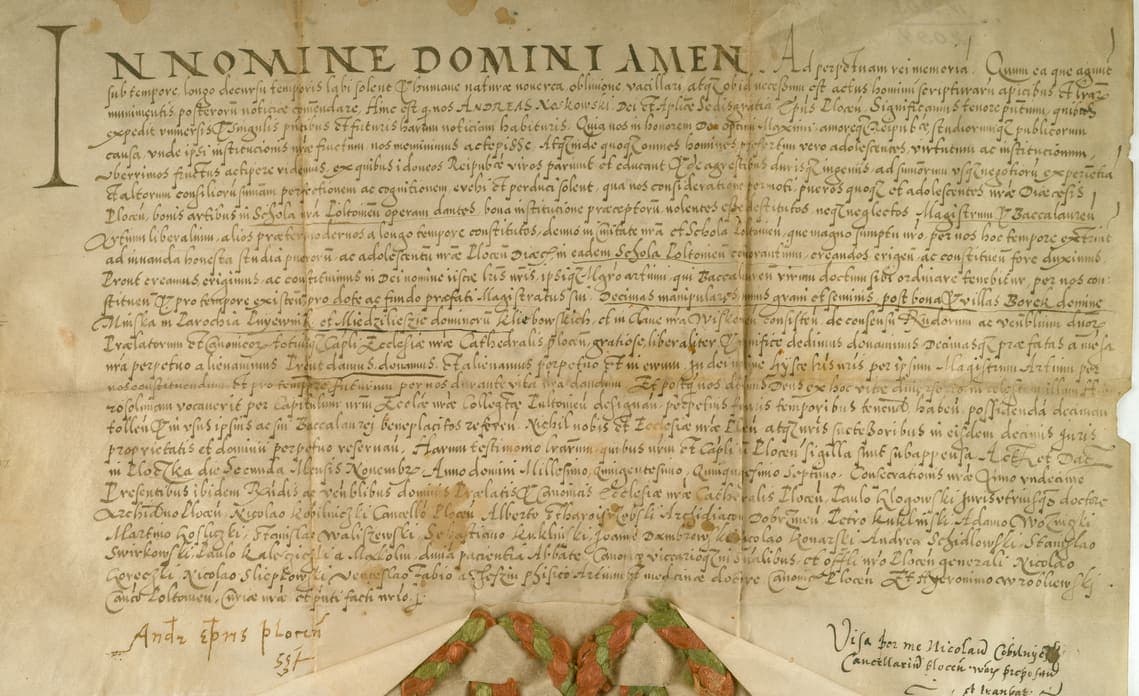
Archiwum Główne Akt Dawnych, Warsaw, Zbiór Dokumentów Pergaminowych 2200, 2 November 1557 · Source · Public domain · Archiwum Główne Akt Dawnych / Wikimedia Polska partnership
Evidano Transcription
IN NOMINE DOMINI AMEN. Ad perpetuam rei memoria[m]. Quum ea que agunt[ur]
sub tempore longo decursu temporis labi solent et humane nature nouerca obliuione vacillari atq[ue] ob id necessum est actus hominu[m] scripturaru[m] apicibus et l[ite]raru[m]
munimentis posteroru[m] noticie co[m]mendare. Hinc est q[uod] nos ANDREAS Noskowski Dei et Ap[osto]lice Sedis gratia Ep[iscopu]s Plocen[sis] Significamus tenore p[rese]ntiu[m] quibus
expedit vniuersis et singulis p[rese]ntibus et futuris haru[m] noticiam habituris. Quia nos in honorem Dei optimi Maximi amoremq[ue] Reipub[lice] et studioru[m]q[ue] publicorum
causa. vnde ipsi institucionis n[ost]re fructum nos meminimus accepisse Atq[ue] inde quoq[ue] omnes homines p[re]sertim vero adolescentes virtutum ac institucionum
vberrimos fructus accipere videmus. ex quibus idoneos Reipub[lice] viros pariunt et educant et de agrestibus durisq[ue] ingeniis ad sum[m]orum vsq[ue] negocioru[m] experientia
et altorum consilioru[m] sum[m]am perfectionem ac cognitionem evehi et perduci solent. qua nos consideratione permoti. pueros quoq[ue] et adolescentes n[ost]re Diocesis
Plocen[sis] bonis artibus in Schola n[ost]ra Poltouien[si] operam dantes. bona institucione p[re]ceptoru[m] nolentes e[ss]e destitutos neq[ue] neglectos Magistrum et Baccalaureu[m]
Artium liberalium. alios preter modernos a longo tempore constitutos. denuo in Ciuitate n[ost]ra et Schola Poltouien[si] que magno sumptu n[ost]ro per nos hoc tempore extruit[ur]
ad iuuanda honesta studia pueroru[m] ac adolescentiu[m] n[ost]re Plocen[sis] Dioc[esis] in eadem Schola Poltouien[si] [illegible] creandos erigen[dos] ac constituen[dos] fore duximus.
Prout creamus erigimus ac constituimus in Dei nomine iisd[em] l[ite]ris n[ost]ris. ipsiq[ue] M[agist]ro artium qui Baccalaureu[m] virum doctum sibi ordinare tenebitur per nos con=
stituen[do] et pro tempore existen[ti] pro dote ac fundo prefati Magistratus sui Decimas manipulares omnis grani et seminis post bona et villas Borek domine
Mniska in Parochia Luyewnik et Miedzilieszie dominoru[m] Sliebowskich. et in claue n[ost]ra Wiskouien[si] consisten[tes] de consensu R[euerend]orum ac ven[erabi]lium d[omi]nor[um]
Prelatorum et Canonicor[um] totiusq[ue] Cap[itu]li Ecclesie n[ost]re Cathedralis Plocen[sis] gratiose. liberaliter et munifice dedimus donauimus Decimasq[ue] prefatas a mensa
n[ost]ra perpetuo alienauimus Prout damus. donamus. et alienamus perpetuo et in euum in dei nomine hysce l[ite]ris n[ost]ris per ipsum Magistrum Artium per
nos constituendum et pro tempore futurum per nos durante vita n[ost]ra dandum Et postq[uam] nos d[omi]n[u]s Deus ex hoc vite diuersorio in celestem illam Hie=
rosolimam vocauerit per Capitulum n[ost]r[u]m Eccl[es]ie n[ost]re Collegiate Pultouien[sis] designan[dum] perpetuis futuris temporibus tenend[as] haben[das] possidend[as] deaman=
tollen[das] et in vsus ipsius ac sui Baccalaurei beneplacitos uerten[das]. Nichil nobis et Ecclesie n[ost]re Plocen[si] atq[ue] Iuris successoribus in eisdem decimis Iuris
proprietatis et dominii perpetuo reseruan[do]. Harum testimonio l[ite]rarum quibus n[ost]r[u]m et Cap[itu]li Plocen[sis] sigilla sunt subappensa. Act[um] et Dat[um]
in Ploczka die Secunda Mensis Nouembr[is] Anno domini Millesimo, Quingentesimo, Quinquagesimo Septimo. Consecrationis n[ost]re Anno vndecimo
Presentibus ibidem R[euerendi]s ac ven[erabi]libus dominis Prelatis et Canonicis Ecclesie n[ost]re Cathedralis Plocen[sis] Paulo Glogowski Iurisutriusq[ue] doctore
Archidiacono Plocen[si] Nicolao Kobilniczki Cancellario Plocen[si] Alberto Stharoijczewski[?] Archidiacono Dobrzinen[si] Petro Kuklinski Adamo Wozniczki[?]
Martino Hosliczki[?] Stanislao Waliszewski Sebastiano Kuklinski Joanne Dambrow[?] Nicolao Konarski Andrea Schidlowski Stanislao
Swirkowski Paulo Kalczinski[?] a Mokolin[?] [illegible] Abbate Canonicis vicariisq[ue] n[ost]ris generalibus et offi[ci]ali n[ost]ro Plocen[si] generali Nicolao
Goreczki Nicolao Sliepkowski Venceslao Fabio a Szeszin[?] phisico Artium et medicine doctore Canonicis Plocen[sibus] Et Hieronimo Wroblewski
Canonico Poltouien[si] Curie n[ost]re et p[rese]ntis facti notario.
Andr[eas] Ep[iscopu]s Plocen[sis]
55[?]
Visa per me Nicolaum Cobylnyczki[?]
Cancellarium Plocen[sem] [illegible] prepositum
[illegible]
Generated by Evidano’s advanced model; not yet checked against a published edition.
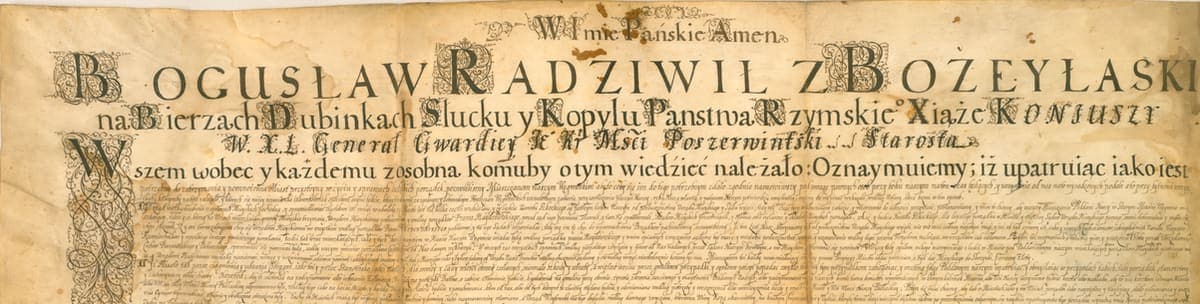
Archiwum Główne Akt Dawnych, Warsaw, Zbiór Dokumentów Pergaminowych 2298, 14 April 1650 · Source · Public domain · Archiwum Główne Akt Dawnych / Wikimedia Polska partnership
Evidano Transcription
W Imie Pańskie Amen
BOGUSŁAW RADZIWIŁ Z BOŻEY ŁASKI
na Bierzach Dubinkach Słucku y Kopylu Panstwa Rzymskie[go] Xiąże KONIUSZY
W. X. L. Generał Gwardiey J. K. Mści Poszerwintski Starosta
Wszem wobec y każdemu zosobna komuby o tym wiedzieć należało: Oznaymuiemy; iż upatruiąc iako iest
[body text in small script too small to read at this resolution]
Generated by Evidano’s advanced model; not yet checked against a published edition.
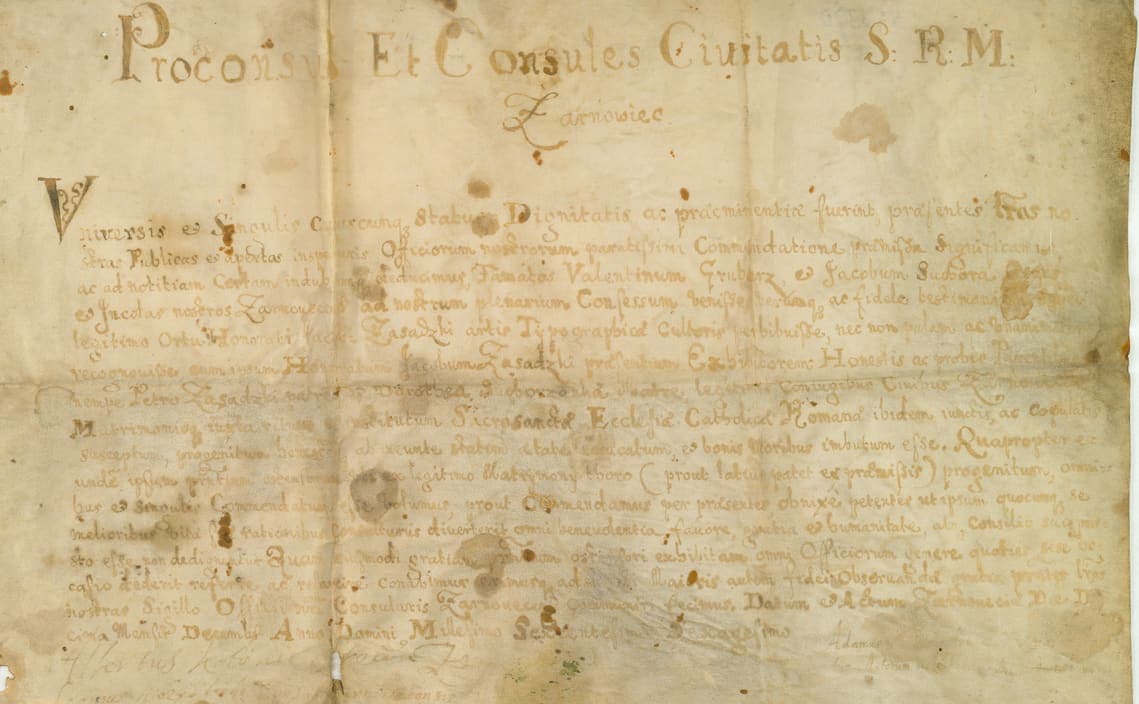
Archiwum Główne Akt Dawnych, Warsaw, Zbiór Dokumentów Pergaminowych 3370, 10 December 1660 · Source · Public domain · Archiwum Główne Akt Dawnych / Wikimedia Polska partnership
Evidano Transcription
Proconsul Et Consules Ciuitatis S. R. M.
Zarnowiec
Vniversis & Singulis Cuiuscunq[ue] Status Dignitatis ac praeeminentiae fuerint, praesentes l[ite]ras no=
stras Publicas & apertas inspecturis Officiorum nostrorum paratissim[am] Commendatione[m] praemissa Significamus,
ac ad notitiam Certam indubiamq[ue] deducimus, Famatos Valentinum Gruberz, & Jacobum Sudora, [illegible]
& Incolas nostros Zarnouiecen[ses] ad nostrum plenarium Consessum venisse stetisseq[ue] ac fidele testimoniu[m] [illegible]
legitimo Ortu Honorati Jacobi Zasadzki artis Typographicae Cultoris perhibuisse, nec non palam ac nominatim[?]
recognouisse, cum ipsum Honoratum Jacobum Zasadzki praesentium Exhibitorem Honestis ac probis Parentibus
Nempe Petro Zasadzki patre, & Dorothea, [illegible] Matre, legitimis Conjugibus Ciuibus Zarnouiecen[sibus]
Matrimonioq[ue] juxta ritum & institutum Sacrosanctae Ecclesiae Catholicae Romanae ibidem iunctis, ac Copulatis
susceptum, progenitum, deinceps ab ineunte statim aetate educatum, & bonis Moribus imbutum esse. Quapropter e=
unde ipsum praefatum [illegible] de legitimo Matrimonij thoro (prout latius patet ex praemissis) progenitum, omni=
bus & singulis Commendatum esse volumus, prout Commendamus per praesentes obnixé petentes ut ipsum quocunq[ue] se
melioribus vitae [illegible] Consequendis diuerterit omni beneuolentia, fauore, gratia & humanitate, atq[ue] Consilio suo prae=
sto esse non dedignemini. Quam huiusmodi gratiam [illegible] ostensori exhibitam omni Officiorum genere quoties sese oc=
casio dederit referre, ac rependere conabimur [illegible] ad [illegible] Maioris autem fidei Obseruantiam praesentes l[ite]ras
nostras Sigillo Officij nostri Consularis Zarnouiecen[sis] communiri fecimus. Datum & Actum Zarnouieciae Die De=
cima Mensis Decembris Anno Domini Millesimo Sexcentesimo Sexagesimo
Albertus [illegible] — Adamus [illegible]
[further signature lines illegible]
Generated by Evidano’s advanced model; not yet checked against a published edition.
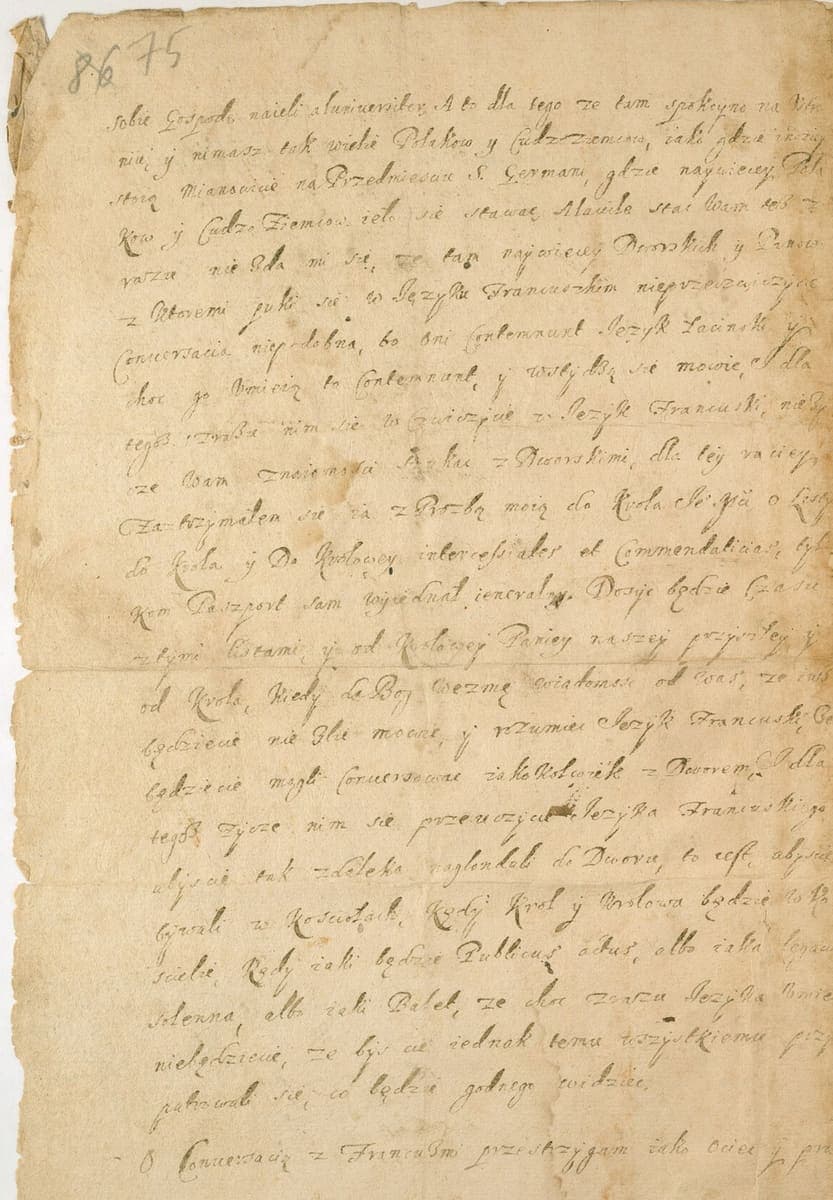
Archiwum Główne Akt Dawnych, Warsaw, Archiwum Publiczne Potockich, sygn. 51, p. 75, 1645 · Source · Public domain · Archiwum Główne Akt Dawnych / Wikimedia Polska partnership
Evidano Transcription
The whole written page. A diplomatic transcription keyed from this scan and marked validated on Polish Wikisource: original spelling, capitals and the macaronic Latin are kept as written, including the long ſ and the ß, and the editor sets the text as running prose rather than line by line. The final word is divided at the foot of the page and stands here as pro-, completed on the following page.
sobie Gospode naieli a luniversitev. A to dla tego że tam spokoyno na ustroniu, y nie masz tak wiele Polaków y Cudzoziemców, iako gdzie indziey stoią mianowicie na Przedmiesciu S. Germani, gdzie naywiecey Polaków y Cudzo Ziemców ieło sie stawać. Alavile stać Wam teß z razu nie ʒda mi się, że tam naywiecey Dworskich y Panów, z ktoremi puki sie w Języku Francuzkim nieprzeczwiczycie Conversacia niepodobna, bo oni Contemnunt Język Łaciński y choć go umieią to Contemnunt, y wstydzą się mowic. Y dla tegoß zraßu nim sie w czwiczycie w Jezyk Francuski, nie ʒycze wam znaiomości szukać z Dworskimi, dla tey raciey zatrzymałem sie za z Prozbą moią do Króla Je. Mci o Listy do Króla y do Królowey interceſsiales et Commendaticios, tylkom Paszport sam wyiednał ieneralny. Dosyc będzie Czasu z tymi listami, y od Królowej Paniey naszey przyszłey y od Króla, kiedy da Bog wezmę wiadomosc od was, ze ius będziecie nie ʒlie mowic, y rozumiec Jezyk Francuski, ße będziecie mogli Conversowac iakokolwiek z Dworem. Y dla tegoß zycze, nim sie przeuczycie Jezyka Francuskiego, abyscie tak zdaleka naglondali do Dworu, to ieſt abyscie bywali w Kosciołach, kędy Król y Królowa będzie w Kościele, kędy iaki będzie Publicus actus, albo iaka legacia solenna, albo iaki Balet, że choc zrazu Jezyka umieć niebędziecie, że bys cie iednak temu wszystkiemu przypatrowali sie, co będzie godnego widzieć.

O Conwersacię z Francußmi przestrzygam iako ociec y pro-
Source: Jakub Sobieski, Instrukcja synom moim do Paryża, p. 75, via Wikisource (Public domain).
Renaissance script in a Commonwealth office
After 1500 the Polish and Lithuanian chanceries write in two traditions at once. The solemn opening keeps late Gothic display letters, often with a decorated initial and pen-flourished tendrils down the left edge, because that is what a royal privilege is supposed to look like. The body underneath is a Renaissance cursive: sloped, connected, with rounded single-storey a, looped ascenders, and the italic e and long s that Polish scribes learned from Italian models, from teachers in Padua and Bologna, and from printed books. In a Polish-language document of the seventeenth century the display line often mixes roman capitals with italic, so a heading can carry two alphabets in the same word.
Polish is now a chancery language in its own right, but its spelling is still settling. The bar of ł, the hook of ą and ę, the dot of ż and the stroke of ś and ć are written when the writer remembers, drift onto the neighbouring letter, or disappear into the ruling. The same document may write z, ż and rz for one sound. Because Latin remains the language of the formula, a Polish sentence can end in a Latin dating clause, and a Latin document can hold Polish field names, weights, coins and offices.
Almost everything is abbreviated. Royal and noble style is contracted to initials — J. K. M. for Jego Królewska Mość, W. X. L. for the Grand Duchy of Lithuania, S. R. M. for Sacra Regia Maiestas — and offices, ranks and place names shrink to a letter and a superscript. Latin endings vanish into the -que sign, the -orum loop and the -us hook. The sheet closes with a corroboration, a date usually in Roman numerals, a signature, and a small chancery note recording that the privilege was seen and entered in the register, all in different hands and sizes.
Why ordinary OCR struggles here
Several hands, one document
The display line, the body, the subscription and the registration note were written by different people at different moments, sometimes years apart. Treated as continuous text they produce nonsense at every join; treated as separate blocks they are each readable.
Titles collapsed into initials
A seventeenth-century Polish charter can run for a line and a half on nothing but abbreviated dignities. Expanding them needs to know the office, the person and the period, and getting one wrong silently changes who granted what to whom.
Diacritics that come and go
A missing bar turns ł into l, a missing dot turns ż into z, and a hook drawn under the wrong letter moves a nasal vowel a syllable to the left. Generic recognition either drops these marks or invents them by analogy with modern Polish, and both make the spelling evidence worthless.
Iron-gall ink, damp and folds
Parchment that has spent centuries folded around a seal shows pale bands across the writing, brown damp stains that swallow whole clauses, and ink that has eaten through the support. A transcription has to mark the loss rather than reconstruct it silently.
Who works with this material
Editors of chancery registers
The Crown Metrica and the Lithuanian registers hold tens of thousands of entries copied in a working hand. Editors need a text that keeps the register’s own numbering and marks where an entry was cancelled or corrected, because those marks are what tell you whether a grant took effect.
Genealogists working on noble families
Proofs of nobility, birth certificates and confirmations of privilege are the backbone of Commonwealth family research. What matters is the names, the offices and the dates, so an abbreviated title expanded wrongly is worse than one left standing with a note.
Historians of towns and guilds
Municipal privileges and guild statutes set out market days, tolls, apprenticeship terms and the exact wording of oaths. A searchable text of a numbered charter lets those clauses be compared across towns rather than read one parchment at a time.
Book and print historians
Printers, binders and papermakers appear in the same certificates and council records as everyone else. Finding them means being able to search a corpus of documents whose only current description is a one-line archival summary.
Getting the best transcription
Name the languages before you start
Say which languages may appear and where — Latin formula with a Polish disposition, or the reverse — and ask for each stretch to be labelled. Documents from this period switch language at a clause boundary, not at a paragraph.
Decide what to do with titles and honorifics
Give the model a short list of the abbreviations you expect and say whether they should be expanded, expanded in brackets, or kept as initials. Keeping them as initials is often the right answer for a first pass, because the expansion depends on who is speaking.
Ask for the closing apparatus separately
Request the date, the signature, the chancery registration note and any dorsal endorsement as their own labelled fields. They are short, they are in different hands, and they carry most of the information an archivist will index the document by.
Test on the heading, then on the worst-damaged block
The display line shows immediately whether mixed capitals and italic are being handled. A stained or folded passage shows whether losses are marked or quietly filled in. Together they tell you what a whole box of privileges will cost you in review time.
Further reading on this hand
The palaeography guides the in-app selector points to for this domain, if you want to check a transcription against the standard references.
- Dawne Pismo
This online palaeography project from the National Archives in Kraków teaches the reading of documents preserved in Polish archives. It provides historical introductions, script examples, glossaries, and graded exercises spanning medieval through modern writing. The materials cover letterform change, abbreviations, punctuation, documentary formulas, and multilingual archival contexts. It is useful for sixteenth- and seventeenth-century Polish chancery records where Humanistic and Gothic traditions overlap.
Frequently asked questions
- Can it handle a document that starts in Latin and continues in Polish?
- Yes, and it can mark the switch. Ask for language labels on each stretch; the transcription then follows the sheet rather than forcing one language on the whole text, which is what causes Polish place names inside a Latin clause to be mangled.
- How are abbreviations such as J. K. M. or W. X. L. treated?
- They are recognised as standing abbreviations of royal and territorial style rather than as stray capitals. You choose whether they stay as initials or are expanded, and an expansion can be given in brackets so a reader can see the original on the page.
- Will faint Polish diacritics be recorded or normalised away?
- Recorded, with a flag where the mark is ambiguous. On sixteenth- and seventeenth-century material the presence or absence of a bar or a hook is evidence about the writer, so guessing from modern Polish spelling would destroy exactly what a linguist is looking for.
- Can the ornamental display line be transcribed as text?
- It can. Flourished capitals, pen tendrils and the decorated initial are read as letters where they are letters and described as decoration where they are not, so the invocation appears in the transcription instead of being skipped as an image.
- What happens where damp or ink corrosion has removed words?
- The gap is marked and, where enough survives, the partial reading is given with an explicit note that it is uncertain. Nothing is supplied from a formula, because the standard phrase and the actual wording are precisely what an editor is checking.
Related scripts and pages
Transcribe your Commonwealth documents
Upload a privilege, a certificate or a register page, choose Polish Chancery and Humanistic Hands, and set the abbreviation rules before the rest of the box.