
Hebrew · c. 1200–1800
Base text and commentary on one page
Sephardi scribes used the shape of their letters to mark rank: the biblical or legal text in a large pointed square hand, the commentary around it in a smaller, rounder semi-cursive. Printers copied that arrangement, cutting the semi-cursive into the type now called Rashi, so a single page can carry three texts, two scripts and one set of vowel points. Evidano keeps the layers apart and reports which block belongs to which verse.
Sample pages
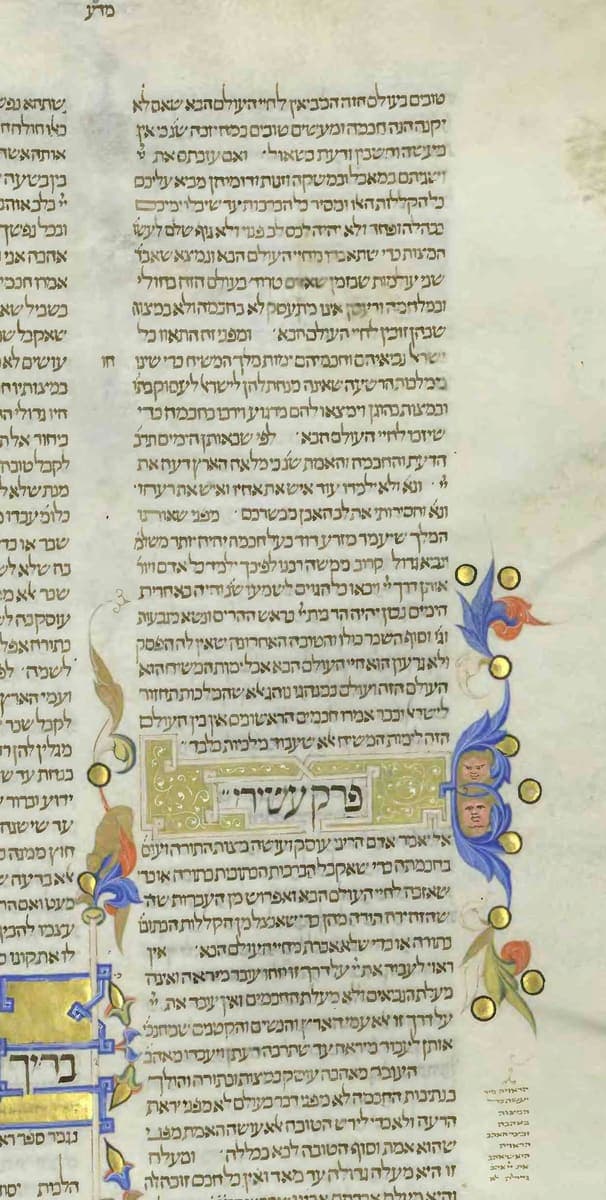
National Library of Israel, Jerusalem, MS Heb. 4°1193, first half of the 14th century · Source · CC BY-SA 3.0 · The National Library of Israel Collections
Evidano Transcription
מדע
[adjacent column on the left cut off]
טובים בעולם הזה הבאין [?] לחיי העולם הבא שאם לא
יקנה הנה חכמה ומעשים טובים במה יזכה שנ' כי אין
מעשה וחשבון ודעת בשאול· ואם עזבתם את יי'
ושגיתם במאכל ובמשקה וזנות ודומיהן מביא עליכם
כל הקללות האלו ומסיר כל הברכות עד שיכלו ימיכם
בבהלה ופחד ולא יהיה לכם לב פנוי ולא גוף שלם לעש
המצות כדי שתאבדו מחיי העולם הבא ונמצא שאבד'
שני עולמות שבזמן שאדם טרוד בעולם הזה בחולי
ובמלחמה ורעבן אינו מתעסק לא בחכמה ולא במצוה
שבהן זוכין לחיי העולם הבא· ומפני זה התאוו כל
ישראל נביאיהם וחכמיהם ימות מלך המשיח כדי שינו [margin: ח]
במלכות הרשעה שאינה מנחת להן לישר' לעסוק בתו'
ובמצות כהוגן וימצאו להם מרגוע וירבו בחכמה כדי
שיזכו לחיי העולם הבא· לפי שבאותן הימים תרב'
הדעת והחכמה והאמת שנ' כי מלאה הארץ דעה את
יי' ונא' ולא ילמדו עוד איש את אחיו ואיש את רעהו·
ונא' והסירותי את לב האבן מבשרכם· מפני שאותו
המלך שיעמד מזרע דוד בעל חכמה יהיה יותר משלמ'
ונביא גדול קרוב ממשה רבנו לפיכך ילמד כל אדם ויור'
אותן דרך יי' ויבאו כל הגוים לשמעו שנ' והיה באחרית
הימים נכון יהיה הר בית יי' בראש ההרים ונשא מגבעות
וגו' וסוף השכר כולו והטובה האחרונה שאין לה הפסק
ולא גרעון הוא חיי העולם הבא אבל ימות המשיח הוא
העולם הזה ועולם כמנהגו נוהג אל' שהמלכות תחזור
לישר' וכבר אמרו חכמים הראשונים אין בין העולם
הזה לימות המשיח אל' שעבוד מלכיות בלבד·
פרק עשירי
אל יאמר אדם הריני עוסק ועושה מצות התורה ועוס'
בחכמתה כדי שאקבל הברכות הכתובות בתורה או כדי
שאזכה לחיי העולם הבא ואפרוש מן העברות שה
שהזהירה תורה מהן כדי שאנצל מן הקללות הכתוב'
בתורה או כדי שלא אכרת מחיי העולם הבא· אין
ראוי לעבוד את יי' על דרך זו וזהו [?] עובד מיראה ואינה
מעלת הנביאים ולא מעלת החכמים ואין עובד את יי'
על דרך זו אל' עמי הארץ והנשים והקטנים שמחנכי'
אותן לעבוד מיראה עד שתרבה דעתן ויעבדו מאהב'
העובד מאהבה עוסק במצות ותורה [?] והולך
בנתיבות החכמה לא מפני דבר בעולם לא מפני יראת
הרעה ולא כדי לירש הטובה אל' עושה האמת מפנ'
שהוא אמת וסוף הטובה לבא בגללה· ומעלה
זו היא מעלה גדולה עד מאד ואין כל חכם זוכה לה
והיא מעלת אברהם [cut off]
[marginal note of nine short lines, too faint to verify]
Generated by Evidano’s advanced model; not yet checked against a published edition.
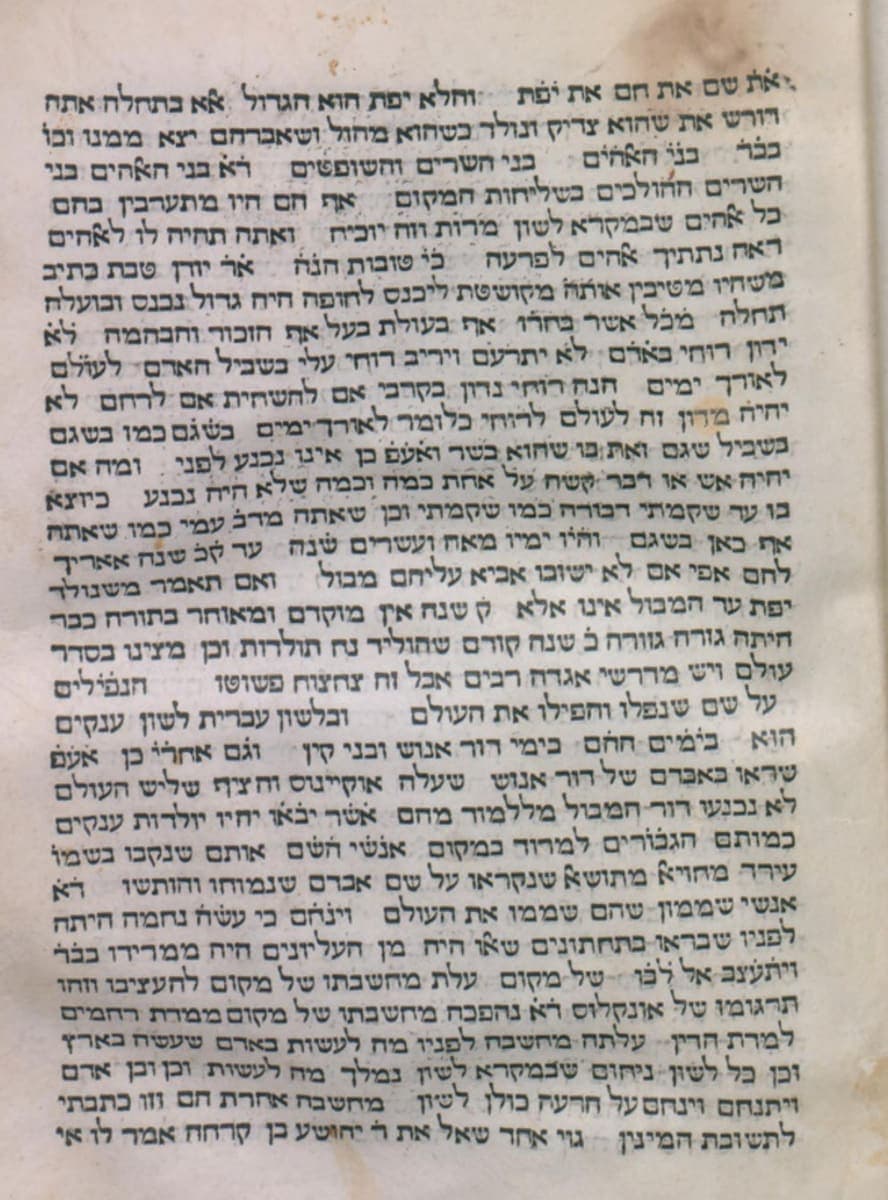
Source · Public domain · Digitised from a copy made available through Internet Culturale
Evidano Transcription
The first two lines of the column, which carry the comment on Genesis 5:32. The wording follows the text printed at he.wikisource; this early edition has יפת הוא הגדול where the received text has יפת הגדול הוא, and abbreviates the biblical lemma to את שם את חם את יפת. The comments that follow, on Genesis 6, are not included.
את שם ואת חם ואת יפת - והלא יפת הגדול הוא אלא בתחלה אתה דורש את שהוא צדיק ונולד כשהוא מהול ושאברהם יצא ממנו וכו׳
Source: רש״י על בראשית ה לב, ויקיטקסט (CC BY-SA 4.0).
Evidano Transcription
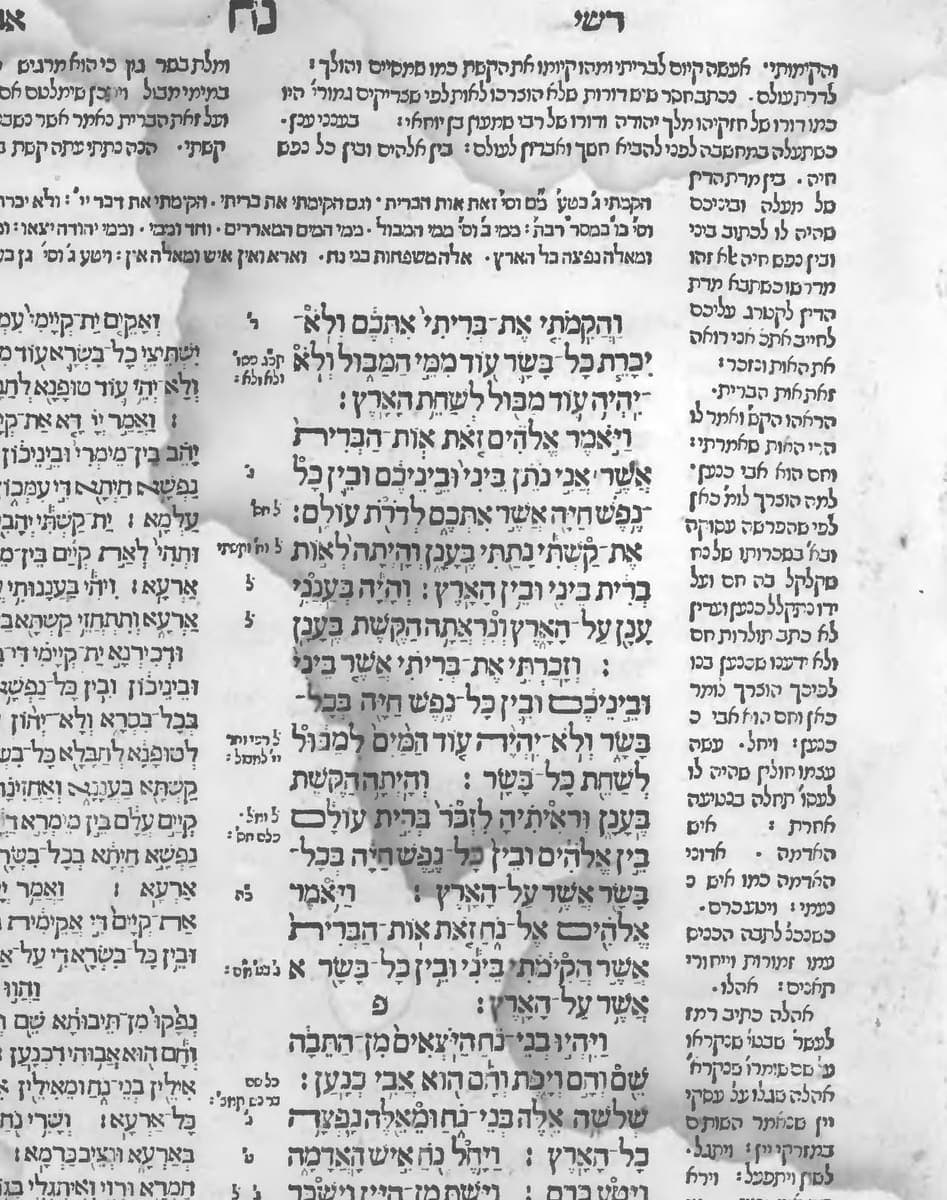
Genesis 9:11–17, the upper part of the central biblical column, with the vowel points and cantillation marks the page carries. The column continues below with verses 18 to 21, and the Targum and the two commentaries beside it are not included.
וַהֲקִמֹתִ֤י אֶת־בְּרִיתִי֙ אִתְּכֶ֔ם וְלֹֽא־יִכָּרֵ֧ת כׇּל־בָּשָׂ֛ר ע֖וֹד מִמֵּ֣י הַמַּבּ֑וּל וְלֹֽא־יִהְיֶ֥ה ע֛וֹד מַבּ֖וּל לְשַׁחֵ֥ת הָאָֽרֶץ׃
וַיֹּ֣אמֶר אֱלֹהִ֗ים זֹ֤את אֽוֹת־הַבְּרִית֙ אֲשֶׁר־אֲנִ֣י נֹתֵ֗ן בֵּינִי֙ וּבֵ֣ינֵיכֶ֔ם וּבֵ֛ין כׇּל־נֶ֥פֶשׁ חַיָּ֖ה אֲשֶׁ֣ר אִתְּכֶ֑ם לְדֹרֹ֖ת עוֹלָֽם׃
אֶת־קַשְׁתִּ֕י נָתַ֖תִּי בֶּֽעָנָ֑ן וְהָֽיְתָה֙ לְא֣וֹת בְּרִ֔ית בֵּינִ֖י וּבֵ֥ין הָאָֽרֶץ׃
וְהָיָ֕ה בְּעַֽנְנִ֥י עָנָ֖ן עַל־הָאָ֑רֶץ וְנִרְאֲתָ֥ה הַקֶּ֖שֶׁת בֶּעָנָֽן׃
וְזָכַרְתִּ֣י אֶת־בְּרִיתִ֗י אֲשֶׁ֤ר בֵּינִי֙ וּבֵ֣ינֵיכֶ֔ם וּבֵ֛ין כׇּל־נֶ֥פֶשׁ חַיָּ֖ה בְּכׇל־בָּשָׂ֑ר וְלֹֽא־יִֽהְיֶ֨ה ע֤וֹד הַמַּ֙יִם֙ לְמַבּ֔וּל לְשַׁחֵ֖ת כׇּל־בָּשָֽׂר׃
וְהָיְתָ֥ה הַקֶּ֖שֶׁת בֶּֽעָנָ֑ן וּרְאִיתִ֗יהָ לִזְכֹּר֙ בְּרִ֣ית עוֹלָ֔ם בֵּ֣ין אֱלֹהִ֔ים וּבֵין֙ כׇּל־נֶ֣פֶשׁ חַיָּ֔ה בְּכׇל־בָּשָׂ֖ר אֲשֶׁ֥ר עַל־הָאָֽרֶץ׃
וַיֹּ֥אמֶר אֱלֹהִ֖ים אֶל־נֹ֑חַ זֹ֤את אֽוֹת־הַבְּרִית֙ אֲשֶׁ֣ר הֲקִמֹ֔תִי בֵּינִ֕י וּבֵ֥ין כׇּל־בָּשָׂ֖ר אֲשֶׁ֥ר עַל־הָאָֽרֶץ׃
Source: בראשית ט, מקרא על פי המסורה, ויקיטקסט (CC BY-SA 4.0).
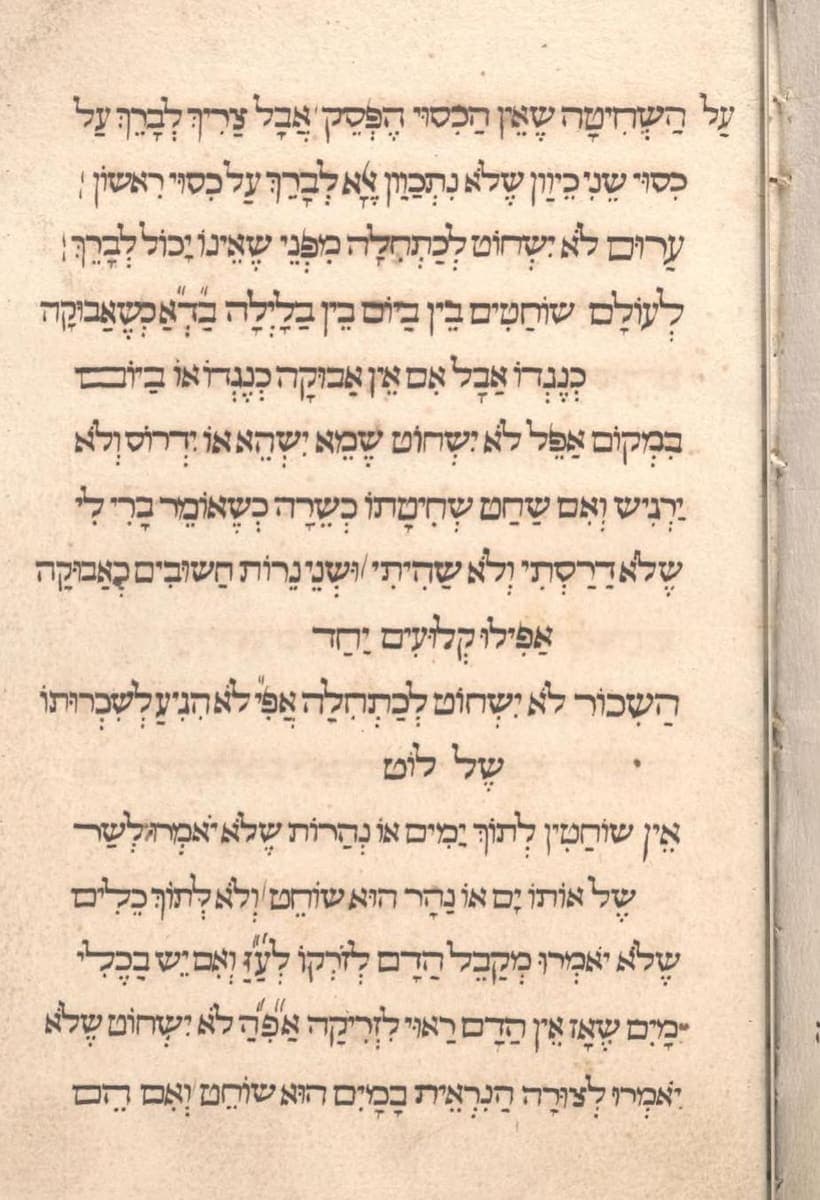
Herbert D. Katz Center for Advanced Judaic Studies, University of Pennsylvania, CAJS Rar Ms 495, 1780 · Source · Public domain
Evidano Transcription
על השחיטה שאין הכסוי הפסק אבל צריך לברך על
כסוי שני כיון שלא נתכון אא לברך על כסוי ראשון :
ערום לא ישחוט לכתחלה מפני שאינו יכול לברך :
לעולם שוחטים בין ביום בין בלילה בד״א כשאבוקה
כנגדו אבל אם אין אבוקה כנגדו או ביום
במקום אפל לא ישחוט שמא ישהא או ידרוס ולא
ירגיש ואם שחט שחיטתו כשרה כשאומר ברי לי
שלא דרסתי ולא שהיתי / ושני נרות חשובים כאבוקה
אפילו קלועים יחד
השכור לא ישחוט לכתחלה אפי׳ לא הגיע לשכרותו
של לוט ·
אין שוחטין לתוך ימים או נהרות שלא יאמרו לשר
של אותו ים או נהר הוא שוחט / ולא לתוך כלים
שלא יאמרו מקבל הדם לזרקו לע״ז ואם יש בכלי
מים שאז אין הדם ראוי לזריקה אפ״ה לא ישחוט שלא
יאמרו לצורה הנראית במים הוא שוחט ואם הם
Generated by Evidano’s advanced model; not yet checked against a published edition.
The Sephardi hand and the type made from it
The Sephardi script family developed in Muslim and Christian Spain, in Provence and across North Africa, and after 1492 it went with the exiles to Italy, Amsterdam, Salonica and the Ottoman lands. Compared with the Ashkenazi hand it is rounder and more even: the pen is held flatter, so the contrast between thick and thin is gentler, the letters sit in a broad rectangle, aleph is drawn as a slanting stroke with two short arms, and the tails of final kaf and nun curve rather than drop straight. Scribes worked in three registers — a formal square hand for Bibles and prayer books, a lighter semi-square or beinoni for study copies, and a joined cursive for deeds, accounts and letters — and used them together, so that on a page of the Pentateuch the verses stand in square letters and Onkelos and Rashi run round them in a smaller mode.
When Hebrew printing began in Italy in the late 1460s the first punchcutters copied that smaller mode rather than the square hand. The type they produced was used for the commentaries in the earliest Pentateuchs, and because Rashi’s was the commentary most often set in it the type has been called Rashi script ever since — it has nothing to do with Rashi himself, who died three and a half centuries earlier. It is an unpointed face with narrow, rounded letters: the head of ד ends flush while ר curves away, ה is open at the left, ב keeps a squared foot where כ is round, and the sequence of a lamed and an aleph is often cast as a single sort. The classic result is the Mikraot Gedolot page, where a pointed and accented biblical column stands in the middle with the Targum beside it and two or three commentaries in the small type filling the outer columns, the head and the foot.
Both manuscript and print use the same shorthand. A geresh marks a shortened word and gershayim an acronym, but many contractions carry neither; rabbinic names collapse into initials; letters serve as numbers for folios, dates and cross-references; and the divine name appears as a pair of yods. Vocalisation is applied to the biblical text and left off everything else on the same sheet, so a system has to switch between reading with and without points several times a page. Copies that passed through Italy often carry a censor’s signature in Latin script at the foot, and study copies collect marginal notes in a later cursive that ignores the ruling entirely.
Why ordinary OCR struggles here
Two scripts, one of them pointed
The centre of the page is large, vocalised and regular; the commentary round it is small, unpointed and abbreviated. A model set up for one of those does badly on the other, and a single pass over the whole sheet tends to average the two into something that fits neither.
Letterforms that converge in the small type
At commentary size ד and ר, ב and כ, ה and ח differ by a fraction of a millimetre of ink, and worn or over-inked impressions close the gaps. Without vowel points there is no second signal, so the reading depends on recognising the word.
Abbreviations, initials and numbers
Rabbinic prose is written in contractions: authorities appear as initials, stock phrases as two or three letters, references as letters used for numbers. Expanding them is an editorial decision, and one made silently in the middle of a transcription cannot be undone later.
Reading order that is not linear
On a Mikraot Gedolot page a commentary begins beside the verse it explains, runs to the foot of its column, continues at the head of the next and may wrap round the central block. Read as parallel columns it produces four texts, none of them continuous.
Who works with this material
Editors of rabbinic texts
Commentaries, codes and responsa are collated across manuscripts and early editions in which the same passage is abbreviated differently. An editor needs the contractions left as they stand, so that a variant is not created or hidden by an expansion.
Cataloguers of Hebrew incunabula and early printing
Early editions are identified by the exact wording of a colophon, the presence of a printer’s formula and the state of a few sorts. Getting those short passages into text lets copies be compared without moving the books.
Historians of Sephardi communities
Communal registers, contracts and letters from Spain, the Maghreb and the Ottoman cities are written in the cursive mode of the same family. Names, sums and dates are what a researcher needs first, and they are the parts most often abbreviated.
Libraries digitising rabbinic collections
A shelf of unindexed volumes becomes usable once each page yields its opening words and its running heads. That is enough to match a scan to a bibliographic record and to find where a tractate or a section begins.
Getting the best transcription
Describe the page as a layout, not a text
Say that there is a pointed central column, a Targum beside it and commentaries in an unpointed small type around the edges, and ask for each as a separate block. That one sentence prevents most of the errors a whole-page pass would make.
Ask for the commentary keyed to its lemma
Rashi and his successors quote two or three words of the verse and then comment. Request that the lemma be marked, so that each note can be attached to the verse it explains rather than to the line it happens to start on.
Fix the abbreviation policy in advance
Decide whether contractions are kept, expanded, or expanded in brackets, and whether letters used as numbers are also given as figures. Repeat the choice in every prompt: it is the setting that most affects how usable a batch is later.
Test on a heavily inked copy
Early editions vary from page to page; some impressions are grey and some are so heavy that the counters of the letters fill in. Run one of the worst pages first, and see whether the small type comes back with an honest note of illegibility rather than a smooth guess.
Further reading on this hand
The palaeography guides the in-app selector points to for this domain, if you want to check a transcription against the standard references.
- Digital Hebrew Palaeography: Script Types and Modes
This scholarly article defines a structured classification for medieval Hebrew scripts by regional type and mode. It includes Sephardi writing and distinguishes square, semi-square, and cursive executions through recurring letter construction. The study provides a vocabulary for comparing manuscripts without treating typographic labels as exact descriptions of handwritten forms. It is especially useful for Sephardi commentary and documentary hands that fall between formal square writing and fully cursive script.
Frequently asked questions
- Is Rashi script a handwriting or a typeface?
- Both, in sequence. The letterforms are those of the Sephardi semi-cursive book hand, which scribes used for commentaries long before printing; the fifteenth-century punchcutters in Italy copied that hand, and the resulting type kept the name of the commentary it was most often used for.
- Can the commentary be linked to the right verse?
- Yes, when the lemma is recognised. The opening words of each note are matched against the biblical column on the same page, so a comment can be returned with the chapter and verse it belongs to, and a note whose lemma cannot be matched is reported rather than assigned by guesswork.
- Are the vowel points and cantillation marks kept?
- On the pointed central text they can be, including the accents, which matter for anyone working on the masoretic tradition. The surrounding commentary is unpointed and is returned as such, so the two do not have to share a convention.
- What about the masoretic notes in the margin?
- They are treated as their own layer. These notes are highly abbreviated and full of letters used as numbers, so they are returned separately with their position, and are worth checking by hand more often than the running text is.
- Does a censor’s signature at the foot of the page get transcribed?
- It is reported as a separate note, usually in Latin script and often with a date. Those signatures are evidence of where a copy was in the sixteenth or seventeenth century, so they are worth capturing even though they are not part of the book.
Related scripts and pages
Transcribe base text and commentary together
Upload a Sephardi manuscript page or an early printed leaf, choose Sephardi Hebrew Semi-Cursive and Rashi-Type Hands, and say how the page is laid out.