
Latin · c. 100 BCE–500 CE
Transcribe Roman cursive and capitals from the object itself
Roman documents survive as scratches in wax, ink on papyrus or paint on plaster, and the Old and Later Roman Cursive used to write them join, abbreviate and misspell words in ways with no modern equivalent. Evidano reads the letterforms specific to each medium and lets you check every line against the photograph before you rely on it.
Sample pages
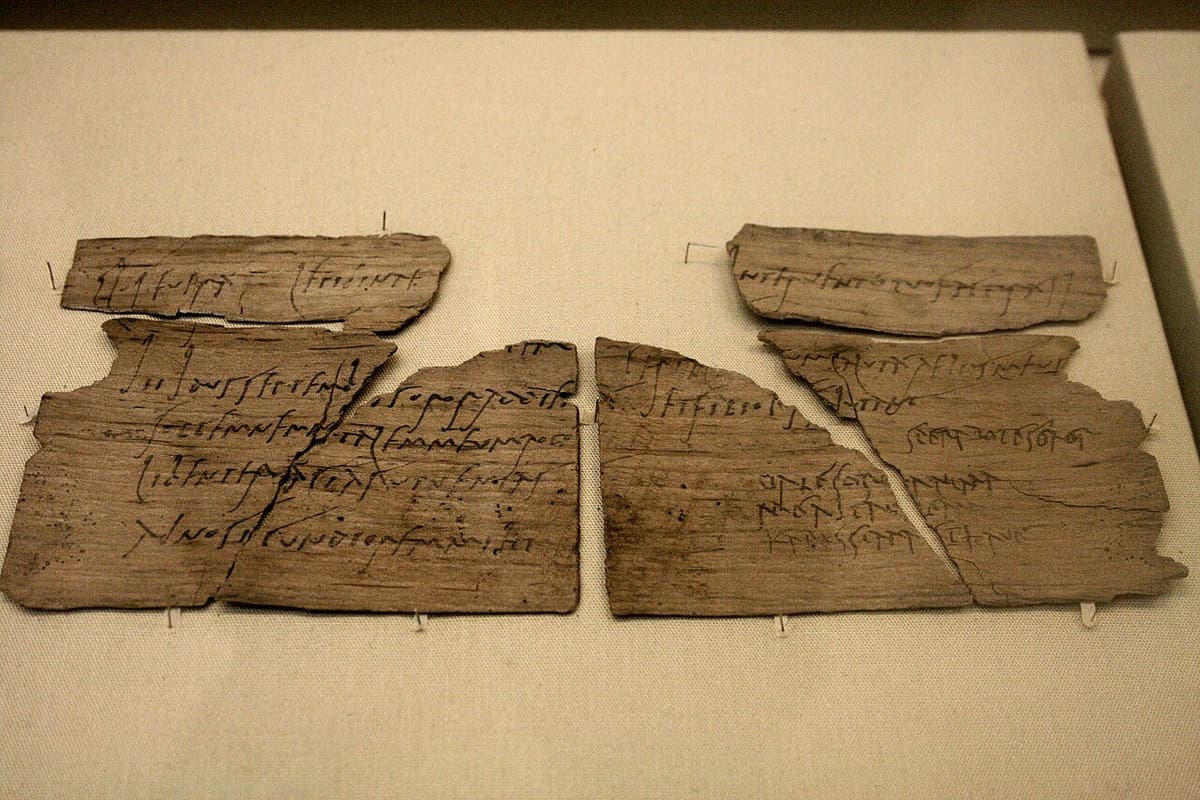
British Museum, c. 97–103 · Source · CC BY-SA 3.0 · Michel wal
Evidano Transcription
[illegible]s noster rogat te [illegible]
si fas est des illi p[illegible]
Iulius secun[?] [illegible] a pet[illegible]o
salute rogo te mi domine ut
[illegible]us noster rogat te
in[?] as f[illegible]s per nuntium
u[illegible]n noster te sa[illegible]
fide et[illegible] ut [illegible]
facies ei ut [illegible]
[illegible]es quia nunt[illegible]
quos emisti
h[illegible] [illegible]em et
[illegible] non re
misi[illegible] spero autem te
cum [illegible] uenire[?]
Generated by Evidano’s advanced model; not yet checked against a published edition.
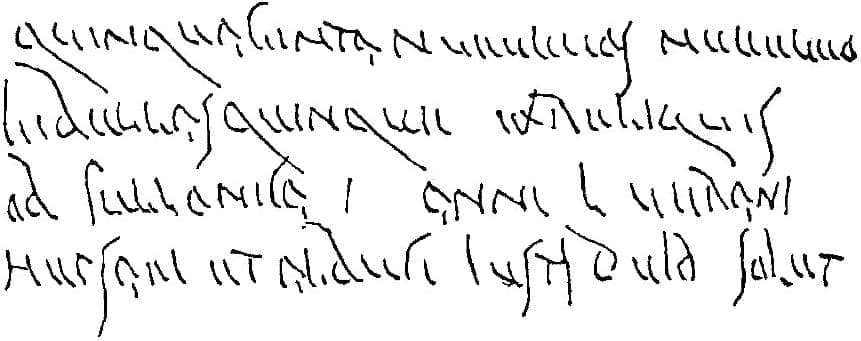
Evidano Transcription
All four lines of the tracing, as transcribed in the 1911 Britannica caption; the edition reads the first word of line 3 as 'ob' and leaves a gap where the tracing is unclear.
quinquaginta nummos nummo
libellas quinque ex reliquis
ob fullonica . . . anni L. Verani
Hupsaei et Albuci Justi d.v.i.d. solut.
Source: Encyclopaedia Britannica (1911), 'Palaeography', vol. 20, p. 620, Fig. 21 (Pompeian Tablet, A.D. 59) (Public domain).
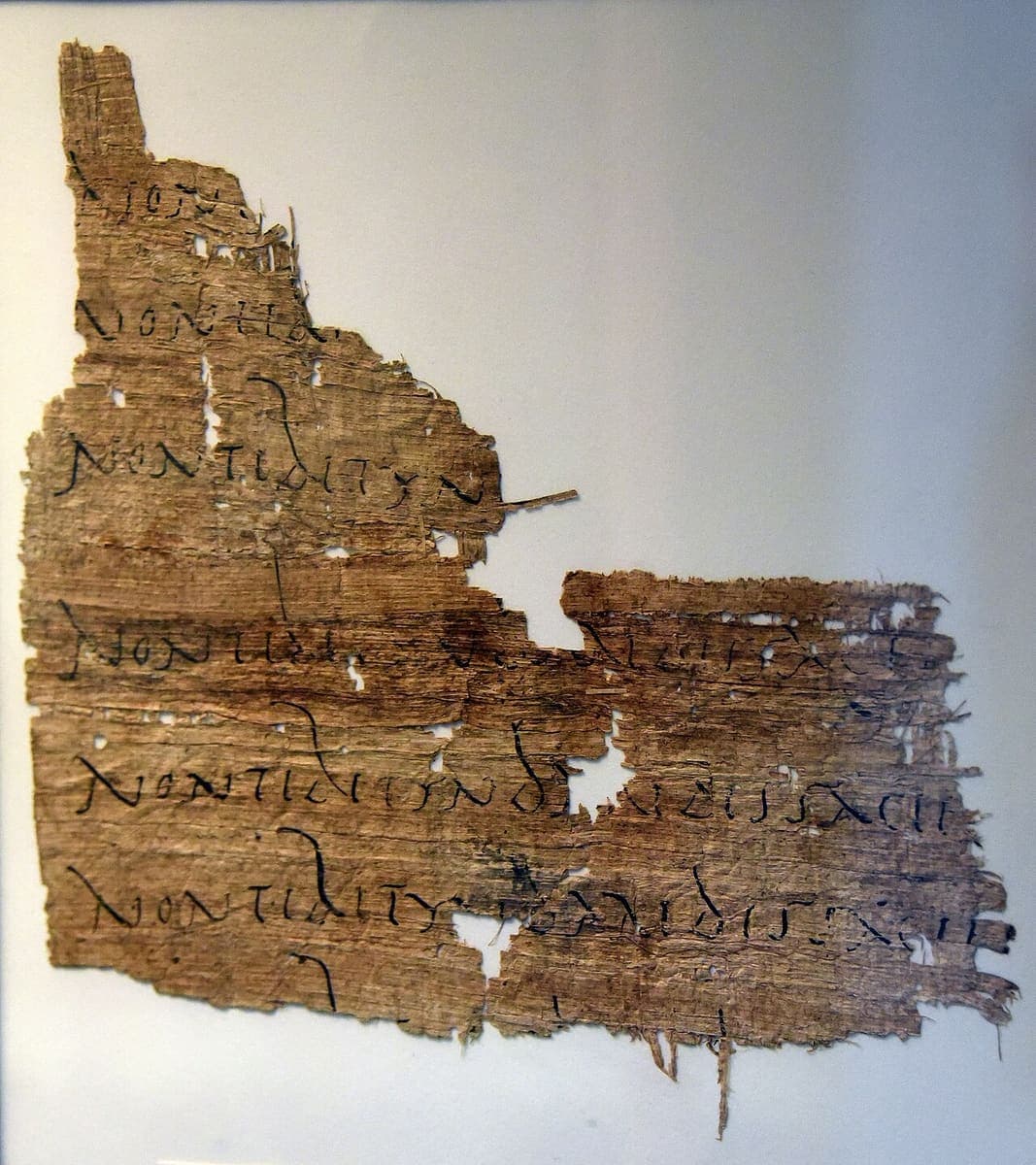
British Museum, 1st century · Source · CC BY-SA 4.0
Evidano Transcription
The repeated line only (Aeneid 2.601), given in the standard modern text; the copying exercise itself may show minor spelling slips typical of a learner’s hand that this edition does not reproduce.
Non tibi Tyndaridis facies inuisa Lacaenae
Source: P. Vergilius Maro, Aeneis, Liber II, via Wikisource (Public domain).
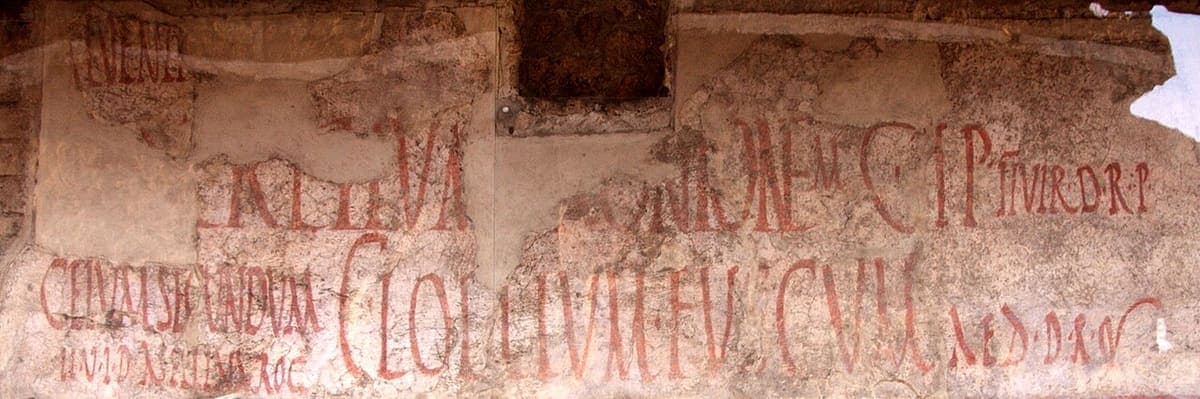
Evidano Transcription
[illegible] VENENT [illegible]
[illegible] RIIVA [illegible] M · C[?] [illegible] IIVIR · D · R · P
CEIVM[?] SECVNDVM
IIVIR · D [illegible] ROG
C · LOLLIVM · FVSCVM
AED · D · R · O · V
Generated by Evidano’s advanced model; not yet checked against a published edition.
What Roman capitals and cursive look like
Latin in this period was written in two unrelated systems side by side. Formal texts – literary rolls, monumental inscriptions, painted notices – used capital letters: square capitals for the grandest work, rustic capitals for everyday books and signs, both built from straight strokes and curves cut or brushed at speed. Everyday documents – letters, accounts, contracts, military returns – used a running cursive hand with no capital-letter equivalent: Old Roman Cursive from the first to third centuries, giving way to the rounder, more looped Later Roman Cursive from the third century onward. The period left the Vindolanda writing tablets from a fort on Hadrian’s Wall, the wax-tablet archives of Pompeii, and thousands of papyri from Egypt.
Cursive letterforms diverge sharply from their capital ancestors. Cursive a is built from two strokes that can look like u; b and d are told apart mainly by which side the bowl sits; e is often two short separate strokes; r drops a tail below the line; long s loops back on itself. Strokes run together without a pen lift, so a word can arrive as one continuous line with no gap to mark where letters end. Formal capitals, by contrast, are widely spaced and sometimes divided by a mid-line interpunct (·), with a short diagonal apex over a long vowel. Numerals are strokes with an overline; dates use consular formulas that are themselves heavily abbreviated.
Abbreviation in documents follows fixed formulas rather than one general system: a single initial letter can stand for a military rank, a legal term or a witness’s role, and only context tells you which. Because the objects are fragile, damage is part of the script: wax has usually perished, leaving only the stylus scratches in the wood beneath it; papyrus ink fades and the fibres tear; painted plaster flakes off a wall. A single wax tablet can also carry more than one hand within a few lines – a scribe for the body of a letter, the sender’s own hand for a closing greeting.
Why ordinary OCR struggles here
Cursive letters that collapse into one shape
In Old and Later Roman Cursive, a, u, n and r can be built from nearly identical strokes, and b and d differ only in which side the bowl falls. Generic OCR, trained on printed Latin, has no model for these forms and guesses from the nearest capital letter, which is usually wrong.
Words with no gaps between them
Documentary cursive runs letters together without lifting the pen, and scribes rarely marked word boundaries the way monumental capitals do with an interpunct. Segmenting a line into words takes knowledge of Latin, not just shape recognition.
Formulaic, context-only abbreviation
A single suspended letter can mean a military rank, a legal formula or part of a consular date, and the same letter means different things in a will, a duty roster and a loan agreement. Reading it means knowing the document type, not just the alphabet.
Damage that differs by medium
Wax tablets survive as bare stylus scratches once the wax is gone, papyrus fades and tears along the fibres, and painted notices flake with the plaster. A transcription has to read the surface it is actually shown, not assume ink on parchment.
Who works with this material
Papyrologists and epigraphers
Anyone editing a documentary papyrus, ostracon or wax tablet needs a diplomatic first pass that keeps cursive letterforms and abbreviation marks distinct from an editor’s expansion, so the two can be checked line by line against the object.
Frontier and military historians
Archives like the Vindolanda tablets record ranks, unit names and supply lists in formulaic Latin. A transcription that keeps names and abbreviations intact makes it possible to trace individual soldiers across many documents.
Classicists studying how texts were copied
School exercises and literary papyri preserve ordinary copyists’ versions of canonical texts, spelling slips included. A transcription that does not silently correct the copyist’s Latin against a standard edition keeps that evidence visible.
Museum and epigraphic-database editors
Large collections of graffiti, dipinti and tablets need consistent handling of damage, restoration brackets and uncertain letters across hundreds of objects photographed in different conditions.
Getting the best transcription
Say which script family you expect
Tell the model whether the object is in formal capitals or in Old or Later Roman Cursive before it reads a line. The two systems share no letterforms, and naming the right one avoids capital-letter guesses on a cursive hand.
Fix an abbreviation policy
Decide whether suspended letters should be left as written, expanded with the supplied letters in brackets, or expanded silently. Legal and military formulas benefit from bracketed expansion so the evidence for the reading stays visible.
Start with the most damaged object
A wax tablet with only faint stylus scratches, or a papyrus with heavy fibre loss, shows whether the model marks illegible stretches honestly rather than inventing plausible Latin. One that behaves well there will handle a clean papyrus easily.
Flag numerals and dating formulas separately
Overlined numeral strokes and consular dating clauses are easy to misread as ordinary letters. Asking for them to be marked lets you check a date without rereading the whole line.
Further reading on this hand
The palaeography guides the in-app selector points to for this domain, if you want to check a transcription against the standard references.
- Latin Paleography
This Hill Museum & Manuscript Library (HMML) course surveys Latin scripts from Roman antiquity through the Renaissance. Its ancient modules cover square capitals, rustic capitals, Older Roman Cursive, and Later Roman Cursive using manuscript and documentary examples. The lessons demonstrate characteristic letterforms, stroke construction, ligatures, abbreviations, punctuation, and numerical signs. They provide a practical foundation for distinguishing monumental or book capitals from the rapidly written cursive of Roman documents.
Frequently asked questions
- Can it tell Old Roman Cursive from Later Roman Cursive?
- Yes, if you say which period or region the document belongs to. The two share a name but not letterforms: Old Roman Cursive’s angular strokes give way, from the third century, to the rounder, more looped Later Roman Cursive, and treating one as the other produces wrong readings.
- How does it read a wax tablet that has no ink left on it?
- It reads whatever the photograph shows: usually the stylus scratches left in the wood once the wax itself has perished. Raking light that throws the scratches into shadow gives the clearest image, and the transcription notes where a stroke is too faint to read with confidence.
- Does it keep interpuncts and apices, or drop them as noise?
- It keeps them. The mid-line interpunct that separates words in monumental capitals and the diagonal apex over a long vowel are both part of the text, and you can ask for them to be reproduced or silently omitted.
- What happens with a painted inscription that has missing letters?
- Gaps are marked rather than filled in. Restoring a damaged CIL-style inscription is an editorial judgement for you or a published edition to make, not something the transcription should guess at silently.
- Can it show that a document was written by more than one hand?
- Yes, if you ask it to note a change of hand. Several Vindolanda letters have a scribe’s hand for the body and the sender’s own hand for a brief closing greeting, and a transcription can flag exactly where that switch happens.
Related scripts and pages
Transcribe your Roman tablets and papyri
Upload a photograph, choose Roman Capitals and Cursive Documents as the domain, and test the prompt on your most damaged object first.