
Latin · c. 300–700
Transcribe the earliest Latin book hands, letter by letter
Uncial and half-uncial have no upper case or lower case, only one alphabet, and the earliest Christian scribes wrote the names of God and Christ as compressed abbreviations under a flat line. Evidano keeps the letterforms and nomina sacra separate from a modern expansion, so you can check a fourth-century Bible page or a copy of a classical author against the object itself.
Sample pages
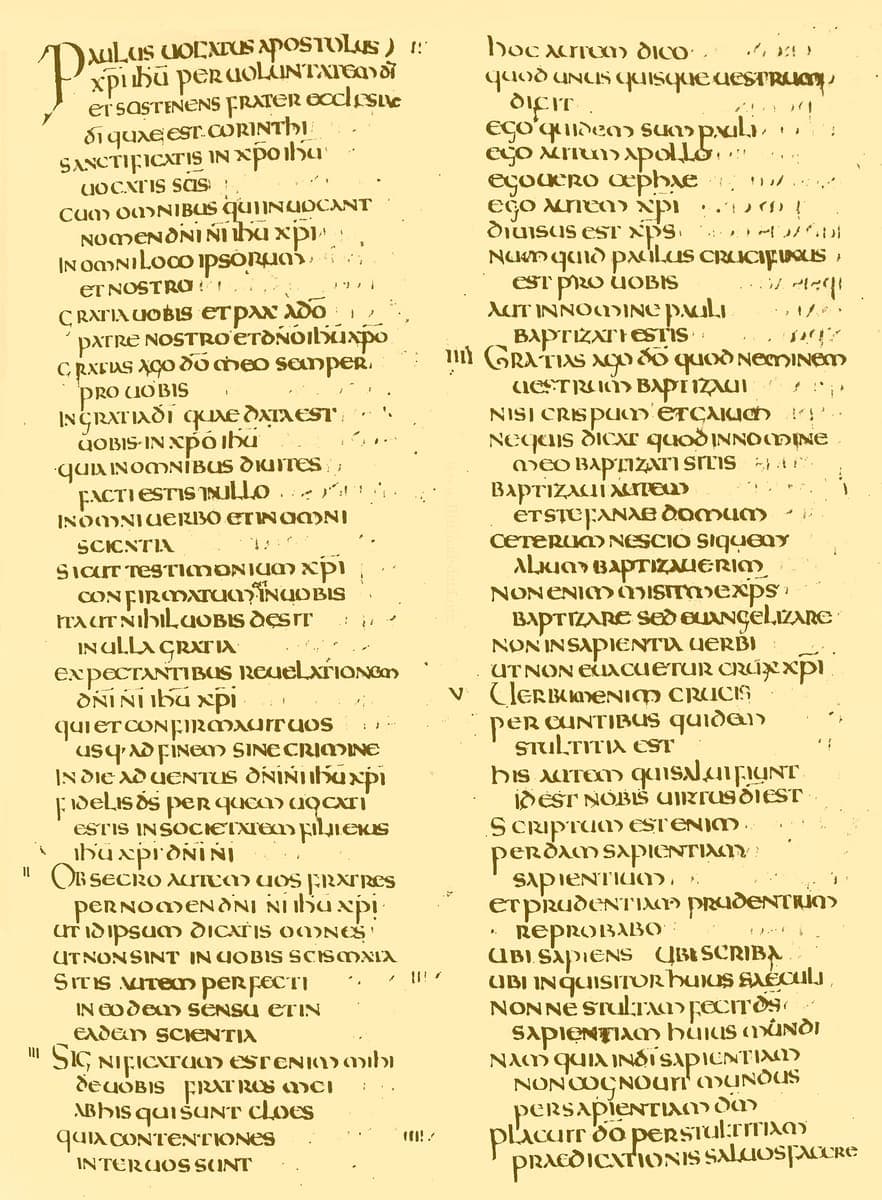
Biblioteca Medicea Laurenziana, Florence, c. 700 · Source · Public domain
Evidano Transcription
1 Corinthians 1:1–21, the whole page, following Tischendorf’s 1854 edition made directly from this manuscript. Nomina sacra (written on the page as XPI, IHU, DI, DNI and similar forms under a bar) are silently expanded here, and the reading “Sostinens” for the more familiar “Sosthenes” is the manuscript’s own spelling, not an error in this transcription.
1 Paulus vocatus apostolus Christi Iesu per voluntatem dei, et Sostinens frater,
2 ecclesiae dei quae est Corinthi, sanctificatis in Christo Iesu, vocatis sanctis, cum omnibus qui invocant nomen domini nostri Iesu Christi in omni loco ipsorum et nostro.
3 Gratia vobis et pax a deo patre nostro et domino Iesu Christo.
4 Gratias ago deo meo semper pro vobis in gratia dei quae data est vobis in Christo Iesu,
5 quia in omnibus divites facti estis in illo, in omni verbo et in omni scientia,
6 sicut testimonium Christi confirmatum in vobis,
7 ita ut nihil vobis desit in ulla gratia, expectantibus revelationem domini nostri Iesu Christi;
8 qui et confirmavit vos usque ad finem sine crimine, in die adventus domini nostri Iesu Christi.
9 Fidelis deus, per quem vocati estis in societatem filii eius Iesu Christi domini nostri.
10 Obsecro autem vos, fratres, per nomen domini nostri Iesu Christi, ut id ipsum dicatis omnes, ut non sint in vobis scismata, sitis autem perfecti in eodem sensu et in eadem scientia.
11 Significatum est enim mihi de vobis, fratres mei, ab his qui sunt Cloes, quia contentiones inter vos sunt.
12 Hoc autem dico quod unusquisque vestrum dicit: Ego quidem sum Pauli; Ego autem Apollo; Ego vero Cephae; Ego autem Christi.
13 Divisus est Christus? numquid Paulus crucifixus est pro vobis, aut in nomine Pauli baptizati estis?
14 Gratias ago deo quod neminem vestrum baptizavi nisi Crispum et Gaium,
15 ne quis dicat quod in nomine meo baptizati sitis.
16 Baptizavi autem et Stefanae domum: ceterum nescio si quem alium baptizaverim.
17 Non enim misit me Christus baptizare sed evangelizare, non in sapientia verbi, ut non evacuetur crux Christi.
18 Verbum enim crucis pereuntibus quidem stultitia est, his autem qui salvi fiunt, id est nobis, virtus dei est.
19 Scriptum est enim: Perdam sapientiam sapientium, et prudentiam prudentium reprobabo.
20 Ubi sapiens? ubi scriba? ubi inquisitor huius saeculi? Nonne stultam fecit deus sapientiam huius mundi?
21 Nam quia in dei sapientiam non cognovit mundus per sapientiam, deum placuit deo per stultitiam praedicationis salvos facere credentes.
Source: Novum Testamentum Latine interprete Hieronymo ex celeberrimo Codice Amiatino, ed. Constantin von Tischendorf (Leipzig, 1854), 1 Corinthians 1, via Internet Archive (Public domain).
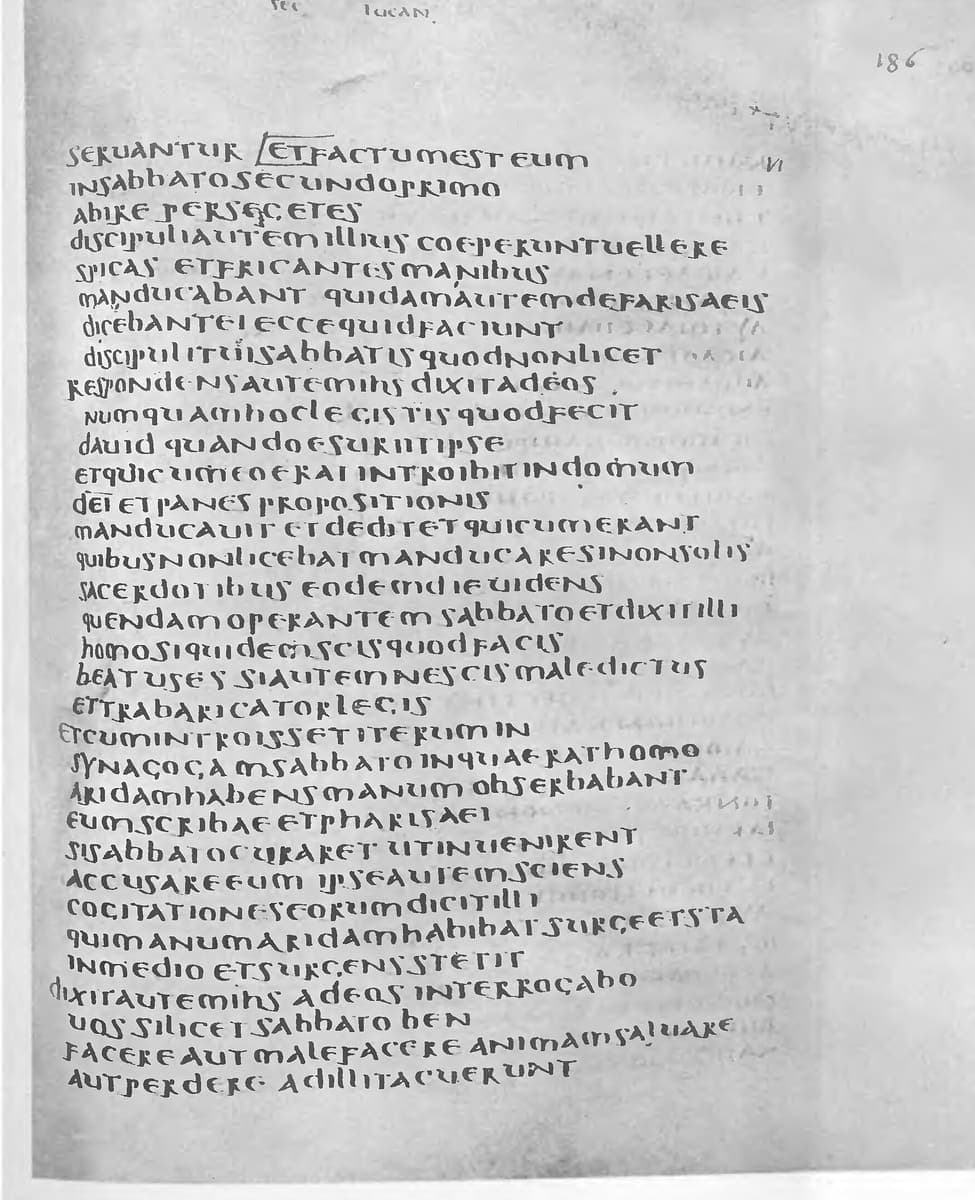
Cambridge University Library, 5th century (plate published 1912) · Source · Public domain
Evidano Transcription
The Latin column only – the Greek facing page is not transcribed here: Luke 6:1–5 and the unique addition after verse 4, following F. H. Scrivener’s 1864 diplomatic edition, which reproduces the manuscript’s own line breaks and spelling rather than a normalised text.
servantur · Et factum est eum
in sabbato secundo primo
abire per segetes
discipuli autem illius coeperunt uellere
spicas et fricantes manibus
manducabant quidam autem de farisaeis
dicebant ei ecce quid faciunt
discipuli tui sabbatis quod non licet
respondens autem ihs dixit ad eos
numquam hoc legistis quod fecit
dauid quando esuriit ipse
et qui cum eo erat introibit in domum
dei et panes propositionis
manducauit et dedit et qui cum erant
quibus non licebat manducare si non solis
sacerdotibus eodem die uidens
quendam operantem sabbato et dixit illi
homo si quidem scis quod facis
beatus es si autem nescis maledictus
et transgressor legis
Et cum introisset iterum in
synagogam sabbato in qua erat homo
aridam habens manum obseruabant
eum scribae et pharisaei
si sabbato curaret ut inuenirent
accusare eum ipse autem sciens
cogitationes eorum dicit illi
qui manum aridam habebat surge et sta
in medio et surgens stetit
dixit autem ihs ad eos interrogabo
uos si licet sabbato bene
facere aut male facere animam saluare
aut perdere at illi tacuerunt
Source: Bezae Codex Cantabrigiensis, ed. Frederick H. Scrivener (Cambridge, 1864), Luke 6, via Internet Archive (Public domain).
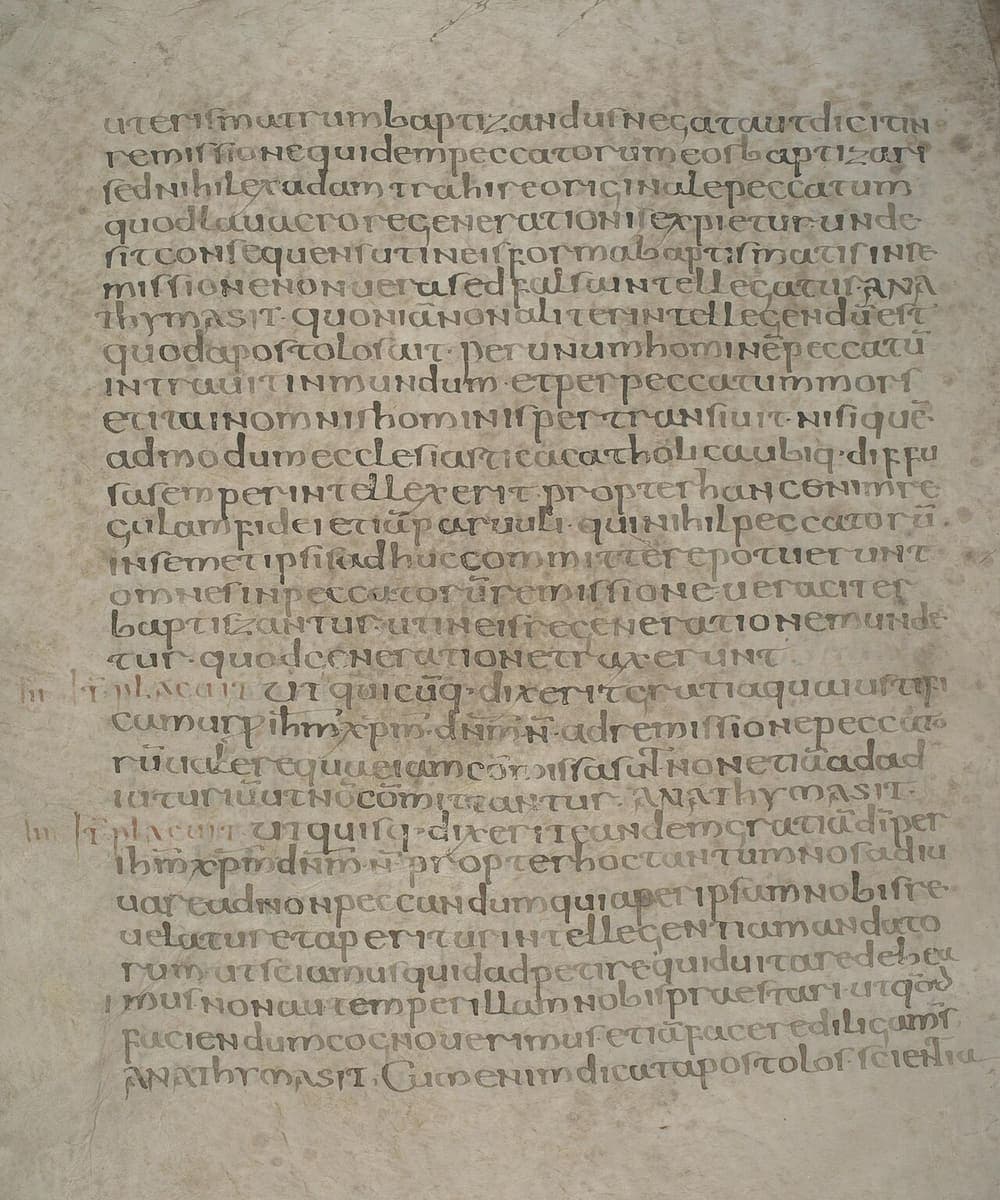
Erzbischöfliche Diözesan- und Dombibliothek, Cologne, Codex 212, fol. 19v, mid or later 6th century · Source · Public domain · Codices Electronici Ecclesiae Coloniensis
Evidano Transcription
The whole written area, which opens and closes in mid-sentence: the end of the canon on the baptism of infants and the two following canons on grace, as printed among the Concilia Africae in Migne’s Patrologia Latina, where they stand under the Council of Milevis of 416 (the same canons are commonly cited as Carthage, 418). Migne writes j and v where the page writes i and u, expands its abbreviations, and his column and page numbers have been dropped here.
… ab uteris matrum baptizandos negat aut dicit in remissionem quidem peccatorum eos baptizari, sed nihil ex Adam trahere originalis peccati quod lavacro regenerationis expietur, unde fit consequens ut in eis forma baptismatis in remissionem quidem peccatorum non vera sed falsa intelligatur, anathema sit. Quoniam non aliter intelligendum est quod ait Apostolus: Per unum hominem peccatum intravit in mundum et per peccatum mors, et ita in omnes homines mors pertransiit in quo omnes peccaverunt: nisi quemadmodum Ecclesia catholica ubique diffusa semper intellexit. Propter hanc enim regulam fidei etiam parvuli, qui nihil peccatorum in semetipsis adhuc committere potuerunt, ideo in peccatorum remissionem baptizantur, ut in eis regeneratione mundetur quod generatione traxerunt.
Item placuit, ut quicunque dixerit gratiam Dei qua justificamur per Jesum Christum Dominum nostrum ad solam remissionem peccatorum valere quae jam commissa sunt, non etiam ad adjutorium ut non committantur, anathema sit.
Item quisquis dixerit eamdem gratiam Dei per Jesum Christum Dominum nostrum propter hoc tantum nos adjuvare ad non peccandum, quia per ipsam nobis revelatur et aperitur intelligentia mandatorum, ut sciamus quid appetere, quid vitare debeamus, non per illam autem nobis praestari ut quod faciendum cognoverimus etiam facere debeamus atque valeamus, anathema sit. Cum enim dicat Apostolus …
Source: Concilia Africae, in J.-P. Migne, Patrologia Latina, via Latin Wikisource (Public domain).
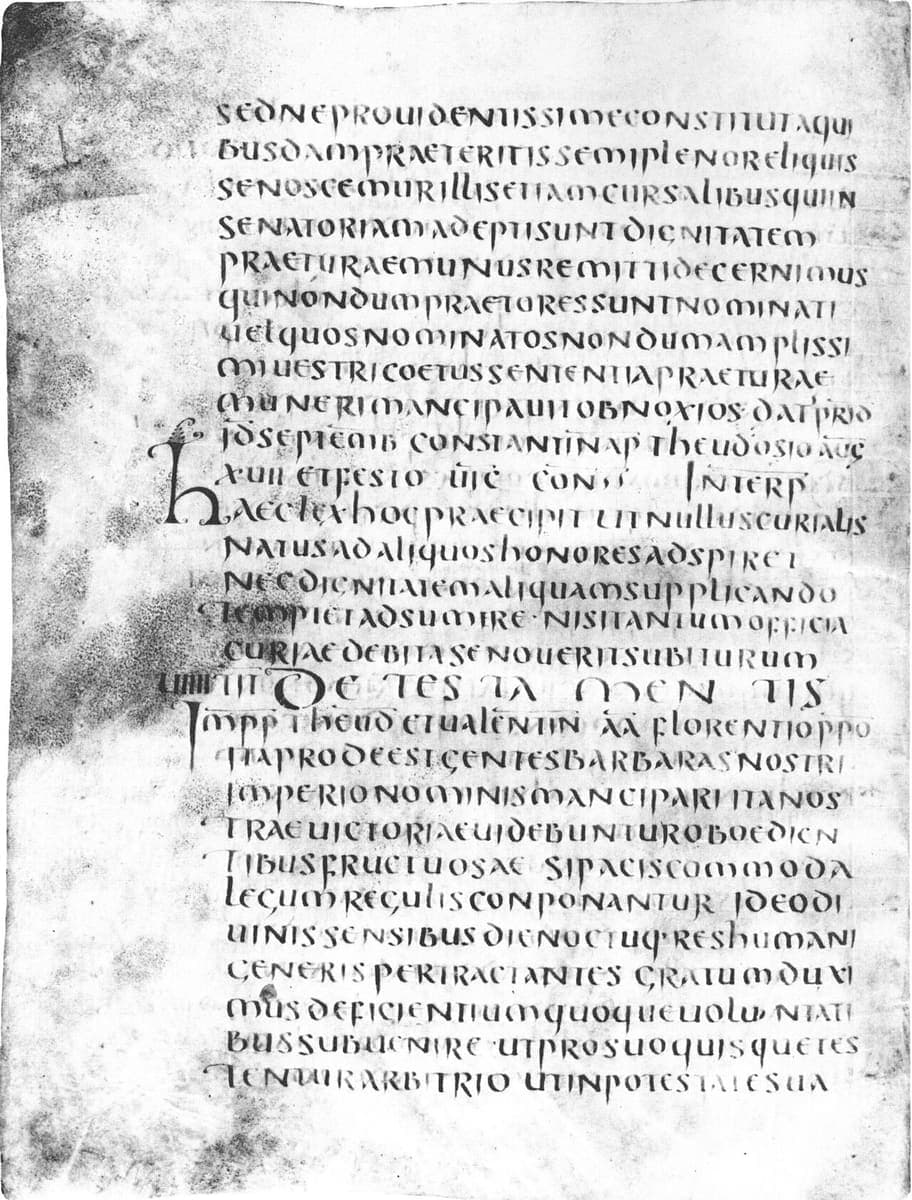
Bayerische Staatsbibliothek, Munich, Clm 22501, fol. 178v, 6th century · Source · Public domain
Evidano Transcription
SEDNEPROUIDENTISSIMECONSTITUTAQUI
BUSDAMPRAETERITISSEMIPLENORELIQUIS
SENOSCEMURILLISETIAMCURSALIBUSQUIIN
SENATORIAMADEPTISUNTDIGNITATEM
PRAETURAEMUNUSREMITTIDECERNIMUS
QUINONDUMPRAETORESSUNTNOMINATI
UELQUOSNOMINATOSNONDUMAMPLISSI
MIUESTRICOETUSSENTENTIAPRAETURAE
MUNERIMANCIPAUITOBNOXIOS DAT[A] PRID[IE]
ID[US] SEPTEMB[RIS] CONSTANTINAP[OLI] THEUDOSIO AUG[USTO]
XVII ET FESTO U[IRO] C[LARISSIMO] CONS[ULIBUS] INTERP[RETATIO]
HAECLEXHOCPRAECIPIT UTNULLUSCURIALIS
NATUSADALIQUOSHONORESADSPIRET
NECDIGNITATEMALIQUAMSUPPLICANDO
TEMPTETADSUMERE NISITANTUMOFFICIA
CURIAEDEBITASENOUERITSUBITURUM
VIIII DE TESTAMENTIS
IMP[ERATORES] THEUD[OSIUS] ET UALENTIN[IANUS] A[UGUSTI] FLORENTIO P[RAEFECTO] P[RAETORI]O
ITAPRODEESTGENTESBARBARASNOSTRI
IMPERIONOMINISMANCIPARI ITANOS
TRAEUICTORIAEUIDEBUNTUROBOEDIEN
TIBUSFRUCTUOSAE SIPACISCOMMODA
LEGUMREGULISCONPONANTUR IDEODI
UINISSENSIBUSDIENOCTUQ[UE] RESHUMANI
GENERISPERTRACTANTES GRATUMDUXI
MUSDEFICIENTIUMQUOQUEUOLUNTATI
BUSSUBUENIRE UTPROSUOQUISQUETES
TENTURARBITRIO UTINPOTESTATESUA
Generated by Evidano’s advanced model; not yet checked against a published edition.
What uncial and half-uncial pages look like
From the fourth century, deluxe Latin books – Bibles, gospel books, and the classical texts monasteries chose to preserve – were copied in uncial: rounded majuscule letters, wide letter spacing and generous margins, with no distinction between a capital and a small form of the same letter. Half-uncial appears alongside it by the fifth century, more compact and already showing true ascenders and descenders; it became the direct ancestor of the regional minuscule scripts that followed across western Europe. The period produced the single-volume Codex Amiatinus, copied in Northumbria from an Italian exemplar; the bilingual Greek-and-Latin Codex Bezae; and copies of Roman historians, like a fifth-century Livy, that survive only because a late antique scriptorium chose to make them.
Individual letters differ sharply from their later descendants. Uncial a is open at the top, built from two curves rather than a closed bowl; d can carry either an upright or a sloped ascender; e and g are fully rounded and closed; m and n keep their strokes rounded rather than angular. The most distinctive feature is the nomina sacra: sacred names – Iesus, Christus, Deus, Dominus, Spiritus – are contracted to two or three letters and marked with a horizontal bar overhead, a convention Latin scribes borrowed directly from Greek Christian practice. Punctuation is sparse, usually one to three points marking a pause rather than a modern sentence break, and word spacing can be irregular or absent altogether, a holdover from the continuous writing of the classical roll.
Layout and condition vary by period and centre. Earlier uncial codices favour plain, unbroken text with rare decoration; by the sixth century, decorated initials and coloured section headings become common. Correctors add marks between the lines of an existing text, and scribes narrow their letters at the end of a line to fit a word that would otherwise run over. Because these are among the oldest surviving Latin books, damage, later marginal additions and outright rebinding are the rule rather than the exception.
Why ordinary OCR struggles here
One alphabet, no case distinction
Modern readers, and OCR trained on later printed Latin, expect separate capital and lower-case letters. Uncial has neither, so a system built for mixed-case type misjudges proportions and confuses letters that only differ by size in later scripts.
Nomina sacra hidden under a bar
Sacred names are compressed to two or three letters under a supralinear stroke. Generic OCR reads that bar as noise or a stray accent and drops it, losing the abbreviation – and the word – entirely.
Continuous or irregular word spacing
Some codices run words together or space them by syllable rather than by word. Segmenting a line into words needs grammatical judgement, not gap detection, and a tool that only looks for gaps will divide words in the wrong places.
Letterforms that shift by scriptorium and decade
The same letter – uncial a or g, in particular – has several regional and period variants across three centuries of use. A single fixed template trained on one manuscript misreads others well outside its narrow range.
Who works with this material
Editors of patristic and biblical texts
Anyone establishing the text of an early Bible or a Church Father needs a diplomatic transcription that keeps a scribe’s nomina sacra separate from an editor’s expansion, so a reading can be traced back to what the page actually shows.
New Testament textual critics
Witnesses like Codex Bezae need line-accurate transcription so that variant readings can be compared word by word against other manuscripts, including exactly where a page departs from every other known copy.
Classicists tracing how Roman texts survived
A late antique uncial copy is often the sole or earliest surviving witness to a classical author. Transcribing it accurately, errors and all, is part of establishing the text, not just a convenience.
Palaeography teachers and students
A precisely dated specimen, like a colophon naming a year, anchors the chronology used to date every undated uncial or half-uncial hand around it, which makes checking a transcription against the page a natural classroom exercise.
Getting the best transcription
Say the script is uncial or half-uncial specifically
A general “Latin manuscript” prompt defaults to assumptions built for later minuscule. Naming uncial or half-uncial directly tells the model to expect one alphabet with no case distinction.
Fix a nomina sacra rule
Decide whether sacred names should be printed as the scribe wrote them, with the bar reproduced, or expanded to the full word, and apply the same rule across the whole codex rather than page by page.
Keep a bilingual page’s columns apart
For a manuscript like Codex Bezae, ask for each language and column to be transcribed on its own rather than merged into a single reading order that mixes Greek and Latin lines.
Test on a page with a colophon or scribal note first
These often carry the manuscript’s date or origin, and confirming that the model reads a colophon correctly is a fast check before running the rest of a long codex.
Further reading on this hand
The palaeography guides the in-app selector points to for this domain, if you want to check a transcription against the standard references.
- Latin Paleography
This Hill Museum & Manuscript Library (HMML) course includes dedicated instruction on the major scripts of Christian Late Antiquity. It presents uncial and half-uncial in dated manuscript examples and situates them between Roman book hands and early medieval regional scripts. The lessons illustrate changing forms of a, d, e, g, m, and other diagnostic letters together with ligatures, punctuation, abbreviations, and page layout. This coverage is directly applicable to biblical, patristic, and liturgical codices written between the fourth and seventh centuries.
Frequently asked questions
- How does it tell uncial apart from later minuscule?
- By the absence of ascenders, descenders and any capital-versus-lower-case distinction, plus letterforms specific to uncial, such as the open, two-curve a. A page with true ascenders and descenders is read as half-uncial or a later script instead.
- Will it expand nomina sacra automatically?
- Only if you ask it to. The default keeps the abbreviation as the scribe wrote it – the contracted letters and the bar above them – so you can decide separately whether to expand it for a reading edition.
- Can it keep a bilingual page’s two languages and columns separate?
- Yes, if you describe the layout. Codex Bezae and similar manuscripts pair a Greek column with a facing or adjacent Latin one, and the transcription can follow each column independently rather than merging them.
- What if word spacing is missing or irregular?
- It segments the line using Latin grammar and flags a word boundary it is not confident about, rather than guessing silently from gaps that may not correspond to actual word divisions.
- Does it notice when a manuscript mixes uncial and half-uncial?
- Yes, if you ask it to flag a change of hand or script. A main text in one hand with later corrections or additions in another is common in manuscripts this old, and the two can be told apart.
Related scripts and pages
Transcribe your uncial or half-uncial codex
Upload a folio, choose Late Antique Uncial and Half-Uncial Codices as the domain, and set your nomina sacra rule before running the rest.