
Ottoman Turkish · c. 1500–1900
Read the chancery hand that was built to resist reading
Dīvānī was designed so that nothing could be inserted into an imperial order after it left the chancery: the words interlock, the lines climb, and every gap is stopped with a decorative dot. Evidano separates the strokes that carry meaning from the ones that fill space, keeps the tughra, the seals and the marginal notes apart from the body, and shows each reading beside the sheet.
Sample pages
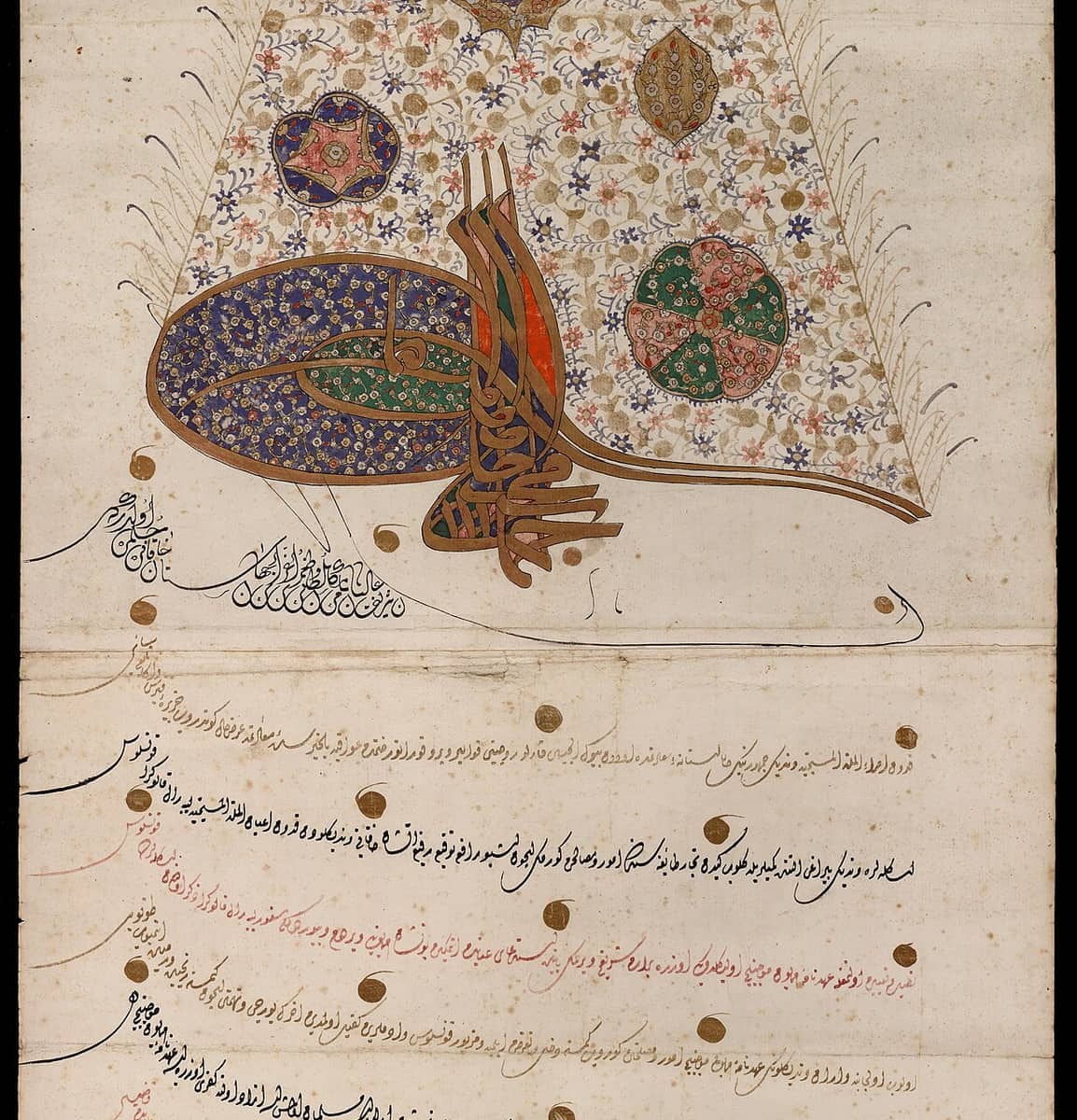
Source · CC BY-SA 4.0 · Photograph by Wikimedia Commons user VenetianNobility
Evidano Transcription
[tughra]
نشان شريف عاليشان سامى مكان وطغراى غراى جهانستان خاقانى حكمى اولدر كه
قدوة امراء الملة المسيحيه ونديك [illegible] بيوك ايلچيسى [illegible] ختمت عواقبه بالخير [illegible] عرضحال كوندروب [illegible]
[remaining lines illegible]
[illegible] قالوكرا قونسلوس
[other marginal and interlinear notes illegible]
Generated by Evidano’s advanced model; not yet checked against a published edition.
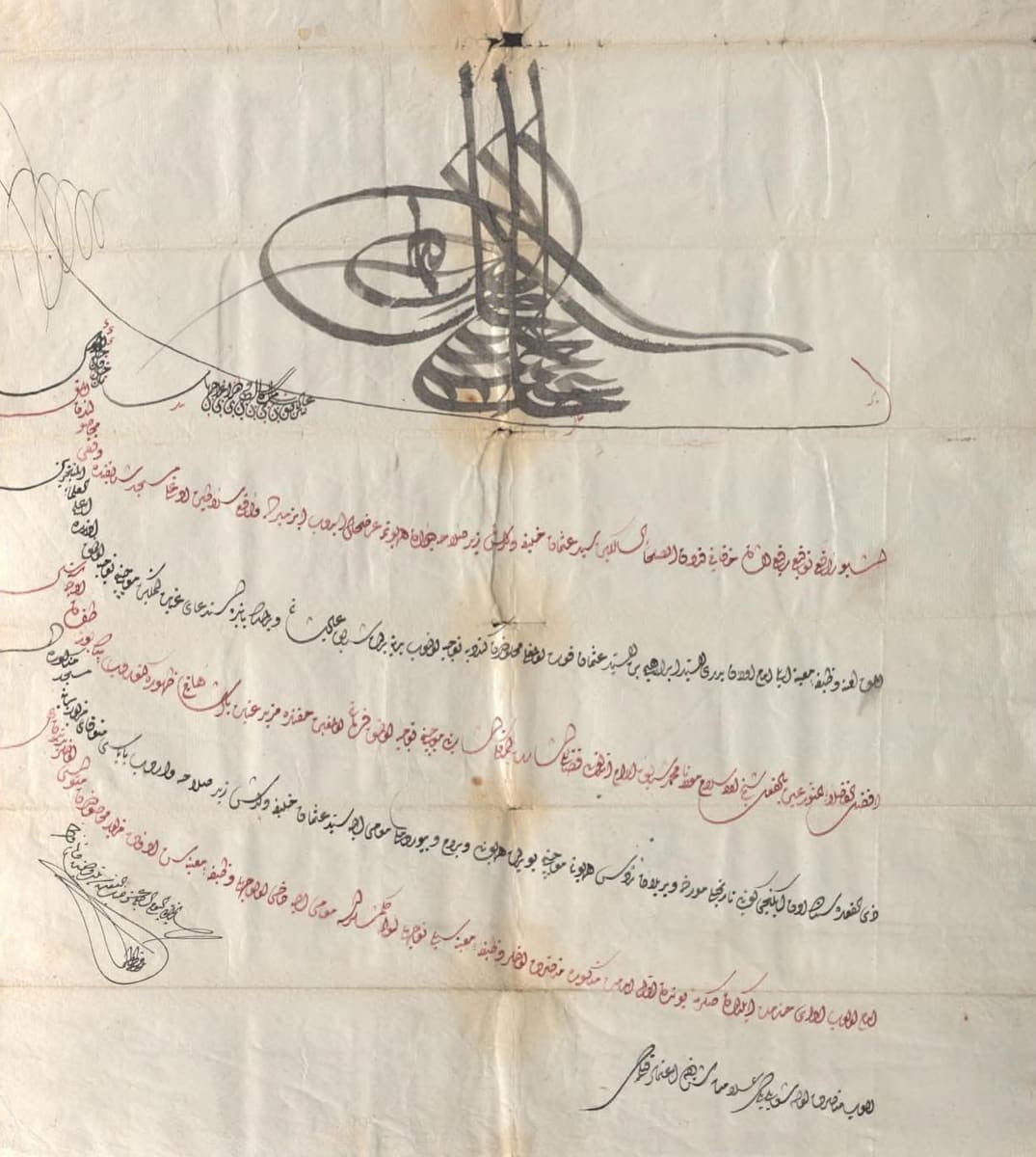
American Philosophical Society, Philadelphia, Ms. Coll. 200, Firman, 1779 · Source · Public domain · Digitised by the University of Pennsylvania Libraries
Evidano Transcription
[tughra]
[illegible]
[illegible] بو رافع توقيع رفيع [illegible] قدوة الصلحا [illegible] سيد عثمان خليفه وكيلى زيد صلاحه [illegible] عرضحال ايدوب [illegible]
[remaining lines illegible]
[illegible] شويله بيلهلر علامت شريفه اعتماد قيلهلر
[marginal notes illegible]
Generated by Evidano’s advanced model; not yet checked against a published edition.
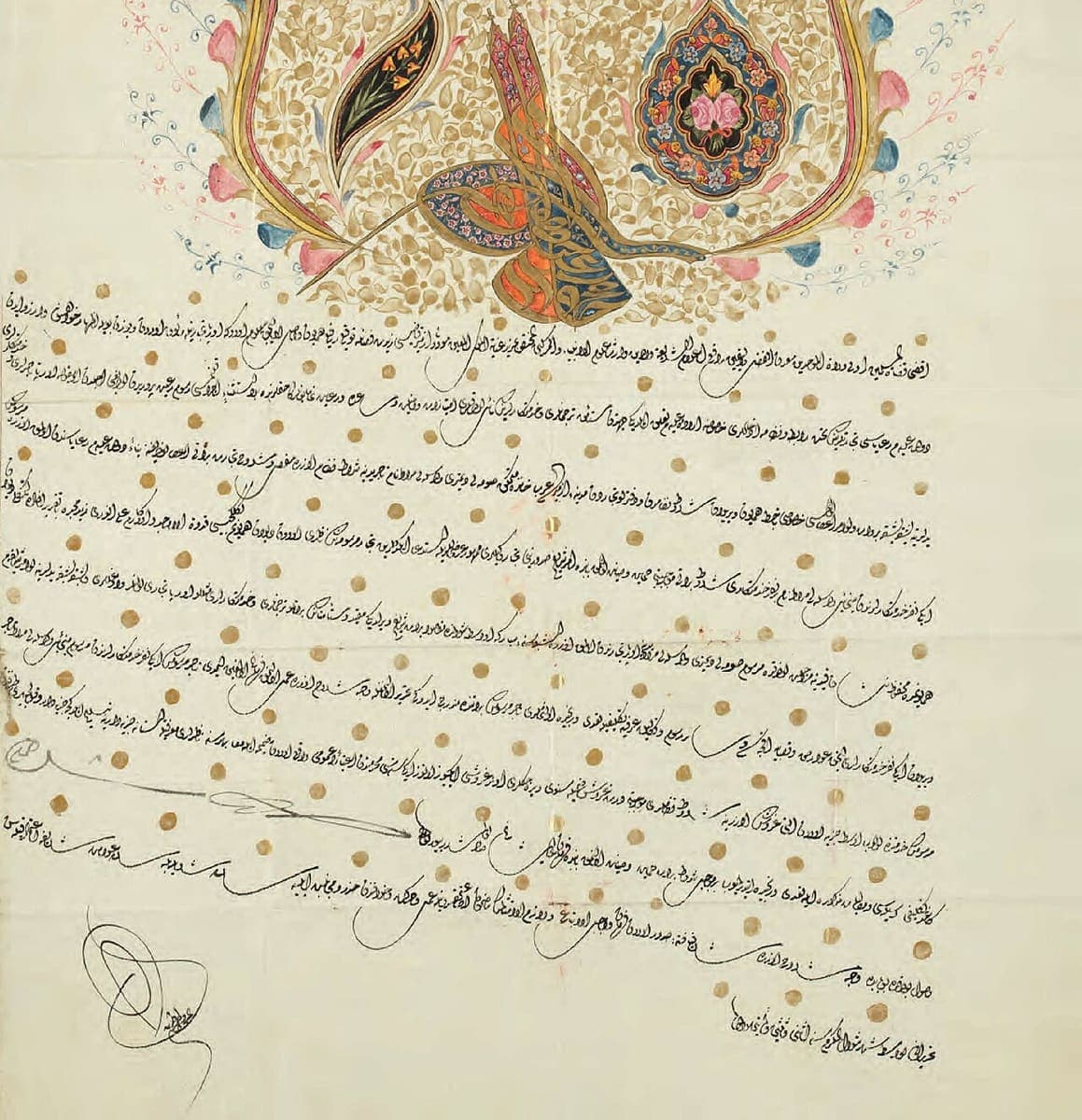
Republic of Türkiye, Directorate of State Archives, 1817 · Source · Public domain · Reproduced from Osmanlı Ferman ve Beratları (State Archives, 4th edn, Istanbul 2021)
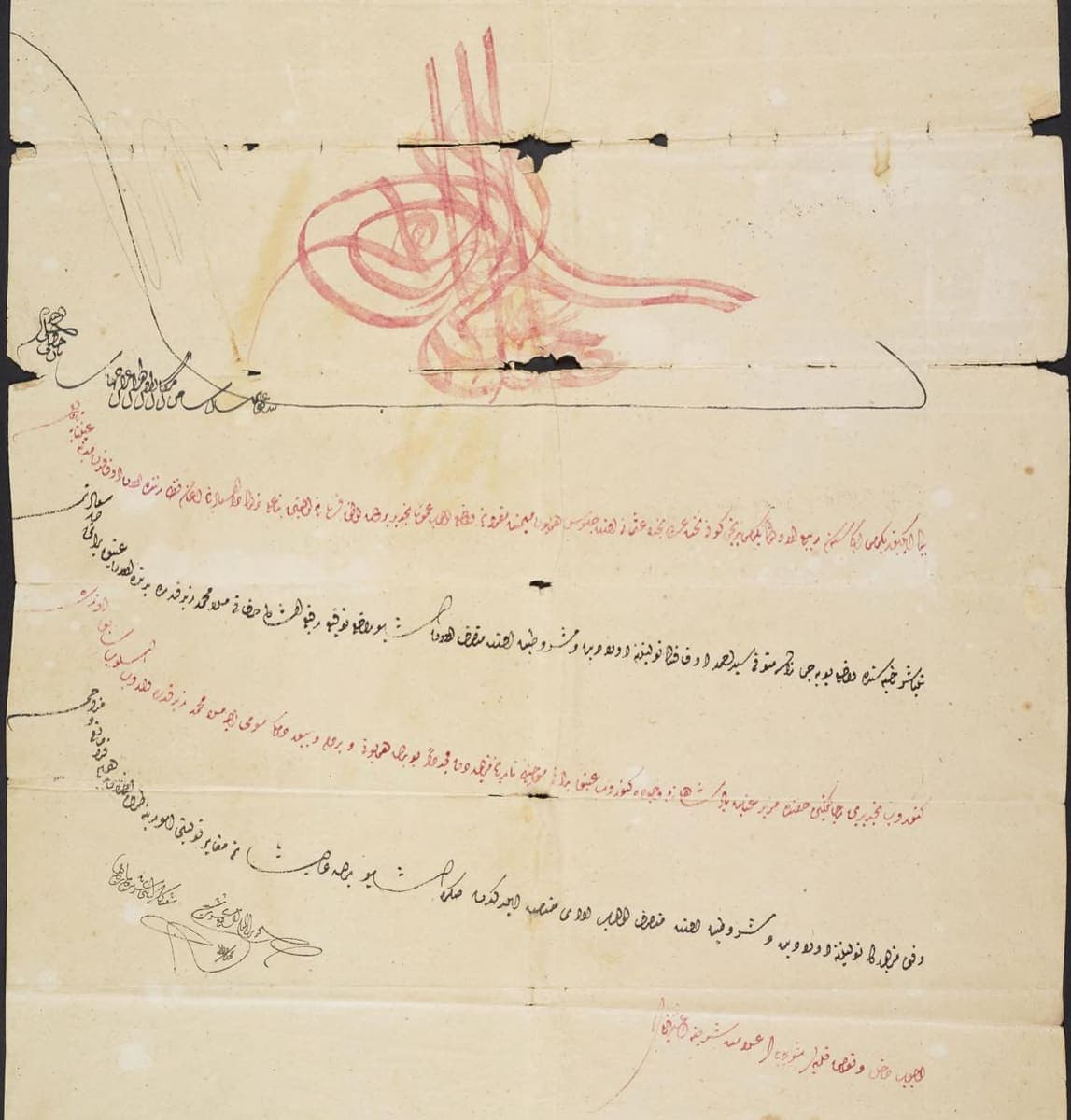
Kislak Center for Special Collections, University of Pennsylvania, Ms. Oversize 22, late 18th–19th century · Source · Public domain
How an imperial document is put together
Dīvānī grew up in the Dîvân-ı Hümâyûn in the later fifteenth century and remained the hand of imperial orders until the end of the empire. Its rules are the opposite of a book hand: word spacing is squeezed out, letters that would normally drop below the line are curled back up, several letters are stacked on top of one another, and each line begins low at the right margin and climbs steadily towards the left, so a sheet of ten lines has ten different baselines. The ceremonial grade, celî dīvānī, goes further, filling every remaining space with dots, small circles and pen flourishes that carry no phonetic value at all. The point was forgery: a clerk cannot slip a word into a line that has no gaps.
The parts of the document are as fixed as the script. A short invocation, usually هو, stands at the top. Below it comes the tughra, the sultan’s emblematic monogram, drawn or illuminated at a scale that dwarfs the text; a document issued by a grand vizier or a governor carries a pençe, a looping personal mark, in the same position or at the side. Then the titulature, which can run for several lines of honorifics before the addressee is named; then the account of the case; then the order itself, often introduced by a formula such as buyurdum ki; then a warning clause; and finally the date, given by decade of a lunar month, and the place of issue, most often Konstantiniyye. Alternating red and black lines, and gold pounce dots scattered over the surface, mark the more solemn grades of ferman and berat.
Around this core sit elements that are not part of the running text at all. Round seal impressions from the officer who registered the document, a wax or ink seal of a witness, notes of registration on the back, and later derkenar remarks added at a slant in the margin when the case came round again. Diplomatic instruments — the ahidnames granted to Venice, France, Poland or Ragusa, the name-i hümayun sent to foreign rulers, the treaty instruments of the eighteenth and nineteenth centuries — use the same hand at its largest and are often several metres of paper rolled into a tube, so the physical sheet has folds and joins across the writing.
Why ordinary OCR struggles here
Filler that looks exactly like letters
The dots, circles and hooks that stop up the gaps in celî dīvānī are drawn with the same pen as the text and sit in the same places as real diacritics. A system that treats every mark as significant will invent letters; one that discards marks indiscriminately will lose the real ones. Telling the two apart depends on knowing where the chancery formula requires a letter.
Ten baselines on one sheet
Because each line rises, a horizontal slice through the page cuts across two or three different lines at once. Ordinary layout analysis therefore produces text in which the end of one line has been glued to the middle of another. The rise has to be modelled explicitly, and lines have to be followed rather than sampled.
Boilerplate that hides the substance
A berat can spend six lines on titles and two on the grant itself. Extracting anything useful means recognising the standard elements so that the names, sums, place names and dates inside them can be picked out, rather than returning a wall of honorifics with the operative clause buried in it.
Dates in more than one calendar
Chancery dates give a ten-day decade of a Hijri month; provincial and post-Tanzimat papers add Rumi financial dates, and nineteenth-century diplomatic instruments carry Gregorian equivalents and Western digits alongside Arabic-Indic ones. All of them read right to left except the Western figures, which do not.
Who works with this material
Historians of Ottoman diplomacy
Capitulations, peace instruments and letters between sovereigns survive in both an Ottoman original and a translated European version, and the two rarely say quite the same thing. Comparing them needs a reading of the Ottoman that keeps the titulature and the operative clauses distinct.
Archives holding ferman and berat collections
Monasteries, churches, synagogues and guild archives across the former empire keep runs of imperial grants confirming privileges. Item-level description usually needs only the date, the sultan, the beneficiary and the subject — all of which sit in predictable places on the sheet.
Provenance and art-market cataloguers
Illuminated fermans are collected as works of art, and a catalogue entry has to say whose tughra it is, what the document grants and when. Reading the tughra legend and the date line is often the whole job.
Legal and property historians
Berats and hüccets are still cited in disputes over endowments and title. What is wanted there is a defensible transcription with the uncertain readings marked, not a smooth paraphrase.
Getting the best transcription
Say what kind of document it is
Naming it as a ferman, a berat, an ahidname or a provincial buyuruldu tells the model which formula skeleton to expect, and the formula is what makes the compressed word groups readable at all. Add the reign if you know it, because the titulature changes with the sultan.
Ask for the non-text elements as fields
Request the tughra legend, any pençe, each seal impression and any dorsal note as separate entries rather than as lines of the body. That keeps the honorific formula of the tughra out of the middle of a sentence about a salary.
Insist on line-by-line output that follows the rise
Ask for one output line per written line, numbered from the top, and for words carried into the margin to be marked as such. This is what makes it possible to check a reading against the photograph without counting strokes.
Test on the date and place line first
The closing formula — decade, month, year, then the place of writing — is short and highly standardised. If the decade word and the regnal year come out cleanly, the settings are working; if they do not, nothing above them is trustworthy either.
Frequently asked questions
- Can the sultan be identified from the tughra alone?
- Usually yes: the tughra spells out the ruler’s name and his father’s, followed by a formula of victory, and those words can be read out of the loops when the drawing is clear. Where the ink has flaked or the emblem is heavily illuminated, the reading should be marked as uncertain.
- What happens to the decorative dots in celî dīvānī?
- They are treated as ornament and excluded from the transcription, with a note where a mark is genuinely ambiguous. Because they cluster in the empty spaces rather than over the letters, position is a strong clue, but the formula is the final test.
- Are marginal derkenar notes worth transcribing?
- They are often the most informative part of the sheet, because they record what happened when the order was acted on. They should be captured as a separate block with their position and, where it can be told, their date.
- How are the ten-day decade dates handled?
- Evâil, evâsıt and evâhir are kept as written and can be expanded to the range of days they denote. Converting them silently to a single date invents precision the chancery never intended.
- Does a document rolled into a long scroll cause problems?
- Long scrolls are usually photographed in sections or as one very tall image. Working section by section keeps the resolution high enough to read the compressed word groups; the sections are then joined by their line numbers.
- Do nineteenth-century documents still use dīvānī?
- The chancery kept it for solemn instruments to the end, but everyday correspondence moved to ruqʿah after the Tanzimat, and many later files mix the two on the same sheet. Saying which hand you expect in which zone of the page helps.
Related scripts and pages
Transcribe your fermans and berats
Upload a sheet, choose Ottoman Dīvānī Imperial and Diplomatic Documents, and check the tughra and date line before running a whole collection.