
Ottoman Turkish · c. 1500–1875
Turn treasury shorthand into figures you can add up
Siyāqat is not a smaller version of ordinary Ottoman writing; it is a professional shorthand in which whole words shrink to a conventional stroke, dots are dropped as a matter of course, and the sums are written out in abbreviated Arabic number-words rather than digits. Evidano reads the entries against the pattern of the register and reports each figure both as it stands on the page and as a number.
Sample pages
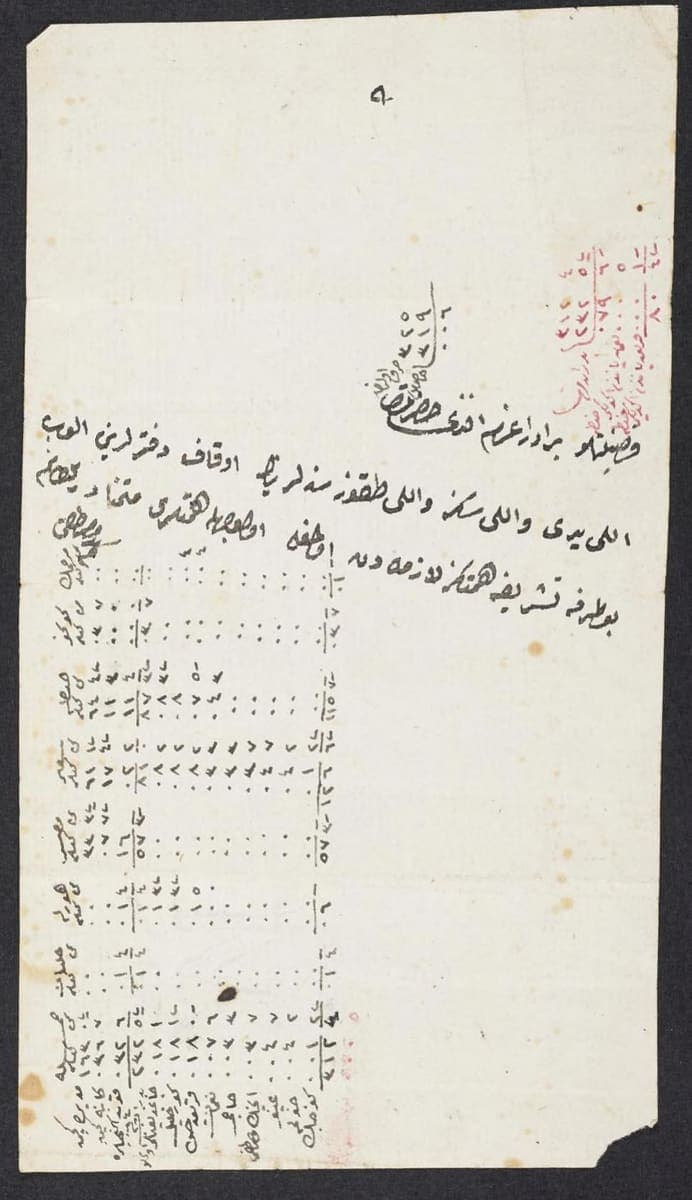
Kislak Center for Special Collections, University of Pennsylvania, Ms. Oversize 22, 19th century · Source · Public domain
Evidano Transcription
٥
[illegible] برادر عزتم افندى حضرتلرى
اللى يدى واللى سكز واللى طقوز سنه لريله اوقاف دفترلرينى الوب
بو طرفه تشريف همتكز [illegible]
[illegible]
[siyāqat entries and figures illegible]
[red marginal notes illegible]
Generated by Evidano’s advanced model; not yet checked against a published edition.
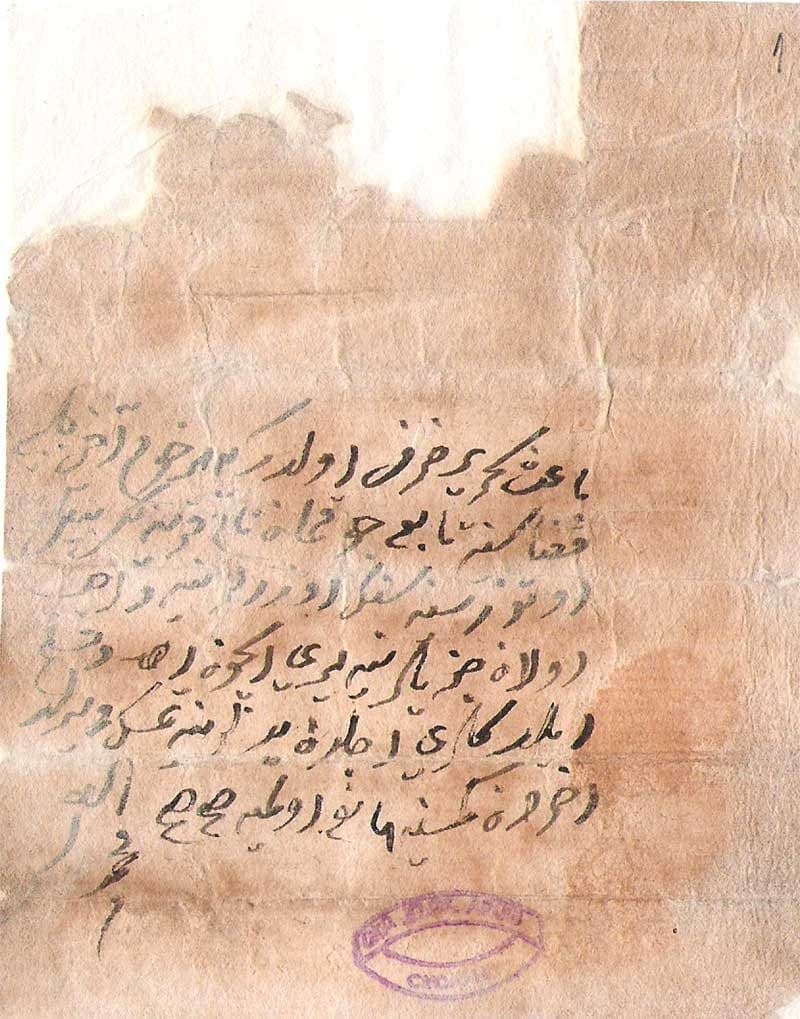
Evidano Transcription
باعث تحریر حروف اولدر که مرحوم آخی بک [?]
قضاسنه تابع [illegible]
[remaining lines illegible]
[signature]
Generated by Evidano’s advanced model; not yet checked against a published edition.
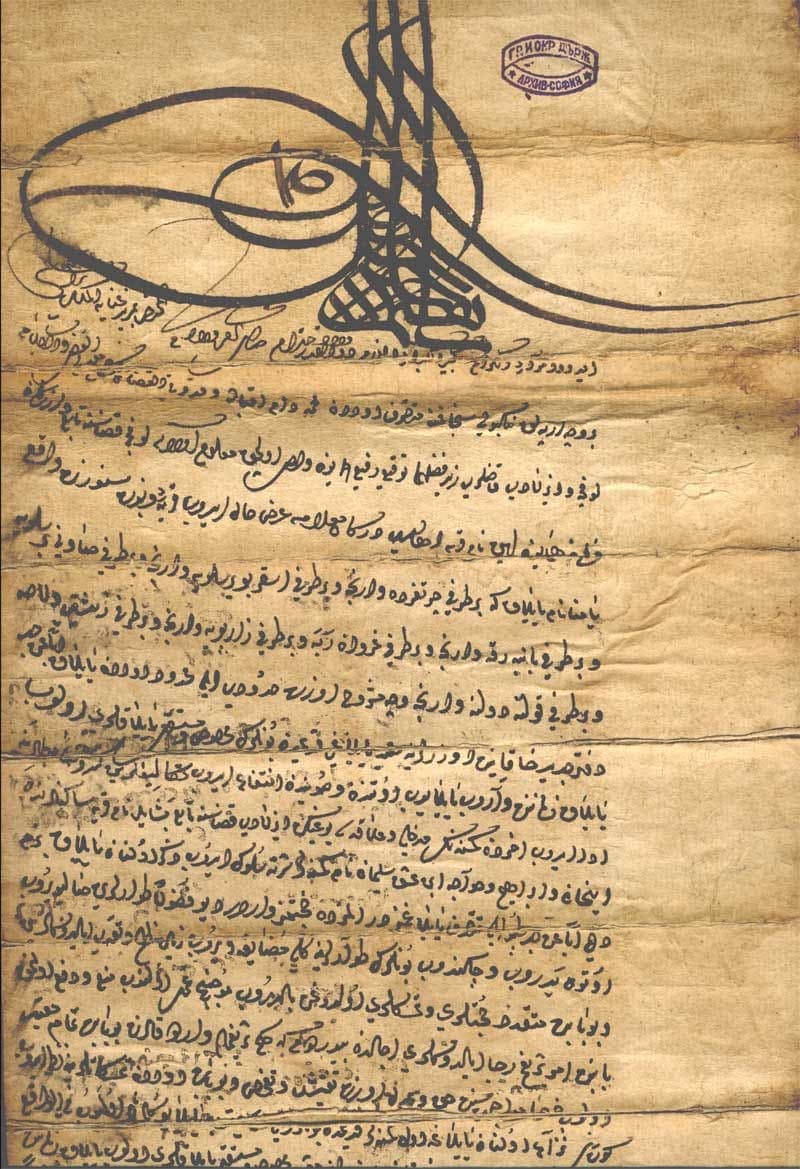
Evidano Transcription
[tughra]
[marginal notes illegible]
[illegible]
[illegible]
[illegible] توقيع رفيع [illegible] واصل اولىجق معلوم [illegible]
[illegible] اهاليسى دركاه معلامه [?] عرض حال ايدوب [illegible] واقع
[illegible] نام يايلاق كه بر طرفى [illegible] وارنجه و بر طرفى [illegible] وارنجه و بر طرفى [illegible]
و بر طرفى [illegible] وارنجه و بر طرفى [illegible] و بر طرفى [illegible] وارنجه و بر طرفى [illegible]
و بر طرفى [illegible] وارنجه وجه مشروح اوزره [illegible] يايلاق [illegible]
دفتر جديد خاقانيده [illegible]
[illegible] انتفاع ايدوب [illegible]
[illegible] قضاسنه تابع [illegible]
[remaining lines illegible]
Generated by Evidano’s advanced model; not yet checked against a published edition.
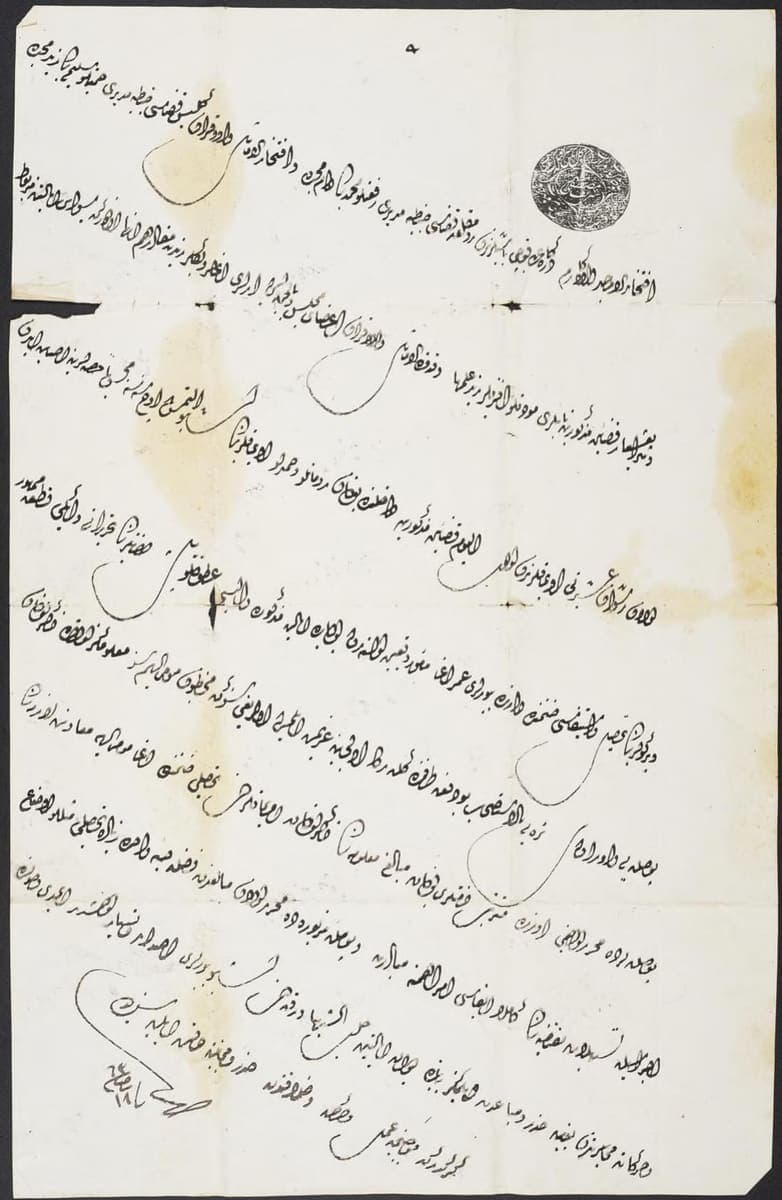
Kislak Center for Special Collections, University of Pennsylvania, Ms. Oversize 22, 19th century · Source · Public domain
Evidano Transcription
٥
[seal]
[illegible] قضاسى خطه مديرى فضيلتلو [illegible] وافتخار [illegible] قضاسى خطه مديرى [illegible]
[remaining lines illegible]
Generated by Evidano’s advanced model; not yet checked against a published edition.
What a fiscal register looks like
From the fifteenth century the Ottoman treasury and the survey offices wrote their books in a hand of their own. Siyāqat keeps the skeleton of the Arabic script but strips it down: the diacritical dots almost entirely disappear, ascenders are shortened, and the recurring vocabulary of the fiscal office — hâne, mücerred, çift, resm, hâsıl, an-cemâʿat, ber-vech-i maktûʿ — is reduced to fixed shapes that a clerk learned as units, much as a shorthand writer learns outlines. Two clerks in different offices could write the same word quite differently, and the same shape can stand for more than one term, so the register is read by position and by comparison with the entries above and below.
The numbers are the second system to learn. Siyāqat figures are not the Arabic-Indic digits used elsewhere in Ottoman writing but heavily contracted forms of the written-out Arabic number-words — a stylised mark for each of the units, tens, hundreds and thousands — combined by writing them side by side and above one another. A sum such as five hundred and fifty akçe is a small cluster of strokes, not three digits, and the same cluster can be read wrongly by an order of magnitude if one element is missed. Totals are habitually written above the item they belong to rather than after it.
The registers themselves are structured objects. A mufassal tahrir defteri lists a village, its adult male householders and bachelors by name, the crops and dues assessed on it and the total; an icmal summarises the same into grants. Cizye, avârız, timar and later temettuat registers repeat their own patterns. Headings in red or in a larger hand span several rows, ditto-like signs stand for a repeated word, a small deleted mark or a later note records that a holding changed hands, and calculations spill into the margin. Alongside the bound volumes sit loose fiscal papers — receipts for the poll tax, statements of account for an endowment, boundary descriptions — usually written in a plainer documentary hand and often carrying a seal.
Why ordinary OCR struggles here
A script with the dots switched off
Where an ordinary Ottoman page gives you a partly dotted skeleton, siyāqat gives you almost none, and it further abbreviates the shapes themselves. There is often no way to decide between two candidate readings from the ink alone; the decision comes from what the column is for and what the neighbouring entries say.
Numbers that are contracted words
Treasury figures are stylised Arabic number-words stacked into a cluster. Systems that expect digits either ignore them or read them as letters, and either way the arithmetic of the register is lost. Recovering a value means recognising the individual elements and then reconstructing the sum.
Columns, spanning headings and sums placed above
A register page is a table without ruled lines. Headings run across several entries, a total sits above its item, and marginal calculations belong to a row three lines up. Reading the page as a sequence of text lines destroys the relationship between a name, a due and a figure.
Corrections made years later
Holdings were reassigned, taxpayers died, exemptions were granted. Clerks struck through entries, wrote new names above them and added dated notes in the margin, sometimes in a different hand and ink. A transcription that flattens all of this into one layer misdates the data it produces.
Who works with this material
Economic and demographic historians
Survey registers are the closest thing the early modern Middle East and Balkans have to a census, and they are used to reconstruct household numbers, crop regimes and tax burdens. That work needs the figures as numbers, with a record of which ones were uncertain.
Local and place-name researchers
A village that has changed its name three times can often be traced only through the spellings in successive defters. What helps is a transcription that gives the Ottoman form exactly as written before anyone tries to identify the modern equivalent.
Endowment and property historians
Waqf accounts show what a foundation owned, what it earned and what it paid its staff, year by year. Reading them means keeping the column structure intact so that a salary can be tied to the post it belonged to.
Archives building item-level finding aids
Repositories with long runs of fiscal registers need enough of each opening captured — place names, dates, headings, totals — to make a volume findable, without committing to a full edition of tens of thousands of entries.
Getting the best transcription
State the register type and its column model
Tell the model whether it is looking at a detailed survey, a summary, a poll-tax roll or an endowment account, and describe the columns you expect. Siyāqat is read by expectation, so the structure you supply does much of the work that the missing dots would otherwise have done.
Ask for figures twice
Request each sum both as the sequence of treasury number-words on the page and as a decimal value, so that a doubtful reading can be checked without going back to the image. Ask for a flag wherever the value depends on a stroke that may or may not be there.
Check the page against its own arithmetic
Most register pages carry a total. Add the items and compare: if the sum does not match, one of the readings is wrong, and the disagreement tells you where to look. This is the fastest quality check the material offers.
Keep later hands in their own layer
Ask for struck-through entries, superscript replacements and marginal notes to be returned separately, with their position. That preserves the difference between the state of a village at the survey and the state of it twenty years later.
Frequently asked questions
- Is siyāqat really a different script or just fast writing?
- It is a distinct professional style with its own repertoire of abbreviated word-shapes and its own numerals, taught inside the financial offices. Someone who reads Ottoman naskh fluently can still be unable to read a treasury page, which is why the two need to be handled as separate problems.
- How are the treasury numerals turned into figures?
- Each element of the cluster stands for a unit, a ten, a hundred or a thousand, and the value is the sum of the elements. Returning both the elements and the total lets a reader see how a figure was arrived at, and makes a mistaken order of magnitude obvious.
- What can be done when a heading spans several rows?
- The heading is captured once and attached to every row it governs, so that a later query for a village or a category does not have to reconstruct the hierarchy from the layout. The original position is recorded as well.
- Do loose fiscal papers need the same treatment as bound registers?
- Receipts, statements and boundary documents are usually written in a plainer hand and read more like ordinary documents, but their figures follow the same treasury conventions. It is worth telling the model which of the two it is looking at.
- Can names in a defter be matched to modern place names?
- Not safely as part of transcription. The Ottoman spelling should be given as written; identification with a modern settlement is a separate editorial judgement that often depends on several registers and on local knowledge.
Related scripts and pages
Transcribe your Ottoman fiscal registers
Upload an opening, choose Ottoman Siyāqat Fiscal and Land Registers, and reconcile one page against its own total before running the volume.