
Ottoman Turkish · c. 1729–1928
Two centuries of Ottoman print, and the handwriting beside it
A printed Ottoman page looks orderly until you notice that a broken sort and an omitted dot are the same black mark, that nothing is vowelled, and that the masthead carries two calendars at once. Evidano reads set type and the everyday ruqʿah hand of letters and forms, keeps the Ottoman numerals as figures, and shows every line against the scan.
Sample pages
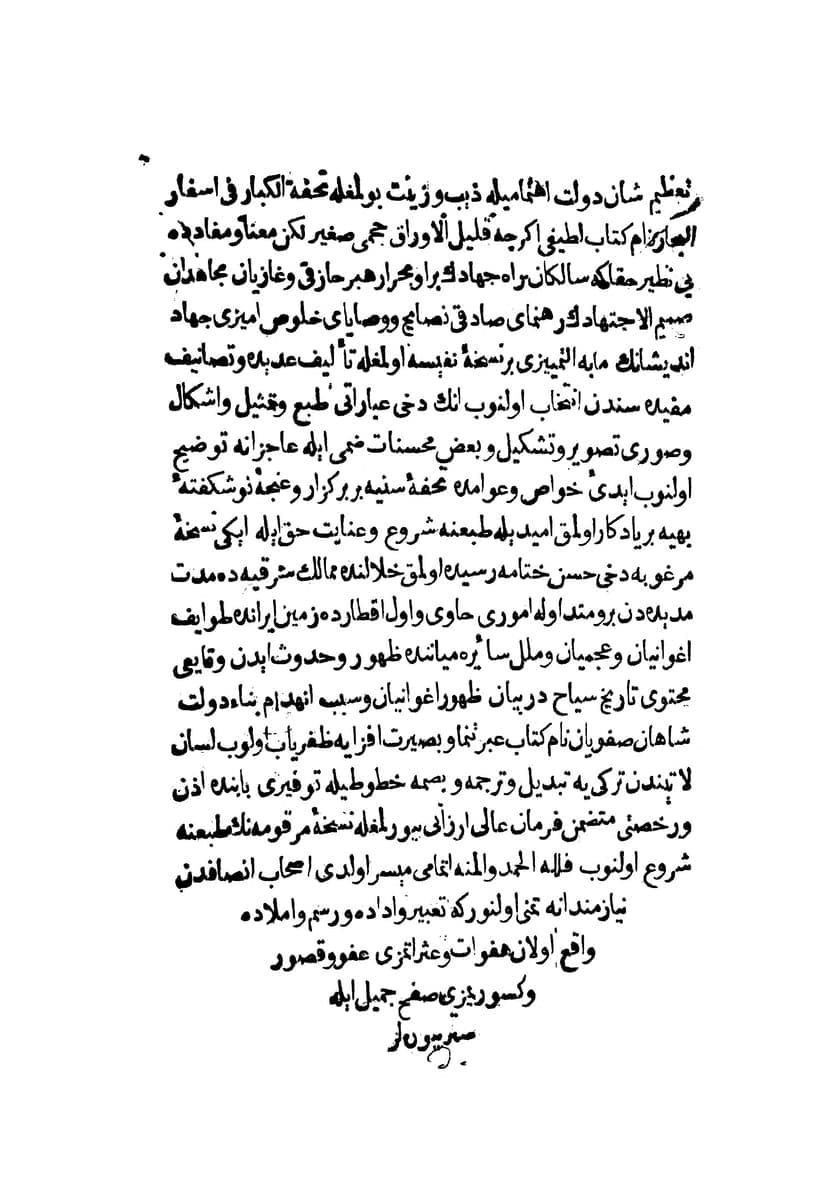
McGill University Library, Rare Books and Special Collections, 1729 · Source · Public domain
Evidano Transcription
تعظيم شان دولت اهتماميله زيب [?] وزينت بولمغله تحفة الكبار في اسفار
البحار نام كتاب لطيفى اگرچه قليل الاوراق حجمى صغير لكن معنا ومفادده
بى نظير حقا كه سالكان راه جهادك براو محرار رهبر حازق وغازيان مجاهدان
صميم الاجتهادك رهنماى صادقى نصايح ووصاياى خلوص اميزى جهاد
انديشانك ما به التمييزى بر نسخهٔ نفيسه اولمغله تأليف عديده وتصانيف
مفيده سندن انتخاب اولنوب انك دخى عباراتى طبع وتمثيل واشكال
وصورى تصوير وتشكيل وبعض محسنات ضمى ايله عاجزانه توضيح
اولنوب ايدى خواص وعوامك تحفهٔ سنيه بربرگزار وغنچهٔ نوشكفتهٔ
بهيه بريادگار اولمق اميديله طبعنه شروع وعنايت حق ايله ايكى نسخهٔ
مرغوبه دخى حسن ختامه رسيده اولمق خلالنده ممالك شرقيه ده مدت
مديده دن برومند اوله امورى حاوى واول اقطارده زمين ايرانك طوايف
اغوانيان وعجميان وملل سايره مياننده ظهور وحدوث ايدن وقايعى
محتوى تاريخ سياح در بيان ظهور اغوانيان وسبب انهدام بناء دولت
شاهان صفويان نام كتاب عبرتنما وبصيرت افزايه ظفرياب اولوب لسان
لاتيندن تركيه يه تبديل وترجمه وبصمه خطوطيله توفيرى بابنده اذن
ورخصتى متضمن فرمان عالى ارزانى بيورلمغله نسخهٔ مرقومهنك طبعنه
شروع اولنوب فلله الحمد والمنه اتمامى ميسر اولدى اصحاب انصافدن
نيازمندانه تمنى اولنوركه تعبير واداده ورسم واملا ده
واقع اولان هفوات وعثراتمزى عفو وقصور
وكسوريمزى صفح جميل ايله
ستر بيورهلر
Generated by Evidano’s advanced model; not yet checked against a published edition.
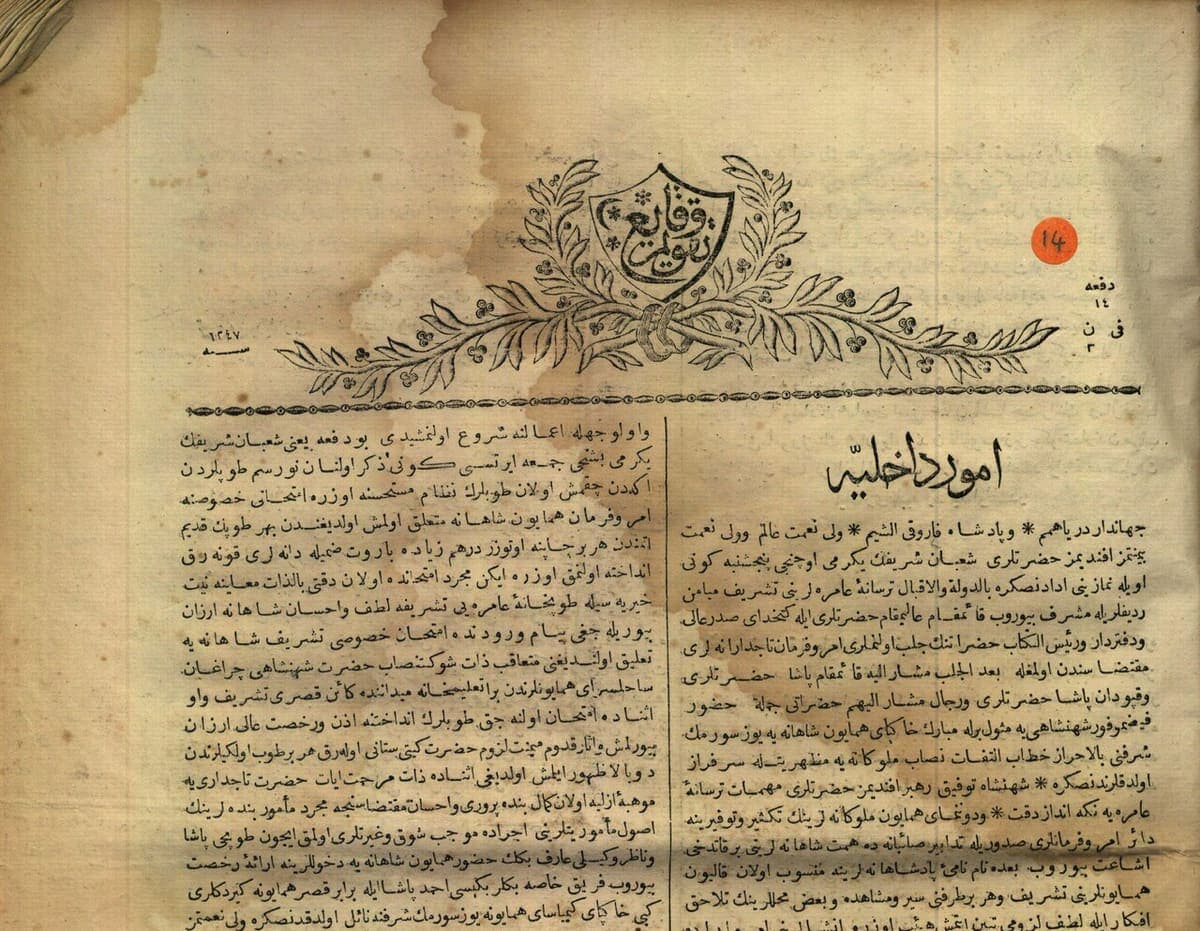
Ankara University newspaper database, 1247 AH (1831–32) · Source · Public domain
Evidano Transcription
تقويم وقايع
سنه ١٢٤٧
دفعه
١٤
فى ن
٣
امور داخليه
جهاندار درياهم * و پادشاه فاروق الشيم * ولى نعمت عالم وولى نعمت
بينمز افنديمز حضرتلرى شعبان شريفك يكرمى اوچنجى پنجشنبه كونى
اويله نمازينى ادادنصكره بالدولة والاقبال ترسانه عامره لرينى تشريف ميامن
رديفلريله مشرف بيوروب قائممقام عاليمقام حضرتلرى ايله كتخداى صدرعالى
ودفتردار ورئيس الكتاب حضراتنك جلب اولنملرى امر وفرمان تاجدارانه لرى
مقتضا سندن اولمغله بعد الجلب مشار اليه قائممقام پاشا حضرتلرى
وقپودان پاشا حضرتلرى ورجال مشار اليهم حضراتى جملة حضور
فيضموفرشهنشاهى يه مثول برله مبارك خاكپاى همايون شاهانه يه يوز سورمك
شرفنى بالاحراز خطاب التفات نصاب ملو كانه يه مظهريتله سرفراز
اولدقلرندنصكره * شهنشاه توفيق رهبر افنديمز حضرتلرى مهمات ترسانه
عامره يه نكه انداز دقت * ودوننماى همايون ملو كانه لرينك تكثير وتوفيرينه
دائر امر وفرمانلرى صدوريله تدابير صائبانه ده همت شاهانه لرينى برقاتدخی
اشاعت بيوروب بعده نام نامى پادشاها نه لرينه منسوب اولان قاليون
همايونلرينى تشريف وهر برطرفنى سير ومشاهده و بعض محللرينك تلاحق
افكار ايله لطف لزومى تبين ايتمش هيئت اوزره انشالرينه اراده
واولو جهله اعمالنه شروع اولنمشيدى بودفعه يعنى شعبان شريفك
يكرمى بشنجى جمعه ايرتسى كونى ذكر اولنان نورسم طوپلردن
اكدن چقمش اولان طوپلرك نظام مستحسنه اوزره امتحانى خصوصنه
امر وفرمان همايون شاهانه متعلق اولمش اولديغندن بهر طوپك قديم
اتندن هر بر چاپنه اوتوزر درهم زياده باروت ضميله دانه لرى قونه رق
انداخته اولنمق اوزره ايكن مجرد امتحانده اولان دقتى بالذات معاينه نيت
خيريه سيله طوپخانه عامره يى تشريفه لطف واحسان شاهانه ارزان
بيوريله جغى پيام ورودنده امتحان خصوصى تشريف شاهانه يه
تعليق اولنديغنى متعاقب ذات شوكتنصاب حضرت شهنشاهى چراغان
ساحلسراى همايونلرندن برا تعليمخانه ميداننده كائن قصرى تشريف واو
اثناده امتحان اولنه جق طوپلرك انداختنه اذن ورخصت عالى ارزان
بيورلمش واثار قدوم ميمنت لزوم حضرت كيتى ستانى اوله رق هر برطوپ اولكيلرندن
دوبا لا ظهور ايلمش اولديغى اثناده ذات مرحمت ايات حضرت تاجدارى يه
موهبه ازليه اولان كمال بنده پرورى واحسان مقتضا سنجه مجرد مأمور بنده لرينك
اصول مأموريتلرينى اجراده موجب شوق وغيرتلرى اولمق ايچون طوپجى پاشا
وناظر وكيلى عارف بكك حضور همايون شاهانه يه دخوللرينه ارائه رخصت
بيوروب فريق خاصه بكلر بكيسى احمد پاشا ايله برابر قصر همايونه كيردكلرى
كبي خاكپاى كيميا ساى همايونه يوز سورمك شرفنه نائل اولدقدنصكره ولى نعمتمز
Generated by Evidano’s advanced model; not yet checked against a published edition.
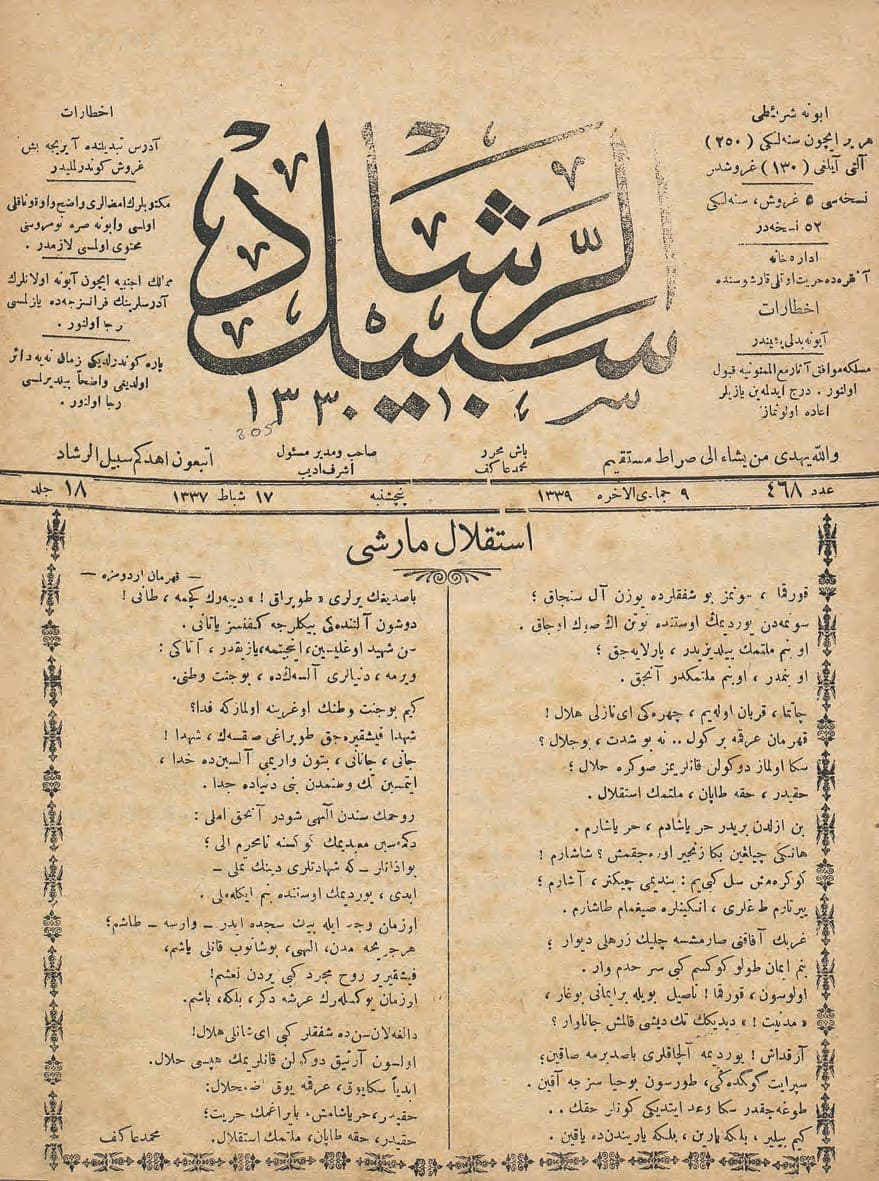
Source · Public domain · Reproduced from Mehmet Akif Ersoy ve İstiklal Marşı (State Archives, Ankara 2021)
Evidano Transcription
The first four stanzas of the poem, which open the right-hand column; the page carries all ten. The text is the Ottoman-script keying on the multilingual Wikisource, so it reproduces the poem rather than this particular setting: the printed page adds the commas and semicolons visible at the ends of the hemistichs, which the keyed text does not.
قورقما سونمز بو شفقلردە یوزن آل سنجاق سونمەدن یورديمك اوستنده توتن اك صوك اوجاق او بنم ملتمك ییلدیزیدر پارلایەجق او بنمدر او بنم ملتمكدر آنجاق چاتما قربان اولایم چهرەكی ای نازلی هلال قهرمان عرقمە بر كول نە بو شدت بو جلال سكا اولماز دوكولن قانلرمز صوكرە حلال حقیدر حقە طاپان ملتمك استقلال بن ازلدن بریدر حر یاشادم حر یاشارم هانکی چیلغین بكا زنجیر اورەجقمش شاشارم كوكرەمش سل كبییم بندیمی چیكنر آشارم ییرتارم طاغلری انكینلرە صیغمام طاشارم غربك آفاقنی صارمشسە چلیك زرهلی دیوار بنم ایمان طولو كوكسم كبی سرحدم وار اولوسون قورقما نصل بویلە بر ایمانی بوغار مدنیت دیدیكك تك دیشی قالمش جاناوار
Source: استقلال مارشی, Ottoman Wikisource (multilingual Wikisource) (Public domain).
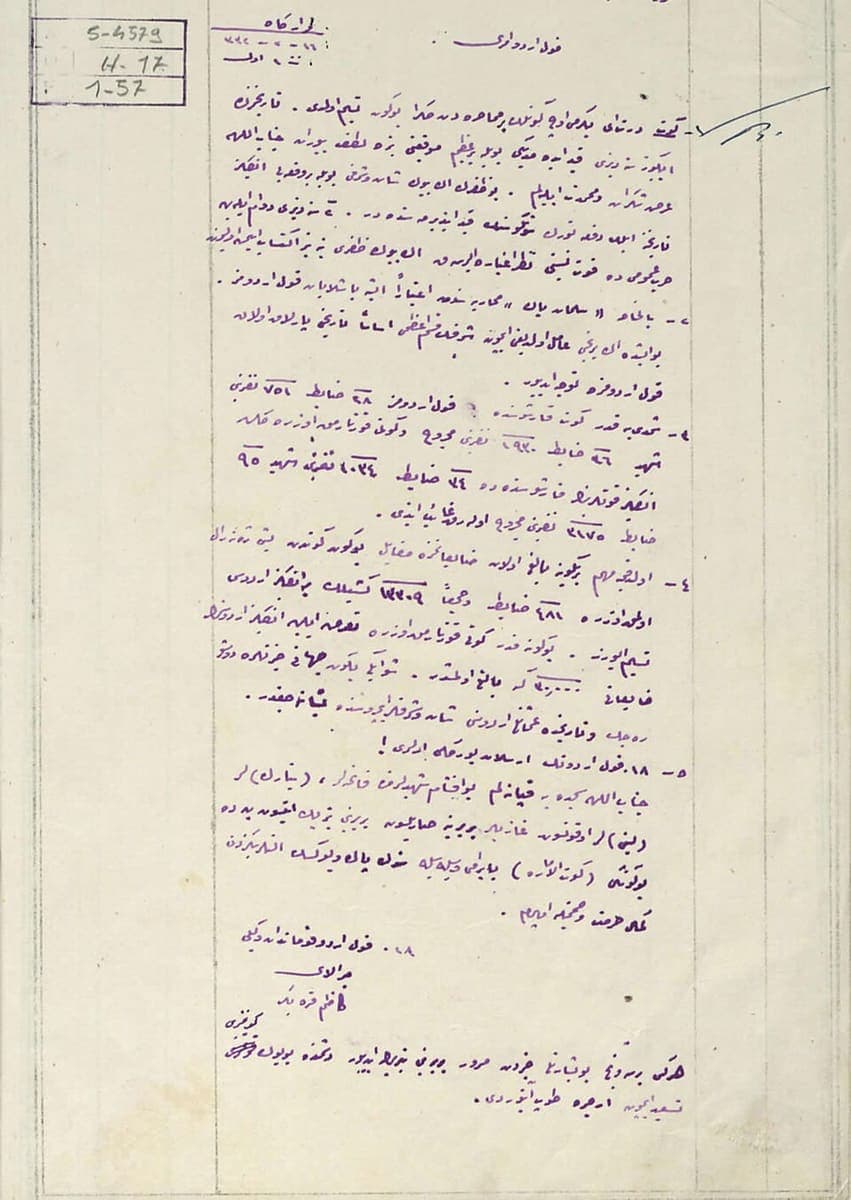
Ottoman State Archives, May 1916 · Source · Public domain
Evidano Transcription
The whole of the order, given as a Latin-alphabet transliteration rather than an Arabic-script transcription: it romanises the Ottoman words as written (muvaffakıyyet, i’tibâra, zâbit) instead of translating them into modern Turkish, marks a doubtful reading with (?), and keeps the numbered sections. The final paragraph is the closing remark written below the signature.
Kolordu Emri
1- Kût, dört ay yirmi üç günlük bir muhâsaradan sonra bugün teslîm oldu. Târihimizin iki yüz seneden beri kayd edemediği böyle bir azîm muvaffakıyyeti(?) bize lûtf buyuran Cenâb-ı Allah’a arz-ı şükrân ve mahmidet eyleyelim. Bu zaferin en büyük şân ve şerefi, böyle bir vak’ayı İngiliz tarihine ilk def’a Türk süngüsünün kayd etdirmesindedir. 2 seneden beri devâm eyleyen Harb-i Umûmî’de kuvvet nisbeti nazar-ı i’tibâra alırsak en büyük zaferi yine biz iktisâb eylemiş oluyoruz.
2- Bi-l-hâssa “Selmanpak” Muhârebesi’nden i’tibâren işe başlayan Kolordumuz bu işde en birinci âmil olduğu için şerefin kısm-ı âzamı esâsen târihi parlak olan Kolordumuza teveccüh ediyor.
3- Şimdiye kadar Kût karşısında Kolordumuz; 28 zâbit, 751 neferini şehîd, 36 zâbit, 1.930 neferini mecrûh ve Kût’u kurtarmak üzere gelen İngiliz kuvvetlerinin karşısında da 34 zâbit, 1.034 neferini şehîd, 95 zâbit, 3.175 neferini mecrûh olarak gaib etdi.
4- Oldukça mühim bir yekûne bâliğ olan zâyiâtımıza mukabil bugün Kût’dan beşi jeneral olmak üzere 481 zâbit ve cem’an 13.309 kişilik bir İngiliz ordusu teslîm alıyoruz. Bugüne kadar Kût’u kurtarmak üzere taarruz eyleyen İngiliz ordusunun zâyiâtı 30.000’e bâliğ olmuşdur. Şu iki yekûn cihânı hayretlere düşürecek ve târihde Osmanlı ordusunu şân ve şerefler içerisinde yaşatacakdır.
5- 18. Kolordunun arslan yürekli erleri!
Cenâb-ı Allah’a secdeye kapanalım. Bu akşam şehîdlerimize Fâtihalar, (Tebâreke)ler, (Yasin)ler okunsun. Gazîler birbirine sarılsın, birbirini tebrîk etsin. Ben de, bugünki (Kûtü’l-amare) Bayramı vesîlesiyle sizin pâk ve yüksek alınlarınızdan kemâl-i hürmet ve samimiyyetle öperim.
18. Kolordu Kumandan Vekîli / Mîr-âlây / Kâzım Karabekir
Herkes pür sevinç, bu beşâretli haberden mesrûr, birbirini tebrîk ediyor. Düşman da büyük günümüzü tes’îd için ara sıra top atıyordu.
Source: Transliteration published on the Wikimedia Commons file page, from the Ottoman State Archives copy (Public domain).
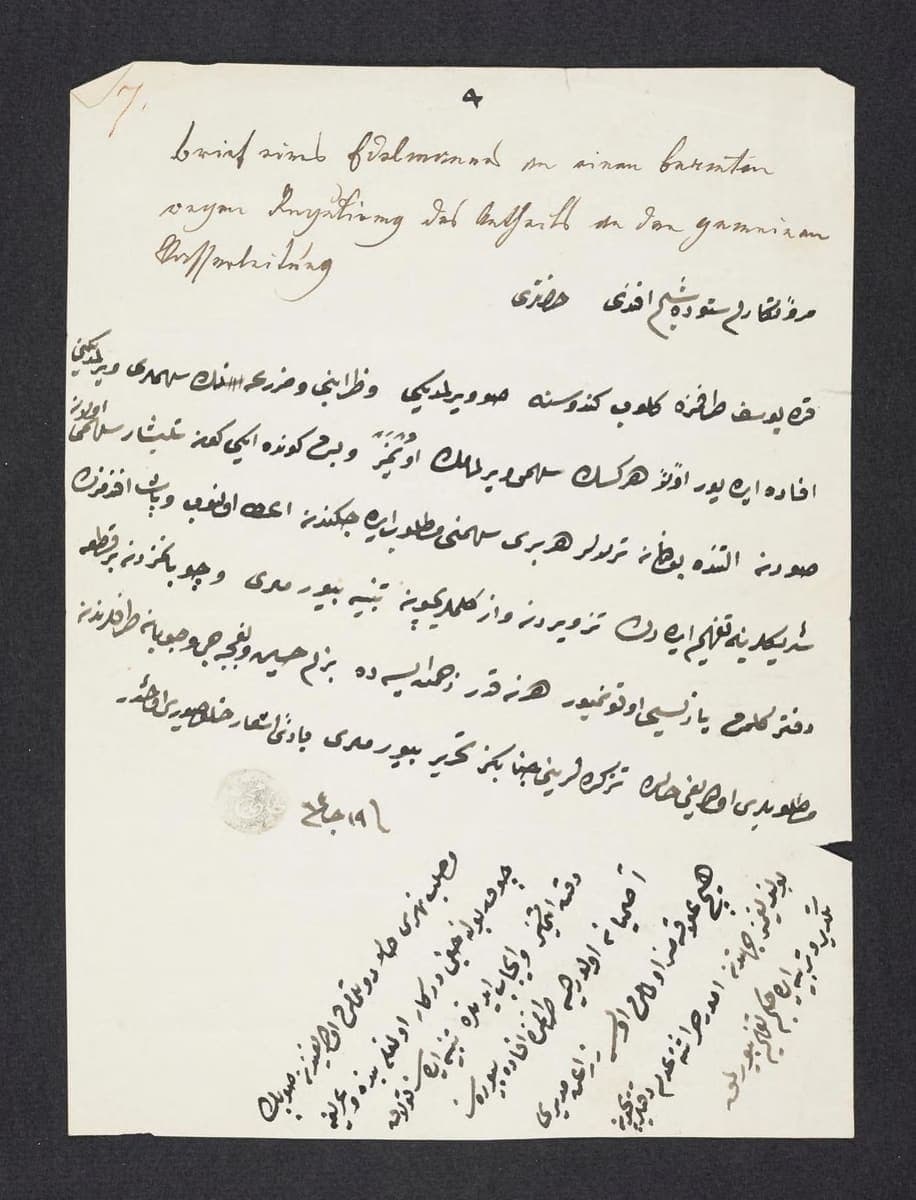
Kislak Center for Special Collections, University of Pennsylvania, Ms. Oversize 22, 19th century · Source · Public domain
Evidano Transcription
٥
Brief eines Edelmannes an einen Beamten
wegen Bezahlung des Antheils an den gemeinen
Wasserleitung
مروتكارم ستوده شيم افندى حضرتى
قره يوسف طرفه كلوب كندوسنه صو ويرلديكى وظائفى ومزرعه سنك سهمى ويرلديكينى
افاده ايدييور [illegible] هركسك سهمى ويرلمك [illegible] وبر كونده ايكى كره نوبت [?] [illegible]
[remaining lines illegible]
١٩ ج
[diagonal marginal notes illegible]
Generated by Evidano’s advanced model; not yet checked against a published edition.
From the first Ottoman press to the alphabet reform
İbrahim Müteferrika opened his press in Istanbul in 1729 with a licence covering everything but religious texts, and printed seventeen works before it closed in 1742. His type is a naskh cut for the page rather than the pen: upright, generously leaded, without vowel signs, and still carrying manuscript habits such as the catchword at the foot. Presses multiplied after 1800 — the state Matbaa-i Âmire, the Üsküdar press, and from the 1830s lithography, which reproduces a scribe’s handwriting rather than composed type and therefore looks nothing like the rest of the printed record. By the end of the century Istanbul, Cairo, Salonica and Beirut were producing novels, textbooks, dictionaries and illustrated magazines in the same alphabet.
Newspapers begin with Takvim-i Vekayi, the official gazette founded in 1831, and multiply after 1860. Their pages set the recognition problems out plainly: several columns divided by rules, a decorative masthead with the title in a monumental hand, a date line carrying the Hijri and the Rumi financial year and often a European date beside them, section headings in a heavier fount, and prices in Arabic-Indic numerals that read left to right inside a text that reads right to left. From the 1860s European punctuation arrives — commas, semicolons, question marks, parentheses — and sits oddly against a script that had managed without it.
The manuscript half of the same period is dominated by ruqʿah, the plain, fast hand standardised in the mid-nineteenth century and taught in every school. Its letters are short and flat, the two dots of a te or a ye are run into a single dash and three dots into a small caret, the vertical strokes are cut down, and no vowel signs are used at all. Almost everything that was not printed is written in it: corps orders and telegrams, petitions and the slanting derkenar replies scribbled on them, registers of births, exercise books, receipts, the ownership note on the flyleaf of a printed book. Printed and handwritten Ottoman therefore turn up on the same sheet, and stop together with the alphabet reform of 1928.
Why ordinary OCR struggles here
A missing dot and a broken sort look identical
Metal type wears, ink squashes into the eye of a letter, and a nineteenth-century paper takes an impression unevenly. A gap where a dot should be may mean the compositor had no such sort, that the sort was damaged, or that the word never carried the dot. Deciding is a matter of comparing other occurrences on the same page.
No vowels in a language that needs them
Printed Ottoman almost never vowels its Turkish, so a graph sequence can correspond to several words distinguished only by vowels. Producing modern Turkish from an Ottoman page is therefore an act of reading rather than of character conversion, and the ambiguities have to be surfaced rather than silently resolved.
Two directions and three calendars on one line
A masthead can give the Hijri date, the Rumi date and a European one, with figures that run left to right embedded in right-to-left text. Tables after the Tanzimat mix Arabic-Indic and Western digits in adjacent columns. Getting the reading order right matters more here than getting any single character right.
Ruqʿah’s flattened letters and merged dots
In a fast ruqʿah hand the distinctive height of a letter is gone and the dots have become dashes, so the difference between several common words rests on a stroke a millimetre long. Handwriting recognition trained on book hands reads it as a naskh gone wrong.
Handwriting on top of print
Ottoman printed books carry endowment stamps, seals, price notes, censorship permissions and readers’ corrections, and newspapers carry archive stamps and pencil filing marks. A pass that does not separate them mixes a 1908 owner’s note into an 1891 novel.
Who works with this material
Newspaper and periodical digitisation projects
Libraries with runs of Ottoman gazettes need full text good enough to search by name, place and date. Column segmentation and reliable date lines matter more here than a perfect reading of every word, because the searcher will look at the page image anyway.
Literary and intellectual historians
The Tanzimat novel, the periodical essay and the poetry of the constitutional period exist mainly as printed Ottoman that has never been reissued in Latin letters. A transliteration that keeps the Ottoman forms is what allows the vocabulary of the period to be studied rather than modernised away.
Family and local historians
Population registers, military service papers, title deeds and letters in ruqʿah sit in family drawers and municipal archives across the former empire. What is wanted is names, dates and places, with an honest note where the hand cannot be read.
Cataloguers of Ottoman imprints
Bibliographic work depends on getting the title page right: the title, the author, the press, the place and the year in whichever calendar the imprint used. Romanised headings then have to follow a stated standard so that records from different libraries can be matched.
Getting the best transcription
Say whether the page is set, lithographed or written
A lithographed book reproduces handwriting and needs to be treated as manuscript, not as type, even though it is a printed object. Naming the production method, and naming the zones if a page mixes them, avoids the commonest source of nonsense output.
Fix the numeral and calendar policy up front
Decide whether Arabic-Indic figures should be kept as written or converted, and whether Hijri and Rumi dates should be left alone or given a Gregorian equivalent alongside. Say it once and the whole run stays consistent.
Name your romanisation standard
If you want Latin letters, specify which convention — the İslâm Ansiklopedisi system, a library romanisation, or plain modern Turkish orthography. They differ over long vowels, the ayn and the ezafe, and mixing them inside one project makes the result unsearchable.
Test on the masthead or the title page
These carry the title, the numbering, the dates and the imprint in a few lines, and every one of them is checkable against a catalogue. If the issue number and both dates come out right, the settings will hold for the body of the paper.
Further reading on this hand
The palaeography guides the in-app selector points to for this domain, if you want to check a transcription against the standard references.
- Identifying Resources in Ottoman Studies
This Princeton University guide explains how Ottoman Turkish books and other resources are identified in catalogs and collections. It covers the Arabic-script printing era from the first Ottoman press in 1729 through the alphabet reform of 1928. The guide discusses inconsistent transliteration, cataloging under Arabic-script or romanized forms, and the difficulties created by variant titles and personal names. It is useful for printed Ottoman material because it defines the bibliographical period and the script-identification problems surrounding surviving editions.
Frequently asked questions
- Can Ottoman print be converted straight to modern Turkish?
- Only with a reading step in between. The script does not record most vowels, so the same printed word can correspond to different Turkish words, and modern spelling also replaces much of the Arabic and Persian vocabulary. Ask for a transliteration first and treat modernisation as a separate, reviewable pass.
- How is a lithographed book handled?
- As handwriting. Lithography from the 1830s reproduces a calligrapher’s page, so the letterforms, ligatures and spacing are those of a manuscript even though the object is an edition. Telling the model this changes the result markedly.
- What happens to text in other scripts on the same page?
- Provincial gazettes often print Ottoman beside Greek, Armenian, Bulgarian or Arabic in parallel columns. Each column can be transcribed separately and labelled, which is far more useful than a single stream that switches script mid-line.
- Are seals, stamps and ownership notes captured?
- They are returned as separate items with their position, so that a censorship permission, a library stamp and a reader’s marginal correction do not end up inside the printed sentence they happen to sit next to.
- Does anything change at the 1928 alphabet reform?
- Printing in Arabic script effectively stops, and material from the transition can carry both alphabets on one sheet. It is worth saying which side of 1928 a document comes from, because a Latin-alphabet Turkish page needs an entirely different pass.
Related scripts and pages
Transcribe your Ottoman books and papers
Upload a page, choose Printed Ottoman Turkish and Ruqʿah Manuscript Material, and check the masthead before running a whole run of issues.