
Persian · c. 1200–1500
Decrees, deeds and letters in the hanging hand
Taʿliq was written to be produced fast and read by people who already knew the formula. Its words hang from the top of the line and slide downhill to the left, connectors stretch for centimetres, and letters that the alphabet keeps apart are hooked together anyway. Evidano follows the slope, separates the seals and the endorsements from the decree itself, and shows you which readings it is unsure of.
Sample pages
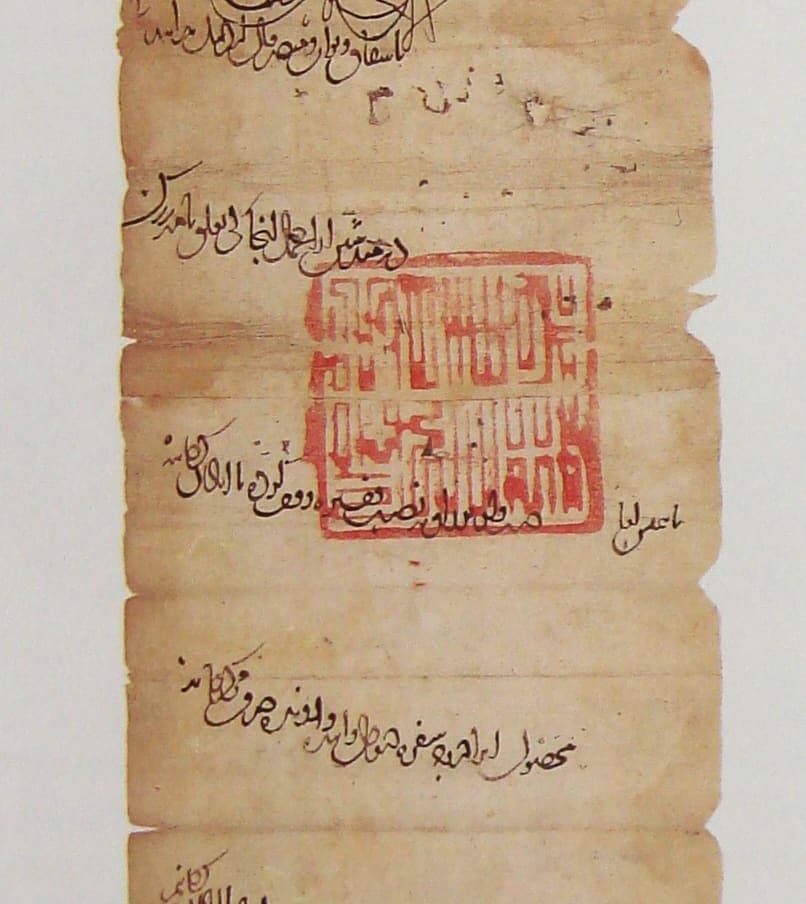
Art and History Collection, LTS1995.2.9, June 1292 · Source · Public domain
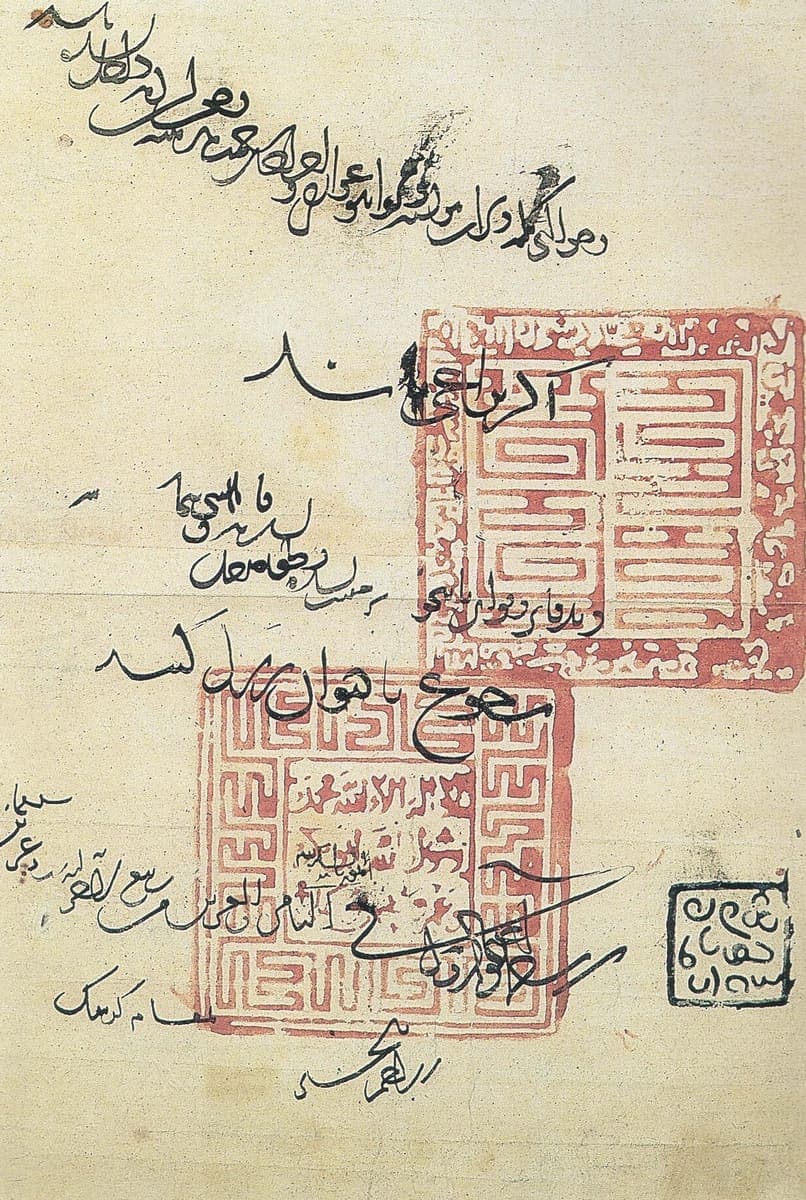
National Library and Archives of Iran, Tehran, 3 April 1326 · Source · Public domain · Photograph by Seyyed Hasan Shahrestani, via asnad.org
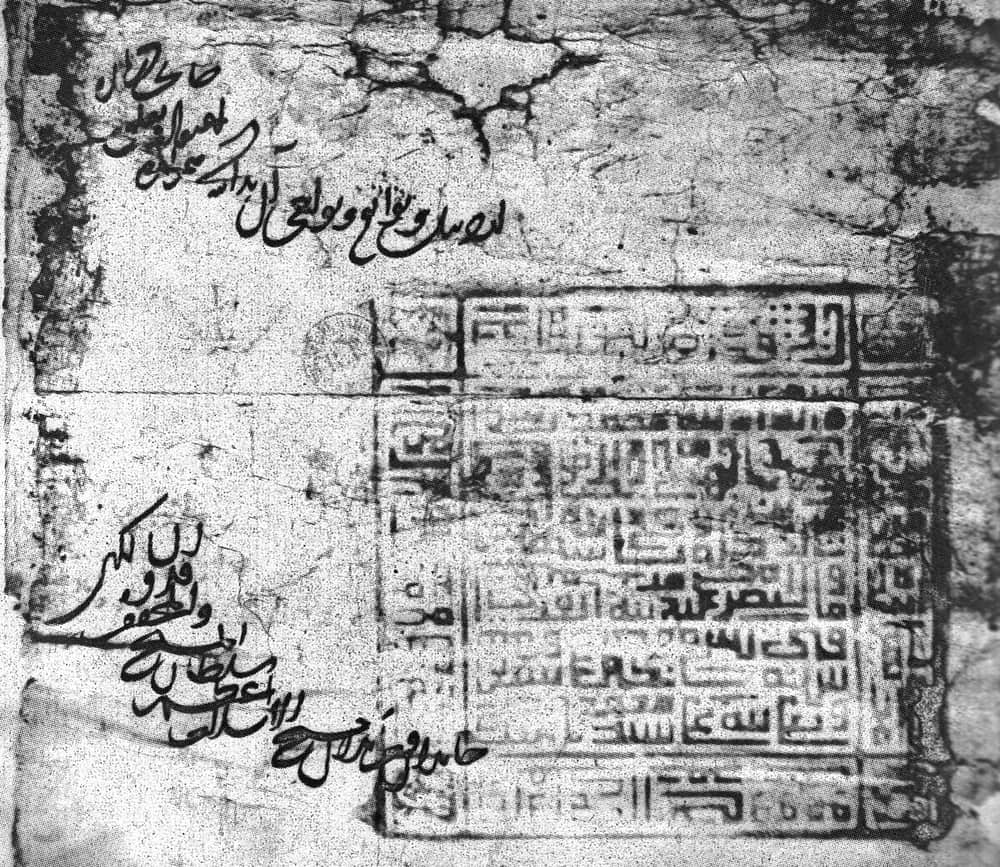
Bibliothèque nationale de France, Supplément persan 1630, May–June 1372 · Source · Public domain · Via asnad.org, Digital Persian Archive
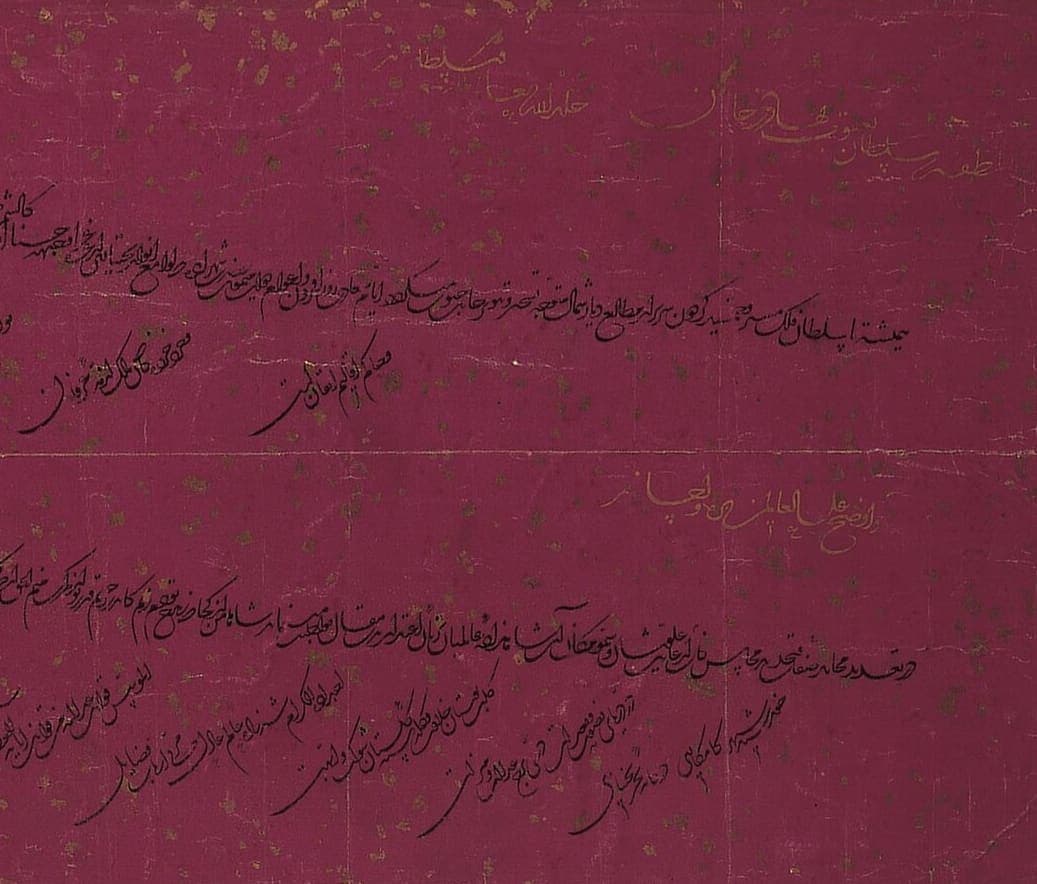
Topkapı Sarayı Müzesi, Istanbul, Hazine 2153, f. 74b, c. 1478–1490 · Source · Public domain
Evidano Transcription
[cut off] سلطان یعقوب [?] بهادر خان خلد الله تعالی [illegible] سلطانه
[lines of fine shikasta taliq in black and a second gold phrase, not verified]
Generated by Evidano’s advanced model; not yet checked against a published edition.
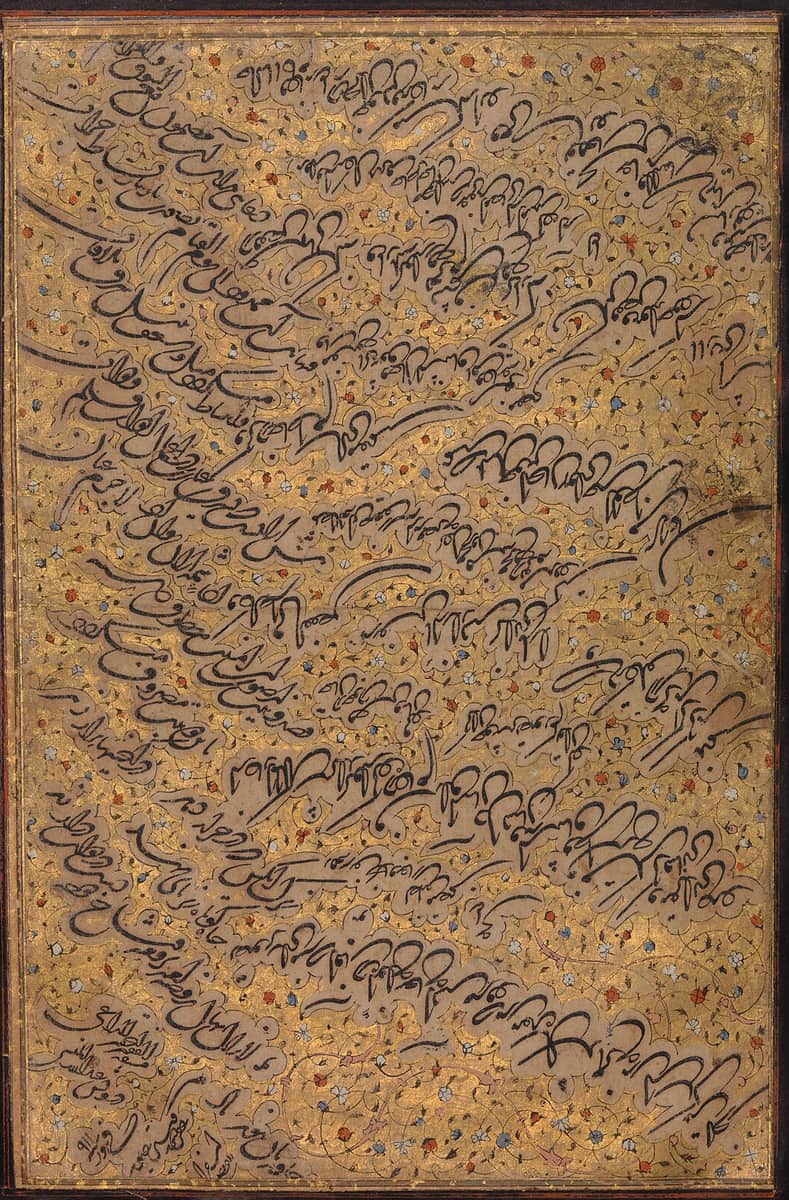
Metropolitan Museum of Art, New York, 2015.139, A.H. 911 / 1505–6 · Source · CC0 1.0
How a taʿliq document is put together
Taʿliq — the name means hanging or suspended — grew up in the Persian chanceries after the Mongol conquest, when the secretaries of the Ilkhanid dīvān needed a hand faster than naskh and more distinctive than the Arabic tawqīʿ they had inherited. It stayed the working script of the Persian-speaking chanceries through the Jalayirid, Timurid, Qara Qoyunlu and Aq Qoyunlu periods, and outlived its own usefulness as an album and diploma hand once nastaʿliq took over books and letters. Its signature is the descent: each word sits on its own falling axis, so a line that begins near the top right of the sheet ends well below where it started, and the eye has to track the drop rather than a ruled baseline.
The letters behave differently from those in a book hand. Connectors are drawn out into long flat sweeps that can carry a whole word across empty paper; the final forms of ی، ن and ل curve back underneath what precedes them; and the seven letters that never join to the left in ordinary writing — ا، د، ذ، ر، ز، و and ژ — are routinely tied to the next letter by a documentary ligature that exists in no printed font. Dots are reduced to slanting dashes, gathered under a single stroke, or dropped altogether, which is tolerable in a text made of repeating formulae and impossible in a personal name. Honorifics are contracted, and a scribe who has written the sultan’s style a thousand times reduces it to a gesture.
A decree is also an object with a history written on it. The sheet is usually a long scroll of pasted lengths of paper; the invocation stands alone at the head, the substantive clauses follow with wide bands of blank paper between them, and the date closes the text, often given both by the Hijri calendar and by the Turco-Mongol twelve-animal year. Seals are stamped over the writing: under the Ilkhans these are square red or black tamghas cut in Chinese seal script, a direct inheritance from the Yuan court. Registration notes, confirmations by later rulers, and archival marks are added in the margins, between the lines and on the reverse, each in a different hand and often at a different angle from the text they annotate.
Why ordinary OCR struggles here
A baseline that falls away
Layout analysis built for print looks for horizontal rows of text. In taʿliq a single line can drop by a third of the sheet from its first word to its last, and the tail of one line can dip below the head of the next. Segmentation that assumes rows either splits one line into three or merges two into one, and the words come back in the wrong order.
Ligatures the alphabet does not allow
When a scribe joins د or ر to the letter after it, the resulting shape is not in any font and not in the training data of a general recogniser. The skeleton on the page has to be matched against what the language allows rather than against a catalogue of expected glyphs, and a stretched connector has to be read as a join and not as a letter of its own.
Names without dots
Formulaic passages survive the loss of dots because the phrase is predictable. Personal names, place names and sums of money do not, and those are exactly the parts of a decree a historian needs. Readings there must be offered as candidates with the uncertainty marked, not silently resolved into the commonest name.
Everything else on the sheet
Seals in Chinese seal script, endorsements running up the margin, a later ruler’s confirmation squeezed between two clauses, and a modern shelfmark pencilled at the top all compete with the decree. A usable transcription tells you which stretch is the original text, which is an addition, and where on the sheet each one sits.
Who works with this material
Historians of the Mongol and Timurid centuries
Decrees are the hardest evidence there is for how taxation, land grants and immunities actually worked. What a historian wants from a first pass is the clauses in order, the names and figures marked where they are doubtful, and the dating formula exactly as it stands.
Shrine, waqf and family archives
Collections such as the Ardabil papers survive because a shrine kept its title deeds. Cataloguing them means recording issuing authority, date, beneficiary and property for hundreds of sheets, which is work a transcription can start and a specialist can finish.
Editors of inshāʾ collections
Chancery manuals and model-letter collections preserve the formulae that make the documents readable at all. Aligning a manual’s wording with a surviving decree needs both in machine-readable form, with the formulaic and the specific parts distinguishable.
Diplomatics and seal studies
Whoever is working on tamghas, registration marks and the layout of decrees needs the position of every stamp and endorsement recorded alongside the text, not a transcription that quietly drops everything that is not the main clause.
Getting the best transcription
Tell the model what kind of document it is
Say that this is a farmān, a deed or a letter and name the expected parts — invocation, protocol, substantive clauses, date, subscription. Given the skeleton of the formulary, the model has something to anchor the dotless stretches to.
Ask for the sheet, not just the text
Request the seals, endorsements and marginal notes as separate blocks, each with its position and orientation on the page, and ask for the reverse to be treated as a separate surface. That keeps a later confirmation from being read as part of the original grant.
Decide how to treat elongations and odd joins
State that a stretched connector carries no letter of its own and that documentary ligatures between normally unjoined letters should be resolved into the two letters they represent. Ask for the transcription in ordinary spelling, with a note wherever the join made the reading doubtful.
Insist on verbatim dates and numbers
Ask for dates and sums to be given exactly as written — animal-cycle year, month, day, and any figures in siyāq notation — before any conversion. A converted date with no record of what stood on the sheet cannot be checked.
Further reading on this hand
The palaeography guides the in-app selector points to for this domain, if you want to check a transcription against the standard references.
- Nasta'liq
This Leiden University digital lesson explains the emergence of Nastaʿliq from Naskh and Taʿliq. It describes Taʿliq as a hanging script used from the medieval period and associates its forms with rapid writing and unusual joining behavior. The lesson demonstrates how slope, ligature, and connected word shape distinguish Persianate scripts from regular Naskh. Its historical explanation is useful for identifying chancery Taʿliq and understanding the graphical features inherited by Nastaʿliq.
Frequently asked questions
- How does taʿliq differ from nastaʿliq?
- Taʿliq is the older documentary hand: looser, less proportioned, with heavier elongation and freer joins, and it was written for chanceries rather than for books. Nastaʿliq, which grew partly out of it, is a codified literary script with fixed proportions. The two need different assumptions about ligature and word shape, so the domain you choose changes the reading.
- Can it follow lines that slope down the page?
- Yes. Lines are traced along their own falling axis rather than assumed to be horizontal, which matters when one line’s tail passes below the head of the next. Where two lines genuinely overlap, the ambiguity is reported instead of being resolved by position alone.
- What happens to the seals?
- Seal impressions are located and described, and their position relative to the text is recorded. Legible seal inscriptions can be read, but a worn tamgha in Chinese seal script is marked as an impression rather than guessed at, since a wrong seal reading corrupts the document’s attribution.
- Are Mongolian or Turkic passages on the same sheet handled?
- Ilkhanid decrees can carry Mongolian in Uyghur script alongside the Persian. Those stretches are identified and kept separate rather than forced into Persian, so a specialist can send them to the right reader.
- Can endorsements on the back of the document be transcribed?
- They can, provided you supply an image of the reverse. Registration notes and later confirmations are usually in a different hand and often upside down or at right angles to the main text; they are transcribed as separate blocks with their orientation noted.
Related scripts and pages
Transcribe your Persian decrees and deeds
Upload a farmān or a chancery letter, choose Persian Chancery Taʿliq as the domain, and start with the sheet that carries the most endorsements.