
Sanskrit · c. 1000–1900
The Sanskrit library that Nepal kept
More Sanskrit survives in the Kathmandu Valley than anywhere else, and most of it is written in scripts no Indian library uses. A Bhujimol leaf hangs every syllable from a little hook, runs the words together, and has a hole punched through the middle of each line for the binding cord. Evidano reads the hooks, the holes and the smaller hand in between.
Sample pages
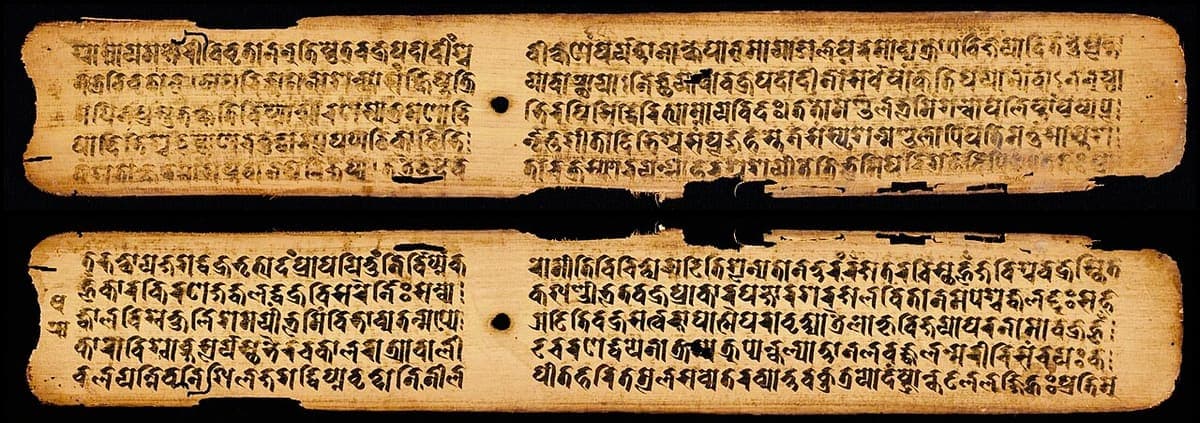
Cambridge University Library, MS Or.154, c. 11th–12th century · Source · CC BY-SA 4.0 · Photograph by Ms Sarah Welch
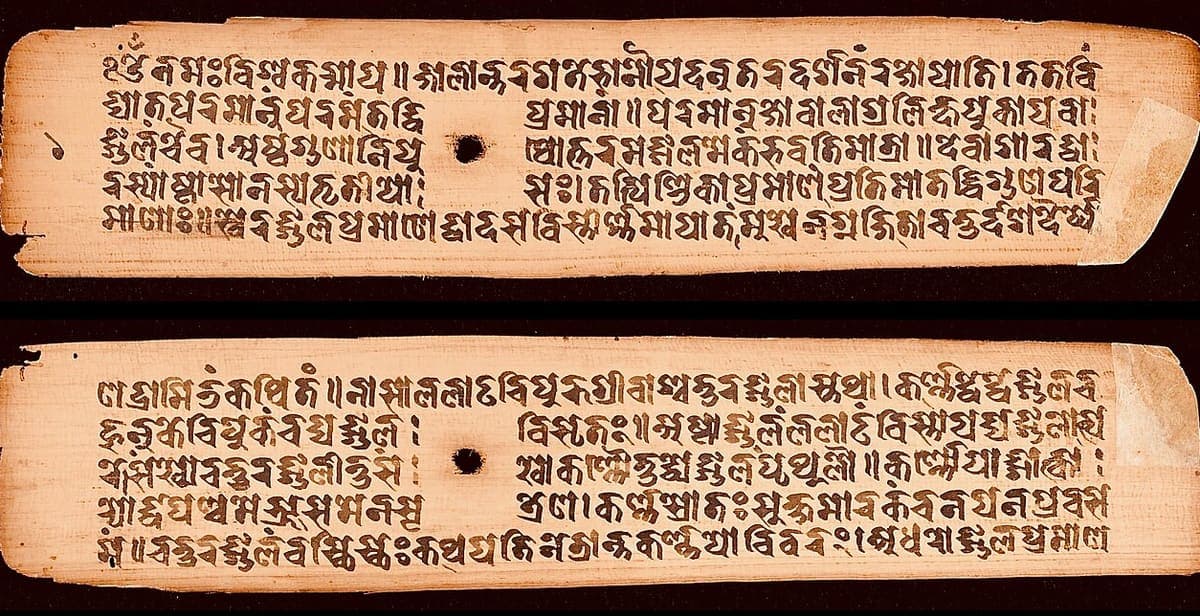
Cambridge University Library, MS Add.1706, 1279 (Nepal Saṃvat 399) · Source · CC BY-SA 4.0 · Photograph by Ms Sarah Welch
Evidano Transcription
The first leaf shown, which opens chapter 57 of the Bṛhatsaṃhitā, the Pratimālakṣaṇa, after a short invocation that is not part of the printed text. Verses 57.1–4 are quoted from the Wikisource text, in Devanagari, without the editor’s variant readings. The identification rests on 57.3, tatpiṇḍikāpramāṇaṃ pratimā tad-dviguṇaparimāṇā, which is legible on the leaf’s second line. This copy is faulty in detail — it misspells and drops syllables — so the printed verses and the leaf will not agree letter for letter.
जालान्तरगे भानौ यदणुतरं दर्शनं रजो याति ।
तद्विन्द्यात्परमाणुं प्रथमं तद्धि प्रमाणानाम् ॥ ५७.१ ॥

परमाणुरजो बालाग्रलिक्षयूकं यवोऽङ्गुलं चैति ।
अष्टगुणानि यथोत्तरमङ्गुलमेकं भवति संख्या ॥ ५७.२ ॥

देवागारद्वारस्याष्टांशोनस्य यस्तृतीयोऽंशः ।
तत्पिण्डिकाप्रमाणं प्रतिमा तद्द्विगुणपरिमाणा ॥ ५७.३ ॥

स्वैरङ्गुलप्रमाणैर्द्वादश विस्तीर्णमायतं च मुखम् ।
नग्नजिता तु चतुर्दश दैर्घ्येण द्राविडं कथितम् ॥ ५७.४ ॥
Source: बृहत्संहिता, अध्यायः ५७ (Varāhamihira, Bṛhatsaṃhitā, chapter 57), via Sanskrit Wikisource (CC BY-SA 4.0).
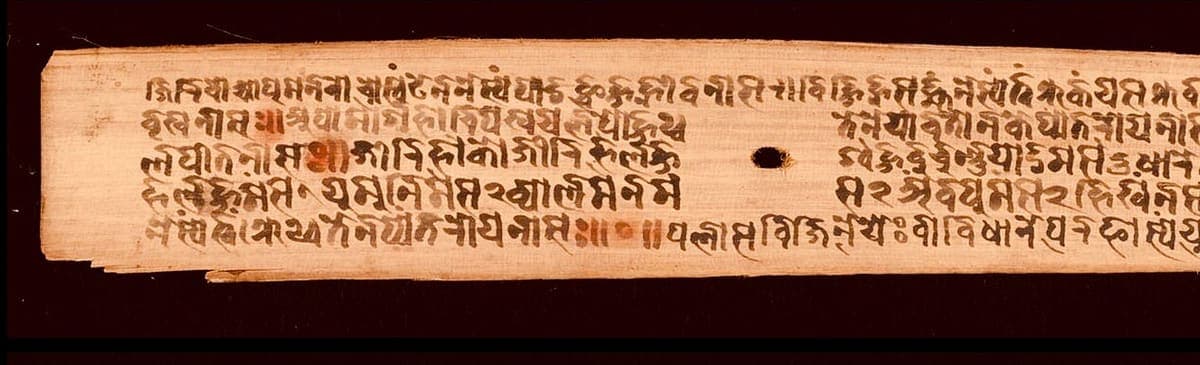
Source · CC BY-SA 4.0 · Photograph by Ms Sarah Welch
Evidano Transcription
ङिनिया थायमनवा थ्यंलेनमथ्यंयाक कुकुझीवनाम्ह यावक्रिकुमकुनथ्यंदिकेवोयतिथा
वुलनामथा श्रयानीमिमाविषयवलेथेकुथ जनयावनेनकथासायनाम
लेयीनिनीमश्रीमानिकावोजीनिकेलेकु द्वेकुद्वेनुयाडमतिकुथ्यानि
देलेकुमन॰ यमुनिमनरश्वालेमनम मरश्रेवयमनरनिविन
नमश्रीदाश्रयान्याधिनाथनामस॥ ॥पजामहिनिनायः वाविधानपरदायेयुं
Generated by Evidano’s advanced model; not yet checked against a published edition.
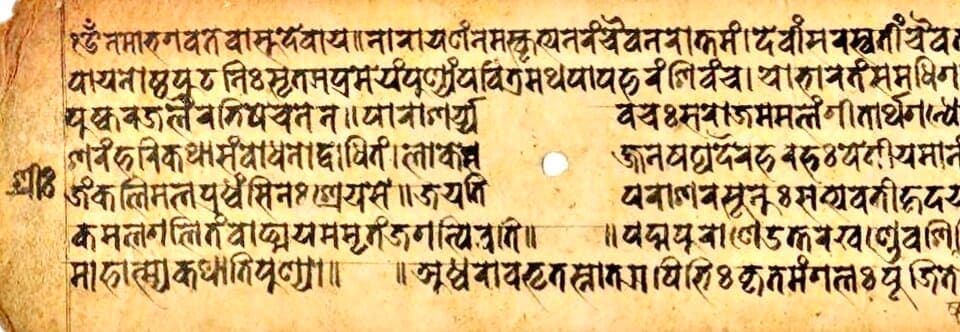
Āsā Archives, Kathmandu, 1614 (Nepal Saṃvat 735) · Source · CC0 1.0 · Photograph by Raghunath Sharma
Evidano Transcription
ॐनमोभगवतेवासुदेवाय॥नारायणंनमस्कृत्यनरंचैवनरोत्तमं।देवींसरस्वतींचैव [cut off]
[remaining lines not transcribed: Newar book hand too hard to verify at this resolution]
Generated by Evidano’s advanced model; not yet checked against a published edition.
Evidano Transcription
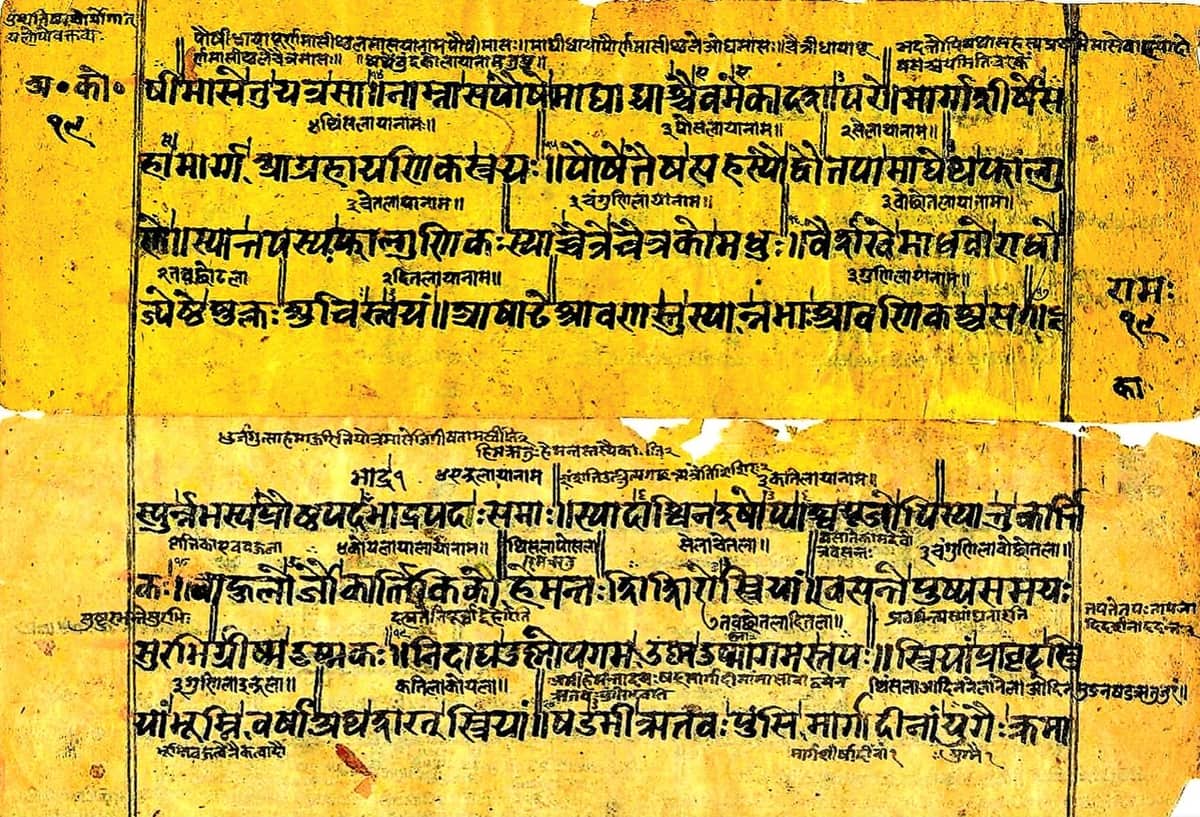
The large main-text lines of both folios, which run from the end of Amarakoṣa 1.4.279 to 1.4.292 in the Wikisource numbering: the names of the months and the six seasons. The upper folio opens in the middle of a half-verse at māse tu yatra sā; the identification is fixed by the phrases bhādrapadāḥ samāḥ, kārtikiko hemantaḥ and mārgādīnāṃ yugaiḥ kramāt, which are legible on the page. The small interlinear hand is the Newar gloss and is not part of this text.
पुष्पयुक्ता पौर्णमासी पौषी मासे तु यत्र सा ॥ १.४.२७९ ॥
नाम्ना स पौषो माघाद्याश्चैवमेकादशापरे ॥ १.४.२८० ॥
मार्गशीर्षे सहा मार्ग आग्रहायणिकश्च सः ॥ १.४.२८१ ॥
पौषे तैषसहस्यौ द्वौ तपा माघेऽथ फाल्गुने ॥ १.४.२८२ ॥
स्यात्तपस्यः फाल्गुनिकः स्याच्चैत्रे चैत्रिको मधुः ॥ १.४.२८३ ॥
वैशाखे माधवो राधो ज्येष्ठे शुक्रः शुचिस्त्वयम् ॥ १.४.२८४ ॥
आषाढे श्रावणे तु स्यान्नभाः श्रावणिकश्च सः ॥ १.४.२८५ ॥
स्युर्नभस्यप्रौष्ठपदभाद्रभाद्रपदाः समाः ॥ १.४.२८६ ॥
स्यादाश्विन इषोऽप्याश्वयुजोऽपि स्यात्तुकार्तिके ॥ १.४.२८७ ॥
बाहुलोर्जौ कार्तिकिको हेमन्तः शिशिरोऽस्त्रियाम् ॥ १.४.२८८ ॥
वसन्ते पुष्पसमयः सुरभिर्ग्रीष्म ऊष्मकः ॥ १.४.२८९ ॥
निदाघ उष्णोपगम उष्ण ऊष्मागमस्तपः ॥ १.४.२९० ॥
स्त्रियां प्रावृट्स्त्रियां भूम्नि वर्षा अथ शरत्स्त्रियाम् ॥ १.४.२९१ ॥
षडमी ऋतवः पुंसि मार्गादीनां युगैः क्रमात् ॥ १.४.२९२ ॥
Source: अमरकोशः, प्रथमकाण्डम्, कालवर्गः (Amarasiṃha, Amarakoṣa, book 1), via Sanskrit Wikisource (CC BY-SA 4.0).
Hooks, holes and yellow paper
When Sanskrit Buddhist literature disappeared from India it survived in Nepal, copied and recopied in Newar monasteries and Brahmin households from the tenth century until the age of printing. Nineteenth-century collectors such as Daniel Wright, Cecil Bendall and Haraprasad Shastri carried thousands of these manuscripts to Cambridge, Calcutta and London, and the microfilming campaign that ran in the valley from the 1970s recorded something in the order of 180,000 more. Hindu texts travelled the same route: purāṇas, law books, lexicons, astronomical and architectural treatises, many of them in copies older than any surviving in India.
The scripts are a family rather than one hand. Bhujimol, the "fly-head" script, hangs each akṣara from a small hooked head, so a line reads as a row of commas rather than under a bar; Nepālākṣara covers the broader run of hooked and half-hooked book hands; Prachalit is the plainer everyday form now encoded as Newa; and Rañjanā, tall and ornamental, is reserved for titles, mantras and the syllables painted on book covers. Devanagari arrives late and coexists with all of them, so one collection can hold four scripts for the same language.
Materials divide the tradition in two. Until about 1400 the writing surface is palm leaf: a long shallow strip, four or five lines to a side, with a hole punched near the centre for the cord that held the stack together and a folio number in the left margin. After that Nepalese paper takes over, thick and tough, often dyed yellow with orpiment, which was also used as correction fluid; scribes kept drawing the old string hole on paper folios long after there was any cord. Colophons are dated in the Nepal era, name the donor and the reigning Malla king, and are the reason so much of this material can be placed to the year. Many folios also carry a second, smaller hand between the lines: a running commentary or word-gloss in the Newar language on a Sanskrit text.
Why ordinary OCR struggles here
Every letter hangs from a hook
The hooked head of Bhujimol sits where a Devanagari reader expects a straight bar, and the body below it is compressed into shapes that do not correspond letter for letter with anything in a modern font. Segmentation trained on printed Devanagari cuts these lines in the wrong places before recognition has even begun.
A hole in the middle of the line
The binding hole falls inside the text, and on many leaves the scribe simply wrote around it. A recogniser reading straight across produces a gap or, worse, invents a punctuation mark. The two halves of the line have to be rejoined, and the hole distinguished from a wormhole or a stain.
Two languages, two sizes, one folio
A lexicon or a ritual manual often carries the Sanskrit in a large hand with a Newar gloss squeezed above and below in a hand half the size. They are different languages in the same script and they interleave physically. Deciding which stream a phrase belongs to is a reading problem, not an image problem.
Copies made by ear
Cambridge MS Add.1706, the dated Bṛhatsaṃhitā leaves shown below, is a handsome manuscript full of misspellings and dropped syllables, apparently because the scribe was working from someone reciting a copy in a script he could not read. Transcribing such a folio means recording the error, not the word the scribe meant.
Who works with this material
Scholars of Sanskrit Buddhism
For a large part of the Mahayana corpus the Nepalese copies are the only Sanskrit witnesses there are, the rest surviving only in Tibetan or Chinese translation. Editors working back from those translations need the Nepalese folios read exactly, including the places where they are plainly wrong.
Manuscript cataloguers
A cataloguer describing an uncatalogued bundle needs the title, the opening words, the closing words and the colophon. Pulling those four things out of every folio image turns a shelf of unidentified stacks into a working handlist.
Newar language and literature
The glosses, commentaries and bilingual manuals in these manuscripts are among the oldest continuous records of Newar. Separating the vernacular stream from the Sanskrit it explains is exactly what a lexicographer of Newar wants from a transcription.
Historians of the Malla kingdoms
Colophons dated in the Nepal era give the day, the reigning king, the donor and often the monastery. Collected across thousands of manuscripts they become a chronology and a social record, but only once they are transcribed and the dates converted.
Getting the best transcription
Say which of the Nepalese scripts you have
Bhujimol, the plainer Newa book hand, Rañjanā and Devanagari all turn up in the same collection and sometimes on the same folio. Naming the one in front of you, and saying that a display line may be in another, stops the model settling on a single set of letterforms for the whole manuscript.
Ask for the streams to be kept apart
Request the main text and the interlinear or marginal gloss as separate blocks, each tagged. Merged into one flow they are almost impossible to untangle afterwards, because the gloss is in a different language and breaks the Sanskrit sentence wherever it falls.
Treat the colophon as its own job
Run the last folio separately and ask for the date, the era, the king’s name and the donor’s name as fields. Nepal Saṃvat dates and Nepalese numerals repay a focused pass far more than they repay being swept up in a page of running prose.
Test on a leaf with a hole in it
Choose a palm leaf where the binding hole falls in the middle of a word and check that the syllables either side are joined back together. A model that handles that will handle a clean paper folio without any further tuning.
Further reading on this hand
The palaeography guides the in-app selector points to for this domain, if you want to check a transcription against the standard references.
- Preliminary Proposal to Encode the Newar Script in ISO/IEC 10646
This Unicode proposal was prepared for the International Organization for Standardization and International Electrotechnical Commission (ISO/IEC) encoding process. It documents the Newar script, now encoded as Newa, and its use for Sanskrit and Newar manuscripts in Nepal. The proposal describes consonants, vowels, dependent signs, conjunct formation, numerals, punctuation, and manuscript symbols using historical examples. It is useful for Nepalese Sanskrit material because it separates true characters and combining signs from stylistic glyph variants.
Frequently asked questions
- Is Bhujimol just Devanagari written badly?
- No. It is a separate development of the same north Indian ancestor, and its hooked heads and letter bodies differ enough that a Devanagari reader cannot follow a page. Treating it as Devanagari gives a transcription that looks like Sanskrit and is not the Sanskrit on the leaf.
- What happens to the binding hole and the folio number?
- The hole is recognised as a hole: the text on either side is joined and no punctuation is invented at the break. The marginal folio number, in Nepalese digits or in letter-numerals, can be returned as a separate field so a scattered stack can be put back in order.
- Can the Sanskrit and the Newar gloss be separated?
- Yes, and it is worth asking for. The two hands differ in size and position, so the transcription can label the main text and the interlinear commentary and keep each in its own sequence rather than interleaving them line by line.
- How are Nepal Saṃvat dates in colophons handled?
- They are transcribed as written, with the era named rather than silently converted. Nepal Saṃvat begins in 879 of the common era, so the conversion is simple once the reading is right; the risk lies in the numerals, which is why the colophon is best run as its own pass.
- Are Rañjanā title lines and cover syllables read too?
- Yes. Rañjanā is tall, angular and quite unlike the surrounding book hand, so it is worth flagging in the prompt that a display line or a painted cover syllable is coming; otherwise a title can be skipped as decoration.
Related scripts and pages
Transcribe your Nepalese folios
Upload a palm leaf or a yellow paper folio, choose Newa and Nepalese Sanskrit Manuscripts, and start with the colophon.