
Sanskrit · c. 1100–1900
Sanskrit cut into palm leaf
Grantha was the script the Tamil country kept for Sanskrit, and it was written with a stylus rather than a pen: the letters are rounded because a straight cut splits the leaf, and they show only where soot has been rubbed into the incisions. Add continuous writing with no gaps between words, conjuncts stacked two and three deep, and two cord holes punched straight through the text, and an ordinary recogniser has nothing to hold on to. Evidano reads the leaf line by line and can hand the result back in Grantha, in Devanāgarī or in IAST.
Sample pages
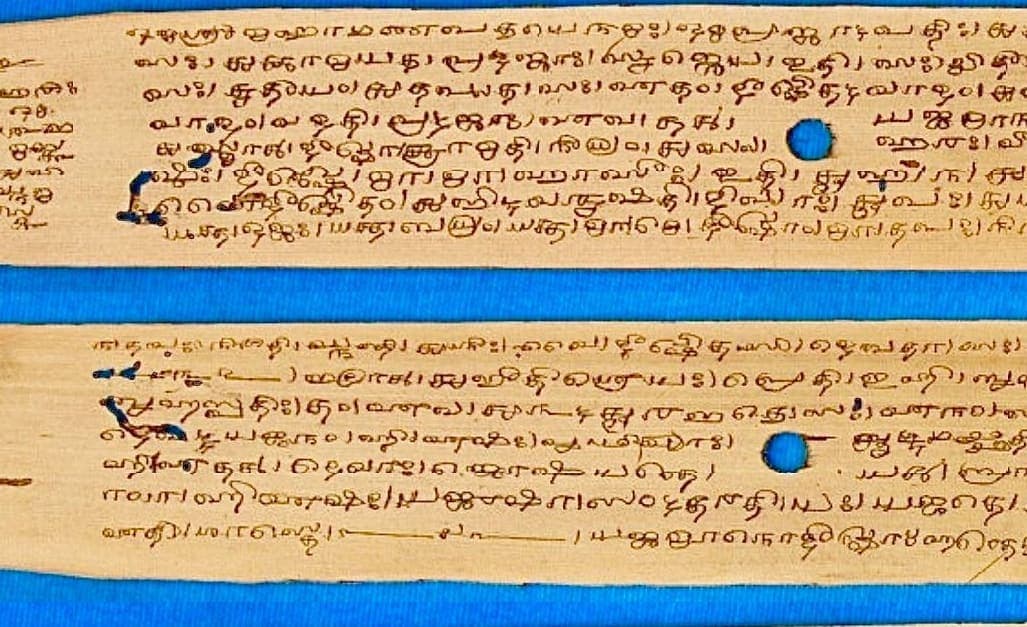
Source · CC BY-SA 4.0 · Photograph by Ms Sarah Welch
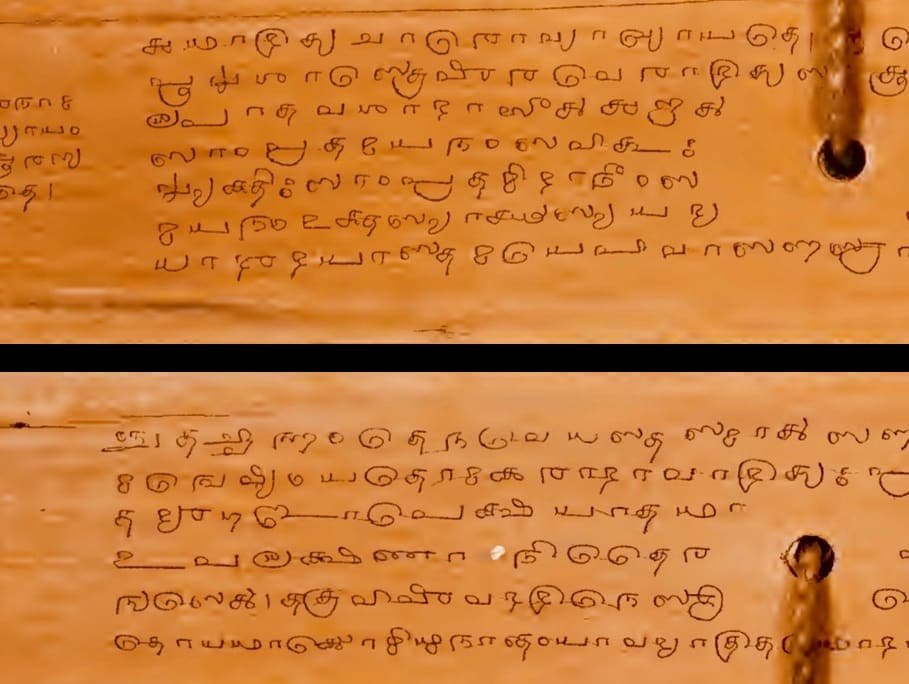
Source · CC BY-SA 4.0 · Photograph by Ms Sarah Welch
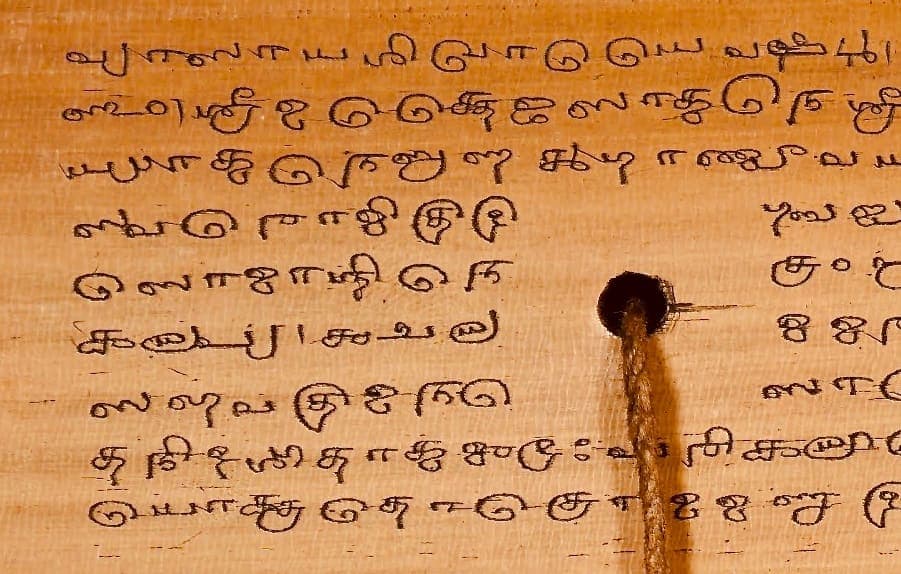
Source · CC BY-SA 4.0 · Photograph by Ms Sarah Welch
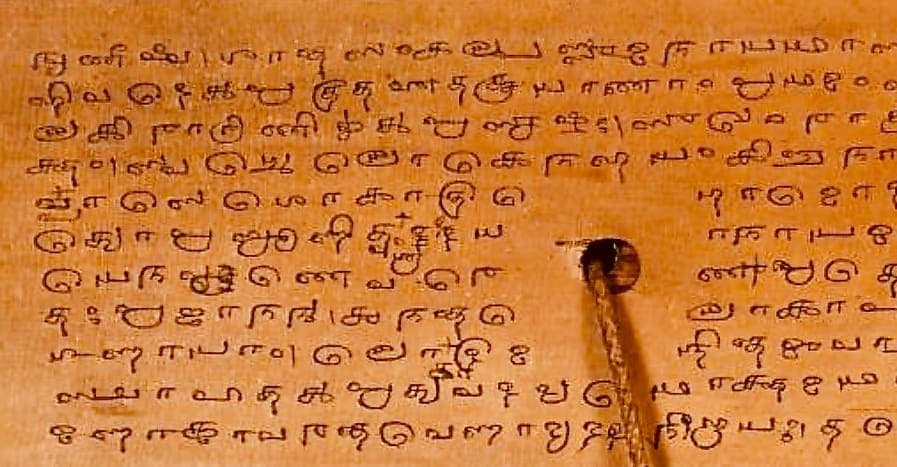
Source · CC BY-SA 4.0 · Photograph by Ms Sarah Welch
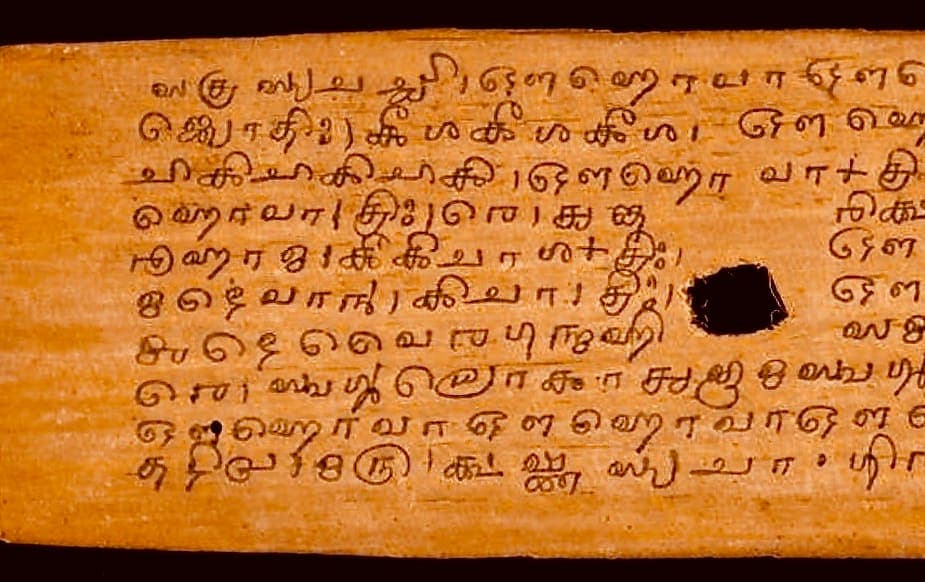
Source · CC BY-SA 4.0 · Photograph by Ms Sarah Welch
What a Grantha leaf looks like
Grantha grew out of the Pallava writing of the sixth and seventh centuries and became the standard vehicle for Sanskrit in the Tamil-speaking south, where the Tamil script itself could not represent the language: Tamil has no separate letters for the voiced and aspirated stops, and only one sibilant, so a Sanskrit text written in Tamil letters cannot be read back correctly. Brahmins in the Tamil country therefore learned two alphabets, and Grantha carried the Vedas, the Āgamas and the Śaiva and Vaiṣṇava commentaries down to the nineteenth century, when print gradually replaced it. The related southern hands of Kerala and the Malayāḷam script grew from the same stock, so a manuscript copied by a Malayāḷi scribe for a Tamil patron can sit halfway between the two.
The material shapes the letters. A leaf of talipot or palmyra is cut into a strip a few centimetres tall and up to half a metre long, and the scribe scratches into it with an iron stylus; a straight horizontal stroke would tear along the fibre, so verticals and horizontals give way to loops and curves, and the whole alphabet takes on the round, bunched look that distinguishes Grantha from the northern scripts. When the leaf is finished it is wiped with soot or lampblack mixed with oil, which stays in the cuts and makes the writing visible. Four to eight lines run the length of a leaf; one or two holes are punched through for the cord that binds the book, and the scribe writes round them, leaving a gap in the middle of a line. Leaf numbers are put in the left margin, usually in letter-numerals rather than digits.
The writing itself gives a reader little help. There are no spaces: sandhi runs the last sound of one word into the first of the next, so the line is a single string of syllables and word division is an act of interpretation. Consonant clusters are written as stacked or ligated conjuncts whose shapes have to be learned individually, and vowels attach above, below, before and after the consonant they follow. Sanskrit needs signs that most Indic scripts share — anusvāra, visarga, the virāma — and two that Grantha writes and few other traditions bother with, jihvāmūlīya and upadhmānīya. Vedic copies add accent marks over and under the line, and Sāmaveda song books add numerals above the syllables to record the melody. Sentences close with a daṇḍa and sections with a double daṇḍa or an ornamental mark.
Why ordinary OCR struggles here
A line with no word boundaries
Continuous writing plus sandhi means the transcription has to decide where words end at the same time as it decides what the letters are. Splitting in the wrong place produces Sanskrit that is well formed and wrong, which no spell-check can catch.
Conjuncts that are shapes, not sequences
A cluster of two or three consonants is written as one ligature, often with the members stacked and the lower ones reduced. The ligature has to be recognised whole and then unpacked into its consonants, and the same cluster can be written differently by two scribes.
Incised writing with almost no contrast
There is no ink. The letters show only where soot remains in the cuts, so a leaf that has been handled, washed or rubbed goes faint in patches, while the grain of the palm and old cracks read as strokes. Contrast, not letterform, is often the limiting factor.
Holes, breaks and mixed scripts
Cord holes interrupt every line in the same two places, edges are broken away, and worms leave tracks through the text. On many leaves Grantha shares the surface with Tamil or Telugu letters for a vernacular gloss, and the switch is not marked in any way.
Who works with this material
Editors of Sanskrit texts
A critical edition of a southern work is built from palm-leaf witnesses that have never been transcribed. What an editor needs is a diplomatic reading of each leaf, with the scribe’s spelling and sandhi kept and every doubtful akṣara marked, not a text tidied towards the printed vulgate.
Āgama and ritual scholarship
The Śaiva and Vaiṣṇava Āgamas survive largely in Grantha copies in temple and monastery collections. Their technical vocabulary is not in the standard dictionaries, so a first reading has to report what is written rather than the nearest classical word.
Manuscript libraries in south India
Institutions in Chennai, Thanjavur and Pondicherry hold hundreds of thousands of leaves catalogued at bundle level. Reading the first and last lines of a bundle gives the title, the extent and the colophon, which is what a catalogue record needs.
Digitisation and encoding projects
Grantha has its own Unicode block, and characters that look similar can require different code points. A transcription that returns Grantha as Grantha, rather than converting everything to Devanāgarī, keeps that distinction available for later work.
Getting the best transcription
Choose the output script first
Grantha, Devanāgarī and IAST are all reasonable targets, and they are not equivalent: converting to Devanāgarī loses the distinction between characters that Grantha writes separately. Say which you want, and ask for a second version if you need both.
Tell it what the text is if you know
Naming the work — an Upaniṣad, a chapter of the Bṛhatsaṃhitā, a section of an Āgama — gives the model the vocabulary and the metre, and metre is the strongest check available on a line with no word breaks. Where the text is unknown, say so, so that nothing is forced into a familiar passage.
Ask for the leaf as it is, holes included
Request the cord holes, breaks and worm damage to be marked in place rather than skipped over, and ask for the leaf number in the margin as a separate field. That is what lets a transcription be checked against the physical bundle later.
Test on a leaf you can already read
Run a leaf from a text you know before committing a bundle. Checking the sandhi decisions and the conjuncts on a familiar passage tells you quickly whether the reading is following the leaf or reciting the printed edition.
Further reading on this hand
The palaeography guides the in-app selector points to for this domain, if you want to check a transcription against the standard references.
- Revised Proposal to Encode the Grantha Script in ISO/IEC 10646
This revised Unicode proposal was prepared for the International Organization for Standardization and International Electrotechnical Commission (ISO/IEC) encoding process. It documents Grantha as a South Indian script used primarily for Sanskrit, including Vedic and religious manuscripts. The proposal details consonants, vowels, virama, conjunct formation, special Sanskrit signs, numerals, punctuation, and interactions with Tamil writing. It is directly useful for Grantha transcription because visually similar manuscript forms may require different character or combining-sign encodings.
Frequently asked questions
- Can it separate the words?
- It proposes a division, because a transcription without one is of little use, and it can also return the unsegmented string of akṣaras so that you can check the split. Where sandhi allows more than one reading the alternatives can be reported instead of one being chosen silently.
- What happens where the cord hole interrupts a line?
- The two halves are joined into a single line with the gap noted at the point where it falls. That matters because a word is often split across the hole, and a transcription that treats each half as a separate token produces two words that do not exist.
- Are Vedic accents and Sāmaveda numerals transcribed?
- They are treated as a separate layer over the syllables, and can be returned attached to the syllable they mark or as their own stream. Forcing them into the line of letters is the commonest way to ruin a Vedic transcription.
- Can it tell Grantha from Tamil or Malayāḷam letters on the same leaf?
- Usually, since the three have distinct shapes for most akṣaras even where they share a common ancestor. Passages in a second script can be tagged so that a Tamil gloss is not silently transliterated as though it were Sanskrit.
- How much does the state of the leaf matter?
- More than the script does. A leaf that has kept its soot reads well; one that has been washed or rubbed can be almost blank in raking light. Where the incisions are visible but unfilled, a photograph taken at a low angle helps considerably.
Related scripts and pages
Transcribe your Grantha palm leaves
Upload a leaf or a bundle, choose Grantha Sanskrit Manuscripts of the Tamil Region, and say whether you want Grantha, Devanāgarī or IAST back.