
Swedish · c. 1500–1700
Danish records in gotisk skrift, read line by line
Between the Reformation and the age of absolutism the Danish chancery wrote a looped Gothic cursive in which e and n are the same two strokes, k and t both end in a hook, and a capital can throw its entry stroke across the word in front of it. Evidano transcribes those pages, marks the passages where the clerk switched to Latin or German, and keeps the money and measure signs intact.
Sample pages
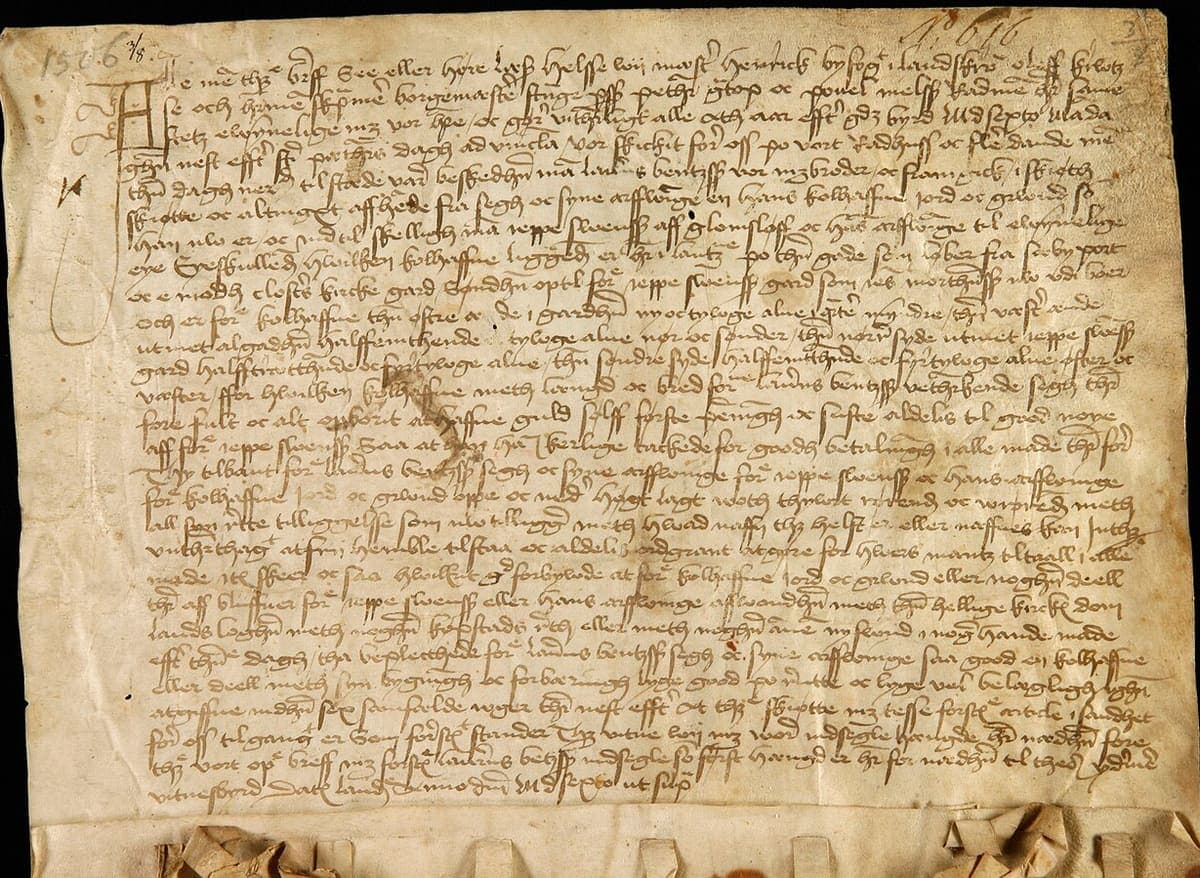
Riksarkivet (National Archives of Sweden), SDHK 42733, 3 August 1506 · Source · Public domain
Evidano Transcription
15[?]6 3/8 [illegible] 616
Alle men th[et]te breff See eller høre laſ helſſe wij meſt[er] heinrick byfog[et] i landſkro[n]e olaff [illegible]
[illegible] och thome[?] [illegible] me[n] borgemeſt[er]e [illegible] petth[er] iſtop[?] oc powel nielſſ radme[n] th[e]r ſamme
ſtetz ewynnelige mz vor h[er]re / oc gør[e] viterligt alle ath aar eft[er] g[u]dz byrd MDſexto [illegible]
then neſt eft[er] ſ[anc]ti petri dagh ad vincula vor ſkickit for oſſ po vort radhuſſ oc fle[re] dande me[n]
thend dagh ner[uerendis] tilſtede vard beſkedhen ma[n] laur[en]s bentzſſ vor mzbroder oc framgick[?] i [illegible]
ſkiøtte oc altinget[?] affhende fra ſigh oc ſyne arffwinge en hans kolhaffue iord oc grwnd ſo[m]
han nw er oc [illegible] til [illegible] ieppe ſwenſſ aff glomſloff oc hans arffwinge til ewynnelige
eye [illegible] hwilken kolhaffue liggend[is] er h[e]r i lantz[?] po th[e]n gade ſo[m] løber fra [illegible] port
oc e[n] modh cloſte[r] kirke gard ſøndhen optil for[ne] ieppe ſwenſſ gard ſo[m] [illegible] morthenſſ nw vdi boer
och er for[ne] kolhaffue th[e]n øſtre e[n]de i gardhen [illegible] oc tywge alne [illegible] / th[e]n vaſt[er] e[n]de
utmet algadhen halffemthende tywge alne nor oc ſønder / th[e]n norr[e] ſyde utmet ieppe ſwenſſ
gard halfftrettende oc fyrtywge alne / th[e]n ſøndre ſyde halffemttende oc fyrtywge alne øſter oc
vaſter / for hwilken kolhaffue meth lengd oc bred for[ne] laur[en]s bentzſſ viterkende ſigh th[e]r
fore fult oc alt opborit at haffue guld ſølff førſte penningh oc ſyſte aldelis til good nøye
aff for[ne] ieppe ſwenſſ ſwa at han th[e]r kerlige tackede for goodh betalingh i alle made th[e]r for
thy tilbant for[ne] laur[en]s bentzſſ ſigh oc ſyne arffwinge for[ne] ieppe ſwenſſ oc hans arffwinge
for[ne] kolhaffue iord oc grwnd oppe oc nedh[er] hygt lagt woth thørwt [illegible] oc [illegible] meth
all ſyn rette tillyggelſe ſo[m] nw tillygger meth hwad naffn th[et] helſt er eller naffnes kan [illegible]
vnthetaget at fri hemble tilſtaa oc aldeliſ ordgrant atgøre for hwers mantz tiltall i alle
made / [illegible] ſkeer oc ſaa hwilket g[u]d forbiwde at for[ne] kolhaffue iord oc grwnd eller noghen deell
th[e]r aff bliffuer for[ne] ieppe ſwenſſ eller hans arffwinge affwandhen meth th[e]n hellige kirke dom
landſloghen meth noghen [illegible] eller meth noghen anne[n] nyfwnd i nogh hande made
eft[er] th[e]nne dagh / th[a] beplectede for[ne] laur[en]s bentzſſ ſigh oc ſyne arffwinge ſaa good en kolhaffue
eller deell meth ſyn bygningh oc forbæringh [illegible] good po rette oc lyge vel beleylighe igh[en]
atgiffue ind[e]n ſex ſamfelde wgh th[e]r neſt eft[er] at th[et] [illegible] mz teſſe forſk[re]ff[ne] artecle i ſandhet
for oſſ tilgang[et] er ſom forſk[re]ff[ne] ſtander th[et] witne wij mz vore indſigle hengende th[e]r nedhen fore
th[et]te vort op[ne] breff mz for[ne] laur[en]s bentzſſ indſigle ſo[m] ſielff [illegible] er h[e]r for nedhen til thes ydh[e]r[mer]e
vitneſbyrd Dat[um] [illegible] Anno [illegible] MDſexto ut ſup[r]a
Generated by Evidano’s advanced model; not yet checked against a published edition.
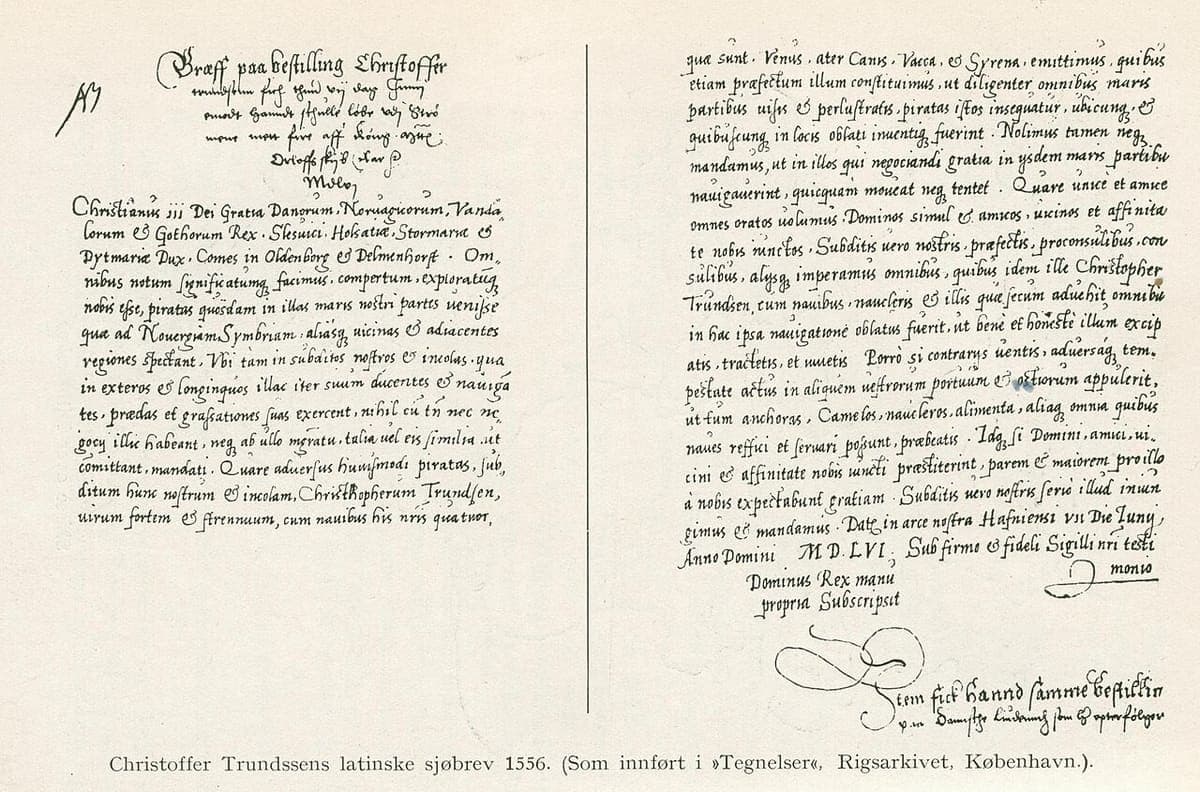
Rigsarkivet (Danish National Archives), Danske Kancelli, Tegnelser, 1556 · Source · CC BY-SA 3.0 · Facsimile from the collections of the Danish State Archives
Evidano Transcription
Breff paa bestilling Christoffer
trundtzsøn fick thend vij dag Junij
emodt hannd schulle løbe vdj Siø[en]
[illegible] [illegible] fire aff kong: ma[tt]:
Orloffs skib [?] [illegible]
Molo [?]
Christianus iij Dei Gratia Danorum, Noruagicorum, Vanda
lorum & Gothorum Rex. Slesuici, Holsatiæ, Stormariæ &
Dytmariæ Dux. Comes in Oldenborg & Delmenhorst. Om
nibus notum significatumq[ue] facimus, compertum, exploratumq[ue]
nobis esse, piratas quosdam in illas maris nostri partes uenisse
quæ ad Nouergiam Symbriam, aliasq[ue] uicinas & adiacentes
regiones spectant. Vbi tam in subditos nostros & incolas, qua[m]
in exteros & longinquos illac iter suum ducentes & nauiga
tes, prædas et grassationes suas exercent, nihil cu[m] t[ame]n nec ne
gocij illic habeant, neq[ue] ab ullo m[a]g[ist]ratu [?], talia uel eis similia ut
comittant, mandati. Quare aduersus huiusmodi piratas, sub
ditum hunc nostrum & incolam, Christhopherum Trundsen,
uirum fortem & strennuum, cum nauibus his n[ost]ris quatuor,
quæ sunt, Venus, ater Canis, Vacca, & Syrena, emittimus, quibus
etiam præfectum illum constituimus, ut diligenter omnibus maris
partibus uisis & perlustratis, piratas istos insequatur, ubicunq[ue] &
quibuscunq[ue] in locis oblati inuentiq[ue] fuerint. Nolimus tamen neq[ue]
mandamus, ut in illos qui negociandi gratia in ysdem maris partibu[s]
nauigauerint, quicquam moueat neq[ue] tentet. Quare unice et amice
omnes oratos uolumus, Dominos simul & amicos, uicinos et affinita
te nobis iunctos, Subditis uero nostris, præfectis, proconsulibus, con
sulibus, alijsq[ue] imperamus omnibus, quibus idem ille Christopher
Trundsen, cum nauibus, naucleris & illis quæ secum aduehit, omnibu[s]
in hac ipsa nauigatione oblatus fuerit, ut bene et honeste illum excip
iatis, tractetis, et iuuetis. Porrò si contrarijs uentis, aduersaq[ue] tem
pestate actus in aliquem uestrorum portuum & ostiorum appulerit,
ut fun[es], anchoras, Camelos, naucleros, alimenta, aliaq[ue] omnia quibus
naues reffici et seruari possunt, præbeatis. Idq[ue] si Domini, amici, ui
cini & affinitate nobis iuncti præstiterint, parem & maiorem pro illo
à nobis expectabunt gratiam. Subditis uero nostris seriò illud iniun
gimus & mandamus. Dat[um] in arce nostra Hafniensi vij Die Junij,
Anno Domini M. D. LVI. Sub firmo & fideli Sigilli n[ost]ri testi
monio
Dominus Rex manu
propria Subscripsit
Item fick hannd samme bestillin[g]
p[aa] Dansche liudend[is] som her epterfølger
Christoffer Trundssens latinske sjøbrev 1556. (Som innført i »Tegnelser«, Rigsarkivet, København.).
Generated by Evidano’s advanced model; not yet checked against a published edition.
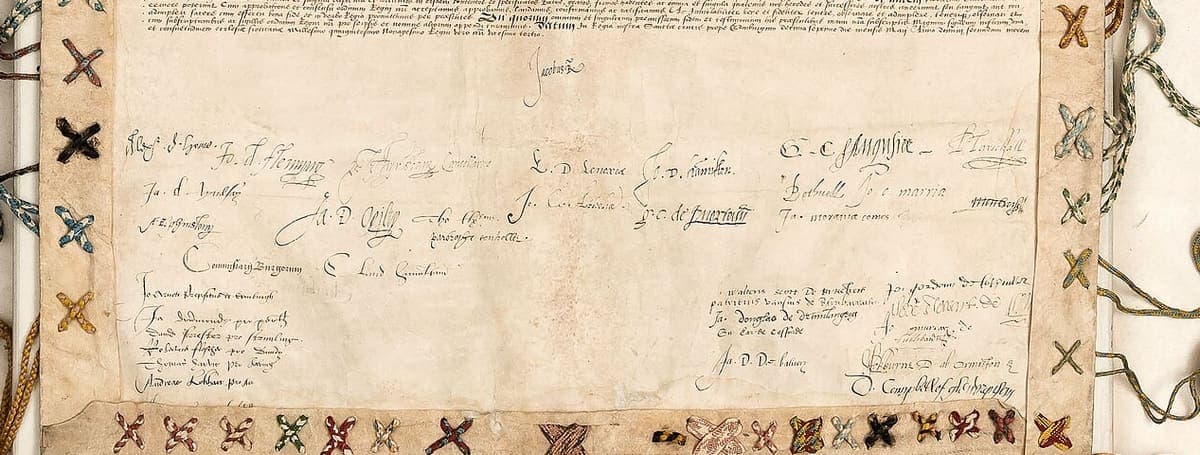
Rigsarkivet (Danish National Archives), Kongehuset, Frederik 2., Prinsesse Anna, Pergamentsbreve, 1589 · Source · CC0 1.0 · Rigsarkivet – Danish National Archives
Evidano Transcription
[cut off]
cernere poterint. Cum approbatione et consensu ordinum Regni n[ost]ri acceptamus approbamus, laudamus, confirmamus ac ratificamus Et Inuiolabiliter fore et fideliter tenere, obseruare, et adimplere, teneriq[ue], obseruari et
adimpleri facere cum effectu bona fide in verbo Regio promittimus p[er] p[re]sentes In quorum omnium et singulorum p[re]missorum fidem et testimonium his p[re]sentibus manu n[ost]ra subscriptis Magnum sigillum n[ost]r[u]m vna
cum subscriptionibus ac sigillis ordinum Regni n[ost]ri pro seipsis et nomine aliorum [illegible] mandauimus. Datum In Regia nostra Sancte crucis prope Edinburgum Decima septima die mensis Maij Anno Domini secundum morem
et consuetudinem ecclesie scoticane millesimo quingentesimo Nonagesimo Regni vero n[ost]ri Vicesimo[?] tertio.
Jacobus R
Jo. d. Flemyng[?] — Ja. D. Ogilby[?] — J. D. Hamilton[?] — G. C. Angusie[?] — Bothuell — Ja. moravia comes
Commissarij Burgorum
[other signatures illegible]
Generated by Evidano’s advanced model; not yet checked against a published edition.
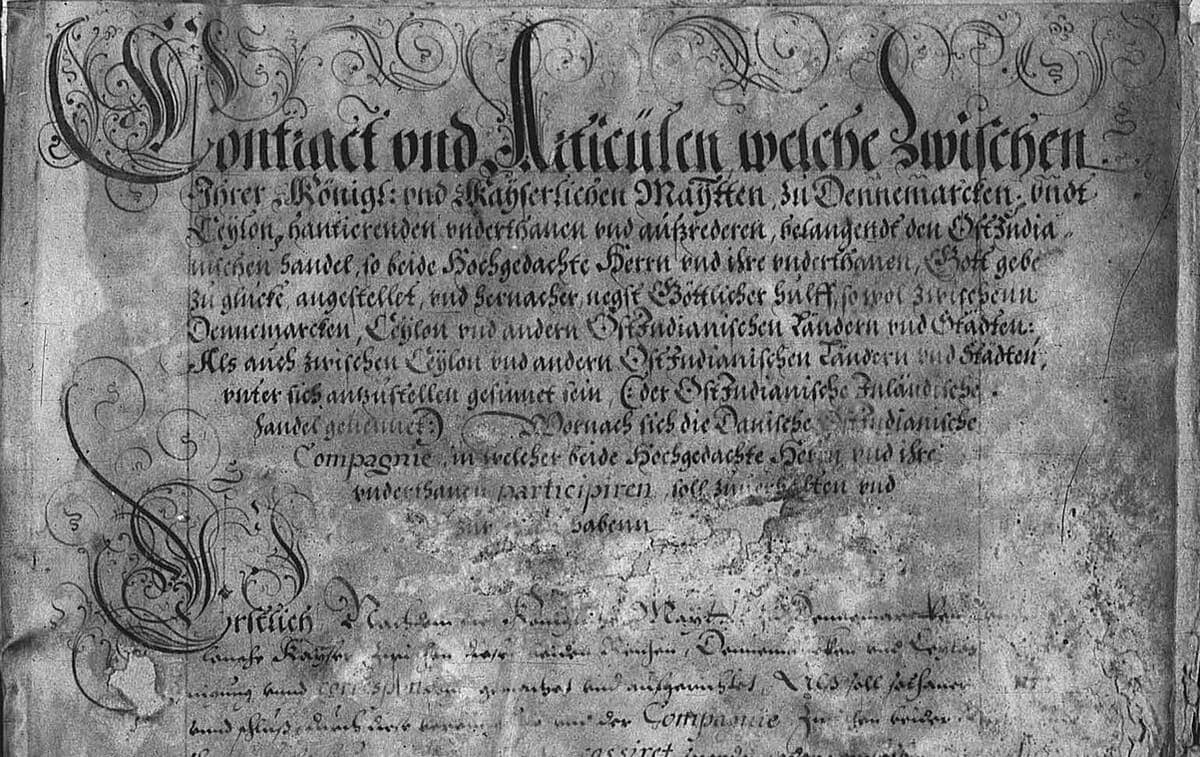
Rigsarkivet (Danish National Archives), Danske Kancelli, Det Ostindiske Kompagni, 2 August 1618 · Source · Public domain
Evidano Transcription
Contract vnd Articulen welche zwischen
Ihrer Königl: vnd Kayserlichen Maytt[en], zu Dennemarcken, vndt
Ceylon, hantierenden vnderthanen vnd außrederen, belangendt den OstIndia=
nischen handel, so beide Hochgedachte Herrn vnd ihre vnderthanen, Gott gebe
zu glücke, angestellet, vnd hernacher, negst Göttlicher hülff, so wol zwischenn
Dennemarcken, Ceylon vnd andern OstIndianischen Ländern vnd Städten:
Als auch zwischen Ceylon vnd andern OstIndianischen Ländern vnd Städten,
vnter sich anzustellen gesinnet sein, (der OstIndianische Inländische
handel genennet:) Wornach sich die Danische OstIndianische
Compagnie, in welcher beide Hochgedachte Herrn vnd ihre
vnderthanen participiren, soll zu verhalten vnd
zu [illegible] habenn.
Erstlich Nachdem Ihr[e] Königl: Mayt: zu Dennemarcken [illegible]
[remaining lines faded, illegible except isolated words: Compagnie, passiret]
Generated by Evidano’s advanced model; not yet checked against a published edition.
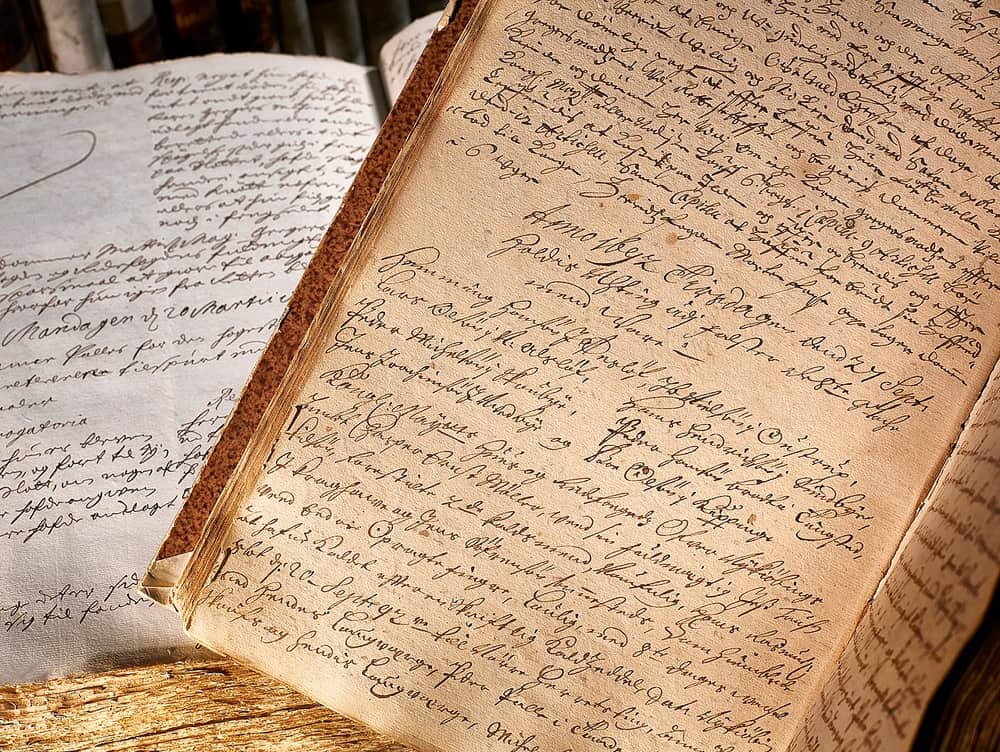
Rigsarkivet (Danish National Archives), 1692 · Source · CC BY-SA 2.0 · Photo: Tom Jersø, Rigsarkivet
Evidano Transcription
[preceding lines illegible]
Anno 1692 Tiisdagen[?]
Holdis Alting udj Falster [illegible] dend 27 Sept.
[remaining lines illegible]
Generated by Evidano’s advanced model; not yet checked against a published edition.
The hand of the Danish chancery
The script Danes call gotisk skrift, and Germans Kurrent, reached Denmark from the north German chanceries in the fifteenth century and remained the ordinary hand for Danish and Norwegian records until well into the nineteenth. Between 1500 and 1700 it went from the broad, still fairly upright letters of the town deeds to a fast, narrow, strongly looped cursive. Royal chancery documents such as recesses and coronation charters use a formal version, written small and evenly across a wide sheet, and are corroborated with rows of pendant seals; town books, court books and probate books use faster versions of the same alphabet, one clerk per volume, with an individual set of shortcuts.
The letters that cause the most trouble are the ones built from the same stroke. Minuscule e is two short strokes and so looks like n; n and u differ only by the hook drawn over u to distinguish it from n, and if the clerk omits that hook the word can go either way; c, r and t all have a short vertical with a hook, so that r is often mistaken for x; and long s, round s and f are separated only by the crossbar and by position. Doubled consonants are frequently written once with a bar over the letter, so kalles and kaldes are separated by one mark. A capital letter is drawn with wide entry and exit flourishes, so that the descender of an F or an H may cross two lines below.
Beside the Danish there is nearly always something else on the page. Latin protocols and Latin quotations keep a humanist or italic hand; German passages, common in trade and military papers, are written in a Kurrent almost identical to the Danish but with a different spelling; and personal names, place-names and foreign words are often written in Latin letters even in the middle of a Danish sentence. Dates mix Roman and Arabic numerals with feast days; sums appear in mark, skilling and daler with their own abbreviations; and every register carries marginal notes, docketing and later additions.
Why ordinary OCR struggles here
The e/n and u/n confusion
A clerk writing quickly makes e, n and u from the same pair of strokes, and the small hook that marks u is the first thing lost when the pen speeds up. Generic OCR has no way to decide between mend, meud and mene, and no Danish lexicon to check the guess against.
Two alphabets in one sentence
Danish clerks wrote the vernacular in Gothic letters and switched to Latin letters for names, Latin phrases and foreign titles, sometimes several times in a line. A recogniser that assumes one alphabet per page reads the Latin-letter passages as noise or transliterates them into nonsense.
Flourishes that cross other lines
Capitals in the chancery hand carry long approach and exit strokes, and the descenders of the line above run down through the line below. Line segmentation built for print cuts these images in the wrong places and attaches the tail of one word to the middle of another.
Sums, measures and dates
A single entry may carry a date by saint’s day, a sum in mark and skilling with symbol abbreviations, and a land measure in tønder hartkorn. These are exactly the fields users want to search, and exactly the ones a general model drops or normalises out of existence.
Who works with this material
Town and estate archives
Bytingbøger, rådstuebøger and estate accounts are consulted constantly and indexed hardly at all. A transcription that keeps the entry headings and the marginal sums turns a bound volume into something a researcher can search by name, farm or year.
Legal and criminal historians
Court books record the procedure as well as the verdict: who was summoned, who witnessed, what was sworn. Readers of these cases need the formulaic frame preserved rather than summarised, because the frame is what makes one court comparable with another.
Editors of chancery registers
Series such as Kancelliets Brevbøger and the Danske Kancelliregistranter were calendared rather than printed in full. Anyone extending that work needs a reading of the register page itself, with the clerk’s abbreviations and the switch between Danish and Latin marked.
Museums and archives writing exhibition labels
A photographed charter or court book is exhibited far more often than it is read. A checked transcription and a translation beside the image let a curator quote the document accurately instead of paraphrasing a catalogue entry.
Getting the best transcription
Give the model the clerk, not just the page
A register volume is usually the work of one or two hands. Transcribe two pages carefully, list the shortcuts that clerk uses — the bar for a doubled consonant, the form of his ss, his way of writing dito — and put that list in the prompt for the rest of the volume.
Ask for script changes to be tagged
Request that stretches written in Latin letters be marked, so that names and Latin formulas are not silently reshaped into Danish spelling. This is the single change that most improves the usefulness of an index built from the output.
Keep sums and dates in their original form
Ask for currency, measures and dates to be transcribed exactly as written, with the abbreviation signs, and for any modern equivalent to be added in a separate field. Otherwise 3 mk 8 sk quietly becomes a decimal number and the evidence is gone.
Start with the hardest opening
Choose a page with a flourished heading and a crowded margin for the first test. If the heading, the body and the marginal notes come back separated there, the rest of the volume, which is plainer, will not need supervision.
Further reading on this hand
The palaeography guides the in-app selector points to for this domain, if you want to check a transcription against the standard references.
- Lær gotisk håndskrift
This Danish National Archives guide teaches the Gothic handwriting used in Danish historical records. It provides alphabets, word exercises, and document-based practice and explains that Gothic script remained an official Danish writing system into the nineteenth century. The lessons develop recognition of connected lowercase forms, capitals, abbreviations, and variation among writers. They are useful for early modern chancery and municipal records whose script is an earlier form of the tradition taught by the course.
Frequently asked questions
- What is the difference between gotisk skrift and German Kurrent?
- Very little at the level of letterforms: the Danish chancery took the script from north Germany and the two traditions stayed close for three centuries. The differences are in spelling, in the abbreviations for administrative words, and in which letters a given clerk connects, so a model tuned to Danish records will read a Danish page more reliably than one trained on German Kurrent alone.
- Can it read the flourished capitals in a chancery heading?
- Yes. Display capitals and cadels are treated as a separate zone from the body text, so the heading is transcribed as a heading and the decorative pen-work around it is not turned into extra letters. The reading order between heading, body and margin is kept.
- How is a passage in Latin or German handled?
- It is transcribed in its own language and can be labelled as such. Danish chancery volumes routinely carry Latin instruments and German trade papers in the same series, and marking them makes it possible to route them to different reviewers.
- Will Danish æ, ø and å appear correctly?
- Yes, with the caveat that the early modern spellings are not the modern ones: the same clerk may write aa, å and a for one sound and ø or ö for another. The transcription reproduces what is on the page, and normalisation to modern orthography is offered as a separate output.
- How much of a court book has to be transcribed to be useful?
- Less than people expect. Because entries follow a fixed shape — date, court, jurors, parties, plea, judgment — transcribing the headings and the first lines of each entry already gives a searchable index, and the full text can be produced only for the cases that matter.
Related scripts and pages
Open your Danish chancery volumes
Upload a court book, a register or a sealed charter, choose Danish Royal and Municipal Gothic Chancery Hands, and test the prompt on one clerk before running the volume.