
Swedish · c. 1700–1875
The hand that recorded everyone
Between about 1700 and the 1870s every baptism, probate inventory and royal ordinance in Denmark and Norway was written in the same angular Gothic cursive, by clerks whose capitals sprawl across half a line and whose e, n, u and r are the same two strokes. The information you want is in the farm names, the ages and the sums in rigsdaler — the parts written fastest and abbreviated hardest.
Sample pages
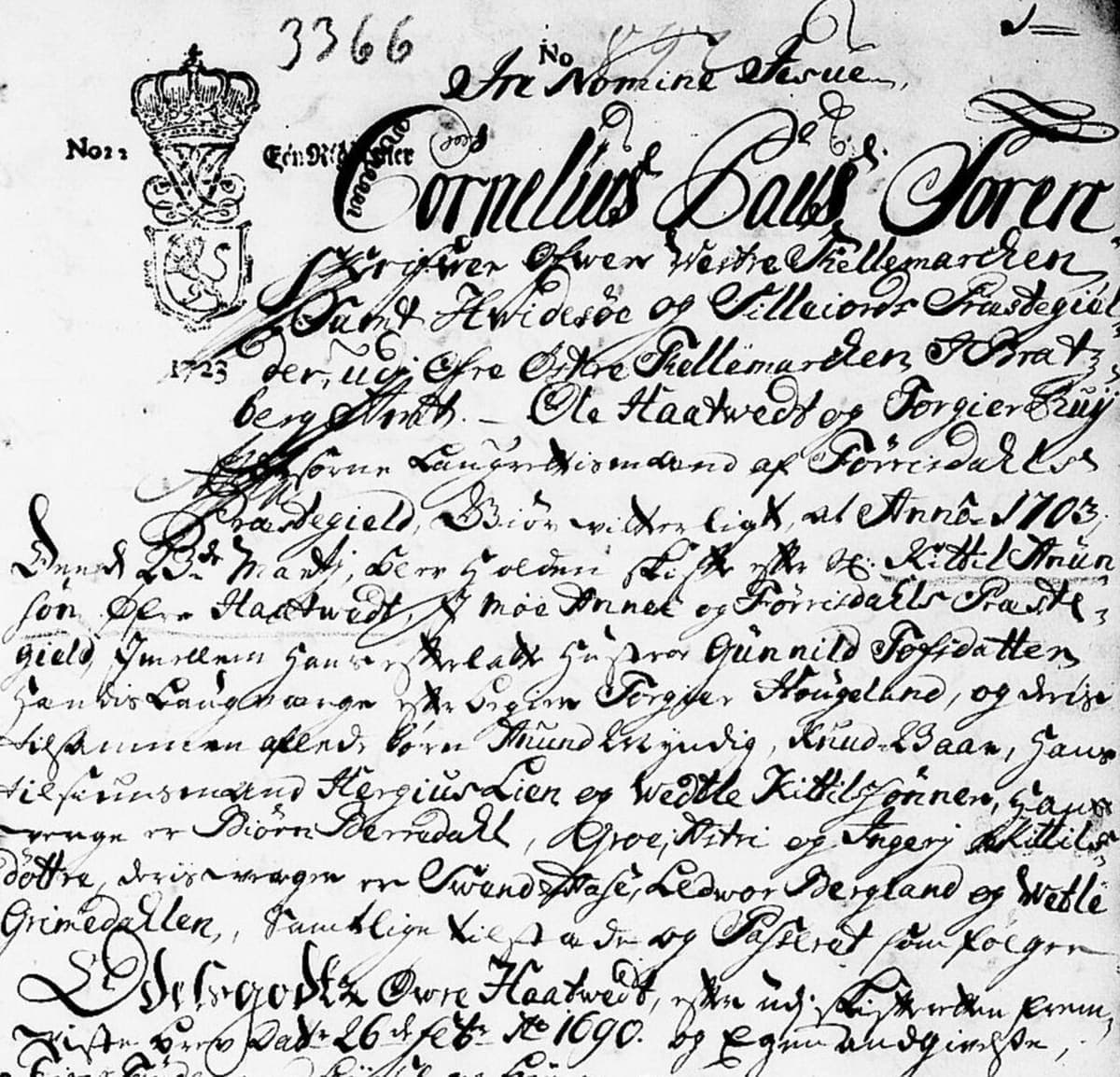
Statsarkivet i Kongsberg, Skifteprotokoll 3 (Haa 0003), 1703–1723, 1703 · Source · Public domain · Arkivverket, Statsarkivet i Kongsberg
Evidano Transcription
3366 No [illegible]
In Nomine Jesu
No 22 Een Rixdaler [stamp]
Cornelius Paus Soren
ſkrifwer Ofwer Weſtre Tellemarcken,
Samt Hwideſöe og Silleiords Præſtegiel=
der, udj Øfre Øſtre Tellemarcken, I Bratz=
berg Ampt. — Ole Haatwedt og Torgier Ruy
Eſworne Laugrettismænd af Forrisdals
Præſtegield, Giör witterligt, at Anno 1703.
Dend 23de [?] Martij, blef holden Skifte efter Sl: Kittel Thun=
ſon Paa Haatwedt, I moe Annex og Forrisdals Præſte=
gield, Imellem hans efterlatte Huſtroe Gunnild Toſtisdatter,
hendis Laugwærge var ſønnen Torgier Hougeland, og deris
tilſammen aflede Börn Thun [?] myndig, Knud 8 aar, hans
tilſiunsmand Torgiüs Lien og Wedtle Kittilsſönner, hans
værge er Biörn Berrudall, Groe, Aſtri og Ingeri Kittils=
dottre, deris værger er Swend Staſe, Ledwor Bergland og Wetle
Grimedallen, Samtlige tilſtæde og Paſſeret ſom fölger
Odelsgodtz Øvre Haatwedt, yder udj [illegible]
[last lines illegible / cut off]
Generated by Evidano’s advanced model; not yet checked against a published edition.
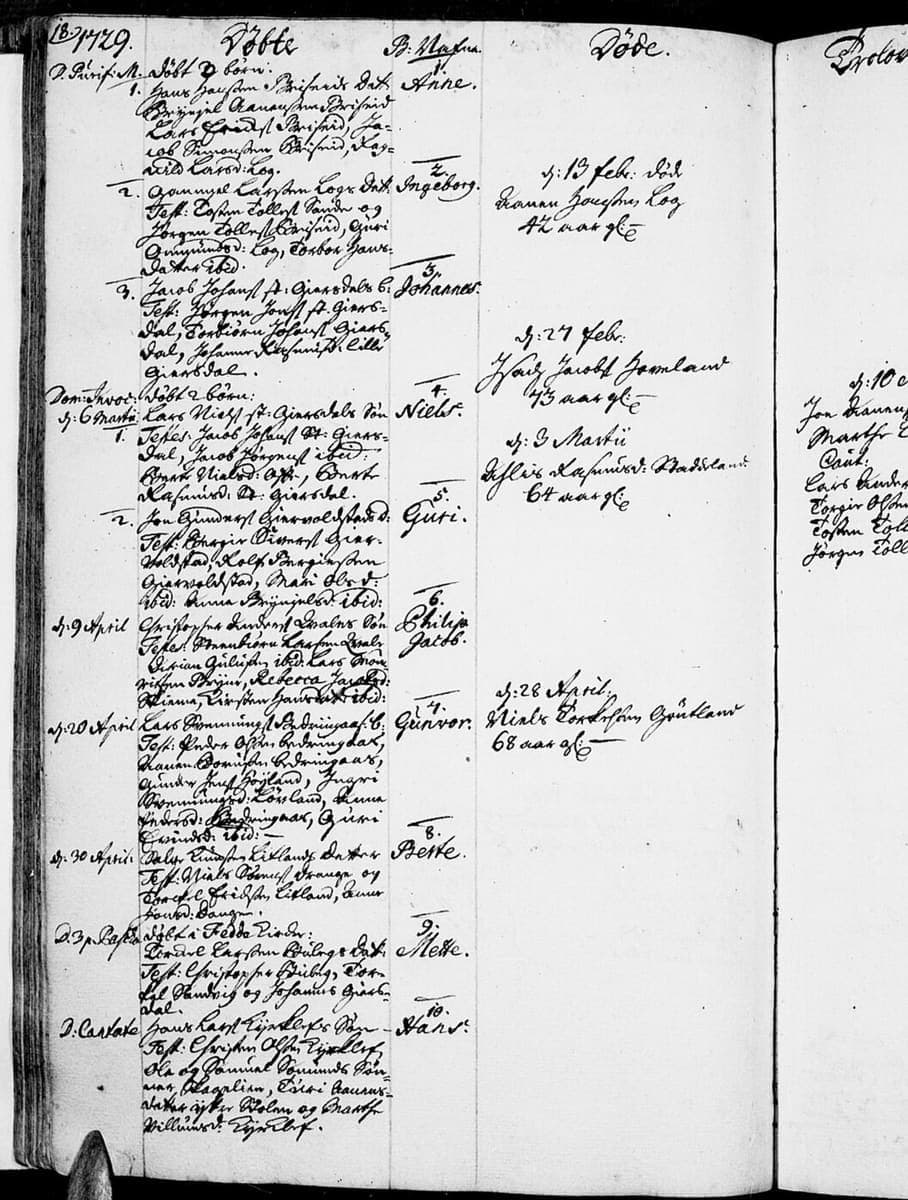
Arkivverket / Digitalarkivet, 1729 · Source · Public domain · Digitalarkivet, kb20070629610642
Evidano Transcription
Døbte
D. Purif. M. Døbt 3 børn:
[baptism entries 1–3 in small cursive: names of parents and witnesses not reliably legible]
Dom: Invoc: Døbt 2 børn:
d: 6 Martii [entries 4–5 not reliably legible]
d: 9 April [entry 6 not reliably legible]
d: 20 April [entry 7 not reliably legible]
d: 30 April [entry 8 not reliably legible]
D. 3 p. Pasch. [entry 9 not reliably legible]
D. Cantate [entry 10 not reliably legible]
B: Nafne.
- Anne.
- Ingeborg.
- Johannes.
- Niels.
- Guri.
- Philip Jacob.
- Gunvor.
- Bette [?]
- Mette.
- Hans.
Døde.
d: 13 febr: død
Kauan [?] Jonssøn [?] Løg
42 aar g[amme]l
d: 27 febr:
Hans Jacobs[øn] Homland
43 aar g[amme]l
d: 3 Martii
Astri [?] Rasmusd[atter]: Staddeland [?]
64 aar g[amme]l
d: 28 April.
Niels Tordssøn [?] Goutland [?]
68 aar g[amme]l
Generated by Evidano’s advanced model; not yet checked against a published edition.
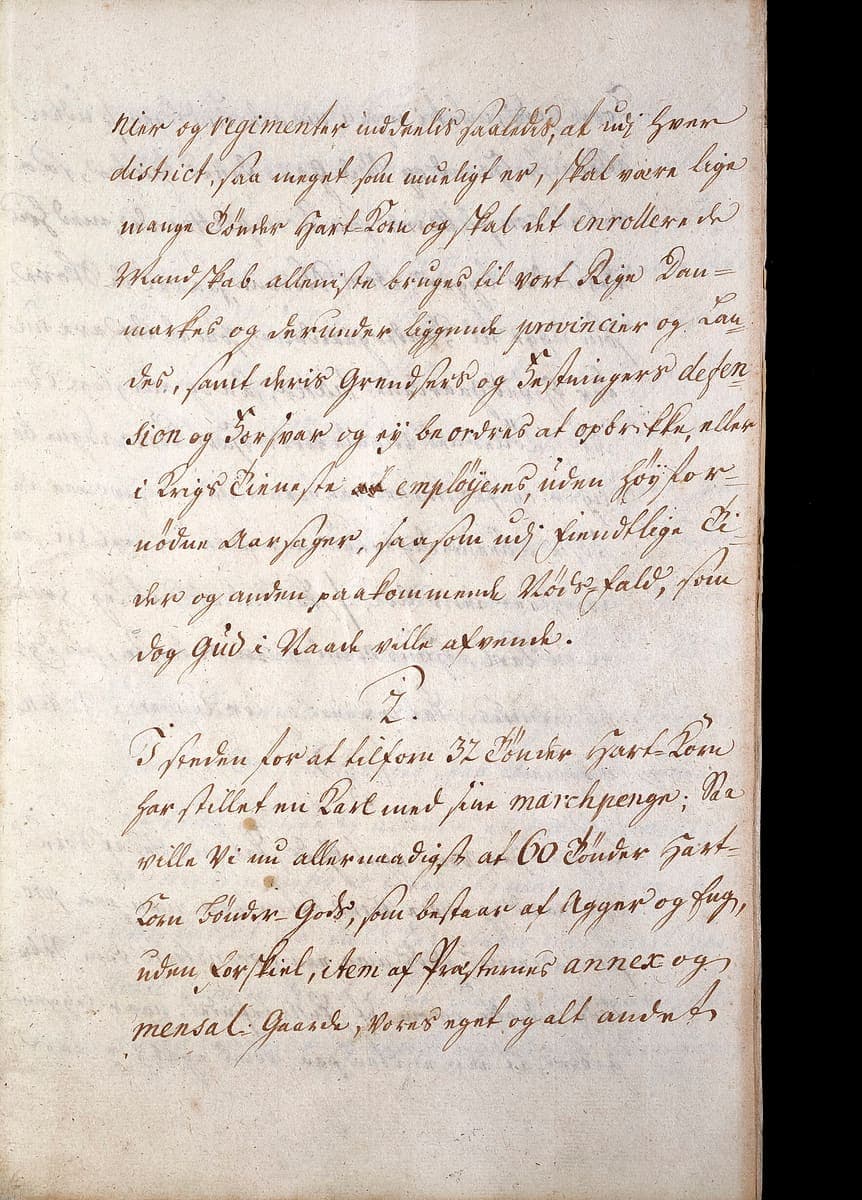
Rigsarkivet (Danish National Archives), 1733 · Source · CC BY-SA 2.0 · Rigsarkivet, photo Tom Jersø
Evidano Transcription
nier og regimenter inddeelis saaledis, at udj Hver
district, saa meget som mueligt er, skal være lige
mange Tønder Hart-Korn og skal det enrollerede
Mandskab alleeniste bruges til vort Rige Dan=
markes og derunder liggende provincier og lan
des, samt deris Grendsers og Fæstningers defen
sion og Forsvar og ej beordres at opbrikke, eller
i Krigs Tieneste [cancelled] employeres, uden höjst paa=
nødne Aarsager, saasom udj fiendtlige Ti
der og andre paakommende Nødsfald, som
dog Gud i Naade ville afvende.
Istedenfor at tilforn 32 Tønder Hart-Korn
har stillet en Karl med sine marchpenge; Saa
ville Vi nu allernaadigst at 60 Tønder Hart=
Korn Bønder-Gods, som bestaar af Ager og Eng,
uden Forskiel, item af Præsternes annex og
mensal-Gaarde, Vornedegods [?] og alt andet
Generated by Evidano’s advanced model; not yet checked against a published edition.
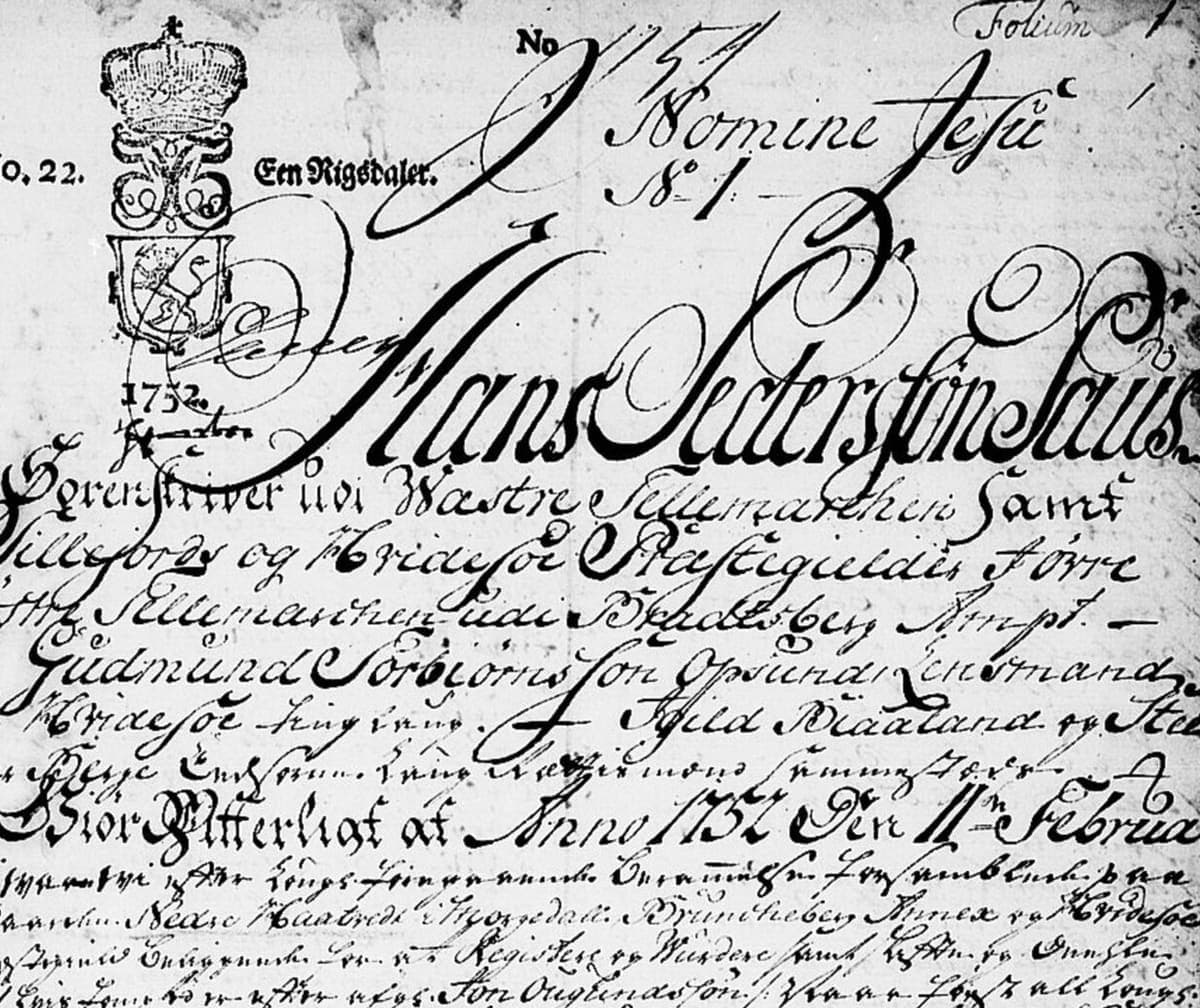
Statsarkivet i Kongsberg, Skifteprotokoll 9 (Haa 0009), 1752–1759, 1752 · Source · Public domain · Arkivverket, Statsarkivet i Kongsberg
Evidano Transcription
No. 22. Een Rigsdaler. No 151 [?] Folium 1
In Nomine Jesu
No 1
- [cancelled: illegible]
Hans Pederssøn Paus
Sorenskriver udi Wæstre Tellemarchen Samt
Sillejords og Hvidesöe Præstegielder Forre [?]
[...]re Tellemarchen udi Bradtsberg Ampt. —
Gudmund Torbiörnssön Opsiund Lendsmand
i Hvidesöe Tinglaug, Asgild [?] Bjaaland og Stee
[illegible]
Giör Witterligt at Anno 1752 Den 11te Februa
[remaining lines illegible]
Generated by Evidano’s advanced model; not yet checked against a published edition.
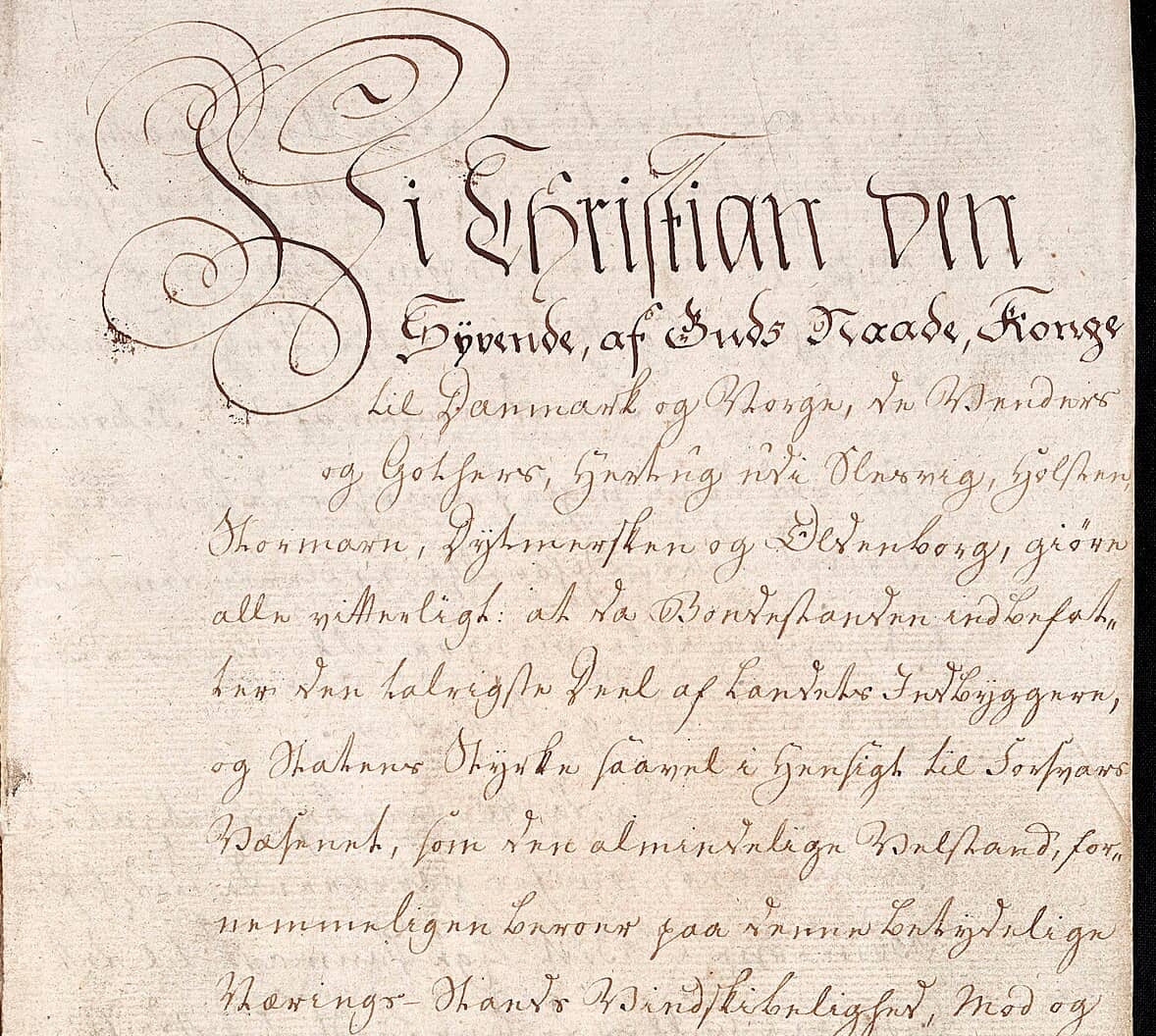
Rigsarkivet (Danish National Archives), Sjællandske Registre 1788, no. 497, 20 June 1788 · Source · CC BY-SA 2.0 · Rigsarkivet, photo Tom Jersø
Evidano Transcription
Vi Christian den
Syvende, af Guds Naade, Konge
til Danmark og Norge, de Venders
og Gothers, Hertug udi Slesvig, Holsten,
Stormarn, Dÿtmersken og Oldenborg, giöre
alle vitterligt: at da Bondestanden indbefat=
ter den talrigste Deel af Landets Indbyggere,
og Statens Styrke saavel i Hensigt til Forsvars
Væsenet, som den almindelige Velstand, for=
nemmeligen beroer paa denne betydelige
Nærings-Stands Vindskibelighed, Mod og
Generated by Evidano’s advanced model; not yet checked against a published edition.
One written language, three kinds of book
Denmark and Norway shared a written language and an administration until 1814, and the records of both look the same well beyond that date. The hand is the mature Gothic cursive taught in schools across the twin kingdoms: narrow, angular and joined, with looped ascenders on h, k and l, a long ſ that dips below the line and a round s only at the end of a word, and the small bow over u that keeps it apart from n. Capitals are another matter altogether — a judge’s name at the head of a protocol can be a single flourished construction two centimetres high, drawn as much as written.
Parish registers before the printed forms of the middle of the nineteenth century are ruled by hand, with headings such as Døbte, Trolovede og Viede and Døde written across the top of the opening and entries listed under them by date. Court and probate protocols open on stamped paper, with the crowned royal monogram and the value of the stamp at the head, an In Nomine Jesu above the judge’s name, and then the business of the day: who died, who the heirs are, and an itemised inventory in two columns with prices in rigsdaler, mark and skilling. Royal ordinances and letters patent are written by a chancery scribe in a more formal version of the same hand, beginning Vi Christian den Syvende, af Guds Naade, Konge til Danmark og Norge.
Names are the recurring difficulty. A person is identified by a patronymic and a farm — Jon Torbjørnsson Opsund, Knud Haatvedt — and the farm name may be spelled differently on the next page. Kinship, occupation and status are abbreviated to a few letters, repeated values are shown by ditto marks, dates are given by the church calendar as often as by the month, and a marginal note may record a later confirmation, a legitimation or an emigration certificate. Archival dockets in a nineteenth-century hand sit in the lower margin of documents written a century earlier.
Why ordinary OCR struggles here
Capitals that are drawings
The initial of a name at the head of a protocol is a flourished construction whose letter has to be recovered from a cage of loops. It matters, because that name identifies the official whose book you are reading and often the district it covers.
Farm names with no dictionary
Norwegian farm names are the backbone of every entry and are spelled by ear. A model that resolves ambiguous strokes with modern Danish or Norwegian vocabulary will quietly turn a farm into a common noun, which is worse than leaving it flagged.
Columns, ditto marks and money
Probate inventories run in two columns of goods and prices, with sums in rigsdaler, mark and skilling and quantities abbreviated. Read as prose the columns interleave; read without the ditto marks expanded, half the entries lose their subject.
Bleed-through, gutters and later hands
These are bound volumes photographed as openings. Ink shows through from the other side of the leaf, the inner columns curve into the gutter, and marginal certificates added decades later cut across the original entry in a different hand and ink.
Who works with this material
Genealogists in Norway and Denmark
Church books, probate protocols and censuses are the whole evidence base for a family before civil registration. What a researcher needs from a page is the names with their patronymics and farms, the dates, the ages and the relationships, in a form that can be checked against the image.
Local historians and bygdebok writers
A parish history is built farm by farm from probate inventories, court cases and land records. That work needs the inventories transcribed with their prices intact, because the value of a kettle or a cow is the evidence for how a household lived.
Archives and volunteer transcription projects
The Norwegian and Danish archives have digitised these series almost completely and rely on volunteers to index them. A first machine reading that fills the columns and flags the doubtful farm names turns indexing into review.
Legal and administrative historians
The ordinances that governed the twin kingdoms survive as chancery originals as well as in printed law collections, and the two are not always identical. Comparing them requires a diplomatic reading of the manuscript, including the docket that records how it was registered.
Getting the best transcription
Give the model the local names
Paste in the farm and place names of the parish, and any surnames you already have from the same volume. Nothing else improves the reading of Danish-Norwegian Gothic as quickly, because the names are exactly where a general model has no expectations.
Ask for the register structure
State the column headings of the opening and request one row per entry, with date, name, farm and remarks in their own fields. On a probate page, ask for the inventory as a list of item and price rather than as running text.
Set the rules for money and abbreviations
Say that rigsdaler, mark and skilling are to be kept in the notation used on the page, and that abbreviations for kinship and occupation should be expanded in brackets or left as they stand. Both choices are defensible; an unmarked mixture is not.
Test on a flourished heading and a crowded margin
The heading of a protocol shows whether display capitals are read; a page with a marginal certificate shows whether later additions are kept separate. Together they tell you how much review a whole protocol will need.
Further reading on this hand
The palaeography guides the in-app selector points to for this domain, if you want to check a transcription against the standard references.
- Lær gotisk håndskrift
This Danish National Archives course teaches Gothic handwriting through alphabets, isolated words, and complete historical documents. It notes that Gothic handwriting remained the official Danish script until 1875 and therefore dominates many parish and administrative collections. Its exercises address letter comparison, connected forms, abbreviations, spelling variation, and contextual reading. The course is directly useful for Danish-Norwegian records because the shared administrative script continued after the political union ended.
Frequently asked questions
- Is Danish-Norwegian Gothic different from German Kurrent?
- They are close relatives and share most letterforms, but the Danish-Norwegian hand keeps its own habits — the shape of the looped h and k, the way capitals are built, and the abbreviations used for kinship and money. Telling the model which tradition it is looking at improves the reading.
- How are patronymics and farm names handled?
- They are transcribed as written, including inconsistent spellings, and can be listed separately as name fields. A normalised form of a farm name can be supplied alongside, but it never replaces the spelling on the page, which is often the only clue to the informant’s pronunciation.
- Can a probate inventory be returned as a table?
- Yes. Item, quantity and price are recognised as columns and returned row by row, with the currency notation preserved. That is usually more useful than a paragraph, because the interest of an inventory lies in comparing values.
- What about the marginal notes added years later?
- They are reported as separate annotations, with a note that the hand differs from the main entry. In a church book these later additions record confirmations, marriages and emigration, and they belong to the record rather than to the original line.
- Does the stamped paper at the head of a protocol matter?
- It does, and it is transcribed. The crowned monogram and the value of the stamp date and rank the document, and archivists use both when identifying a stray leaf that has become separated from its volume.
Related scripts and pages
Read a kirkebok or a skifteprotokoll
Upload an opening from a parish register, a probate protocol or a royal ordinance and get names, farms and sums back as checkable fields.