
German · c. 1400–1650
Read the hand behind an early modern German document
Between 1400 and 1650, German administration, law and correspondence were written in a fast cursive Kanzleischrift full of looped ascenders and heavily flourished capitals, often mixed on the same page with Latin formulas or an Italian news report. Evidano reads these documents at the level of the individual document, not a generic printed alphabet.
Sample pages
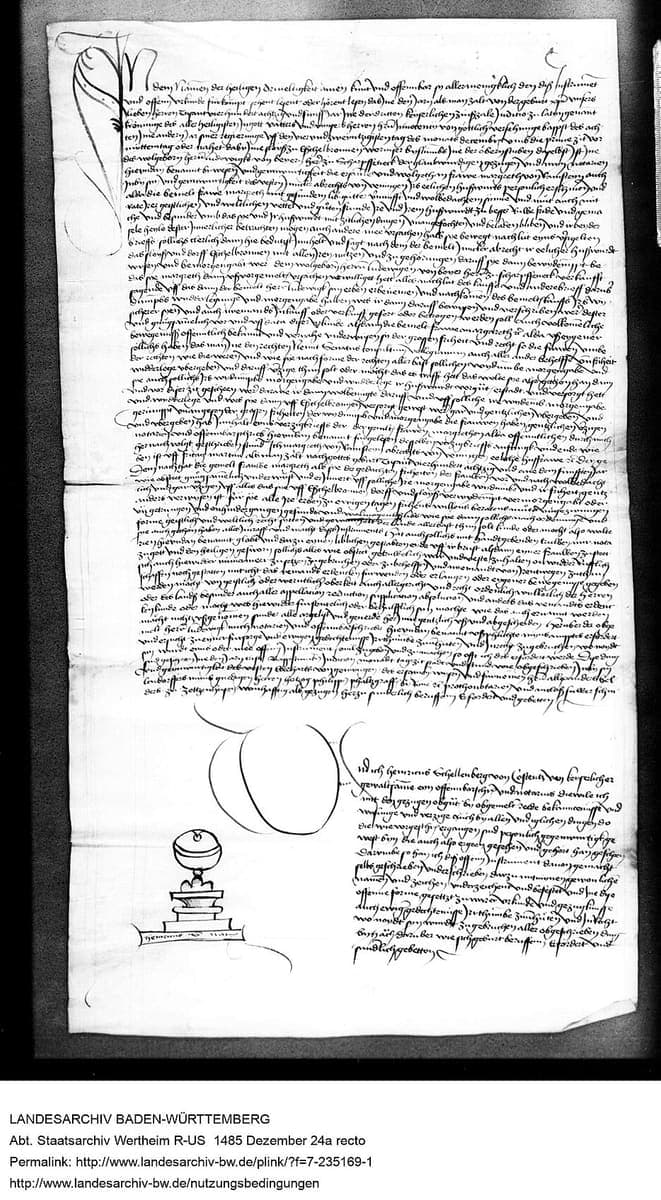
Landesarchiv Baden-Württemberg, Staatsarchiv Wertheim, Staatsarchiv Wertheim, R-US, 24 December 1485, 24 December 1485 · Source · CC BY 3.0
Evidano Transcription
IN dem Namen der heiligen driueltigkeit amen kund vnd offenbar sy allermeniglich den diss Instrument
vnd offen vrkunde furkumpt sehent lesent oder horent lesen das in den Jaren als man zalt von der geburt cristi[?] vnsers
lieben herren Tusent vierhundert achtzig vnd funff Jar [illegible] Romerischer zinszale[?] Indictio z[u] latin genant
kronunge des allerheiligsten In got vatters vnd herren herren Innocencij von gotlicher vorsehunge bapst des ach
[remaining lines of the instrument illegible]
Vnd ich Heinricus Schellenberg[?] von Costentz [illegible] keyserlicher
gewaltsame ein offenbar schriber vnd notarius diewile ich
mit den getzugen obg[ena]nt by obgemelte rede bekantnuss vnd
vffgebunge[?] vnd verzige ouch by allen vnd yglichen dingen so
viel wie vorgeschr[iben] ergangen sind personlich gegenwertig [illegible]
[illegible] die auch also eigentlich[?] gesehen vnd gehort han [illegible]
Darumbe so han ich diss offenn Instrument daruss gemacht
selbs geschriben vnderschriben[?] darzu mit minen gewonlichen
namen vnd zeichen vnderzeichent vnd besiegelt[?] [illegible]
offenne forme gesetzt [illegible]
[remaining lines illegible]
[signum]
LANDESARCHIV BADEN-WÜRTTEMBERG
Abt. Staatsarchiv Wertheim R-US 1485 Dezember 24a recto
Permalink: http://www.landesarchiv-bw.de/plink/?f=7-235169-1
http://www.landesarchiv-bw.de/nutzungsbedingungen
Generated by Evidano’s advanced model; not yet checked against a published edition.
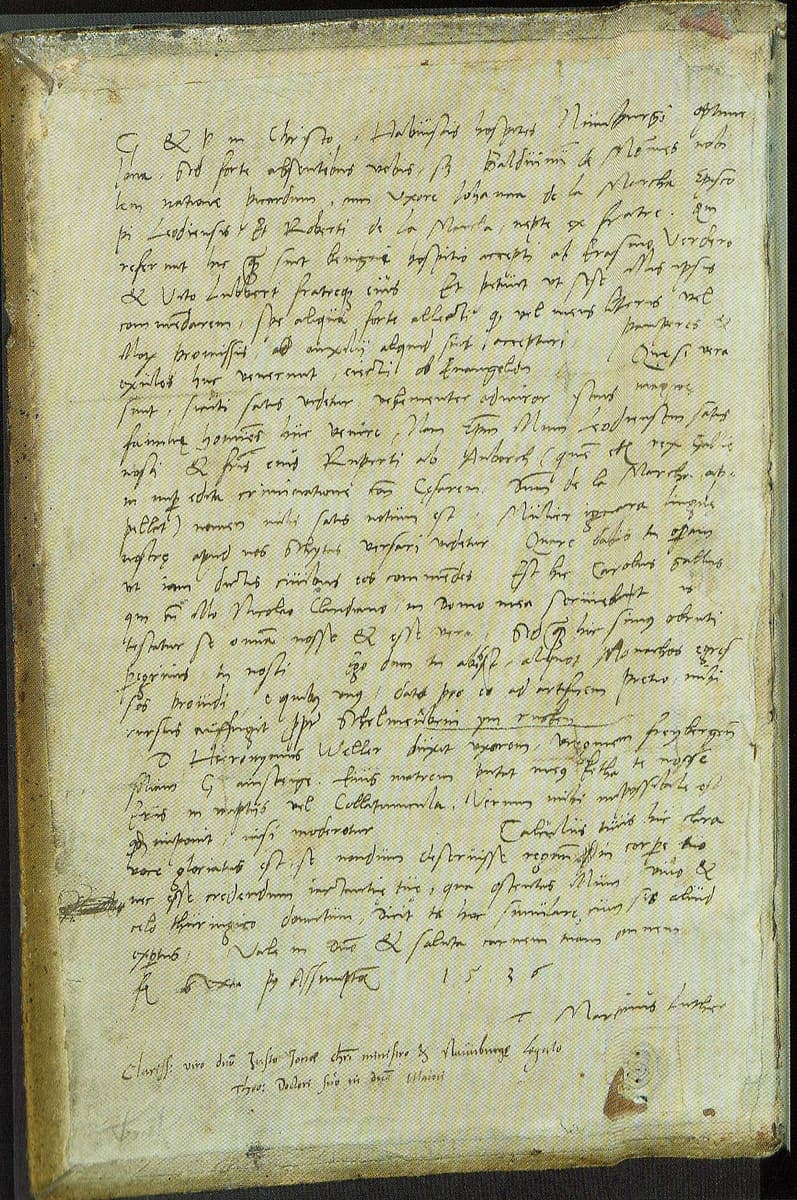
Naturhistorisches Museum Schloss Bertholdsburg, Schleusingen, Hennebergische Gymnasialbibliothek, Z 42, 18 August 1536 · Source · Public domain
Evidano Transcription
The body of the letter and its subscription, as printed in de Wette’s edition of Luther’s correspondence (vol. 5, no. MDCCXXXIII, headed “18. August. An Justus Jonas”). Two points of honesty: de Wette set his text from Aurifaber’s manuscript collection rather than from this autograph, so the wording differs from the leaf in small ways — most visibly in the third and fourth manuscript lines, where the autograph adds “Episcopi Leodiensis et Roberti de la Marcha” after the wife’s name; and the printed edition does not cover the address written at the foot of the page. Paragraphing is de Wette’s, his footnote reference numerals are dropped, his query mark after “domitum” is kept, and the German words he sets in Fraktur are given in roman here.
G. et P. in Christo. Habuistis hospites Naumburgi, optime Jona, sed forte absentibus vobis, scilicet Balduinum de Momes, nobilem natione Picardum, cum uxore Joanna de la Marcha, nepte ex fratre, qui referunt hic, quam sint benigne hospitio accepti ab Erasmo Verdero et Vito Lubbert fratreque ejus. Et petivit, ut sese illis ipsis commendarem, spe aliqua forte allecti, quod vel meis literis, vel illorum promissis auxilii sint aliquid accepturi. Pauperes et exules huc venerunt, ejecti ob Evangelion. Quae si vera sunt, sicuti satis videtur, vehementer admiror, istius magnae familiae homines huc venire. Nam Episcopum illum Leodiensem satis nosti, et fratris ejus Ruperti ab Anborch (quem etiam Rex Galliae in nuper edita criminatione contra Caesarem Dominum de la Marcha appellat) nomen mihi satis notum est. Mulier ignara linguae nostrae apud nos Scythas versari videtur. Quare dabis tu operam, ut jam dictis civibus eos commendes. Et hic Carolus Gallus, qui cum illo Nicolao Claudiano in domo mea serviebat, is testatur se nosse omnia, et esse vera. Sed quam hic simus obruti peregrinis, tu nosti. Ego, dum tu abes, aliquot monachis egressis providi, e quibus unus, dato pro eo ad artificem pretio, mihi rursus aufugit propter Schelmereyen im Nacken.
Doctor Hieronymus Weller duxit uxorem virginem Freybergensem, filiam G. am Steige. Ejus patrem putat meus Ketha te nosse. Eris in nuptiis vel collatiuncula, verum mihi impossibile est, quod imponit, nisi moderetur. Calculus tuus hic clara voce gloriatus est, se nondum deseruisse regnum in corpore tuo, nec esse credendum jactantiae tuae, qua ostendas illum. Vivo et celo Thurnigico domitum. (?) Dicit te hoc simulare, cum sis aliud expertus. Vale in Domino, et saluta carnem tuam. Feria 6. post Assumtionis, anno MDXXXVI.
T. Martinus Luther.
Source: Dr. Martin Luthers Briefe, Sendschreiben und Bedenken, ed. W. M. L. de Wette, vol. 5 (Berlin: G. Reimer, 1828), no. MDCCXXXIII, pp. 18–19, via Internet Archive (Public domain).
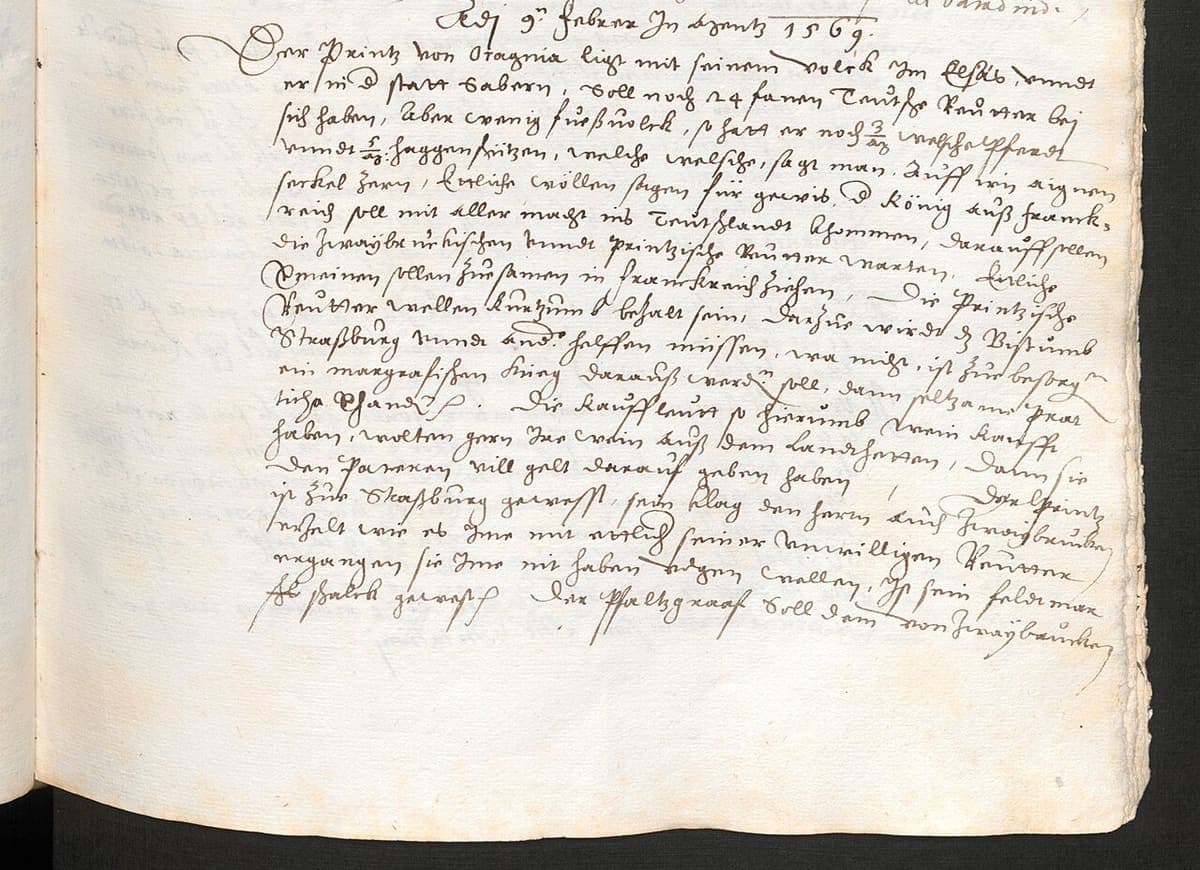
Österreichische Nationalbibliothek, 1569 · Source · Public domain
Evidano Transcription
Ady 9ten feberer In Agentz[?] 1569.
Der Printz von Oragnia ligt mit seinem volck Im Elsas, vnnd
er / in d statt Zabern, Soll noch 24 fanen Teütsche Reütter beÿ
sich haben, Aber wenig füeßvolck, so hatt er noch 3/m welsche pferdt
vnndt 5/m haggenschützen, welche welsche, sagt man, Auff irn aignen
seckel zeren, Eetliche wöllen sagen für gewis, D könig auß franck=
reich soll mit aller macht ins Teütschlandt khommen, darauff sollen
die Zwaÿbrückhischen vnndt printzische Reütter warten, Eetliche
Meinen sollen Zusamen in franckreich Ziehen, Die Printzische
Reütter wellen kreuzum d behalt sein, darZüe wirdt d Bistümb
Straßburg vnndt and[er] halten müßen, wo nicht, ist Züe besorg[en]
ein margräfischer krieg darauß werd[en] soll, dann seltzame prac
tische Händel[?]. Die kauffleütt so hieümb wein kaufft
haben, wolten gern den wein auß dem landtfaren, dann sie
den Paurern vill gelt darauff geben haben / Der Printz
ist Züe Straßburg gewest, sein klag den herrn auß Zwaÿbrück[en]
erZelt wie es Ime mit etlich seinen vnwilligen Reüttern
ergangen sie Ime nit haben volgen wellen, Ist sein feldt mar
schalck gewest Der pfaltzgraaf Soll dem von Zwaÿbrück[en]
Generated by Evidano’s advanced model; not yet checked against a published edition.
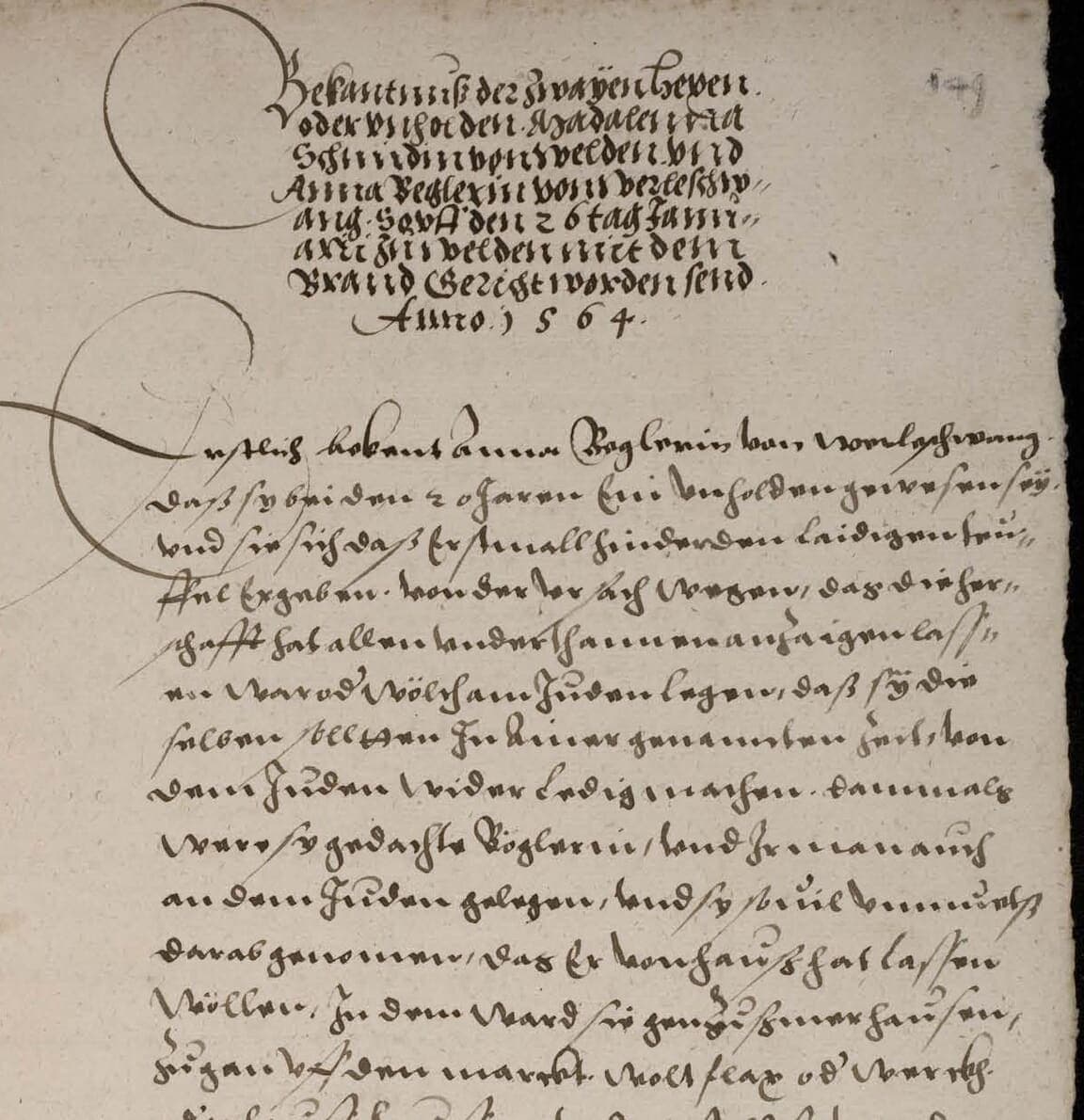
Universitätsbibliothek Heidelberg, Cod. Pal. germ. 331, f. 149r, 1564 · Source · Public domain
Evidano Transcription
The heading and the first thirteen lines of Anna Beglerin’s confession — that is, everything inside this crop — from the validated diplomatic transcription of f. 149r on German Wikisource. Spelling, capitalisation and the clerk’s line division are kept as they stand; “od(er)” is the transcriber’s expansion of an abbreviation mark. Her editorial footnotes fall on lines below the part shown here.
Bekantnuß der zwayen Hexen
oder vnholden Madalenna
Schmidin von welden vnd
Anna Beglerin von Werleschwang.
So vff den 26 tag Januarii
zu Welden mit dem
Brand Gericht worden send
Anno 1564.

Erstlich bekent Anna Beglerin von werleschwang
daß sy bei den 20 Jaren Ein vnholden gewesen sey,
vnd sie sich daß Erstmall hinder den laidigen teuffel
Ergeben. von der vrsach wegen, das die herschafft
hat allen vnderthannen anzaigen lassen
war od(er) wölch am Juden legen, daß sy die
selben solltten In Ainer genannten Zeit, von
dem Juden wider Ledig machen. Dammals
were sy gedachte Böglerin, vnd Ir man auch
an dem Juden gelegen, vnd sy souil vnmuetß
darab genomen, das Er von hauß hat lassen
wöllen, In dem ward sie gen Zußmerhausen,
zu gan vff den marckt. wolt flax od(er) werckh
Source: “Geständnisse der 1564 in Welden als Hexen verbrannten Magdalena Schmidin und Anna Beglerin”, Cod. Pal. germ. 331, Bl. 149r, validated transcription on German Wikisource (CC BY-SA 4.0).
What a chancery-hand document looks like
This period covers the transition from the formal Gothic book hand of the later Middle Ages to the fast cursive that German writers used for everyday business: Kanzleischrift in notarial instruments and civic administration, a related cursive in private letters, and a more angular humanist cursive for scholars writing Latin correspondence. A notarial deed such as a property sale or a marriage settlement typically opens with an elaborate calligraphic flourish, states the parties and terms in dense running text, and closes with the notary’s own hand-drawn signum, a personal mark unique to that notary.
The letterforms are markedly more cursive and personal than the Gothic book hand that came before: ascenders and descenders loop well beyond the body of the letter, medial and final forms of the same letter can look quite different, and capitals — especially at the start of a name or a formal opening — are often flourished well past the point of being simply decorative. Long s continues in use alongside round s and the emerging ß ligature; a nasal stroke over a vowel still marks a missing m or n, and further Latin-derived abbreviations (a hook for -us, a crossed descender for -er) appear in Latin passages within otherwise German documents.
Genre shapes the page as much as period does. A princely or civic chancery document is formal and formulaic, with a fixed structure a trained eye recognises at a glance. A private letter, such as one of Martin Luther’s, is faster and more personal, sometimes slipping between German and Latin within a single paragraph. A commercial newsletter such as the Fuggerzeitungen — handwritten news reports commissioned by the Fugger banking house from correspondents across Europe — mixes German dispatches from German-speaking cities with Italian avvisi from Rome or Venice on the same folio, reflecting the international network that produced it.
Why ordinary OCR struggles here
Personal, looping cursive with no fixed model
Unlike the more standardised Gothic book hand, Kanzleischrift varies substantially from one writer to the next: a notary’s flourish or a correspondent’s fast hand has no single reference alphabet a generic model can be trained against.
Latin and German on the same page
A German document can switch into Latin for a legal formula, a scholarly aside or an entire letter, as in several of Martin Luther’s surviving letters to fellow humanists. A transcription has to follow the actual language of each passage rather than assume one language for the whole page.
Newsletters mixing German and Italian dispatches
A single Fuggerzeitung folio can carry an Italian avviso from Venice above a German report from Vienna, in the same commercial secretary hand. Recognising the language boundary is as important as reading the script itself.
Formulaic openings and heavy abbreviation
Notarial and chancery documents lean on fixed opening and closing formulas and dense, Latin-derived abbreviation for titles, dates and legal terms. Expanding these correctly requires recognising the formula, not just the individual letters.
Who works with this material
Legal and notarial-archive historians
Reconstructing property transfers, marriage settlements and civic disputes from notarial instruments requires accurate transcription of formulaic Latin and German passages alike, tied to the specific notary’s signum and the document’s date.
Reformation historians and editors of humanist correspondence
Letters between Reformation-era scholars mix German and Latin within a single page and often exist only as a single autograph. A transcription that follows the language switch faithfully supports close reading of tone and argument, not just content.
Historians of early modern news and communication
The Fuggerzeitungen and similar manuscript newsletters are a primary source for how information moved across sixteenth-century Europe. Separating German dispatches from the Italian and Latin material on the same folio is the first step in using them.
Genealogists working with early modern deeds
Family and property history researchers use notarial instruments to trace ownership and kinship across generations; a reliable transcription of the parties, dates and witnesses named in a deed is the core of that research.
Getting the best transcription
Identify the document type before transcribing
Tell the model whether the page is a notarial deed, a personal letter or a newsletter dispatch. Each genre follows different formulas and abbreviation conventions, and naming the type helps the model apply the right expectations.
Ask for language switches to be marked
Where German and Latin, or German and Italian, appear on the same page, ask for each passage to be labelled by language rather than transcribed as a single undifferentiated block.
Set an abbreviation policy for chancery formulas
Decide whether standard Latin-derived abbreviations (title contractions, -us and -er hooks) should be expanded silently, expanded with brackets, or left as written, and apply that choice consistently across a run of documents.
Test on the most heavily flourished opening
A document’s opening line is usually its most elaborately decorated and hardest to read. If the model handles that correctly, the plainer running text that follows is usually straightforward.
Further reading on this hand
The palaeography guides the in-app selector points to for this domain, if you want to check a transcription against the standard references.
- German: Gothic Handwriting
This Brigham Young University guide introduces the Gothic handwriting traditions used in German-speaking Europe. It explains the historical development of Kurrent from late medieval and early modern cursive practices and notes variation by region, date, and writer. Its alphabet materials illustrate characteristic capital and lowercase forms and the visual contrast between Gothic and Latin handwriting. It is useful for chancery records in which emerging Kurrent conventions coexist with older documentary forms.
Frequently asked questions
- How does the transcription cope with a notary’s personal signum or a heavily flourished capital?
- The signum is described rather than transcribed as text, since it is a personal mark, not writing; the surrounding flourished capital is read as the letter it represents, with the decoration noted separately if you ask for it.
- Can it separate a German passage from a Latin one on the same page?
- Yes. Chancery and correspondence documents from this period often switch languages mid-page, and the transcription follows that switch rather than defaulting to one language throughout.
- Does it recognise the standard opening and closing formulas of a notarial deed?
- It recognises common chancery formulas as formulas, which helps with heavily abbreviated openings and closings, though the exact wording is still read from the page rather than assumed.
- How are the Italian dispatches in a Fuggerzeitung folio handled if I only want the German text?
- You can ask for only the German-language sections to be transcribed, with the Italian portions noted as present but left untranscribed, or you can request both languages if you need the full folio.
- What if ink has faded or the parchment has darkened, as on many notarial deeds?
- Illegible words are marked rather than guessed, and a partial reading is offered with a note where the model is uncertain, so an editor can decide how to fill the gap.
Related scripts and pages
Transcribe your early modern German document
Upload a scan, choose German Chancery Hands as the domain, and set a language policy before running a full collection.