
Swedish · c. 1100–1500
Read Nordic charters as the notary wrote them
A Scandinavian diploma packs a Latin protocol, a Norse or Danish body and a witness list onto one sheet of parchment, then abbreviates half of it away. Evidano keeps the thorns, the crossed suspensions and the Roman numerals of the dating clause where the scribe put them, so you can check a reading against the sheet instead of guessing at a flattened output.
Sample pages
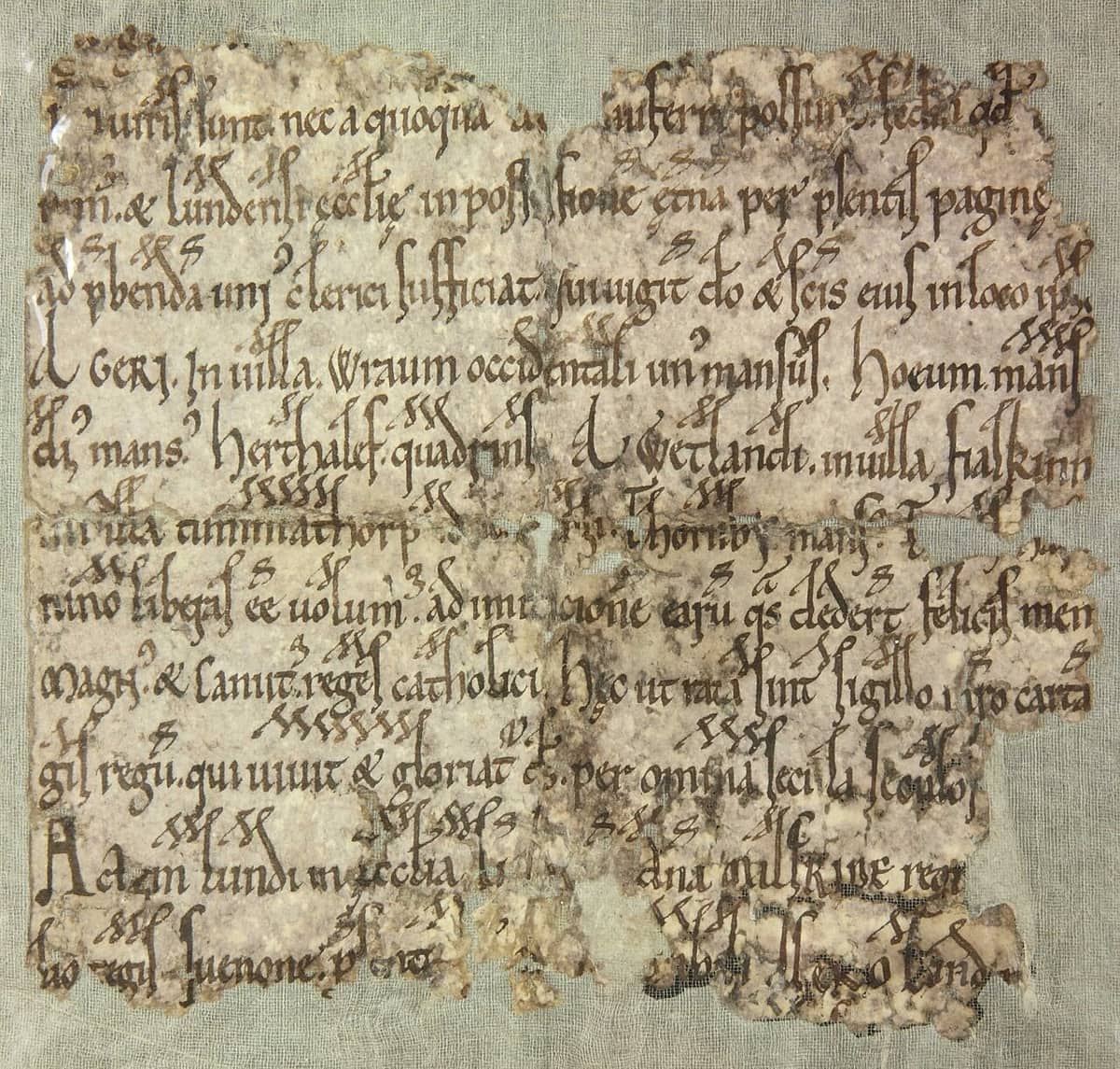
Riksarkivet (National Archives of Sweden), SDHK 180, 6 January 1135 · Source · Public domain
Evidano Transcription
The surviving fragment, from De bonis que nostri juris sunt to the archbishop’s name at the foot, as printed by J. G. Liljegren in 1829. The edition expands the scribe’s abbreviations silently and keeps his punctuation points; the list of donated estates in the middle of the text is left out here and marked with an ellipsis, and long s has been normalised to s.
De bonis que nostri juris sunt. nec a quoquam. legibus aufferri possunt. secundum
quod infra descriptum est. gratanter offeremus. et lundensi ecclesie in pos-
sessionem eternam per presentis pagine auctoritatem contradimus, quantum
ad prebendam vnius clerici sufficiat. quod jugiter Deo et sanctis eius in
loco ipso pro salute regis deseruiat. […]
Terras has a justicia regali immunes & omnino liberas esse volumus. ad imitacionem earum.
quas dederunt felicis memorie predecessores nostri. Sweno magnus et Ca-
nutus. Reges catholici. Hec vt rata sint sigillo nostro cartam hanc signaui-
mus. Ad honorem regis regum. qui viuit & gloriatur Deus per omnia se-
cula seculorum Amen. Actum Lundi. in ecclesia sancti Laurencij. Domina
Malfride regina consenciente & collaudante. et filio regis suenone, presente
domino ac venerabili ascero lundensi archiepiscopo.
Source: Svenskt Diplomatarium, vol. I, ed. J. G. Liljegren (Stockholm, 1829), no. 33, via Internet Archive (Public domain).
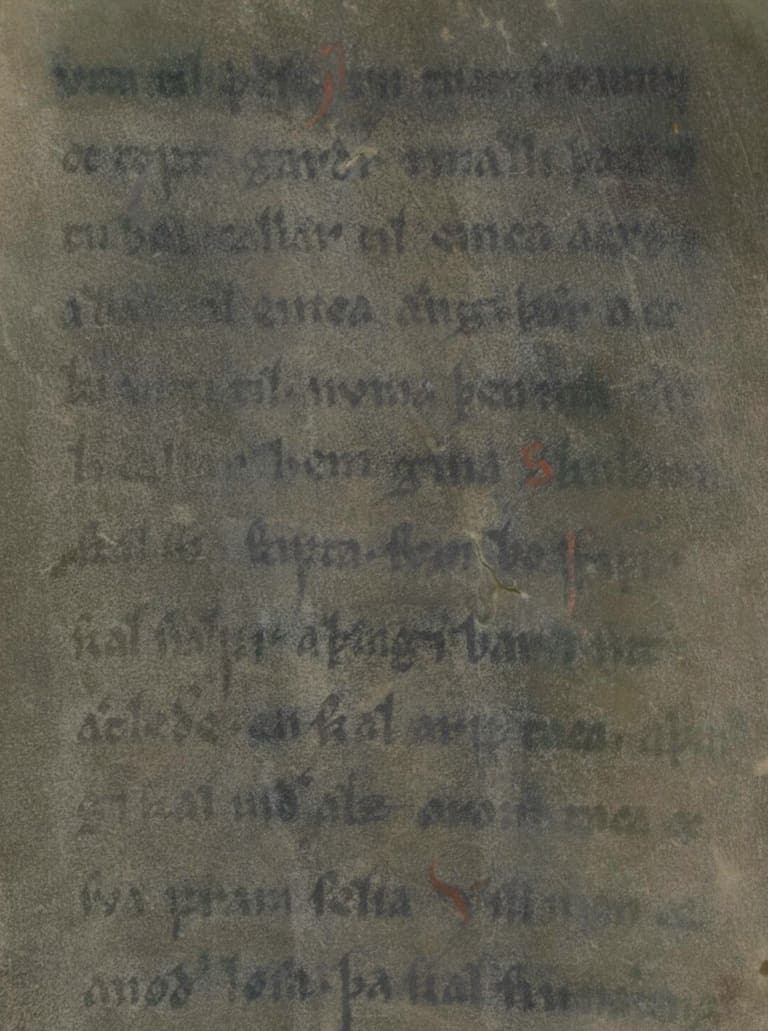
Kungliga biblioteket (National Library of Sweden), KB B 193, fol. 1r, c. 1250 · Source · CC0 1.0
Evidano Transcription
All twelve lines of the folio, in Otto von Friesen’s diplomatic transcription of 1904, which keeps the manuscript’s own letterforms — dotless ı, insular ꝼ, ꝛ, ꝺ, ð, þ, the hooked a written a’ — and its raised points. Letters supplied where the parchment is damaged stand in square brackets; the expansion of an abbreviation is italicised in the printed edition and is given in plain letters here.
vıtu tıl þeſſ A’ru tuar ſtouur ·
oc toꝼt garðr ıma’llı þa a’rv
tu bol · callar tıl eınca acrs
a’llar tıl eınca a’ng · þa’r a ec
kı vıtu tıl · nvma þen uılı a’r
han callar hem gíua Skulꝺum
ƙal ſva ƙiꝼta · ſvm bo Faþır
ƙal ſıalꝼr aþıngı barn ſıtt
a’tleðe · en ƙal arꝼ taca · a þin
gi ƙal uið alz ørom taca oc
ſva ꝼram ſelía Vıll man oꝛ
anøð løſa · þa ƙal ſiuna’t[ı]ng
Source: Otto von Friesen, Vår älsta handskrift på fornsvänska (Uppsala, 1904), Text, via Swedish Wikisource (Public domain).
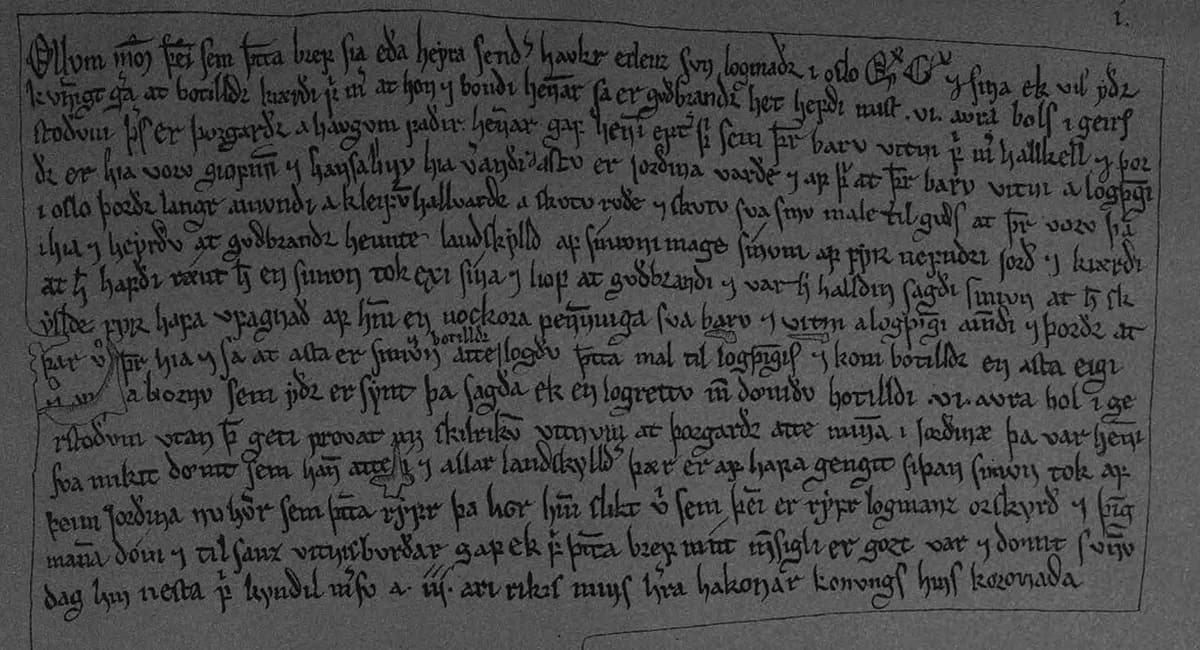
Riksarkivet (National Archives of Norway), 28 January 1302 (facsimile 1847) · Source · Public domain
Evidano Transcription
The opening of the charter and its dating clause, as printed from the original by P. A. Munch in 1847 — a text that follows the parchment closely but resolves the scribe’s abbreviations. The printed line breaks are the editor’s, not the manuscript’s; þ and ð, which the Internet Archive OCR turned into f) and o, have been restored against the facsimile. Q. G. stands for kveðju guðs, God’s greeting.
Ollvm monnvm þeim sem þetta bref sia eða heyra
sendir Havkr Erlenz svn logmaðr i Oslo Q. G. ok sina ek
vil yðr kvnnigt gera at Botilldr kiærði firir mer at hon ok
bondi hennar sa er Gvðbrandr het hefði mist .vi. avra
bols i Geirsstoðvm þers er Þorgarðr a Havgvm faðir hennar
gaf henni eftir þvi sem þeir barv vitni firir mer Hallkell
ok Þorðr er hia vorv giofinni ok hansalinv hia verandi ok
Astv er jordina varðe ok af þvi at þeir barv vitni a log-
þingi i Oslo Þorðr langr Amvndi a Kleifvm Hallvarðr a
Skvtvrvðe ok skvtv sva sinv male til gvðs at þeir vorv
þa i hia ok heyrðv at Gvðbrandr heimte landskylld af Si-
mvni mage sinvm af fyrr nefndri jord ok kiærði at hann […]
gort var ok dæmt svnnvdag hin nesta firir kyndilmersv
a .iij. ari rikis mins herra Hakonar konvngs hins koronada.
Source: P. A. Munch, ‘Om Rigsraaden Hr. Hauk Erlendsson’, Annaler for nordisk Oldkyndighed og Historie (Copenhagen, 1847), pp. 214–215, via Internet Archive (Public domain).
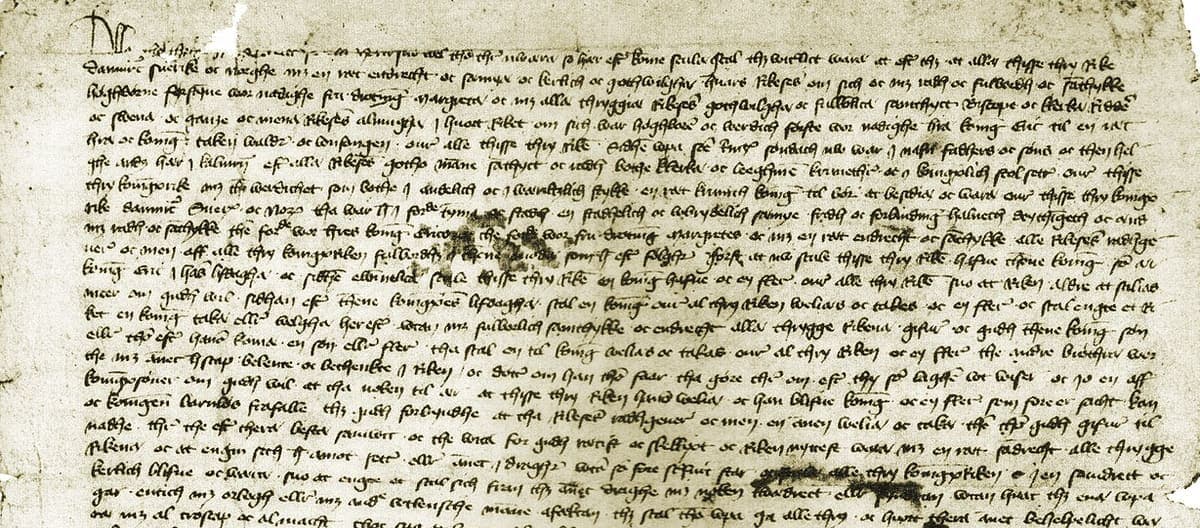
Riksarkivet (National Archives of Sweden), 1397 · Source · Public domain
Evidano Transcription
The opening of the letter down to the end of its second article, the last line of which is cut across by the lower edge of the image; given in the normalised spelling and punctuation of Norges gamle Love, not line for line with the manuscript.
Allæ the thettæ breff høræ eller se eller høræ, suo wel thom ther nw æræ, som hær efter komme sculæ, scal thet witerlict waræ, at efter thet at allæ thisse thry rike, Danmarc, Suerike oc Norghe, met en ræt endrecht oc sæmyæ oc kerlich oc gothwilghæ huars rikesens om sich oc met radh oc fulbordh oc samthykke høghbørne førstynne, wor nadighe fru drotning Margretæ, oc met allæ thryggiæ rikesens gothwilghæ oc fulkomlicæ samthyct, biscope oc klerkæ, ridderæ oc swenæ oc ganze oc menæ rikesens almughæ j huort riket om sich, war høghboren oc werdich første, wor nadighe herræ koning Eric til en ræt herræ oc koning taken, walder oc wnfongen ouer alle thisse thry riken, sidhen wpa sancte trinitatis søndach nw war j nafn Fadhers oc Søns oc then Helghe Andz hær j Kalmarn efter allæ rikesens gotho manne samthyct oc radh, bothe klerkæ oc leeghmen, krunether oc j koningxlich stol setter ouer thisse thry koningxrike met then werdichet, som bothe j andelich oc j wæriltzlich stykke en ræt krunith koning til bør at besidiæ oc wæræ ouer thisse thry koningxrike, Danmarc, Suerike oc Norghe; tha war her j forde tymma oc stadh en stadhelich oc wbrydelich sæmye, fridh oc forbinding halneth, deythingeth oc ænd met radh oc samthykke then forde wor herres koning Erics oc then forde wor fru drotning Margretes oc met en ræt endrecht oc samthykke alle rikesens radhgeuere oc men aff alle thry koningxriken fulbordhet j thenne modæ, som her efter følgher:

Først at nw scule thisse thry riken hafue thenne koning, som ær koning Eric, j hans lifdaghæ, oc sidhen ewinnelicæ scule thisse thry riken en koning hafue oc ey flere ouer alle thry riken, suo at riken aldre at scilias meer, om Gudh wil. Sidhan efter thenne koningxens lifdaghæ scal en koning ouer al thry riken weliæs oc takes oc ey flere, oc scal engte et riket en koning takæ eller welghæ her efter wtan met fulborlich samthykke oc endrecht allæ thrygge rikenæ. Gifuer oc Gudh thenne koning søn eller thom, efter hanom kommæ, en søn eller flere, tha scal en til koning weliæs oc takas ouer al thry riken oc ey flere; the andre brøthræ worthe met annet herscap belente oc bethenkte j riken, oc døttre, om han thom faar, tha gøre ther om efter thy, som laghen wt wiser, oc jo en aff koningxsøner, om Gudh wil, at tha noken til ær, at thisse thry riken hanom weliæ, oc han blifue koning oc ey flere, som fore er sacht. Kan oc koningen barnløs frafalle, thet Gudh forbyudhe, at tha rikesens radhgeuere oc men en annen weliæ oc takæ, then, thom Gudh gifuer til nadhe, ther the efter theræ bestæ samwit oc the witæ for Gudh rætist oc skellixt oc riken nyttest wæræ met en ræt samdrecht alle thrygge rikenæ, oc at engin sich her amot setter eller annet j dragher, wtan som fore screfuit star.

Oc sculæ alle thry koningxriken j en samdrect oc kerlich blifue oc wæræ, suo at engte et scal sich fran thet annet draghe met noken twædrect eller syndran, wtan huat thet enæ wpa gar entich met orlogh eller met andre wtlensche manne afæktan, thet scal thom wpa ga alle thry, oc huort thera annet behelpelicht wæræ met al troscap oc al macht, thoc suo at huort riket blifuer widh syn lagh oc ræt, oc koningen efter thy, hanom bør at hafue.
Source: Unionsbrevet, Kalmar 1397, printed after Norges gamle Love 2. R. I nr. 22 (Kjelder til norsk historie, Universitetet i Bergen) (Public domain (medieval text; 19th–20th-century edition)).
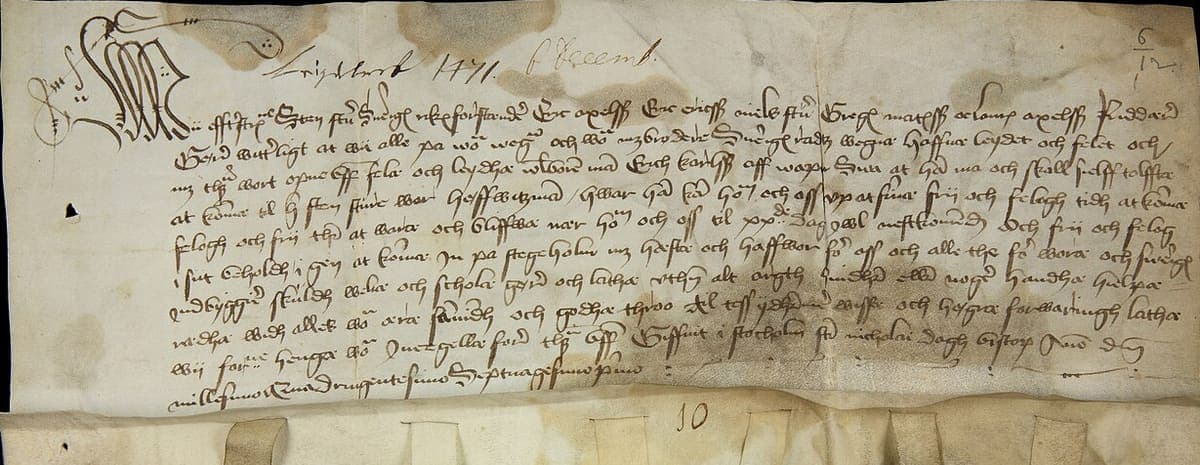
Riksarkivet (National Archives of Sweden), SDHK 29327, 6 December 1471 · Source · Public domain
Evidano Transcription
[illegible] 1471 6 Decemb.
6
12
Wii [illegible] Sten ſtu[re] Swerigh[is] rikeſforſtand[ere] Erik axelſſ[on] Erik [illegible] [illegible] ſtu[re] Birgh[er][?] [illegible] oc Iwar[?] axelſſ[on] Riddare
Gör[e][?] witterligt at wii alle pa wor[e] wegna och wor[e] mzbrødhr[e][?] Swerigh[is] radh[s] wegna haffua leydt och [illegible] och
mz th[et]ta wort opne breff fela och leydha welbor[e]n ma[n] Erich karlſſ[on] aff wapn [illegible]
[remaining lines illegible]
Generated by Evidano’s advanced model; not yet checked against a published edition.
What a Nordic charter looks like
Writing arrived in the Nordic kingdoms with the Church, and the first charters, from the early twelfth century, are in Latin and in the same early Gothic documentary hands as the rest of Latin Europe. Denmark leads, with the oldest surviving originals from Lund, then the seat of the Nordic archbishopric; Sweden and Norway follow through the thirteenth century. From about 1280 the vernacular takes over for business between Scandinavians while Latin stays for anything involving the papacy or a foreign chancery. By 1400 the ordinary charter is a small oblong of parchment, eight to twenty lines, ruled in drypoint, with a fold at the foot from which tags carry pendant wax seals.
The letterforms are Gothic cursive: narrow, laterally compressed, built from minims that make in, m, ni and iu almost interchangeable. Long s (ſ) descends below the line and is easily read as f; r rotunda (ꝛ) appears after o and other round letters; u and v are one letter, as are i and j. Vernacular charters keep thorn (þ) for th and, in Norway and Iceland, eth (ð); Sweden loses both during the fourteenth century in favour of th and dh. Abbreviation is constant: a bar over a vowel for a nasal, a crossed p for per or pro, the Tironian ⁊ for et or ok, superscript vowels for a whole syllable, and set contractions such as dns for dominus. Numbers are Roman and are pointed, .vi. avra bol, with a final i often hooked into a j.
The structure repeats, and that repetition is what makes a charter tractable. A Norwegian diploma opens Ollum monnum þeim sem þetta bref sia eða heyra sendir N. kveðju guðs ok sina; a Latin one opens with a verbal invocation and Omnibus presens scriptum cernentibus. The body sets out the transaction, the corroboration announces the seals, and the dating clause fixes the day by a church feast and the year by regnal year or Anno Domini. Later hands add archival endorsements on the dorse, and nineteenth-century archivists add pencil numbers, so a single sheet can carry writing from four centuries.
Why ordinary OCR struggles here
Minims, long s and r rotunda
Gothic cursive reduces many letters to identical vertical strokes, so a word such as minnum is a row of teeth to be counted rather than read. Long s and f differ only by a crossbar that scribes often omit; r rotunda looks like a 2. Layout-based OCR has no lexicon of Old Norse or Old Swedish to fall back on and produces plausible nonsense.
Two abbreviation systems on one sheet
The Latin protocol uses the standard European set of suspensions and contractions; the vernacular body uses a smaller, looser set plus the Tironian sign for ok. A transcription has to know which system it is in at any point, and record whether a letter was written or supplied.
Letters the modern keyboard lost
Thorn, eth, the a-with-hook used for æ in Swedish manuscripts, o with a superscript stroke for ø, and the crossed d all vanish in ordinary OCR output. Losing them destroys the evidence a linguist needs and turns distinct names into the same string.
Damage, folds and later hands
Charters were folded, stored in bundles and gnawed at the edges; ink has flaked where the fold ran. Around the medieval text sit dorse endorsements, register numbers and modern archival stamps that must not be mixed into the body of the document.
Who works with this material
Diplomatarium and cartulary editors
The national charter series — Diplomatarium Danicum, Svenskt Diplomatarium, Diplomatarium Norvegicum — are still being extended and re-edited. A first transcription that preserves abbreviation marks and points gives an editor something to correct rather than something to retype.
Historians of land and settlement
Charters are the earliest evidence for farm names, field measures and units such as the öresland and the aurabol. Getting the numerals and the place-name spellings off the parchment intact is the whole point; a normalised reading destroys the variant that dates the form.
Philologists working on Old Norse and Old Swedish
Historical linguists need to know whether a scribe wrote þ or th, ð or dh, and where the hooked a stands for æ. Those distinctions carry the dating evidence, so they have to survive the transcription rather than be tidied away.
Archives running charter digitisation
Nordic archives have photographed tens of thousands of medieval sheets and now want searchable text behind the images. Consistent handling of the dating clause and the witness list makes the collection usable for indexing by date, place and person.
Getting the best transcription
Name the language of each part
Say in the prompt that the protocol may be Latin while the body is Old Swedish, Old Danish or Old Norse, and ask for the switch to be marked. Otherwise a Latin dating clause tacked onto a vernacular charter is read as more of the same language and quietly mangled.
Decide what happens to abbreviations
Choose one policy and keep it: reproduce the marks, expand silently, or expand with the supplied letters in brackets or italics. For a diplomatic edition ask for brackets, and ask for the Tironian sign to be flagged so ok and et are not confused.
Handle the dating clause separately
Roman numerals with points, feast days and regnal years are where most errors land. Ask for the clause to be transcribed exactly and for any calendar conversion to be given as a note, not substituted for what the sheet says.
Keep the dorse out of the body
Test on a sheet that carries an endorsement or a modern archival number. If those are labelled separately from the medieval text on that page, a whole bundle can be run without the register numbers contaminating the transcriptions.
Further reading on this hand
The palaeography guides the in-app selector points to for this domain, if you want to check a transcription against the standard references.
- Latin Paleography
This Hill Museum & Manuscript Library (HMML) course teaches the Gothic book and documentary scripts used for medieval Latin records. It covers diagnostic letters, minim sequences, ligatures, abbreviations, punctuation, numerals, and distinctions between formal and cursive hands. Scandinavian medieval charters participated in this wider European Latin scribal culture while incorporating local names and vernacular forms. The course is therefore useful for identifying the shared script system underlying Swedish, Danish, and Norwegian charter material.
Frequently asked questions
- Are thorn and eth kept, or replaced with th and dh?
- Either, as you specify. The default keeps þ and ð where the scribe wrote them, because the choice between þ and th is dating evidence in Swedish charters of the fourteenth century. A search-friendly version with th and dh can be produced from the same pass.
- How are Roman numerals in Nordic charters handled?
- They are transcribed as written, with the points that enclose them and the hooked final j, so .vi. avra bol stays .vi. avra bol. Converting them to Arabic figures is a separate step you can ask for as an extra column rather than a replacement.
- Can it tell a Latin charter from a vernacular one?
- Yes, and it can tell them apart within a single sheet. Latin protocols with Omnibus presens scriptum cernentibus and vernacular bodies beginning Ollum monnum use different abbreviation systems, and the transcription can mark where one gives way to the other.
- What about the endorsements on the back of a charter?
- Dorse texts are usually a later summary of the contents, sometimes centuries later and in a different script. Photograph them as a separate image and they will be transcribed as their own document, with the hand and approximate date noted.
- Is a nineteenth-century lithographed facsimile good enough to work from?
- Often yes. Facsimiles such as Munch’s plate of the 1302 Oslo judgment reproduce letterforms accurately and can be clearer than a photograph of a darkened original, though a lithographer may regularise a shaky stroke, so a doubtful reading should still be checked against the sheet.
Related scripts and pages
Transcribe your medieval Nordic charters
Upload a diploma, choose Medieval Scandinavian Latin and Vernacular Charters, and check the dating clause before running the rest of the bundle.