
Latin · c. 1100–1500
Transcribe Gothic charters and the humanistic hand that replaced them
By 1200 Latin had compressed into a dense, angular Gothic hand where a run of identical short strokes can spell any of i, m, n, u or their combinations, and legal and university documents abbreviate almost every word ending. A century later, Italian scholars deliberately revived an older, rounder script to escape exactly that difficulty. Evidano reads both, resolving minims and abbreviation in the Gothic hand and following the humanists back to the Caroline forms they were imitating.
Sample pages
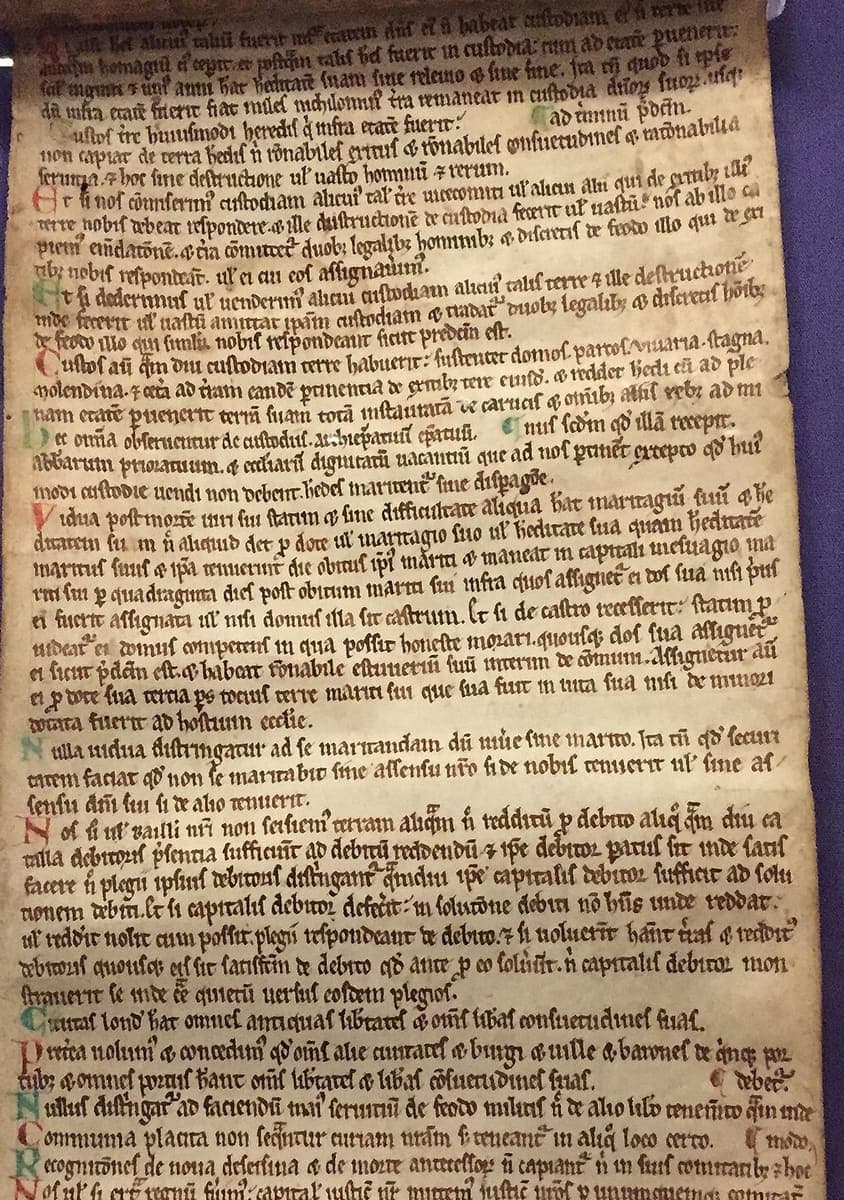
Society of Antiquaries of London, after 1225 · Source · CC BY-SA 4.0 · Jacklee
Evidano Transcription
[cut off]
[S]i he[re]s alicui[us] taliu[m] fu[er]it inf[ra] etatem d[omi]n[u]s ei[us] n[on] habeat custodiam ei[us] n[ec] t[er]re sue
anteq[uam] homagiu[m] ei[us] cep[er]it. et postq[u]am talis he[re]s fu[er]it in custodia: cu[m] ad etate[m] puenerit:
scil[icet] uiginti ⁊ uni[us] ann[i] h[abe]at he[re]ditate[m] suam sine releuio ⁊ sine fine. Ita t[ame]n quod si ipse
du[m] inf[ra] etate[m] fu[er]it fiat miles nichilomin[us] t[er]ra remaneat in custodia d[omi]nor[um] suor[um]. usq[ue]
Custos t[er]re huiusmodi heredis q[ui] infra etate[m] fu[er]it: ad t[er]minu[m] p[re]d[i]c[tu]m.
non capiat de terra he[re]dis n[isi] r[ati]onabiles exitus ⁊ r[ati]onabiles consuetudines ⁊ r[ati]onabilia
seruitia. ⁊ hoc sine destructione u[e]l uasto hominu[m] ⁊ rerum.
Et si nos co[m]miserim[us] custodiam alicui[us] tal[is] t[er]re uicecomiti u[e]l alicui alii qui de exitib[us] illi[us]
terre nobis debeat respondere. ⁊ ille destructione[m] de custodia fecerit u[e]l uastu[m]: nos ab illo ca
piem[us] em[en]datione[m]. ⁊ t[er]ra co[m]mittet[ur] duob[us] legalib[us] hominib[us] ⁊ discretis de feodo illo qui de exi
tib[us] nobis respondeat. u[e]l ei cui eos assignau[er]im[us].
Et si dederimus u[e]l uenderim[us] alicui custodiam alicui[us] talis terre ⁊ ille destructione[m]
inde fecerit u[e]l uastu[m] amittat ipsam custodiam ⁊ tradat[ur] duob[us] legalib[us] ⁊ discretis ho[m]i[ni]b[us]
de feodo illo qui sim[i]lit[er] nobis respondeant sicut p[re]dictu[m] est.
Custos au[tem] q[uam] diu custodiam terre habuerit: sustentet domos. parcos. uiuaria. stagna.
molendina. ⁊ cet[er]a ad t[er]ram eande[m] p[er]tinentia de exitib[us] terre eiusd[em]. ⁊ reddet he[re]di cu[m] ad ple
nam etate[m] puenerit terra[m] suam tota[m] instaurata[m] de carucis ⁊ om[n]ib[us] aliis reb[us] ad mi
Hec om[n]ia obseruentur de custodiis. archiep[iscop]atuu[m] ep[iscop]atuu[m]. nus scd[u]m q[uo]d illa[m] recepit.
abbatiaru[m] prioratuu[m]. ⁊ eccl[es]iaru[m] dignitat[um] uacantiu[m] que ad nos p[er]tine[n]t excepto q[uo]d hui[us]
modi custodie uendi non debent. he[re]des maritent[ur] sine disparag[ation]e.
Vidua post morte[m] uiri sui statim ⁊ sine difficultate aliqua h[abe]at maritagiu[m] suu[m] ⁊ he
ditatem sua[m] n[ec] a[li]quid det p[ro] dote u[e]l maritagio suo u[e]l he[re]ditate sua quam he[re]ditate[m]
maritus suus ⁊ ip[s]a tenuerint die obitus ip[s]i[us] mariti ⁊ maneat in capitali mesuagio ma
riti sui p[er] quadraginta dies post obitum mariti sui infra quos assignet[ur] ei dos sua nisi pri[us]
ei fuerit assignata u[e]l nisi domus illa sit castrum. Et si de castro recesserit: statim p[ro]
uideat[ur] ei domus competens in qua possit honeste morari. quousq[ue] dos sua assignet[ur]
ei sicut p[re]d[i]c[tu]m est. ⁊ habeat r[ati]onabile estuueriu[m] suu[m] interim de co[m]muni. Assignetur au[tem]
ei p[ro] dote sua tertia p[ar]s totius terre mariti sui que sua fuit in uita sua nisi de minori
dotata fuerit ad hostium eccl[es]ie.
Nulla uidua distringatur ad se maritandam du[m] uiue[re][?] sine marito. Ita t[ame]n q[uo]d securi
tatem faciat q[uo]d non se maritabit sine assensu n[ost]ro si de nobis tenuerit u[e]l sine as
sensu d[omi]ni sui si de alio tenuerit.
Nos u[er]o u[e]l bailli n[ost]ri non seisiem[us] terram aliq[uam] n[ec] redditu[m] p[ro] debito aliq[uo] q[uam] diu ca
talla debitoris p[re]sentia sufficiu[n]t ad debitu[m] reddendu[m] ⁊ ipse debitor parat[us] sit inde satis
facere n[ec] plegii ipsius debitoris distringant[ur] q[uam]diu ipse capitalis debitor sufficit ad solu
tionem debiti. Et si capitalis debitor defecerit in solutione debiti no[n] h[abe]ns unde reddat.
u[e]l redd[er]e nolit cu[m] possit: plegii respondeant de debito. ⁊ si uolueri[n]t h[abe]ant t[er]ras ⁊ reddit[us]
debitoris quousq[ue] eis sit satisf[a]c[tu]m de debito q[uo]d ante p[ro] eo solue[r]i[n]t. n[isi] capitalis debitor mon
strauerit se inde e[ss]e quietu[m] uersus eosdem plegios.
Ciuitas lond[onie] h[abe]at omnes antiquas lib[er]tates ⁊ om[n]es lib[er]as consuetudines suas.
P[re]terea uolum[us] ⁊ concedim[us] q[uo]d om[n]es alie ciuitates ⁊ burgi ⁊ uille ⁊ barones de q[ui]nq[ue] por
tub[us] ⁊ omnes portus h[abe]ant om[n]es lib[er]tates ⁊ lib[er]as co[n]suetudines suas. debet[ur].
Nullus distringat[ur] ad faciend[um] mai[us] seruitiu[m] de feodo militis n[ec] de alio lib[er]o tenem[en]to q[uam] inde
Co[m]munia placita non sequ[a]ntur curiam n[ost]ram s[ed] teneant[ur] in aliq[uo] loco certo. modo.
Recognit[i]ones de noua deseisina ⁊ de morte antecessor[um] n[on] capiant[ur] n[isi] in suis comitatib[us] ⁊ hoc
Nos u[e]l si ext[ra] regnu[m] fu[er]im[us]: capital[is] iustic[iarius] n[oste]r mittem[us] iustic[iarios] n[ost]ros p[er] unumquemq[ue] comitat[um]
Generated by Evidano’s advanced model; not yet checked against a published edition.
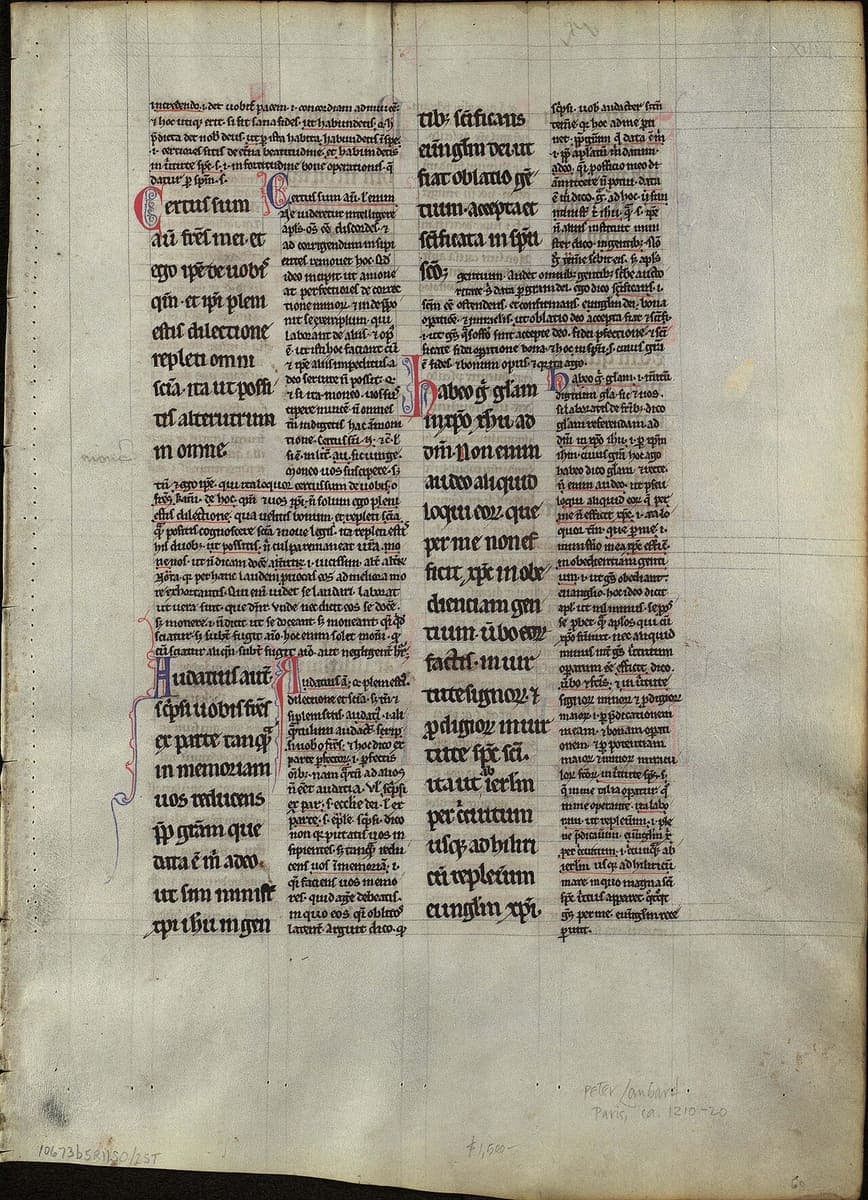
Portland State University Library, c. 1210–1220 · Source · CC BY-SA 4.0 · Lgw2
Evidano Transcription
The biblical lemma text only – Romans 15:14–19 – as it runs through the larger, darker script on this leaf; the smaller surrounding commentary is Peter Lombard’s gloss and is not transcribed here.
14 Certus sum autem fratres mei et ego ipse de vobis, quoniam et ipsi pleni estis dilectione, repleti omni scientia, ita ut possitis alterutrum monere.
15 Audacius autem scripsi vobis fratres ex parte, tamquam in memoriam vos reducens: propter gratiam, quae data est mihi a Deo,
16 ut sim minister Christi Iesu in gentibus: sanctificans Evangelium Dei, ut fiat oblatio gentium accepta, et sanctificata in Spiritu Sancto.
17 Habeo igitur gloriam in Christo Iesu ad Deum.
18 Non enim audeo aliquid loqui eorum, quae per me non efficit Christus in obedientiam gentium, verbo et factis:
19 in virtute signorum, et prodigiorum, in virtute Spiritus Sancti: ita ut ab Ierusalem per circuitum usque ad Illyricum repleverim Evangelium Christi.
Source: Biblia Sacra Vulgata, Vulgata Clementina, Epistle to the Romans, via Wikisource (Public domain).
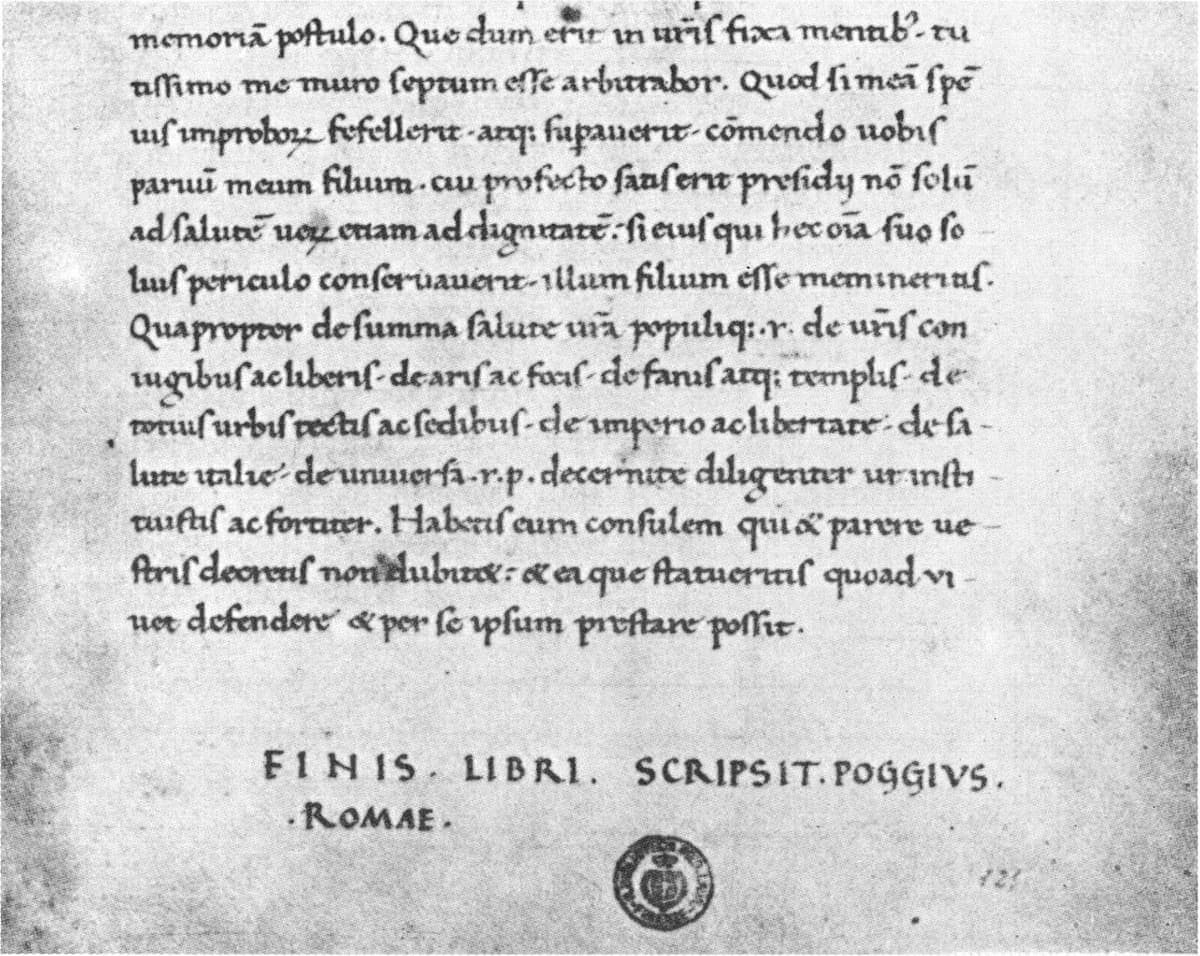
Biblioteca Medicea Laurenziana, Florence, 1425 · Source · Public domain
Evidano Transcription
The whole page: the close of the Fourth Catilinarian Oration and Poggio’s own colophon.
memoria postulo. Quod dum erit in vestris fixa mentibus, tutissimo me muro saeptum esse arbitrabor. Quodsi meam spem vis improborum fefellerit atque superaverit, commendo vobis parvum meum filium, cui profecto satis erit praesidii non solum ad salutem, verum etiam ad dignitatem, si eius, qui haec omnia suo solius periculo conservarit, illum filium esse memineritis. Quapropter de summa salute vestra populique Romani, de vestris coniugibus ac liberis, de aris ac focis, de fanis atque templis, de totius urbis tectis ac sedibus, de imperio ac libertate, de salute Italiae, de universa re publica decernite diligenter, ut instituistis, ac fortiter. Habetis eum consulem, qui et parere vestris decretis non dubitet et ea, quae statueritis, quoad vivet, defendere et per se ipsum praestare possit.

Finis libri. Scripsit Poggius Romae.
Source: M. Tullius Cicero, In L. Catilinam orationes, Oratio IV, via Wikisource (Public domain).
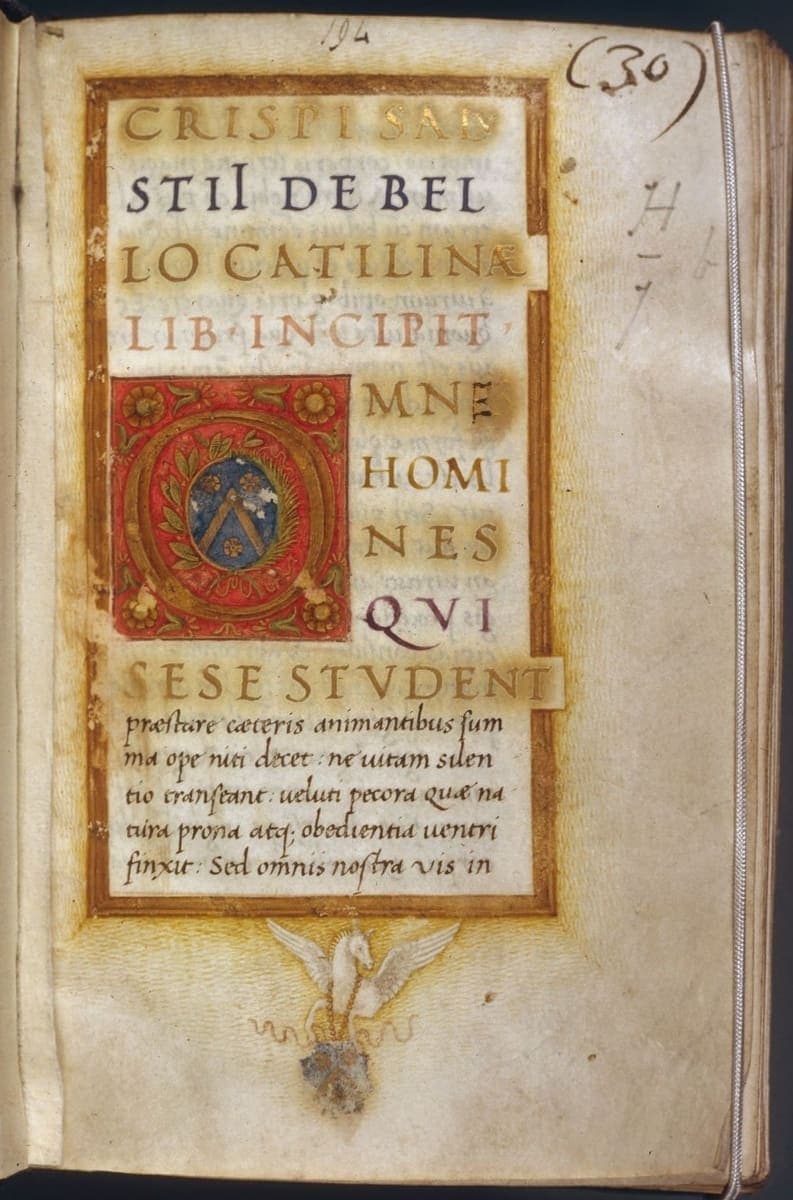
Houghton Library, Harvard University, c. 1490 · Source · Public domain
Evidano Transcription
The opening sentences of Sallust’s Bellum Catilinae, as this page carries them: the words begun inside the illuminated initial (O·MNES HOMINES QVI), the gold display line SESE STVDENT, and the five lines of humanistic minuscule beneath it, breaking where the page does. The manuscript’s reading “animantibus” and its word order “omnis nostra vis” are well-attested variants on the standard modern text (“animalibus”, “nostra omnis vis”) and are kept as written. Spelling otherwise follows the printed edition, so the scribe’s ae-digraphs and abbreviations — caeteris, atq; — appear here as ceteris and atque.
Omnes homines qui sese student praestare ceteris animantibus summa ope niti decet, ne vitam silentio transeant veluti pecora, quae natura prona atque obedientia ventri finxit. Sed omnis nostra vis in …
Source: C. Sallustius Crispus, De Catilinae coniuratione, via Wikisource (Public domain).
From Gothic compression to humanistic revival
Gothic textualis, the formal book hand for Bibles, liturgy and university texts, is built on “biting” curves where adjoining letters overlap, and on minims – short parallel vertical strokes that make i, m, n, u and their combinations hard to tell apart without careful counting. Documentary and chancery hands (cursiva and hybrida) are more current and looped but no less compressed, and this is the script of Magna Carta, sealed by King John in 1215 in a documentary hand already showing the compression the coming century would push much further. Universities in Paris and Oxford developed their own extremely small, heavily abbreviated textualis for portable “pocket Bibles”, and for glossed texts used in theology and law faculties, where a larger central column of scripture is surrounded by a much smaller commentary hand on the same page.
In early fifteenth-century Florence, scholars including Poggio Bracciolini and Niccolò Niccoli went looking for manuscripts of classical texts to copy from, and mistook Carolingian minuscule books for genuinely ancient Roman writing. They revived its rounder, more open letterforms as “lettera antica” – what is now called humanistic minuscule: separated, rounded letters closer to Carolingian than to Gothic, and far less abbreviation than Gothic practice used. Niccoli’s own quicker, sloped variant of the hand later became the model for italic type. The humanistic hand spread with the wider revival of classical learning across Italy over the course of the century.
The two traditions treat abbreviation almost as opposites. Gothic scribes abbreviate systematically and often: suspension marks cut a word short, contraction marks omit its middle, superscript letters and special signs stand in for whole syllables like per-, pro- and con- or endings like -us and -que, and a legal or university document pushes this further than any service book. Humanistic scribes, by contrast, deliberately wrote most words in full, in conscious imitation of what they took to be ancient practice, so a fifteenth-century humanistic manuscript can look, at a glance, centuries older than it is.
Why ordinary OCR struggles here
Minim pile-ups
i, m, n, u and their combinations in Gothic textualis are all built from identical short vertical strokes, so a word can arrive as a solid fence of near-identical marks that only careful counting, and any surviving dots over the i, can separate correctly.
Extensive, systematic abbreviation
Gothic scribes routinely abbreviate common word endings and whole syllables – per-, pro-, con-, -us, -que – and university and legal documents push this further than any other period of Latin writing.
Chancery hands compress fastest
A legal instrument like a royal charter is often smaller and more heavily abbreviated than a contemporary service book, because chancery scribes wrote for other trained readers rather than for general legibility.
Humanistic manuscripts imitate an older hand on purpose
A fifteenth-century humanistic copy can look, at a glance, like a much earlier Carolingian manuscript. Getting the actual date wrong changes which abbreviation and spelling conventions a transcription should expect.
Who works with this material
Legal and constitutional historians
Charters, writs and statutes surviving from this period are written in a hand deliberately compressed for other trained clerks, not for later readers, and a transcription that resolves the minims and abbreviations correctly turns a document into usable evidence.
Editors of glossed university texts
A Paris or Oxford glossed Bible or law book packs a biblical or legal lemma and its commentary onto the same page in two different scales of the same script; an edition needs the two kept apart, not merged into one transcription.
Classicists studying humanist book production
Humanistic manuscripts like Poggio’s own copies are primary evidence for how classical texts were edited, corrected and circulated in fifteenth-century Italy, and a colophon naming a scribe and place is often the only such record for a given book.
Palaeography students learning to date a hand by its abbreviation
Comparing how densely a Gothic and a humanistic page abbreviate the same kind of text is a direct, checkable way to see the humanist reform in action rather than reading about it secondhand.
Getting the best transcription
Say whether the hand is Gothic or humanistic
The two traditions abbreviate at opposite extremes, so telling the model which one it is looking at up front avoids it applying Gothic suspension rules to an almost unabbreviated humanistic page, or the reverse.
Set a minim-resolution policy for Gothic textualis
Ask the model to flag any run of minims it is not fully confident about rather than silently picking one reading, so you can check the hardest words against the image yourself.
Keep a glossed page’s text and commentary apart
For a university manuscript with a biblical or legal lemma surrounded by commentary, ask for the two to be transcribed separately, since they are usually different texts by different authors sharing one page.
Test on a colophon or dated clause first
A scribe’s signed colophon, or a charter’s dating clause, gives you a short, checkable passage before you commit to transcribing an entire manuscript in the same prompt.
Further reading on this hand
The palaeography guides the in-app selector points to for this domain, if you want to check a transcription against the standard references.
- Abbreviations
This chapter in The Oxford Handbook of Latin Palaeography surveys abbreviation practices across medieval Latin writing. It explains major mechanisms such as suspension, contraction, superscript letters, special signs, and ligatures and illustrates frequently encountered forms. The discussion emphasizes how the shape and interpretation of an abbreviation depend on script, period, and textual context. It is especially useful for the dense abbreviation systems of Gothic books and documents and for comparison with the more restrained practices of Humanistic manuscripts.
Frequently asked questions
- How does it deal with minims in words like minimum or unum?
- It counts strokes and applies Latin morphology to decide the likeliest split between i, m, n and u, and flags a run it is not confident about rather than guessing silently, so you can check that word against the image.
- Can it expand Gothic suspension and contraction marks?
- Yes, and you can choose whether to see the expansion silently, with the supplied letters marked in brackets, or not at all, with the abbreviation left exactly as written.
- Does it know that Magna Carta’s hand is different from a contemporary Bible?
- Yes, if you tell it the document is a charter rather than a book. Chancery hands compress and abbreviate more heavily than a service book from the same decade, and naming the document type helps it read the abbreviations correctly.
- Will it treat a humanistic manuscript as if it were centuries older?
- Not if you give it the actual date. Humanistic scribes deliberately imitated Carolingian letterforms, and telling the model the manuscript is fifteenth-century keeps it from applying eighth- or ninth-century spelling and abbreviation conventions by mistake.
- Can it separate a glossed text from its surrounding commentary?
- Yes. A larger biblical or legal lemma and a smaller surrounding gloss are usually different texts, often by different authors, and asking for them to be kept apart avoids the two being run together in the output.
Related scripts and pages
Transcribe your Gothic or humanistic Latin manuscript
Upload a page, choose Gothic and Humanistic Latin Manuscripts as the domain, and tell the model whether it is looking at a charter, a gloss or a classical text.