
Swahili
Read Swahili in Ajami, in colonial print, or in today’s spelling
For centuries Swahili verse was written not in the Latin alphabet but in Ajami, Arabic script adapted for a Bantu language and read right to left down the coast from Lamu to Zanzibar. Evidano reads Ajami as the poetry it carries, keeps German colonial-era spelling as printed rather than modernising it, and works through present-day Swahili signage and print with the same care.
Sample pages
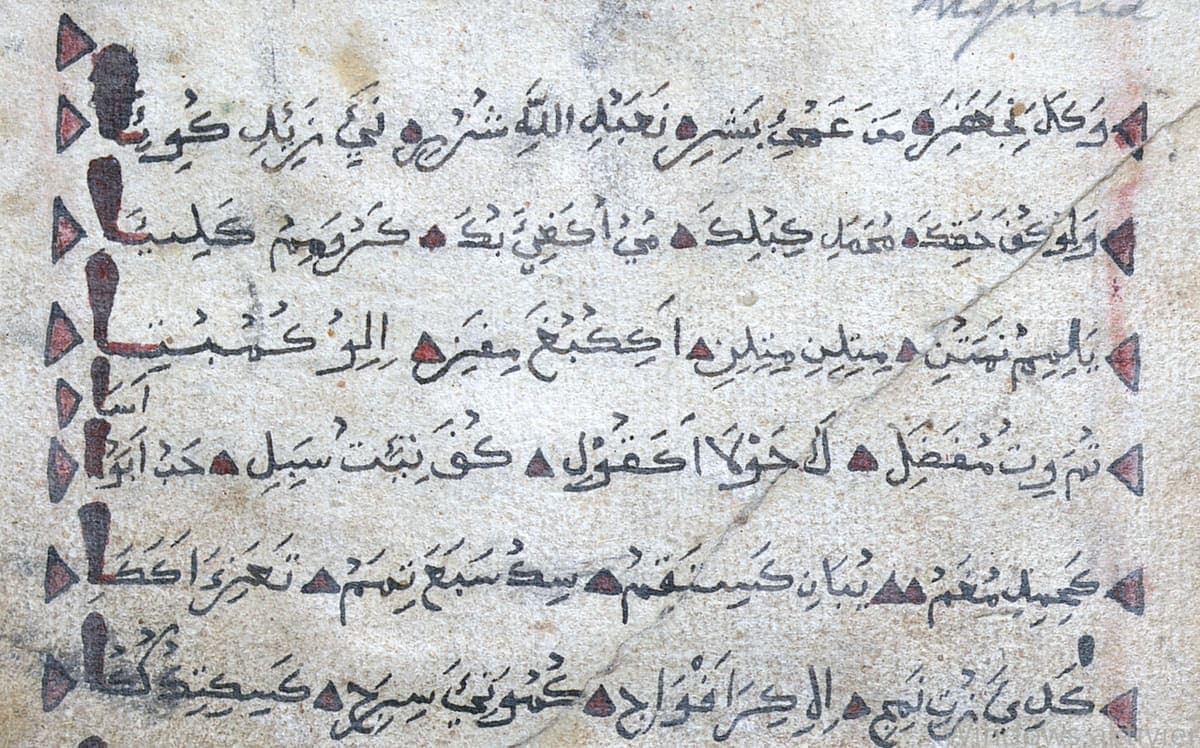
SOAS, University of London, 19th century · Source · Public domain
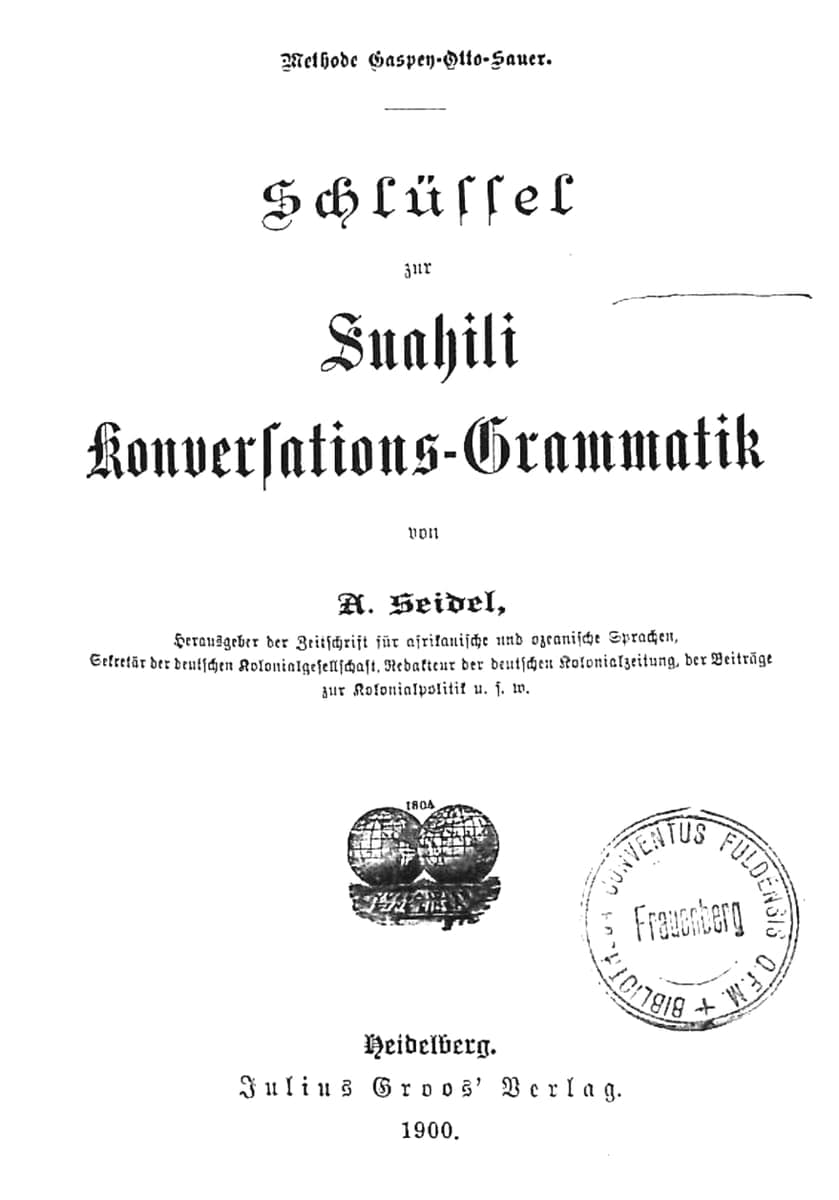
Source · Public domain · August Seidel
Evidano Transcription
Methode Gaspey-Otto-Sauer.
Schlüssel
zur
Suahili
Konversations-Grammatik
von
A. Seidel,
Herausgeber der Zeitschrift für afrikanische und ozeanische Sprachen,
Sekretär der deutschen Kolonialgesellschaft, Redakteur der deutschen Kolonialzeitung, der Beiträge
zur Kolonialpolitik u. s. w.
1804
CONVENTUS FULDENSIS
Frauenberg
BIBLIOTHECA O.F.M. +
Heidelberg.
Julius Groos' Verlag.
1900.
Generated by Evidano’s advanced model; not yet checked against a published edition.
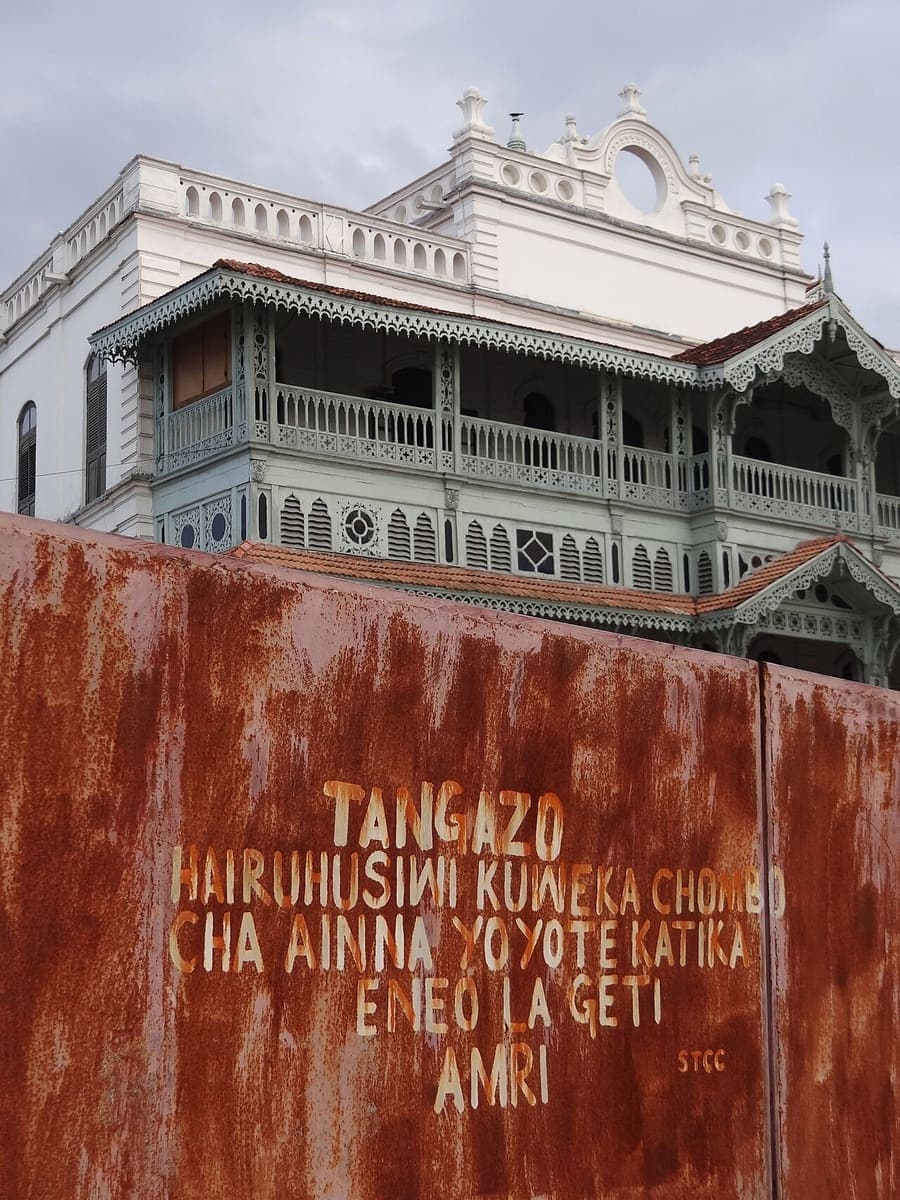
Source · CC BY-SA 2.0 · Adam Jones
Evidano Transcription
TANGAZO
HAIRUHUSIWI KUWEKA CHOMBO
CHA AINNA YOYOTE KATIKA
ENEO LA GETI
AMRI STCC
Generated by Evidano’s advanced model; not yet checked against a published edition.
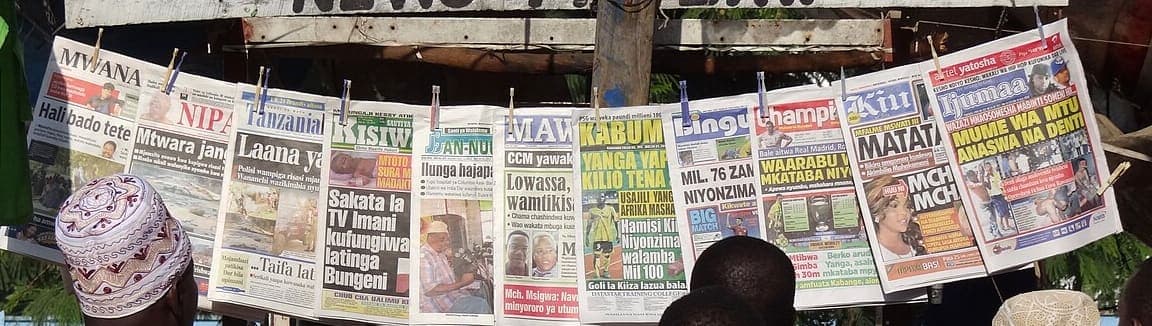
Evidano Transcription
MWANA
Hali bado tete
NIPA
Mtwara jang
Tanzania
Laana ya
Polisi wampiga risasi mjan
Wananchi wazikimbia nyu
...Taifa lat
KISIW
MTOTO
SURA M
MADAKT
Sakata la
TV Imani
kufungiwa
latinga
Bungeni
AN-NU
Ilunga hajap
MAW
CCM yawak
Lowassa,
wamtikis
Chama chashindwa kuw
Wao wakata mbuga kus
Mch. Msigwa: Nav
minyororo ya utum
KABUM
YANGA YAP
KILIO TENA
USAJILI YANG
AFRIKA MASHA
Hamisi Ki
Niyonzima
walamba
Mil 100
Goli la Kiiza lazua bala
Bingu
MIL. 76 ZAN
NIYONZIMA
BIG MATCH
Champ
Bale aitwa Real Madrid, Ro
WAARABU V
MKATABA NIY
Mtibwa
Simba
h 30m
Berko arud
Yanga, asai
mkataba mp
amfuata Kabange, alon
Kiu
MFALME MSWATI III[?]
MATATA
MCH
MCH
airtel yatosha
Ijumaa
WAZAZI MNAOSOMESHA MABINTI SOMENI H
MUME WA MTU
ANASWA NA DENTI
Generated by Evidano’s advanced model; not yet checked against a published edition.
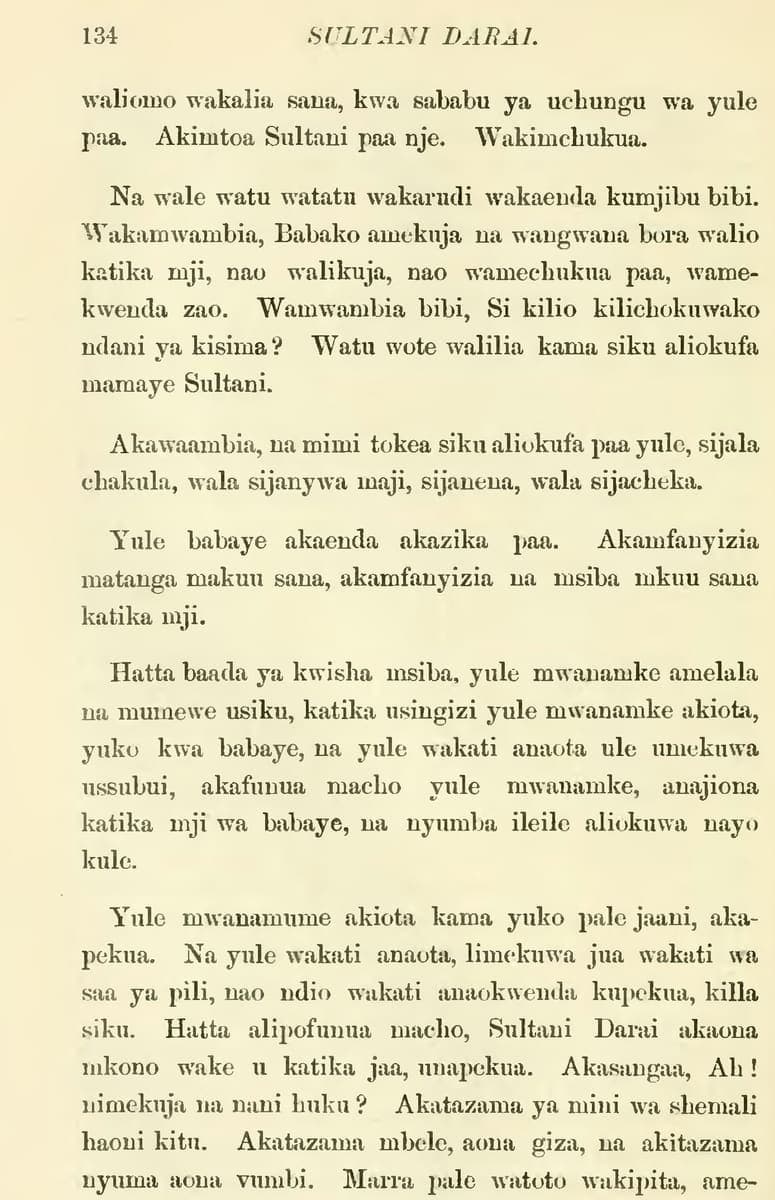
Bell and Daldy, London, 1870 · Source · Public domain
Evidano Transcription
The six paragraphs of the page body, from the sentence carried over from the preceding page to the word left half-printed at the foot. Taken from the proofread text of this exact page (pagequality level 3) on the multilingual Wikisource. The running head "134 SULTANI DARAI." is header markup there and is not repeated in the text; each paragraph is given as one line rather than following the printed line breaks, and the hyphenated word split at the page turn is left as the printed "ame-".
waliomo wakalia sana, kwa sababu ya uchungu wa yule paa. Akimtoa Sultani paa nje. Wakimchukua.
Na wale watu watatu wakarudi wakaenda kumjibu bibi. Wakamwambia, Babako amekuja na wangwana bora walio katika mji, nao walikuja, nao wamechukua paa, wamekwenda zao. Wamwambia bibi, Si kilio kilichokuwako ndani ya kisima? Watu wote walilia kama siku aliokufa mamaye Sultani.
Akawaambia, na mimi tokea siku aliokufa paa yule, sijala chakula, wala sijanywa maji, sijanena, wala sijacheka.
Yule babaye akaenda akazika paa. Akamfanyizia matanga makuu sana, akamfanyizia na msiba mkuu sana katika mji.
Hatta baada ya kwisha msiba, yule mwanamke amelala na mumewe usiku, katika usingizi yule mwanamke akiota, yuko kwa babaye, na yule wakati anaota ule umekuwa ussubui, akafunua macho yule mwanamke, anajiona katika mji wa babaye, na nyumba ileile aliokuwa nayo kule.
Yule mwanamume akiota kama yuko pale jaani, akapekua. Na yule wakati anaota, limekuwa jua wakati wa saa ya pili, nao ndio wakati anaokwenda kupekua, killa siku. Hatta alipofunua macho, Sultani Darai akaona mkono wake u katika jaa, unapekua. Akasangaa, Ah! nimekuja na nani huku? Akatazama ya mini wa shemali haoni kitu. Akatazama mbele, aona giza, na akitazama nyuma aona vumbi. Marra pale watoto wakipita, ame-
Source: Page:Swahili tales.djvu/154, via Wikisource (Public domain).
Ajami verse, colonial grammars, and a spelling settled by committee
Ajami — Arabic script adapted to write a language other than Arabic — carried Swahili poetry and scholarship for at least three centuries before the Latin alphabet took over. Manuscripts from Lamu, Pate, Mombasa and Zanzibar record the classical utenzi (or utendi) verse form in four-line stanzas, each line closed with a small red or black diamond or triangle, and scribes adapted the Arabic letters for sounds Swahili has and Arabic does not: prenasalised consonants such as mb and nd, implosive b and d, and a five-vowel system with no long-short distinction to mark. The poet Mwana Kupona binti Mshamu, remembered for her Utendi wa Mwana Kupona of advice to a daughter, is among the classical voices preserved this way; much of what survives was copied in the early twentieth century by the Lamu scribe Muhammad Kijuma, whose hand fills many of the Ajami manuscripts now held at SOAS and the British Library.
German East Africa, administered from 1885 to 1918, needed Swahili for government and mission work, and colonial officials produced grammars and phrasebooks in Latin transliteration — August Seidel’s Schlüssel zur Suaheli-Konversationsgrammatik, published at Heidelberg in 1900, is one of many that taught the language to German speakers while still acknowledging the coast’s own Arabic-script tradition in its introduction. After Britain took over Tanganyika as a League of Nations mandate, the Inter-Territorial Language (Swahili) Committee met at Zanzibar in 1930 and fixed a single standard, based on the Kiunguja dialect of Zanzibar Town, that settled the Latin-script spelling still taught today.
Swahili is now written almost everywhere in that standardised Latin script — in newspapers, government forms and street signage across Kenya, Tanzania, Uganda and beyond — while Ajami survives mainly in Quranic schools and among a shrinking number of religious scribes on the coast. A single research collection can therefore hold a scribe’s Ajami utenzi, a German colonial phrasebook predating the 1930 standard, and a modern municipal notice, each needing to be read on its own terms rather than one.
Why ordinary OCR struggles here
An Arabic script stretched over a Bantu language
Swahili’s prenasalised consonants, implosive b and d, and five plain vowels have no dedicated letters in classical Arabic orthography, so scribes improvised spellings that vary from one manuscript, and sometimes one line, to the next.
Verse-end marks a prose-trained model will miss
Utenzi manuscripts close every line with a small triangular or diamond mark and group lines into four-line stanzas. A model trained on Arabic prose has no reason to expect this punctuation and can drop or misplace it.
Colonial transliteration that predates the 1930 standard
German colonial-era grammars and early administrative Swahili used spelling not yet fixed by the 1930 Zanzibar standardisation, so a name or word can look like an error to a model trained only on today’s Standard Swahili.
Worn paper and idiosyncratic scribal hands
Ajami manuscripts copied by hand over generations show heavy wear, uneven letter spacing and personal abbreviations that a generic Arabic-script recogniser, tuned to printed Qur'ans or newspapers, is not built to expect.
Who works with this material
Swahili manuscript and Ajami philology projects
SOAS, the British Library and Lamu- or Zanzibar-based digitisation programmes hold Ajami utenzi and religious manuscripts by named and anonymous scribes. They need a diplomatic transcription that keeps Arabic-script spelling and verse-end marks rather than silently converting straight to Latin Swahili.
Coastal and Islamic historians of East Africa
Reading Ajami correspondence, waqf deeds and religious rulings from Lamu, Mombasa and Zanzibar means keeping period spelling and Arabic loanwords distinct from later standardised Swahili, so a date or a legal term is not read back into the modern form.
Colonial and missionary-record researchers
German East African administrative files, mission diaries and pre-1930 Swahili grammars need their pre-standard spelling reproduced as printed, so word forms can be dated and compared against the 1930 Zanzibar standard that replaced them.
Press archives and language-planning bodies
Tanzanian and Kenyan Swahili-language newspaper archives, government gazettes and heritage signage projects need modern transcription that keeps headlines, bylines and captions distinguishable from body text at volume.
Getting the best transcription
Name the script before anything else
Telling the model a page is Swahili in Ajami keeps it reading Bantu prenasalised and implosive sounds correctly, rather than forcing the text into Arabic vocabulary the way a generic Arabic-script reading would.
Ask for verse-end marks and stanzas to be kept
For utenzi poetry, request that the diamond or triangle marks and the four-line stanza grouping are preserved in the output, since they carry the structure of the poem, not just decoration.
Flag pre-1930 material by date
Telling the model a grammar or document predates the 1930 Zanzibar standardisation keeps its older spelling intact instead of silently correcting it to modern Standard Swahili.
Start a worn manuscript on its clearest leaf
Condition varies leaf to leaf in a hand-copied Ajami manuscript. Confirm the model has settled on the scribe’s hand on a clean page before working through faded or damaged ones.
Frequently asked questions
- Can it read Swahili written in Ajami (Arabic script)?
- Yes. It reads Ajami as adapted Arabic script for a Bantu language, handling the prenasalised and implosive sounds Swahili has and Arabic does not, rather than forcing the text into Arabic vocabulary.
- Does it recognise the verse-end marks in utenzi poetry manuscripts?
- Yes, the small triangular or diamond marks that close each line of an utenzi are read as structural markers, and the four-line stanza pattern can be kept in the output.
- Will pre-1930 Swahili spelling be corrected to the modern standard automatically?
- No, unless you ask for that. German colonial-era and other pre-standardisation spellings are reproduced as printed, with a modernised version available as a separate output if you want one.
- Can it tell Ajami Swahili apart from Arabic itself?
- Yes, Swahili vocabulary and grammar are recognised even when written in the Arabic script, rather than the text being read as though it were Arabic.
- Does it handle German-language colonial material alongside Swahili?
- Yes, German and Swahili passages are each transcribed in their own language rather than merged, which is useful for colonial-era grammars and mission records that mix the two.
- Can it read hand-painted or stencilled Swahili signage?
- Yes, uneven stencilled or hand-painted lettering on worn or rusted surfaces is read the same way as printed text, with damaged or missing letters flagged rather than guessed at.
Related scripts and pages
Transcribe your Swahili material
Upload an Ajami manuscript, a colonial-era grammar, a photograph of signage or a page of Swahili print, and check the reading line by line before you export it.