
Somali
Read Somali in whichever of its three scripts it was written
Somali had no official script until 1972, so one family’s papers can hold a Quranic-school note in Arabic-script Wadaad’s writing, a mid-century pamphlet in the home-grown Osmanya alphabet, and a modern form in the Latin script that finally won out. Evidano reads each on its own terms rather than assuming the Latin alphabet is the only one that matters, keeping the letterforms and spelling of whatever is in front of it.
Sample pages
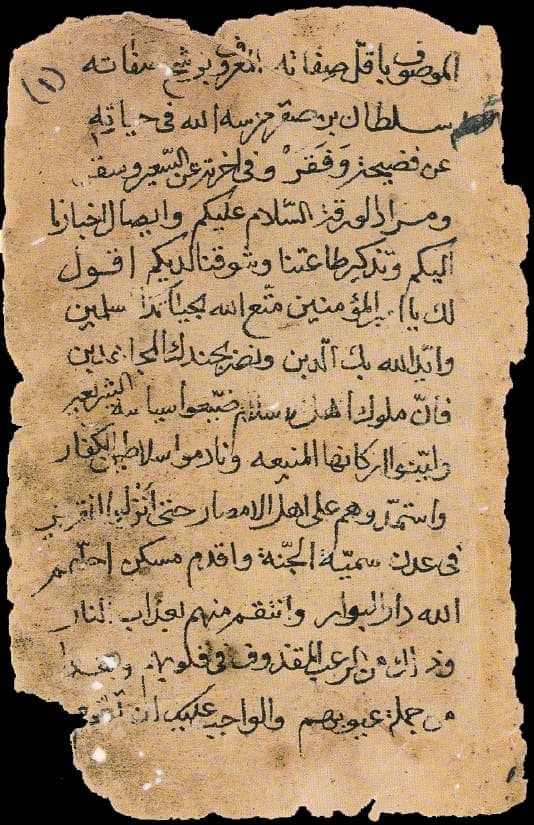
Source · Public domain · Sultan bin Muhammad Al-Qasimi
Evidano Transcription
الموصوف باقل صفاته المعروف بشين سفاته (1)
سلطان بن صقر[?] حرسه الله في حياته
عن فضيحة وفقر وفي اخرته عن السعير وسقر
ومراد الورقة السلام عليكم وايصال اخبارنا
اليكم وتذكير طاعتنا وشوقنا لديكم اقول
لك يا امير المؤمنين متع الله بحياتك المسلمين
وايد الله بك الدين ونصر بجندك المجاهدين
فان ملوك اهل سيلع[?] ضيعوا سياسة الشريعه
وابادوا[?] اركانها المنيعه ونادوا سلاطين الكفار
واستمدوهم على اهل الامصار حتى انزلوا الفرنج
في عدن سمية الجنة واقدم مسكن احلهم
الله دار البوار وانتقم منهم بعذاب النار
وذلك من الرعب المقذوف في قلوبهم وعدوا[?]
من جملة عيوبهم والواجب عليك ان [illegible] [cut off]
Generated by Evidano’s advanced model; not yet checked against a published edition.
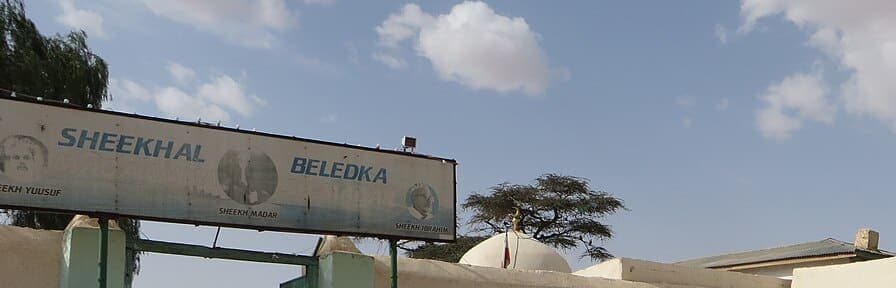
African Studies Centre, Leiden, 19 July 2019 · Source · CC BY-SA 4.0 · Gerard van de Bruinhorst
Evidano Transcription
SHEEKHAL BELEDKA
SHEEKH YUUSUF SHEEKH MADAR SHEEKH IBRAHIM
Generated by Evidano’s advanced model; not yet checked against a published edition.
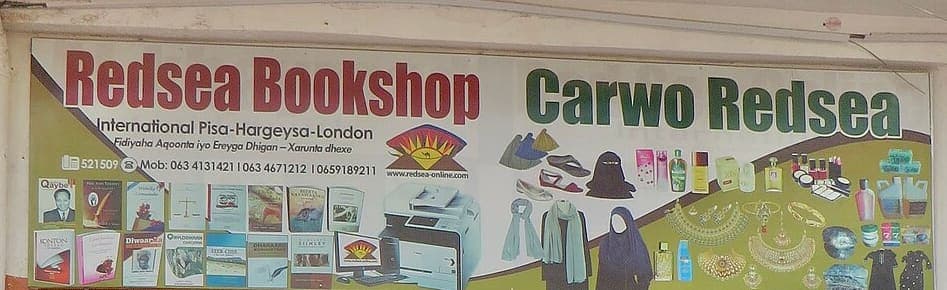
African Studies Centre, Leiden, 17 July 2019 · Source · CC BY-SA 4.0 · Gerard van de Bruinhorst
Evidano Transcription
Left
Redsea Bookshop
International Pisa-Hargeysa-London
Fidiyaha Aqoonta iyo Ereyga Dhigan - Xarunta dhexe
521509 Mob: 063 4131421 | 063 4671212 | 0659189211
www.redsea-online.com
Right
Carwo Redsea
Generated by Evidano’s advanced model; not yet checked against a published edition.

African Studies Centre, Leiden, 22 July 2019 · Source · CC BY-SA 4.0 · Gerard van de Bruinhorst
Evidano Transcription
HARGEYSA INTERNATIONAL BOOK FAIR
Events
·HIBF·
12th
BANDHIGGA CAALAMIGA AH EE BUUGAAGTA HARGEYSA
HARGEYSA INTERNATIONAL BOOK FAIR معرض هرجيسا الدولي للكتاب ٢٠١٩
Theme of the year:
COEXISTENCE
Theme of the year:
COEXISTENCE
#HIBF2019
تحت عنوان التعايش
20-25 July 2019
Wadanoolaansho
Wadanoolaansho
Theme of the year:
COEXISTENCE
#HIBF2019
تحت عنوان التعايش
تحت عنوان التعايش
Generated by Evidano’s advanced model; not yet checked against a published edition.
No official script until 1972: three systems, one language
For most of its history Somali was spoken rather than routinely written, and where it was written before the 1970s, religious scholars and secular correspondents alike usually used Arabic letters informally adapted to Somali sounds — known as Wadaad’s writing, from wadaad, a religious teacher. It served Quranic annotation, personal correspondence, poetry notes and protective amulets rather than print or formal record-keeping, and because no standard ever fixed its spelling, letter choices varied from one scribe to the next. A letter of the late 1830s shows the other half of the picture: writing to Sheikh Sultan bin Saqr Al Qasimi of Ras al-Khaimah for help against a British blockade of Berbera, the Isaaq elders Sultan Farah Guled and Haji Ali wrote not in Somali but in high, rhymed Arabic, the register such correspondence took when it left the coast. The same schooling and the same cursive hand produced both, and it is only in the Somali-language material that a fluent Arabic reader has to work out which letters are standing in for sounds Arabic itself does not have.
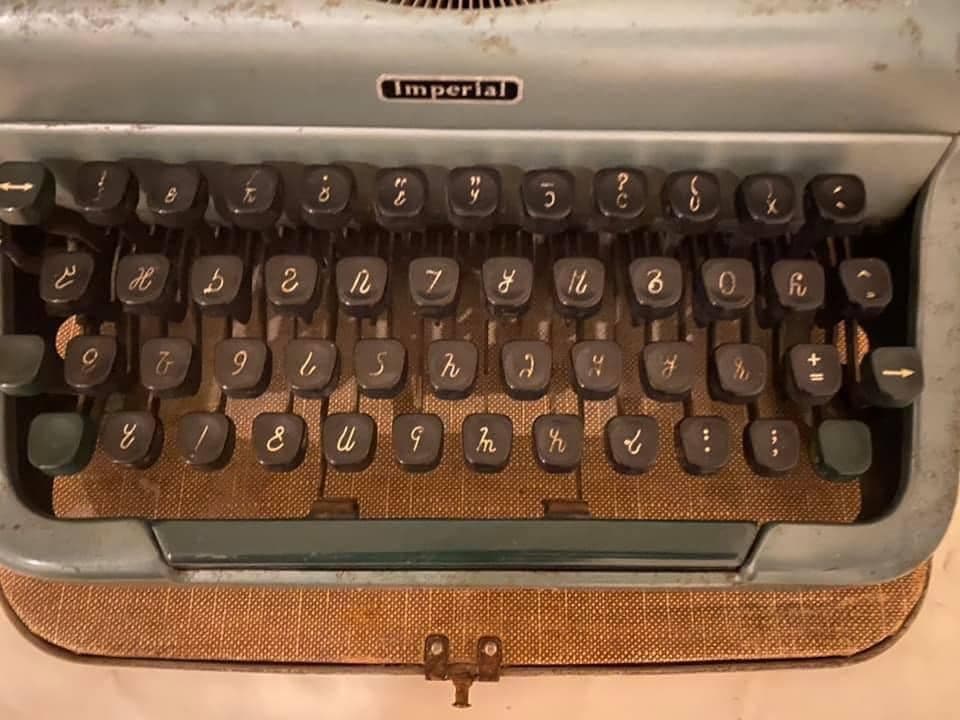
Around 1920–1922, Osman Yusuf Kenadid, of the Majeerteen sultanate’s ruling family, invented Osmanya, also called far Soomaali ("Somali writing"), a script built specifically for Somali’s own sounds and read left to right with its own digits. Promoted especially by his nephew Musa Haji Ismail Galal, it was taught in a handful of schools, used in a small number of publications, and even cut into the keys of purpose-built typewriters — but it never won government backing and stayed a minority practice against the far larger uses of Arabic and, increasingly, Latin script.
The "orthography question" was argued over for more than a decade after independence in 1960, with Arabic script, Osmanya and Latin script all proposed, before the Somali Language Committee under the Siad Barre government settled it by decree on 21 October 1972. The Latin-based system it adopted, worked out chiefly by Shire Jama Ahmed, uses c, x, dh and kh for sounds the plain Latin alphabet has no letters for, and doubles a vowel — aa, ee, ii, oo, uu — to mark length; every other script was barred from official use from that date. That standard is now the only script in ordinary or official use across Somalia and Somaliland, which is why a single research file can still hold Wadaad’s writing, Osmanya and Latin Somali side by side.
Why ordinary OCR struggles here
No two Wadaad’s writing texts spell things alike
Since Wadaad’s writing was never standardised, its Arabic letters were adapted to Somali sounds informally and inconsistently — the 1830s Isaaq letter to Ras al-Khaimah shown on this page uses conventions a reader fluent only in Arabic would not expect. A recogniser cannot rely on one fixed mapping and has to work out a scribe’s own conventions from the page in front of it.
Osmanya letters that resemble no other script
Osmanya was invented from scratch rather than adapted from an existing alphabet, so a generic recogniser trained on Latin, Arabic or Brahmic scripts has no model for its shapes at all, and may not even register that text is present.
The same sounds, written three different ways
Somali’s pharyngeal consonants and its short and long vowels are represented differently in Wadaad’s writing, in Osmanya, and in the 1972 Latin standard — and older colonial or missionary Latin transcriptions add yet more conventions again, all easy to conflate.
Undated, uncatalogued, informally kept material
Because neither Wadaad’s writing nor Osmanya was ever official, most surviving examples are personal papers, single sheets or objects rather than catalogued archive holdings, usually without the institutional metadata a formal manuscript collection would carry.
Who works with this material
Somali script-history and orthography researchers
Documenting the 1970s standardisation debate and what survives of Wadaad’s writing and Osmanya requires each system to be transcribed on its own terms, so no script is silently normalised into another before it can be studied.
Genealogists and diaspora family-history projects
Family papers — an older relative’s Quranic notebook, a personal letter — can turn up in any of the three systems. Family historians need a reading that identifies which script a document is in before it can be dated or attributed to a person.
Heritage bodies and language-planning institutions
Cultural centres and language academies cataloguing Somali-language signage, publications and oral-history transcripts need consistent modern transcription that follows the 1972 standard’s spelling exactly, letter for letter.
Quranic-school and Islamic education researchers
Reading Wadaad’s writing on slates, notebooks and amulets used in traditional dugsi schools means recognising informally adapted Arabic letters rather than expecting the conventions of standard Arabic or Persian.
Getting the best transcription
Identify the script before transcribing
State plainly whether a page is in Wadaad’s Arabic-script writing, Osmanya, or Latin Somali. The three should never be assumed from a glance, since a page in poor light can superficially resemble more than one.
For Wadaad’s writing, expect improvised spelling
Tell the model there is no fixed standard to check against, so an unusual letter choice should be transcribed as written rather than corrected to expected Arabic or modern Somali forms.
For Osmanya, ask for it by name
Because Osmanya resembles no other script, request an Osmanya reading explicitly rather than a generic response, and ask for a Latin transliteration as a separate step if you need one for searching.
For Latin-script Somali, keep the 1972 letters intact
C, x, dh, kh and doubled vowels are correct Somali spelling, not errors, and should never be silently corrected to plain c, h, d or single vowels.
Frequently asked questions
- How can I tell which of Somali’s three scripts a document uses?
- Wadaad’s writing and Arabic share the same letterforms running right to left; Osmanya has its own rounded letters found in no other script; Latin Somali uses the familiar alphabet with doubled vowels and the letters c, x and dh. If you are unsure, upload the image and ask for the script to be identified first.
- Does it recognise the Osmanya alphabet?
- Yes, Osmanya’s letters are read as their own script rather than reported as unrecognised marks, and a Latin transliteration can be produced alongside the Osmanya reading if you want one.
- Will Wadaad’s writing be forced into standard Arabic spelling?
- No. Since Wadaad’s writing was never standardised, letter choices are transcribed as they appear on the page rather than corrected to expected Arabic or modern Somali forms.
- Are the doubled vowels and special letters in modern Somali kept as written?
- Yes, aa, ee, ii, oo and uu, and the letters c, x, dh and kh fixed by the 1972 orthography, are transcribed exactly as printed rather than simplified.
- Can it read a document that mixes more than one Somali script?
- Yes, each script is identified and transcribed separately, which matters for archives where a single file might combine, for example, a Latin-script cover note with an older Wadaad’s-writing letter inside it.
- Does the material need to be dated or catalogued to work?
- No. Undated personal papers, single sheets and informally kept objects are read the same way as catalogued manuscripts; any dating has to come from context, which the transcription can help establish.
Related scripts and pages
Transcribe your Somali material
Upload a page of Wadaad’s writing, an Osmanya document or object, or a modern Latin-script form or sign, and check the Somali reading line by line before you export it.