
Spanish · c. 700–1200
Read Visigothic script from the Iberian scriptoria
Visigothic minuscule writes a like u, hides the sound of ti inside a ligature, and dates every charter by an era that runs thirty-eight years ahead of the Christian year. Evidano transcribes the codices of San Millán, León and Toledo and the cursive charters of the northern kingdoms line by line, expands only what you tell it to expand, and lets you check each reading against the folio.
Sample pages
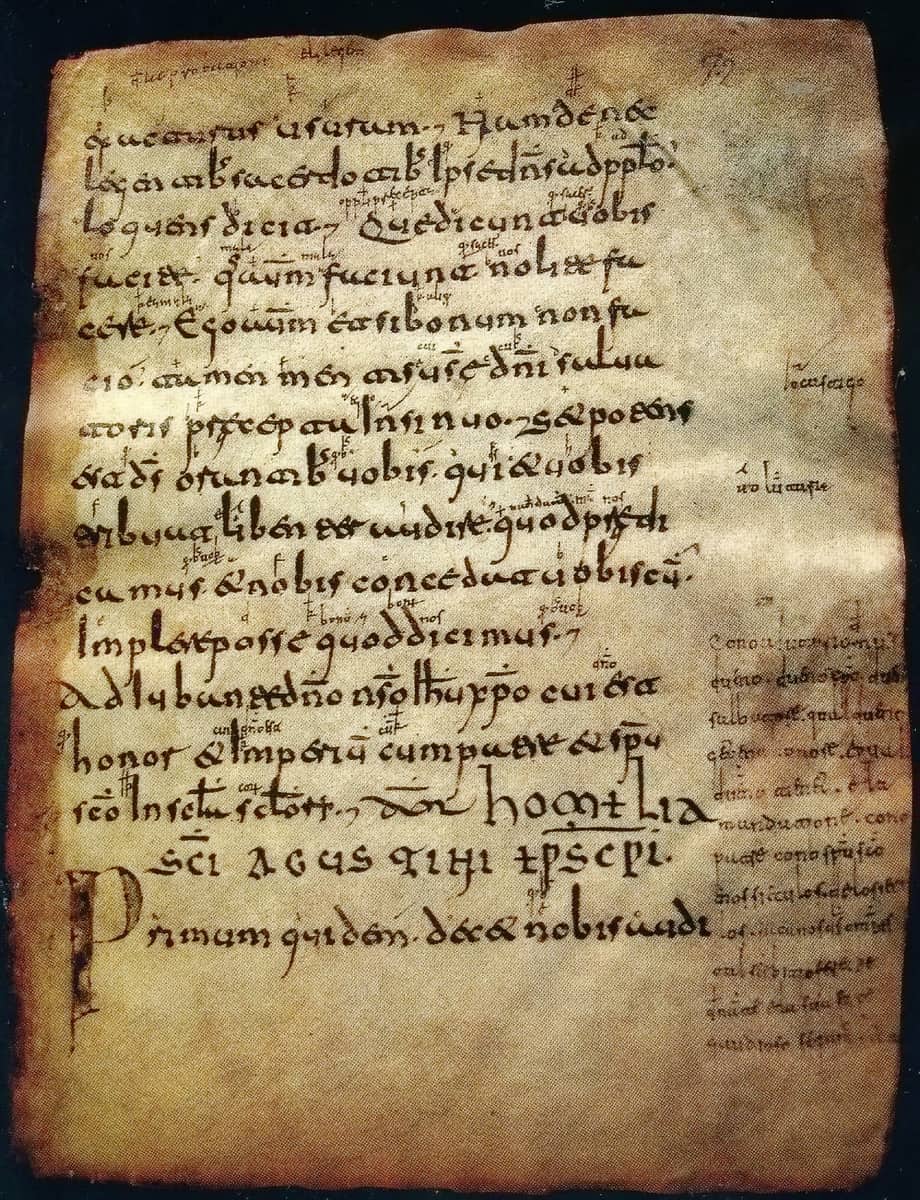
Real Academia de la Historia, Madrid, Cod. 60, f. 72r, c. 1000 · Source · Public domain
Evidano Transcription
The twelve-line Romance gloss in the lower right margin only, in the normalised reading printed on Spanish Wikisource: word division and capitals are the editor’s, the interlinear Latin and Romance glosses and the Latin homily text are not included.
Con o aiutorio de nuestro
dueno Christo, dueno
salbatore, qual dueno
get ena honore et qual
duenno tienet ela
mandatione con o
patre con o spiritu sancto
en os sieculos de lo siecu
los. Facanos Deus Omnipotes
tal serbitio fere ke
denante ela sua face
gaudioso segamus. Amen.
Source: Glosas Emilianenses, via Wikisource (Spanish) (Public domain).
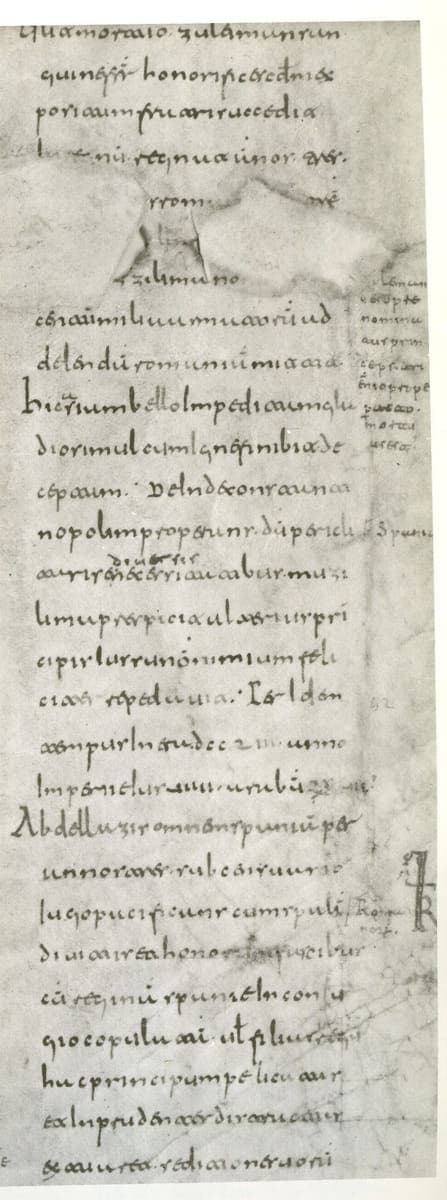
British Library, Egerton MS 1934, f. 2r, c. 750–900 · Source · Public domain
Evidano Transcription
The right-hand column only, which carries the end of chapter 78 and the start of chapter 79 in Mommsen’s numbering, from the death of Walid to the rule of ʿAbd al-ʿAzīz. Given as Mommsen’s edited text with his sentence punctuation rather than the manuscript line breaks; the square brackets he uses for words lost in the hole of this leaf (his manuscript A) have been removed and the OCR errors of the digitised volume corrected against the folio. The column ends at “seditione”; the rest of the chapter is supplied in the edition from other manuscripts. The left-hand column and the marginal notes are not included.
Ulit mortuo Zuleiman sanguine frater honorifice secundum expositum fratri succedit in regnum. Regnat annos tres.
hic infestus Romanie fratrem non dissimili matre progenitum Muzilima nomine cum centum milia armatorum ad delendum Romaniam mittit.
hic Asiam bello impeditam gladio simul cum igne finibit deceptam.
deinde Constantinopolim properans, dum periclitari se diversis necessitatibus Muzilima prespicit, ulterius principis iussu non nimium feliciter repedavit.
Per idem tempus in era DCCLIII, anno imperii eius VIIII, Arabum LXLVII, Abdellazis omnem Spaniam per annos tres sub censuario iugo pacificans, cum Spalim divitiis et honorum fascibus cum reginam Spanie in coniugio copulatam vel filias regum hac principum pelicatas et inprudenter distractas extuaret, seditione
Source: Continuatio Hispana a. DCCLIV, ed. Theodor Mommsen, MGH Auctores antiquissimi XI, Chronica minora II (Berlin, 1894), pp. 355–356, via Internet Archive (Public domain).
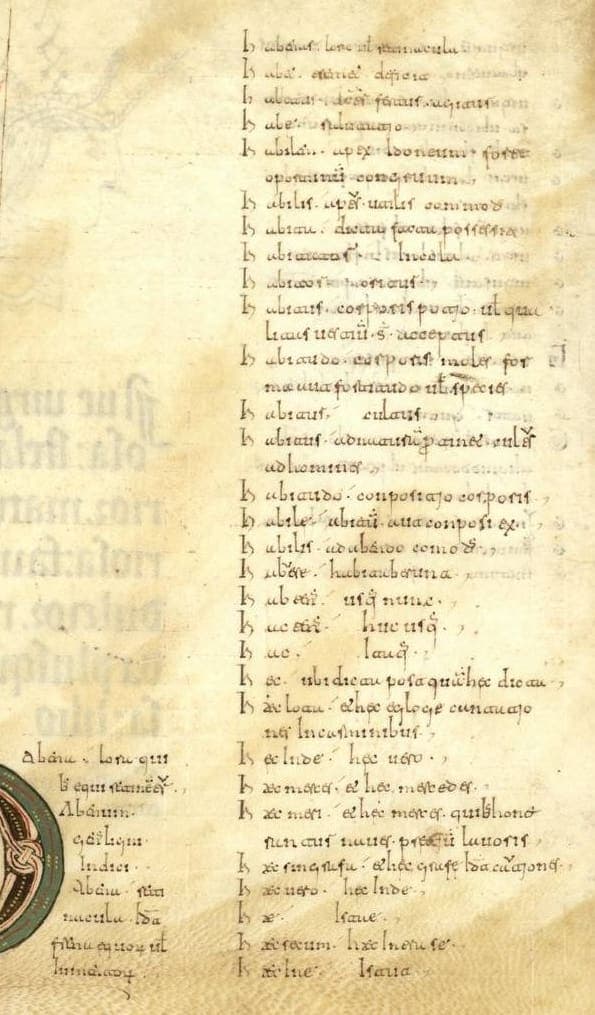
Real Academia de la Historia, Madrid, Cod. 46, f. 72v, 964 · Source · Public domain
Evidano Transcription
Abanu[?] . [illegible] qui
[illegible] equi [illegible]
Abanin[?] .
ge[n]us ligni .
Indici .
Abanu[?] . [illegible]
[illegible] . [illegible]
filiu[?] equor[um] ut
[illegible]
H aban[?] . lene ut [illegible]
H aba[?] . [illegible]
H abeat[ur][?] . id e[st] factus . [illegible]
H abe . [illegible]
H abilia . apta[?] . idoneum . forte
oportunu[m] . congruum .
H abilis . apt[us] . ualens omnimod[is][?]
H abitu[?] . dictu[m] factu[m] possess[illegible]
H abitua[illegible] . [illegible]
H abit[illegible] . [illegible]
H abitus . corporis [illegible] . u[e]l qua
litas uestiu[m] . s[iue] . acceptus
H abitudo . corporis moles . for
ma uita fortitudo u[e]l species
H abita[illegible] . culta[illegible]
H abitans . adiuuans [illegible] annos . cult[illegible]
ad homines
H abitudo . conpositio corporis
H abile . abitu[m] . apta conposit[a] ex
H abilis . [illegible] comod[illegible]
H abere . habitauerunt[?]
H abeten[us][?] . usq[ue] nunc .
H ucten[us][?] . huc usq[ue] .
H uc . [illegible]
H ec . ubi [illegible] posita [illegible] hec [illegible]
H ecloa[illegible] . [illegible] hec egloge [illegible]
na in carminibus .
H e[illegible] . hec uero .
H ec merce[?] . id hec mercedes .
H ec mer[illegible] . id hec mer[illegible] . quib[us] hono
rant[ur] naues . [illegible] lauoris[?]
H ec sing[illegible] . id hec [illegible]
H ec uero . hec inde .
H ec . [illegible]
H ec secum . hec [illegible]
H ec[illegible] . [illegible]
Generated by Evidano’s advanced model; not yet checked against a published edition.
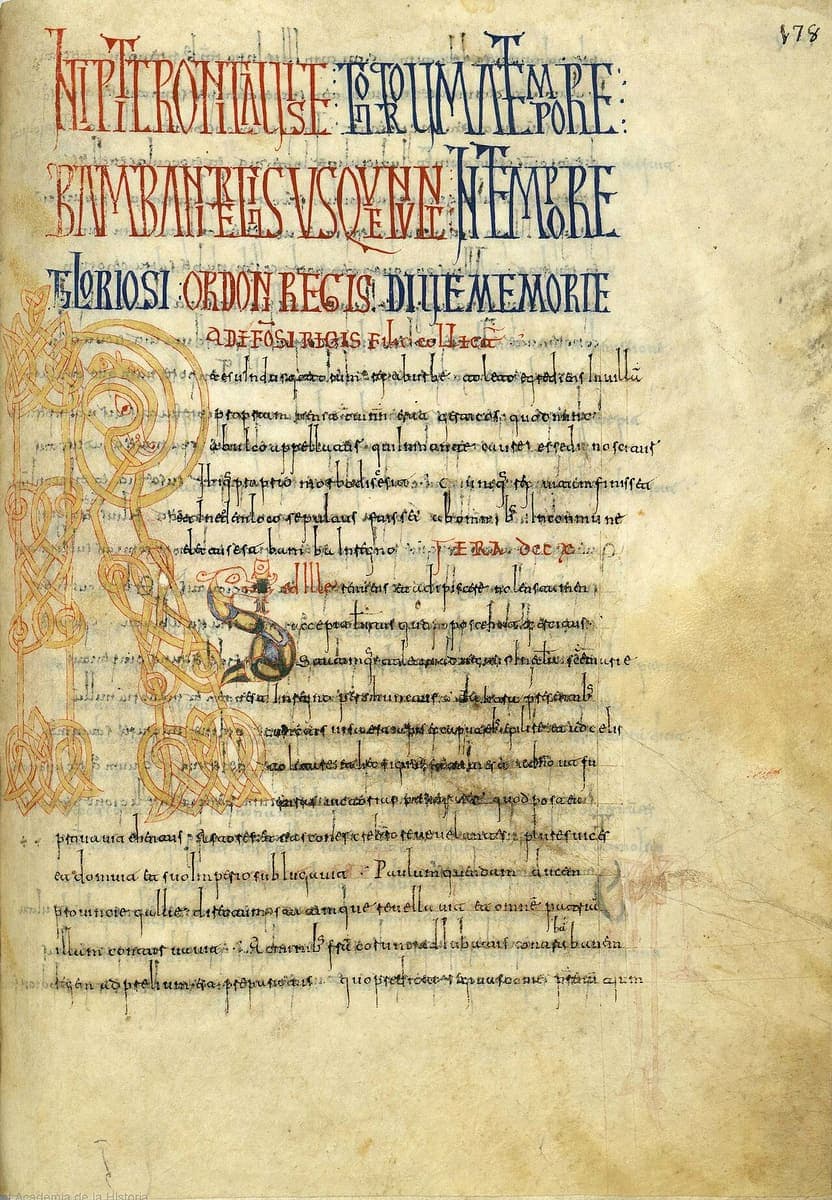
Real Academia de la Historia, Madrid, Cod. 78, f. 178r, c. 990 · Source · Public domain
Evidano Transcription
178
INCIPIT CRONICA VISEGOTORUM[?] : A TEMPORE :
BAMBANI REGIS USQUE NUNC IN TEMPORE
GLORIOSI ORDONI REGIS DIVE MEMORIE
ADEFONSI REGIS FILI[?] COLLECTA
[lines 1–6 of the text illegible] ERA DCCX
[remaining lines illegible]
Generated by Evidano’s advanced model; not yet checked against a published edition.
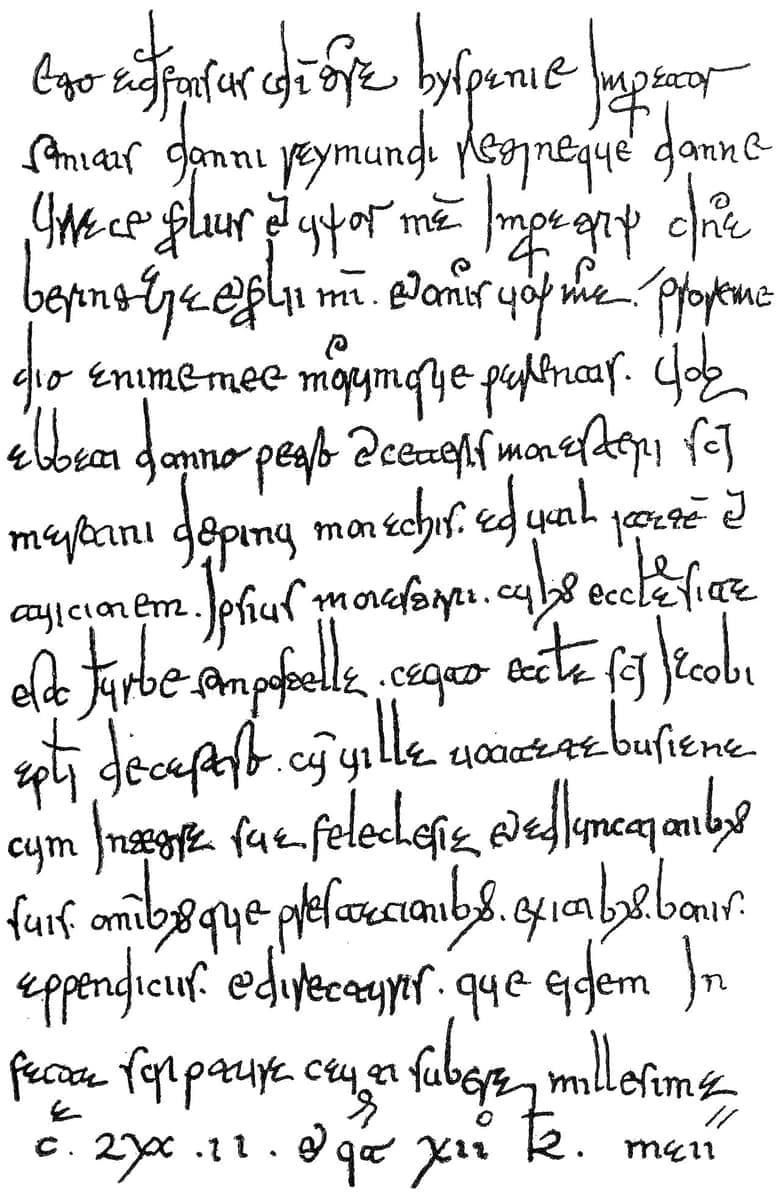
Muñoz y Rivero, Paleografía visigoda, plate XXXIX (facsimile), April 1134 (facsimile 1919) · Source · Public domain · Facsimile plate from Jesús Muñoz y Rivero, Paleografía visigoda (Madrid, 1919)
Evidano Transcription
The whole plate, in Muñoz y Rivero’s own reading of the fragment he reproduced: a normalised transcription that expands every abbreviation silently, prints j for consonantal i (cujus, Jacobi) and adds modern punctuation. The plate breaks off after “que eidem in” and resumes with the dating clause; that gap belongs to the facsimile, not to the parchment.
Ego Adefonsus Dei gratia Hispanie imperator comitis domni Raymundi regineque domne Urrace filius et uxor mea imperatrix domina Beringaria et filii mei et omnis vox mea pro remedio anime mee meorumque parentis. Vobis abbati domno Petro et ceteris monasterii sancti Martini de Pinu monachis, ad utilitatem et tuicionem ipsius monasterii cujus ecclesia sita est in urbe Compostella, cauto ecclesia sancti Jacobi apostoli de castro cum villa vocitata Busiana cum integra sua feleclesia et adjunctionibus suis omnibusque prestacionibus, exitibus, bonis appendiciis et directuris que eidem in
Facta scriptura cauti sub era millesima CLXXII et quot XII Kalendas Maii.
Source: Jesús Muñoz y Rivero, Paleografía visigoda (Madrid, 1919), p. 156, transcription of plate XXXIX, via Internet Archive (Public domain).
What Visigothic writing looks like
From the eighth century until the early twelfth, the Christian north of the Iberian Peninsula and the Mozarabic communities of the south wrote in a national script descended from late Roman cursive rather than from the Caroline minuscule of the Frankish world. Palaeographers call it Visigothic, although almost everything that survives postdates the Visigothic kingdom: the Beatus commentaries, the Bibles of León, the glossaries and homiliaries of San Millán and Silos, and thousands of charters kept in monastic archives. It exists as a calligraphic book hand with short, rounded bodies and as a cursive charter hand whose letters lean, stretch and link. The Council of Burgos in 1080 and the arrival of Cluniac monks brought in Caroline minuscule, the letra francesa, and by the 1130s only conservative Galician and Leonese scribes, and the Mozarabs of Toledo, still wrote the old way.
The letters that mark the script are few but decisive. The a is open at the top and easily read as u; the g looks like a q with a long tail, or like the figure 9; the t carries a bowl to the left of its stem, and when t stands before a vowel in an assibilated syllable the scribe uses a distinct ti ligature that a Caroline-trained eye reads as ci or gi. The z drops a tail below the line, and that tailed z, used for the sound of Romance ç, is the ancestor of the cedilla. Tall I opens words and stands for the consonant, e climbs into ligatures with r, s and t, and the round s of the book hand alternates with the long s of the cursive.
Abbreviation follows its own conventions. A wavy stroke over a vowel drops a nasal; per is a p with a bar through the descender; -us and -is are shown by hooks and by the sign ꝸ; the nomina sacra and words such as noster and omnis are contracted under a bar, and superscript vowels stand for whole syllables. Charters open with a chrismon, the monogram of Christ drawn as a large sign, and close with a dating clause in the Hispanic era, where the X may carry a tail that makes it worth forty, followed by confirmations and witness signa in crosses and personal monograms. Book pages run in two columns of thirty or so lines, with headings in mixed uncial and capital letters, often nested one inside another and alternating red and blue, and later readers added interlinear and marginal glosses in Latin, Romance and, at San Millán, Basque.
Why ordinary OCR struggles here
a, u and the ti ligature
Because the Visigothic a is open, sequences such as aut, au and ua become a run of near-identical strokes, and the assibilated ti ligature resembles no letter that a Latin OCR model has seen. Engines trained on Caroline hands or on print resolve them by guessing from a dictionary, which silently rewrites the Latin.
Abbreviations that look like letters
The ꝸ sign for -us, the hooked -is, the barred p for per and the superscript vowels of the cursive sit inside the word rather than above it, so a reader must recognise them before expanding them. Generic OCR treats them as stray letters or drops them, and the case endings that carry the syntax vanish.
Display capitals and glosses on the same page
A rubric in nested capitals across the width of the page, a lacework initial that fills a column, interlinear glosses in a smaller cursive and marginal notes by a later hand all compete with the main text. A transcription is only useful if it says which is which and keeps the reading order of each.
Cursive charters and their dates
In the documentary hand ascenders stretch, letters join in long ligatures and the whole line slopes. The dating clause mixes Roman calendar days, the era count and abbreviated numerals, and an error of one stroke moves a charter by decades. Witness lists with crosses and monograms add signs that are not text at all.
Who works with this material
Editors of cartularies and monastic archives
Diplomatic editions of the charters of Sahagún, Celanova, San Millán or Santo Toribio depend on a first transcription that keeps the scribe’s spelling, marks expansions and separates the notarial subscription from the body of the act. Line-true output lets the editor collate against the older printed collections.
Historians of early Romance
The glosses of San Millán and Silos, the Nodicia de kesos and the vernacular words buried inside Latin charters are the earliest evidence for Castilian, Leonese and Navarro-Aragonese. Linguists need the exact letters, including the tailed z and the open a, rather than a normalised Latin.
Liturgists and Mozarabic studies
The Old Hispanic rite survives chiefly in Visigothic-script antiphoners, orationals and homiliaries. Reconstructing a formulary means matching hundreds of rubrics and incipits across manuscripts, which goes far faster once every page is searchable text.
Teachers of Spanish palaeography
Courses on letra visigótica still use the plates of Muñoz y Rivero. A transcription placed beside a modern photograph gives students an answer key for every ligature and lets a class compare a Riojan book hand with a Galician charter hand.
Getting the best transcription
Name the script and the type of hand
Say whether the page is a book minuscule or a documentary cursive, and where it was written if you know, because the Leonese, Riojan, Toledan and Galician forms of g, t and the ti ligature differ. The model then reads the strokes against the right alphabet instead of a generic medieval one.
Fix the expansion and glyph rules
Choose whether ꝸ, the barred p and the nasal stroke are expanded silently, expanded in brackets or left as signs, and whether the tailed z is to be printed as z or ç. State that u and v, i and j should follow the manuscript.
Ask for the layout to be labelled
Have rubrics, interlinear glosses and marginalia returned as separate blocks, in the order they occur, with the main text line by line. For a charter, ask for the chrismon, the dating clause and each subscription to be marked so the diplomatic structure stays visible.
Check the dating clause and numerals first
Before accepting a batch of charters, verify the era, the calendar day and the regnal notes on one document and compare them with the printed catalogue. If the model reads the crossed X as forty and the Kalends correctly there, the rest of the archive will follow.
Further reading on this hand
The palaeography guides the in-app selector points to for this domain, if you want to check a transcription against the standard references.
- Spanish Handwriting History
This Brigham Young University guide outlines the major historical handwriting systems used for Spanish and its Iberian predecessors. It describes Visigothic writing, its chronological range, and characteristic forms including the Visigothic z associated with the cedilla. The guide then traces the replacement of Visigothic forms by later Gothic and humanistic scripts. Its early section provides direct orientation for Spanish or Romance material written in Visigothic manuscripts and charters.
Frequently asked questions
- Will the transcription keep the Visigothic letterforms or modernise them?
- It gives a diplomatic transcription by default: letters are recorded as Latin letters, so an open a is a and the ti ligature is ti, but nothing is normalised. If you want Romance ç for the tailed z, or classical spellings, ask for them in the prompt and the rule is applied throughout.
- How does it deal with the era dates?
- The Hispanic era is transcribed as written, including the crossed X for forty, and can be converted to the Christian year on request with the thirty-eight-year offset applied. The conversion is reported separately so that the original numeral stays in the text.
- Can it read the cursive charter hand as well as the book hand?
- Yes. The cursive has longer, more slanted strokes and many more ligatures, and it is where most errors happen. Test on the least tidy charter in your set; a clean result there means the calligraphic pages will be straightforward.
- What about the Romance and Basque glosses?
- Glosses are returned as separate items keyed to the word they gloss, in the language in which they are written. They are not merged into the Latin text and they are not translated unless you ask.
- Does it recognise the chrismon, signa and monograms?
- It marks them as non-textual signs with a short description, for example a chrismon at the head of the charter or a cross before a witness name, instead of trying to read them as letters.
- How are damaged or faded passages handled?
- Lost text is marked with a gap of the estimated length and uncertain readings are flagged. If a printed edition exists, as for the Chronicle of 754 or the charters of Alfonso VII, you can paste its readings alongside for comparison.
Related scripts and pages
Transcribe your Visigothic folios and charters
Upload a scan, choose Iberian Visigothic Manuscripts and Charters as the domain, and test one charter or one glossed page before running the rest.