
Chinese · c. 206 BCE–220 CE
From frontier strips and stele rubbings to searchable text
Han writing runs from the broad, wave-tailed clerical of a carved stele to the hurried cursive of a soldier’s tally scratched on a shaved-down strip of poplar. Evidano handles both, keeps the formulae of a garrison register in their columns, and separates the text of a rubbing from the fragment edges and the mounting.
Sample pages
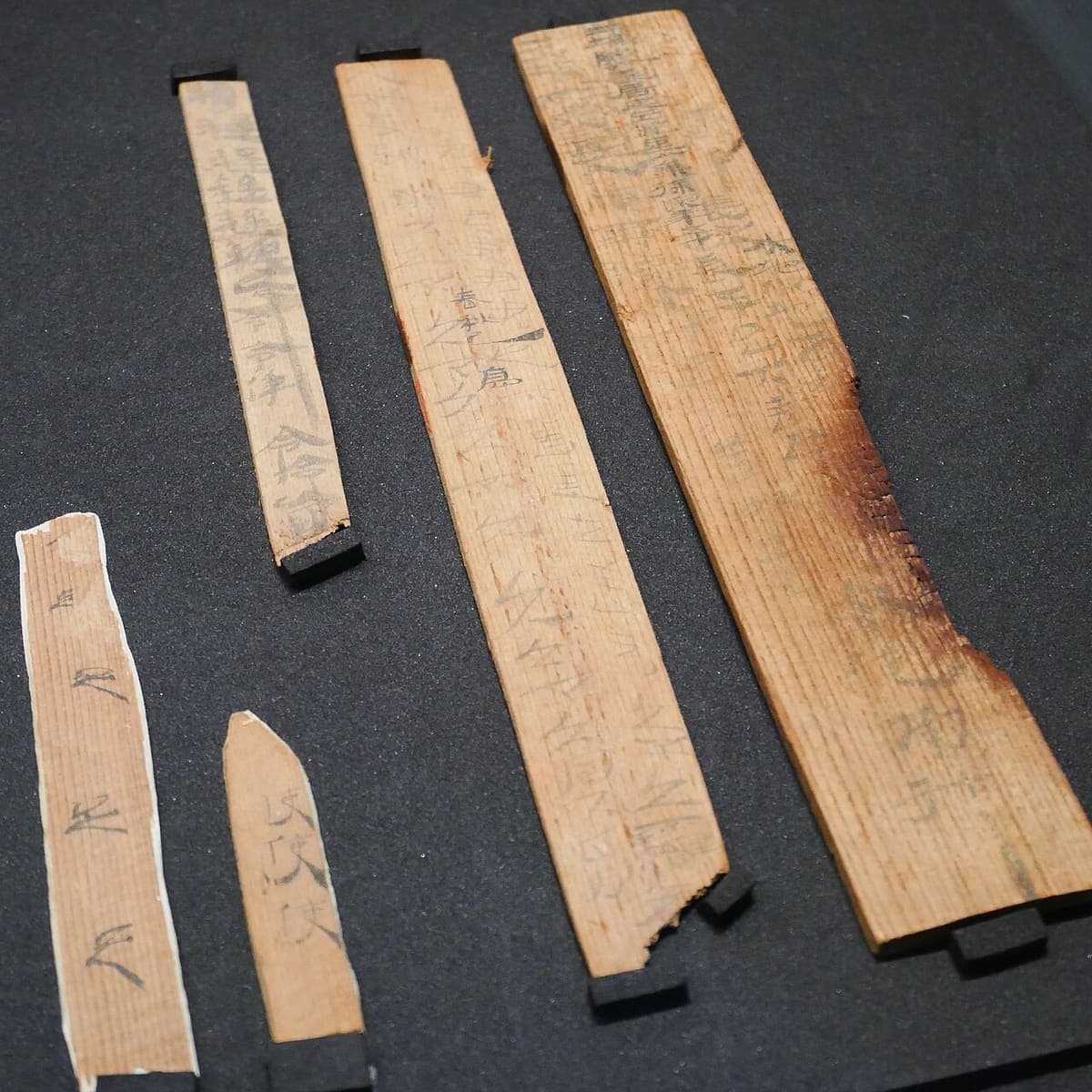
Museum of the Institute of History and Philology, Academia Sinica, Taipei, Juyan slips 24.1, 32.12, 26.9, 101.2, 227.98, Han, c. 100 BCE–100 CE · Source · CC0 1.0 · Photograph by 氏子
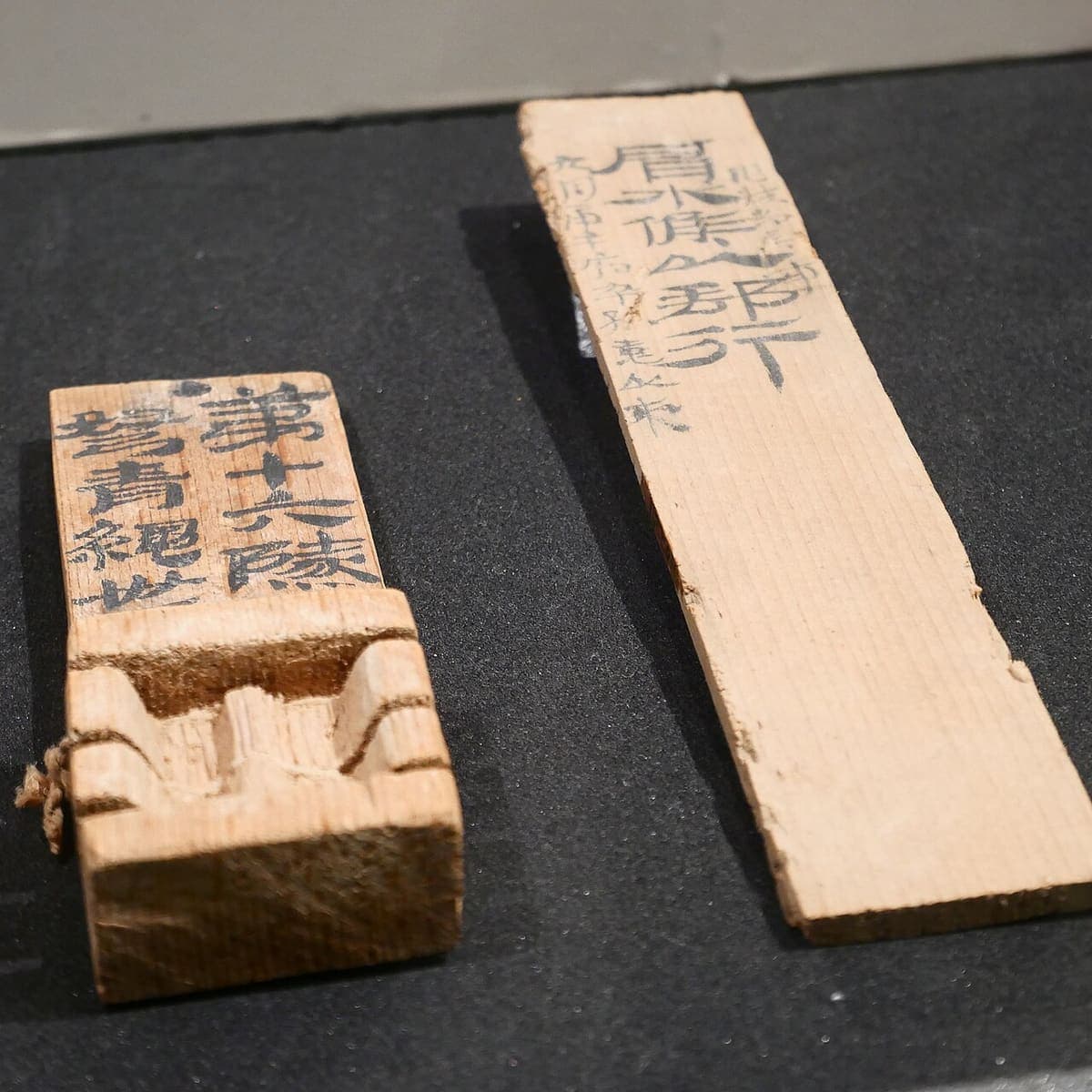
Museum of the Institute of History and Philology, Academia Sinica, Taipei, Han, c. 100 BCE–100 CE · Source · CC BY-SA 4.0 · Photograph by 氏子
Evidano Transcription
第十六隊
弩青繩[?]卅[?]
[illegible]
肩水候以郵行
[illegible]以來
Generated by Evidano’s advanced model; not yet checked against a published edition.
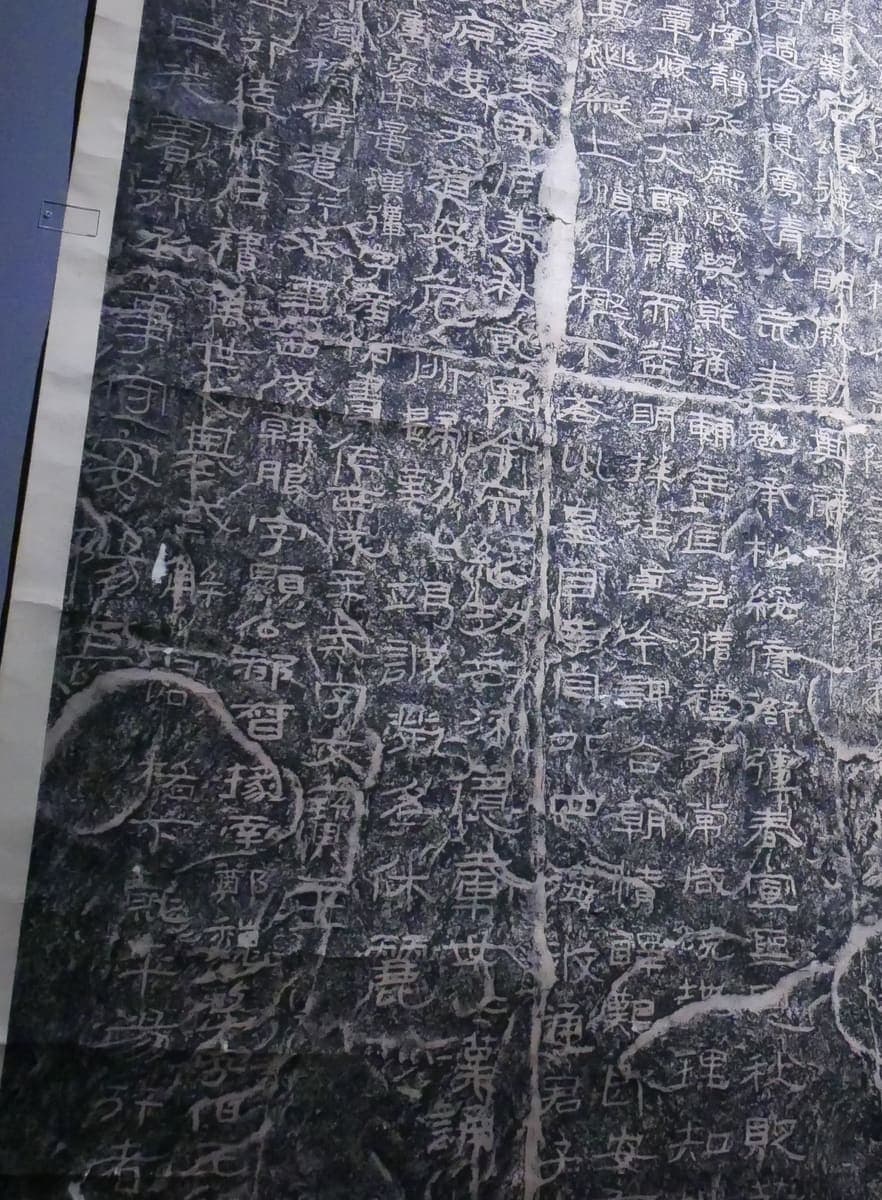
National Museum of History, Taipei, 148 CE (rubbing, modern) · Source · CC BY-SA 4.0 · Photograph by 氏子
Evidano Transcription
The whole of the Shimen song, of which this detail shows part, as printed in Zeng Guofan’s anthology Jingshi baijia chaochao and transcribed on Chinese Wikisource. That edition is punctuated and set in simplified characters, so it is a reading text rather than a copy of the cut forms; the inscription’s own repetition marks are resolved.
惟坤灵定位,川泽股躬,泽有所注,川有所通。余谷之川,其泽南隆,八方所达,益域为充。高祖受命,兴于汉中,道由子午,出散入秦,建定帝位,以汉诋焉。后以子午,涂路涩难,更随围谷,复通堂光。凡此四道,垓鬲尤艰。至于永平,其有四年,诏书开余,凿通石门。中遭元二,西夷虐残,桥梁断绝,子午复循。上则县峻,屈曲流颠;下则入冥,倾写输渊。平阿泉泥,常荫鲜晏。木石相距,利磨确盘。临危枪砀,履尾心寒。空舆轻骑,滞碍弗前。恶虫憋狩,蛇蛭毒蟃。未秋截霜,稼苗夭残,终年不登,匮馁之患。卑者楚恶,尊者弗安。愁苦之难,焉可具言。于是明知故司隶校尉犍为武阳杨君,厥字孟文,深执忠伉,数上奏请。有司议驳,君遂执争。百辽咸从,帝用是听。废子由斯,得其度经。功饬尔要,敞而晏平,清凉调和,烝烝艾宁。至建和二年仲冬上旬,汉中太守犍为武阳王升,字稚纪,涉历山道,推序本原,嘉君明知,美其仁贤,勒石颂德,以明厥勋。其辞曰:
君德明明,爇焕弥光,刾过拾遗,厉清八荒。奉魁承杓,绥亿衙疆。春宣圣恩,秋贬若霜。无偏荡荡,真雅以方。宁静烝庶,政与乾通。辅主匡君,循礼有常。咸晓地理,知世纪纲。言必忠义,匪石厥章。恢宏大节,谠而益明。揆往卓今,谋合朝情,释艰即安,有勋有荣。禹凿龙门,君其继踪,上顺斗极,下答坤皇。自南自北,四海攸通。君子安乐,庶土悦雍。商人咸憘,农夫永同。春秋记异,今而纪功。垂流亿载,世世叹诵。
Source: 經史百家雜鈔, 卷六, 王升〈石門頌〉, Chinese Wikisource (CC BY-SA 4.0).
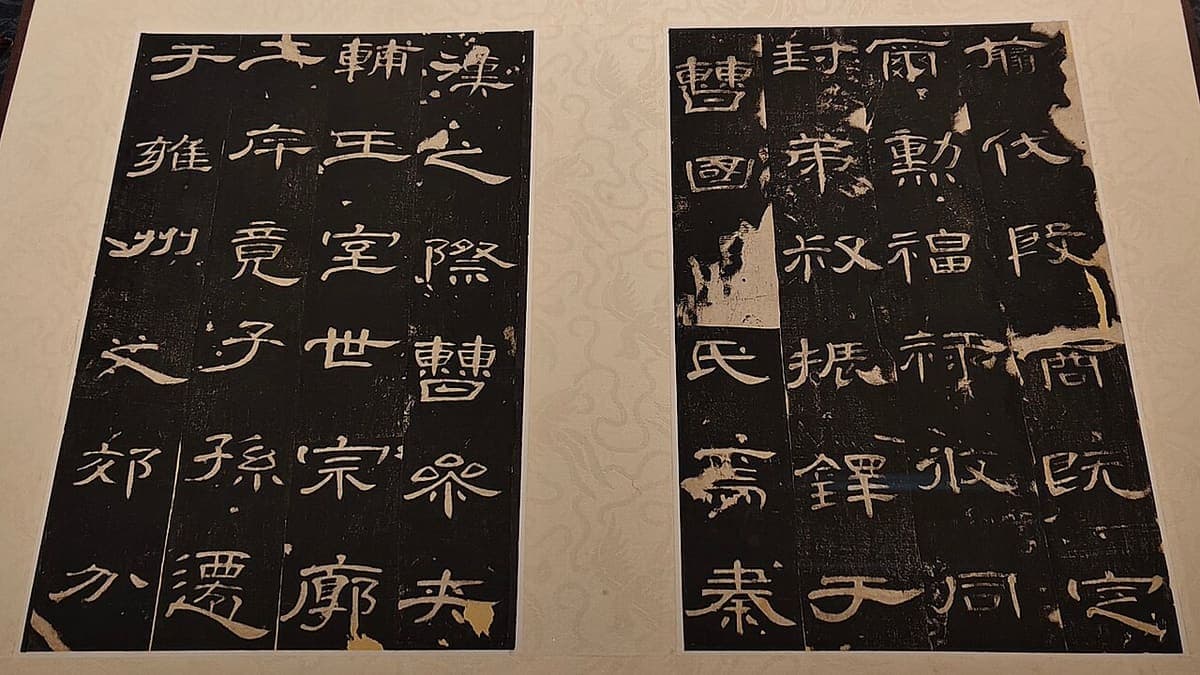
National Museum of History, Taipei, 185 CE (album of rubbings) · Source · CC0 1.0 · Photograph by 丘崈
Evidano Transcription
The opening paragraph of the stele, in the text of the inscription as edited on Chinese Wikisource; the two leaves shown here carry the middle of it, from the account of the family’s descent from the Zhou royal house to the move west into Yongzhou.
君諱全,字景完,敦煌效穀人也。其先蓋周之胄,武王秉乾之機,翦伐殷商,既定爾勳,福禄攸同,封弟叔振鐸于曹國,因氏焉。秦漢之際,曹參夹輔王室。世宗廓土斥竟,子孫遷于雍州之郊,分止右扶風,或在安定,或處武都,或居隴西,或家敦煌,枝分葉布,所在為雄。
Source: 漢郃陽令曹全碑, 碑陽, Chinese Wikisource (CC BY-SA 4.0).
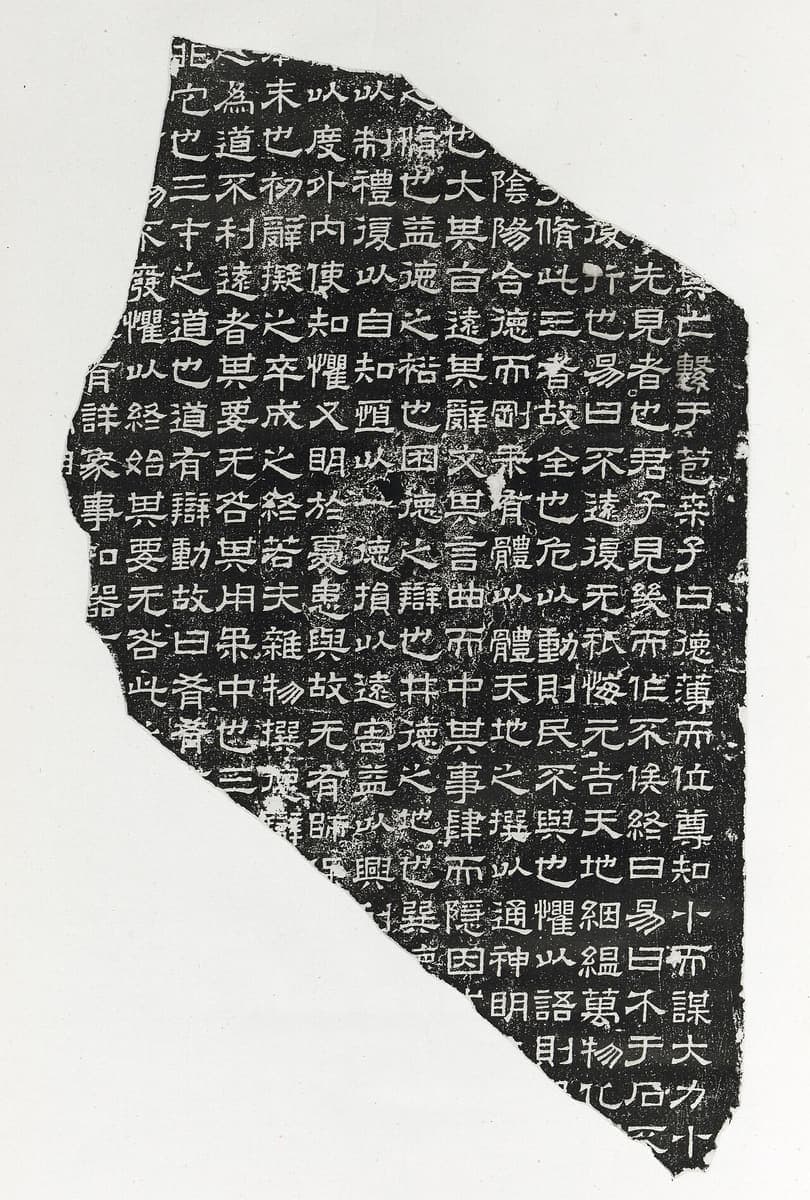
Shanghai Museum, 175–183 CE · Source · Public domain
Evidano Transcription
亡繫于苞桑子曰德薄而位尊知小而謀大力小
先見者也君子見幾而作不俟終日易曰不于石
復行也易曰不遠復无祇悔元吉天地絪縕萬物化
脩此三者故全也危以動則民不與也懼以語則
陰陽合德而剛柔有體以體天地之撰以通神明
也大其旨遠其辭文其言曲而中其事肆而隱因
脩也益德之裕也困德之辯也井德之地也巽德
以制禮復以自知恒以一德損以遠害益以興
以度外內使知懼又明於憂患與故无有師保
末也初辭擬之卒成之終若夫雜物撰德
為道不利遠者其要无咎其用柔中也三
非它也三才之道也道有辯動故曰爻爻
物不廢懼以終始其要无咎此
有詳象事知器
Generated by Evidano’s advanced model; not yet checked against a published edition.
Clerical script on wood, stone and silk
Clerical script, lishu, is the Han standard and the hinge of the whole history of Chinese writing: the round, even strokes of the seal script are broken into straight segments, the graph spreads sideways instead of standing tall, and one horizontal in each character is drawn out into a heavy wave that lifts at the end. On a formal stele, cut around the middle of the second century CE, the characters sit in a ruled grid and every wave is deliberate. On a wooden strip from a north-western garrison the same script is written at speed, with the strokes running into one another and whole components reduced to a hook — the beginnings of what will become cursive and then regular script.
The documentary material is enormous and repetitive. Tens of thousands of strips from Juyan on the Edsen-gol and from the Dunhuang limes carry duty rosters, grain issues, arrow counts, medical notes, passports and private letters, all built from a small set of formulae: a date by reign era, month and ganzhi day, an office, a name, a figure. Tags with a notched or perforated head were tied to bundles; sealing strips with a cut groove for the cord carried the addressee’s name; discarded strips were shaved clean with a knife and used again for writing practice, so the same piece of wood may hold two texts in two hands. Silk and, from the second century, paper carry the same script in a more careful form.
Stone is the other half of the record. Eulogies cut into the cliff face along the Baoxie road, honorific steles for officials, and the Xiping Stone Classics — the authorised text of the Confucian canon carved on some forty-six stelae at the imperial academy between 175 and 183 CE and smashed within a few decades — survive mostly as ink rubbings, in which the cut strokes come out white on a black ground and the broken edge of a fragment prints as a ragged silhouette. A Song or Qing rubbing of a stele can preserve characters that have since weathered off the stone, which is why an edition often cites a dated rubbing rather than the monument.
Why ordinary OCR struggles here
Two very different hands under one name
The measured clerical of a stele and the racing hand of a duty roster share a name and little else. A system tuned to the monumental forms will fail on the strips, where a character may be three strokes long, and a system tuned to the strips will over-read the deliberate waves of the stone.
Registers that are tables without rules
A grain issue or a roster is a table held together by position and repetition, not by ruled lines. Names, quantities and dates line up down the strip; run them together into prose and the figures detach from the people they belong to.
Shaved, reused and split wood
Strips were pared down and rewritten, so ghost strokes from an earlier text sit under the present one. Wood splits along the grain, warps and darkens, and slips reach the excavator broken at one or both ends, with the number of lost characters to be judged from spacing.
Rubbings, mountings and later hands
A stele rubbing is usually cut up and pasted into an album, so the reading order runs leaf by leaf, right to left, and a page may end mid-character. Around the inked area sit mounting paper, collectors’ seals and colophons, none of which belongs to the Han text.
Who works with this material
Historians of the Han frontier
Work on garrison administration, on the grain supply and on military service is built from thousands of near-identical strips. What matters is that every date, office, name and figure comes out in the same shape, so that a table can be built and the outliers looked at by eye.
Epigraphers and stele scholars
Dated rubbings of the same stele differ, because the stone kept weathering. Transcribing several states of one monument and comparing them shows which characters were still legible when, and gives an edition something firmer than a single reading.
Editors of the classics
The stone-classics fragments are evidence for the wording of the canon in the second century. Matching a fragment against the transmitted text depends on transcribing exactly what is cut, including the characters that look like mistakes.
Calligraphy teaching and collections
Albums of Han rubbings are studied character by character. A transcription tied to leaf and position turns an album into something a student can search, and helps a collection tell one cutting of a copybook from another.
Getting the best transcription
Say whether it is wood, stone or a rubbing of stone
The three need different assumptions about tone, about how regular the columns will be, and about what the marks that are not characters mean. For an album, add that the leaves are read right to left and that a column may continue on the next leaf.
Describe the record type for documentary strips
Telling the model that a strip is a duty roster, a grain issue or a passport brings the standard formula with it, and formulae are what make a damaged strip readable. Ask for the date, the office and the figures to be pulled out as fields as well as left in the text.
Separate the underlying and overlying writing
On a shaved and reused strip, ask explicitly for the two layers to be reported separately, with a note on which is later where that can be judged from the ink. The same instruction handles a rubbing where a later inscription crosses the Han text.
Check against a copybook you know
Run a page of a well-known stele such as the Cao Quan or the Yi Ying first. Because the text is published and the characters are large, a graph-by-graph comparison takes minutes and tells you exactly how the prompt is behaving before you turn it on a pile of strips.
Further reading on this hand
The palaeography guides the in-app selector points to for this domain, if you want to check a transcription against the standard references.
- China's Calligraphic Arts
This Smithsonian National Museum of Asian Art resource describes clerical script as a major stage in the historical development of Chinese writing. It identifies the script's broad horizontal structure and characteristic emphasized strokes and places it between early seal forms and later regular writing. The guide also explains the importance of brush, wood, silk, and paper as writing media. This overview is useful for Han documents because their clerical forms and material supports jointly shape the appearance of individual graphs.
Frequently asked questions
- Can it read the fast cursive on frontier strips?
- To a useful degree, and better when you say what kind of document it is. Early cursive reduces components to hooks and joins characters together, so some readings will stay uncertain; those are marked rather than guessed, and the document formula usually settles most of them.
- How are dates by reign era and ganzhi day handled?
- They are transcribed as written and can also be returned as a separate field, era name, year, month and cyclical day kept apart. Conversion to a Julian date is left to you, since it depends on which calendar table you use and on how intercalary months are treated.
- Does it work from an album of rubbings?
- Yes. Photograph the leaves in order and say that the album opens right to left; the transcription then runs leaf by leaf and marks where a character is split across the join between two mounted pieces.
- What about the characters that differ from the modern form?
- Han clerical uses component forms and whole characters that were later abandoned, and stone-classics fragments in particular preserve wordings the transmitted texts have lost. These are reported as they stand, with a note where a form is unusual, rather than corrected to the received reading.
- Can it tell writing practice from a real document?
- Repetition of a single character down a strip is easy to see and is flagged. Whether a strip is a draft, a practice piece or a discarded record is a judgement for the reader, but the transcription gives the evidence for it, including any earlier text still showing through.
Related scripts and pages
Transcribe Han strips and rubbings
Upload a plate of wooden slips or an album of stele rubbings, choose Han Clerical-Script Manuscripts and Documents, and keep the excavation numbers with the text.