
Chinese · c. 500–206 BCE
Read brush-written slips one column at a time
A Warring States book is a bundle of bamboo strips a centimetre wide, each holding a single column of thirty or forty graphs written in a regional script that no later dictionary covers. Evidano transcribes slip by slip, keeps the repetition and ligature marks that change the word count, and never quietly reorders slips whose sequence the excavators have not settled.
Sample pages
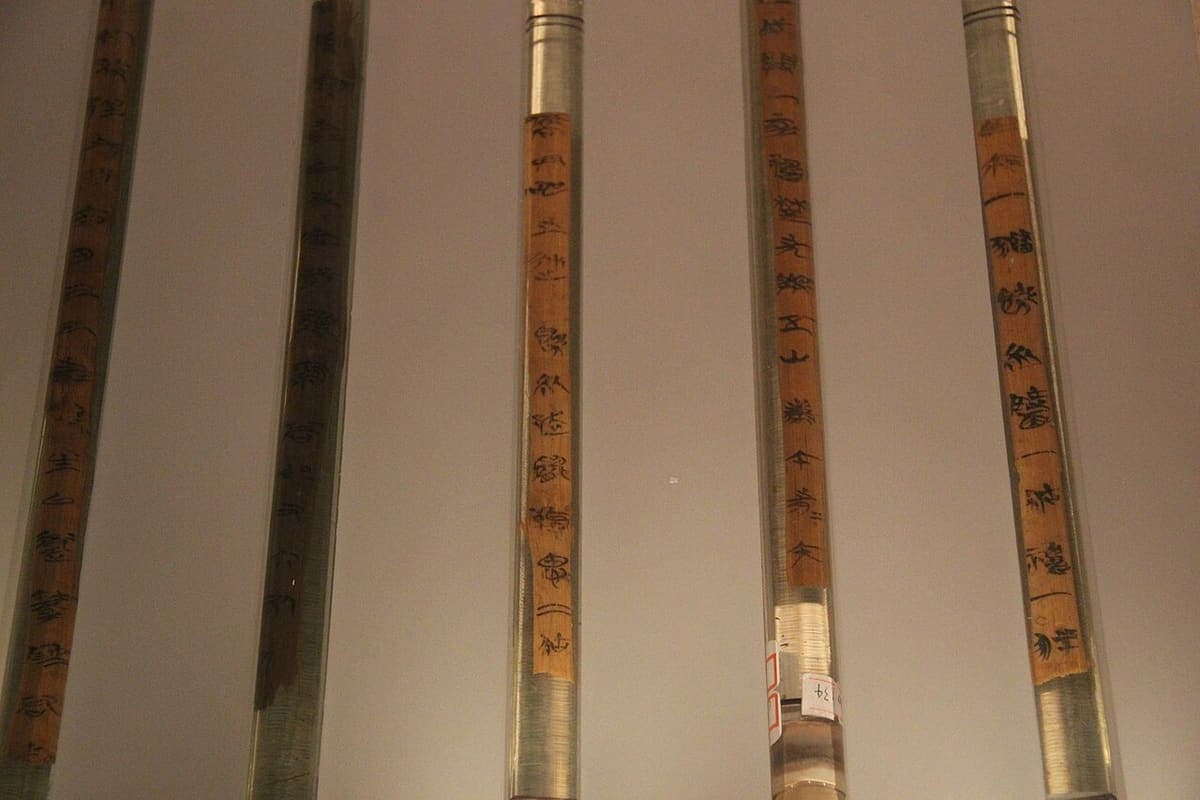
National Museum of Chinese Writing, Anyang, Warring States, c. 400–250 BCE · Source · CC0 1.0 · Photograph by Gary Todd
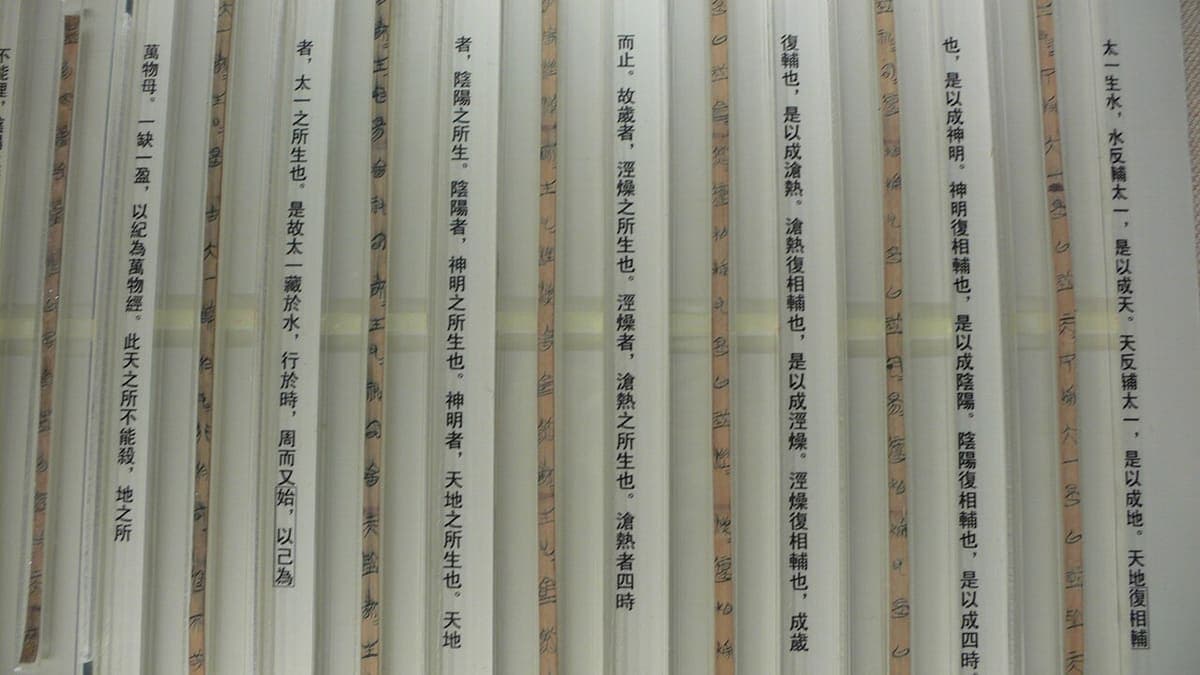
Hubei Provincial Museum, c. 300 BCE · Source · CC BY-SA 3.0 · Photograph by Sharkman
Evidano Transcription
The whole of Taiyi sheng shui in the second of the two reading editions on Chinese Wikisource, of which the slips in this case carry the opening. Square brackets mark graphs restored by the editors, boxes mark graphs that are lost, and a row of dots marks a break in the reconstructed sequence of slips.
大一生水,水反輔大一,是以成天。天反輔大一,是以成地。天地【復相輔】也,是以成神明;神明復相輔也,是以成侌昜;侌昜復相輔也,是以成四時;四時復【相】輔也,是以成寒熱;寒熱復相輔也,是以成濕燥;濕燥復相輔也,成歲而止。故歲者,濕燥之所生也;濕燥者,寒熱之所生也;寒熱者,四時【之所生也;四時】者,侌昜之所生;侌昜者,神明之所生也;神明者,天地之所生也。天地者,大一之所生也。是故大一乘於水,行於時,周而又【始】,□□□萬物母。一缺一盈,以己為萬物經。此天之所不能殺,地之所不能釐,侌昜之所不能成。君子知此之謂……
天道貴弱,削成者以益生者,伐於強,積於【弱】……下,土也,而謂之地;上,氣也,而謂之天。道,亦其字也;青昏其名?以道從事者必託其名,故事成而身長;聖人之從事也,亦託其名,故功成而身不傷。天地名字竝立,故過其方,不思相【當。天不足】於西北,其下高以強;地不足於東南‧其上□□□。【不足於上】者,有餘於下;不足於下者,有餘於上…………
Source: 太一生水(郭店楚簡), 解讀版本二, Chinese Wikisource (CC BY-SA 4.0).
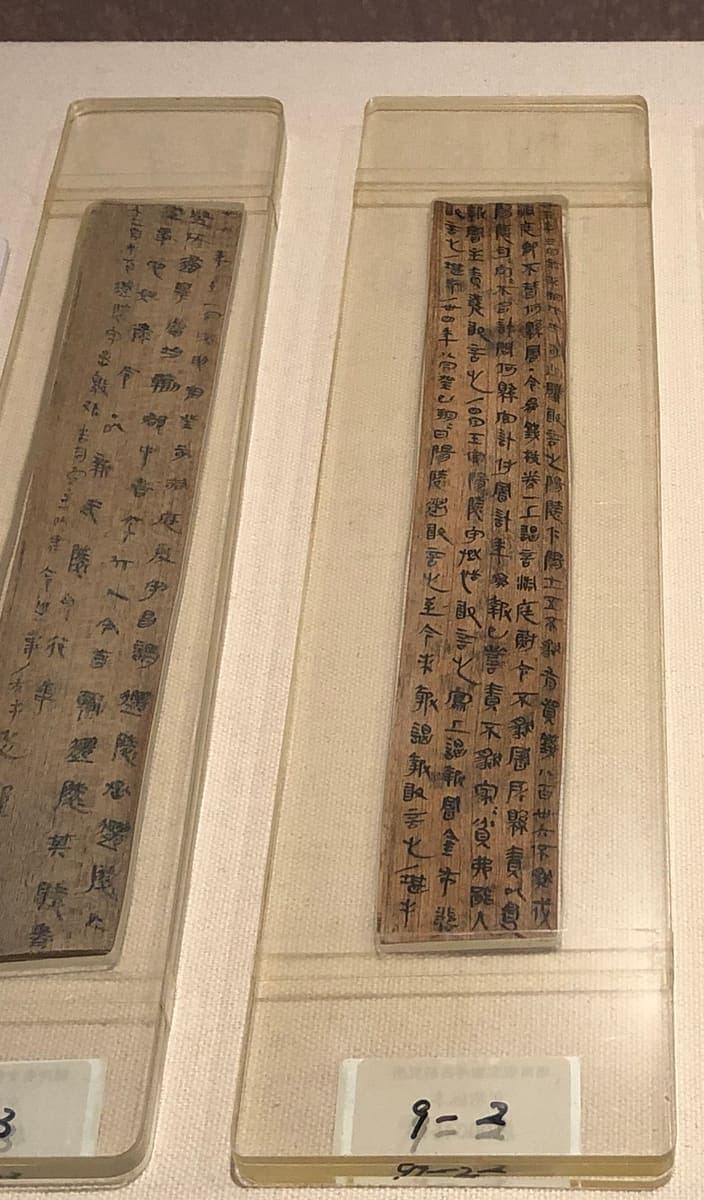
Liye Qin Slips Museum, Longshan, Hunan, Qin, c. 222–208 BCE · Source · CC BY-SA 4.0 · Photograph by Urga
Evidano Transcription
[illegible]騰敢言之陽陵下[illegible]士五不識有貲錢八百卅六不識戍
洞[?]庭郡不智[?]何縣署·今為錢校券一上謁言洞[?]庭尉令不識署所縣責以受[?]
陽陵司[?]空[?]不名[?]計問何縣官計付署計年為[?]報已訾責不識家=貧弗能入
報署主責發敢言之/四月[illegible]陽陵守[illegible]敢言之寫上謁報報署金布發
敢言之/堪[?]手[?]/卅四年八月[?]癸[?]巳[?]朔[illegible]陽陵[illegible]敢言之至今未報謁報敢言之/堪手
9-2
Generated by Evidano’s advanced model; not yet checked against a published edition.
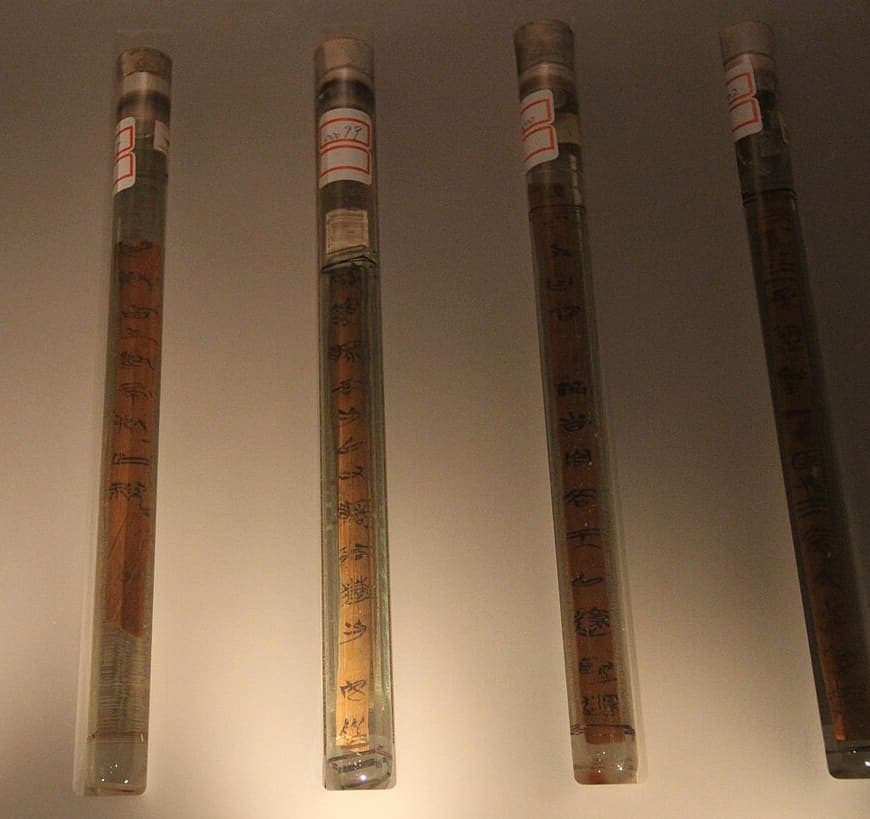
National Museum of Chinese Writing, Anyang, Warring States, c. 400–250 BCE · Source · CC0 1.0 · Photograph by Gary Todd
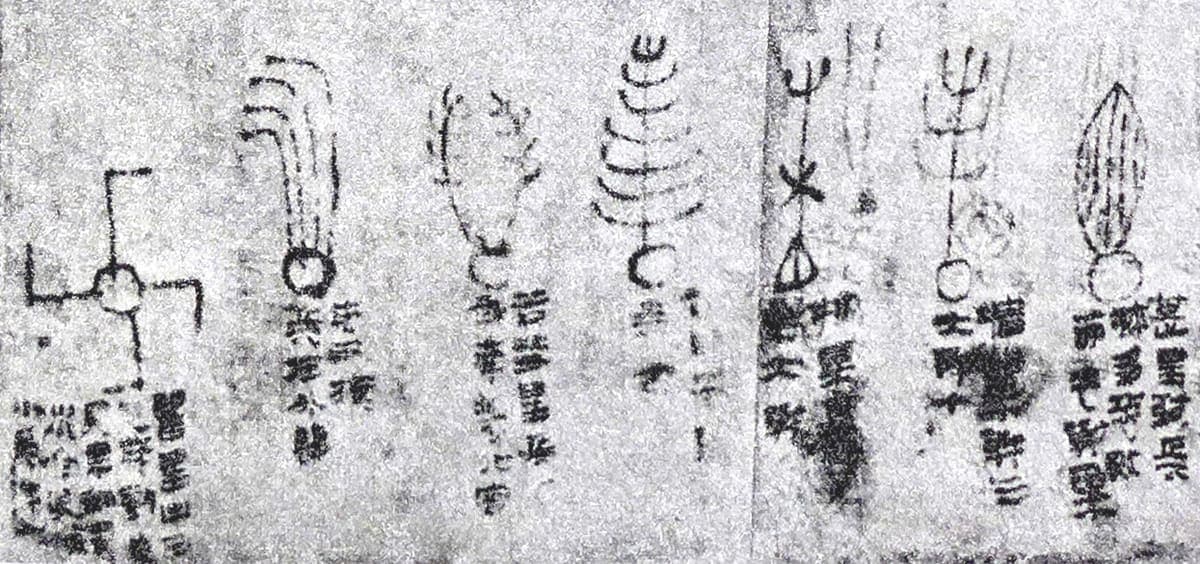
Hunan Museum, Changsha, 2nd century BCE · Source · Public domain
Evidano Transcription
Only two of the seven comet captions: the rightmost one (甚星) and the third from the right (抐星, the drawing with an x on the tail), in the edition's punctuation and without the image's column breaks; the other captions, including the one between them, are not covered.
甚星,致兵疢多,恐敗而衣〈卒〉戰果。

抐星,兵也,大戰。
Source: 長沙馬王堆漢墓簡帛集成 vol. 4 (ed. 裘錫圭, Zhonghua Shuju 2014), 天文氣象雜占, pp. 274-275, as quoted in 蕭旭, 馬王堆帛書《五星占》、《天文氣象雜占》校補 (Fudan FDGWZ, 2015) (Ancient text (public domain); short quotation from a scholarly edition).
Slips, boards and silk
Between the fifth and the third centuries BCE the ordinary book was a set of bamboo strips, planed flat, written on with a brush and tied into a roll with two or three cords. Each strip carries one column read from top to bottom; the strips themselves are read from right to left when the roll is opened. Wider wooden boards were used for letters, tallies and administrative records, and could carry several columns side by side. Silk, expensive and reserved for important copies, was often ruled into columns with a red line and could take diagrams beside the text. None of these supports uses punctuation as we know it, though scribes did mark the end of a section with a hooked stroke or a black block, and separated entries in a register with a space.
The scripts are regional. Chu manuscripts from Hubei and Hunan write familiar words with unfamiliar components, run strokes together, and shorten graphs in ways that vary from copyist to copyist; the same word may appear in three writings within a single text. Two marks do the work of abbreviation: a small double stroke below a graph tells the reader to say it twice, or marks two graphs written as one. Qin documents of the same period are already moving towards clerical script, with flattened proportions and a long dragging final stroke, which is why a Qin register and a Chu philosophical text can look like two different writing systems.
What survives is fragmentary and dislocated. Cords rot, so a bundle reaches the excavator as a heap of loose strips; ends snap off, water stains the surface, and a slip may be photographed upside down or joined to the wrong neighbour. Slip order is reconstructed from the numbers written on the verso, from the marks left by the binding cords, from scratched lines that run diagonally across the backs of a bundle, and from the sense of the text. Any transcription that quietly assumes the order in the photograph is the original order is hiding the most contested part of the evidence.
Why ordinary OCR struggles here
Regional graphs with no dictionary form
Chu writings of a word often share no component with the modern character, and hundreds of graphs are still argued over. An OCR system trained on printed Chinese produces confident nonsense; what is needed is a reading that separates the graph as written from the word it is taken to stand for.
One column per object, and the objects move
A page here is a physical strip. Photographs show slips laid side by side in whatever order the conservator arranged them, sometimes with a fragment from another text among them. The transcription has to be anchored to slip numbers, not to left-to-right position in the frame.
Repetition marks and ligatures
A double stroke under a graph may mean “read this graph twice” or “these are two graphs written as one”. Miss it and the sentence loses a word; expand it silently and the graph count no longer matches the strip. The same mark also serves as a section divider in some manuscripts.
Breaks, stains and displaced fibres
Bamboo splits along the grain, ink flakes, and mud leaves marks that read as strokes. Where a slip is broken, the missing graphs must be counted from the spacing rather than guessed, so that a restoration can be argued for later rather than smuggled into the text.
Who works with this material
Editors of excavated manuscripts
Producing a slip-by-slip edition means recording what is on each strip, how many graphs are missing at a break, and which readings are conjectural. A machine first pass that respects those boundaries gives an editor a checkable draft rather than a clean but untrustworthy text.
Textual critics of the classics
Guodian, the Shanghai Museum slips and Mawangdui preserve versions of the Laozi, the Odes and the Analects centuries older than the received editions. Comparing them line by line depends on a transcription that keeps the manuscript writing beside the modernised reading.
Historians of Qin administration
Tens of thousands of dated records came out of the well at Liye alone. Extracting the date, the office and the names from each one is repetitive work where consistency matters more than elegance, and where the graph count is the check on whether anything was skipped.
Conservators and photographers
Infrared and multispectral shots of a slip reveal ink that is invisible in ordinary light. Running a transcription over each exposure shows quickly which imaging pass is worth keeping and where the remaining illegible stretches are.
Getting the best transcription
Give the model the slip numbers
Ask for output keyed to the excavation number of each strip and refuse a running text. If the numbers are written on the mount rather than the slip, say so, and say whether the numbers run left to right or right to left in the photograph.
Ask for the graph as written and the word as read
Two parallel columns — the manuscript writing, then the standard character it is understood as — make the difference between the two visible and let a specialist disagree with the second without redoing the first. For Chu material this is the single most useful instruction.
Set a convention for breaks and lost graphs
Decide how a snapped end, a hole and an illegible but present graph are each to be marked, and ask for an estimate of how many graphs the gap could hold. Restorations from a parallel text should be flagged as restorations, not merged into the reading.
Try a text you can check first
Start with a manuscript that has a received counterpart, such as one of the Laozi copies, and see how the output handles a passage you already know. It shows immediately whether the model is reading the slip or reciting the transmitted text.
Further reading on this hand
The palaeography guides the in-app selector points to for this domain, if you want to check a transcription against the standard references.
- Towards a Profile of Graphic Variation: On the Distribution of Graphic Variants within the Mawangdui Laozi Manuscripts
This scholarly study analyzes graphic variation in early Chinese manuscripts through the Mawangdui copies of the Laozi. It examines how variant graphs are distributed within manuscripts and how scribal choices affect the identification of written forms. The article treats component variation as structured manuscript evidence rather than simple error or later character substitution. Its method is useful for Warring States and early imperial slip or silk texts where multiple allographs may represent the same word.
Frequently asked questions
- Can it tell Chu writing from Qin writing?
- The two look different enough that the distinction is usually clear, and it is worth stating in the prompt which you expect. Saying that a manuscript is Chu, Qin or from the Shanghai Museum collection also sets which of the competing readings of a graph are plausible.
- How is slip order handled when the bundle came apart?
- It is not decided for you. Each slip is transcribed on its own with whatever identifier you supply, and the assembled sequence stays your editorial decision, informed by verso numbers, cord marks and the scored lines across the backs of a bundle.
- Does it read infrared photographs of slips?
- Yes, and they are usually the better source, because ink that has sunk into darkened bamboo comes back strongly under infrared. Sending the visible-light and infrared images of the same slip together lets the two readings be compared graph by graph.
- What happens to the marks that are not characters?
- Repetition marks, ligature marks, section hooks and the black blocks that end a chapter are reported as marks in their place on the slip. You choose whether a repetition mark is left as a mark or resolved into the repeated graph.
- Can it work on silk as well as bamboo?
- Yes. Silk brings its own problems — ruled column lines that can be read as strokes, fold damage running across several columns, and diagrams interleaved with captions — so it helps to say that the sheet is silk and whether the text wraps around pictures.
Related scripts and pages
Transcribe your slip photographs
Upload a plate of bamboo strips or a silk sheet, choose Warring States and Qin Bamboo or Silk Manuscripts, and keep the slip numbers with the text.