
Chinese · c. 220–1900
Classical Chinese pages, column by column
A page of Classical Chinese carries no punctuation, no word spacing and no capitals; the reader supplies the sentence breaks. Add commentary set at half size in double columns, characters written in forms that no modern font contains, and seals stamped across the text by later owners, and an ordinary recogniser has nothing to hold on to. Evidano reads the columns in order, keeps the layers apart, and marks what it cannot resolve.
Sample pages
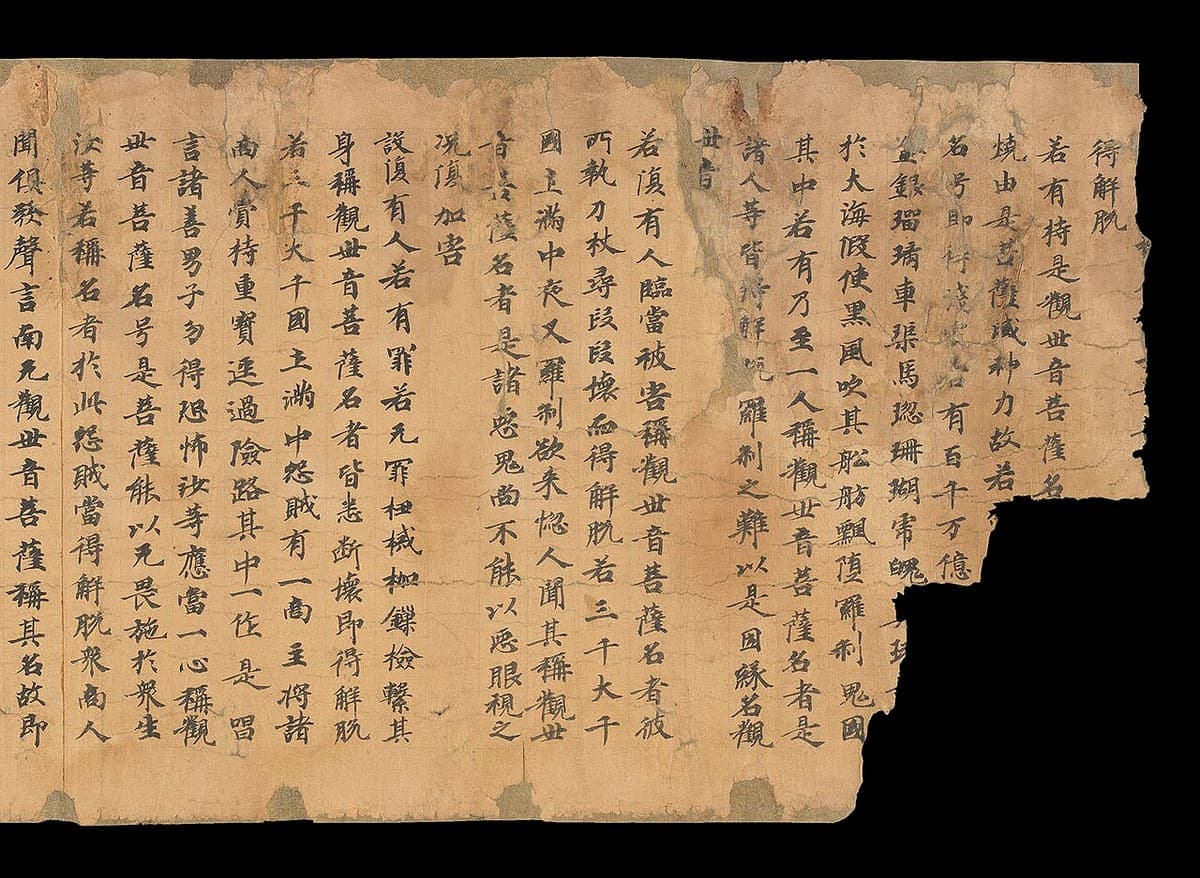
British Library, Or.8210/S.1609, Tang, c. 600–900 · Source · CC BY-SA 4.0 · International Dunhuang Project / British Library
Evidano Transcription
The passage carried by the columns visible here, from Chapter 25 of the Lotus Sutra in Kumārajīva’s translation, as edited on Chinese Wikisource. That edition marks the sense breaks with a full stop where the manuscript has none, and prints the standard forms of characters the copyist writes as variants.
皆得解脫。若有持是觀世音菩薩名者。設入大火。火不能燒。由是菩薩威神力故。若為大水所漂。稱其名號。即得淺處。若有百千萬億眾生。為求金、銀、琉璃、硨磲、瑪瑙、珊瑚、琥珀、真珠等寶。入於大海。假使黑風吹其船舫。飄墮羅剎鬼國。其中若有乃至一人。稱觀世音菩薩名者。是諸人等。皆得解脫羅剎之難。以是因緣。名觀世音。
若復有人。臨當被害。稱觀世音菩薩名者。彼所執刀杖。尋段段壞。而得解脫。若三千大千國土。滿中夜叉羅剎。欲來惱人。聞其稱觀世音菩薩名者。是諸惡鬼。尚不能以惡眼視之。況復加害。設復有人。若有罪。若無罪。杻械枷鎖。檢繫其身。稱觀世音菩薩名者。皆悉斷壞。即得解脫。
若三千大千國土。滿中怨賊。有一商主。將諸商人。齎持重寶。經過險路。其中一人作是唱言。諸善男子。勿得恐怖。汝等應當一心稱觀世音菩薩名號。是菩薩能以無畏。施於眾生。汝等若稱名者。於此怨賊當得解脫。眾商人聞。俱發聲言。南無觀世音菩薩。稱其名故。即得解脫。
Source: 妙法蓮華經, 觀世音菩薩普門品第二十五, Chinese Wikisource (CC BY-SA 4.0).
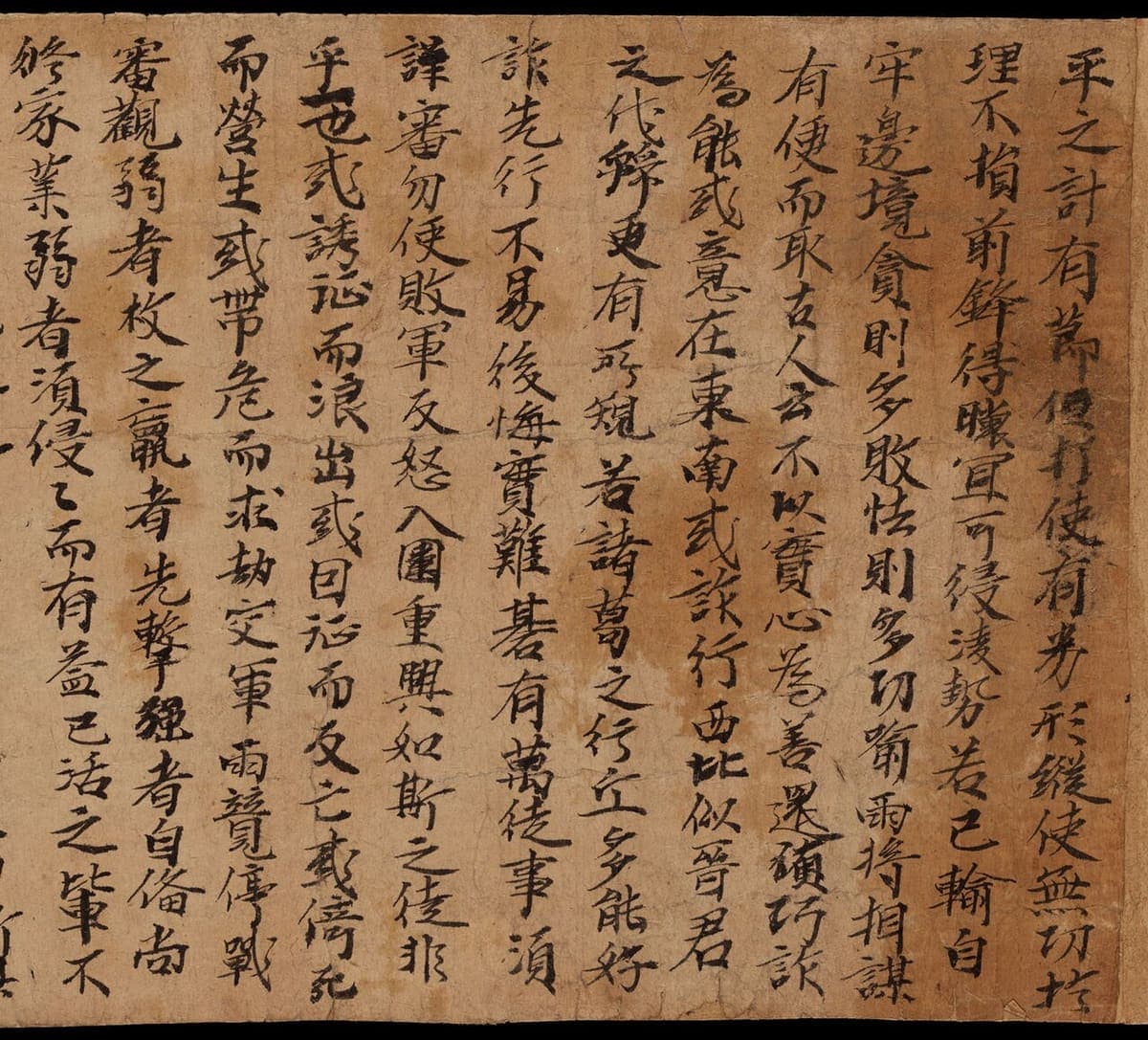
British Library, Or.8210/S.5574, c. 6th–9th century · Source · Public domain · International Dunhuang Project
Evidano Transcription
平之計有節便打使有勞形縱使無切於
理不損前鋒得曠宜可侵凌勢若已輸自
牢邊境貪則多敗怯則多切苟爾將相謀
有便而取古人云不以實心為善還須巧詐
為能或意在東南或詐行西北似晉君
之伐虢更有所規若諸葛之行兵多能好
詐先行不易後悔實難甚有萬徒事須
詳審勿使敗軍反怒入圍重興如斯之徒非
乎也或誘寇而浪出或因寇而反亡或倚死
而營生或帶危而求劫交軍兩競停戰
審觀弱者救[?]之羸者先擊強者自備尚
修家業弱者須侵之而有益己活之輩不
Generated by Evidano’s advanced model; not yet checked against a published edition.
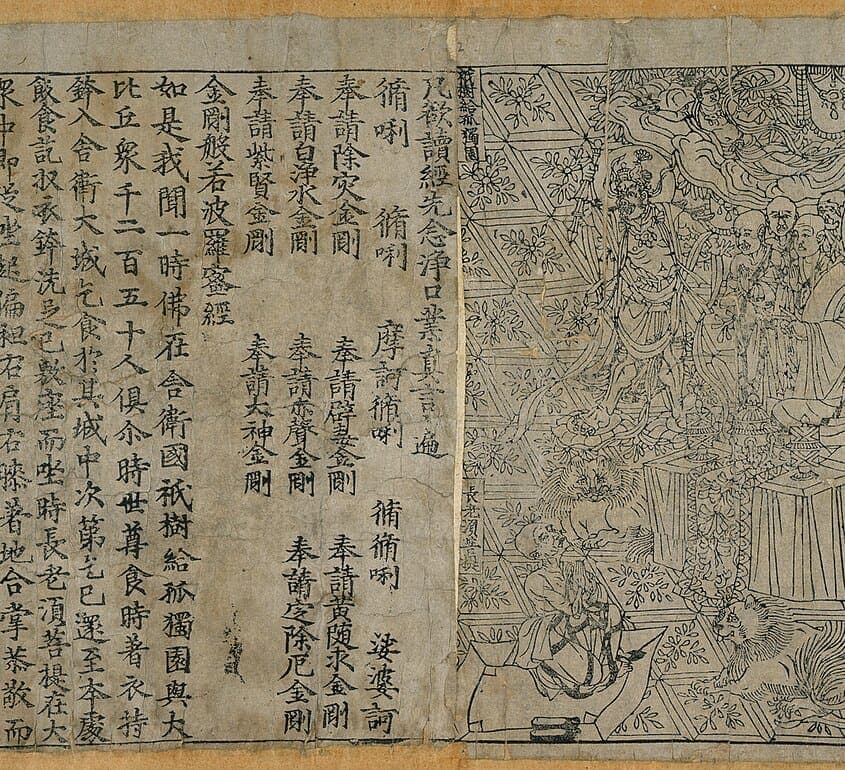
British Library, Or.8210/P.2, 11 May 868 · Source · CC0 1.0 · British Library
Evidano Transcription
The opening of the sutra, which begins at the title in the fourth column from the frontispiece, in Kumārajīva’s translation as edited on Chinese Wikisource. The invocations printed before it are a Chinese devotional preface and are not part of the sutra; the edition supplies punctuation the block does not have.
金剛般若波羅蜜經
如是我聞。一時,佛在舍衛國祇樹給孤獨園,與大比丘眾千二百五十人俱。爾時,世尊食時,著衣持缽,入舍衛大城乞食。於其城中,次第乞已,還至本處。飯食訖,收衣缽,洗足已,敷座而坐。
時,長老須菩提,在大眾中,即從座起,偏袒右肩,右膝著地,合掌恭敬。
Source: 金剛般若波羅蜜經 (鳩摩羅什譯), Chinese Wikisource (CC BY-SA 4.0).
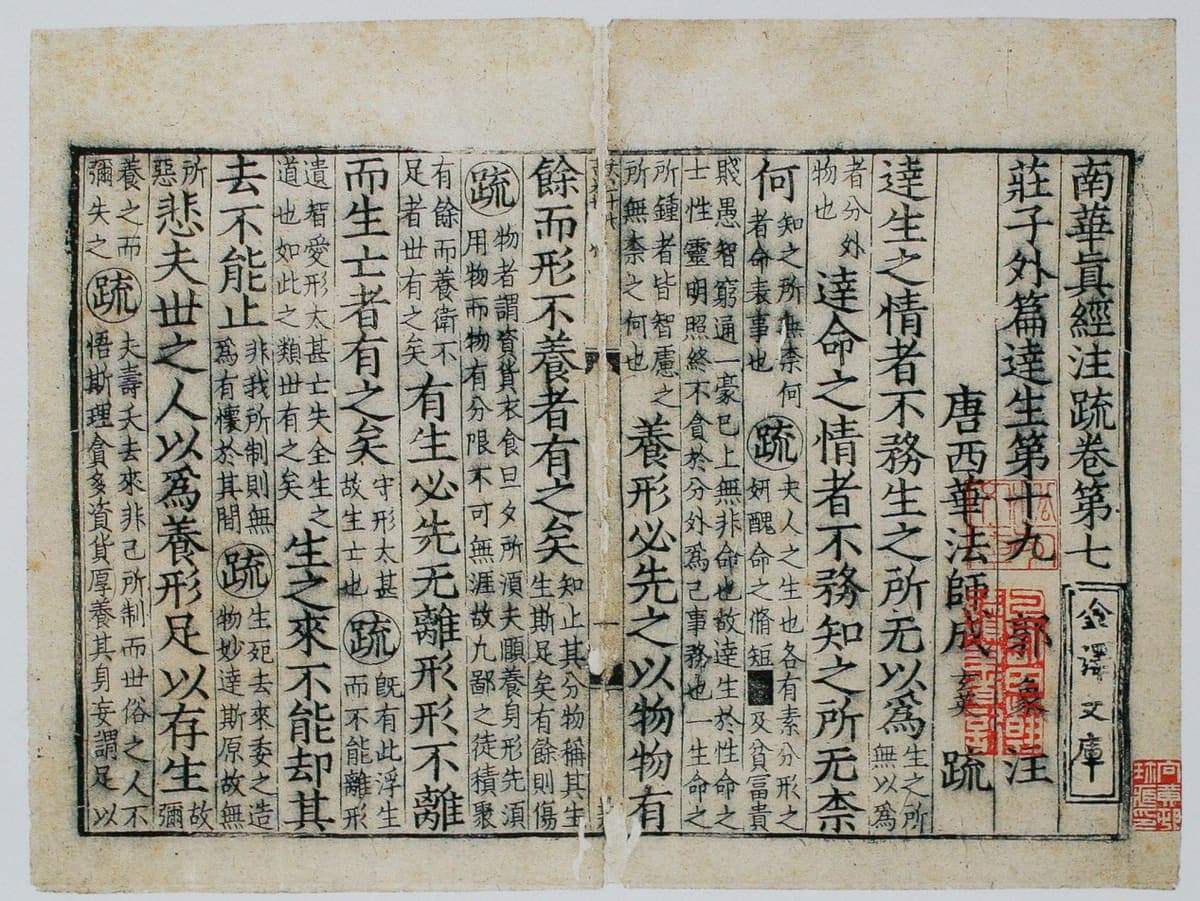
Seikadō Bunko Library, Tokyo, 13th century · Source · Public domain
Evidano Transcription
The main text of the chapter opening, which occupies the large characters on these leaves, from the Zhuangzi as edited on Chinese Wikisource. The half-size commentary and subcommentary interleaved with it are not included, and the edition’s punctuation is editorial.
達生之情者,不務生之所无以為;達命之情者,不務知之所无柰何。養形必先之以物,物有餘而形不養者有之矣。有生必先无離形,形不離而生亡者有之矣。生之來不能卻,其去不能止。悲夫!世之人以為養形足以存生;而養形果不足以存生,則世奚足為哉!雖不足為而不可不為者,其為不免矣。
Source: 莊子, 達生第十九, Chinese Wikisource (CC BY-SA 4.0).
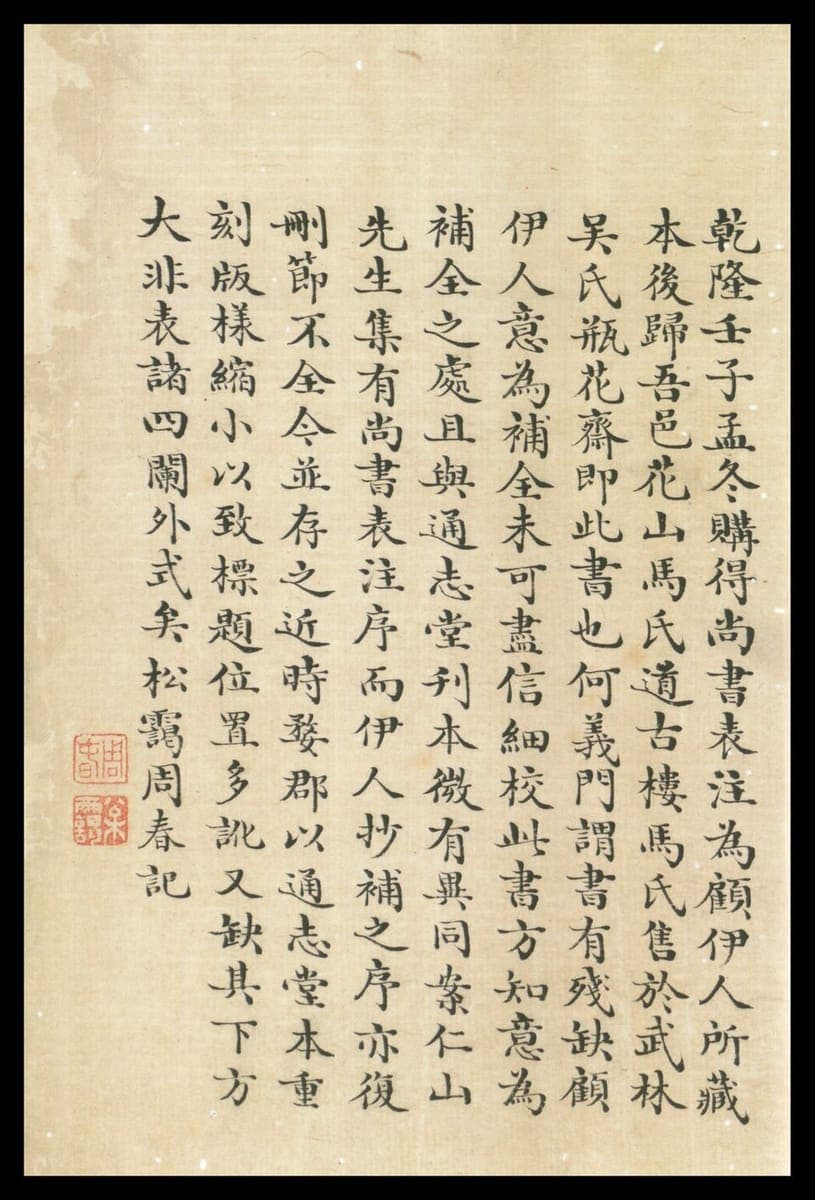
Source · Public domain · World Digital Library item 11378
Evidano Transcription
乾隆壬子孟冬購得尚書表注為顧伊人所藏
本後歸吾邑花山馬氏道古樓馬氏售於武林
吳氏瓶花齋即此書也何義門謂書有残缺顧
伊人意為補全未可盡信細校此書方知意為
補全之處且與通志堂刊本微有異同案仁山
先生集有尚書表注序而伊人抄補之序亦復
刪節不全今並存之近時婺郡以通志堂本重
刻版樣縮小以致標題位置多訛又缺其下方
大非表諸四闌外式矣松靄周春記
Generated by Evidano’s advanced model; not yet checked against a published edition.
Manuscript, print and the layers on top of them
From the third century onwards Classical Chinese was written on paper in three related hands. Regular script, kaishu, settles by the Tang into the form still taught today, and is what a professional copyist used for a sutra or a memorial. Running script, xingshu, joins the strokes and shortens components in a hand that is quick but still readable word by word. Cursive script, caoshu, reduces whole characters to one or two continuous movements and can only be read by someone who knows the repertoire. A single object may use all three: a printed classic in regular script, a reader’s note in running script down the margin, and a signature in cursive.
Layout is remarkably stable across seventeen centuries. Text runs top to bottom, columns right to left, in a scroll, a folded booklet or a thread-bound volume. Commentary is set at half size and often in double columns inside the width of one main column, so that two levels of text interlock; in a classic with commentary and subcommentary there may be three. There is no punctuation in the text as written. Readers add it: dots or small circles beside the column, marks for a full stop and a pause, sometimes tone marks on a character with two readings, and marginal notes on all four sides. A repetition mark stands in for a repeated character, and reign-period taboo means the personal name of a ruling emperor may be written with a stroke missing or replaced by a synonym.
Characters themselves vary. Manuscript culture kept hundreds of variant forms in use, especially in Dunhuang material of the fifth to eleventh centuries, and the same word may be written two ways on one sheet. Printing does not end this: Song, Ming and Qing editions each have their own preferences, and a hand-copied page inserted to replace a lost leaf in an old printed book will follow the copyist’s habits, not the printer’s. On top of everything sit the ownership layers — red seals, a title slip, colophons by successive collectors — which are historically valuable and are not part of the text.
Why ordinary OCR struggles here
No punctuation, so no sentence boundaries
Where the sentence ends is an interpretation, made from grammar, particles and parallelism. A transcription should reproduce the columns and, if punctuation is wanted, add it as a separate decision that can be reviewed, not silently bake it into the text.
Two or three sizes of text on one line
Half-size commentary in double columns interrupts the main text and then hands back to it. Systems that scan straight down a column merge the two, producing a text where a gloss on one word is spliced into the sentence it glosses.
Variant and taboo characters
Manuscript forms, printers’ variants, and characters deliberately written with a missing stroke to avoid an emperor’s name all look like errors to a recogniser trained on modern type. They matter: a taboo form can date a copy to within a reign, which is lost if it is normalised away.
Seals, colophons and damage
Vermilion seals sit on top of characters, colophons in running or cursive hands fill the margins and the end sheet, and old paper is torn, wormed and patched. Each layer needs to be reported separately, and the losses counted rather than filled in.
Who works with this material
Rare book and special collections cataloguers
A catalogue record needs the title as printed, the block-centre information, the colophons and the seals. Getting those off a set of page images and into a record is slow work that repeats across thousands of volumes and rewards a consistent first pass.
Editors of Buddhist and Daoist canons
Canonical texts survive in manuscript at Dunhuang, in Song and later printed canons, and in Japanese and Korean recensions. Collating them means transcribing variant characters exactly, since the variants are the evidence for how the recensions are related.
Local historians and genealogists
Gazetteers, lineage registers and land contracts are written in the same script and layout as the classics but in a much rougher hand, and they are where family names, places and dates are found. What matters is the names and the dates, captured with the columns they came from.
Digital humanities projects
Building a searchable corpus from page images needs main text and commentary kept in separate streams, characters recorded in the forms actually used, and each string tied back to a page and column so a reader can check it.
Getting the best transcription
Ask for the reading order to be stated
Say that columns run top to bottom and right to left, and that a double-column commentary block is read down the right half and then the left half before the main text resumes. On a folded booklet, add that the block centre carries the title and leaf number and is not part of either.
Decide about punctuation before you start
Choose between an unpunctuated transcription, one that reproduces only the marks a reader added to the page, and one that is punctuated editorially. All three are legitimate; mixing them across a run is what makes a corpus unusable.
Set the policy on variant and taboo forms
Say whether variant characters are to be kept as written, given with the standard form beside them, or normalised. Ask for taboo forms with a missing stroke to be flagged rather than corrected, since they carry dating evidence.
Test on a page with seals and marginalia
Pick a leaf that has a vermilion seal over the text and a note in the margin. If the transcription separates the base text, the reader’s marks and the ownership layer there, the plain pages will look after themselves.
Further reading on this hand
The palaeography guides the in-app selector points to for this domain, if you want to check a transcription against the standard references.
- China's Calligraphic Arts
This Smithsonian National Museum of Asian Art resource surveys seal, clerical, regular, running, and cursive scripts across the history of Chinese calligraphy. It describes regular script as structured and running or cursive scripts as progressively more connected and abbreviated. The guide connects stroke form with brush practice, writing surface, artistic function, and historical period. It is useful for Classical Chinese manuscripts because it provides the script distinctions needed to interpret variant and reduced handwritten graphs.
Frequently asked questions
- Does it separate commentary from the main text?
- Yes. Half-size commentary, whether in double columns inside a main column or in the upper margin, is returned as its own stream, tagged to the point in the main text where it appears. Subcommentary can be kept as a third level where an edition has one.
- How much cursive can it read?
- Running script is usually reliable; full cursive is harder, and a signature or a colophon in wild cursive may come back as a partial reading with alternatives. Saying that a passage is cursive, and giving the name or the text you expect, improves it considerably.
- Are variant characters preserved?
- They can be. The default is to report the character in the form used on the page where a Unicode point exists for it, and to note the standard equivalent. If you would rather have a normalised text for searching, ask for both and keep the pair.
- What happens to seals stamped across the text?
- A seal is identified as a seal, its position given, and the characters under it read where they can still be made out. The seal legend itself, usually in seal script and often on a red ground, is treated as a separate short inscription rather than as part of the page.
- Can it tell a printed page from a hand-copied one?
- Usually, from the evenness of the characters and the ruled frame, and it is worth asking, because old printed books often contain leaves copied by hand to replace losses. Those leaves follow a copyist’s habits and should be flagged in any collation.
Related scripts and pages
Transcribe your Classical Chinese pages
Upload a scroll, a printed leaf or a manuscript volume, choose Medieval to Late Imperial Classical Chinese Manuscripts, and set the punctuation and commentary rules once.