
Japanese · c. 1100–1600
Turn medieval deeds, letters and diaries into checkable text
From the twelfth century onwards a Japanese document is rarely written in one script at a time: a land grant sets Chinese characters in Japanese order with no kana at all, a letter of the same year runs kana so joined that four syllables share one unbroken stroke. Evidano reads both, marks the monogram and the seal for what they are rather than guessing at characters, and leaves the formulae in place so a specialist can check them.
Sample pages
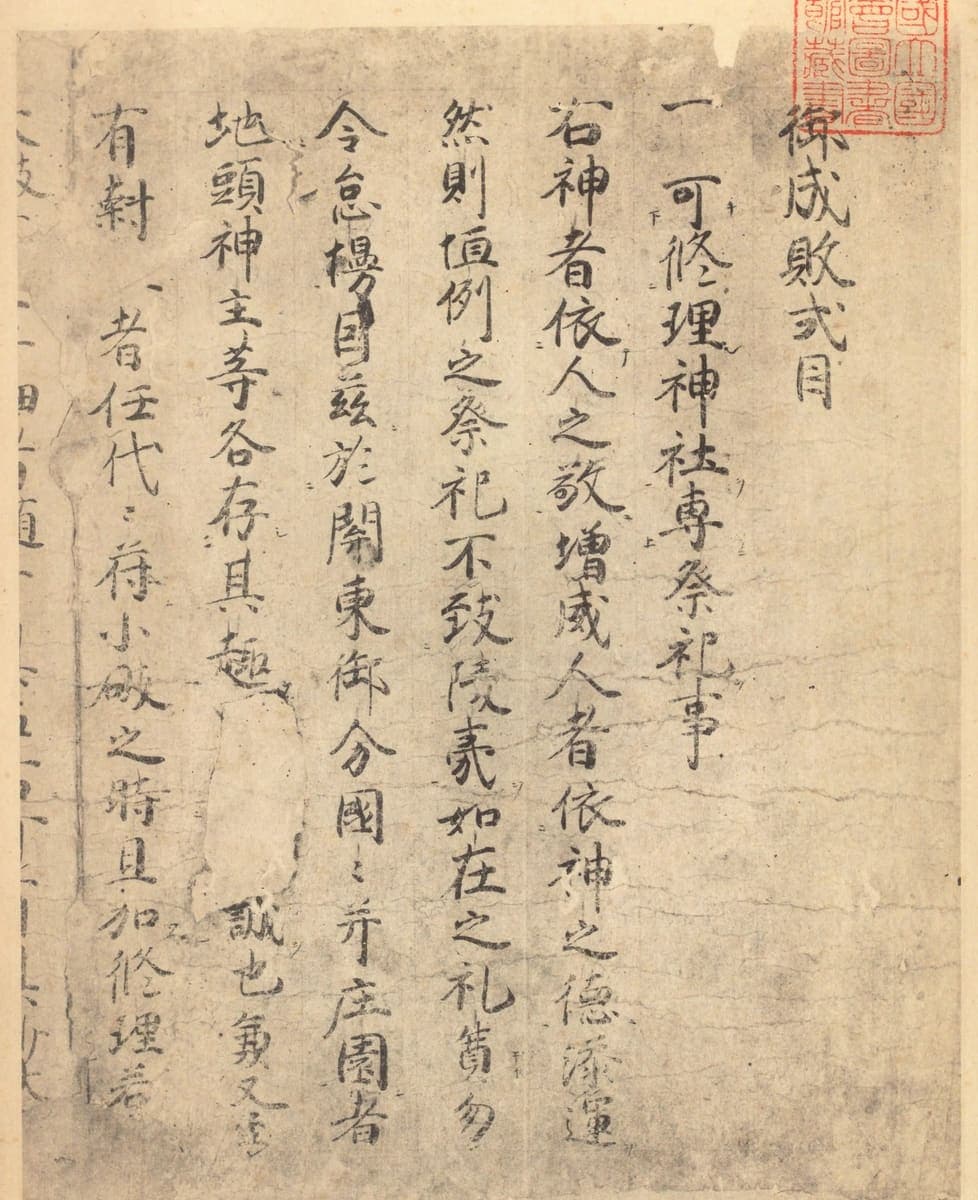
National Diet Library, Tokyo, NDL 322.14-G64g (pid 1882887), text of 1232; facsimile published 1930 · Source · Public domain · National Diet Library digital collections
Evidano Transcription
Article 1 of the code, which fills the page below the title 御成敗式目, from the Gunsho ruijū text on Japanese Wikisource. The edition prints the return marks (レ, 一/二, 上/下) that guide the Japanese reading; they are omitted here so that the line gives the characters as the column has them, and the manuscript carries its own marks at the same points. Variant-form selectors used by the edition have also been removed.
一可修理神社専祭祀事。
右神者依人之敬增威。人者依神之德添運。
然則恒例之祭祀不致陵夷。如在之禮奠莫令
怠慢。因玆於關東御分國々幷庄園者。地頭神
主等。各存其趣。可致精誠也。兼又至有封社
者任代々符。小破之時且加修理。若及大破令
言上子細者。隨其左右可有其沙汰矣。
Source: 御成敗式目 (Goseibai Shikimoku), ed. Hanawa Hokiichi, Gunsho ruijū 15 (1894), via Japanese Wikisource (Public domain).
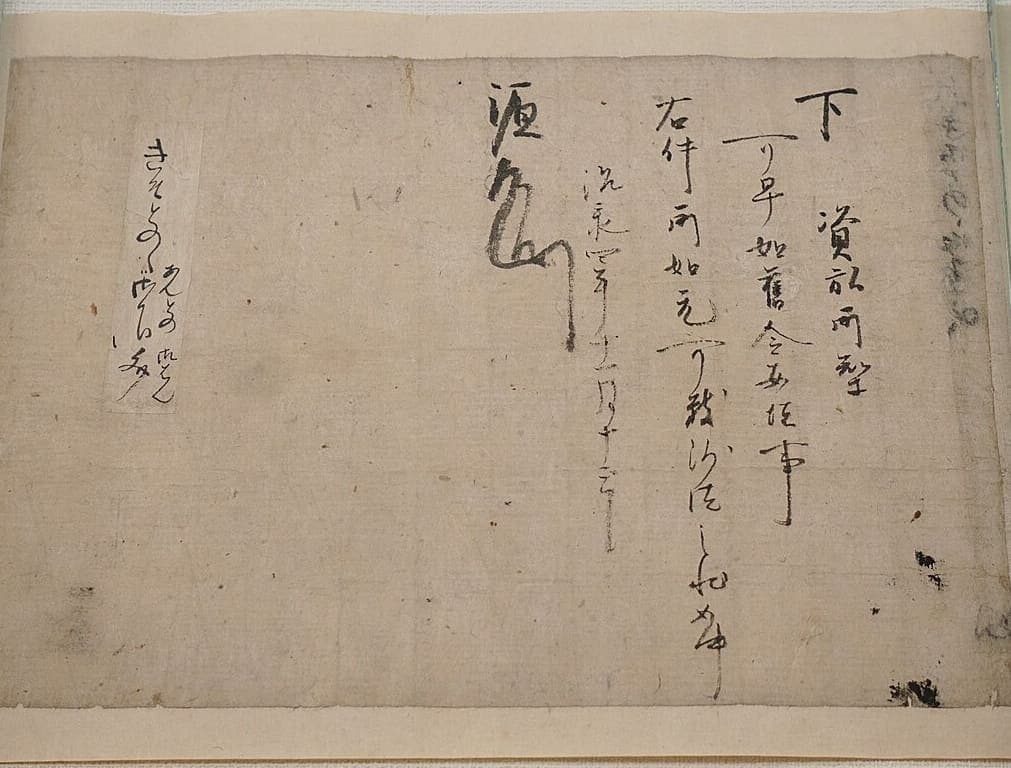
Homma Museum of Art, Sakata, Ichikawa-ke monjo, 11th month, Jishō 4 (1180) · Source · CC BY-SA 4.0 · Photograph by Kikucha (掬茶)
Evidano Transcription
下 資弘所望[?]
一可早如舊令安堵事
右件所如元可致沙汰之状如件
治承四年十一月十三日
源[monogram]
きそとの御はん[?] [illegible]
Generated by Evidano’s advanced model; not yet checked against a published edition.
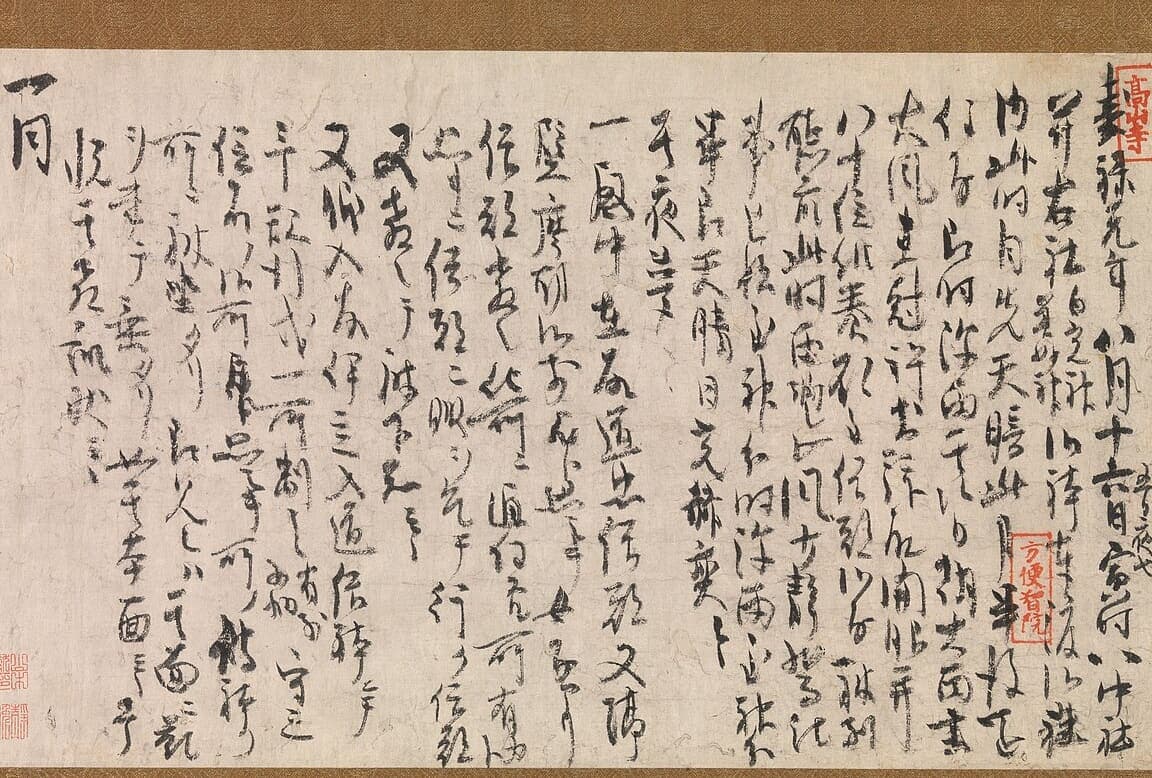
Evidano Transcription
[seal: 高山寺]
嘉禄元年八月十六日[illegible]
[remaining lines illegible]
[seal: 方便智院]
一同[cut off]
Generated by Evidano’s advanced model; not yet checked against a published edition.
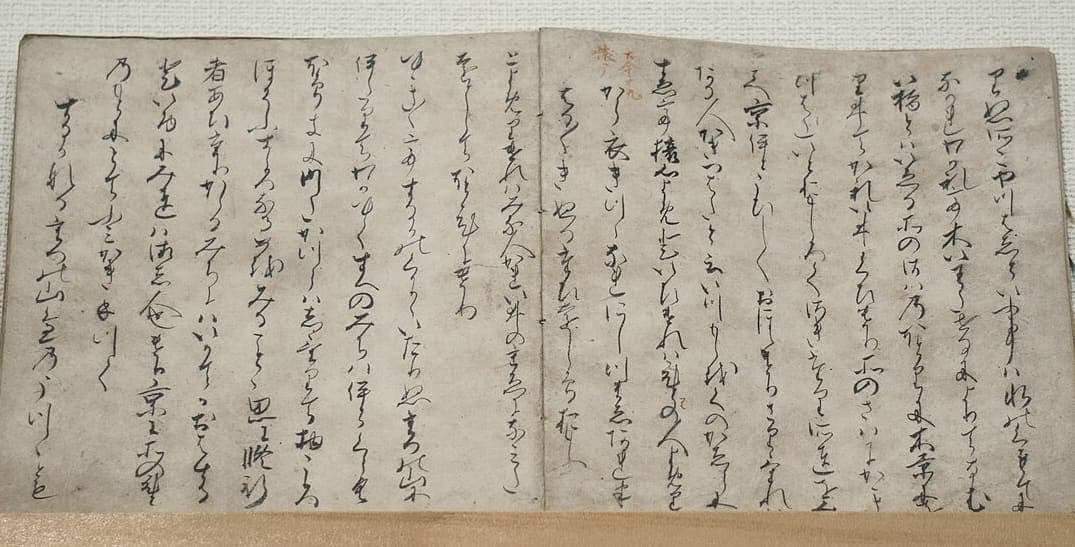
Homma Museum of Art, Sakata, Kamakura period · Source · CC BY-SA 4.0 · Photograph by Kikucha (掬茶)
Evidano Transcription
The whole opening (Ise monogatari section 9, from the arrival at Yatsuhashi to the first half of the Utsu no yama poem), given in the Gunsho ruiju text of the same Suzaku-in nurigome-bon recension, not a transcription of this Homma copy: the Homma manuscript is an abridged member of the line, so its wording, kanji/kana choices and exact first words may differ, and the red marginal note is not included.
みかはのくにやつはしといふ所にいたりぬそこやつはしといふことは水のくもてになかれわかれて木八わたせるによりてなむ八橋とはいへるその沢のほとりに木かけにおりゐてかれいひくひけりその沢にかきつはたいとおもしろくさきたりそれを見て都いとこひしくおほえけりさりけれはある人かきつはたといふいつもしをくのかしらにすへてたひの心よめといひけれはひとの人よめり

から衣きつゝなれにしつましあれははる/\きぬるたひをしそおもふ

と読りけれはみな人かれいひのうへに涙落してほとひにけりゆき/\てするかの国にいたりぬうつの山にいたりてわかゆくすゑのみちはいとくらくほそきにつたかつらはしけりてもの心ほそうすゝろなるめを見ることゝおもふにす行者あひたりかゝるみちにはいかてかおはするといふに見れは見し人なりけり京にその人のもとにとて文かきてつく

するかなるうつの山へのうつゝにも
Source: Ise monogatari, Suzaku-in nurigome gohon (Gunsho ruiju, vol. 307), Japanese Text Initiative, University of Virginia Library (Public domain text; electronic edition (c) 2004 Rector and Visitors of the University of Virginia).
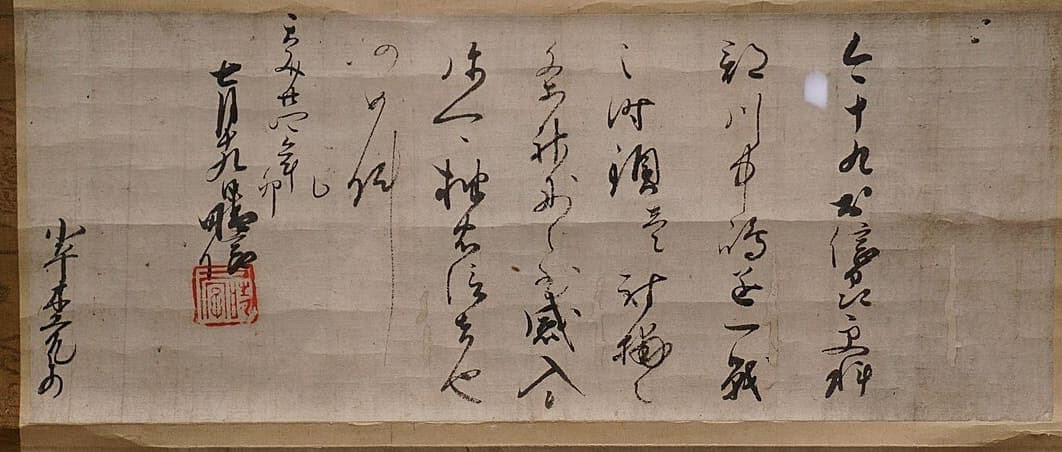
Homma Museum of Art, Sakata, 1555 · Source · CC BY-SA 4.0 · Photograph by Kikucha (掬茶)
Evidano Transcription
[illegible]
[illegible]川中嶋[illegible]一戦
[illegible]討捕[illegible]
[illegible]感入
[illegible]
[illegible]
弘治元年[?]乙卯
七月廿九日 晴信 [monogram] [seal]
小平木工丞[?]殿
Generated by Evidano’s advanced model; not yet checked against a published edition.
Hands and formats between the Genpei war and Sekigahara
The medieval documentary record is built out of a small number of forms repeated for four hundred years. A kudashibumi issued downwards to an estate, a migyōsho conveying a lord’s order, a kanjō commending a warrior after a battle, a yuzurijō dividing property among heirs, a baiken recording a sale: each opens and closes with fixed phrases, and it is those phrases, not the individual characters, that a reader recognises first. The language is a Japanese variety of literary Chinese, so a clause such as 之状如件 (“the terms of this document are as above”) is written in characters alone and read out in Japanese; the same page will date itself by era name, year, month and day, and end with a personal monogram called a kaō, drawn rather than written.
Alongside it stands writing in kana. Private letters, vows, poem slips and copies of Genji, Ise monogatari and the war tales are written in a cursive hand that joins several syllables in a single descent of the brush, and that still draws on a wide stock of kana variants: one syllable may appear as three different shapes on one page depending on which character the calligrapher started from. Kanji in these books are themselves cursive, reduced to a few strokes, and the boundary between a heavily abbreviated kanji and a kana is not always obvious. Iteration marks do further work: 々 repeats a character, ゝ a kana, and a long vertical 〳〵 repeats a whole word.
The physical document carries information of its own. Letters were folded, and the fold lines cross the writing; a postscript may run up the right margin or continue on the reverse as an uragaki. Vermilion seals, monastic 牛王 talismanic papers used for oaths, later collectors’ seals and mounting joins all appear in the same field of view. Scale marks status: an endorsement or a note of receipt is written smaller than the body, and a clerk’s file note may be squeezed sideways into a margin at half the size of everything around it.
Why ordinary OCR struggles here
The kaō is not a character
A monogram is a designed shape, unique to one person, that occupies the place a signature would take. Character recognition tries to read it and produces plausible nonsense. What an archivist wants instead is a note that a kaō is present, whose it appears to be if the document says so, and where on the sheet it sits.
Chinese characters, Japanese order
A grant or an order is written without kana, yet it is not Chinese: object and verb follow Japanese syntax and set phrases stand in for grammar. Recognising the characters is not enough to produce a usable reading, and a system that silently supplies a Chinese reading order will invert the sense of the clause.
Joined kana and reduced kanji
In a fluent letter hand the brush does not lift between syllables, so the unit on the page is a stroke group rather than a character. Segmentation has to be learned from the writing itself, and the same stroke group can resolve into different syllables depending on which source character the writer favoured.
Folds, margins and reverse sides
The reading order is not simply top right to bottom left. Text can continue up a margin, onto the back of the sheet, or into a later endorsement added by a different office. A transcription that does not record where each block sits leaves an editor unable to reconstruct the document.
Who works with this material
Local history and komonjo editors
Prefectural and municipal history projects work through boxes of estate deeds, sale records and receipts that have never been printed. What they need first is a searchable reading with dates, place names and personal names correct, and an honest mark wherever the paper is worn.
Temple and shrine archives
Monastic houses hold registers of land, lists of ritual duties and correspondence with patrons across several centuries in one hand-written series. Cataloguers need each item summarised and dated before conservation priorities can be set, which means reading the opening and closing formulae reliably.
Editors of literary manuscripts
Anyone collating copies of the war tales or of Ise monogatari has to record where a witness differs by a single kana. A transcription that follows the columns of the page, and that flags a kana whose source character is ambiguous, is worth far more than a smoothed modern text.
Family and regional archives of the warring states
Warlord correspondence survives in family collections scattered across museums. Researchers tracing a campaign need the day and month, the addressee and the sender’s monogram captured for every sheet so that undated letters can be placed in sequence.
Getting the best transcription
Name the document type in the prompt
Saying that a sheet is a kudashibumi, a commendation or a private letter tells the model which opening and closing formulae to expect and where the date and signature will fall. That single line of context does more for accuracy than any amount of image adjustment.
Ask for monograms and seals as separate entries
Request that a kaō, a vermilion seal or a later collector’s stamp be reported as an object with its position, not transcribed as text. You then have a clean body text and a list of authenticating marks that can be compared across a family archive.
Fix the treatment of iteration marks and dates
Decide whether 々 and ゝ should be kept or resolved into the repeated character, and whether era-name dates should be left exactly as written. Leaving them as written and converting separately keeps the transcription checkable against the sheet.
Give the folds and margins their own lines
Ask for marginal postscripts, endorsements and text on the reverse to be output as labelled blocks after the main body. Test this on a folded letter first: if the blocks come back in the right order there, a whole box of correspondence can be run without re-ordering afterwards.
Further reading on this hand
The palaeography guides the in-app selector points to for this domain, if you want to check a transcription against the standard references.
- Old Japanese Characters: Kuzushiji
This University of Zurich training module introduces kuzushiji through Japanese manuscripts and printed materials produced before 1900. It provides guided exercises for learning cursive kana and kanji forms in their original page contexts. The module emphasizes comparison of historical graphs, recognition of connected writing, and adaptation to individual hands. It is useful for medieval Japanese documents in which kana, kanji, and annotation systems appear together.
Frequently asked questions
- Can it read a document written entirely in Chinese characters but meant to be read in Japanese?
- Yes, and you can ask for both layers: the characters in the order they stand on the sheet, and a Japanese reading of the same clause. Keeping them apart matters, because the formulae that carry the legal force of a grant are recognisable only in their written form.
- What does it do with a kaō?
- It reports the monogram rather than inventing characters for it, with a note of where it sits — above the opening word, beside the date, or worked into the signature. Where the document names the person elsewhere, that name is given as the likely owner and flagged as an inference.
- How reliable is it on joined kana in a letter hand?
- Fluent correspondence hands are the hardest material on this page, and the honest answer is that they need review. Uncertain stroke groups are marked rather than smoothed over, which lets a reader work through a letter far faster than starting from the image alone.
- Are era-name dates converted to the Western calendar?
- Only if you ask. The default keeps the date as the document gives it — era name, year, month and day — because the conversion depends on the lunar month and is a judgement an editor may want to make. A converted date can be added as a second field.
- Can it tell a medieval original from a later copy?
- Not as a matter of certainty, and it should not pretend to. What it can do is surface the evidence: a copyist’s note, a colophon giving the date of copying, brush behaviour that does not match the stated period, or a monogram drawn rather than written in one movement.
Related scripts and pages
Transcribe your medieval Japanese documents
Upload a deed, a letter or a manuscript opening, choose Medieval Japanese Kana and Kanbun Documents, and check the formulae before running the box.