
Chinese · c. 1250–1046 BCE
Read Shang divination records graph by graph
Oracle-bone graphs were cut with a knife into bone and shell, squeezed around the heat cracks they comment on, and written in short units that can run down, up or inwards from either edge. Evidano keeps each inscription unit separate, records the graph it can see rather than the modern character you might expect, and marks the places where the surface has flaked away.
Sample pages
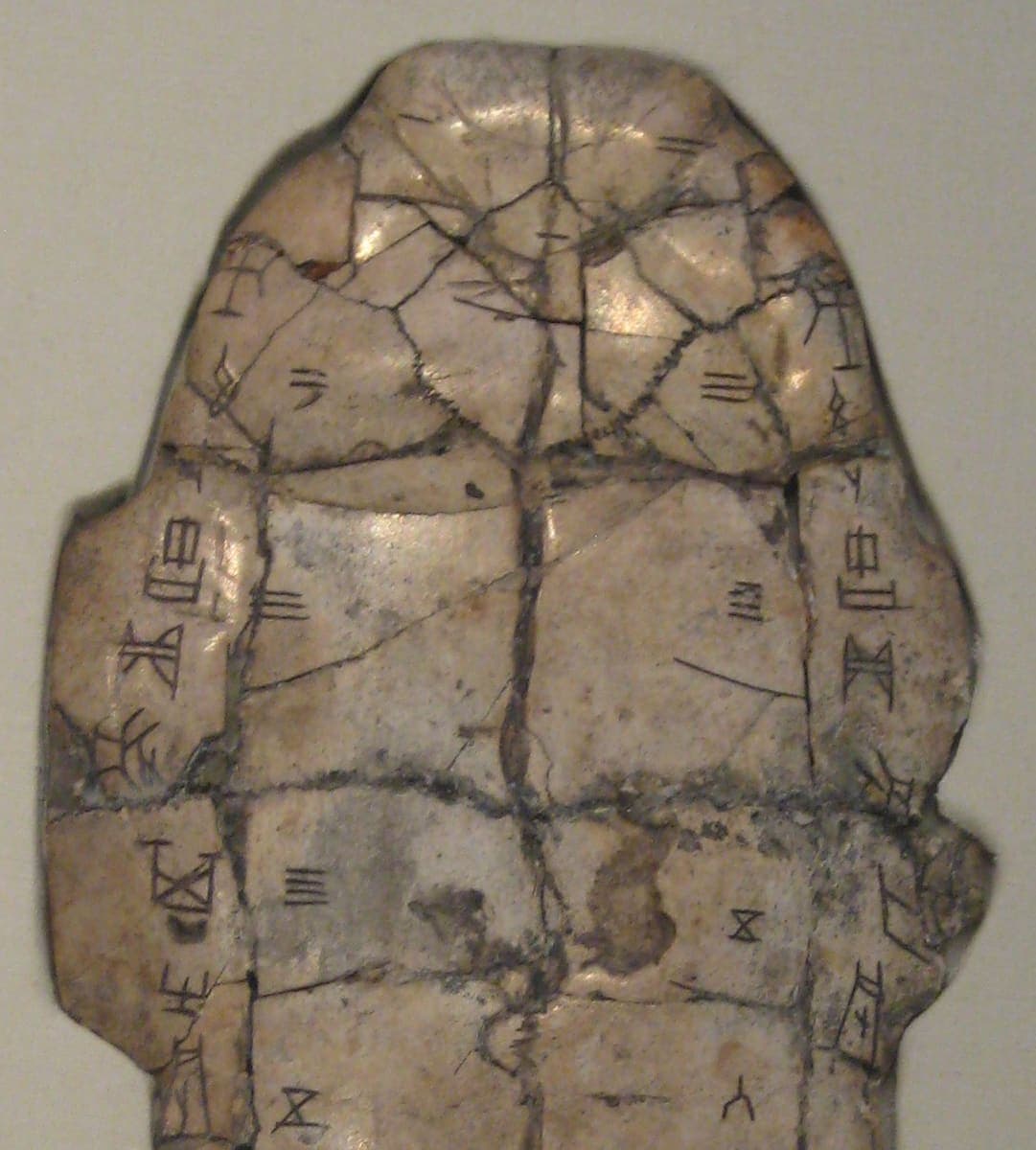
National Museum of China, Heji 4264r, c. 1200 BCE · Source · CC BY-SA 3.0 · Photograph by Andrew West (BabelStone)
Evidano Transcription
The three inscription units on the plastron, each labelled with its position on the shell, as given in the shiwen (釋文) on the Wikimedia Commons file page, which cites the National Museum of China catalogue entry and Djamouri’s study of the piece. Graphs are given in their conventional modern character equivalents.
(左)戊午卜古貞般其有
(右)戊午卜古貞般亡禍
(右下)吉
Source: File:Shang dynasty inscribed tortoise plastron.jpg, inscription field, Wikimedia Commons (CC BY-SA 4.0).
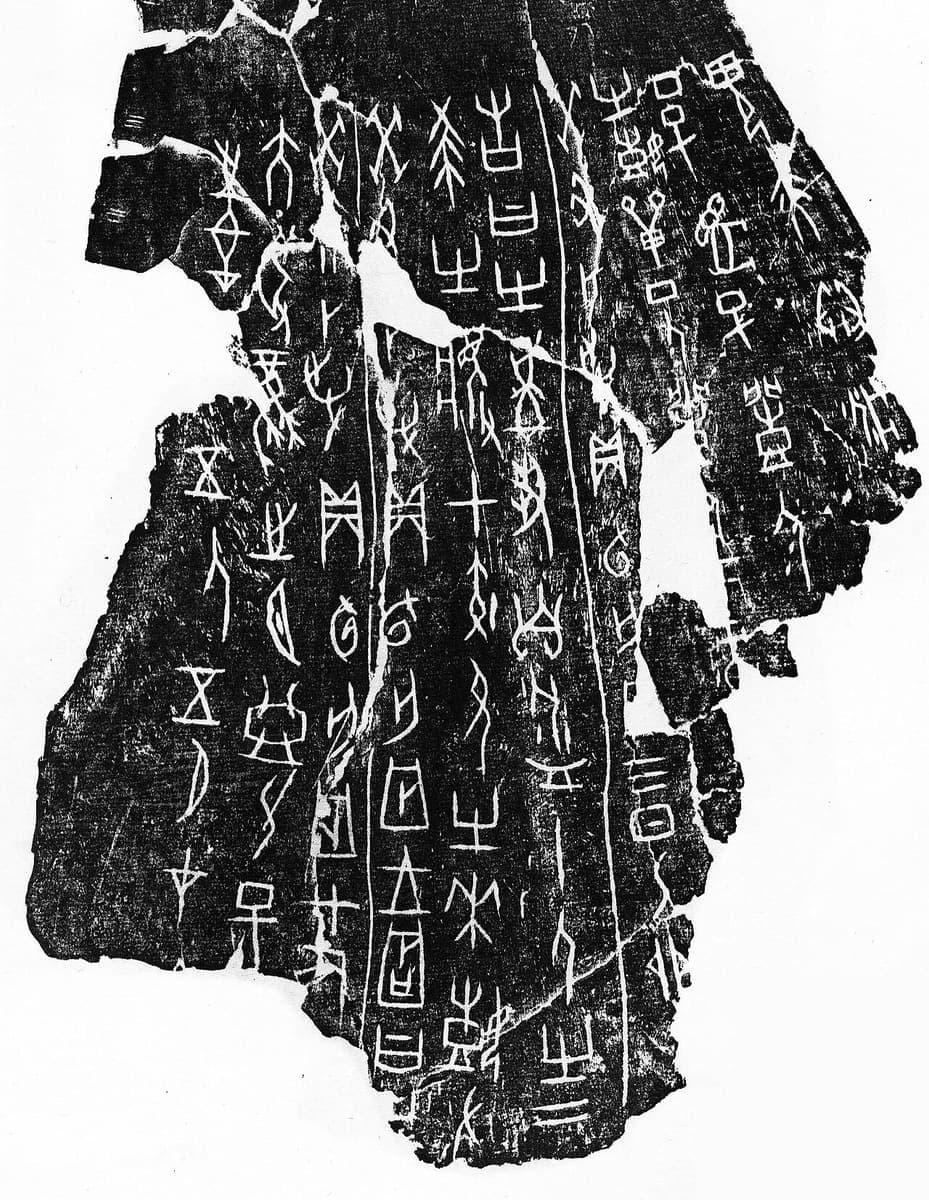
National Museum of China, Heji 137r, c. 1200 BCE (rubbing) · Source · Public domain
Evidano Transcription
The four inscription units of Heji 137 recto, the piece this rubbing was taken from, as set out in the shiwen (釋文) on the Wikimedia Commons page for the same bone. Boxes mark graphs that are lost or illegible, square brackets uncertain readings, and a parenthesis after a rare graph gives its component structure; the readings follow Hu Houxuan’s Jiaguwen heji shiwen.
(上)☐☐卜,☐,貞[旬]亡𡆥。
(左)癸卯卜,爭,貞旬亡𡆥。甲辰☐大掫風,之曰皿,乙巳[疛]𰙫(⿱止幸)☐五人。五月在[𦎧]。
(中)癸丑卜,爭,貞旬亡𡆥。王𰉏(⿴囗占)曰:有祟,有夢。甲寅,允有來艱。左告曰:有往芻自𰤹(⿱汄皿),十人又二。
(右)癸丑卜,爭,貞旬亡𡆥。三日乙卯[有]𰌌(⿰壴女)艱,單邑豊[尿]于彔……丁已貍子豊尿……鬼亦得疾。
Source: File:Shang dynasty inscribed scapula.jpg, inscription field, Wikimedia Commons (CC BY-SA 4.0).
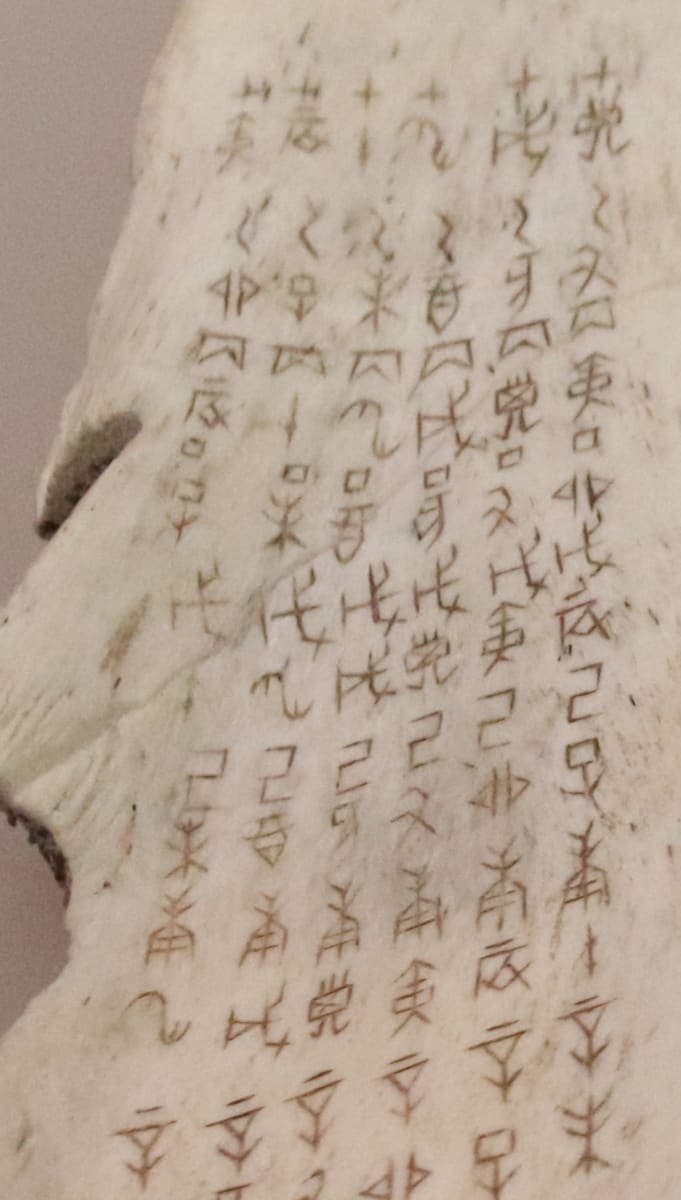
Yinxu Museum, Anyang, Heji 37986, c. 1100–1046 BCE · Source · CC0 1.0 · Photograph by Gary Lee Todd; rotated and cropped by Kanguole
Evidano Transcription
甲子乙丑丙寅丁卯戊辰己巳庚午辛未[cut off]
甲戌乙亥丙子丁丑戊寅己卯庚辰辛巳[cut off]
甲申乙酉丙戌丁亥戊子己丑庚寅辛卯[cut off]
甲午乙未丙申丁酉戊戌己亥庚子辛[cut off]
甲辰乙巳丙午丁未戊申己酉庚戌辛[cut off]
甲寅乙卯丙辰丁巳戊午己未庚申辛[cut off]
Generated by Evidano’s advanced model; not yet checked against a published edition.
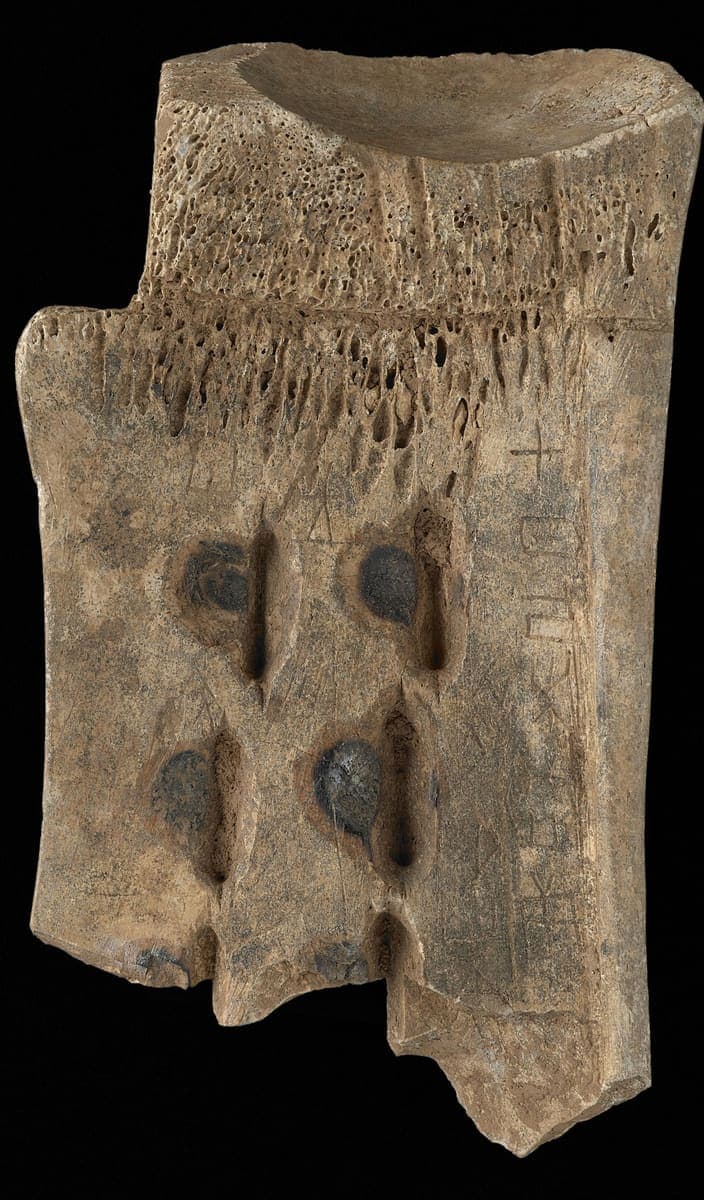
British Library, Or. 7694/1595 verso, c. 1192 BCE · Source · CC0 1.0 · British Library
Evidano Transcription
The single inscription unit on the right-hand edge, given in modern character equivalents with an English rendering, from the shiwen (釋文) published on the Wikimedia Commons page for the British Library’s other photograph of this same bone, which cites Keightley’s Sources of Shang History and Zhang Peiyu’s dating of the eclipse.
七日己未斲庚申月又食
“On the seventh day jǐwèi (day 56) cleaving into gēngshēn (day 57), the moon was eaten.”
Source: File:Oracle bone - BL Or. 1595 verso.png, inscription field, Wikimedia Commons (CC BY-SA 4.0).
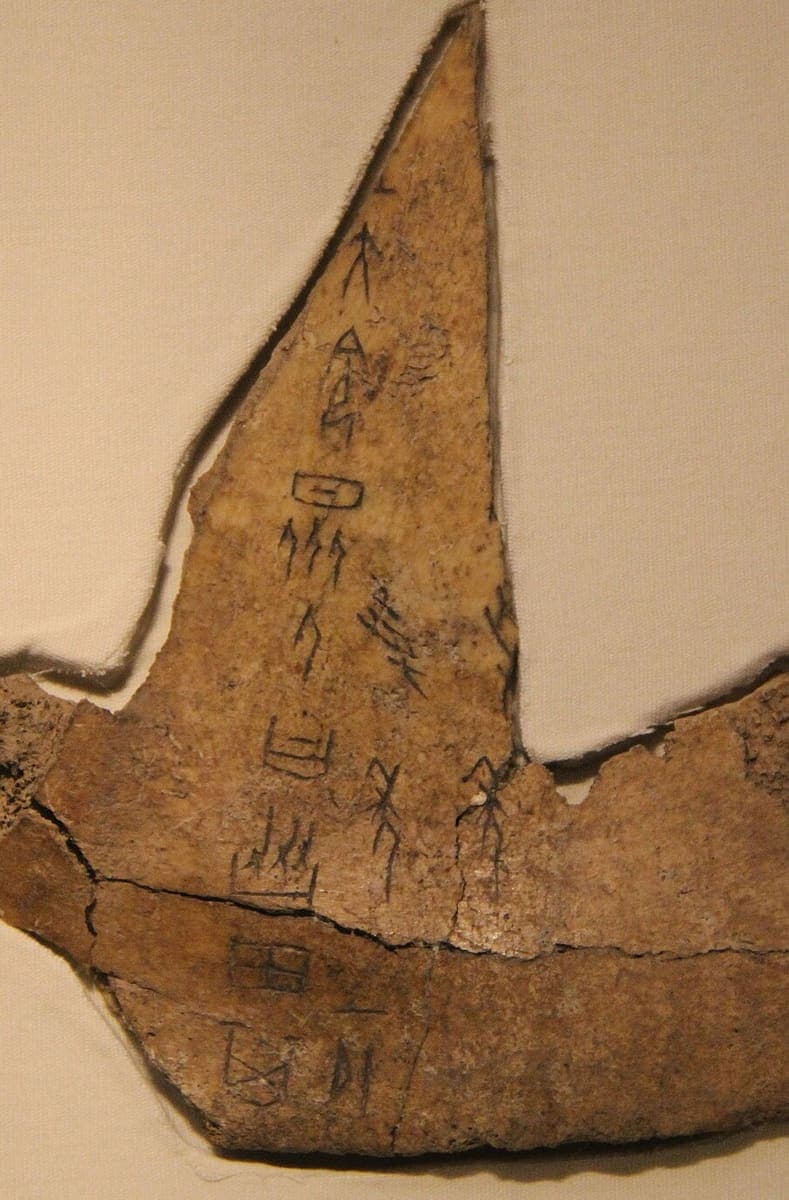
National Museum of China, joins Hebu 657, c. 1200 BCE · Source · CC0 1.0 · Photograph by Gary Todd
Evidano Transcription
[cut off]大令眾人曰劦田其
受[?]年[?][illegible]
[illegible]
Generated by Evidano’s advanced model; not yet checked against a published edition.
What an inscribed bone or shell looks like
The Shang court at Anyang divined by applying a heat source to hollows chiselled into the back of an ox scapula or a turtle plastron and reading the cracks that opened on the front. The charge, the diviner’s name, the day in the sixty-day ganzhi cycle, the king’s prognostication and sometimes a later verification were then incised beside them. Writing is therefore laid out around the cracks rather than in even columns: units are short, often paired as a positive and a negative charge on the two halves of a plastron, and each runs vertically but may be set to be read inwards from the right edge on one side and from the left edge on the other. A single bone can carry a dozen unrelated divinations cut on different days by different hands.
The graphs themselves are the ancestors of Chinese characters but not yet standardised. The same word may be written with components in different positions, with a different number of strokes, turned on its side, or mirrored, and the knife turns curves into straight segments and joins into sharp angles. Numerals are stacked horizontal strokes up to four; the ten ganzhi stems and twelve branches recur constantly and are the most reliable anchor in a damaged text. There is no punctuation and no word spacing, and a substantial minority of graphs have never been securely matched to a later character at all, so any transcription has to be able to say “this graph, undeciphered” instead of guessing.
Most of the corpus is studied from ink rubbings rather than from the pieces themselves. A rubbing is a negative: damp paper is beaten onto the surface and inked, so the incised strokes come out white on black and the broken edges of the fragment print as a ragged black silhouette. Roughly 150,000 inscribed pieces are known, catalogued by number in Jiaguwen heji (the Heji) and its supplements, and many are fragments that join pieces held elsewhere, which is why a reading is tied to a catalogue number rather than to a photograph.
Why ordinary OCR struggles here
Cracks and drill hollows that look like strokes
The T-shaped divination cracks, the chiselled hollows on the reverse, root marks and the fractures along which a bone broke all present as clean incised lines. Generic OCR takes them for parts of graphs, or lifts the numbered crack ordinals as if they were text.
Graphs that are not modern characters
Recognisers trained on printed Chinese snap every shape to a character in the standard Unicode blocks. Oracle-bone graphs often have no such equivalent, or several competing candidate readings; a usable output leaves the identification open rather than substituting a plausible modern character.
No punctuation and no fixed reading direction
Sentences are unmarked, and the order of units on a piece follows their position relative to the cracks and to the axis of the shell. A model that assumes one continuous top-to-bottom, right-to-left text interleaves two unrelated divinations into a single sentence, which is much harder to spot later than a missed graph.
Rubbings, photographs and hand copies behave differently
A rubbing gives white strokes on black with the fragment edge in solid ink; a raking-light photograph gives faint incisions on pale bone with strong shadows; a published hand copy is already an interpretation. Each needs different handling, and the transcription should record which of the three it came from.
Who works with this material
Palaeographers working through a catalogue
Anyone reading systematically through the Heji needs the units separated, the ganzhi days and diviner names picked out, and uncertain graphs flagged rather than silently resolved. A first pass over a plate of rubbings saves the hours spent copying out what is legible before the argument starts.
Museums and rubbing archives
Collections hold rubbings, photographs and cards for the same fragment under different numbers. Pulling the visible graphs and the catalogue number off each sheet makes it possible to match duplicates, spot pieces that join, and give the public catalogue something searchable beyond a shelf reference.
Historians of the calendar and of ritual
Work on the Shang calendar, on eclipse records and on sacrifice schedules depends on collecting every dated unit across thousands of pieces: the day sign, the month notation and the verb, captured consistently, with a pointer back to the plate.
Students learning the script
A transcription set beside the rubbing lets a beginner test a reading against a published one immediately, and a sexagenary table gives sixty known graphs to practise on before moving to a broken charge.
Getting the best transcription
Say what kind of image you are sending
State whether the file is a rubbing, a raking-light photograph or a hand copy, and for a rubbing say that white marks on the black ground are the incised strokes and that the ragged outline is the edge of the fragment. This alone prevents most of the nonsense readings on jiagu material.
Ask for units, not for a running text
Request one block per inscription unit, each with its position on the piece — right half, left half, lower edge, reverse — and let the units stay unordered. Deciding the sequence is an editorial judgement, and it is easier to make once the graphs are down.
Fix a convention for what cannot be read
Choose one marker for a lost graph, one for a visible but unidentified graph and one for an uncertain reading, and ask for them to be counted so a unit of nine graphs is not returned as seven. Ganzhi pairs and numerals should be labelled, since they are the pegs everything else hangs on.
Test on a piece with a published reading
Start with a well-known bone that already has a shiwen in print — a sexagenary table or a familiar Bin-group charge — and compare graph counts before running a whole plate. Errors show up as missing units far more often than as wrong graphs.
Further reading on this hand
The palaeography guides the in-app selector points to for this domain, if you want to check a transcription against the standard references.
- China's Calligraphic Arts
This Smithsonian National Museum of Asian Art resource surveys the development of Chinese writing and calligraphy from early inscriptions onward. It introduces writing on oracle bones, bronze, stone, bamboo, silk, and paper and relates writing tools to changes in graphic form. The guide distinguishes major script families and explains that early graphs differ markedly from later standardized characters. Its chronological and material framework is useful for recognizing oracle-bone writing as an incised archaeological system rather than ordinary brush calligraphy.
Frequently asked questions
- Can it read oracle-bone graphs that have no modern character?
- It can locate and describe them, and it can note the candidate identifications that have been proposed, but it will not force an unidentified graph into a modern character. In the output such graphs are marked and left for you to resolve against the reference works.
- Does it work better on rubbings or on photographs of the bone?
- Rubbings are usually clearer, because the strokes print as solid white lines with no shadow. Photographs carry what a rubbing loses — colour, pigment in the strokes, the hollows on the reverse — so run both where a piece has been published twice.
- How are the divination cracks and their numbers handled?
- The cracks are described as features rather than transcribed as graphs, and the small ordinal numbers cut beside them can be listed separately from the charge. You can ask for them to be omitted altogether if you only want the text.
- Will it put the inscription units in the right order?
- It reports each unit with its position and does not merge them. A matched pair of positive and negative charges on a plastron is noted as a pair, but the final reading order is left to the editor, because on many pieces it is still argued over.
- Can the output be matched to a Heji number?
- Yes. If you supply the catalogue number with the image it is carried through into the record, which is what makes a batch of transcriptions comparable with the published shiwen and with other fragments of the same bone.
Related scripts and pages
Transcribe your oracle-bone plates
Upload a rubbing or a photograph, choose Shang Oracle-Bone Inscriptions, and check the graph count against a published reading before running the rest.