
Chinese · c. 1046–221 BCE
Turn a bronze rubbing into a working text
Zhou inscriptions were cast, not written: the graphs sit in the curved wall of a vessel under two thousand years of patina, and most scholars meet them as ink rubbings taken from the inside of a basin or a cauldron. Evidano reads the columns in the order the caster laid them out, keeps the ligatured numerals and repetition marks as they stand, and flags the graphs that corrosion has eaten.
Sample pages
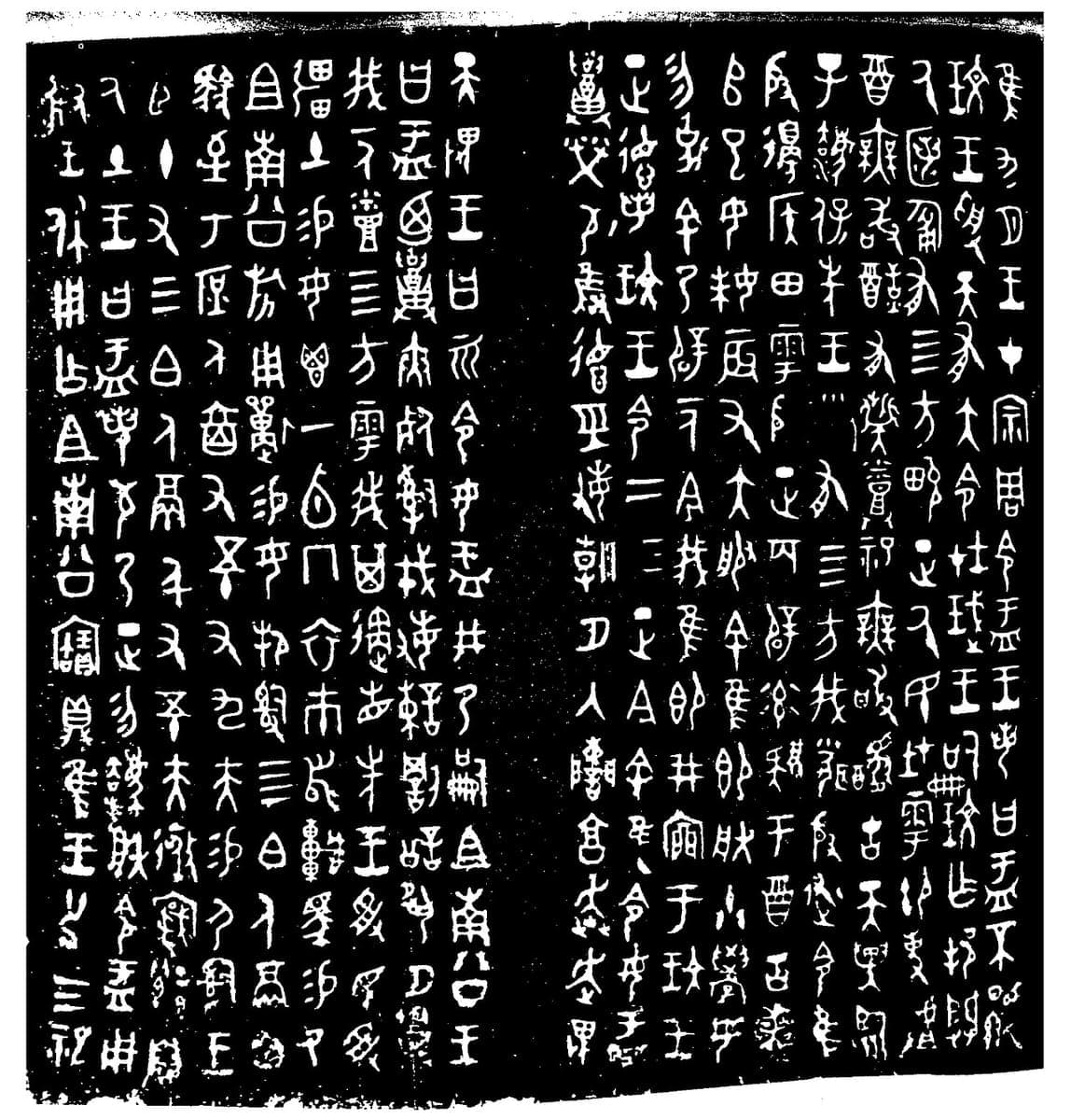
National Museum of China, Jicheng 2837, early Western Zhou, c. 1000 BCE · Source · Public domain
Evidano Transcription
The full inscription set out column by column against this rubbing (竪排拓片釋文) on Chinese Wikisource: nineteen lines of graphs in their conventional modern equivalents, with the blank column kept as an empty line. Stray spacing around rare characters has been closed up; no readings have been changed.
隹九月,王才宗周,令盂。王若曰:盂!不顯
玟王,受天有大令,杜珷王嗣玟乍邦,闢
氒匿,匍有亖方,㽙正氒民。杜𩁹𢓷事,𠭯
酉無𠭖酖,有祡蒸祀,无𠭖擾,古天異臨
子,灋保先王,匍有亖方。我䎽殷述令,隹
殷𠐈𥎦、田,𩁹殷正百辟,率肄于酉,古喪
𠂤。巳!女妹辰又大𦨕,余隹即𦨶小學。女
勿勉余乃辟一人,今我隹即井㐭于玟王
正德,若玟王令二三正。今余隹令女盂,
𥃝𤇾茍雝德巠,敏朝夕入讕,亯奔走,畏

天畏。王曰:而!令女盂井乃嗣且南公。王
曰:盂!𠧟𥃝夾,𣦸𤔲戎,敏誎罰訟,夙夕𥃝
我一人烝亖方,𩁹我𠀠遹省先王受民受
彊土,易女鬯一卣,冂、衣、巿、舃、𨏖馬,易乃
且南公旂,用𡃣。易女邦𤔲亖白,人鬲自
𩣓至于𤇈人六百又五十又九夫;易尸𤔲王
臣十又三白,人鬲千又五十夫,𢔔𡧿𨟦自
氒土。王曰:盂!若茍乃正,勿灋𦨶令!盂用
對王休,用乍且南公寶鼎,隹王廿又三祀。
Source: 大盂鼎銘文, 竪排拓片釋文, Chinese Wikisource (CC BY-SA 4.0).
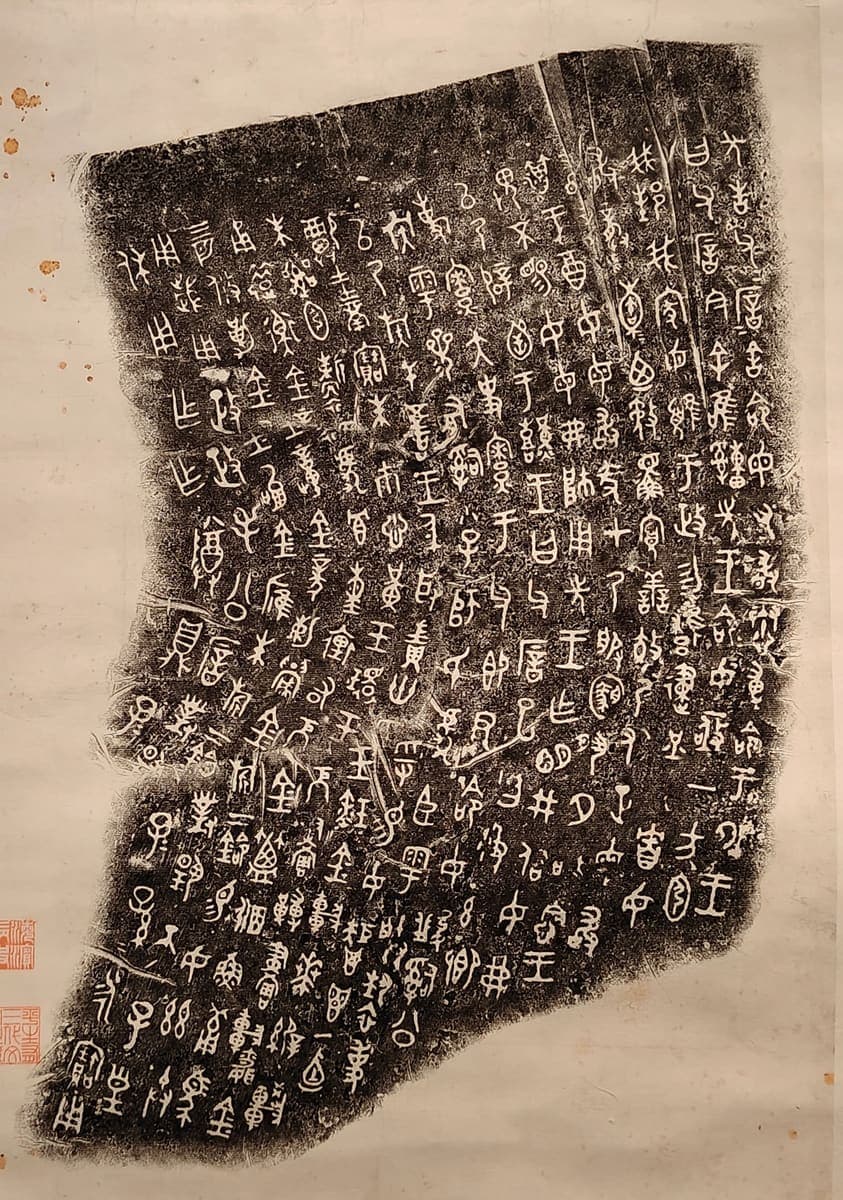
Shanghai Museum, Jicheng 2841 (vessel), late Western Zhou (rubbing, Qing dynasty) · Source · Public domain
Evidano Transcription
The complete inscription of the Mao Gong ding, of which this sheet carries part, in the reading edition on Chinese Wikisource. That page notes that its text is an interpreted reading rather than a graph-for-graph copy of the bronze: archaic forms are replaced by their standard equivalents and the king’s speeches are set as paragraphs.
王若曰:「父𫨏,丕顯文武,皇天引厭厥德,配我有周,膺受大命,率懷不庭方,亡不閈于文武耿光。唯天將集厥命,亦唯先正恪乂厥辟,庸勤大命,肆皇天亡斁,臨保我有周,丕鞏先王配命,旻天疾威,嗣余小子弗彶,邦將曷吉。𬋶𬋶四方,大嘩不靜。嗚呼!懼余小子圂湛于艱,永邛先王。」
王曰:「父𫨏,今余唯肇經先王命,命汝乂我邦、我家內外,憃于小大政,屏朕位,虩許上下若否雩四方尸,毋動余一人在位,矧唯乃智余非,庸有聞。汝毋敢荒寧,虔夙夕助我一人擁我邦小大猷,毋斦緘,告余先王若德。用仰卲皇天,申固大命,康能四國,欲我弗作先王羞。」
王曰:「父𫨏,雩之庶出入使于外,敷命敷政,設小大胥賦,無唯正聞。矧其唯王知,廼唯是喪我國。歷自今,出入敷命于外,厥非先告父𫨏,父𫨏捨命,毋有敢憃敷命于外。」
王曰:「父𫨏,今余唯申先王命,命汝極一方,𫸭我邦、我家。毋𲉮于政,勿壅□庶有□。毋敢龔㯱,龔㯱廼侮鰥寡。善教乃友正,毋敢𱩸于酒。汝毋敢惰,在乃服,恪夙夕敬念王威不易。汝毋弗帥用先王作明型,欲汝弗以乃辟陷于艱。」
王曰:「父𫨏,已!曰𬆠兹卿事寮、太史寮,于父即尹。命汝總司公族雩叄有司、小子、師氏、虎臣雩朕褻事。以乃族捍敔王身。取𧶲卅鋝。錫汝秬鬯一卣,祼圭瓚寶,朱韍、蔥衡、玉環、玉㻌、金車、𠦪𦃘較、朱𡄹、𫸭、鞎、虎冪熏裹、厷軶、畫𩌏、畫𨍌、金筩、錯衡、金踵、金轙、約軝、金簟茀、魚箙、馬四匹、鋚勒、金鉤、金膺、朱旂二鈴。錫汝兹訓,用歲用政。」
毛公𫨏對揚天子皇休,用作尊鼎,子子孫孫永寶用。
Source: 毛公鼎銘文, Chinese Wikisource (CC BY-SA 4.0).
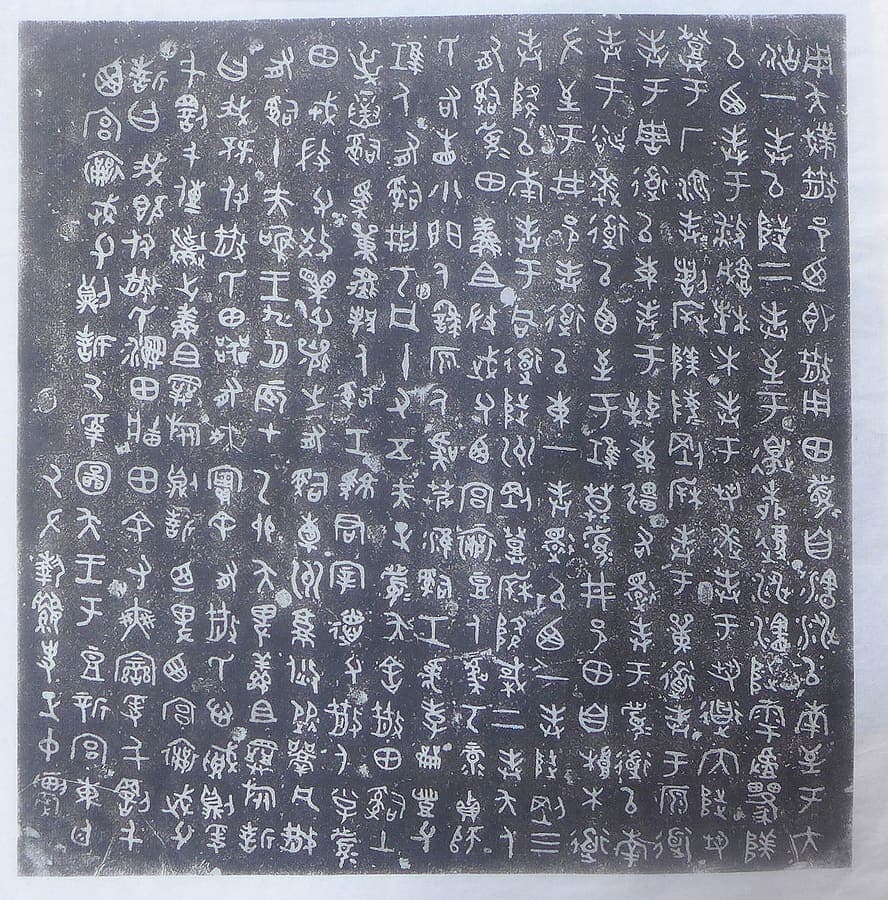
National Palace Museum, Taipei (vessel), Jicheng 10176, late Western Zhou (rubbing published 1912) · Source · Public domain
Evidano Transcription
The whole inscription in the reading edition on Chinese Wikisource, run on as four paragraphs rather than in the nineteen columns of the bronze. Round brackets give the standard character behind an archaic writing, a box marks a graph the editors leave unidentified, and rare forms are printed with their component structure noted.
用夨𫼆散邑,廼即散用田。履自𬉄涉,以南至于大沽,一封;以陟,二封;至于邊,柳。復涉𬉄,陟𩁹,□𨺰(美)
以西,封于𫿓城、楮木;封于芻逨,封于芻□(道);内陟芻,登于厂湶,封𪟈𣐼、𨺰陵、剛𣐼。封于原道,封于周道;以東封于□(⿰𣳂卓)東彊右;還,封于履道;以南,封于□(⿰谷者)逨道;以西,至于𨾊莫。履井邑田:自桹木道左至于井邑;封,道,以東一封;還,以西一封;陟崗,三封;降,以南,封于同道;陟州崗,登𣐼;降,棫;二封。
夨人有𤔲(司)履田:鮮且、𢼸、武父、西宮𬡫、豆人虞丂(考)、彔、貞、師氏右眚、小門人□(繇)、原人虞艿、淮𤔲(司)工虎、𫪡、豐父、𨾊人有𤔲(司)㓝、丂(考),凡十又五夫。正履夨舍散田:𤔲(司)徒屰(逆)寅𤔲(司)單堒、邦人𤔲(司)工𬳮君、宰德父;散人小子履田戎、𢼸父、𢼂(效)𪳐父、襄之有𤔲(司)橐、州□(⿱高京)、修從𩰫,凡散有𤔲(司)十夫。
隹(唯)王九月,辰在乙卯,夨卑(俾)鮮且、□旅誓曰:「我既付散氏田器,有爽,實余有散氏心賊,則爰千罰千,傳棄之。」鮮且、□旅則誓。廼卑(俾)西宮𬡫、武父誓曰:「我既付散氏隰田𬌅(畛)田,余有爽𫴥(䜌),爰千罰千。」西宮𬡫、武父則誓。厥受圖,夨王于豆新宮東廷。厥左執䌁(要)史正中農。
Source: 散氏盤銘文, Chinese Wikisource (CC BY-SA 4.0).
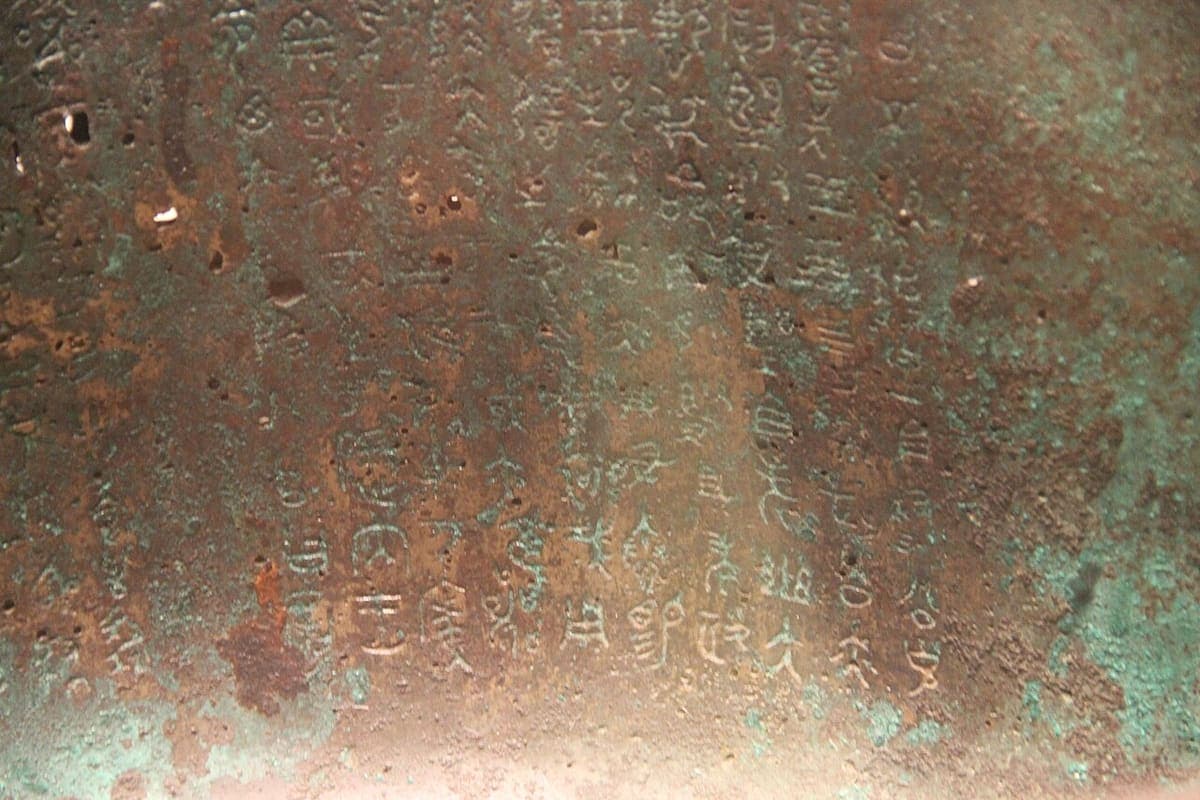
National Museum of China, late Western Zhou, reign of King Li · Source · CC0 1.0 · Photograph by Gary Todd
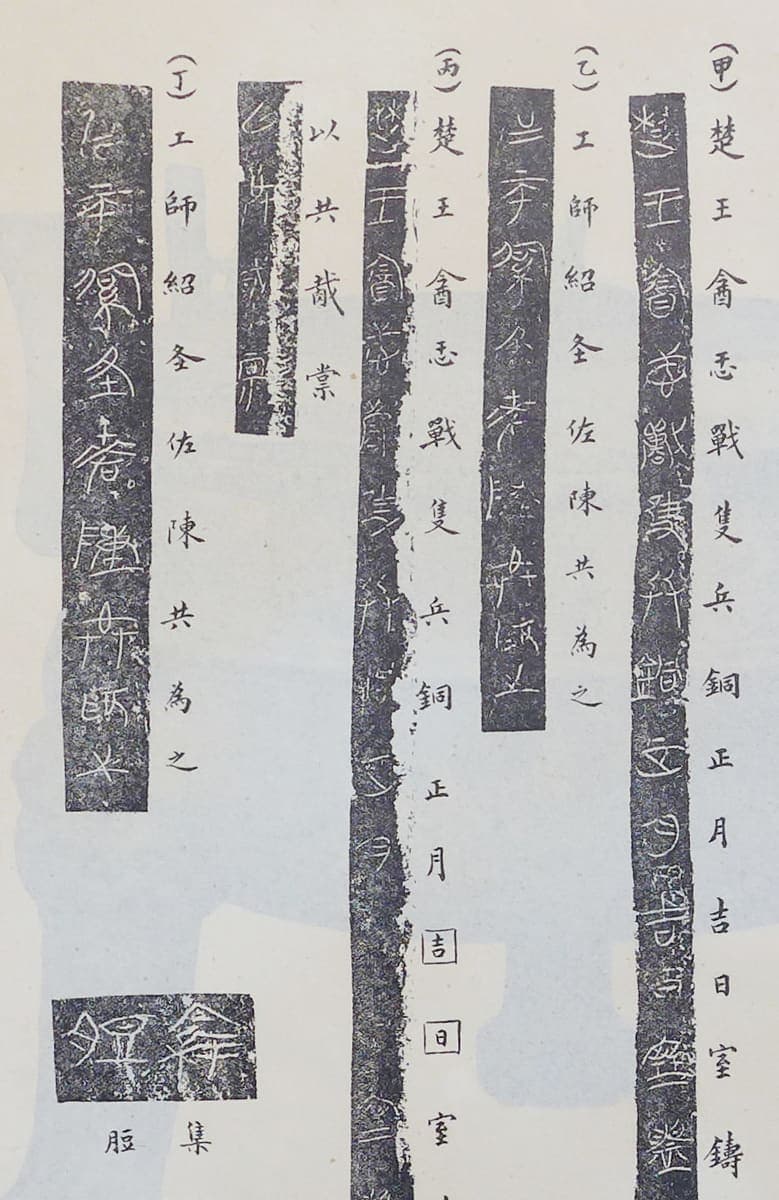
Tianjin Museum (vessel), Warring States (plate published 1954) · Source · Public domain
Evidano Transcription
(甲) 楚王酓忎戰隻兵銅正月吉日室鑄 [cut off]
(乙) 工師紹圣佐陳共為之
(丙) 楚王酓忎戰隻兵銅正月吉日室 [cut off]
以共歲[?]棠[?]
(丁) 工師紹圣佐陳共為之
脰 集
Generated by Evidano’s advanced model; not yet checked against a published edition.
What a cast inscription looks like
From the eleventh century BCE the Zhou aristocracy recorded royal appointments, campaigns, lawsuits and land settlements on the bronzes they used in ancestral sacrifice. The text was written into the clay model or piece-mould before casting, so it comes out raised or sunk in the metal, deep inside a ding cauldron, on the floor of a pan basin or on the inner face of a gui lid. It is set in vertical columns read from top to bottom and, in nearly every case, from right to left, sometimes ruled into a grid; there is no punctuation. Inscriptions range from a two-graph dedication to the 497 graphs of the Mao Gong ding, and the great ones open with a date formula naming month, moon-phase term and ganzhi day, then run through the king’s speech and close with the maker’s wish that his descendants use the vessel for ever.
The script is bronze script (jinwen), the immediate ancestor of the small seal script standardised under Qin. Strokes are even and tapering, brushed forms rounded rather than knife-cut, and the shapes are still fluid: components move around inside the graph, a phonetic can be swapped for another, and early vessels often carry a pictorial clan emblem that is not a word at all. Two abbreviating marks matter for counting: the repetition mark, a pair of short strokes meaning “repeat the preceding graph”, and the ligature, where two graphs such as a number and its unit are squeezed into a single square. From the eighth century regional traditions diverge, and Chu, Qi, Jin and Yue vessels of the Warring States are written in elongated or ornamented hands that a reader trained on Western Zhou forms will not recognise at sight.
The corpus is edited from rubbings, and the rubbing is a document in its own right. A sheet taken in the nineteenth century by a collector such as Chen Jieqi may be mounted as a hanging scroll, stamped with seals and inscribed with colophons; the same vessel may also be published as a photograph of the metal and as a printed transcription in regular script. The standard reference numbering is Yin Zhou jinwen jicheng, and a reading is worth little unless it says which of these three surfaces it was taken from.
Why ordinary OCR struggles here
Patina, casting flaws and curvature
On a photograph of the vessel itself the graphs compete with green corrosion, gas bubbles left by the casting, and the shadow line where the wall curves away from the camera. Strokes fade in and out along a single column, and generic OCR reads the pitting as extra marks or drops the graph entirely.
Graphs that predate the seal script
Bronze forms are not the small seal script and are certainly not modern characters, so a recogniser trained on print substitutes whatever looks nearest. Clan emblems, place names and personal names are the worst affected, since there is no context to correct the guess and no dictionary form to fall back on.
Ligatures and repetition marks distort the count
A ligature holds two words in one square and a repetition mark stands for a whole graph, so the number of squares on the bronze never matches the number of words in the text. Any transcription that silently expands or silently keeps them makes the columns impossible to line up with the image afterwards.
Rubbings carry later writing too
A mounted rubbing usually has collectors’ seals, a title slip and colophons in a nineteenth-century running hand around the inked area, and a catalogue plate may print a modern reading beside each sheet. These layers are centuries apart from the inscription and must be reported separately, not folded into it.
Who works with this material
Editors of bronze corpora
Compiling or revising a corpus means moving between the rubbing, the vessel and the earlier editions for every piece. A first transcription that follows the columns and marks the doubtful graphs gives the editor something to argue with instead of a blank sheet.
Excavation and museum staff
New hoards come out of the ground with dozens of inscribed vessels at once, and the site report needs a provisional reading and a graph count for each before specialists can be brought in. The same output feeds the label text and the accession record.
Historians of the Western Zhou state
Appointment inscriptions are the primary evidence for offices, fiefs and the royal calendar. Collecting the date formulae, the titles and the gift lists across hundreds of vessels is exactly the sort of repetitive extraction that is worth automating and then checking by hand.
Calligraphers and rubbing collectors
Studios and private collections hold rubbing sheets whose vessel is not identified. Reading enough of the text to match it against a published inscription turns an anonymous scroll into a known piece with a catalogue number.
Getting the best transcription
Name the surface before anything else
Tell the model whether it is looking at an ink rubbing, a photograph of the bronze or a printed plate, and where the inscription sits in the vessel. A rubbing inverts the tones, and a photograph adds shadows that the same prompt will otherwise treat as strokes.
Set the rule for ligatures and repetition marks
Decide whether a ligature is to be written as one unit or expanded, and whether a repetition mark is to be kept or resolved, then ask for the graph count per column either way. Column counts are what let you align the reading with the image.
Ask for emblems and later additions to be listed apart
Clan emblems, casting numbers and the seals and colophons on a mounted rubbing should come back as their own list, described rather than read, so that the inscription itself stays clean.
Start from a vessel with a published reading
Run a famous inscription first and compare column by column with its edition. The differences will show whether the prompt is producing an archaic-form copy or a modernised reading, which is a choice worth making deliberately before a long run.
Further reading on this hand
The palaeography guides the in-app selector points to for this domain, if you want to check a transcription against the standard references.
- China's Calligraphic Arts
This Smithsonian National Museum of Asian Art guide includes bronze inscriptions within a broad history of Chinese calligraphic media. It explains how writing appeared on ritual metal objects and how early inscriptional forms preceded standardized seal, clerical, and regular scripts. The resource relates graphical appearance to the techniques and surfaces on which writing was produced. It is useful for Zhou bronzes because it encourages attention to material context and to graph forms that cannot be read as later standard characters without comparison.
Frequently asked questions
- Does it read the archaic bronze forms or modern characters?
- Either, on request. A modernised reading is what most historians want, since it can be searched and compared with published editions; a copy that keeps the archaic writings is what a palaeographer needs. Asking for both, in parallel columns, is the safest option on an unfamiliar vessel.
- How are clan emblems handled?
- An emblem is described and its position recorded rather than converted into a character, because many are not words and have no accepted reading. If the emblem is one of the identified ones you can supply the identification and it will be used consistently across a batch.
- Can it work from a photograph of the vessel instead of a rubbing?
- Yes, though the results are weaker where the patina is heavy or the wall curves sharply away from the lens. Sending several exposures of the same area, or a rubbing alongside the photograph, recovers most of the graphs that a single image loses.
- What about Eastern Zhou regional scripts?
- Chu, Qi, Jin, Yue and Qin vessels of the Spring and Autumn and Warring States periods write the same words with different components and proportions, and some are deliberately ornamented. Saying which state or region a vessel comes from noticeably improves the reading.
- Will the seals and colophons on a mounted rubbing confuse it?
- They are recognised as later material and reported separately from the inscription. A red seal, a title slip in a Qing hand and a collector’s note can each be listed with its place on the sheet, which is useful when you are tracing the provenance of the rubbing itself.
Related scripts and pages
Read your bronze rubbings
Upload a rubbing sheet or a shot of the vessel wall, choose Western and Eastern Zhou Bronze Inscriptions, and compare the first column count with the published edition.