
Czech · c. 1700–1918
Ruled columns, three languages, one clerk’s hand
A Bohemian or Moravian register page is a grid: printed headings in Latin, German or Czech, and under them a parish priest’s Kurrent working quickly through names, house numbers, ages and causes of death. The information is in the relation between a cell and its heading, so a transcription that loses the columns loses the record.
Sample pages
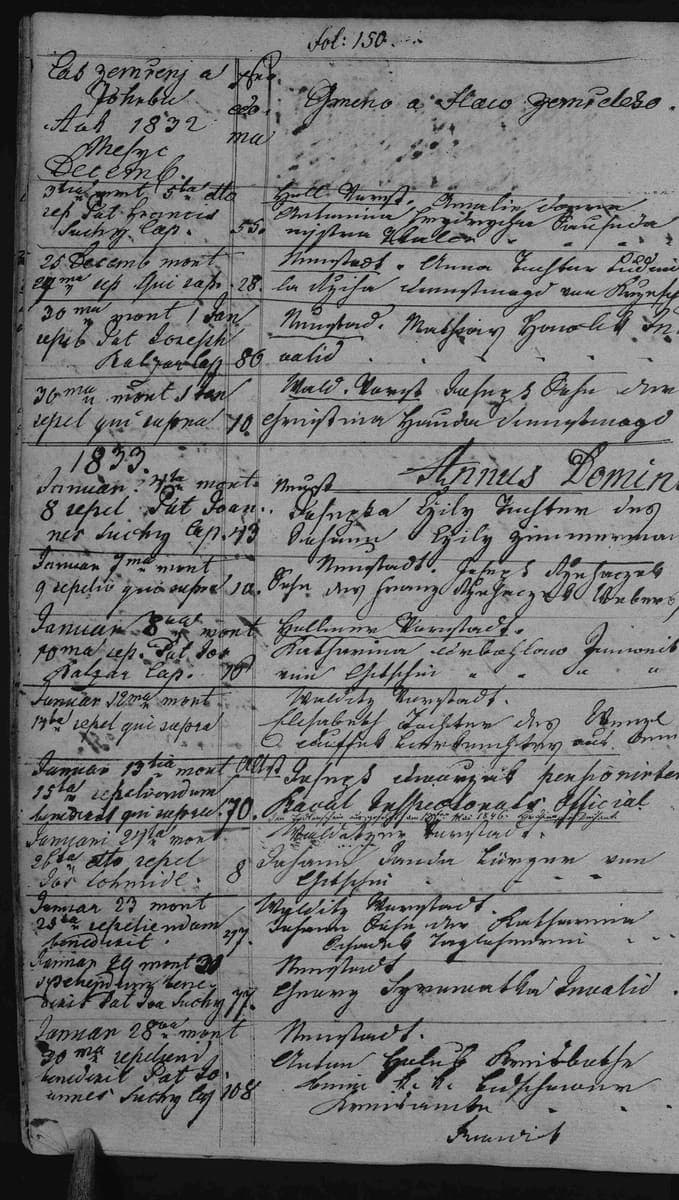
Státní oblastní archiv v Zámrsku, Jičín 70/35, 1810–1848, 1833 · Source · Public domain · Státní oblastní archiv v Zámrsku, digitised parish registers
Evidano Transcription
Fol: 150
| Cas zemřenj a Pohřbu Rok 1832 Měsyc Decemb. | Nro domu[?] | Gméno a Staw zemřelého. |
|---|---|---|
| 3tia[?] mort 5ta dto sep Pat Francis Suchy Cap. | 55. | Hall. Neust. Amalia [illegible] |
| 25 Decemb mort 27ma sep Qui sup. | 28. | Neustadt. Anna Tochter [illegible] Dienstmagd[?] von [illegible] |
| 30ma mort 1 Jan sepel Pat Joseph Balzar Cap | 86 | Neustadt. Mathias [illegible] Invalid |
| 30ma mort 1 Jan sepel qui supra | 10[?] | Mal. Neust. Josef Sohn der Christina [illegible] Dienstmagd[?] |
| 1833. Januar: 7ta mort 8 sepel Pat Joannes Suchy Cap. | 73 | Neust. Annus Domini Josepha Hily Tochter des Joseph Hily Zimmermann |
| Januar 7ma mort 9 sepeliv qui supra | 10. | Neustadt. Josef [illegible] Sohn des Franz [illegible] Webers |
| Januar 8va mort 10ma sep. Pat Jos Balzar Cap. | 70 | [illegible] Neustadt. Katharina [illegible] |
| Januar 12ma mort 14ta sepel qui supra | [illegible] Neustadt. Elisabeth Tochter des Wenzel [illegible] | |
| Januar 13tia mort 15ta sepeliendum benedixit qui supra. | 70. | Altst. Josef [illegible] pensionirter Kaval Inspectorats Official [small note dated 1846, illegible] |
| Januari 21ta mort 26ta dto sepel Pat [illegible] | 8 | [illegible] Neustadt. Susanna [illegible] |
| Januar 23 mort 25ta sepeliendum benedixit. | 27. | [illegible] Neustadt. Josef Sohn der Katharina [illegible] |
| Januar 24 mort 26 sepeliendum benedixit Pat Joa Suchy | 77. | Neustadt. Georg [illegible] Invalid |
| Januar 28va mort 30ma sepeliend benedixit Pat Joannes Suchy Cap | 108 | Neustadt. Anton [illegible] |
Generated by Evidano’s advanced model; not yet checked against a published edition.
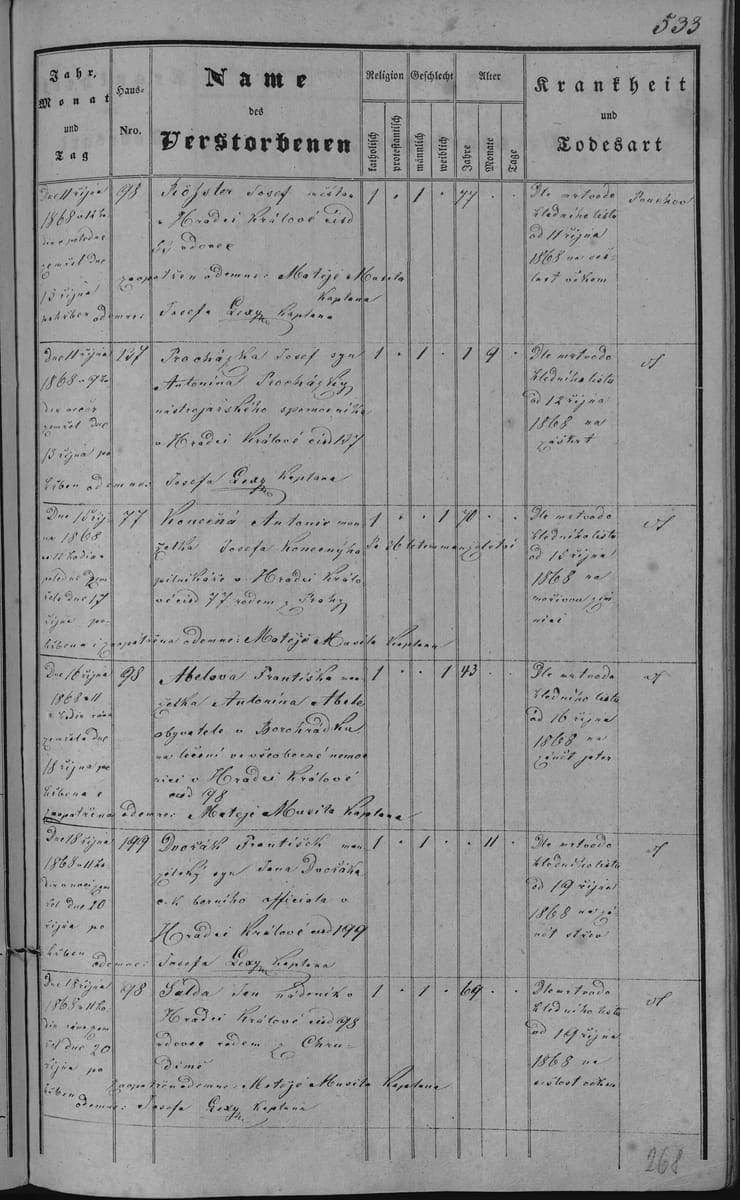
Státní oblastní archiv v Zámrsku, Hradec Králové 51/23, 1846–1875, 1868 · Source · Public domain · Státní oblastní archiv v Zámrsku, digitised parish registers
Evidano Transcription
533
| Jahr, Monat und Tag | Haus-Nro. | Name des Verstorbenen | Religion katholisch | Religion protestantisch | Geschlecht männlich | Geschlecht weiblich | Alter Jahre | Alter Monate | Alter Tage | Krankheit und Todesart | |
|---|---|---|---|---|---|---|---|---|---|---|---|
| Dne 11 října 1868 v 12[?] hodin v poledne zemřel dne 13 října pohřben od mne: | 98 | Rößler[?] Josef měšťan v Hradci Králové čís 98 vdovec zaopatřen od mne: Matěje Musila kaplana · Josefa Cízy kaplana | 1 | . | 1 | . | 77 | . | . | Dle mrtvoohledního listu dd 11 října 1868 na sešlost věkem | Pauchov |
| Dne 11 října 1868 v 9 hodin večer zemřel dne 13 října pohřben od mne: | 147 | Procházka Josef syn Antonína Procházky nástrojařského pomocníka v Hradci Králové čís 147 · Josefa Cízy kaplana | 1 | . | 1 | . | 1 | 4 | . | Dle mrtvoohledního listu dd 12 října 1868 na záškrt | 〃 |
| Dne 16 října 1868 v 11 hodin v poledne zemřela dne 17 října pohřbena i zaopatřena od mne: | 77 | Konečná Antonie manželka Josefa Konečnýho pilníkáře[?] v Hradci Králové čís 77 rodem z Prahy · Matěje Musila kaplana | 1 | . | . | 1 | 70 | . | . | Dle mrtvoohledního listu dd 16 října 1868 na mozkovou zimnici | 〃 |
| Po 26letém manželství | |||||||||||
| Dne 16 října 1868 v 11 hodin ráno zemřela dne 18 října pohřbena i zaopatřena od mne: | 98 | Abelova Františka manželka Antonína Abele obyvatele v Borohrádku na léčení ve všeobecné nemocnici v Hradci Králové čís 98 · Matěje Musila kaplana | 1 | . | . | 1 | 43 | . | . | Dle mrtvoohledního listu dd 16 října 1868 na zánět jater | 〃 |
| Dne 18 října 1868 v 11 hodin v noci zemřel dne 20 října pohřben od mne: | 199 | Dvořák František manželský syn Jana Dvořáka c. k. berního officiala v Hradci Králové čís 199 · Josefa Cízy kaplana | 1 | . | 1 | . | . | 11 | . | Dle mrtvoohledního listu dd 19 října 1868 na zánět střev | 〃 |
| Dne 18 října 1868 v 11 hodin ráno zemřel dne 20 října pohřben od mne: | 98 | Salda Jan nádeník v Hradci Králové čís 98 vdovec rodem z Chrudimě zaopatřen od mne: Matěje Musila kaplana · Josefa Cízy kaplana | 1 | . | 1 | . | 69 | . | . | Dle mrtvoohledního listu dd 19 října 1868 na sešlost věkem | 〃 |
268
Generated by Evidano’s advanced model; not yet checked against a published edition.
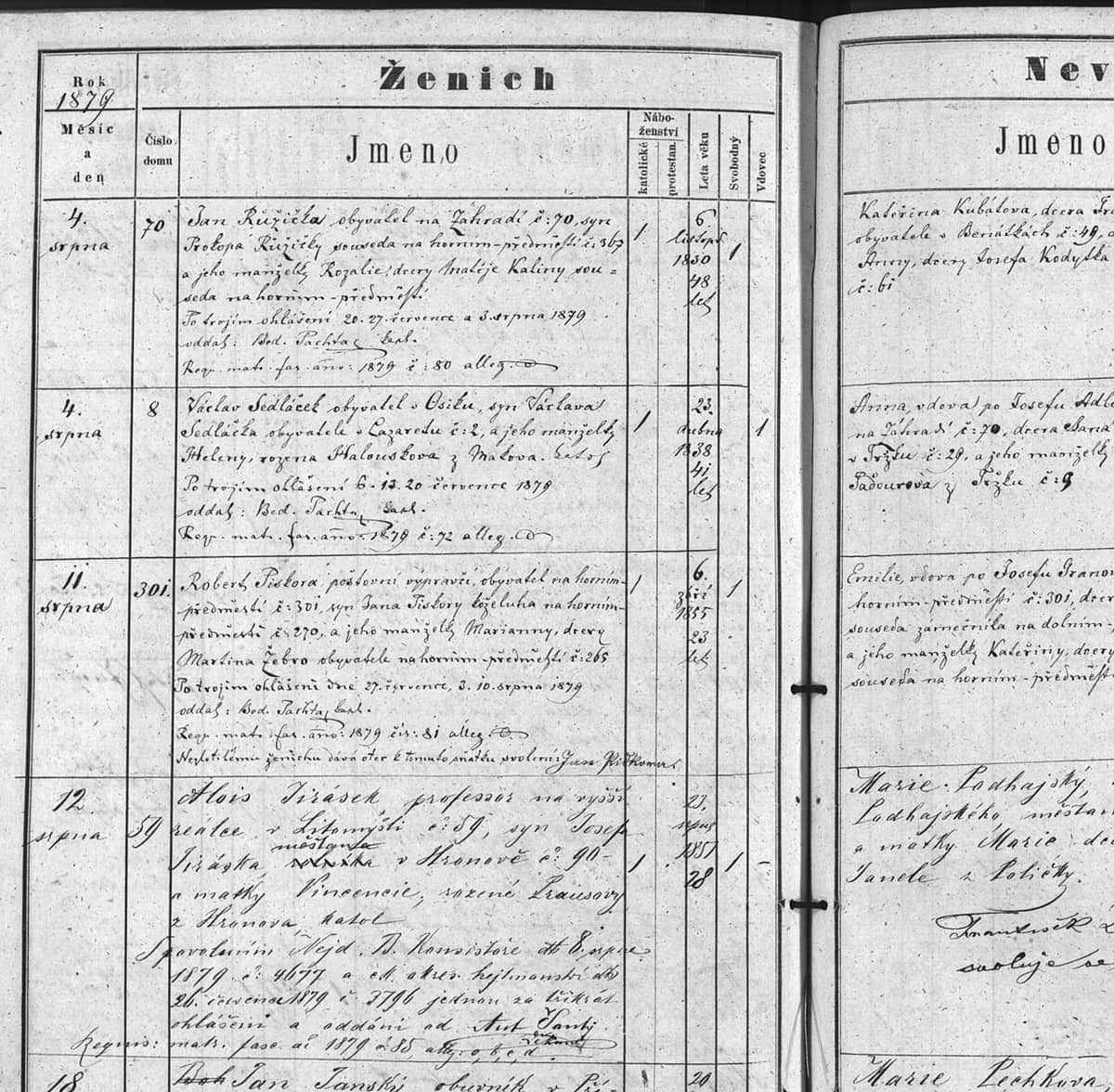
Státní oblastní archiv v Zámrsku, Litomyšl 5409, 1865–1884, 1879 · Source · Public domain · Státní oblastní archiv v Zámrsku, digitised parish registers
Evidano Transcription
| Rok 1879 Měsíc a den | Číslo domu | Ženich Jmeno | Náboženství katolické | Náboženství protestan. | Leta věku | Svobodný | Vdovec |
|---|---|---|---|---|---|---|---|
| 4. srpna | 70 | Jan Růžička obyvatel na Záhradí č: 70, syn Prokopa Růžičky souseda na horním-předměstí č: 367 a jeho manželky Rozalie, dcery Matěje Kaliny sou=seda na horním-předměstí. Po trojím ohlášení 20. 27. července a 3. srpna 1879 oddal: Bed. Pachta kapl. Reg. mat. far. ano: 1879 č: 80 alleg. | 1 | 6. listop. 1830 48 let | 1 | ||
| 4. srpna | 8 | Václav Sedláček obyvatel v Osiku, syn Václava Sedláčka obyvatele v Lazaretu č: 2, a jeho manželky Heleny, rozena Halouskova z Malova[?]. katol. Po trojím ohlášení 6. 13. 20 července 1879 oddal: Bed. Pachta kapl. Reg. mat. far. ano: 1879 č: 72 alleg. | 1 | 23. dubna 1838 41 let | 1 | ||
| 11. srpna | 301. | Robert Piskora poštovní výpravčí, obyvatel na horním-předměstí č: 301, syn Jana Piskory koželuha na horním-předměstí č: 270, a jeho manželky Marianny, dcery Martina Žebro obyvatele na horním-předměstí č: 265 Po trojím ohlášení dne 27. července, 3. 10. srpna 1879 oddal: Bed. Pachta kapl. Reg. mat. far. ano: 1879 čís: 81 alleg. Nezletilému ženichu dává otec k tomuto sňatku svolení: Jan Piskora | 1 | 6. září 1855 23 let | 1 | ||
| 12. srpna | 59 | Alois Jirásek professor na vyšší realce v Litomyšli č: 59, syn Josef[a] Jiráska měšťana [cancelled: illegible] v Hronově č: 90 a matky Vincencie, rozené Krausovy z Hronova katol. S povolením Nejd. B. Konsistoře dtto 8. srpna 1879 č: 4677 a c. k. okres. hejtmanství dtto 26. července 1879 č. 3796 jednou za třikrát ohlášeni a oddáni od Ant. Šantý[?] děkan. Reg. čís: mat. fasc. ao 1879 č. 85 alleg. a b c d | 1 | 23. srpna 1851 28 | 1 | — | |
| 18. | [cancelled: Boh] Jan Janský obuvník v P[cut off] | 20 |
Nev[ěsta] [right-hand page, cut off at the edge]
Jmeno
Kateřina Kubálova, dcera Fr[cut off]
obyvatele v Bernálkách[?] č: 49, a[cut off]
Anny, dcery Josefa Kodytka[?] [cut off]
č: 61
Anna, vdova po Josefu Adle[cut off]
na Záhradí č: 70, dcera Jana[?] [cut off]
v Tržku č: 29, a jeho manželky [cut off]
Paďourova z Tržku č: 9
Emilie, vdova po Josefu Granov[cut off]
horním-předměstí č: 301, dcer[cut off]
souseda zámečníka[?] na dolním-[cut off]
a jeho manželky Kateřiny, dcery [cut off]
souseda na horním-předměstí [cut off]
Marie Lodhajský[?] [cut off]
Lodhajského měšťan[cut off]
a matky Marie de[cut off]
Janele[?] z Poličky.
František L[cut off]
svoluje se[cut off]
Marie Pechkova[?] [cut off]
Generated by Evidano’s advanced model; not yet checked against a published edition.
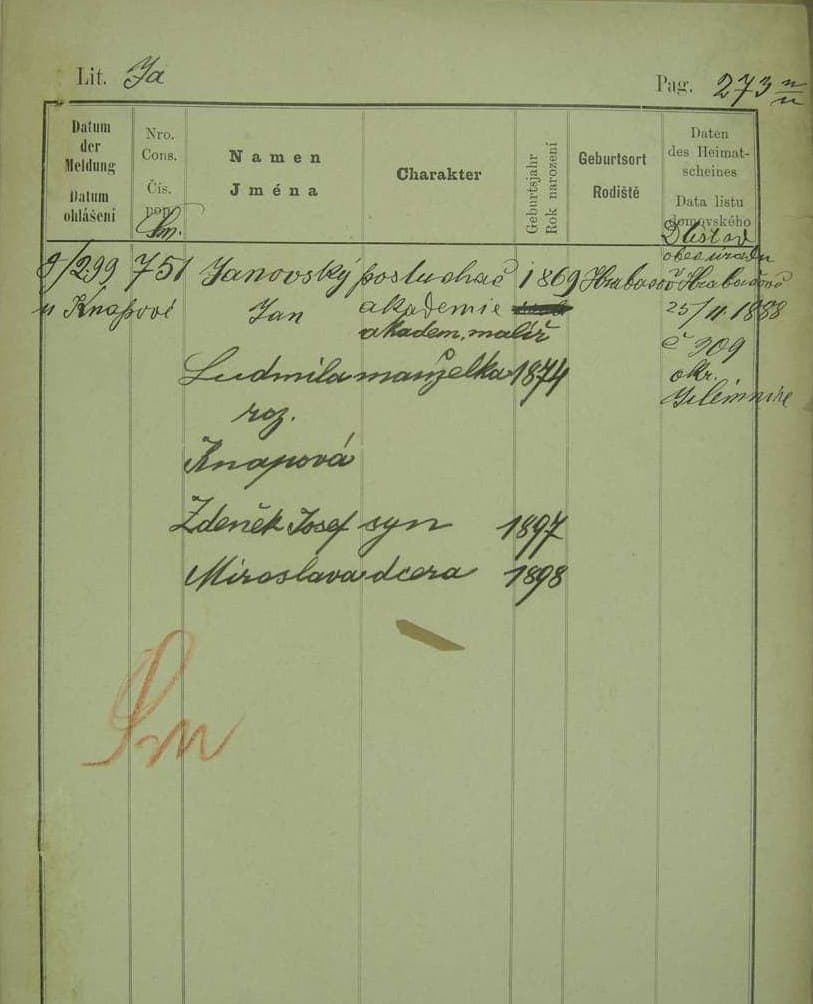
Národní archiv, Prague, Pobytové přihlášky pražského policejního ředitelství 1850–1914, c. 1900 · Source · Public domain · Národní archiv, Prague
Evidano Transcription
Lit. Ja | Pag. 273 n/n[?]
| Datum der Meldung / Datum ohlášení | Nro. Cons. / Čís. pop. | Namen / Jména | Charakter | Geburtsjahr / Rok narození | Geburtsort / Rodiště | Daten des Heimatscheines / Data listu domovského |
|---|---|---|---|---|---|---|
| 9/2 99 u Knapové | 751 | Janovský Jan | posluchač akademie [cancelled: illegible] akadem. malíř | 1869 | Hrabacov | D. list od obec. úřadu v Hrabacově 25/11 1888 č. 309 okr. Jilemnice |
| Ludmila roz. Knapová | manželka | 1874 | ||||
| Zdeněk Josef | syn | 1897 | ||||
| Miroslava | dcera | 1898 |
Sm [red pencil]
Generated by Evidano’s advanced model; not yet checked against a published edition.
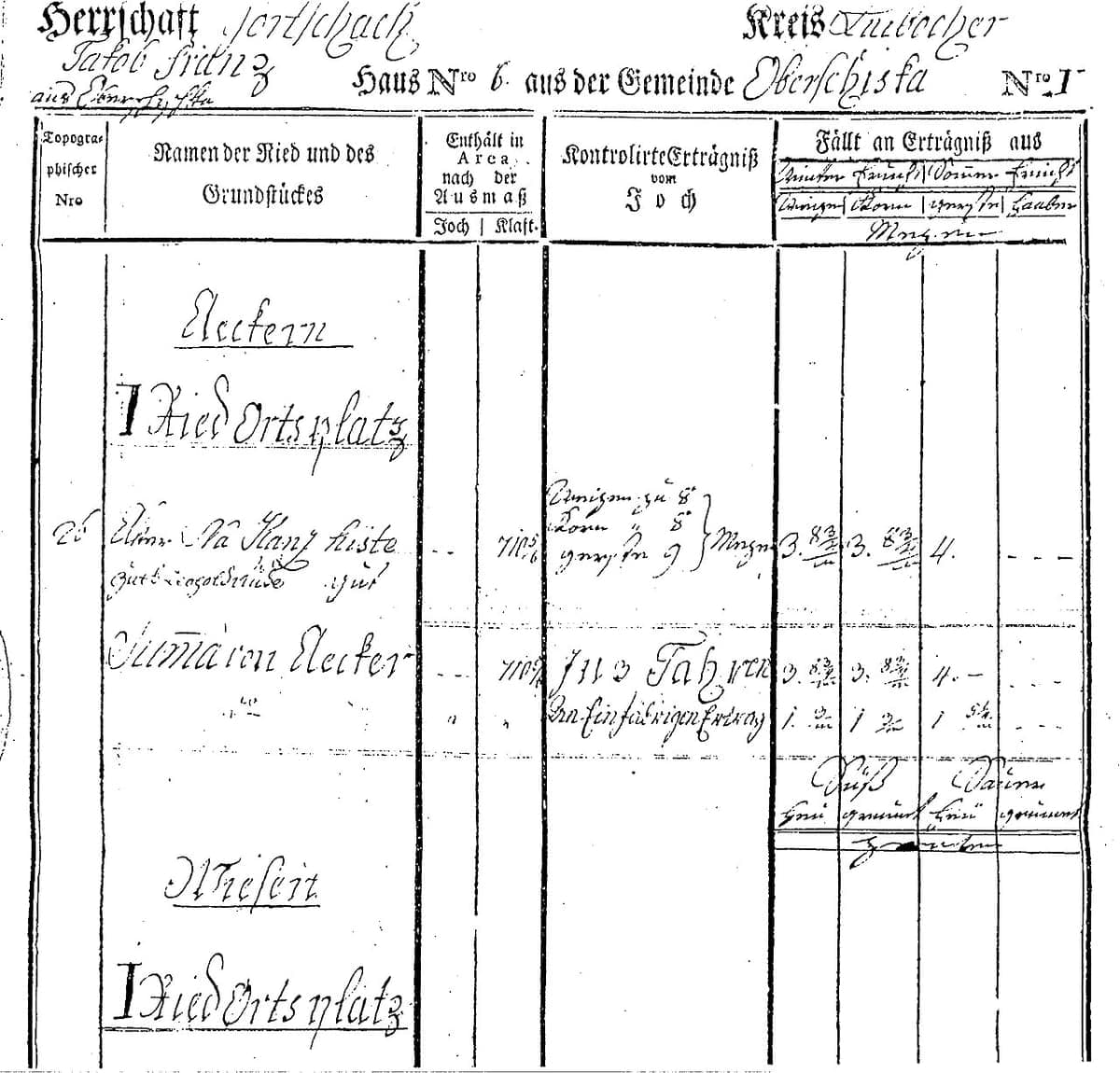
Source · Public domain · Josephine cadastre for Carniola
Evidano Transcription
Herrschaft Jortschach[?] Kreis Laibacher
Jakob Frenz[?] Haus Nro 6 aus der Gemeinde Oberschiska Nro I
aus [illegible]
| Topographischer Nro | Namen der Ried und des Grundstückes | Enthält in Area nach der Ausmaß Joch | Enthält in Area nach der Ausmaß Klaft. | Kontrolirte Erträgniß vom Joch | Fällt an Erträgniß aus: Winter frucht | Sommer frucht | ||
|---|---|---|---|---|---|---|---|---|
| Waizen | Korn | gersten | Haaber | |||||
| Metzen | ||||||||
| Aeckern | ||||||||
| I Ried Ortsplatz | ||||||||
| 25 | Acker die Planz liste[?] | -- | 710 5/6 | Waizen zu 8 / Korn " 8 / gersten 9 } Metzen | 3. 8 3/4 | 3. 8 3/4 | 4. | --- |
| gut [illegible] gut | ||||||||
| Suma von Aecker | -- | 710 5/6 | In 3 Jahren | 3. 8 3/4 | 3. 8 3/4 | 4. — | ||
| " | " | Den einjährigen Ertrag | 1. [?] | 1 [?] | 1 [?] | --- | ||
| Süß | Sauer | |||||||
| Heu | grumet | Heu | grumet | |||||
| Zentner | ||||||||
| Wiesen | ||||||||
| I Ried Ortsplatz |
Generated by Evidano’s advanced model; not yet checked against a published edition.
How the registers are built
Parish registers in the Habsburg lands were standardised in the eighteenth century and again by the patents of 1770 and 1784, which turned them into ruled tables with fixed columns and, from then on, into the state’s own civil record. An older volume is ruled by hand with Latin headings and runs its entries as short paragraphs; a nineteenth-century one is a printed form. The columns are always much the same — year, month and day, house number, name, religion, sex, age, and for deaths the illness and manner of death — so once the grid is known, every page in the volume can be read the same way.
The hand is German Kurrent, whatever the language of the entry. Its e, n, u and r are variations on one short stroke, the u carries a small bow to keep it apart from n, the long ſ drops below the line, and h and k throw loops into the line above. Into that alphabet the priest has to fit Czech, Slovak, German, Hungarian and Polish names, so Vaněk, Čapek and Šmíd arrive with their diacritics improvised or dropped, and the same family can appear as Kříž on one page and Kržische on another. From the 1860s Czech parishes begin printing their headings in Czech and writing in a Latin-script cursive, and the change can happen in the middle of a volume.
Around the registers sits a whole apparatus of forms built the same way. The Theresian and Josephine cadastres record each holding on a printed sheet with the fields, their area in Joch and Klafter and their yield entered in Kurrent; conscription and residence-registration cards carry bilingual German and Czech headings; military and school records follow the same logic. All of them mix printed type, handwriting, ditto marks, fractions, abbreviations for occupations and kinship, official stamps and later annotations added in a different ink.
Why ordinary OCR struggles here
The grid carries the meaning
A date, an age and a house number are only interpretable under their headings. Read as running text, a register page turns into a list of numbers with no owner, and a column of religion codes ends up attached to the wrong person.
Slavonic names in a German alphabet
Kurrent has no ž, č or ř, and the clerk improvises: a hook that could be a flourish, a doubled letter, or a German spelling of the sound. Recognition has to keep what is on the page while making the name findable, which means recording both the written form and a normalised one.
Ditto marks and abbreviations
Repeated villages, occupations and surnames are shown by a ditto mark, a stroke, or the word detto; kinship and status are abbreviated to two or three letters. Expanded silently, the entry looks complete; left unexpanded, it is unusable. Either way the reader has to be told which it is.
Faded ink, gutters and later hands
Bound volumes are photographed as openings, so the inner columns disappear into the gutter, ink has bled through from the other side, and a marginal note about a later marriage or a legitimation was added decades afterwards in a different hand.
Who works with this material
Genealogists and indexing volunteers
Czech, Slovak and Austrian registers are digitised by the million and indexed by hand, entry by entry. A first-pass transcription that fills the columns correctly, flags the doubtful names and leaves the ditto marks visible turns transcription work into checking work.
Historical demographers
Ages at death, causes of death, house numbers and family reconstitution all come out of these grids. The analysis stands or falls on whether a value stayed in its own column, and on whether repeated values were expanded honestly rather than guessed.
Local historians and house researchers
Cadastral sheets, land registers and residence cards tie a family to a numbered house and a parcel of ground. What they need is the numbers, the measures and the field names transcribed exactly, since a misread house number moves a family to the other end of the village.
Archives publishing digitised registers
A regional archive may put half a million scanned pages online with nothing but a volume-level description. Even a partial transcription of names and dates makes the collection searchable and takes weight off the reading room.
Getting the best transcription
Describe the table before the text
Give the column headings, in the language they are printed in, and ask for output row by row with each value under its heading. This single step removes most of the errors that make register transcription useless.
Ask for names twice
Request the name exactly as written and, separately, a normalised Czech, Slovak or German form. Searching needs the second; the evidence is in the first, and a page where one clerk wrote Kržische for Kříž is worth knowing about.
Set a rule for repeated values
Say whether ditto marks should be expanded and, if so, that the expansion must be marked as such. The same instruction should cover abbreviations for occupations, kinship and religion, which are the other place where a transcription quietly invents information.
Test where the language changes
Take a volume that crosses the 1860s and try a page of German headings and a page of Czech ones, plus a page with a marginal note added later. That covers nearly everything the rest of the series will do.
Further reading on this hand
The palaeography guides the in-app selector points to for this domain, if you want to check a transcription against the standard references.
- German: Gothic Handwriting
This Brigham Young University guide introduces Kurrent and related Gothic handwriting used across German-speaking and neighboring Central European regions. It supplies historical context and alphabet resources illustrating lowercase, capital, and writer-specific variants. The guide stresses regional and chronological variation and distinguishes Gothic cursive from Latin handwriting. It is useful for Czech and other Central European registers because Kurrent was often used regardless of whether the recorded names or words were German.
Frequently asked questions
- Can the printed headings and the handwriting be told apart?
- Yes, and they should be. The headings are read once and used as the structure of the output; the Kurrent entries are read per row. This also means a Fraktur heading is never reported as something the priest wrote about a particular family.
- How are Czech names written in Kurrent handled?
- They are transcribed as written, including a dropped hook or a German spelling of a Czech sound, with a normalised form supplied alongside. That way a search finds the family and the record still shows what the clerk actually put on the page.
- What happens to ditto marks in a column?
- They can be expanded from the value above, with a flag that the expansion was inferred, or kept as they stand. The choice is yours; what does not happen is a silent expansion that makes an inferred value look like a written one.
- Are ages, dates and fractions kept exactly?
- They are. Ages split into years, months and days stay in their own fields, cadastral areas in Joch and Klafter keep their fractions, and a date written in words is not converted to figures without being shown as it stands.
- Can it handle a volume that changes language halfway through?
- Yes. Each page is identified by the language of its headings and of its entries, so a register that switches from German Fraktur to Czech print, or from Kurrent to Latin script, is transcribed correctly on both sides of the change.
Related scripts and pages
Turn register pages into rows
Upload an opening from a parish register, a cadastral sheet or a registration card and get the columns back as structured, checkable text.