
Czech · c. 1526–1800
Three languages, three kinds of writing
A Bohemian office after 1526 wrote Czech in a looped chancery cursive, German in Kurrent or Fraktur type, and Latin in a rounder hand or in roman type — and it switched between them inside a sentence when the subject changed. Reading a privilege or a patent means recognising the switch as a switch, not as a change of spelling.
Sample pages
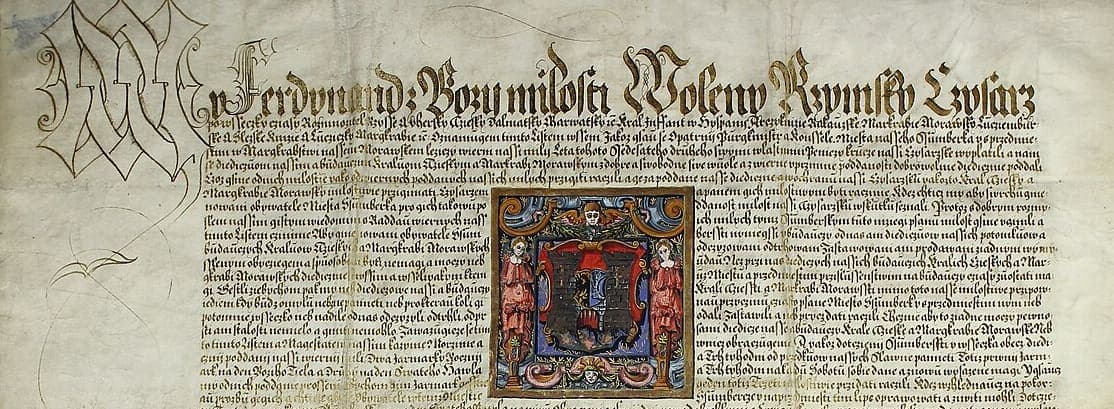
Státní okresní archiv Šumperk, Archiv města Šumperka, inv. č. 19, sig. 3, 23 April 1562 · Source · CC0 1.0 · Státní okresní archiv Šumperk
Evidano Transcription
My Ferdynand : Bozy milosti Woleny Rzymsky Cysarz
powsseczky czasy Rozmnozitel Rzysse A Vhersky Czesky Dalmatsky Charwatsky ꝛc Kral Infant w Hyspany Arczyknize Rakauzske Markrabie Morawsky Luczembur
ske A Slezske Knize A Luczizky[?] Margkrabie ꝛc Oznamugem timto Listem wssem Jakoz gsau se Opatrny Purgkmystr a Konssele · Miesta nasseho Ssumberka y s przedmie
stim w Margkrabstwi nassem Morawskem leziczy wierni nassi mily Leta tohoto Ssedesateho druheho swymi wlastnimi peniezy k rucze nassi Cysarzske wyplatili a nam
[?] diediczuom nassim a budauczim Kraluom Czeskym a Markraby Morawskym z dobre a swobodne swe wuole a z wierne vprzimne poddanosti dobrowolnie diediczne poddali
Coz gsme od nich milostiwie yako od wiernych poddanych nassich milych przigiti raczili a ge za poddane nasse diediczne a w ochranu nassi Cysarzsku yakozto Kral Czesky a
[remaining lines, on both sides of the painted arms, too small to read at this resolution]
Generated by Evidano’s advanced model; not yet checked against a published edition.
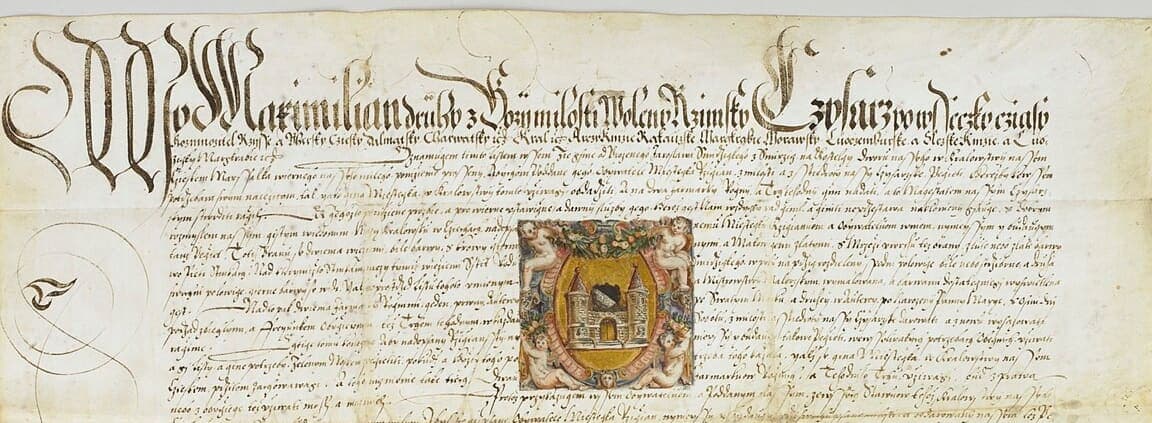
Státní okresní archiv Praha-venkov, Archiv města Říčany, 1575 · Source · Public domain · Státní okresní archiv Praha-venkov
Evidano Transcription
My Maximilian druhy z Bozy milosti Woleny Rzimsky Cysarz powsseczky[?] czasy
Rozmnozitel Rzysse a Vhersky Czesky dalmatsky Charwatsky ꝛc Kral ꝛc Arczyknize Rakauzske Margkrabie Morawsky Lucemburske a Slezske Knize a Lu
zicky[?] Margkrabie ꝛc Oznamugem timto listem wssem [remaining text illegible]
[remaining lines of small cursive, on both sides of the painted arms, too small to read at this resolution]
Generated by Evidano’s advanced model; not yet checked against a published edition.
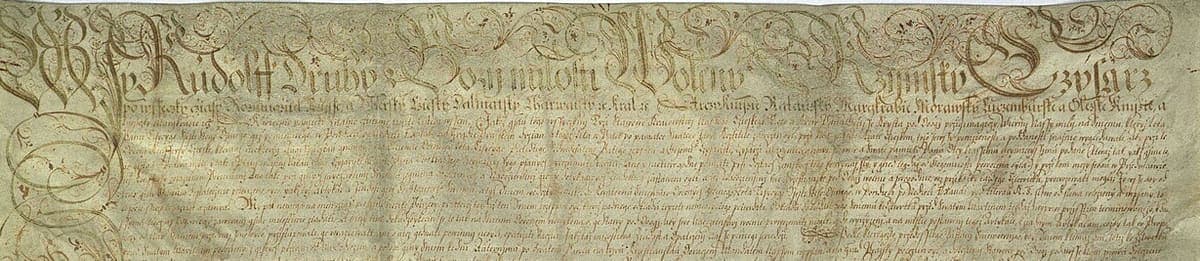
Národní archiv, Prague, Archiv České koruny, inv. č. 2293, 9 July 1609 · Source · Public domain · Národní archiv, Prague
Evidano Transcription
My Rudolff Druhy z Bozy milosti Woleny Rzimsky Czysarz
[body text (small chancery cursive) too small to read at this resolution]
Generated by Evidano’s advanced model; not yet checked against a published edition.
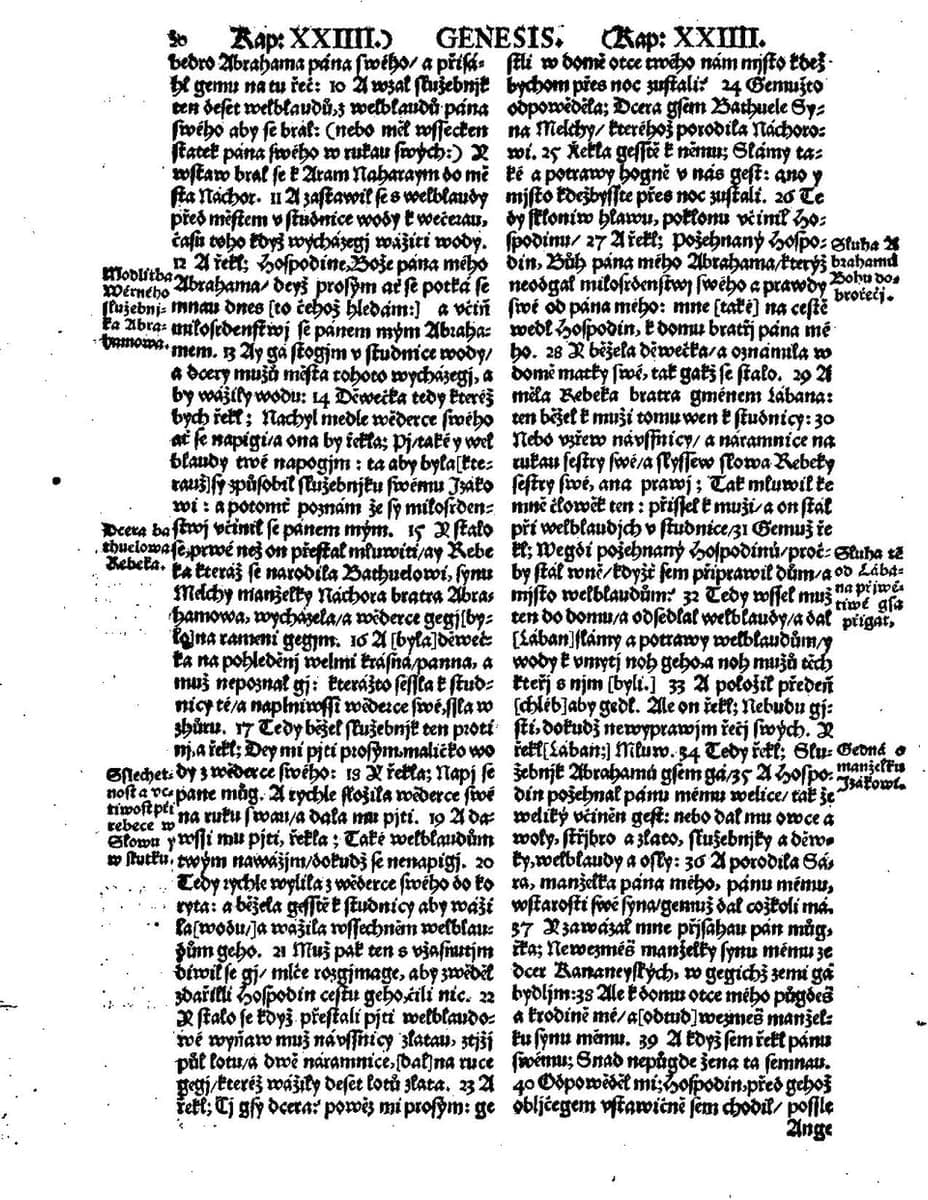
Source · Public domain · Scan of the 1613 edition on Wikimedia Commons
Evidano Transcription
Genesis 24:12–20, the left column of the page. The text is the Czech Wikisource transcription of this page of the same scan, which keeps the Brethren orthography (long ſ, ľ for the barred l, w for v, g for j) and marks editorial additions in square brackets.
12 A řekľ; Hoſpodine, Bože pána mého Abrahama/ deyž proſým ať ſe potká ſe mnau dnes [to čehož hledám:] a včiň miľoſrdenſtwj ſe pánem mým Abrahamem.
13 Ay gá ſtogjm v ſtudnice wody/ a dcery mužů měſta tohoto wycházegj, aby wážiľy wodu.
14 Děwečka tedy kteréž bych řekľ; Nachyľ medle wěderce ſwého ať ſe napigi/ a ona by řekľa; Pj/ také y weľbľaudy twé napogjm: ta aby byľa [kterauž] ſy způſobiľ ſľužebnjku ſwému Izákowi: a potomť poznám, že ſy miľoſrdenſtwj včiniľ ſe pánem mým.
15 Y ſtaľo ſe, prwé než on přeſtaľ mľuwiti/ ay Rebeka kteráž ſe narodiľa Bathuelowi, ſynu Melchy manžeľky Náchora bratra Abrahamowa, wycházeľa/ a wěderce gegj [byľo] na rameni gegjm.
16 A [byľa] děwečka na pohleděnj welmi kráſná/ panna, a muž nepoznaľ gj: kterážto ſeſſľa k ſtudnicy té/ a naplniwſſi wěderce ſwé, ſſľa wzhůru.
17 Tedy běžeľ ſľužebnjk ten proti nj, a řekľ; Dey mi pjti proſým, maličko wody z wěderce ſwého:
18 Y řekľa; Napj ſe pane můg. A rychle ſľožiľa wěderce ſwé na ruku ſwau/ a daľa mu pjti.
19 A dawſſi mu pjti, řekľa; Také weľbľaudům twým nawážjm/ dokudž ſe nenapigj.
20 Tedy rychle wyliľa z wěderce ſwého do koryta: a běžeľa geſſtě k ſtudnicy aby wážiľa [wodu/] a wážiľa wſſechněm weľbľaudům geho.
Source: Bible kralická (1613)/Genesis, transcribed from this scan on Czech Wikisource (Public domain).
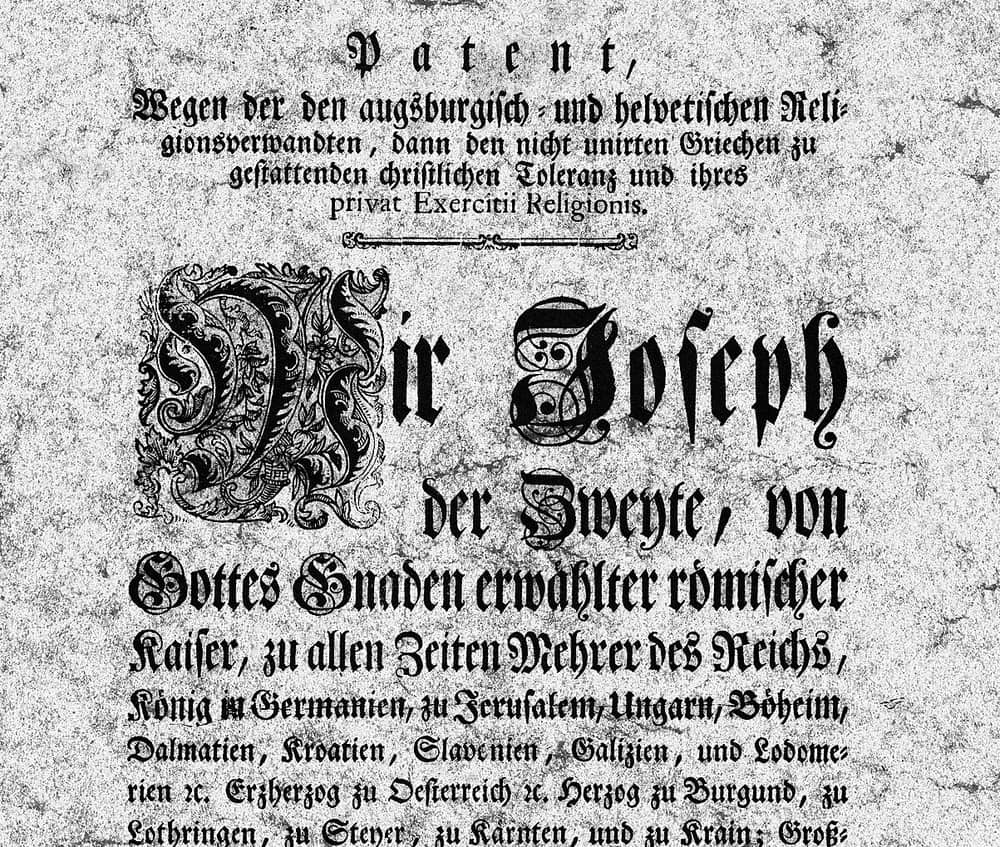
Source · Public domain · Scan of a facsimile of the printed patent
Evidano Transcription
P a t e n t ,
Wegen der den augsburgisch= und helvetischen Reli=
gionsverwandten, dann den nicht unirten Griechen zu
gestattenden christlichen Toleranz und ihres
privat Exercitii Religionis.
Wir Joseph
der Zweyte, von
Gottes Gnaden erwählter römischer
Kaiser, zu allen Zeiten Mehrer des Reichs,
König in Germanien, zu Jerusalem, Ungarn, Böheim,
Dalmatien, Kroatien, Slavenien, Galizien, und Lodome=
rien ꝛc. Erzherzog zu Oesterreich ꝛc. Herzog zu Burgund, zu
Lothringen, zu Steyer, zu Kärnten, und zu Krain; Groß=
[cut off]
Generated by Evidano’s advanced model; not yet checked against a published edition.
What the Bohemian chancery produced
From the accession of Ferdinand I in 1526 the Bohemian lands are governed through a chancery that works in Czech, German and Latin at once. Solemn charters keep the medieval shape: a huge decorated display line carrying the ruler’s name and titles, a text block in a small, even chancery cursive, a dating clause, and a pendant seal in a metal case. Underneath the calligraphy the everyday hand is a looped cursive with tall ascenders, a long ſ that reaches below the line, and the Czech letters ě, ř, ž, ů marked by a dot, a hook or a superscript o, all of which can be lost in the ruling.
Language use follows the business. Czech remains the language of privileges for Czech towns, of land tables and of much internal correspondence into the seventeenth century; German gains ground steadily and dominates after 1627, when the Renewed Land Ordinance puts it on an equal footing; Latin holds the dating formula, the chancery subscription — Ad mandatum Sacrae Caesareae Maiestatis proprium — and the vocabulary of law. Printed patents mirror the same division on the page: German set in Fraktur, Latin words and legal terms in roman type inside the same sentence.
Numbers, money and dates are their own small system. Sums appear in kopy grošů, zlatých and krejcarů, quantities in strychy and lány, and dates run either by the feast day (na den svatého Jiří) or by the Roman-numeral year in the Latin clause. Registration notes, chancery numbers and later archival hands crowd the dorse and the lower margin; the parchment itself is folded, sealed and, in one famous case, cut through.
Why ordinary OCR struggles here
Display script that is barely writing
The opening line of a charter is drawn, not written: letters two or three centimetres tall, filled with pen-work, with the ruler’s name stretched across a third of the sheet. It carries the identification of the document, so it cannot be skipped, but it needs to be read as calligraphy rather than as ordinary script.
A language change with no visual warning
A Czech sentence can end in a Latin dating clause and a German patent can carry Latin terms in a different typeface every other line. Forced into one language, the recognition mangles whichever passages belong to the other, and those are usually the legally decisive ones.
Fraktur and antiqua in one line
Printed patents deliberately set foreign words in roman type inside Fraktur text. Generic OCR trained on one of the two founts loses the other, so precisely the Latin technical terms — the words that say what the patent does — come out as noise.
Damage, folds and later interventions
These documents were folded around seals, stored in chests, cut, repaired and annotated by archivists over four centuries. Cracks pass through words, ink has faded to the colour of the parchment, and a nineteenth-century pencil number sits in the margin of a sixteenth-century text.
Who works with this material
Town and regional archives
Municipal privileges, guild charters and correspondence make up the founding series of every Bohemian town archive, and their inventories give a date and a summary. A transcription that reports the display line, the disposition and the subscription separately turns each item into a searchable record.
Legal and constitutional historians
The documents of 1526 to 1627 are the evidence in a long argument about how much the Bohemian estates conceded and when. Working on it means quoting exact wording, in the language it was written in, with the Latin formulas intact rather than translated.
Historians of the book and of religion
The Kralice Bible, the patents of the Counter-Reformation and the toleration legislation of the 1780s belong to the same story. Comparing editions and issues of a printed text needs the page transcribed as set, including which words were put into roman type.
Estate and family researchers
Grants, confirmations and land records name holders, villages, dues and measures. What matters is that names and quantities survive the transcription unchanged, since the argument is usually about who held what and on what terms.
Getting the best transcription
Give the document its structure
Ask for the display line, the body, the dating clause, the subscription and any dorsal note as separate fields. Bohemian charters are formulaic enough that this structure is stable, and it is what makes two documents comparable.
Declare the language mix
State that Czech, German and Latin may all appear and that each stretch should be labelled. Then Latin abbreviations get Latin expansions, German gets German ones, and Czech diacritics are not read as stray marks in a German word.
Ask for typefaces to be distinguished in printed items
On a patent, request a note of which words are set in roman type inside the Fraktur. That single distinction recovers the legal vocabulary, and it also tells you which terms the printer treated as foreign.
Test on a charter opening and on a damaged fold
The opening shows whether calligraphic display letters are read; a crack or a fold shows whether losses are marked instead of invented. Both are cheap tests, and together they predict how much review a whole fonds will need.
Further reading on this hand
The palaeography guides the in-app selector points to for this domain, if you want to check a transcription against the standard references.
- Dawne Pismo
This National Archives in Kraków project teaches scripts used across the multilingual archival culture of Central Europe. Its historical materials and exercises include Latin, vernacular Humanistic hands, and German Gothic cursive alongside explanations of abbreviations and document formulas. The site emphasizes chronological letterform change and the need to distinguish script from language. It is useful for Habsburg Bohemian records where Czech, German, and Latin may each appear in a different handwriting system.
Frequently asked questions
- Can the enormous first line of a charter be transcribed?
- Yes. Drawn display letters are read as letters where they are letters and described where the pen-work is purely ornamental, so the ruler’s name and title appear in the transcription instead of being dropped as decoration.
- How are Czech, German and Latin kept apart?
- Each stretch is labelled with its language, and expansions follow the rules of that language. This matters most at the end of a document, where a Czech text usually closes with a Latin dating clause and a Latin chancery subscription.
- What happens with Fraktur and roman type in one sentence?
- Both are recognised, and you can ask for the roman-type words to be marked. In eighteenth-century patents these are the Latin legal terms, so keeping them flagged preserves a distinction the printer made deliberately.
- Are sums and measures converted?
- No. Kopy grošů, zlaté, krejcary, lány and strychy are transcribed as written, with the numeral in the form it appears. A conversion can be added as a note, but the figure in the text stays the figure the scribe wrote.
- Can it deal with a sheet that is cracked or cut?
- Damage is marked at the point where it interrupts the text, with a partial reading where enough survives. On a document such as the Letter of Majesty, where the parchment itself was cut, that mark is part of the historical record and should not be smoothed away.
Related scripts and pages
Transcribe a Bohemian charter or patent
Upload a privilege, a printed patent or a page of a register and get the Czech, German and Latin returned as separate, labelled text.