
German · c. 1650–1915
Turn German Kurrent letters and registers into checked text
For two and a half centuries almost every German speaker who could write used Kurrent: a connected, angular cursive in which a letter’s shape depends heavily on the strokes joining it to its neighbours. Evidano reads Kurrent from parish register entries to personal letters, distinguishing the handful of letters that cause most of the trouble and keeping later corrections separate from the original hand.
Sample pages
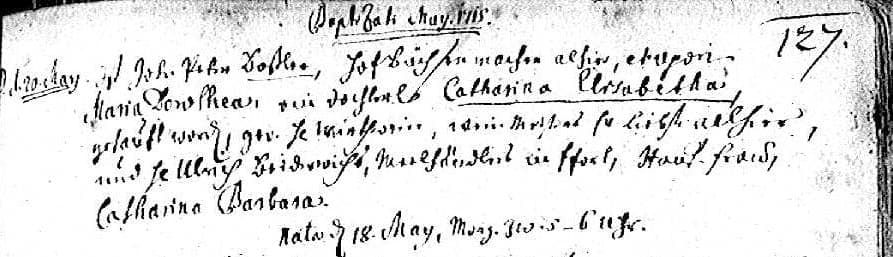
Zentralarchiv der Evangelischen Kirche in Hessen und Nassau, 20 May 1715 · Source · Public domain
Evidano Transcription
Baptizati May. 1715.
d. 20. May. Ist Joh. Peter Kößler[?], Hoffbüchsenmacher allhier, et uxori
Maria Dorotheae ein Töchterl. Catharina Elisabetha,
getaufft word[en], gev. Fr. Wintherin, weinMeisters Eheliebste allhier,
und Hr. Ulrich Bridewitz[?], Marckhändlers[?] in Pfort, Hauß-frau,
Catharina Barbara.
nata d. 18. May, Morg. zw. 5 - 6 Uhr.
Generated by Evidano’s advanced model; not yet checked against a published edition.
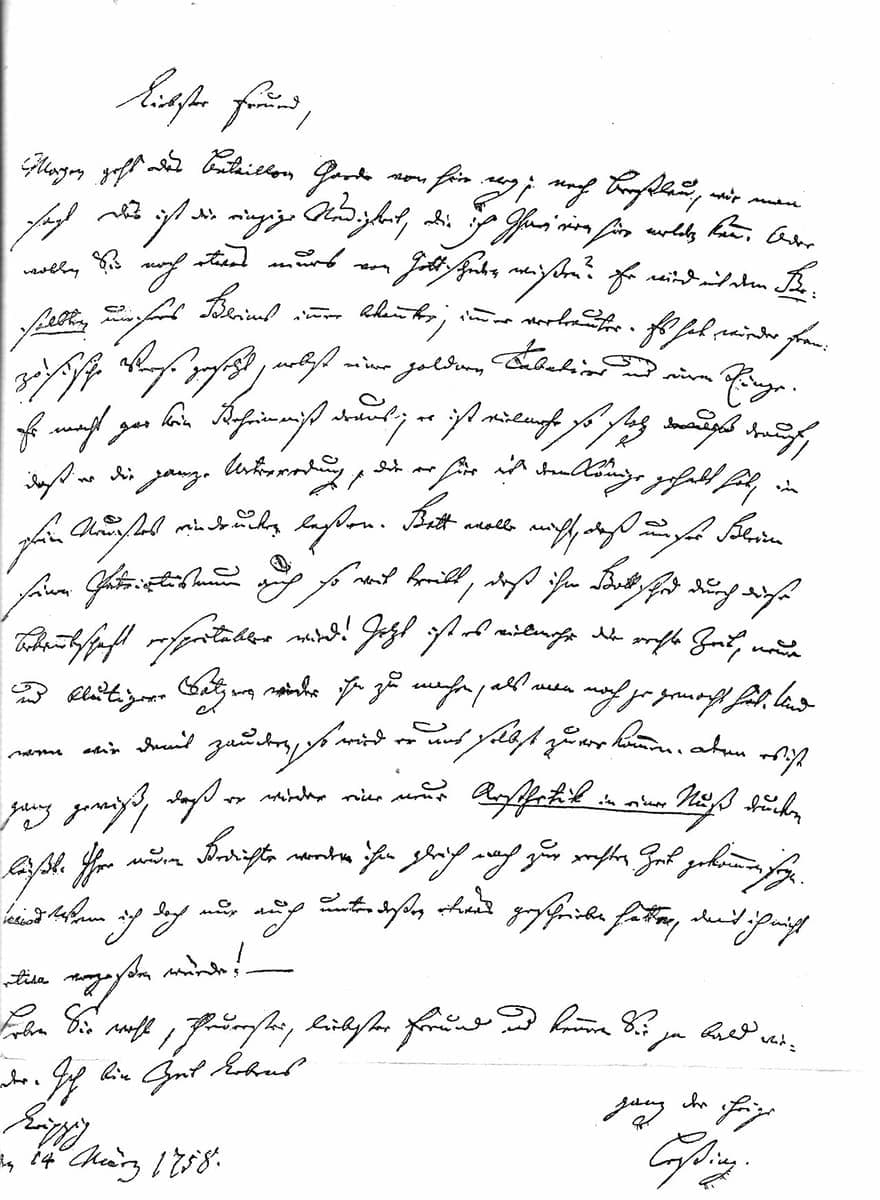
Bayerische Staatsbibliothek, Munich, 14 March 1758 · Source · Public domain
Evidano Transcription
What is on this sheet: the salutation, then the passage Muncker prints at page 144, lines 13–33, down to the signature. The letter’s opening paragraphs — Muncker page 143 line 4 to page 144 line 12, which begin “Unser Gleim ist ein rechter böser Mann” — are not here; Muncker records that the letter was reproduced in facsimile only from page 144 line 13 onwards. The text is Muncker’s printed edition, which normalises Lessing’s spelling rather than transcribing the hand diplomatically, and it was read from the page scans rather than from the Internet Archive’s Fraktur OCR. On the sheet the place-and-date line and the subscription sit side by side; they are stacked here.
Liebster Freund,
Morgen geht das Bataillon Garde von hier weg; nach Breßlau, wie man sagt. Das ist die einzige Neuigkeit, die ich Ihnen von hier melden kann. Oder wollen Sie noch etwas neues von Gottscheden wißen? Er wird mit dem Gesalbten unsers Gleims immer bekannter, immer vertrauter. Es hat wieder französische Verse gesetzt, nebst einer goldnen Tabatiere und einem Ringe. Er macht gar kein Geheimniß draus; er ist vielmehr so stolz drauf, daß er die ganze Unterredung, die er hier mit dem Könige gehabt hat, in sein Neustes eindrucken laßen. Gott wolle nicht, daß unser Gleim seinen Patriotismum auch so weit treibt, daß ihm Gottsched durch diese Bekanntschaft respectabler wird! Jetzt ist es vielmehr die rechte Zeit, neue und blutigere Satyren wider ihn zu machen, als man noch je gemacht hat. Und wenn wir damit zaudern, so wird er uns selbst zuvor kommen. Denn es ist ganz gewiß, daß er wieder eine neue Aesthetik in einer Nuß drucken läßt. Ihre neuen Gedichte werden ihm gleich noch zur rechten Zeit gekommen seyn. Wenn ich doch nur auch unterdeßen etwas geschrieben hätte, damit ich nicht etwa vergeßen würde! —
Leben Sie wohl, theuerster, liebster Freund und kommen Sie ja bald wieder. Ich bin Zeit Lebens
Leipzig, den 14 März 1758.
ganz der ihrige
Leßing.
Source: Briefe von und an Gotthold Ephraim Lessing, ed. Franz Muncker, vol. 1 (Leipzig, 1904), letter 96, pp. 143–144, via Internet Archive (Public domain).
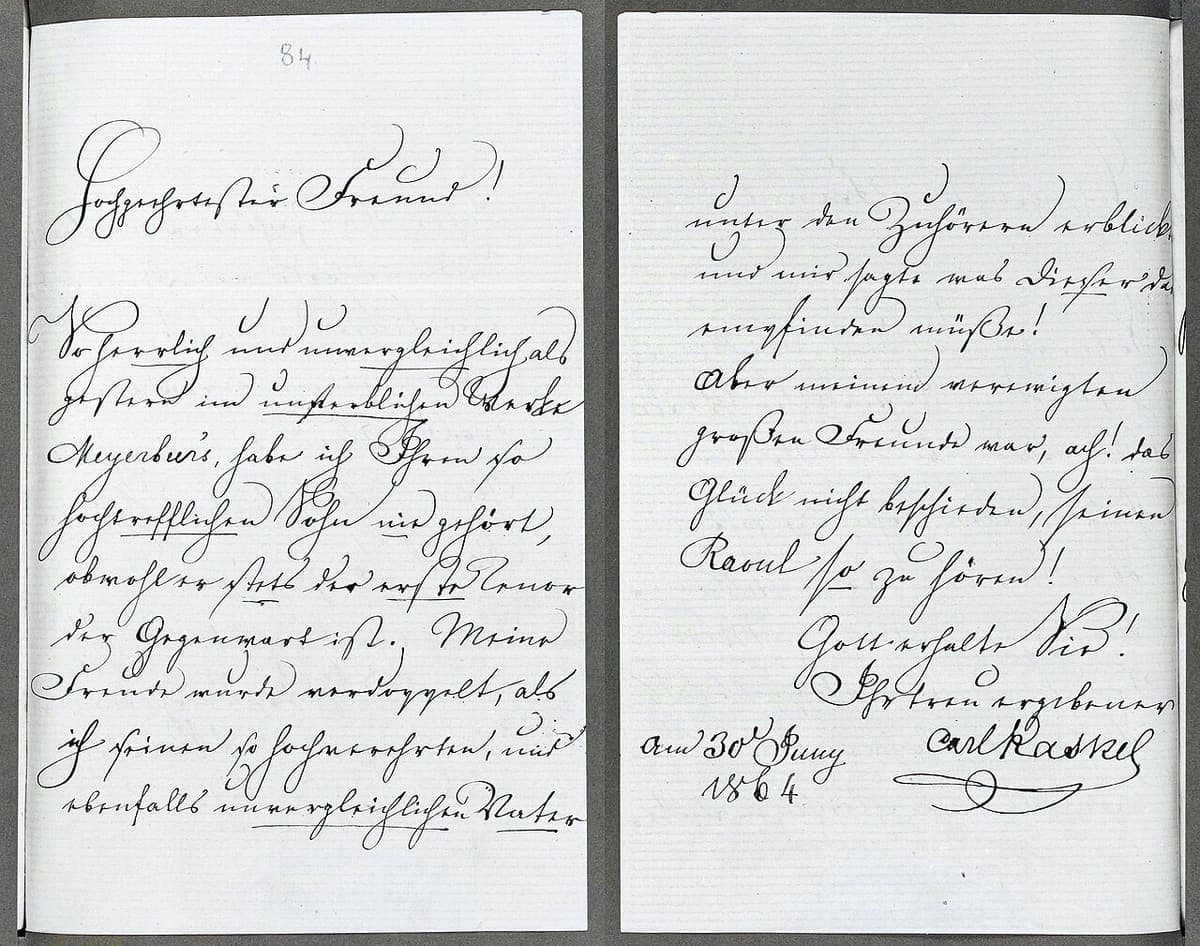
Sächsische Landesbibliothek – Staats- und Universitätsbibliothek Dresden (SLUB), Mscr.Dresd.n.Inv.15.Bd.21, Blatt 84, 30 June 1864 · Source · Public domain
Evidano Transcription
The complete letter, transcribed in full on the Commons file page from the Deutsche Fotothek catalogue record for this item.
Hochverehrter Freund!
So herrlich und unvergleichlich als gestern im unsterblichen Werke Meyerbeers, habe ich Ihren so hochvortrefflichen Sohn nie gehört, obwohl er stets der erste Tenor der Gegenwart ist. Meine Freude wurde verdoppelt, als ich seinen so hochverehrten, und ebenfalls unvergleichlichen Vater unter den Zuhörern erblickte und mir sagte was dieser da empfinden müßte!
Aber meinem verewigten großen Freunde war, ach! das Glück nicht beschieden, seinen Raoul so zu hören!
Gott erhalte Sie!
Ihr treu ergebenster
Carl Kaskel
am 30. Juny 1864
Source: Deutsche Fotothek, Objekt 80172981 (Carl von Kaskel to Julius Schnorr von Carolsfeld), via Wikimedia Commons file description (Public domain).
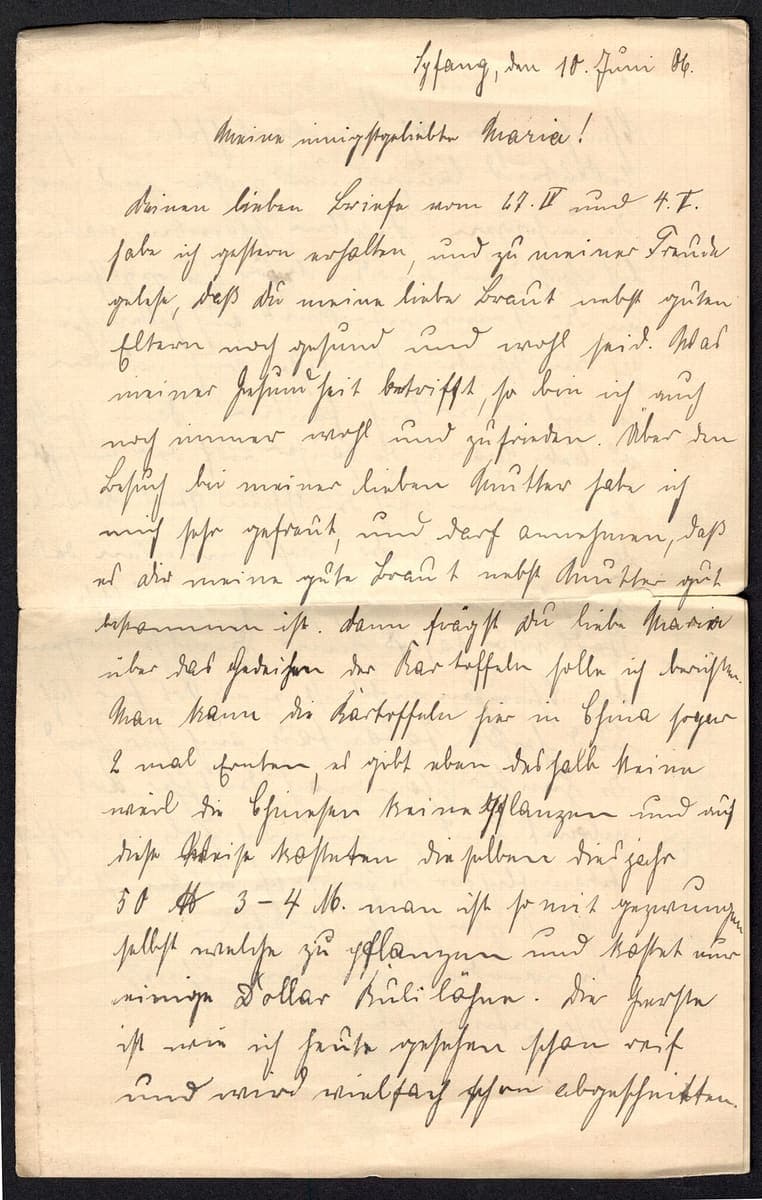
Wikipedia Hannover (private loan, digitised 2026), 10 June 1906 · Source · CC0 1.0
Evidano Transcription
Syfang, den 10. Juni 06.
Meine innigstgeliebte Maria!
Deinen lieben Briefe vom 27. V und 4. VI.
habe ich gestern erhalten, und zu meiner Freude
gelesen, daß du meine liebe Braut nebst guten
Eltern noch gesund und wohl seid. Was
meiner Gesundheit betrifft, so bin ich auch
noch immer wohl und zufrieden. Über den
Besuch bei meiner lieben Mutter habe ich
mich sehr gefreut, und darf annehmen, daß
es dir meine gute Braut nebst Mutter gut
bekommen ist. dann frägst du liebe Maria
über das Gedeihen der Kartoffeln solle ich berichten.
Man kann die Kartoffeln hier in China sogar
2 mal Ernten, es gibt eben deshalb keine
weil die Chinesen keine Pflanzen und auf
diese Weise kosteten dieselben dies Jahr
50 ℔ 3-4 M. man ist somit gezwungen
selbst welche zu pflanzen und kostet nur
einige Dollar Kulilöhne. die Gerste
ist wie ich heute gesehen schon reif
und wird vielfach schon abgeschnitten.
Generated by Evidano’s advanced model; not yet checked against a published edition.
What German Kurrent looks like
Kurrent developed out of late medieval chancery cursive and was the everyday German handwriting from roughly the mid-seventeenth century until the early twentieth, used for everything from parish baptismal registers and civil administration to private letters and diaries. It was taught in schools across the German-speaking world, including Austria and German-speaking Switzerland, so its basic letterforms are broadly consistent even as individual handwriting varies enormously from a careful clerk’s register entry to a hurried personal letter.
The script is built from narrow, angular loops and short connecting strokes, and several letters are distinguished mainly by small, easily missed details: e and n differ chiefly in the height and closure of their loops; u carries a small curved mark above it to separate it from n and m; long s and f are close enough in shape that context often does more work than the letterform itself. Umlauts appear as two short strokes or a small loop above the vowel rather than modern dots, and capital letters, especially decorative ones at the start of a name or a formal salutation, can differ substantially from their lower-case counterparts.
Genre and period both shape what a Kurrent page looks like. A parish register entry is compact and formulaic, recording a name, a date and a set of standard details in an experienced clerk’s economical hand. A personal letter is far more variable, ranging from an educated writer’s fluent, well-formed Kurrent to a working correspondent’s faster and more idiosyncratic version of the same script, and colonial and diaspora letters from German speakers abroad show the same script carrying entirely new vocabulary for unfamiliar places and goods.
Why ordinary OCR struggles here
e, n and u look alike at speed
The letters that cause the most confusion in Kurrent are also the most common: e, n and u are built from very similar strokes, and only small details — a closed versus open loop, a diacritic mark over u — tell them apart. A fast or informal hand can blur those details further.
Handwriting quality varies by writer, not by period
A trained clerk’s parish register entry and an ordinary correspondent’s personal letter can be a century apart in date but decades apart in legibility. A model needs to read what is actually on the page rather than assume a fixed level of care.
Abbreviations, ditto marks and numerals
Registers and administrative documents use abbreviation loops for common words, ditto marks to avoid repeating a name or place, and a mix of Roman and Arabic numerals for dates and amounts, all of which need to be recognised as what they are rather than transcribed as ordinary letters.
Corrections and later insertions
A working letter draft can carry crossed-out words and squeezed-in corrections from the same sitting, while a register page may carry a later marginal note added by a different clerk. Keeping the original text distinct from what was added afterwards matters for accurate transcription.
Who works with this material
Genealogists and parish-register indexers
Building a family tree from Kirchenbücher means turning thousands of short, formulaic entries into searchable names and dates, consistently enough that the same surname is spelled the same way across a register.
Editors of literary and personal correspondence
Preparing an edition of a writer’s letters, from Lessing to lesser-known correspondents, needs an accurate first transcription that a scholarly editor can then annotate and compare against printed collections.
Family and local historians working with private letters
Letters kept in family archives, including correspondence sent home from German communities abroad, are often the only surviving record of an ordinary person’s life; a reliable transcription makes that record usable and shareable.
Archivists digitising administrative and church records
Libraries and archives converting Kurrent-era registers and files into searchable catalogues need transcription that keeps entries in their original order and flags uncertain readings for staff review.
Getting the best transcription
Tell the model the document type
A parish register entry, a personal letter and an administrative file each follow different conventions for abbreviation and layout; naming the type helps the model apply the right expectations for that genre.
Set a policy for the trickiest letters
Decide in advance how e/n confusion and the u-diacritic should be handled when a reading is genuinely ambiguous — flagged for review, or resolved against the surrounding word — and apply that rule consistently.
Start with a clean, well-formed page
Before running a whole register or letter collection, test the prompt on the clearest example you have. Once that comes back accurately, move to faster or more personal handwriting from the same source.
Ask for corrections and later additions to be marked
Where a letter has crossed-out words or a register carries a later marginal note, ask for these to be identified separately from the original text rather than folded silently into the transcription.
Further reading on this hand
The palaeography guides the in-app selector points to for this domain, if you want to check a transcription against the standard references.
- German Kurrent Script
This University of Zurich resource introduces German Kurrent within the Ad fontes training environment for historical source work. It explains the script's development and supplies alphabetic forms and examples for learning its connected Gothic cursive. The material draws attention to diagnostic strokes and to the substantial variation produced by different periods and individual hands. It is directly useful for administrative, ecclesiastical, commercial, and personal documents written in Kurrent.
Frequently asked questions
- How does the transcription tell e, n and u apart in fast Kurrent?
- It reads the small distinguishing marks — the loop closure that separates e from n, and the diacritic stroke over u — in context with the surrounding word, which is how a trained reader resolves the same ambiguity.
- Can it handle a badly worn or faded parish register page?
- Yes, though legibility limits still apply. Words that cannot be read confidently are marked rather than guessed, so a genealogist can decide how to treat the gap.
- Does it recognise standard Kurrent abbreviations and ditto marks?
- It recognises common abbreviation loops and ditto marks used in registers and administrative documents, and can expand them or leave them as written, depending on what you ask for.
- What happens with a letter that has crossed-out words or squeezed-in corrections?
- Struck-through text and later insertions are identified as such rather than merged silently into the main text, so the transcription reflects what the writer actually changed.
- Will names and place names be transcribed accurately even if unfamiliar?
- Personal and place names are read letter by letter like the rest of the text rather than matched against a fixed dictionary, which matters for colonial-era letters and other documents using names a general-purpose model would not otherwise recognise.
Related scripts and pages
Transcribe your German Kurrent document
Upload a scan, choose German Kurrent Administrative and Personal Hands, and start with your clearest page.