
Polish · c. 1650–1918
Polish names written in a German hand
In the Prussian and Austrian provinces a clerk trained in Kurrent had to get Węglewo, Kostrzewska and Paszkowski onto a ruled line. What comes out is a page where e, n, u and r are the same short stroke repeated, and where the family’s own spelling of its name often survives only in the Latin-script signature at the foot. Evidano reads both alphabets on one line and keeps them apart.
Sample pages
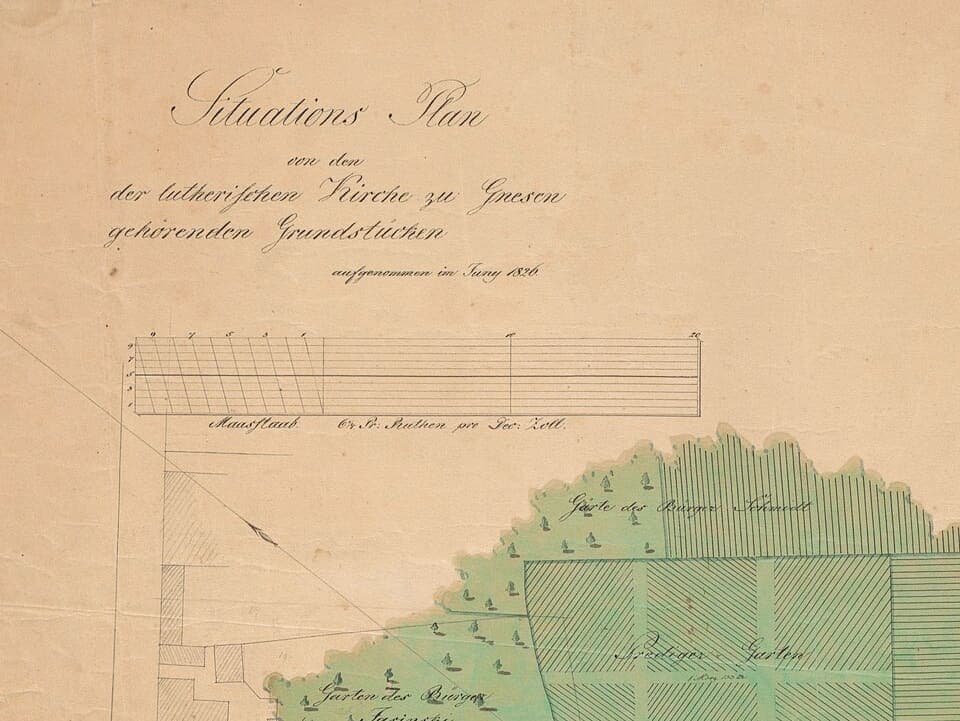
Archiwum Państwowe w Poznaniu, 53/1033/0/-/5034, June 1826 · Source · CC0 1.0 · State Archive in Poznań / Wikimedia Polska cooperation project
Evidano Transcription
Situations Plan
von den
der lutherischen Kirche zu Gnesen
gehörenden Grundstücken
aufgenommen im Juny 1826.
9 7 5 3 1 10 20
Maasstaab 6r Pr: Ruthen pro Dec: Zoll.
Gärte des Bürger Schmidt
Prediger Garten
Garten des Bürger
Jasinsk[illegible]
Generated by Evidano’s advanced model; not yet checked against a published edition.
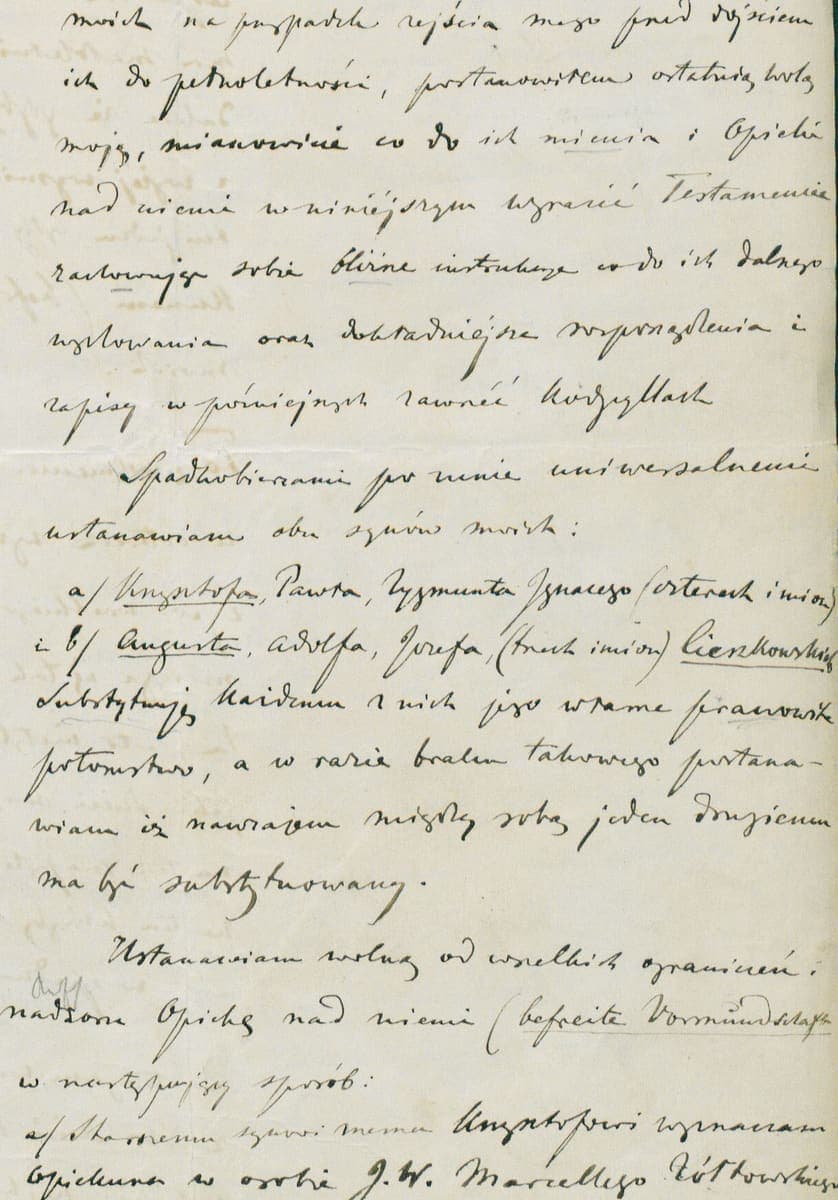
Archiwum Państwowe w Poznaniu, 53/1441/1376, 31 May 1864 · Source · CC0 1.0 · State Archive in Poznań / Wikimedia Polska cooperation project
Evidano Transcription
moich na przypadek zejścia mego przed dojściem
ich do pełnoletności, postanowiłem ostatnią wolą
moją, mianowicie co do ich mienia i Opieki
nad niemi w niniejszym wyrazić Testamencie
zachowując sobie bliższe instrukcye co do ich dalszego
wychowania oraz dokładniejsze rozporządzenia i
zapisy w późniejszych zawrzeć kodycyllach
Spadkobiercami po mnie uniwersalnemi
ustanawiam obu synów moich:
a/ Krzysztofa, Pawła, Zygmunta Ignacego (czterech imion)
i b/ Augusta, Adolfa, Józefa, (trzech imion) Cieszkowskich
Substytuuję każdemu z nich jego własne prawowite
potomstwo, a w razie braku takowego postana-
wiam iż nawzajem między sobą jeden drugiemu
ma być substytuowany.
Ustanawiam wolną od wszelkich ograniczeń i
[cancelled: bez] nadzoru Opiekę nad niemi (befreite Vormundschaft)
w następujący sposób:
a/ Starszemu synowi memu Krzysztofowi wyznaczam
Opiekuna w osobie J. W. Marcelego Żółtowskiego
Generated by Evidano’s advanced model; not yet checked against a published edition.
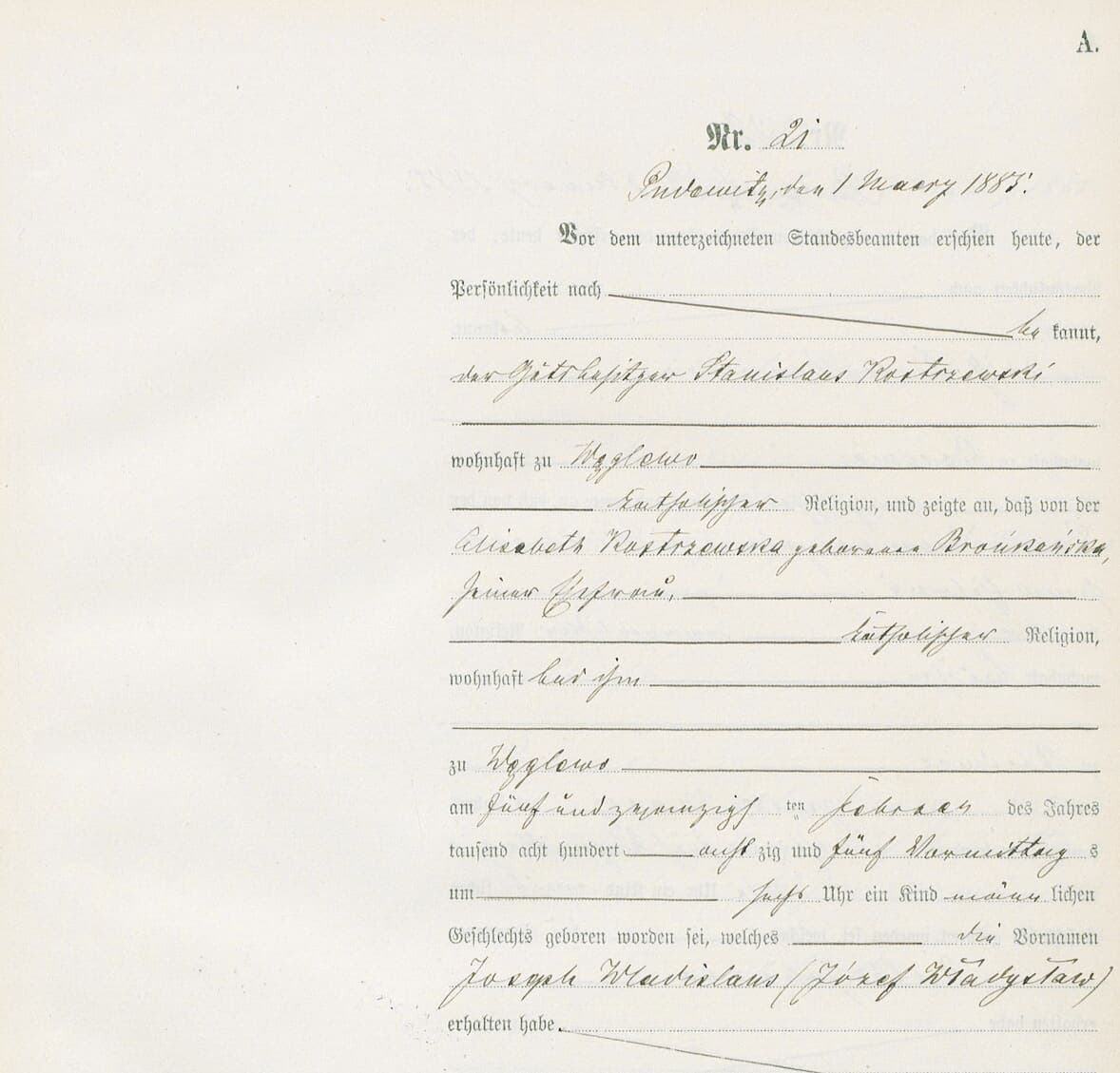
Archiwum Państwowe w Poznaniu, 53/2029/0/1/34, 1 March 1885 · Source · CC0 1.0 · State Archive in Poznań / Wikimedia Polska cooperation project
Evidano Transcription
A.
Nr. 21
Pudewitz, den 1 Maerz 1885.
Vor dem unterzeichneten Standesbeamten erschien heute, der
Persönlichkeit nach
be kannt,
der Gutsbesitzer Stanislaus Rostrzewski
wohnhaft zu Węglewo
katholischer Religion, und zeigte an, daß von der
Elisabeth Rostrzewska geborenen Brońkowska,
seiner Ehefrau,
katholischer Religion,
wohnhaft bei ihm
zu Węglewo
am fünf und zwanzigs ten februar des Jahres
tausend acht hundert acht zig und fünf Vormittag s
um sechs Uhr ein Kind männ lichen
Geschlechts geboren worden sei, welches die Vornamen
Joseph Wladislaus (Józef Władysław)
erhalten habe.
Generated by Evidano’s advanced model; not yet checked against a published edition.
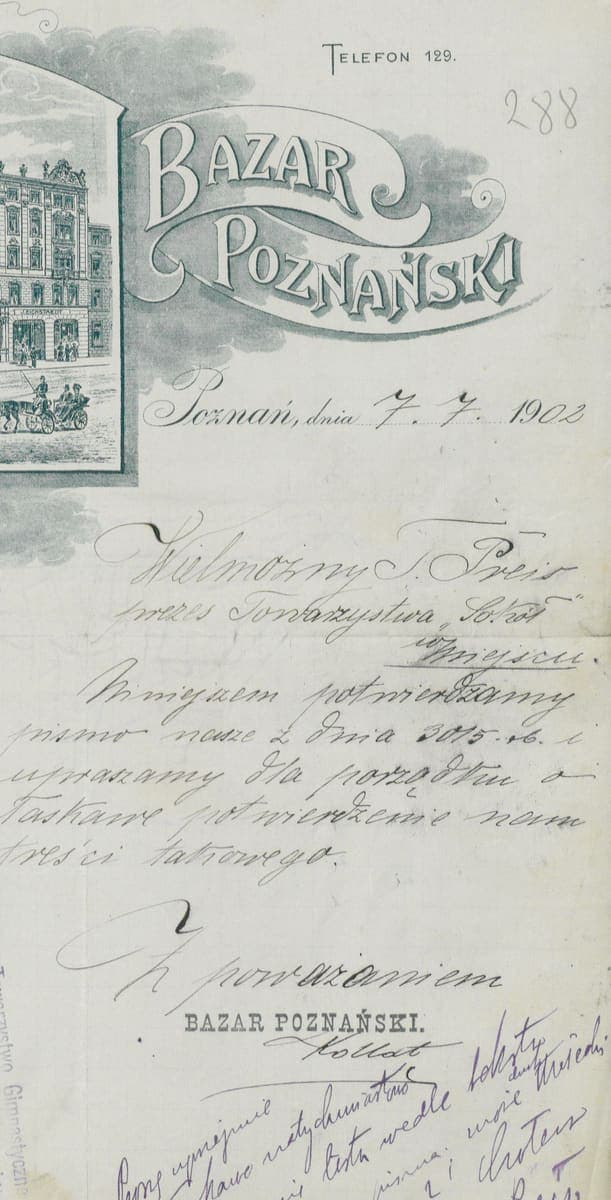
Archiwum Państwowe w Poznaniu, 53/2007/23, 7 July 1902 · Source · Public domain · State Archive in Poznań / Wikimedia Polska cooperation project
Evidano Transcription
TELEFON 129.
288
BAZAR
POZNAŃSKI
Poznań, dnia 7. 7. 1902
Wielmożny J. Preis
prezes Towarzystwa „Sokół”
w miejscu.
Niniejszem potwierdzamy
pismo nasze z dnia 30/5. rb. i
upraszamy dla porządku o
łaskawe potwierdzenie nam
treści takowego.
Z poważaniem
BAZAR POZNAŃSKI.
Kollat [?]
[stamp: …warzystwo Gimnastyczn… (cut off)]
Proszę uprzejmie [?] … natychmiastowo [?] … wedle tekstu … [illegible, cut off at bottom edge]
Generated by Evidano’s advanced model; not yet checked against a published edition.
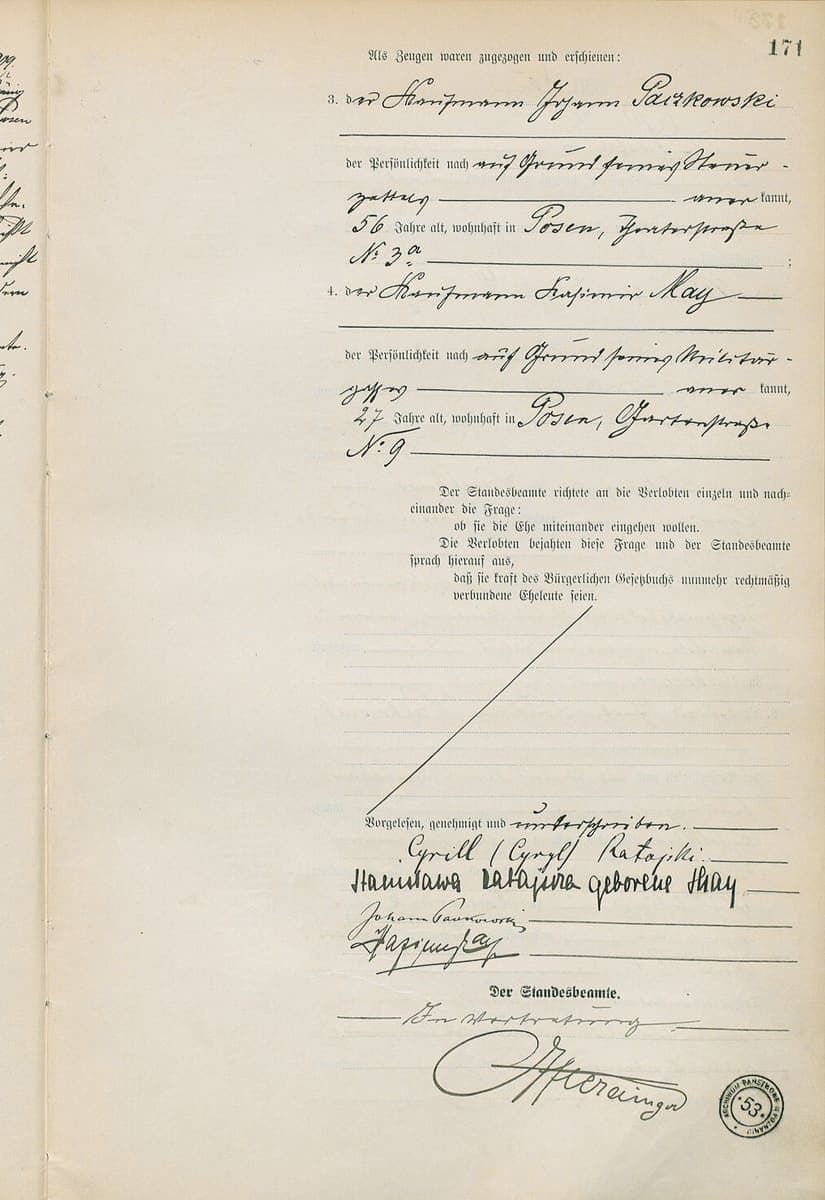
Archiwum Państwowe w Poznaniu, 53/1926/0/3/986, 1908 · Source · CC0 1.0 · State Archive in Poznań / Wikimedia Polska cooperation project
Evidano Transcription
171
Als Zeugen waren zugezogen und erschienen:
3. der Kaufmann Johann Paczkowski
der Persönlichkeit nach auf Grund seines Steuer-
zettels
anerkannt,
56 Jahre alt, wohnhaft in Posen, Gerberstraße
No 3a
4. der Kaufmann Kasimir May
der Persönlichkeit nach auf Grund seines Militair-
passes
anerkannt,
27 Jahre alt, wohnhaft in Posen, Gartenstraße
No 9
Der Standesbeamte richtete an die Verlobten einzeln und nach=
einander die Frage:
ob sie die Ehe miteinander eingehen wollen.
Die Verlobten bejahten diese Frage und der Standesbeamte
sprach hierauf aus,
daß sie kraft des Bürgerlichen Gesetzbuchs nunmehr rechtmäßig
verbundene Eheleute seien.
Vorgelesen, genehmigt und unterschrieben.
Cyrill (Cyryl) Ratajski
Stanisława Ratajska geborene May
Johann Paczkowski
Kasimir May
Der Standesbeamte.
In Vertretung
Ofterdinger
Generated by Evidano’s advanced model; not yet checked against a published edition.
Two alphabets in one register
Kurrent — deutsche Schrift — is the everyday cursive of German-speaking administration from the seventeenth century to the First World War, and it is the hand in which most surviving records of Polish life under Prussia and Austria were written. It is narrow, pointed and built from a few repeated strokes: n, u, m, e and r are separated by hooks a fraction of a millimetre high, h and k carry looped ascenders that tangle with the line above, and long ſ differs from f only in which side of the stem the cross-stroke sits. The small bow drawn over u is not decoration but a diacritic telling a u from an n; when a clerk forgets it, a word can be read three ways.
Polish inside that system is a compromise. The Gothic alphabet has no ł, ą, ę, ś, ź or ż, so a clerk either leaves the sound unmarked, spells it German-fashion (Wenglewo for Węglewo, the hissing consonants rendered by rz or sch), or balances the Polish mark on a Kurrent letter, where it is easily mistaken for the u-bow. Personal names swing between forms across a single volume: the same child is Joseph in the body of an entry and Józef in the brackets beside it, and a surname takes a feminine ending — Kostrzewska, Ratajska — or the older -ówna and -owa suffixes for daughters and wives. Many writers switch to Latin script for proper names, so an entry can be a Kurrent sentence with a Latin-script island in the middle of it.
Layout matters as much as the letters. Prussian civil registers after 1874 are pre-printed Fraktur forms with blanks for a Kurrent filling, so the standing formula and the individual facts sit in two typefaces and two inks. Austrian parish registers in Galicia are ruled into columns under Latin headings — natus, baptisatus, pater, mater, patrini — with the family’s house number in the left-hand column. Dates are written out in words, sums appear in Thaler and Silbergroschen or in Gulden and Kreuzer, repetition is shown by ditto marks, and a marginal note added decades later on the order of a court may change a name without touching the original line.
Why ordinary OCR struggles here
Minim strings without a German word behind them
A reader of Kurrent resolves an ambiguous run of strokes by knowing which German word it must be. A Polish surname gives no such help: Mniszewska is a legitimate sequence of hooks under almost any reading, so recognition has to work from the letterforms and from other occurrences of the name in the same book rather than from a German lexicon.
Diacritics that belong to another alphabet
The bar of ł, the hook of ą and ę and the dot of ż were drawn by writers who had never been taught them. They land too high, too far right, or on the neighbouring letter, and they compete with the bow over u and with the abbreviation strokes. Dropping them silently turns Łagiewniki into Lagiewniki; inventing them from modern Polish spelling is just as damaging.
Script changes inside a sentence
Kurrent for the formula, Latin script for the name, Fraktur for the printed form and a signature in the signer’s own hand can all appear within four lines. Generic recognition treats the page as one alphabet and mangles whichever passages are in the other, which in practice means it mangles exactly the names an index is built from.
Forms, columns and later hands
Registers, plans and certificates carry printed text, ruled columns, ditto marks, stamps and corrections entered years after the event. Reading straight across a column boundary joins a father’s occupation to a godparent’s village, and a marginal correction taken as part of the entry produces a fact nobody recorded.
Who works with this material
Genealogists working across partition borders
One family can leave records in Kurrent at Poznań, in Latin columns in a Galician parish book and in Cyrillic across the Russian frontier. They need names, dates, ages, occupations and villages pulled out of each entry in a comparable form, with the original spelling preserved beside the normalised one.
Archives indexing civil registers
Registry-office volumes survive by the shelf-metre and are indexed, if at all, by surname and entry number. Turning entries into structured fields — child, parents, witnesses, place, date, corrections — is what makes a series searchable, and it must be done without inventing values for blanks the clerk left empty.
Land and estate researchers
Plans, mortgage books and parcel registers name holders, plot numbers, measures and boundaries. A transcription is useful only if numbers and units survive it intact, because the argument being made is usually about who held which parcel in which year.
Historians of language and naming
How a German-speaking office wrote a Polish name is evidence in itself, and so is the moment a clerk gives up and switches to Latin script. That work depends on transcriptions recording spelling exactly as it stands, variant by variant, rather than tidying it toward a modern norm.
Getting the best transcription
Declare both scripts before you begin
Say that the page carries German Kurrent, printed Fraktur and Latin-script proper names, and ask for each stretch to be labelled with the script it is in. That single instruction prevents the commonest failure, in which the Latin-script names are read as though they were Kurrent letters.
Supply the local name stock
Paste in the village names of the district and any surnames you already know from the volume. Kurrent recognition improves sharply when an ambiguous run of hooks can be matched against a name that appeared five pages earlier.
Keep the form and the filling apart
Ask for the printed formula and the handwritten insertions as separate fields, and for ruled columns to be returned row by row with their headings. This is what stops a pre-printed Fraktur paragraph from being reported as something the clerk wrote about this particular family.
Test on a corrected entry
Choose a page carrying a marginal note added years later by order of a court, and check that it comes back as an annotation with its own date rather than folded into the original entry. If that works, the rest of the volume will usually behave.
Further reading on this hand
The palaeography guides the in-app selector points to for this domain, if you want to check a transcription against the standard references.
- German Kurrent Script
This University of Zurich resource introduces Kurrent as the connected Gothic cursive used widely in German-speaking administration. It provides historical context, alphabets, and manuscript examples showing diagnostic strokes and variation among writers. The material helps distinguish easily confused lowercase forms and contrasts Kurrent with Latin handwriting. It is useful for Polish territories under Prussian or Austrian administration because Polish names and text were often entered using the governing German script.
Frequently asked questions
- Should Polish names be corrected to their modern spelling?
- Not in the transcription itself. The reading follows the page — Wenglewo, Kostrzewska, Josef — and a modernised form is supplied as a separate field, so the index can be searched both ways without losing the evidence of how the office wrote the name.
- How is a name written twice, in German and in Polish, handled?
- Both are kept, in the order they appear, with the bracketed or Latin-script version marked as such. In many Prussian entries that second form is the only place the family’s own spelling appears, so collapsing the two throws away the most useful line on the page.
- What happens with the ruled columns of a Galician parish register?
- Each row is returned with its Latin column headings attached, so house number, date of birth, date of baptism, parents and godparents stay in their own fields. Ditto marks are expanded with a note that the value was repeated rather than written out.
- Are dates written out in words converted to figures?
- The words are transcribed as they stand and a normalised date is offered alongside. Kurrent entries often spell the year across two lines and give the hour in words too, and a converted date on its own hides whether the clerk wrote it or left the blank unfilled.
Related scripts and pages
Read your partition-era records
Upload a registry volume, a parish page or a family letter, choose Polish-Language Kurrent, and set the rule for names before the rest of the box.