
Czech · c. 1400–1550
Czech and Latin arguing on one page
A Hussite book rarely stays in one language. A Czech song carries a Latin heading, a Latin chant is glossed in Czech between the staves, and a polemical picture book puts its case in Czech on a scroll over a Latin caption. Add the first Czech diacritics, red rubrics that are part of the sentence, and later readers writing in the margins, and a single leaf can hold four kinds of writing.
Sample pages
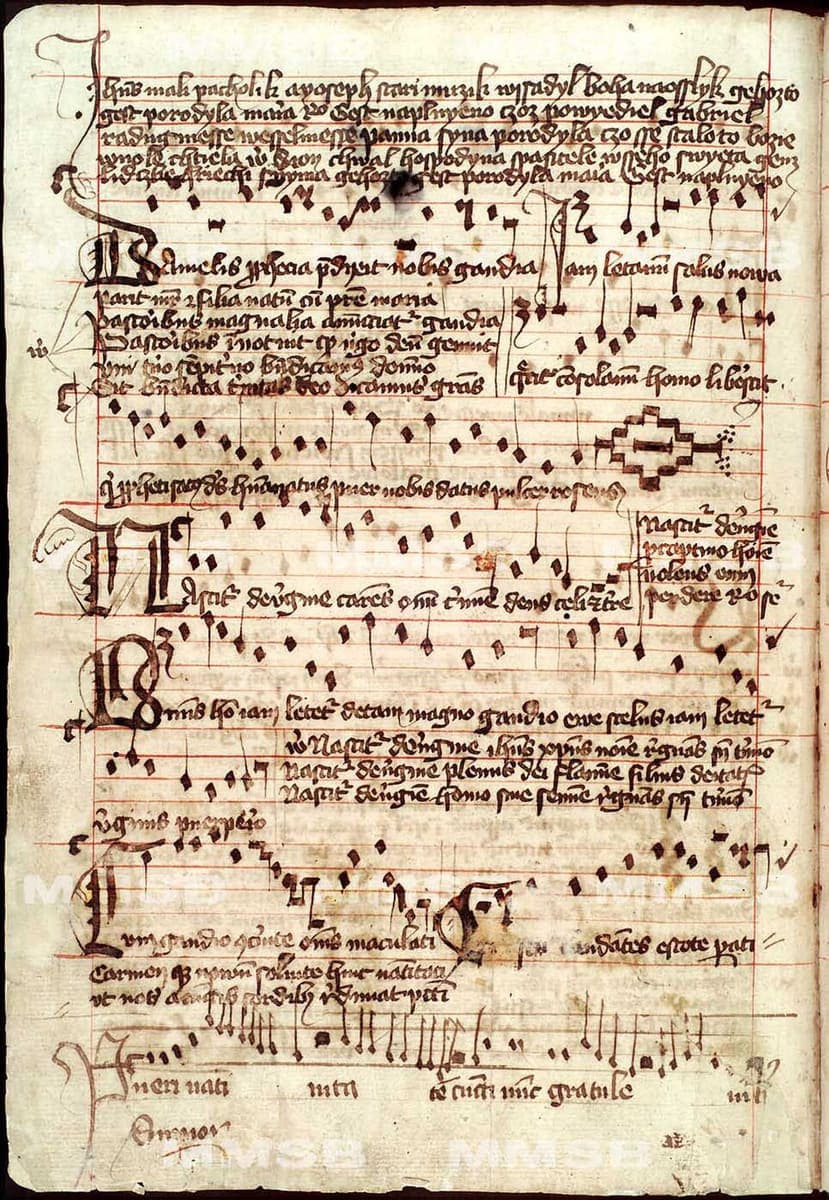
Knihovna Národního muzea, Prague, II C 7, f. 121v, c. 1420 · Source · Public domain · Digitised by Manuscriptorium
Evidano Transcription
Ihus mali pacholi[?] [illegible] a Joseph stari muzik[?] nyſadyl[?] boha [illegible] geho[?]
geſt porodyla maria [illegible] geſt [illegible] czoz powyedyel Gabriel
[illegible] panna ſyna porodyla czo ſſe ſtalo to bozie
[illegible] chwal hoſpodyna [illegible] wſſeho ſwyeta [illegible]
[illegible] geſt porodyla maria [illegible]
Danielis p[ro]phetia p[ro]pſit[?] nobis gaudia
[illegible] filia nati [illegible] noua[?]
paſtoribus magnalia [illegible] gaudia
paſtoribus [illegible]
[illegible] domino
[illegible]
Iam letamini [illegible] noua
[illegible] homo liberat
[illegible] puer nobis natus [illegible]
Natus [illegible]
Omnes [illegible] iam letet[ur] [illegible] magno gaudio [illegible] iam letet[ur]
Natus [illegible]
Natus [illegible]
Natus [illegible] homo [illegible]
L[illegible] gaudio [illegible] omnes maculati
Carmen [illegible] natiuitati
ut nos [illegible]
[illegible] eſtote pati
Pueri nati [illegible] te cuncti nunc gratule
[remaining text illegible]
Generated by Evidano’s advanced model; not yet checked against a published edition.
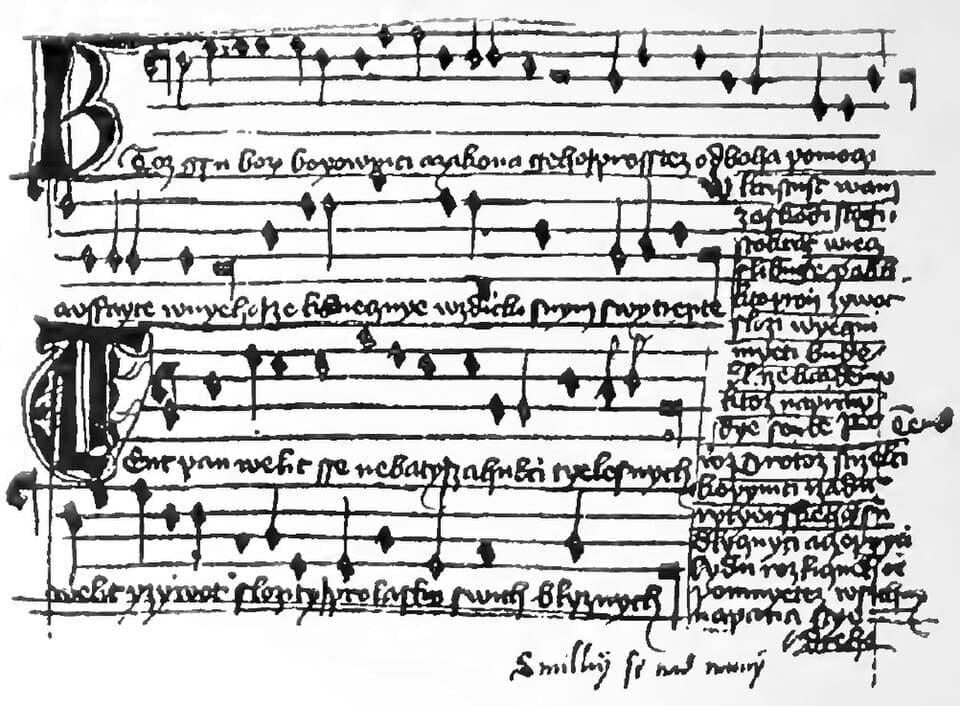
Source · Public domain · Plate from Bohemia’s Claim for Freedom (Czechoslovak London Committee, 1915)
Evidano Transcription
The first three stanzas of the hymn, in the diplomatic spelling of the Jistebnice Hymnal; the plate carries the first two stanzas syllable by syllable under the notation and the rest in the right-hand column. Editorial marks are those of the Wikisource text.
Ktoz jsu bozi boyownici
a zakona jeho
prosstez od boha pomoci
a uffayte w nyeho
ze konecnye wzdicki s nim swytˇezite

Kristus wam za skodi stoji
stokrate wiecz slibuye
pakli kto proń źywot slozi
wieczny źywot mieti bude
blaze kazdemu ktoz na prawdye se(.)de

Tent pan welit sse nebaty
zahubci tyelesnych
welit y źywot slozity
pro lasku swich blyznych
Source: Ktož jsú boží bojovníci, from the Jistebnický kancionál, via Czech Wikisource (Public domain).
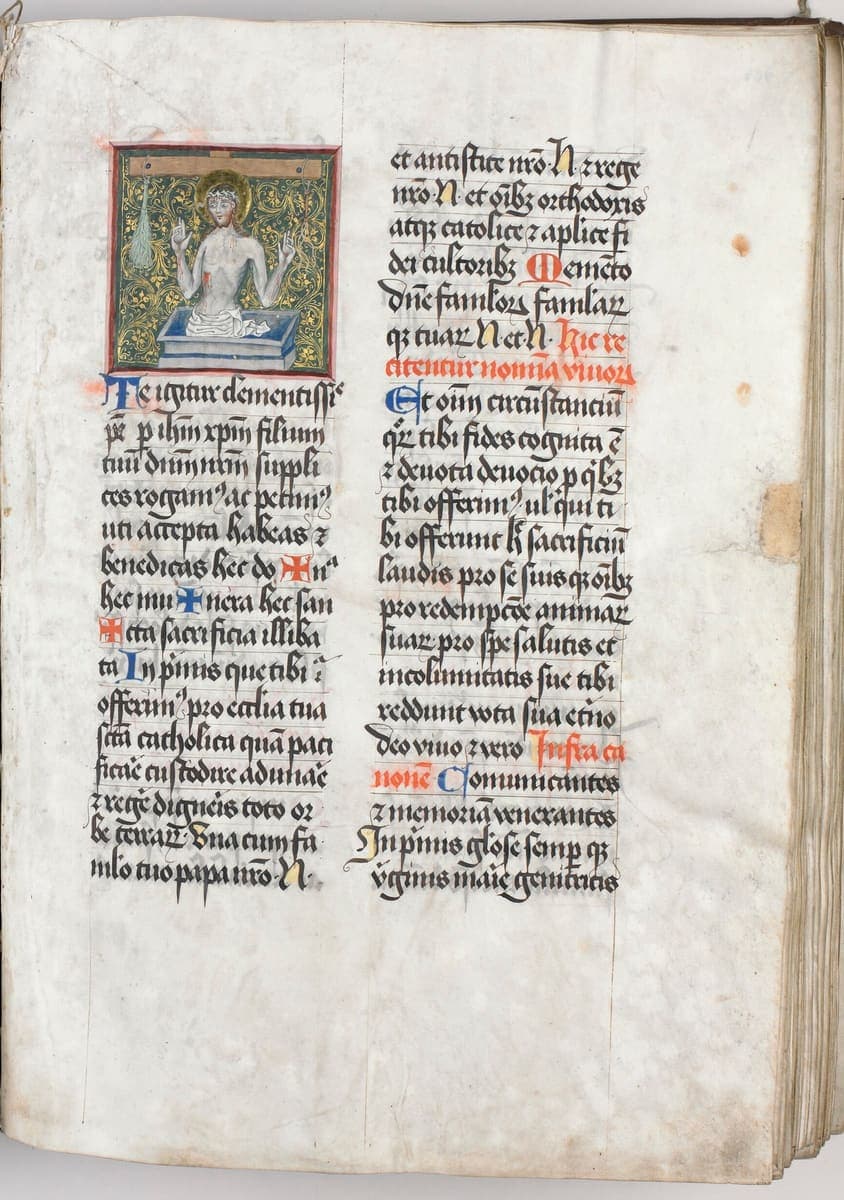
Státní okresní archiv Kutná Hora, f. 136, 1486 · Source · Public domain · Státní okresní archiv Kutná Hora
Evidano Transcription
[miniature]
Te igitur clementiss[im]e
p[ate]r p[er] ih[esu]m xp[istu]m filium
tuu[m] d[omi]n[u]m n[ost]r[u]m suppli
ces rogam[us] ac petim[us]
uti accepta habeas et
benedicas hec do ✠ na
hec mu ✠ nera hec san
✠ cta sacrificia illiba
ta In p[ri]mis que tibi
offerim[us] pro eccl[es]ia tua
s[an]cta catholica qua[m] paci
ficare custodire adunare
et regere digneris toto or
be terrar[um] · Vna cum fa
mulo tuo papa n[ost]ro · N ·
et antistite n[ost]ro · N · et rege
n[ost]ro · N · et o[mn]ib[us] orthodoxis
atq[ue] catolice et ap[osto]lice fi
dei cultorib[us] Memento
d[omi]ne famulor[um] famular[um]
q[ue] tuar[um] N · et · N · Hic re
citentur nomina viuor[um]
Et o[mn]i[u]m circu[m]stanciu[m]
q[uo]r[um] tibi fides cognita e[st]
et deuota deuocio p[ro] q[ui]b[us]
tibi offerim[us] uel qui ti
bi offerunt h[oc] sacrificiu[m]
laudis pro se suis q[ue] o[mn]ib[us]
pro redempc[i]o[n]e animar[um]
suar[um] pro spe salutis et
incolumitatis sue tibi
reddunt uota sua et[er]no
deo viuo et vero Infra ca
none Communicantes
et memoria[m] uenerantes
In p[ri]mis glo[rio]se semp[er] q[ue]
u[ir]ginis marie genitricis
Generated by Evidano’s advanced model; not yet checked against a published edition.
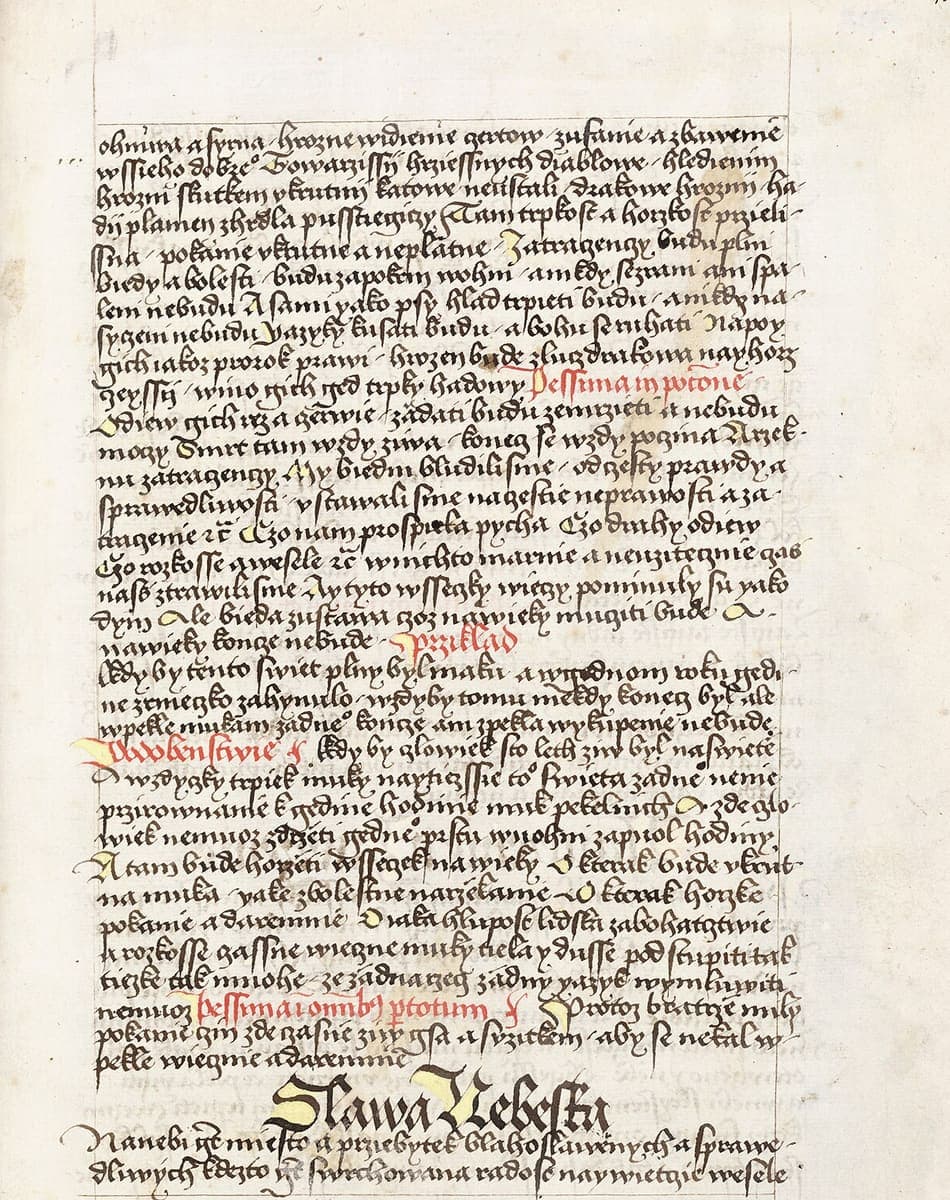
Digitised by the National Museum, Prague (eSbírky), f. 107r, c. 1490–1510 · Source · Public domain · Attributed to Janíček Zmilelý z Písku; digitised at esbirky.cz
Evidano Transcription
ohniwa a syrna · hrozne widienie gektow[?] · zufanie a zbawenie
wssieho dobrze[ho] · Towarzissy hrziessnych diablowe · hledienym
hrozni skutkem vkrutiny[?] katowe neustali · drakowe hrozni ha
dy plamen z hrdla[?] pusstiegicy[?] · Tam trplost a horzkost przieli
ssna · pokanie vkrutne a neplatne · Zatragengy budu pln
biedy a bolesti · budu zapokiny[?] w ohni · ani kdy se zrani[?] ani spa
lem nebudu · A sami yako psy hlad trpieti budu · ani kdy na
sycen nebudu · Yazyky kusati budu · a bolesti se nihati[?] · Napoy
gich iakoz prorok prawi · hrozen bude z lugu[?] drakowa nayhorz
zeyssy · wino gich ged trpky hadowy · Pessima in potone
Odiew[?] gich rza[?] a gerwie[?] · zadati budu zemrzieti a nebudu
mogy · Smrt tam wzdy ziwa · koneg se wzdy pogina · Rzek
nu zatragengy · My biedni bludili sme · od cesty prawdy a
sprawedlnosti · vstawali sme na cestie neprawosti a za
tragenie ꝛc · Czo nam prospiela pycha · Czo dulhy[?] odiew
Czo rozkosse a wesele ꝛc · wssechto[?] marnie a neuzitegnie gas
nass ztrawili sme · A y tyto wssecky wiecy pominuly su yako
dym · Ale bieda zustawa czoz nawieky muciti bude · A
nawieky konce nebude · Przyklad
Kdy by tento swiet plny byl maku · a w gednom roku[?] gedi
ne zrnegko zahynulo · wzdy by tomu nekdy koneg byl · ale
w pekle mukam zadne[ho] konce ani z pekla wykupenie nebude
Podobenstwie · Kdy by glowiek sto leth ziw byl na swiete
a wzdycky trpiel muky naytiezssie to[ho] swieta zadne nemie
przirownanie k gedine hodinie muk pekelnych · A zde glo
wiek nemuoz zdrzeti gedne prsti w ohni za puol[?] hodiny
A tam bude horzeti wssecek na wieky · O kterak bude vkrut
na muka · yake z bolestne narzekanie · O kterak horzke
pokanie a darmnie · O yaka hlupost lidska za bohatstwie
k rozkossi gassne[?] wiecznie muky tiela y dusse podstupiti tak
tiezke tak mnohe · ze zadna rzecz zadny yazyk wymluwiti
nemuoz · Pessima a omnib[us] [illegible] · Protoz bratrzie mily
pokanie czin zde zasie ziwy gsa a s uzitkem · aby se nedal w
pekle wiecznie a darmnie
Slawa Nebeska
Na nebi gest miesto a przebytek blahoslawenych a sprawe
dliwych kdezto gest swrchowana radost naywietzie wesele
Generated by Evidano’s advanced model; not yet checked against a published edition.
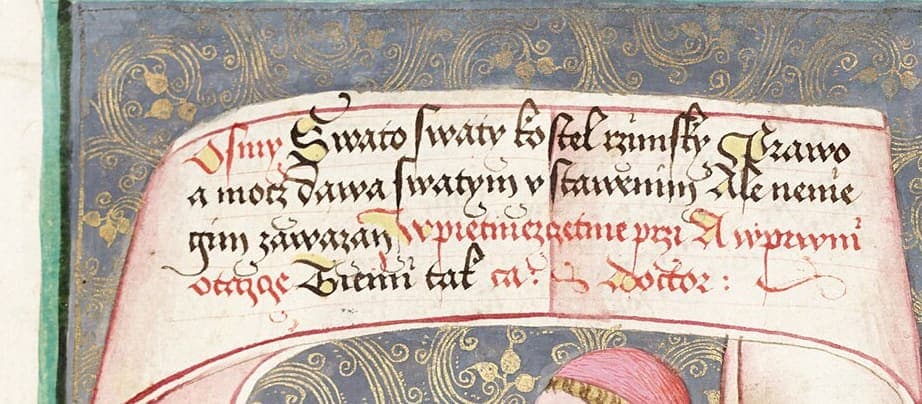
Digitised by the National Museum, Prague (eSbírky), f. 22r, c. 1490–1510 · Source · Public domain · Attributed to Janíček Zmilelý z Písku; digitised at esbirky.cz
Evidano Transcription
Osmy[?] Swato swaty kostel rzimsky Prawo
a moc dawa swatym v stawenim Ale neme-
gim zawazan w pietinaczetme[?] przi A w prwni
otazce Trzeti tak ca[?] Doctor :
Generated by Evidano’s advanced model; not yet checked against a published edition.
Books made for an argument
The manuscripts of the Hussite century are working books: hymnals carried to services, sermon collections, postils, polemical compilations, and after 1436 the liturgical books of the Utraquist parishes that kept communion in both kinds. They are written in Gothic cursive and Bastarda rather than in formal Textualis, quickly and often by more than one hand, and the script changes register within a page — a display line in large Gothic letters for a title, a smaller Bastarda for the text, a rapid cursive for an addition squeezed into the margin.
Language follows function. Latin remains the language of the liturgy, of rubrics and of scholastic reference; Czech is the language of preaching, of song and of polemic aimed at people who read no Latin. The two sit inside one another: a Latin incipit over a Czech stanza, a Czech gloss between two lines of a Latin chant, a red Latin word marking a section of Czech prose. Jan Hus’s proposal to replace the old digraphs with a dot and a stroke spreads through exactly these books, so a copyist may write ss and cz on one line and a dotted letter on the next.
Musical and liturgical books add another layer. Chant is written in black rhomboid or mensural notes on four- or five-line staves ruled in red, with the text syllables spaced out under the notes, so a transcription has to know that a word is broken across a stave rather than mis-spelled. Initials are large, flourished and often left for a rubricator who never came; pilcrows, marginal crosses, pointing hands and later Utraquist or Catholic annotations mark passages that mattered to a particular reader long after the book was made.
Why ordinary OCR struggles here
Language switching inside a line
A Latin rubric can end and Czech begin without a break, capital or punctuation mark. A transcription that assumes one language per page turns the Latin into misspelled Czech, or the Czech into nonsense Latin, at exactly the joins that carry the structure of the book.
Text broken up by notation
Under chant, syllables are spread across the stave to sit beneath their notes, and a single word may be split over half a line. Reading the text without recognising the notation produces fragments; recognising the stave lines as text produces worse.
Old spelling meeting new diacritics
These are the decades in which Czech orthography changes. Digraphs, dots and hooks appear side by side, sometimes in one word, and the marks are small, faint and easily confused with the flourishes above them. Neither modernising them nor ignoring them leaves the evidence intact.
Layers added by later readers
Corrections, interlinear glosses, marginal crosses and long annotations were added over a century of use, and some of them are polemical answers to the text. Keeping them apart from the original layer, and dating them roughly by their script, is part of reading the page.
Who works with this material
Historians of the Reformation
Hussite polemic, the Four Articles and the arguments over the chalice survive in compilations that have never been printed in full. Getting at them means reading Czech and Latin passages that answer one another inside the same volume, with the marginal responses of later readers kept separate.
Musicologists working on early Czech song
The hymnals are the earliest large body of vernacular song in Central Europe. Their texts have to be recovered under the notation, syllable by syllable, so that a melody can be matched to the words it was actually sung to rather than to a modern edition of them.
Editors of liturgical books
Utraquist missals and graduals differ from Roman ones in small, deliberate places. Finding those differences means transcribing rubrics as carefully as prayers, because a rubric is where a parish records what it actually did at the altar.
Museums and archives with a single famous codex
A regional archive may hold one illuminated book that everyone photographs and nobody reads. A transcription of its captions, banderoles and colophons turns a display object into a text that can be quoted, searched and taught from.
Getting the best transcription
Ask for language labels on every stretch
Tell the model that Czech and Latin alternate within a page and request each passage to be tagged. Latin abbreviations can then be expanded and the Czech left as written, and the rubrics come back as rubrics rather than as part of the sentence they interrupt.
Say what to do with the notation
State that chant staves are present and that the text under them should be reassembled into words, with the syllable division noted. Otherwise the transcription reports either a run of single syllables or a stave line read as a row of letters.
Separate the original layer from the additions
Ask for interlinear and marginal material as its own labelled block, with a note on whether the hand looks contemporary or later. On these books that distinction is often the point of the research.
Test on a rubricated song page
A page with a Latin incipit, Czech stanzas and notation exercises everything at once. If the incipit, the sung text and the marginal voice come back as three labelled blocks, the rest of the hymnal will be routine.
Further reading on this hand
The palaeography guides the in-app selector points to for this domain, if you want to check a transcription against the standard references.
- Latin Palaeography in Central Europe
This teaching resource places Bohemian manuscripts within the wider development of Central European Latin writing. It covers late Gothic book and cursive scripts and their transition toward Humanistic forms. The guide demonstrates letterforms, abbreviations, ligatures, punctuation, and manuscript organization using historically situated examples. It is useful for Hussite and Utraquist compilations because Czech and Latin commonly share the same late medieval scribal repertoire.
Frequently asked questions
- Can a page that mixes Czech and Latin be transcribed in one pass?
- Yes. The two languages are recognised and labelled separately within the same pass, so a Latin rubric in red and the Czech text it introduces stay distinct, each with its own expansion rules.
- How is chant notation handled?
- The staves are treated as musical notation, not as text, and the words spread underneath them are reassembled into full forms with their syllable breaks recorded. The notes themselves are described rather than transcribed, unless you are working with an encoding scheme and ask for one.
- Are the early Czech diacritics recognised?
- They are, and so is their absence. A dot over a letter, a hook, or an older digraph in the same word are all reported as they stand, which is what allows a copy to be placed in the decades when the new orthography was spreading.
- What about the banderoles in illuminated polemical books?
- Text drawn inside a scroll or a picture is transcribed as text, with its position noted. In the Jena Codex the banderole often carries the whole argument of the page, so treating it as decoration would leave the illustration without its point.
- Can later marginal annotations be dated?
- Not to a year, but a transcription can say that a hand is later than the main text, describe it, and keep it in its own block. That is usually enough for an editor to decide whether an annotation belongs to the book’s Utraquist use or to a later Catholic reader.
Related scripts and pages
Read a Hussite book properly
Upload a hymnal opening, a polemical folio or an Utraquist missal page and get the Czech, the Latin and the notation as separate blocks.