
Czech · c. 1300–1500
Spelling that dates the page
A fourteenth-century Czech scribe had no č, ř or š, so he wrote cz, rz and ss and let the reader work it out — and the same sound could be spelled three ways in three lines. That is a problem for recognition and a gift to the historian: the spelling alone places a manuscript within a few decades. Evidano reads Old Czech as it stands on the page instead of correcting it into the modern alphabet.
Sample pages
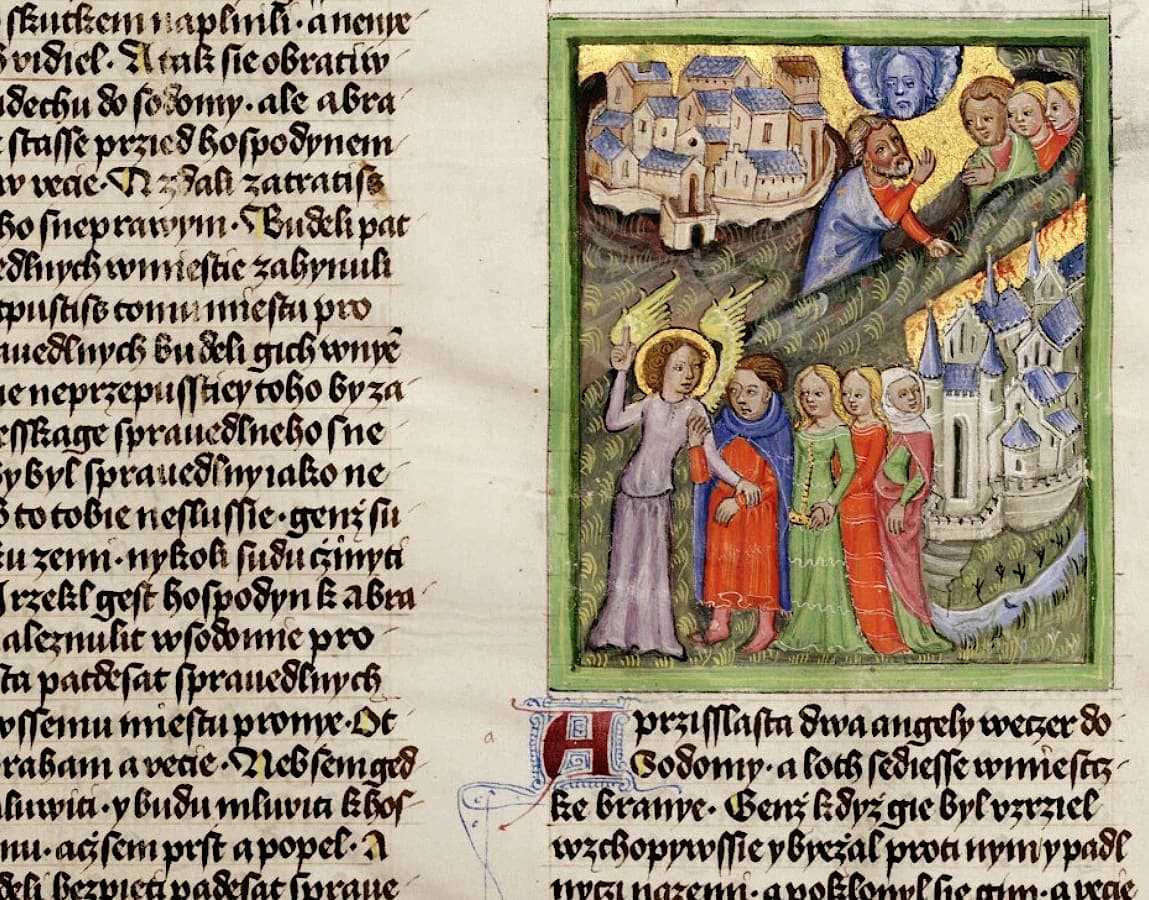
Vědecká knihovna v Olomouci, M III 1/I, f. 8r, 1417 · Source · Public domain · Vědecká knihovna v Olomouci, via digitalniknihovna.cz
Evidano Transcription
[left edge cut off on every line]
skutkem naplnili · a neny
widiel · A tak sie obratiw
dechu do sodomy · ale abra
stasse przied hospodynem
w vecie · A[?] zdali zatratiss
ho s neprawym · Budeli pat
dlnych w mniestie zahynuli
pustiss tomu mniestu pro
auedlnych budeli gich wnye
ie neprzepusstiey toho by za
esskage sprauedlneho s ne
y byl sprauedlny iako ne
to tobie neslussie · genz su
u zemi · nykoli sudu czinyti
rzekl gest hospodyn k abra
aleznulit w sodomie pro
ta padesat sprauedlnych
wssemu mniestu pro nye · Ot
rabam a vecie · Nebsem ged
luwia · y budu mluwia k hos
nu · acz sem prst a popel · A
deli bezpieti padesat sprawe
[miniature]
A przisslasta dwa angely weczer do
Sodomy · a loth sediesse w miestie[?]
ke brany · Genz kdyz gie byl vzriel
wzchopywssie y byezal proti nym y padl
nyci[?] na zemi · a poklonyl sie gim · a rze [cut off]
Generated by Evidano’s advanced model; not yet checked against a published edition.
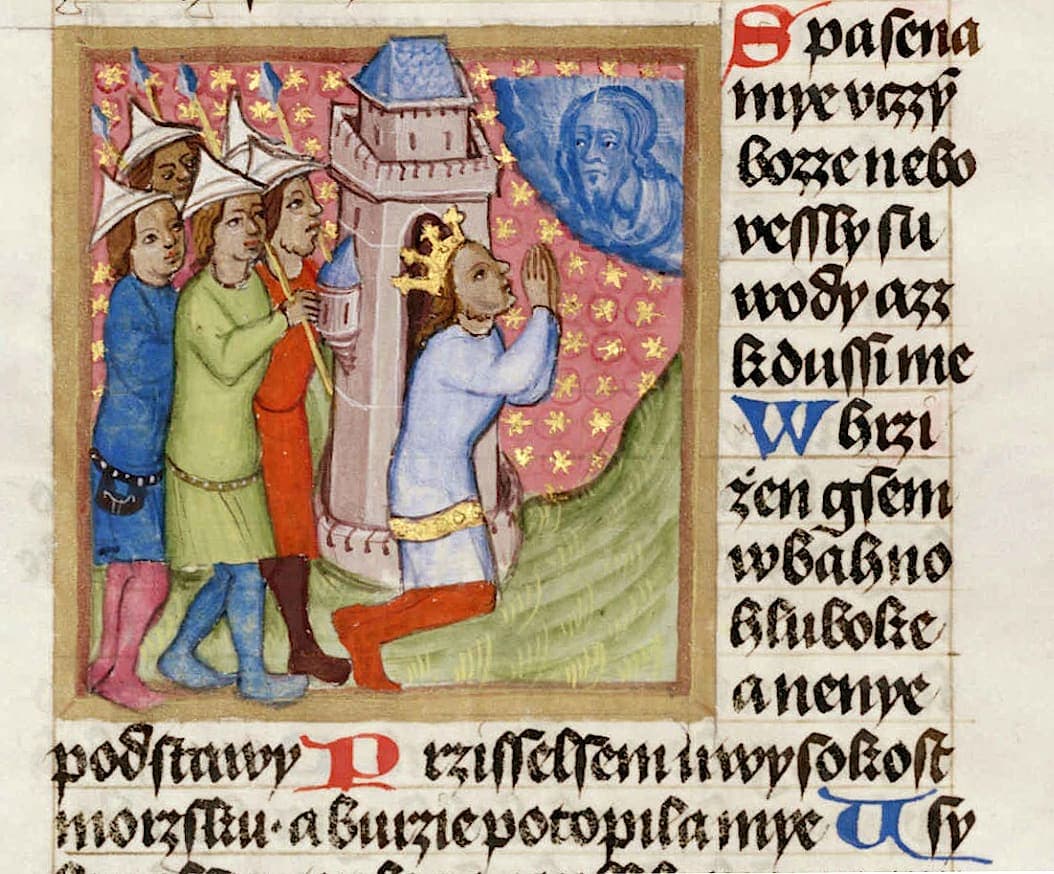
Vědecká knihovna v Olomouci, M III 1/I, f. 272v, 1417 · Source · Public domain · Vědecká knihovna v Olomouci, via digitalniknihovna.cz
Evidano Transcription
Spasena
mye vczyn
bozze nebo
vessly su
wody azz
kdussi me
Wbrzi-
zen gsem
wbahno
hluboke
a nenye
podstawy Przissel sem iu[?] wysokost
morzsku · a burzie potopila mye · Usy-
[cut off]
Generated by Evidano’s advanced model; not yet checked against a published edition.
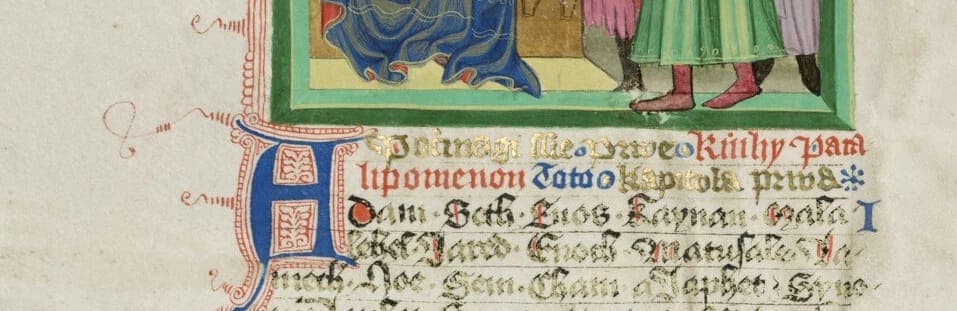
Vědecká knihovna v Olomouci, M III 3, f. 158v, c. 1420 · Source · Public domain · Vědecká knihovna v Olomouci
Evidano Transcription
Poczinagi sie · prwe · Knihy Para-
lipomenon Toto[?] · Kapitola prwa ·
Adam · Seth · Enos · Kaynan · Mala-
leel · Jared · Enoch · Matusale[?] · La-
mech · Noe · Sem · Cham a Japhet · Syno-
[cut off]
Generated by Evidano’s advanced model; not yet checked against a published edition.
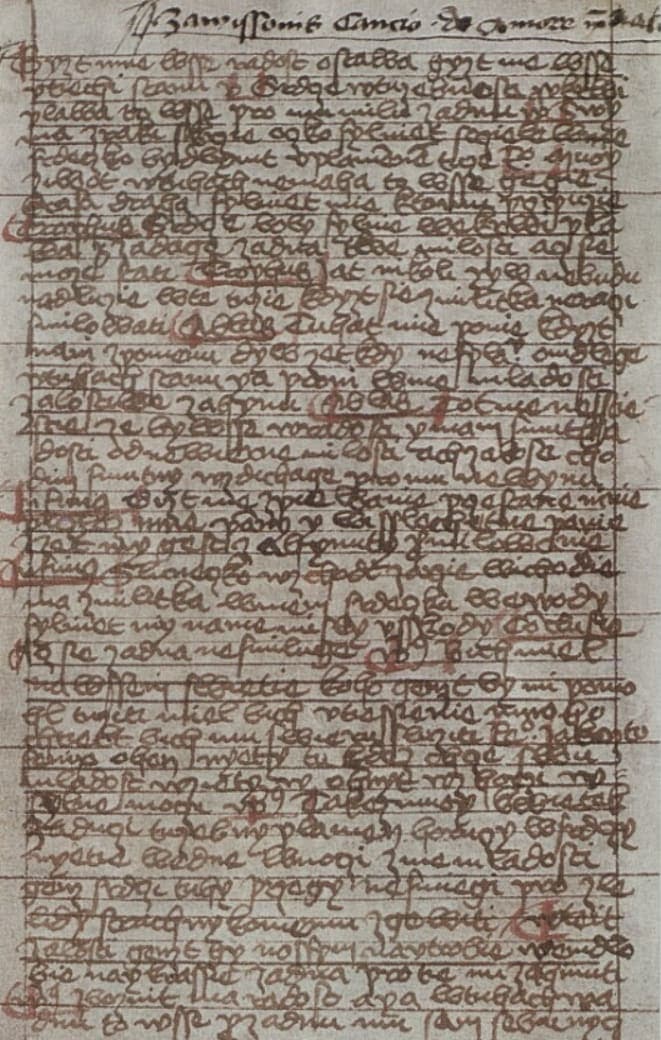
Source · CC0 1.0 · Scribe Oldřich Kříž z Telče; reproduction released as CC0 on Wikimedia Commons
Evidano Transcription
Zawyssionis cancio de amore [illegible]
[remaining lines (Czech Bastarda cursive) illegible at this resolution]
Generated by Evidano’s advanced model; not yet checked against a published edition.
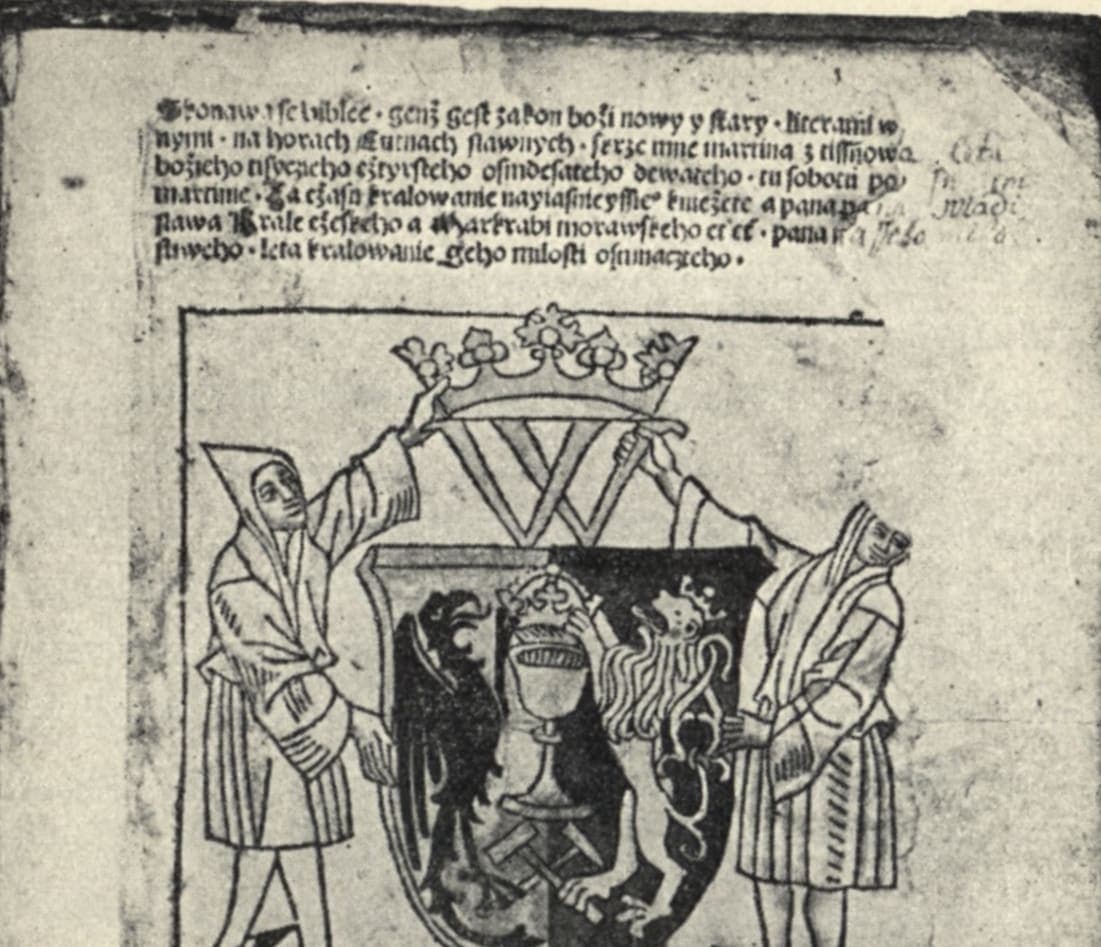
Source · Public domain · Photograph published in 1926
Evidano Transcription
[D]okonawa se biblee · genž gest zakon boži nowy y stary · literami w
nyni · na horach Kutnach slawnych · skrze[?] mne martina z tissnowa
božieho tisyczieho cztyrsteho osmdesateho dewateho · tu sobotu po
martinie · Za czasu kralowanie nayiasnieyssi[ho] kniežete a pana pa[illegible]
slawa Krale czeskeho a Markrabi morawskeho etc. · pana [illegible]
stiweho · leta kralowanie geho milosti osmnacteho ·
[handwritten marginal note, illegible]
Generated by Evidano’s advanced model; not yet checked against a published edition.
What Old Czech looks like on parchment
Czech becomes a written language of books in the fourteenth century, and it borrows its scripts from Latin. Formal manuscripts — bibles, psalters, legends, liturgical books — are copied in Gothic Textualis, an upright, angular hand in which every letter is built from vertical strokes of the same width, m, n, u and i differ only by their joins, and the round r after o, b and p (r rotunda) looks nothing like the r elsewhere on the line. Cheaper and faster books use Bastarda, the hybrid of book and charter hand, with a single-compartment a, long descenders on f and ſ, and looped ascenders; private copies, songs and student collections use a plain cursive that runs the letters together and abbreviates freely.
Before the diacritic reform associated with Jan Hus, Czech sounds with no Latin letter were written with digraphs and doubled letters: cz for č, rz for ř, ss for š, zz for ž, chz, y where a modern reader expects i, and vowel length usually not marked at all. Manuscripts of the fifteenth century mix the old digraphs with the newer dot and hook, sometimes in the same paragraph, so the spelling is evidence for the date and the exemplar as much as for the sound. Names, place names and biblical terms often keep the Latin form beside the Czech one.
The page around the text follows Latin practice. Chapter openings are rubricated in red, initials are drawn in red and blue with pen-flourishes, a pilcrow or a coloured stroke marks a new verse, and sentences are divided by a punctus or a virgula rather than by modern punctuation. Latin passages inside a Czech text — rubrics, source references, glosses between the lines — bring their own abbreviation system with them: superscript vowels, the nasal bar, the crossed p and the Tironian et, which are unlikely to appear in the Czech passages a line above.
Why ordinary OCR struggles here
Digraphs that recognition wants to modernise
Every model trained on modern Czech has a strong prior that ss is š and cz is č, and the moment it applies that prior the transcription stops being evidence. The reading has to keep the manuscript spelling and, if you want a modernised version, produce it separately.
Minim thickets in Textualis
A word such as minumu is a fence of identical strokes, and Old Czech supplies plenty of them. Resolution depends on spacing, on the hairline joins at the top and bottom of each stroke, and on knowing which words the text is likely to use — not on a dictionary of present-day Czech.
Two languages, two abbreviation systems
Czech is written out; Latin is contracted hard. A rubric, a marginal reference and an interlinear gloss may each be Latin while the body is Czech, so the same page needs Latin expansions in some places and none at all in others.
Rubrication, initials and later readers
Red display letters, flourished initials that occupy several lines, and marginal notes added a century later by a different hand all sit on the same leaf. A transcription that reads them as continuous text produces a sentence nobody ever wrote.
Who works with this material
Editors of Old Czech texts
Critical editions still begin with a diplomatic reading of each witness, including its spelling variants and its corrections. A machine-made first reading that keeps every digraph and marks every uncertain letter saves the collation stage without deciding anything for the editor.
Historians of the Czech language
The shift from digraphs to diacritics, the marking of length and the spread of the new orthography across regions are all measured from manuscript spellings. That research is impossible on a normalised text, and it needs enough transcribed pages to count occurrences rather than cite examples.
Libraries digitising medieval collections
Olomouc, Prague and Brno hold thousands of Czech and Latin codices whose catalogue entry is a title and a date. Even a rough transcription of the opening and closing leaves, with rubrics and colophons, turns a shelf list into something a researcher can search.
Students learning to read the script
A parallel transcription beside a folio is the standard way of learning Textualis and Bastarda. What matters is that the parallel text is honest about what is abbreviated, what is rubricated and what is illegible, so the beginner learns the script rather than a cleaned-up version of it.
Getting the best transcription
Ask for the manuscript spelling first
State explicitly that cz, rz, ss, zz and y are to be transcribed as written and that no modern Czech orthography is to be applied. Request the modernised form, if you want one, as a second field beside the diplomatic reading.
Name the languages and mark the switches
Say that Latin rubrics, headings and glosses may surround a Czech text, and ask for each to be labelled. Latin abbreviations can then be expanded in brackets while the Czech passages are left as the scribe wrote them.
Handle the decoration explicitly
Tell the model how to report rubrics, coloured initials and pen-flourished capitals — as marked-up text, or as a note — and how to treat the line-fillers and paragraph marks. Otherwise a three-line initial disappears and the first word of a chapter goes with it.
Start with a rubricated opening
Test on a leaf that has a chapter opening: it combines red display script, an initial, a Latin rubric and Czech body text in a few centimetres. If the four come back separated and correctly labelled, an ordinary text page will be straightforward.
Further reading on this hand
The palaeography guides the in-app selector points to for this domain, if you want to check a transcription against the standard references.
- Latin Palaeography in Central Europe
This academic guide examines medieval Central European manuscript scripts with examples connected to Bohemian collections. It describes the transition from Caroline to Gothic writing and distinguishes formal book hands from cursive documentary forms. Letter morphology, abbreviations, ligatures, punctuation, and regional chronology form central parts of the discussion. These features provide the palaeographical framework needed for Old Czech texts copied in Gothic and Bastarda hands.
Frequently asked questions
- Will the transcription convert cz and ss into č and š?
- Only if you ask for it. The default is a diplomatic reading that keeps the letters on the page, because in this period the choice of digraph is dated evidence; a normalised parallel text can be produced alongside for readers who want it.
- How are the earliest Czech diacritics treated?
- The dot over a letter, the hook and the acute of the fifteenth century are recorded where they appear, including when a scribe uses them inconsistently beside older digraphs. That mixture is one of the clearest signals of when and where a copy was made.
- Can Latin and Czech be separated on the same page?
- Yes. Rubrics, glosses and source references are labelled by language, so Latin contractions are expanded under Latin rules and Czech is left uncontracted. Without that separation, a Latin rubric read as Czech corrupts the beginning of every chapter.
- Does it work on cursive as well as on formal book hands?
- It does, though a fast fifteenth-century cursive with heavy abbreviation needs more review than a calligraphic Textualis. The practical difference is the number of flagged readings per page, not whether the hand can be read at all.
- What about a printed incunable in Bastarda type?
- Early Czech printing copies the manuscript hand closely, so the same recognition applies to a 1489 bible page as to a codex. What changes is the layout — set columns, running heads and a colophon — and that structure is reported as part of the transcription.
Related scripts and pages
Transcribe an Old Czech codex
Upload a folio of Textualis, Bastarda or fifteenth-century cursive and set the spelling rules before the whole manuscript.