
Czech · c. 1000–1300
Read the oldest written records of the Czech lands
Everything written in Bohemia and Moravia before about 1300 is in Latin, but the people, villages and rivers in it are Czech, spelled with whatever Latin letters a scribe thought came closest. Evidano transcribes these charters and codices line by line, keeps the scribe’s own spelling of Zassadee or Wyssegrad, and shows you which strokes it read as abbreviation marks.
Sample pages
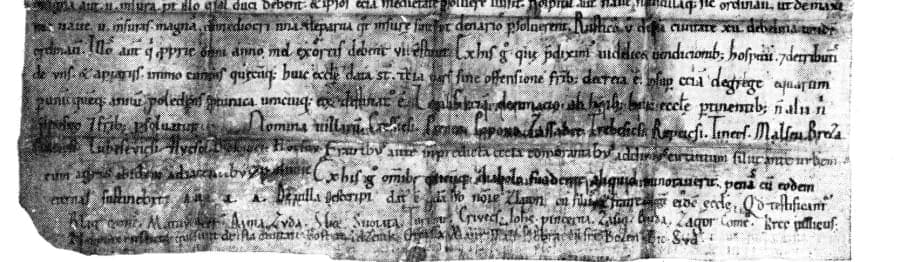
State Regional Archives in Litoměřice, Kapitula Litoměřice, sign. R2, c. 1057, with additions to the thirteenth century · Source · Public domain
Evidano Transcription
The lines shown, from the middle of the toll clauses to the last line of the front, in Gustav Friedrich’s edition of the original (version A of CDB I, no. 55). Angle brackets are the editor’s and mark passages written in paler ink by later hands over erasures; e caudata (ę) has been restored from the Internet Archive text. The edition prints in narrow columns, so its line breaks are not those of the parchment.
De magna autem II mensuras, preter illos, qui sal duci debent, et ipsos eciam medietatem persolvere iussit.
Hospitum autem naves naviculasque sic ordinavit, ut de maxima nave II mensuras magnas, de mediocri unam, de parva, quot mensurę sint, tot denarios persolverent.
Rusticos vero de ipsa civitate XII, de Belina totidem ordinavit. Illos autem, qui proprie omni anno mel ex ortis debent, VI constituit.
Ex his ergo, quę prediximus, videlicet vendicionibus hospitum et de tributis de viis et apiariis, immo cunctis quęcunque huic ecclesię data sunt, tercia pars sine offensione fratribus decreta est.
Insuper eciam de grege equarum per unum quemque annum poledrus pro tunica unicuique eorum destinatus est.
Legalis eciam decimacio ab hominibus huic ecclesię pertinentibus non alii nisi preposito et fratribus persolvatur.
Nomina villarum: Cressicsi, Prenee, Popouo, Zassadee, Trebesicsi, Repcicsi, Tinees, Malseu, Breza, Ptacicsi, Lubesevicsi, Hvcsci, <Bvsouici, Hotsov>.
Fratribus autem in predicta ecclesia commorantibus addimus circuitum silvę ante urbem cum agris ibidem adiacentibus et poduine.
Ex his ergo omnibus quicunque diabolo suadente aliquid minoraverit penas cum eodem eternas sustinebit. Amen. Amen. Amen.
<De villa Desecripi datus est quidam homo nomine Zlaton cum filiis et fratre ad legem eiusdem ecclesię. Quod testificantur Blag comes, Matuvs, Petrus, Dama, Zvda, Sbor, Suoiata, Turdmir, Crivecs, Johannes pincerna, Zasin, Buda, Zagor comes, Krec villicus.>
Nomina rusticorum, qui sunt de ista civitate: Gosten, Idzenik, Ottassa, Maur, Mali, Dobrac cum fratre Bozen, Bic, Svd.
Source: Codex diplomaticus et epistolaris regni Bohemiae I, ed. Gustav Friedrich (Prague, 1904–07), no. 55, via Internet Archive (Public domain).
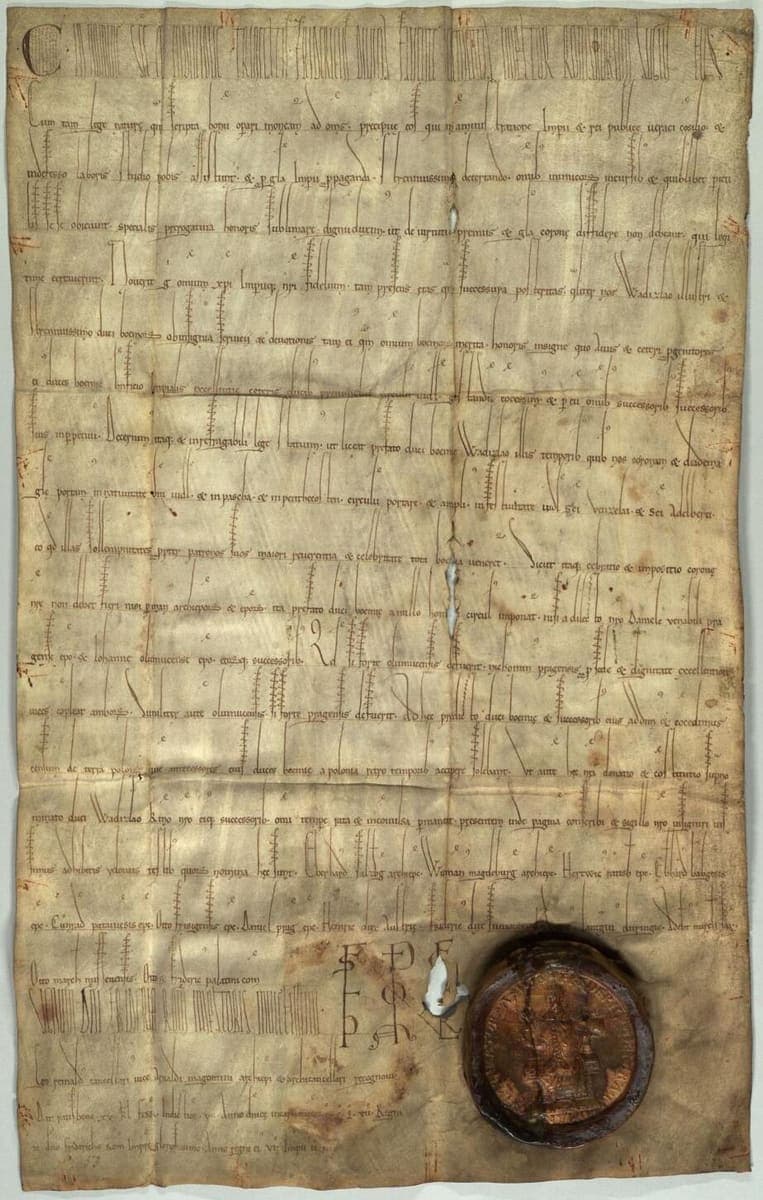
National Archives, Prague, Archiv České koruny, inv. no. 1, 18 January 1158 · Source · Public domain
Evidano Transcription
The elongated first line and the first nine lines of text, in Gustav Friedrich’s edition (CDB I, no. 180); a normalised Latin text with editorial punctuation, printed here as continuous sentences rather than in the edition’s narrow columns. E caudata (ę) has been restored from the Internet Archive text, and the duke’s name reads Wladizlao on the parchment. The doubled successoribus is the scribe’s slip and is recorded as such by the editor.
In nomine sancte et individue trinitatis. Fridericus, divina favente clementia imperator Romanorum augustus.
Cum tam lege naturę quam scripta bonum operari moneamur ad omnes, precipue eos, qui in amministratione imperii et rei publicę veraci consilio et indefesso laboris studio nobis assistunt et pro gloria imperii propaganda strennuissime decertando omnibus inimicorum incursibus et quibuslibet periculis sese obiciunt, specialis prerogativa honoris sublimare dignum duximus, ut de virtutum premiis et gloria coronę diffidere non debeant, qui legitime certaverint.
Noverit igitur omnium Christi imperiique nostri fidelium tam presens ętas quam successura posteritas, qualiter nos Wladizlao, illustri et strennuissimo duci Boemorum, ob insignia servicii ac devotionis tam eius quam omnium Boemorum merita honoris insigne, quo avus et ceteri progenitores eius duces Boemię beneficio imperialis excellentię ceteris ducibus preminebat, circulum videlicet gestandum concessimus et per eum omnibus successoribus successoribus suis in perpetuum.
Decernimus itaque et inrefragabili lege statuimus, ut liceat prefato duci Boemię Wladizlao illis temporibus, quibus nos coronam et diadema glorię portamus, in nativitate domini videlicet et in pascha et in penthecosten, circulum portare, et amplius in festivitate videlicet sancti Venzelai et sancti Adelberti,
Source: Codex diplomaticus et epistolaris regni Bohemiae I, ed. Gustav Friedrich (Prague, 1904–07), no. 180, via Internet Archive (Public domain).
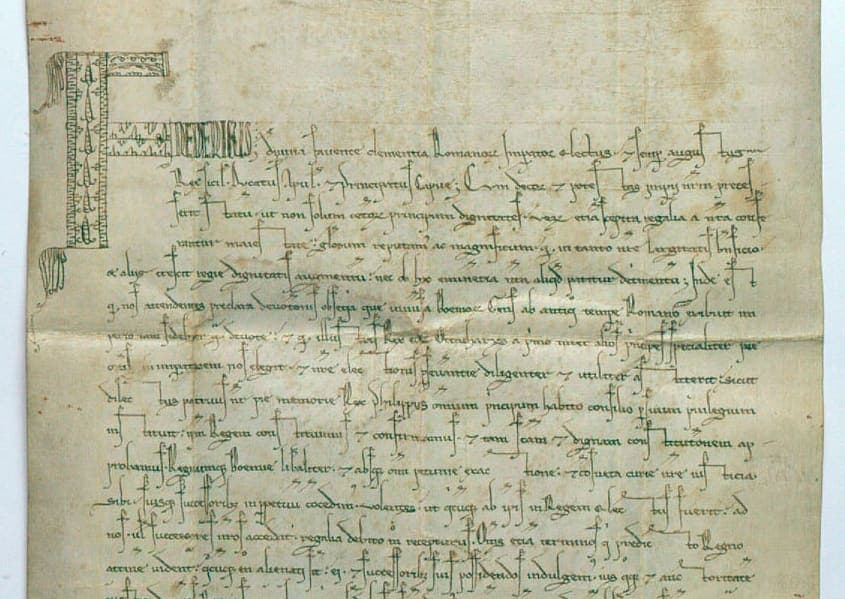
National Archives, Prague, Archiv České koruny, inv. no. 2, 26 September 1212 · Source · Public domain
Evidano Transcription
The opening protocol and the first seventeen lines of the charter, in Gustav Friedrich’s edition (CDB II, no. 96). The edition marks some of the parchment’s line ends with double bars and carries footnote letters in the text; both have been removed here, and the text is broken at sentence boundaries.
Fredericus, divina favente clementia Romanorum imperator electus et semper augustus, rex Sicilie, ducatus Apulie et principatus Capue.
Cum decor et potestas imperii nostrum precesserit statum, ut non solum ceterorum principum dignitates, verum etiam sceptra regalia a nostra conferantur maiestate, gloriosum reputamus ac magnificum, quod in tanto nostre largitatis beneficio et aliis crescit regie dignitatis augmentum, nec ob hoc eminentia nostra aliquod patitur detrimentum.
Inde est, quod nos attendentes preclara devotionis obsequia, que universa Boemorum gens ab antiquo tempore Romano exibuit imperio tam fideliter quam devote, et quod illustris rex eorum Ottacharvs a primo inter alios principes specialiter pre ceteris in imperatorem nos elegit et nostre electionis perseverande diligenter et utiliter astiterit: sicut dilectus patruus noster, pie memorie rex Philippus, omnium principum habito consilio, per suum privilegium instituit, ipsum regem constituimus et confirmamus et tam sanctam et dignam constitutionem approbamus;
regnumque Boemie liberaliter et absque omni pecunie exactione et consueta curie nostre iusticia sibi suisque successoribus in perpetuum concedimus; volentes, ut quicumque ab ipsis in regem electus fuerit, ad nos vel successores nostros accedat, regalia debito modo recepturus.
Source: Codex diplomaticus et epistolaris regni Bohemiae II, ed. Gustav Friedrich (Prague, 1912), no. 96, via Internet Archive (Public domain).
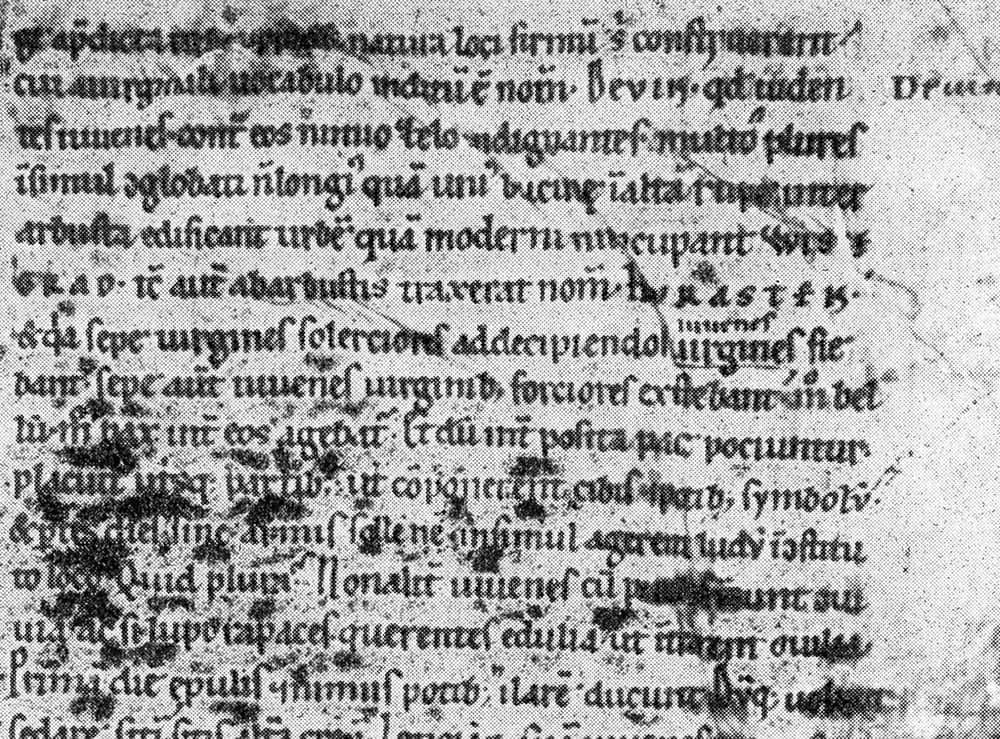
Library of the National Museum, Prague, MS VIII F 69, f. 7r, twelfth or early thirteenth century · Source · Public domain
Evidano Transcription
[illegible] natura loci firmu[m] [?] construxeru[n]t
ca[illegible] uirginali uocabulo inditu[m] [est] nom[en] · D E V I N · q[uo]d uiden
tes iuuenes · cont[ra] eos nimio zelo indignantes multo plures
i[n]simul [con]globati n[on] longi[?] qua[ntum] uni[us] bucine i[n] alta rupe inter
arbusta edificant urbe[m] qua[m] moderni nu[n]cupant W I S [illegible]
G R A D · t[un]c a[utem] ab arbustis traxerat nom[en] · H R A S T E N ·
Et q[ui]a sepe uirgines solerciores ad decipiendos [cancelled: uirgines] iuuenes fie
bant · sepe a[utem] iuuenes uirginib[us] forciores existeba[n]t [?] in bel
lu[m] [?] pax int[er] eos agebat[ur] · Et du[m] int[er] posita pac[e] pociuntur
placuit utriq[ue] partib[us] ut co[m]ponerent cibis [illegible] potib[us] symbolu[m]
et p[er] tres dies sine armis solle[m]ne insimul agerent ludu[m] i[n] statu
to loco · Quid plura · Non aliter iuuenes cu[m] p[illegible] au
uia ac si[?] lupi[?] rapaces querentes edulia ut intrant ouilia
Prima die epulis et nimiis potib[us] ilare[m] ducunt [illegible]
[last line cut off]
[margin:] Deuin[?] [cut off]
Generated by Evidano’s advanced model; not yet checked against a published edition.
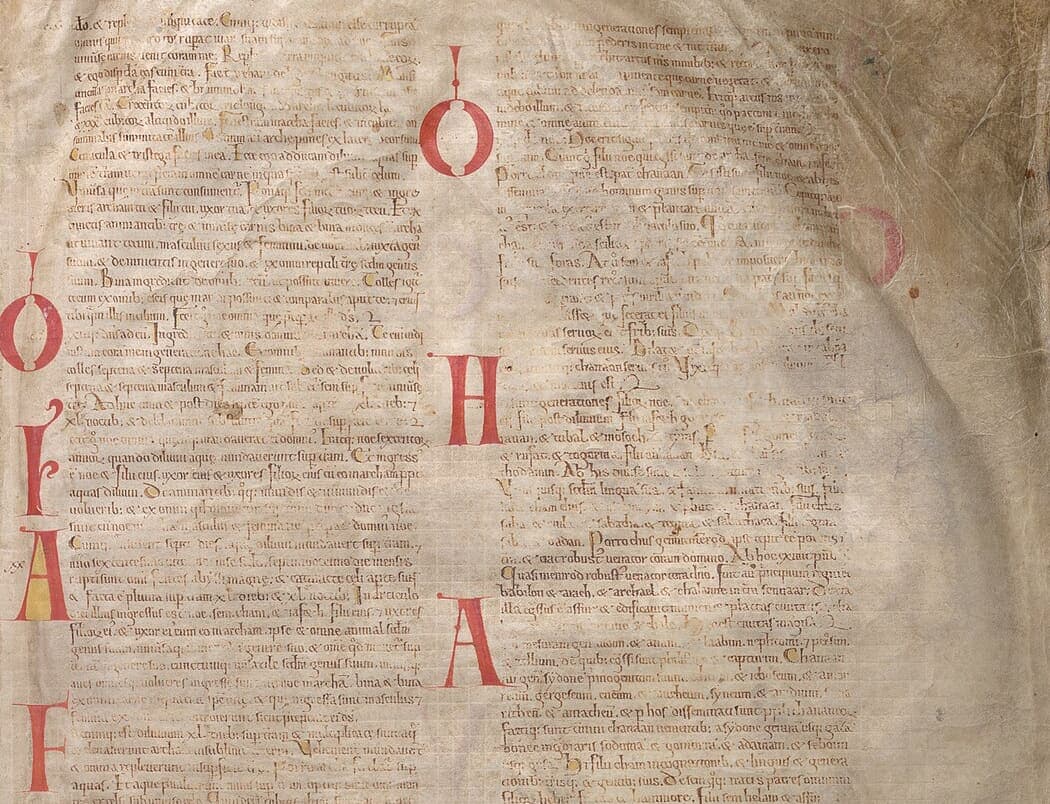
National Library of Sweden, Stockholm, Codex Gigas, c. 1229 · Source · Public domain · Kungliga biblioteket digitisation
Evidano Transcription
[left column and upper part of right column illegible at this resolution]
[illegible] adan. Porro chus genuit nemrod. ipse cepit e[ss]e pot[en]s i[n]
[illegible] & erat robust[us] uenator coram domino. Ab hoc exiuit p[ro]u[er]biu[m][?]
Quasi nemrod robust[us] uenator cora[m] d[omi]no. Fuit au[tem] principium regni [illegible]
babilon & arach. & archad. & chalanne in t[er]ra sennaar. De t[er]ra
illa egressus [est] assur & edificauit [illegible] & plateas ciuitatis. & cha
[illegible] est ciuitas magna. [illegible]
[illegible] gen[uit] ludim. & anam[illegible] laabim. nephtuim. & phetrusim.
[illegible]luim. de quib[us] egressi sunt phil[illegible] capturim[?]. Chanaan
au[tem] gen[uit] sydone[m] primogenitum suu[m]. [illegible] & iebuseum. & amor
reum. gergeseum. eueum [illegible] aracheum. syneum. & aradium. [illegible]
[illegible] & amatheu[m][?]. & p[ost] hos disseminati sunt p[o]p[u]li chananeo[rum].
Factiq[ue] sunt t[er]mini chanaan uenientib[us] a sydone gerara usq[ue] gaza
donec ingrediaris sodoma[m] & gomorra[m]. & adama[m]. & seboim
usq[ue] [illegible]. Hi filii cham in cognationib[us]. & linguis & genera
tionib[us] t[er]risq[ue]. & gentib[us] suis. De sem q[uo]q[ue] nati s[unt] patre[?] omniu[m]
filior[um] heber [illegible] maiore. Filii sem helam & assur
Generated by Evidano’s advanced model; not yet checked against a published edition.
What an early Bohemian page looks like
Latin writing arrived in the Czech lands with the Prague bishopric in the late tenth century, and its first two hundred years are Caroline minuscule: rounded, well-separated letters written between ruled lines in the monasteries at Břevnov, Ostrov and Sázava and at the Vyšehrad chapter. From the later twelfth century the letters narrow and their feet gain serifs; by the time the Codex Gigas was written at Podlažice, around 1229, the book hand is a full Gothic textualis in which m, n, u and i dissolve into rows of identical minims and adjacent bows are fused. Charters follow a separate track. A solemn diploma opens with a chrismon and a line of litterae elongatae — letters stretched two or three times their normal height, packed with wedges and hairlines — then drops into a small documentary minuscule, and closes with a monogram, a recognition line and a wax or gold seal on cords.
The abbreviation system is the main obstacle. A horizontal bar over a vowel drops an m or n; a superscript stroke turns p into per, prae or pro depending on where it cuts the stem; a 9-shaped sign stands for con- at the start of a word and -us at the end; ꝛ (r rotunda) follows o and other bows; the Tironian sign for et looks like a 7. Nomina sacra are contracted to dm, ds, xps and spu, and technical words of estate administration — episcopus, ecclesia, denarius, ebdomada, mensura — are cut to two or three letters with a stroke. Numbers are Roman, often flanked by points as in ·XXX· or ·LXX·, and dates are given by regnal and imperial years, indiction and church feasts rather than by a month and a day.
Czech itself appears only in fragments, and never with diacritics. Scribes wrote the sounds Latin lacked with digraphs and stand-ins: cz, cs or c for what would later be č, s or ss for š, z or s for ž, and a final -ih for the locative plural, which is why one charter lists villages as Cressicsi, Trebesicsi and Lubesevicsi. Personal names are pulled halfway into Latin — Sdeszlavs, Guclinvs — so the same man can look different on two lines of one sheet. Many of these documents were also edited on the parchment itself, with words scraped away and rewritten in paler ink a century or more later.
Why ordinary OCR struggles here
Names that no dictionary contains
Generic OCR corrects towards words it knows, so Ptacicsi becomes Placidsi and Hotsov becomes Hobson. Bohemian toponyms have to be read letter by letter and left exactly as the scribe wrote them, because their value to a historian lies in the spelling itself.
A bar can mean four different things
The same horizontal stroke suppresses an m, marks a contraction, indicates a Roman numeral or simply decorates the top of an ascender. Reading it correctly means recognising the whole word, and a transcription that expands silently hides the places where the scribe was ambiguous.
Minims in Gothic book hands
In a page of the Codex Gigas, immo, uiuunt and nummi are strings of vertical strokes distinguished only by hairline joins and the position of a dot over i. Line-by-line context, not shape matching, decides how many minims belong to which letter.
Layers of hands on one sheet
Charters were amended for a century after they were issued. Erasures, paler ink, a slightly later letterform and text squeezed into the margin or onto the dorse all have to be separated from the original grant rather than merged into one flat block of text.
Who works with this material
Diplomatic editors
Anyone continuing the Codex diplomaticus of Bohemia or editing a monastic archive needs a first reading that reproduces the sheet as written, doubled words and passages added over erasures included, so the apparatus can be built from the transcription itself.
Place-name and personal-name researchers
Historical toponymy depends on early spellings. A transcription that leaves Zassadee, Hvcsci and Sdeszlavs untouched lets a researcher trace one settlement across three centuries of charters; a normalised one destroys the evidence.
Archives publishing digitised charters
Collections such as the Archive of the Bohemian Crown are online as images with a one-line summary. Full text under each image, even a draft one, turns a viewer into something searchable by witness, village or formula.
Teachers of Latin palaeography
A course on Central European scripts moves from Caroline to Gothic in a few weeks. A transcription beside each plate lets students test their reading of minims and abbreviation marks before the seminar rather than during it.
Getting the best transcription
Fix the abbreviation policy first
Say whether you want ecclesie or eccl(es)ie, and whether the bar over a vowel should be resolved silently. For an edition, ask for the supplied letters in round brackets so every expansion stays visible and reversible.
Protect the proper names
Tell the model not to modernise or Czech-ify names and to copy the letters it sees, flagging any it cannot read. Adding the few known forms from the same archive to the prompt helps it choose between c, cs and cz where the ink is faint.
Ask for the parts of the document separately
A charter has an elongated first line, a body, a witness list, a dating clause and often notes on the dorse. Requesting them as labelled blocks keeps the witness names out of the narrative text and makes the dating clause easy to check.
Test on a sheet that was altered
Choose a charter with erasures and later insertions for the first run. If the model marks the paler additions and refuses to guess at scraped words there, a clean codex page will give no trouble.
Further reading on this hand
The palaeography guides the in-app selector points to for this domain, if you want to check a transcription against the standard references.
- Latin Palaeography in Central Europe
This academic teaching resource surveys Latin palaeography through manuscripts and charters produced in Central Europe. It gives particular attention to script development in medieval Bohemia and to the relationship between book and documentary hands. The material discusses diagnostic letterforms, abbreviations, ligatures, punctuation, and the dating or localization of scripts. It is directly useful for Czech lands where early vernacular evidence survives within Latin scribal traditions.
Frequently asked questions
- Will Czech names be turned into their modern forms?
- Not unless you ask. The default is to copy what is on the parchment, so Trebesicsi stays Trebesicsi. If you also want a modern identification, request it as a separate column so the manuscript spelling and the interpretation never get mixed together.
- How are suspension and contraction marks treated?
- They are read as abbreviations rather than as accents or specks of dirt. You choose the output: the sign as written, a silent expansion, or an expansion with the supplied letters in brackets, applied the same way across a whole cartulary.
- Can it separate a later addition from the original text?
- Differences in ink colour, letterform and line spacing are visible to the model, and it can label a passage as a probable later hand. The judgement stays yours, but the transcription tells you where to look instead of presenting one flat text.
- What happens with the stretched letters of a charter’s first line?
- Litterae elongatae are transcribed as ordinary text and marked as the elongated line, so the invocation and the emperor’s title appear in the right place rather than being skipped as decoration or read as a row of vertical rules.
- Are Roman numerals and dating clauses handled reliably?
- Numerals are kept as they stand, points and all, rather than converted to Arabic figures, and dating clauses by indiction, regnal year and feast day are transcribed as written. Converting them to a calendar date is a separate step you control.
- Does it work on a two-column Gothic Bible page?
- Yes. Reading order is set per column, so the left column runs to the foot of the page before the right one begins, and marginal chapter initials are reported as headings rather than dropped into the running text.
Related scripts and pages
Transcribe your Bohemian charters
Upload a scan, choose Medieval Bohemian Latin Caroline and Gothic Records, and try the prompt on one amended sheet before running the fonds.