
Latin · c. 750–1150
Transcribe the hand that standardised medieval Latin
Caroline minuscule replaced a patchwork of regional Latin scripts with one clear, widely spaced alphabet, and for three centuries it was used for gospel books, royal law codes, and the only surviving copies of several Roman historians. Evidano reads its consistent letterforms while still telling apart the abbreviations, marginal reference numbers and later Romanesque compression a page can carry.
Sample pages
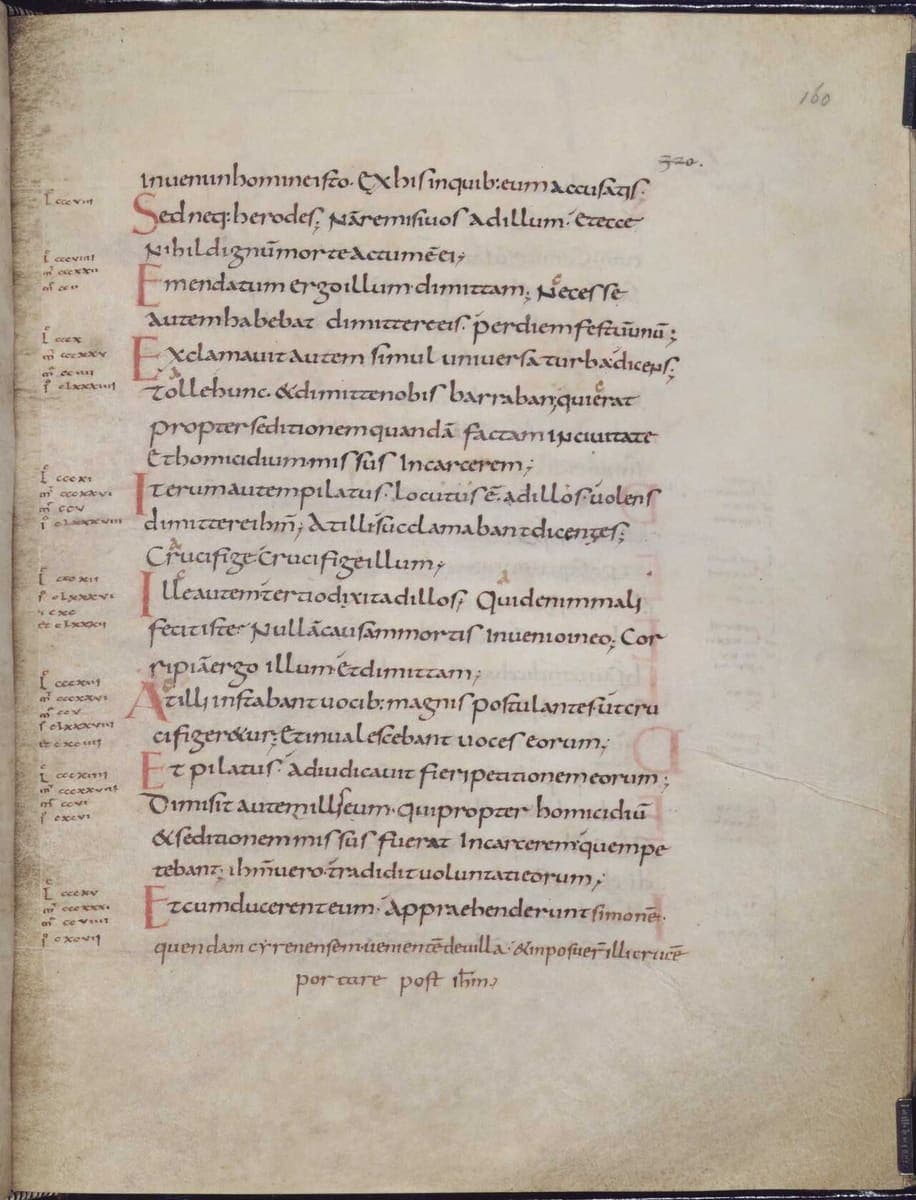
British Library, 9th century · Source · Public domain
Evidano Transcription
Luke 23:14–26, the whole page, following the Vulgate text. The manuscript’s own ct and st ligatures and suspension strokes are silently expanded here, and the small marginal numerals are Eusebian canon-table cross-references, not part of the running text.
14 dixit ad illos: Obtulistis mihi hunc hominem, quasi avertentem populum, et ecce ego coram vobis interrogans, nullam causam inveni in homine isto ex his in quibus eum accusatis.
15 Sed neque Herodes: nam remisi vos ad illum, et ecce nihil dignum morte actum est ei.
16 Emendatum ergo illum dimittam.
17 Necesse autem habebat dimittere eis per diem festum unum.
18 Exclamavit autem simul universa turba, dicens: Tolle hunc, et dimitte nobis Barabbam:
19 qui erat propter seditionem quamdam factam in civitate et homicidium missus in carcerem.
20 Iterum autem Pilatus locutus est ad eos, volens dimittere Iesum.
21 At illi succlamabant, dicentes: Crucifige, crucifige eum.
22 Ille autem tertio dixit ad illos: Quid enim mali fecit iste? nullam causam mortis invenio in eo: corripiam ergo illum et dimittam.
23 At illi instabant vocibus magnis postulantes ut crucifigeretur: et invalescebant voces eorum.
24 Et Pilatus adiudicavit fieri petitionem eorum.
25 Dimisit autem illis eum qui propter homicidium et seditionem missus fuerat in carcerem, quem petebant: Iesum vero tradidit voluntati eorum.
26 Et cum ducerent eum, apprehenderunt Simonem quemdam Cyrenensem venientem de villa: et imposuerunt illi crucem portare post Iesum.
Source: Biblia Sacra Vulgata, Vulgata Clementina, Gospel of Luke, via Wikisource (Public domain).
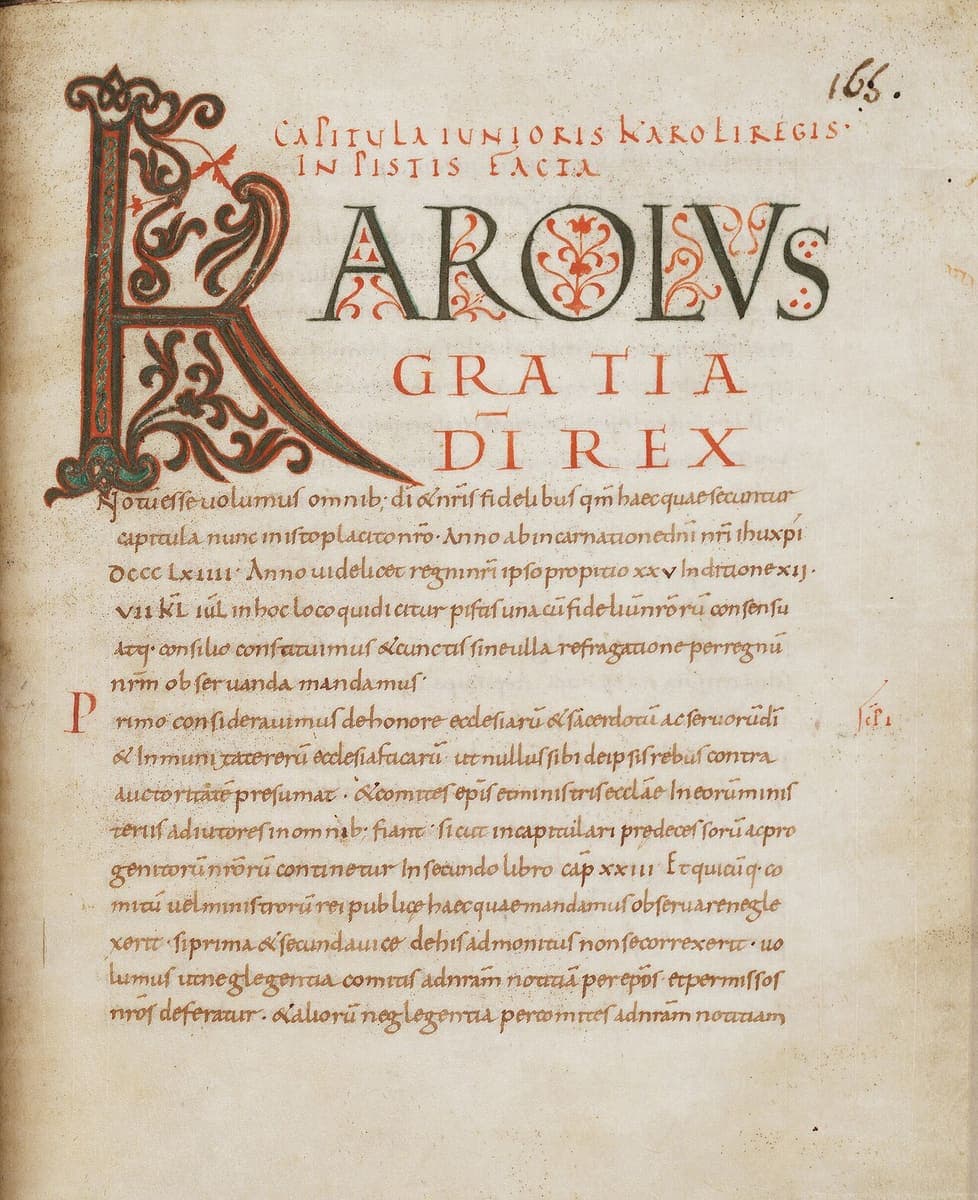
Beinecke Rare Book and Manuscript Library, Yale University, 9th century · Source · Public domain
Evidano Transcription
CAPITVLA IVNIORIS KAROLI REGIS .
IN PISTIS FACTA
KAROLVS
GRATIA
D[E]I REX
Notu[m] esse uolumus omnib[us] d[e]i & n[ost]ris fidelibus q[uo]n[iam] haec quae secuntur
capitula nunc in isto placito n[ost]ro . Anno ab incarnatione d[omi]ni n[ost]ri ih[es]u xp[ist]i
Dccc lxiiii . Anno uidelicet regni n[ost]ri ipso propitio xxv Inditione xii .
vii K[a]L[endas] iul[ias] in hoc loco qui dicitur pistis una cu[m] fideliu[m] n[ost]roru[m] consensu
atq[ue] consilio constituimus & cunctis sine ulla refragatione per regnu[m]
n[ost]r[u]m obseruanda mandamus .
P rimo considerauimus de honore ecclesiaru[m] & sacerdotu[m] ac seruoru[m] d[e]i
& Inmunitate reru[m] ecclesiasticaru[m] . ut nullus sibi de ipsis rebus contra
auctoritate[m] presumat . & comites ep[iscop]is et ministris eccl[esi]ae In eoru[m] minis
teriis adiutores in omnib[us] fiant . sicut in capitulari predecessor[um] ac pro
genitoru[m] n[ost]roru[m] continetur In secundo libro cap[itulo] xxiii Et quicu[m]q[ue] co
mitu[m] uel ministroru[m] rei publice haec quae mandamus obseruare negle
xerit . si prima & secunda uice de his admonitus non se correxerit . uo
lumus ut neglegentia comitis ad n[ost]ram notitia[m] per ep[iscop]os et per missos
n[ost]ros deferatur . & alioru[m] neglegentia per comites ad n[ost]ram notitiam
[margin, beside Primo:] [illegible]
Generated by Evidano’s advanced model; not yet checked against a published edition.
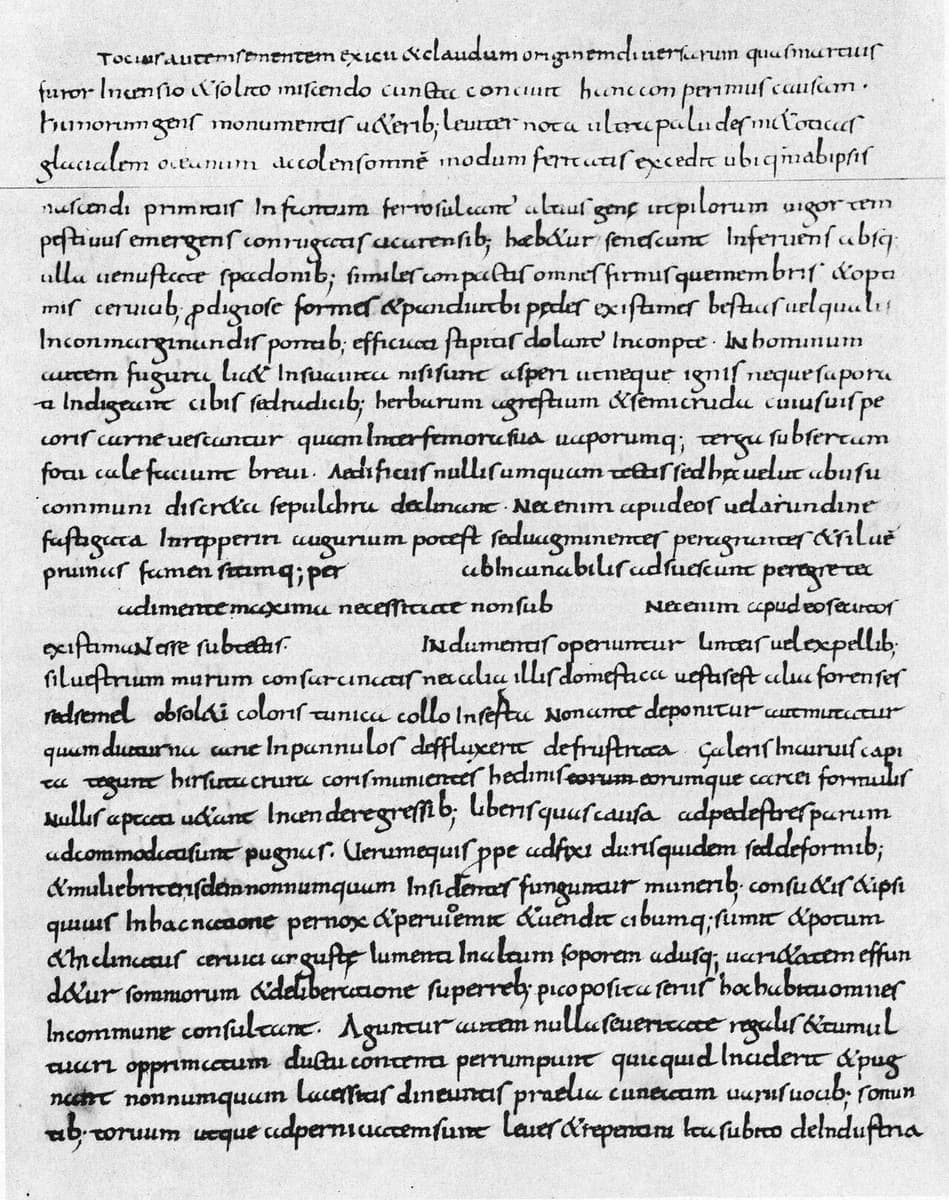
Biblioteca Apostolica Vaticana, 9th century · Source · Public domain
Evidano Transcription
Tocius autem sementem exicii & cladium originem diuersarum quas martius
furor Incensio & solito miscendo cuncta concuit hanc conperimus causam .
Hunorum gens monumentis ueterib; leuiter nota ultra paludes meoticas
glacialem oceanum accolens omne[m] modum feritatis excedit ubiqui ab ipsis
nascendi primitus Infantum ferro sulcant[ur] altius genę ut pilorum uigor tem
pestiuius emergens conrugatis cicatricib;[?] hebetur senescunt Inferuiens absq;
ulla uenustate spadonib; similes conpactis omnes firmisque membris & opi
mis ceruicib; p[ro]digiose formes & pandi ut bi pedes existimes bestias uel quales
In conmarginandis pontib; efficiati stipites dolant[ur] Inconpte . In hominum
autem figura licet Insuauia uisi sunt asperi ut neque ignis neque sapora
ta Indigeant cibis sed radicib; herbarum agrestium & semicruda cuiusuis pe
coris carne uescantur quam Inter femora sua equorumq; terga subsertam
fotu calefaciunt breui . Aedificiis nullis umquam tecti[?] sed haec uelut ab usu
communi discreta sepulchra declinant . Nec enim apud eos uel arundine
fastigiata Inrepperiri augurium potest sed uagi minentes peragrantes & silue[?]
pruinas famen sitimq; per [gap] ab Incunabulis adsuescunt peregre tec
[gap] adimente maxima necessitate non sub [gap] Nec enim apud eos securos
existimant esse sub tectis . [gap] Indumentis operiuntur linteis uel ex pellib;
siluestrium murium consarcinatis nec alia illis domestica uestis est alia forenses
sed semel obsoleti coloris tunica collo Inserta non ante deponitur aut mutatur
quam diuturna carie In pannulos defluxerit defrustrata galeris Incuruis capi
ta tegunt hirsuta crura coriis munientes hedinis [cancelled: eorum] eorumque calcei formulis
nullis aptati uetant Incedere gressib; liberis quas[?] causa ad pedestres parum
adcommodati sunt pugnas . Uerum equis p[ro]pe adfixi duris quidem sed deformib;
& muliebriter isdem nonnumquam Insidentes funguntur munerib; consuetis & ipsi
quiuis In hac natione pernox & perdius[?] & uendit cibumq; sumit & potum
& Inclinatus ceruici angustę iumenta In altum soporem adusq; uarietatem effun
ditur somniorum & deliberatione super reb; p[ro]posita seriis hoc habitu omnes
In commune consultant . Aguntur autem nulla seueritate regalis & tumul
tuari opprimatum ductu contenti perrumpunt quicquid Inciderit & pug
nantes nonnumquam lacessiti[?] ineunt[?] praelia cuneatim uariis uocib; sonan
tib; toruum ueque ad pernicitatem sunt leues & repentini Ita subito de Industria
Generated by Evidano’s advanced model; not yet checked against a published edition.
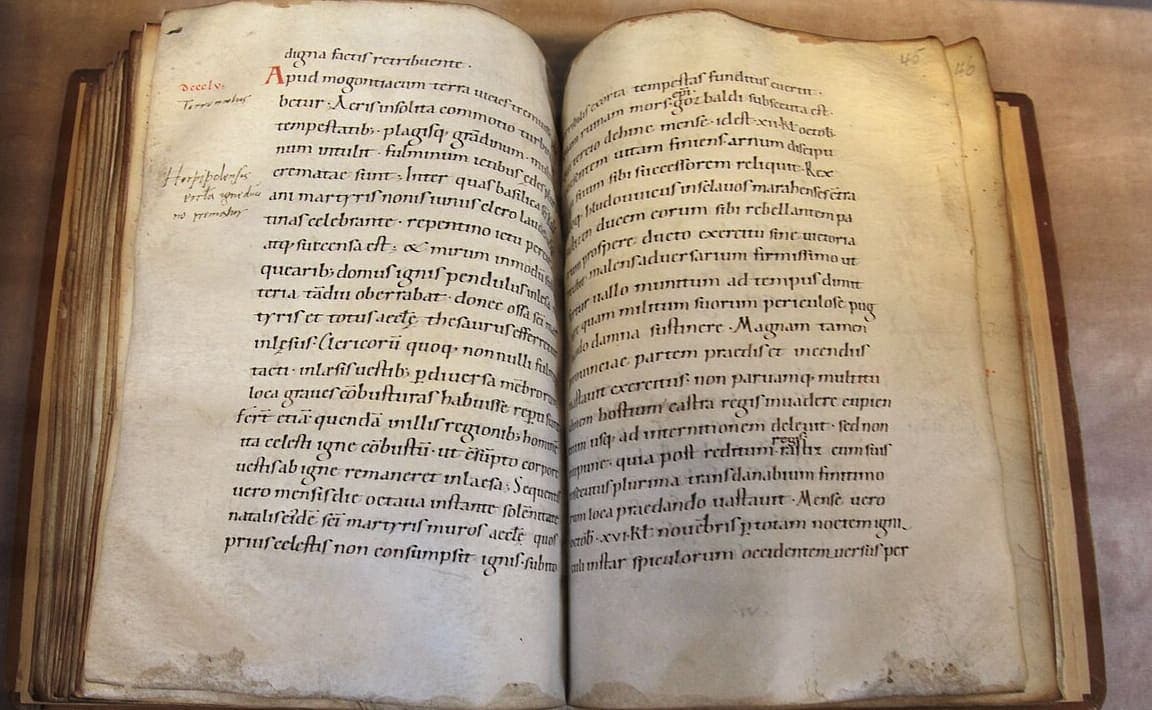
Source · CC BY-SA 2.0 · Alexandre Dulaunoy
Evidano Transcription
digna factis retribuente .
Apud mogontiacum terra uicies tremu[cut off]
betur . Aeris insolita commotio turb[cut off]
tempestatib[us] . plagisq[ue] gra[n]dinum . m[cut off]
num intulit . fulminum ictibus celes[cut off]
crematae sunt . Inter quas basilica [cut off]
ani martyris nonis iunii[?] clero lau[cut off]
tinas celebrante . repentino ictu per[cut off]
atq[ue] succensa est . & mirum inmodu[cut off]
quearib[us] domus ignis pendulus inle[cut off]
teria ta[n]diu oberrabat . donec ossa s[cut off]
tyris et totus aeccl[esi]e thesaurus effer[cut off]
inlesus . Clericoru[m] quoq[ue] non nulli fu[cut off]
tacti . inlesis uestib[us] p[er] diuersa me[m]bror[cut off]
loca graues co[m]busturas habuisse rep[cut off]
fer[un]t etia[m] quenda[m] in illis regionib[us] homin[cut off]
ita celesti igne co[m]bustu[m] . ut [illegible] corpor[cut off]
uestis ab igne remaneret inlaesa . Sequen[cut off]
uero mensis die octaua instante sole[m]nita[cut off]
natalis eiusde[m] s[an]c[t]i martyris muros aeccl[esi]e quo[cut off]
prius celestis non consumpsit ignis . subit[cut off]
Dccclv .
Terraemotus[?]
Herbipolensis
eccl[esi]a igne diui
no p[er]cussa[?]
[cut off] exorta tempestas funditus euertit .
[cut off]rumam mors \epi/ gozbaldi subsecuta est .
[cut off]tercio dehinc mense . id est . xii . k[a]l[endas] octob[ris]
[cut off]tem uitam finiens arnum discipu
[cut off] sibi successorem reliquit . Rex
[cut off] hludouuicus in sclauos marahenses et ra
[cut off] ducem eorum sibi rebellantem pa
[cut off] prospere ducto exercitu sine uictoria
[cut off] malens aduersarium firmissimo ut
[cut off] uallo munitum ad tempus dimit
[cut off] quam militum suorum periculose pug
[cut off] damna sustinere . Magnam tamen
[cut off]uinciae partem praedis et incendiis
[cut off]stauit exercitus . non paruamq[ue] multitu
[cut off] hostium castra regis inuadere cupien
[cut off] usq[ue] ad internitionem deleuit . sed non
[cut off]pune . quia post reditum \regis/ fallax cum suis
[cut off] plurima transdanabium[?] finitimo
[cut off] loca praedando uastauit . Mense uero
[cut off] . xvi . k[a]l[endas] nouembris p[er] totam noctem igni
[cut off] instar speculorum occidentem uersus per
Generated by Evidano’s advanced model; not yet checked against a published edition.
What Carolingian and Romanesque minuscule look like
From the late eighth century, scriptoria across the Frankish realm adopted a single reformed minuscule, associated with the educational reforms pursued under Charlemagne: rounded, clearly separated letters with true ascenders and descenders, drawing on half-uncial and on earlier local minuscule experiments at centres such as Corbie and Luxeuil. Because it was legible and consistent, it became the hand for copying scripture, patristic authors, royal capitularies, and classical Latin texts that survive today largely because a Carolingian scriptorium chose to copy them – Ammianus Marcellinus’s history among them.
Individual letters stand upright and clearly apart from their neighbours. Tall and short forms of s coexist depending on position; open and closed forms of a both appear; an uncial-shaped d with an upright ascender and a minuscule d with a sloped one can turn up in the same manuscript. The ct, st and et combinations are often joined into a single ligature. Abbreviation is comparatively restrained next to later Gothic practice: a suspension stroke over a missing m or n, a shorthand for the ending -us, and the Tironian sign (⁊) for et cover most cases. Punctuation uses points placed at different heights to mark pauses of different lengths, an early ancestor of the modern comma and full stop, and gospel books carry marginal Eusebian canon numbers cross-referencing parallel passages in the other Gospels.
By the eleventh and twelfth centuries, in what is usually called the Romanesque phase, the same basic letterforms persist but the hand compresses: letters narrow and lean, spacing tightens, and ligatures and abbreviations grow more frequent, anticipating the fully compressed Gothic textualis that follows after about 1150. Layout diversifies with the purpose of the text: royal and legal documents use display capitals and rubrication for headings and dates, while a monastic chronicle kept year by year, sometimes by several scribes over a century, is often written in a plainer, faster version of the same hand.
Why ordinary OCR struggles here
Same letter, two competing forms
Both uncial and minuscule versions of d, and both tall and short s, can appear side by side in one manuscript depending on their position in a word. A rigid template treats one form as an error rather than a normal variant.
Compression that changes across a page
Romanesque-phase minuscule narrows and links letters more than earlier Carolingian book hands, and a single manuscript can shift character partway through if more than one scribe worked on it over time.
Legal and administrative abbreviation systems
Capitularies and charters abbreviate recurring legal and chancery formulas differently from a gospel book, and reading one correctly means recognising its own vocabulary of contractions, not a general medieval Latin shorthand.
Marginal apparatus sharing the page with the text
Eusebian canon numbers, later correctors’ notes and interlinear glosses sit on the same page as the main hand and need to be told apart from it rather than read as part of the running text.
Who works with this material
Editors of Carolingian gospel books and psalters
Preparing an edition means keeping the main text apart from marginal canon numbers and later corrections, which a diplomatic first-pass transcription can do automatically if it is told to look for them.
Legal historians working on capitularies and early charters
Carolingian and Ottonian legislation survives mostly in manuscript, and its formulaic legal Latin needs a transcription that recognises chancery vocabulary rather than reading it as ordinary prose.
Classicists tracing how Roman texts were transmitted
Several classical authors survive only because a Carolingian scriptorium copied them. Transcribing the sole surviving witness accurately, including its apparent errors, is textual-critical work, not just convenience.
Historians of monastic chronicle-writing
Annals added year by year, sometimes by several hands over a century, benefit from a transcription that can flag a change of scribe or ink alongside the text itself.
Getting the best transcription
Say roughly which century you are working with
Tell the model whether the page is an early Carolingian book hand or a later, denser Romanesque-phase hand, since the two compress differently even though the underlying letter shapes are related.
Fix a rule for common ligatures and the Tironian sign
Decide whether the ct, st and et ligatures, and the Tironian ⁊, should be expanded or kept as written, and apply that choice consistently across the manuscript.
Name the document type for legal and administrative texts
Telling the model it is looking at a capitulary, charter or annal helps it read formulaic abbreviations in the right context rather than as generic suspensions.
Test on a page with marginal apparatus first
Canon numbers, a corrector’s note, or a visible change of scribe show whether the model separates apparatus from the main text before you run a whole manuscript through the same prompt.
Further reading on this hand
The palaeography guides the in-app selector points to for this domain, if you want to check a transcription against the standard references.
- Latin Paleography
This Hill Museum & Manuscript Library (HMML) course provides a substantial module on Caroline Minuscule and its place in medieval script history. Its examples show the regularized alphabet, ascenders and descenders, ligatures, abbreviations, and punctuation used in Carolingian and post-Carolingian books. The exercises also demonstrate variation by date and scriptorium rather than presenting the script as completely uniform. It is therefore useful for manuscripts written during both the classical Carolingian phase and the denser Romanesque transition.
Frequently asked questions
- Can it tell early Carolingian minuscule from the later Romanesque phase?
- Yes, if you say roughly which century the manuscript is from. The two differ mainly in compression and how often letters link together, rather than in the basic shape of individual letters.
- Does it keep Eusebian canon numbers separate from the Gospel text?
- Yes; the marginal cross-reference numerals are recognised as apparatus rather than running text, and you can choose to include or omit them from the final transcription.
- How does it handle a capitulary’s legal abbreviations?
- By treating them as belonging to that document type. A suspension mark in a royal edict is read differently from the same mark in a psalter, and naming the document type in the prompt helps the model apply the right convention.
- What if a manuscript is the only surviving copy of a classical text?
- The transcription reads exactly what is on the page, including apparent scribal errors, rather than silently correcting it to match a later printed edition based on other, non-existent manuscripts.
- Can it flag where one scribe’s hand ends and another’s begins in a chronicle?
- Yes, if you ask for changes of hand or ink to be noted. Annals kept up over decades commonly show several scribes taking over from each other, and marking that is straightforward once you ask for it.
Related scripts and pages
Transcribe your Carolingian or Romanesque manuscript
Upload a folio, choose Carolingian and Romanesque Minuscule as the domain, and tell the model roughly which century it is working with.