
Polish · c. 1100–1400
Charters in Latin, names in Polish
A Piast charter is Latin written by a scribe with no settled way of spelling Polish. One village can be Crezouicz on the parchment, Cresouici in the cartulary copy and Krzeszowice in the index, and the letters that carry the difference — c, z, s, ch — are the ones a Gothic documentary hand crushes hardest. Evidano treats the formula and the vernacular names as two separate reading problems and shows the line on the parchment beside each one.
Sample pages
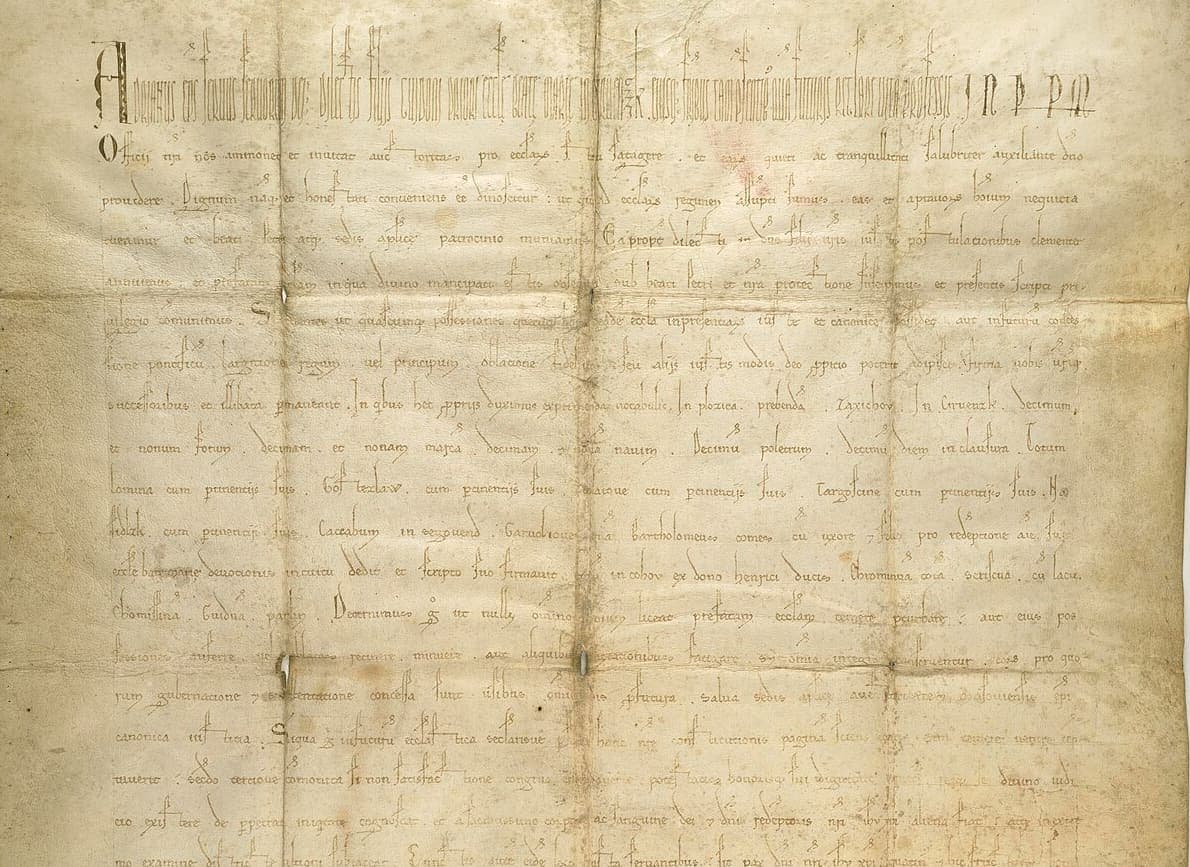
Archiwum Główne Akt Dawnych, Warsaw, Zbiór Dokumentów Pergaminowych 6418, 18 April 1155 · Source · Public domain · Archiwum Główne Akt Dawnych / Wikimedia Polska partnership
Evidano Transcription
ADRIANUS EP[ISCOPU]S SERVUS SERVORUM DEI · DILECTIS FILIIS GUIDONI[?] PRIORI ECCL[ESI]E BEATE MARIE IN CRUENZK EIUSQ[UE] FRATRIBUS TAM PRESENTIB[US] QUAM FUTURIS REGULARE[M] VITA[M] PROFESSIS IN PP[ETUU]M
Officii n[ost]ri nos ammonet et inuitat auctoritas pro eccl[es]iar[um] statu satagere . et ear[um] quieti ac tranquillitati salubriter auxiliante d[omi]no
prouidere . Dignum nam[que] et honestati conueniens esse dinoscitur : ut qui ad eccl[es]iar[um] regimen assumpti sumus . eas et a prauor[um] hominum nequitia
tueamur et beati Petri atq[ue] sedis ap[osto]lice patrocinio muniamus . Ea propter dilecti in d[omi]no filii u[est]ris iustis postulationibus clementer
annuimus . et prefatam eccl[es]iam in qua diuino mancipati estis obsequio . sub beati Petri et n[ost]ra protectione suscipimus . et presentis scripti pri
uilegio communimus . Statuentes ut quascumq[ue] possessiones quecumq[ue] bona eadem eccl[es]ia inpresentiar[um] iuste et canonice possidet . aut in futuru[m] conces
sione pontificu[m] . largitione regum . uel principum . oblatione fidelium . seu aliis iustis modis deo propitio poterit adipisci . firma uobis u[est]risq[ue]
successoribus et illibata permaneant . In quibus hec propriis duximus exprimenda uocabulis . In plozica . prebenda . Taxichov . In Cruenzk . Decimum .
et nonum forum . decimam . et nonam marca . decimam . [illegible] nauium . Decimu[m] polecrum[?] . decimu[m] diem in clausura . Totum
Lomina[?] cum pertinentiis suis . Gostezlaw . cum pertinentiis suis . [illegible]atoue cum pertinentiis suis . Targoscane[?] cum pertinentiis suis . Ho
[illegible] cum pertinentiis suis . Caccabum in sezguend[?] . Garuolicue[?] [illegible] bartholomeus comes cu[m] uxore et filiis pro redemptione a[n]i[m]e sue
eccl[es]ie b[ea]te marie deuotionis intuitu dedit et scripto suo firmauit . [illegible] in cohov ex dono henrici ducis . Chrominna[?] [illegible] . scrissua[?] . cu[m] lacu .
Chomilsina[?] . Gudna . partim . Decernimus ergo ut nulli omnino hominu[m] liceat prefatam eccl[es]iam temere perturbare . aut eius pos
sessiones auferre . uel ablatas retinere . minuere . aut aliquibus uexationibus fatigare . sed omnia integra conseruentur . eor[um] pro quo
rum gubernatione et sustentatione concessa sunt usibus omnimodis profutura . salua sedis ap[osto]lice auctoritate [illegible] ep[iscop]i
canonica iustitia . Siqua igitur in futurum eccl[es]iastica secularisue persona hanc n[ost]re constitutionis paginam sciens contra eam temere uenire temp
tauerit . secundo tertioue commonita si non satisfactione congrua emendauerit [?] potestatis honorisq[ue] sui dignitate careat . reamq[ue] se diuino iudi
cio existere de perpetrata iniquitate cognoscat . et a sacratissimo corpore ac sanguine dei et d[omi]ni redemptoris n[ost]ri ih[es]u xp[ist]i aliena fiat . atq[ue] in extre
mo examine districte ultioni subiaceat . Cunctis autem eidem loco sua iura seruantibus sit pax d[omi]ni n[ost]ri ih[es]u xp[ist]i [cut off]
Generated by Evidano’s advanced model; not yet checked against a published edition.
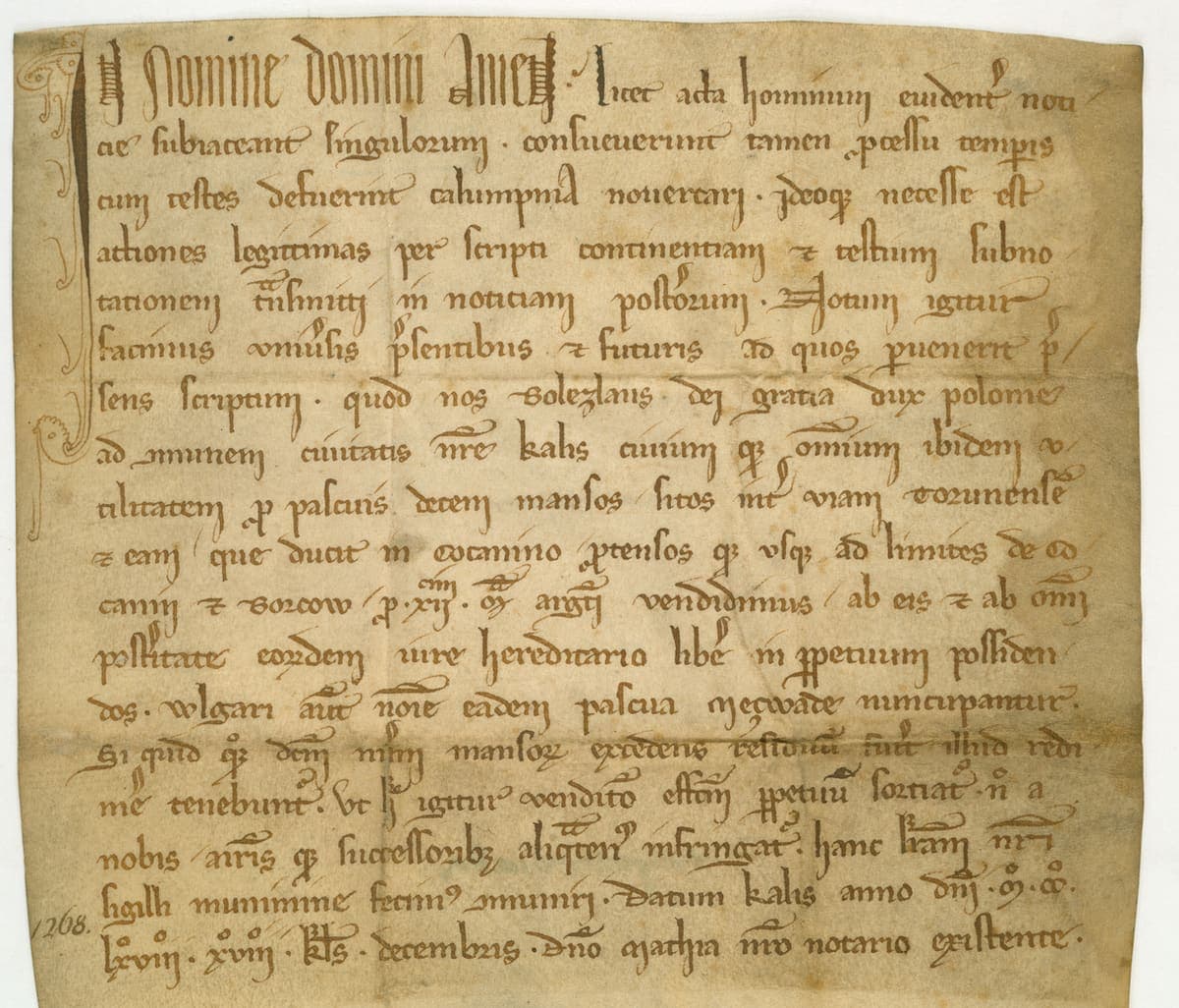
Archiwum Główne Akt Dawnych, Warsaw, Zbiór Dokumentów Pergaminowych 3371, 14 November 1268 · Source · Public domain · Archiwum Główne Akt Dawnych / Wikimedia Polska partnership
Evidano Transcription
In Nomine domini Amen · Licet acta hominum euidenter nou
ae subiaceant singulorum · consueuerint tamen processu temporis
cum testes defuerint calumpnia nouercari · Ideoq[ue] necesse est
actiones legittimas per scripti continentiam et testium subno
tationem transmitti in notitiam posterorum · Notum igitur
facimus uniuersis presentibus et futuris ad quos peruenerit pre
sens scriptum · quod nos Bolezlaus dei gratia dux polonie
ad communem ciuitatis n[ost]re kalis ciuium q[ue] omnium ibidem u
tilitatem pro pascuis decem mansos sitos int[er] uiam Torunense[m]
et eam que ducit in Cotannino[?] protensos q[ue] usq[ue] ad limites de Co
camy[?] et Borcow pro · xii · m[a]rc[is] arg[ent]i uendidimus · ab eis et ab omni
posteritate eorundem iure hereditario libere in perpetuum possiden
dos · vulgari aut[em] no[m]i[n]e eadem pascua megwade nuncupantur ·
Si quid u[er]o de[cem] n[umer]um mansor[um] excedens residuu[m][?] fuit illud redi
mere tenebunt · Vt h[ec] igitur uendito[rum] effectum p[er]petuu[m] sortiat[ur] · n[ec] a
nobis a[ut] [nost]ris[?] q[ue] successorib[us] aliquate[nus] infringat[ur] · hanc l[itte]ram n[ost]ri
sigilli munimine fecim[us] communiri · Datum kalis anno d[omi]ni · m · cc ·
lxviii · xviii · k[a]l[endas] · decembris · d[omi]no Mathia n[ost]ro notario existente ·
[margin:] 1268.
Generated by Evidano’s advanced model; not yet checked against a published edition.
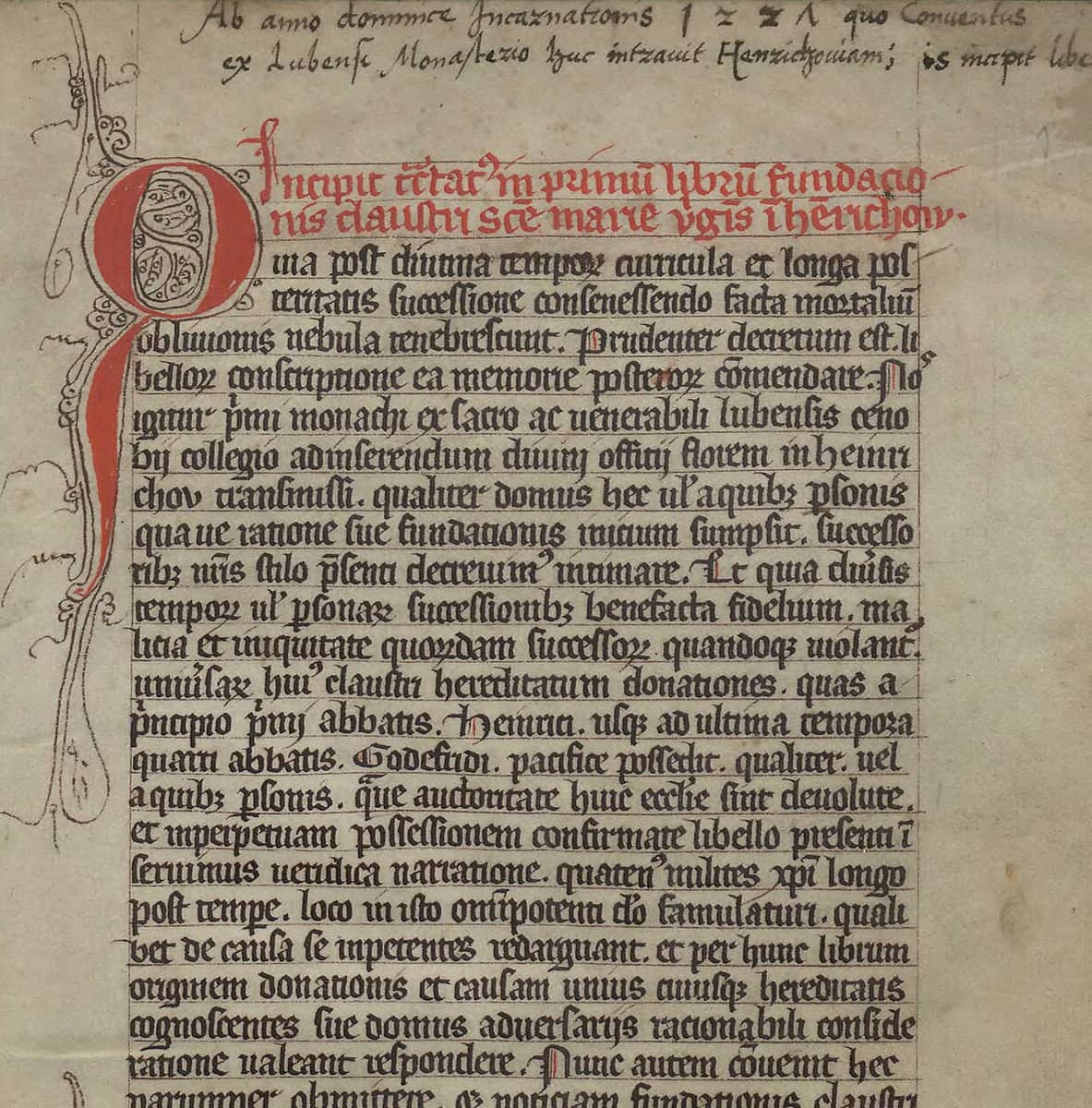
Archdiocesan Archive, Wrocław, c. 1268–1273 · Source · Public domain
Evidano Transcription
Ab anno dominice Incarnationis 1227[?] quo Conuentus
ex Lubensi Monasterio huc intrauit Henrichouiam; is incipit libe[r] [cut off]
Incipit tractat[us] in primu[m] libru[m] fundacio
nis claustri s[an]c[t]e marie u[ir]g[in]is i[n] heinrichow ·
Quia post diuturna tempor[um] curricula et longa pos
teritatis successione consenescendo facta mortaliu[m]
obliuionis nebula tenebrescunt . Prudenter decretum est . li
bellor[um] conscriptione ea memorie poster[orum] co[m]mendare . Nos
igitur primi monachi ex sacro ac uenerabili lubensis ceno
bii collegio ad inserendum diuini officii florem in heinri
chov transmissi . qualiter domus hec u[e]l a quib[us] p[er]sonis
qua ue ratione sue fundationis initium sumpsit . successo
rib[us] n[ost]ris stilo p[re]senti decreuim[us] intimare . Et quia diu[er]sis
tempor[um] u[e]l p[er]sonar[um] successionib[us] benefacta fidelium . ma
licia et iniquitate quor[un]dam successor[um] quandoq[ue] uiolant[ur] .
uniu[er]sar[um] hui[us] claustri hereditatum donationes . quas a
principio primi abbatis . Henrici . usq[ue] ad ultima tempora
quarti abbatis . Godefridi . pacifice possedit . qualiter . uel
a quib[us] p[er]sonis . que auctoritate huic eccl[es]ie sint deuolute .
et in perpetuam possessionem confirmate libello presenti i[n]
serimus ueridica narratione . quaten[us] milites xp[ist]i longo
post temp[or]e . loco in isto omnipotenti d[e]o famulaturi . quali
bet de causa se impetentes redarguant . et per hunc librum
originem donationis et causam unius cuiusq[ue] hereditatis
cognoscentes sue domus aduersariis racionabili conside
ratione ualeant respondere . Nunc autem co[n]uenit hec
[last line cut off]
Generated by Evidano’s advanced model; not yet checked against a published edition.
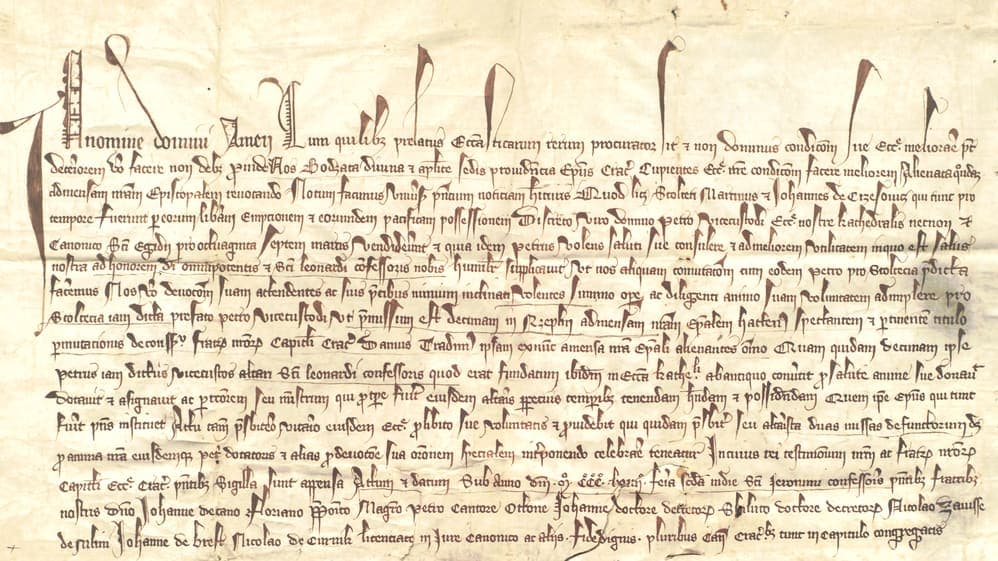
Archiwum Główne Akt Dawnych, Warsaw, Zbiór Dokumentów Pergaminowych 2880, 30 September 1364 · Source · Public domain · Archiwum Główne Akt Dawnych / Wikimedia Polska partnership
Evidano Transcription
In nomine domini Amen Cum quilib[et] prelatus Eccl[es]iasticarum rerum procurator sit et non dominus condicione[m] sue Eccl[es]ie meliorare p[ot]e[st]
deteriorem uero facere non debet . p[ro]inde Nos Bodzanta diuina et ap[osto]lice sedis prouidencia Ep[iscop]us Crac[ouiensis] Cupientes Eccl[es]ie n[ost]re condicione[m] facere meliorem seu alienata quedam
ad mensam n[ost]ram Episcopalem reuocando Notum facimus uniu[er]sis p[re]sencium noticiam habituris Quod lic[et] Scolteti Martinus et Johannes de Crzesowic[?] qui tunc pro
tempore fuerunt p[ro] eorum libera empcione et eorundem pacificam possessionem Discreto Viro domino petro Vicecustodi Eccl[es]ie nostre kathedralis necnon et
Canonico S[an]c[t]i Egidii pro octuaginta septem marcis vendiderunt et quia idem petrus volens saluti sue consulere et ad meliorem condicionem in quo est status
nostra ad honorem dei omnipotentis et S[an]c[t]i leonardi confessoris nobis humiliter supplicauit ut nos aliquam commutacionem cum eodem petro pro Scoltecia p[re]dicta
faceremus Nos uero deuocione[m] suam attendentes ac suis precibus nimium inclinati uolentes summo ope ac diligenti animo suam uoluntatem adimplere pro
Scoltecia iam dicta prefato petro Vicecustodi ut p[re]missum est decimam in Rzeplin ad mensam n[ost]ram Ep[iscop]alem hactenus spectantem et p[er]tinentem titulo
p[er]mutacionis de consensu fratrum n[ost]ror[um] Capituli Crac[ouiensis] Damus Tradimus ipsam exnunc a mensa n[ost]ra Ep[iscop]ali alienantes omnino Quam quidem decimam ipse
petrus iam dictus vicecustos altari S[an]c[t]i leonardi confessoris quod erat fundatum ibidem in Eccl[es]ia kathe[dra]li ab antiquo con[?] pro salute anime sue donauit
Dotauit et assignauit ac p[er]petuam seu ministrum qui p[ro] t[em]p[o]re fuit eiusdem altaris p[er]petuis temporib[us] tenendam habendam et possidendam Quem ipse ep[iscopu]s qui tunc
fuit p[ro] t[em]p[o]re instituet [illegible] tam p[re]sbiterio[?] [illegible] eiusdem Eccl[es]ie p[ro] libito sue uoluntatis et prouidebit qui quidam p[re]sbiter seu altarista duas missas defunctorum de
p[ro] anima n[ost]ra eiusdemq[ue] pet[ri] donatoris et alias p[ro] deuocione sua oracionem specialem inponendo celebrare teneatur In cuius rei testimonium n[ost]rum ac fratrum n[ost]ror[um]
Capituli Eccl[es]ie Crac[ouiensis] p[re]sentib[us] Sigilla sunt appensa Actum et datum Sub anno d[omi]ni · m · ccc · lxiiii · feria s[e]c[un]da in die S[an]c[t]i Jeronimi confessoris p[re]sentib[us] fratrib[us]
nostris d[omi]no Johanne decano Floriano preposito Magistro petro cantore Ottone Johanne doctore decretorum [illegible] doctore decretorum Nicolao Zawisse
de [illegible] Johanne de brest[?] Nicolao de Cirnik[?] licenciato in Jure canonico ac aliis fidedignis · pluribus can[onicis] Crac[ouiensibus] tunc in capitulo congregatis
Generated by Evidano’s advanced model; not yet checked against a published edition.
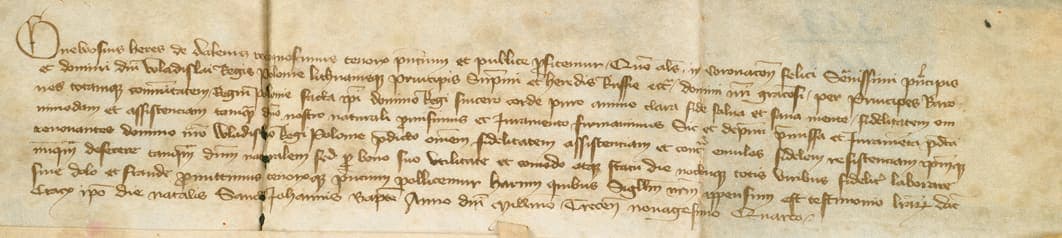
Archiwum Główne Akt Dawnych, Warsaw, Zbiór Dokumentów Pergaminowych 592, 24 June 1394 · Source · Public domain · Archiwum Główne Akt Dawnych / Wikimedia Polska partnership
Evidano Transcription
Gneuiossius[?] heres de dalewicz[?] recognoscimus tenore presencium et publice p[ro]fitemur Quia alias in coronacione felici Serenissimi principis
et domini d[omi]ni wladislai Regis polonie lithwanieq[ue] principis supremi et heredis Russie etc / domini n[ost]ri graciosi / per principes baro
nes totamq[ue] communitatem Regni polonie facta ipsi domino Regi sincero corde puro animo clara fide salua et sana mente / fidelitatem om
nimodam et assistenciam tamq[ue] d[omi]no nostro naturali promisimus et Juramento firmauimus Sic et denuo [illegible] premissa et Juramenta p[re]dic
ta renouantes domino n[ost]ro wladislao Regi polonie p[re]dicto omnem fidelitatem assistenciam et contra omnes [illegible] fidelem resistenciam promitti
mus [illegible] deserere tamq[ue] d[omi]n[u]m naturalem sed pro bono suo [illegible] et comodo [illegible] stare die noctuq[ue] totis uiribus fideliter laborare
sine dolo et fraude promittimus tenoreq[ue] presencium pollicemur harum quibus Sigillum n[ost]r[u]m appensum est testimonio litterarum Dat[um]
Craco[uie] ipso die natalis Sancti Johannis baptiste Anno d[omi]ni Millesimo Trecentesimo nonagesimo Quarto
Generated by Evidano’s advanced model; not yet checked against a published edition.
What a Piast charter looks like
The oldest originals surviving in Polish archives date from the twelfth century and are written in a late Caroline minuscule, round and widely spaced, often by a scribe trained in Rome, Bamberg or Prague rather than in Poland. Across the thirteenth century the ducal chanceries of Kraków, Poznań, Płock and Wrocław move through a proto-Gothic phase into a fully Gothic documentary hand: letters compressed laterally, feet broken at an angle, ascenders shortened. By the middle of the fourteenth century a royal or episcopal office writes a practised chancery cursive whose first line is drawn in exaggerated tall letters — littera elongata — announcing the invocation before the reader has parsed a word of it.
The document is formulaic, which helps. Most open with a cross or a decorated invocation such as In nomine domini amen, move to a notification (Notum facimus universis quibus expedit), state the grant, add a corroboration naming the seal, and close with a dating clause built from Roman numerals and the Roman calendar: Datum Kalis anno domini M CC LX VIII, XVIII kalendas decembris. Papal privileges add their own furniture — the wheel-shaped rota, the BENE VALETE monogram, and a column of cardinal subscriptions each beginning Ego. Witness lists, notarial signs, pendant seals on cords and later archival endorsements crowd the same skin.
Abbreviation is constant rather than occasional. A bar marks a lost m or n or a contracted word (dns for dominus); p with a crossed descender is per, with a looped one pro; the 9-shaped sign is con- at the start of a word and -us at the end; the Tironian sign for et looks like a 7. Into this system the scribe drops Polish names that Latin has no letters for: the sound now written cz appears as c, cz, ch or z; ł is simply l; the nasal vowels are a, e, an or en. Vernacular forms are sometimes flagged — vulgariter, wlgari nomine — and sometimes not.
Why ordinary OCR struggles here
One village, six spellings
Polish names are outside every Latin word list an ordinary OCR engine relies on, so the engine quietly rewrites them into something Latin-shaped: Sorcow becomes Sortou, Rzeplin becomes Reptin. Because the whole value of these documents for local and family history lies in the name forms, a transcription that tidies them is worse than none.
Marks that are not punctuation
Bars, superscript vowels, hooks and the Tironian sign are grammar, not decoration. Read as accents or stray strokes they turn a legible sentence into a string of fragments; expanded silently and inconsistently they hide what the scribe actually wrote. Both failures are common on the same page.
Minim thickets and r rotunda
In a compressed Gothic charter hand, i, m, n and u are the same stroke repeated, and the dot on the i is absent or displaced. The r rotunda used after o, b and p is easily taken for a 2 or a z — which matters, because z is precisely the letter that carries Polish sibilants.
Everything added later
A charter carries archival numbers in ink and pencil, a nineteenth-century date in the margin, folds, seal cords and sometimes a dorsal summary in a much later hand. All of it sits in the same image as the medieval text and has to be kept out of the transcription rather than merged into it.
Who works with this material
Editors of diplomatic codices
The Kodeks dyplomatyczny series and its regional successors are still being extended. An editor wants a semi-diplomatic first pass that keeps the line breaks of the parchment, marks every expansion, and flags the readings that need a second eye, so the apparatus can be built from the transcription rather than from scratch.
Place-name and onomastic projects
Historical-geographical dictionaries are assembled by collecting every attested form of a settlement or a personal name with its date. That work fails if the transcription silently regularises Zvichov to Zwichów. What it needs is the graph exactly as written, with the surrounding clause for context.
Cathedral, monastic and municipal archives
Chapter and abbey collections hold thousands of single-sheet parchments described only by a one-line summary. A full text attached to each scan turns a shelf list into something a researcher can search by field name, tithe, mill or witness.
Teachers of Latin palaeography
Courses work from charters precisely because they combine a fixed formula with unpredictable vernacular. Setting a machine reading beside a student reading shows at once whether a mistake came from the letterforms or from the abbreviation system.
Getting the best transcription
Tell it which formula to expect
Say whether the document is a papal privilege, a ducal grant or a private act. Knowing that a corroboration clause and a dating clause are coming lets a damaged abbreviation be resolved from context instead of guessed at letter by letter.
Separate expansion policy from name policy
Ask for Latin abbreviations to be expanded with the supplied letters in brackets, and in the same instruction ask for personal and place names to be left exactly as written, unexpanded and unmodernised. Without the second half of that rule the names are quietly repaired.
Pull the dating clause and witness list out separately
Request the dating clause verbatim, with its Roman numerals and its kalendae or feast day untranslated, and the witness subscriptions as a list. Both are where indexing value sits, and both are where a continuous prose transcription blurs the structure.
Calibrate on a charter that is already edited
Start with a document printed in one of the diplomatic codices. Comparing the output with a known edition shows how r rotunda, suspension bars and vernacular clusters are being handled before you turn to the unpublished sheets in the same box.
Further reading on this hand
The palaeography guides the in-app selector points to for this domain, if you want to check a transcription against the standard references.
- Pismo w pigułce
This educational resource from the National Archives in Kraków introduces the historical development of writing represented in Polish archives. It surveys medieval Latin scripts and explains the functions of common abbreviation systems in manuscripts and charters. The material covers suspension, contraction, superscript letters, Tironian signs, and recurring sigla associated with letters such as p and q. It is useful for Polish medieval charters because their vernacular names occur inside a Latin scribal and abbreviation system.
Frequently asked questions
- Will Polish names keep their medieval spelling?
- Yes, when you ask for it, and it is worth asking explicitly. The default for this material is to reproduce name forms as written — Kalis, Crezouicz, Sorcow — rather than resolving them to the modern place name. A modern identification can be added in a separate column or note so the attested form and the identification never get confused.
- How are suspension bars, superscripts and the Tironian sign handled?
- They are read as abbreviation marks rather than as accents or stray ink. You choose whether they are expanded silently, expanded with the added letters in brackets, or left as the sign itself. Whichever you choose is applied consistently across a whole box of charters, which is what makes the output comparable.
- Can it separate the charter from later archival notes?
- A charter usually carries a modern shelfmark, an added date, a dorsal summary and sometimes pencil numbering. These can be transcribed into a separate block, labelled by hand and position, so the medieval text stays clean while nothing on the sheet is thrown away.
- Does it convert the dating clause into a modern date?
- Only if you ask. The safer default is to transcribe the clause as it stands, Roman numerals and feast day included, and to give the modern equivalent as a note. Polish charters date by the Roman calendar and by saints’ days, and both conversions carry assumptions an editor may want to check.
- What about papal privileges with a rota and cardinal subscriptions?
- The body of the privilege, the rota motto, the BENE VALETE monogram and the column of Ego subscriptions can each be transcribed as its own element and labelled, so the layout of the bull is recoverable from the text file rather than flattened into one paragraph.
Related scripts and pages
Transcribe your medieval charters
Upload a parchment scan, choose Medieval Latin Charters with Polish Names, and test the expansion rules on a document you already have an edition for.