
Polish · c. 1350–1550
Old Polish before the spelling settled
Fifteenth-century Polish is written with a Latin alphabet that has no letter for half its sounds. Scribes improvise: sz for both s and sz, cz for c and cz, an o with a hook for the nasal vowels, and often three different solutions on the same leaf. Evidano transcribes what the pen made rather than what modern Polish would require, and keeps the Latin around the vernacular clearly marked.
Sample pages
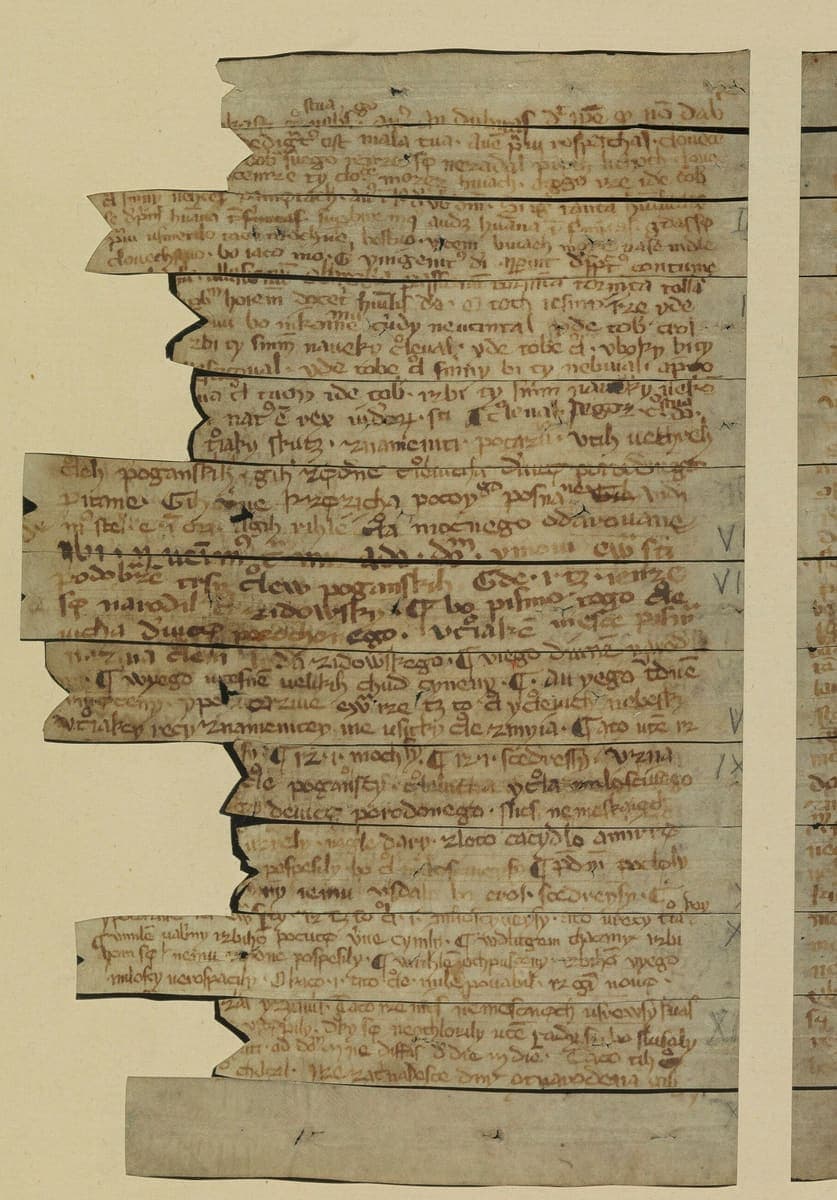
Biblioteka Narodowa, Warsaw, c. 1301–1350 · Source · Public domain · National Library of Poland, via Polona
Evidano Transcription
[upper strips illegible]
cleh poganskih [illegible]
[illegible]
[illegible] mocnego [illegible]
[illegible]
[illegible] clew poganskih [illegible]
se narodil [illegible] zidowskego . [illegible] bo pismo [illegible]
[illegible] ego . [illegible]
[illegible] zidowskego . [illegible]
[remaining strips illegible]
Generated by Evidano’s advanced model; not yet checked against a published edition.
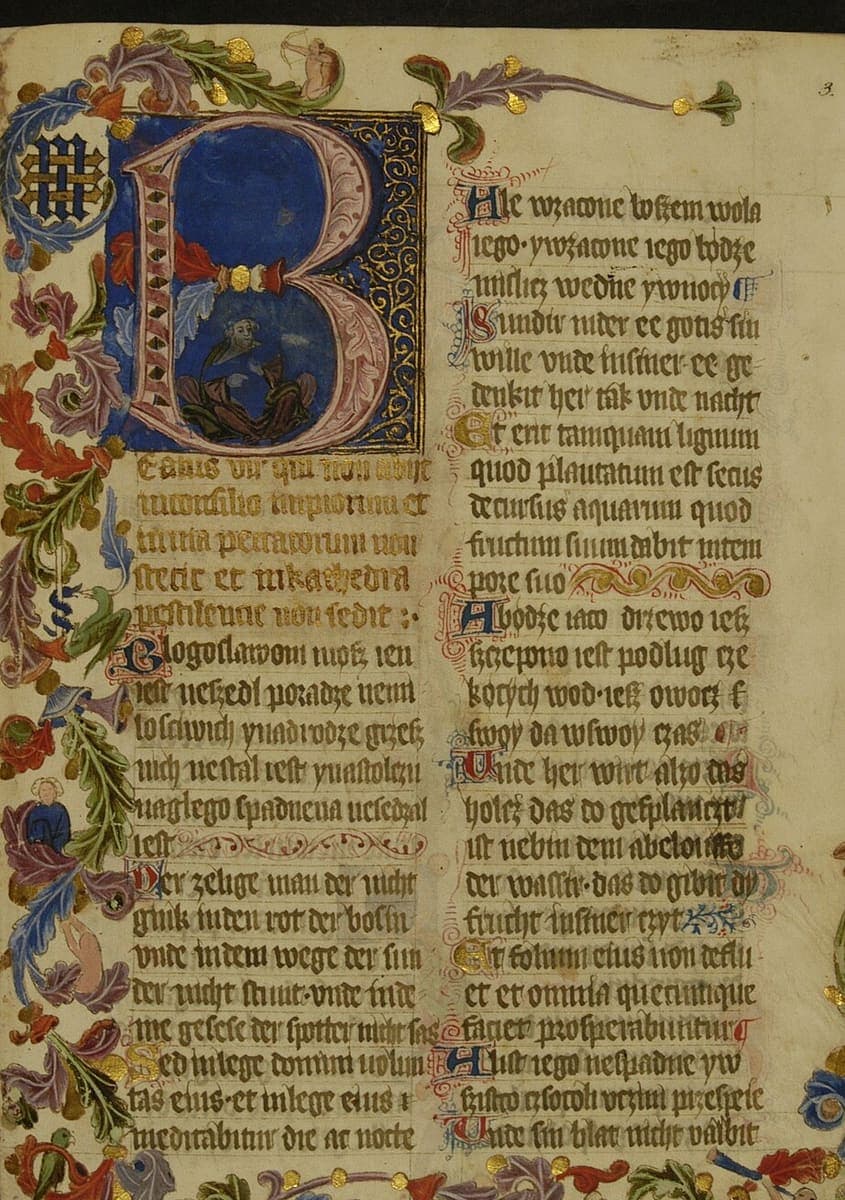
Biblioteka Narodowa, Warsaw, c. 1395–1405 · Source · Public domain · National Library of Poland, via Polona
Evidano Transcription
3
[illuminated initial B]
Eatus vir qui non abiit
in consilio impiorum et
in uia peccatorum non
stetit et in kathedra
pestilencie non sedit :
Blogoslawoni mosz ien
iesz nesedl poradze nemi
losciwich y na drodze grzesz
nich nestal iesz y na stolczu
naglego spadnena nesedzal
iesz
Der zelige man der nicht
gink in den rot der bosin
vnde in dem wege der sun
der nicht stunt · vnde ufe
me gesese der spotter nicht sas
Sed in lege domini volun
tas eius · et in lege eius
meditabitur die ac nocte
Ale wzakone boszem wola
iego · y w zakone iego bodze
myslicz we dne y w noczy
Sunder under ee gotis sin
wille vnde in syner ee ge
denkit her tak vnde nacht
Et erit tamquam lignum
quod plantatum est secus
decursus aquarum quod
fructum suum dabit in tem
pore suo
A bodze iako drzewo iesz
szczepono iest podlug cze
koczych wod · iesz owocz s
woy da w swoy czas
Vnde her wirt alzo das
holcz das do gesplanczt
ist nebin dem abelouffe[?]
der wasser · das do gibit dy
frucht in syner czyt
Et folium eius non deflu
et et omnia quecumque
faciet prosperabuntur
A list iego nespadne y w
szistko czsokoli uczini przespele[?]
Vnde sin blat nicht valbit
Generated by Evidano’s advanced model; not yet checked against a published edition.
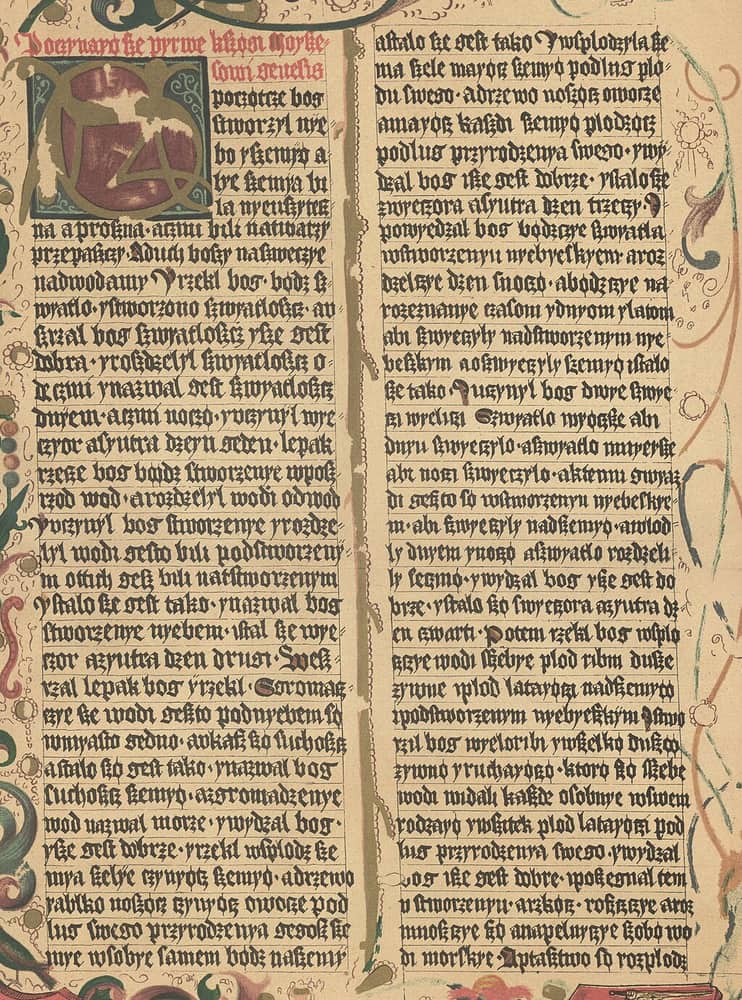
Biblioteka Narodowa, Warsaw, 1453–1461 (facsimile 1871) · Source · CC0 1.0 · National Library of Poland, via Polona
Evidano Transcription
Genesis 1:1–20, the two columns of the plate, in Antoni Małecki’s edition of 1871 as proofread on Polish Wikisource. Małecki prints the manuscript spelling; the hooked o of the nasal vowels is rendered ø, the verse numbers and the parenthetical gloss are his, the (!) is his mark for a scribal error, and his footnote reference marks have been left out here.
Poczynayø sze pyrwe kszøgi Moyszesowi, genesis.
1. Na poczøtcze bog stworzyl nyebo y szemyø,
2. alye szemya bila nyeuszyteczna a proszna, a czmi bili na twarzy przepaszczy, a duch boszy naszweczye (!) nad wodamy.
3. Y rzekl bog: bødz szwyatlo, y stworzono szwyatloszcz.
4. A uszrzal bog szwyatloszcz, ysze gest dobra, y roszdzelyl szwyatloszcz ode czmi,
5. y nazwal gest szwyatloszcz dnyem, a czmi noczø. y uczynyl wyeczyor a s yutra, dzeyn geden.
6. Lepak rzecze bog: bøødz stworzenye w poszrzod wod, a rozdzelyl wodi od wod.
7. Y uczynyl bog stworzenye y rozdzelyl wodi, gesto bili pod stworzenym, ot tich, gesz bili nat stworzenym. Y stalo sze gest tako.
8. Y nazwal bog stworzenye nyebem. i stal sze wyeczor a z yutra, dzen drugi.
9. Weszrzal lepak bog y rzekl: sgromaczczye sze wodi, geszto pod nyebem sø, w myasto gedno, a ukasz szø suchoszoz. a stalo szø gest tako.
10. Y nazwal bog suchoszcz szemyø, a zgromadzenye wod nazwal morze. y wydzal bog, ysze gest dobrze.
11. Y rzekl: wsplodz szemya szelye czynyøcz szemyø (siemię) a drzewo yablko noszøcz czynyøcz owocze podlug swego przyrodzenya, gegosz szemye w sobye samem bødz na szemy. A stalo sze gest tako.
12. Y wsplodzyla szema szele mayøcz szemyø podlug plodu swego, a drzewo noszøcz owocze a mayøcz kaszdi szemyø plodzøcz podlug przyrodzenya swego. y wydzal bog, ysze gest dobrze.
13. Y stalo sze z wyeczora a s yutra, dzen trzeczy.
14. I powyedzal bog: bødzczye szwyatla w stworzenyu nyebyeskyem, a rozdzelcze dzen s noczø, a bødzczye na rozeznanye czasom y dnyom y latom,
15. abi szwyeczyly nad stworzenym nyebeszkym, a oszwyeczyly szemyø. i stalo sze tako.
16. I uczynyl bog dwye szwyeczi wyeliczi, szwyatlo wyøczsze, abi dnyu szwyeczylo, a szwyatlo mnyeysze, abi noczi szwyeczylo, a k temu gwyazdi,
17. geszto sø w stworzenyu nyebeskym, abi szwyeczyly nad szemyø,
18. a wlodly dnyem y noczø, a szwyatlo rozdzelily se czmø. y wydzal bog, ysze gest dobrze.
19. Y stalo szø s wyeczora a z yutra, dzen czwarti.
20. Potem rzekl bog: wsploczczye wodi s szebye plod ribni,
Source: Biblia Królowéj Zofii, ed. Antoni Małecki (Lwów, 1871), Księga Rodzaju 1, via Wikiźródła (Public domain).
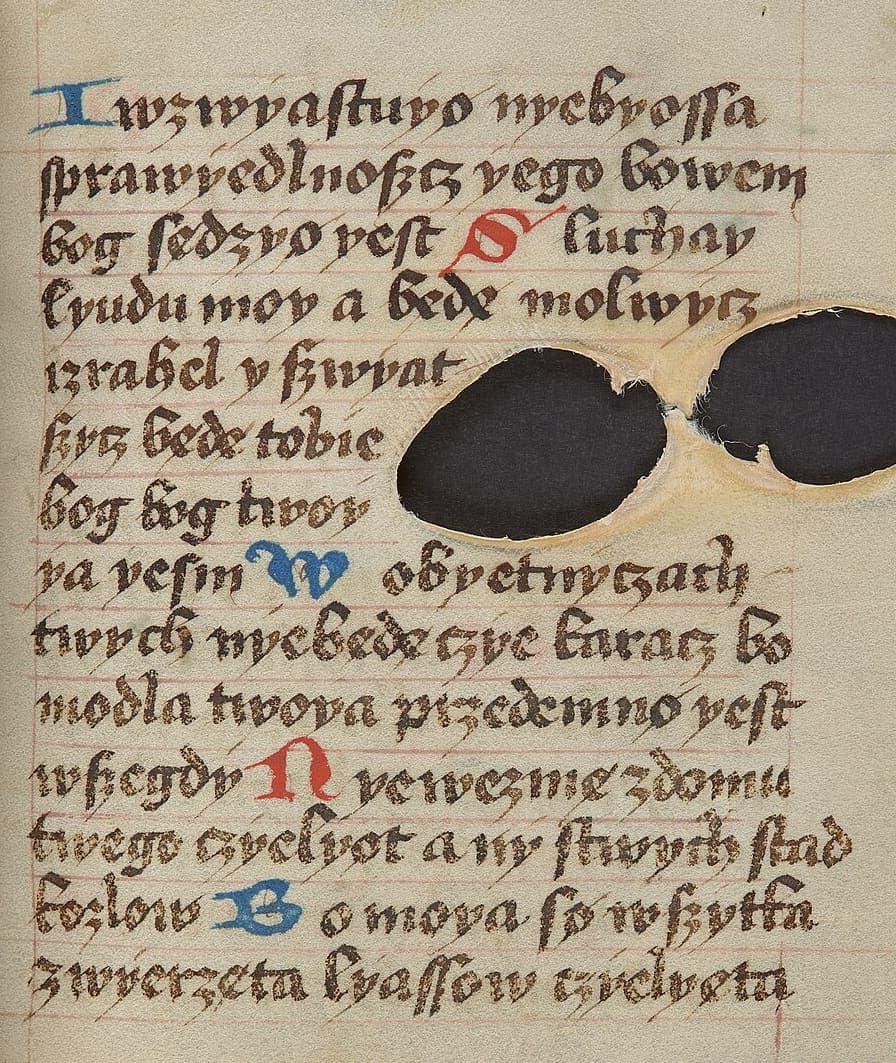
Biblioteka Narodowa, Warsaw, f. 201, c. 1470–1480 · Source · Public domain · National Library of Poland, via Polona
Evidano Transcription
I wzwyastuyo nyebyossa
sprawyedlnoszcz yego bowyem
bog szedzyo yest Sluchay
lyudu moy a bede molwycz
izrahel y szwyat
szkyz [?] bede tobie
bog bog twoy
ya yesm W obyetnyczach
twych nyebede czye karacz bo
modla twoya przedemno yest
wszegdy Nyewezme z domu
twego czyelyot any s twych stad
kozlow Bo moya so wszytka
zwyerzeta lyassow czyelyeta
Generated by Evidano’s advanced model; not yet checked against a published edition.
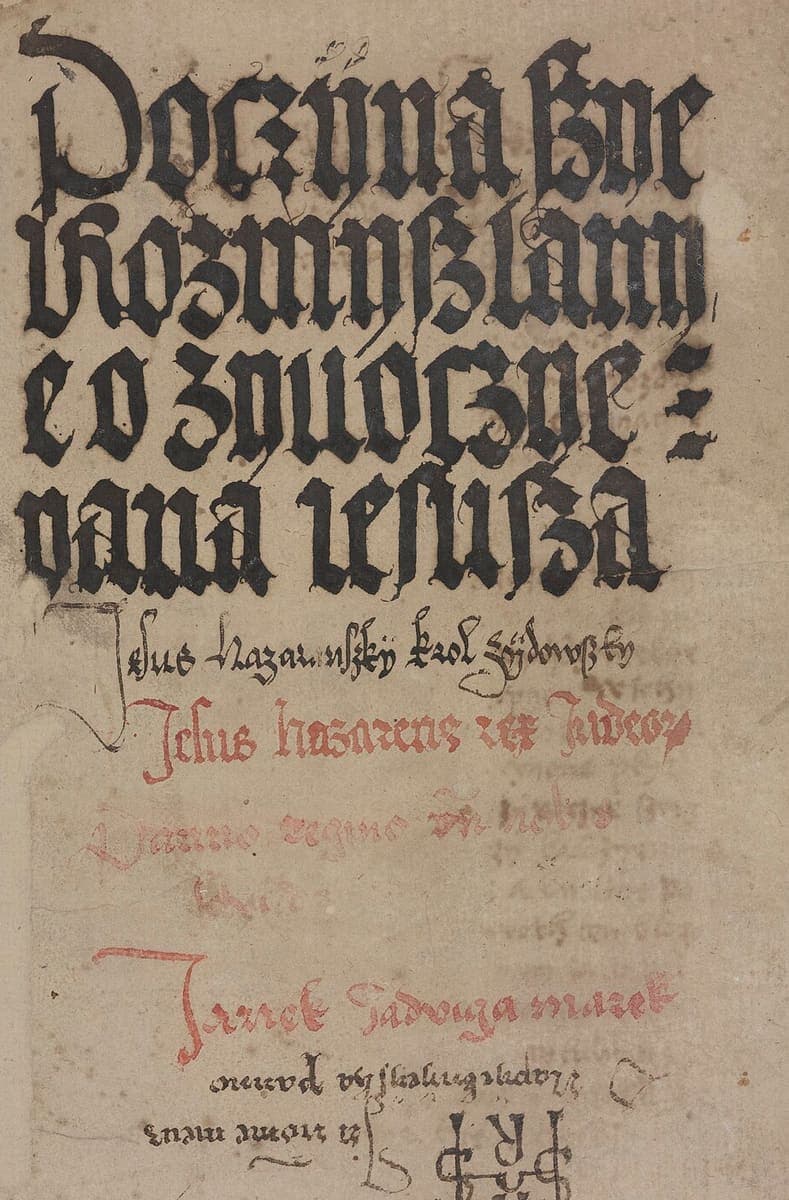
Biblioteka Narodowa, Warsaw, early sixteenth century · Source · CC0 1.0 · National Library of Poland, via Polona
Evidano Transcription
Poczyna sye
Rozmyslany
e o zywocze
pana Iesusa
Iesus Nazarensky krol zydowsky
Iesus Nazarenus rex Iudeorum
[faded red lines and later cursive notes (partly upside down) illegible] [monogram]
Generated by Evidano’s advanced model; not yet checked against a published edition.
Gothic book hands writing a vernacular
The two centuries in which Polish first appears at length are the centuries of Gothic script. A formal codex uses textualis: upright, angular, every stroke separately made, minims closed with a diamond foot. A working book or a fast scribe uses bastarda, the hybrid of book and cursive hand that gives long s and f descenders below the line, single-compartment a, and looped ascenders on b, h, k and l. Both appear in Polish material, and the same manuscript can shift from one to the other where a corrector or a continuator takes over. Rubrication in red, alternating red and blue initials, and ruled lines in lead or ink organise the page.
Polish had no orthography and would not get one until the sixteenth century. The sound now spelled sz appears as s, ſ, ſſ, sch or z; cz is written cz, c or ch; ż and ź share signs with z; ł is plain l. The nasal vowels ą and ę are the hardest case: an o or a with a small tail, hook or superscript is the usual answer, but scribes also write an, en, am or om, and some simply leave the plain vowel. Because the psalters and the Bible translation were made from Latin with Czech intermediaries, Bohemian spellings and Bohemian words sit inside the Polish text.
Layout is bilingual almost everywhere. The Florian Psalter alternates Latin, Polish and German verse by verse in the same column; the Puławy Psalter puts an interpretive argumentum before each psalm; sermons carry a Latin thema and Latin authorities inside a Polish exposition; and Latin glosses crowd the margins of Polish prose. Abbreviation stays a Latin habit — the bar for m and n, the Tironian sign, p with a stroke — so a Polish word can be abbreviated by rules borrowed wholesale from another language.
Why ordinary OCR struggles here
Sounds without letters
When one grapheme covers three modern letters and one modern letter is written five ways, no lexicon lookup helps. A model has to accept the spelling as evidence rather than noise, and record the hook or tail on a nasal vowel as a distinct sign instead of dropping it as a stray mark.
Two languages in one column
A psalter verse in Latin is followed immediately by the same verse in Polish and then in German, in the same hand and the same size. A transcription has to segment the languages correctly or the Polish will be corrupted by the Latin that touches it at both ends.
Damaged, cut and re-used leaves
Much of the earliest Polish survives because someone cut a codex up for binding waste. The Holy Cross Sermons are eighteen narrow strips; other texts are fragments trimmed through the writing. Line beginnings and endings are simply gone, and holes in the parchment interrupt lines the scribe wrote around.
Minims, long s and bastarda loops
In bastarda a long s and an f differ by a short cross-stroke, the round s at the end of a word looks like a 6 or a 3, and i, m, n and u run together without dots. Add the loops thrown up by ascenders from the line below and a stretch of clean text can still be misread letter by letter.
Who works with this material
Historians of the Polish language
Work on the phonology and morphology of Old Polish depends on counting spellings — how often a nasal is written with a hook, where Bohemian forms intrude, when a scribe switches system mid-text. That is only possible if the transcription preserves the graphemes instead of resolving them.
Dictionary and corpus builders
The historical dictionaries of Polish are built from quotations keyed to a manuscript line. A first-pass text with the folio and line recorded lets an editor move from a citation slip straight to the place on the page, and lets a corpus be searched by variant rather than by headword.
Library and fragment cataloguers
Polish fragments turn up inside bindings all over central Europe, usually described as unidentified vernacular waste. Even a rough transcription of a few lines is enough to match a strip against a known psalter or sermon cycle and reunite it with its siblings.
Editors of religious literature
Anyone preparing an edition of a psalter, a passion narrative or a sermon collection needs the Latin, the Polish and the marginal glosses kept apart, and needs the places where the copy differs from its Latin source to be visible rather than smoothed over.
Getting the best transcription
Describe the spelling system, not the modern language
State plainly that the text predates standard orthography, that nasal vowels may be written with a hook or with a vowel plus n or m, and that the transcription should not be normalised. Ask for a note wherever a mark on a vowel is ambiguous rather than a silent decision.
Ask for language tagging on bilingual pages
On a psalter or a glossed page, request that each stretch be labelled Latin, Polish or German and transcribed in reading order. That single instruction prevents the commonest failure on this material, which is a Polish clause absorbed into the Latin verse beside it.
Set a convention for loss and holes
Fragments have cut edges and parchment flaws. Decide in advance how missing text is marked, whether a partial word is given as far as it survives, and whether the space a scribe left around a hole is noted, so the same convention holds across a whole set of strips.
Start with a page that has a printed edition
Psalters and the Bible translation were edited in the nineteenth century. Running one of those folios first shows how the output handles hooks, digraphs and rubrics, and gives you a measured sense of what to expect from the unedited sermon fragments.
Further reading on this hand
The palaeography guides the in-app selector points to for this domain, if you want to check a transcription against the standard references.
- Pismo w pigułce
This National Archives in Kraków resource explains medieval and early modern handwriting through examples from Polish collections. It introduces Gothic script development and illustrates the abbreviation practices inherited from Latin manuscript culture. The guide discusses special signs, superscript forms, contractions, suspension, and the interpretation of difficult letter groups. It is particularly useful for Old Polish texts written in the same Gothic hands used for neighboring Latin material.
Frequently asked questions
- Can the hooked nasal vowels be kept as written?
- Yes. The tail, hook or superscript that marks a nasal can be reproduced with a single agreed character throughout, rather than being converted to ą and ę. That matters because the medieval sign does not map one-to-one onto the two modern letters, and any conversion is already an editorial decision.
- How is the trilingual layout of the Florian Psalter handled?
- Verse by verse, in the order the scribe wrote them, with each stretch labelled by language. You can also ask for the three languages to be split into parallel columns after the first pass, which is usually easier to check against the folio than a single running text.
- Will Latin glosses in the margin be kept separate from the Polish?
- They can be transcribed as a separate block with their position noted, and where a gloss is tied to a word by a reference mark that link can be recorded too. Merging glosses into the main text is the default failure mode on glossed Polish prose, and it is avoidable.
- What happens with binding fragments where the lines are cut through?
- Only what survives is transcribed, with the loss marked at the start or end of the line. Restoration from a parallel copy is left to the editor, because on this material the parallel is often another fragment of uncertain relationship rather than a complete text.
- Is a nineteenth-century facsimile usable when the manuscript is lost?
- For the Bible of Queen Sophia it is all there is. A good chromolithograph or photolithograph reproduces the letterforms faithfully enough to transcribe, and the caption should say that the reading comes from the facsimile rather than from the codex itself.
Related scripts and pages
Transcribe your Old Polish leaves
Upload a folio or a binding fragment, choose Old Polish Gothic and Bastarda Manuscripts, and set the spelling rules before running the rest of the codex.