
Dutch · c. 1400–1600
Turn Dutch charters and chancery registers into text
A Burgundian clerk looped his ascenders into the line above and abbreviated half of every formula to a stub: voirs., voirn., etc. Evidano reads charters, registers, minutes and placards from the fifteenth- and sixteenth-century Low Countries, keeps or expands those stubs to a rule you set once, and leaves Roman numeral dates such as XVc LXXVI exactly as the clerk wrote them unless you ask for a reading.
Sample pages
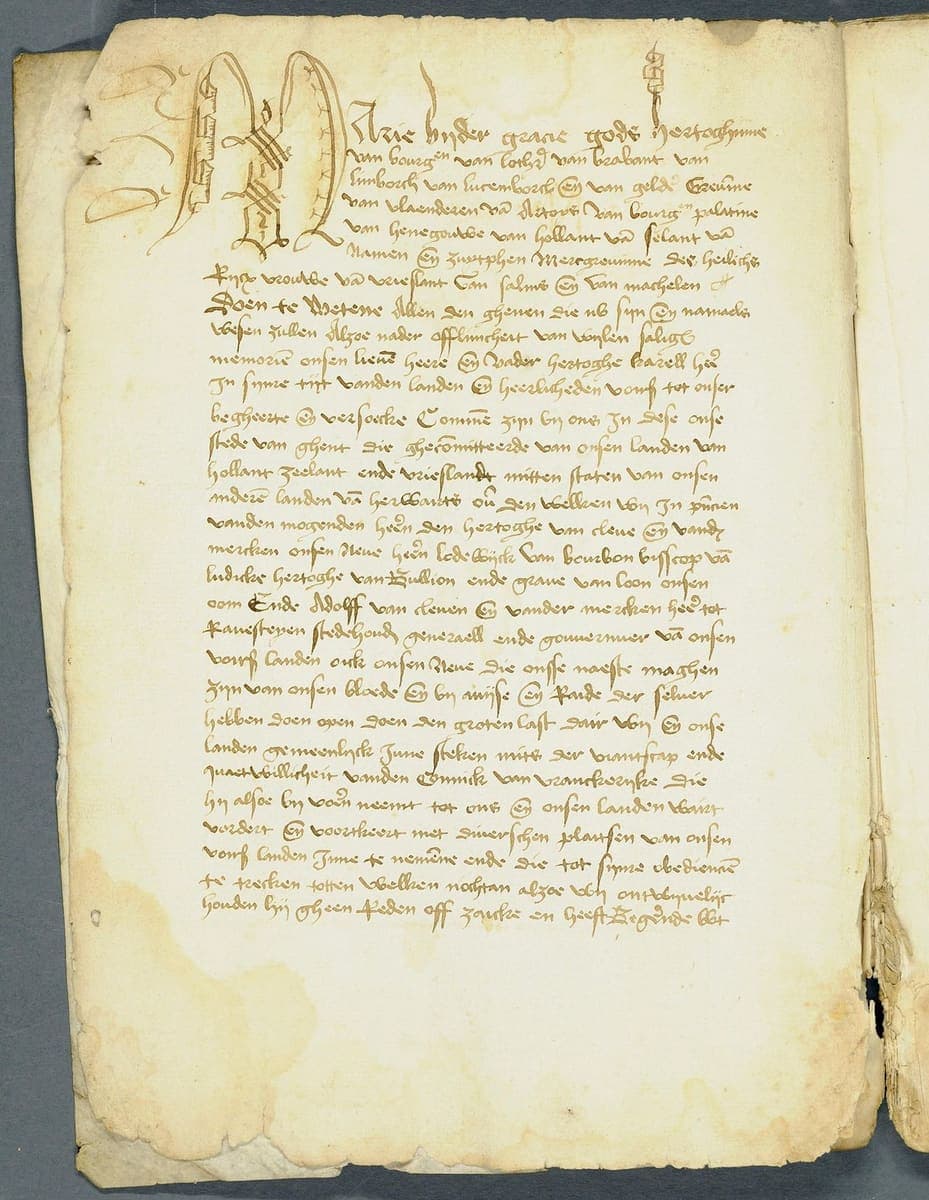
Nationaal Archief, The Hague, 3.22.01.01, inv. no. 683, 1477 or shortly after · Source · Public domain
Evidano Transcription
MArie byder gracie gods hertoghinne
van bourg[oign]en van loth[rijc] van brabant van
limborch van luxemborch en[de] van geld[re] Grauinne
van vlaenderen va[n] Artoys van bourg[oign]en palatine
van henegouwe van hollant va[n] zelant va[n]
Namen en[de] zutphen Marcgrauinne des heilichs
Rycx vrouwe va[n] vrieslant van salins en[de] van machelen [etc]
Doen te wetene Allen den ghenen die nu sijn en[de] namaels
wesen sullen Alzoe nader affliuicheit van wylen salige[r]
memorie onsen lieue[n] heere en[de] vader hertoghe karell he[?]
In synre tijt vanden landen en[de] heerlicheden voirs[creven] tot onser
begheerte en[de] versoecke Comme[n] zijn by ons In dese onse
stede van ghent die ghecommitteerde van onsen landen van
hollant zeelant ende vrieslandt mitten staten van onsen
andere landen va[n] herwaerts ou[er] den welken wy In p[re]sen[cien]
vanden mogenden heere[n] den hertoghe van cleue en[de] vand[er]
mercken onsen lieue heere[n] lodewijcke van bourbon bysscop va[n]
ludike hertoghe van bullion ende graue van loon onsen
oom Ende Adolff van cleuen en[de] vander mercken hee[re] tot
Rauesteyn stedehoud[er] generaell ende gouuerneur va[n] onsen
voirs[creven] landen oick onsen lieue die onse naeste maghen
zijn van onsen bloede En[de] by auijse en[de] Rade der seluer
hebben doen open doen den groten last dair wy en[de] onse
landen gemeenlyck Inne steken mits der viantschap ende
quaetwillicheit vanden Coninck van vranckeryke die
hy alsoe hy voir neemt tot ons en[de] onsen landen voirt
vordert en[de] voortkeert met diuerschen plaetsen van onsen
voirs[creven] landen Inne te neme[n] ende die tot synre obedience
te trecken totten welken nochtan alzoe wy ontwyuelijc
houden hy gheen Reden off zake en heeft Zegende dat
Generated by Evidano’s advanced model; not yet checked against a published edition.
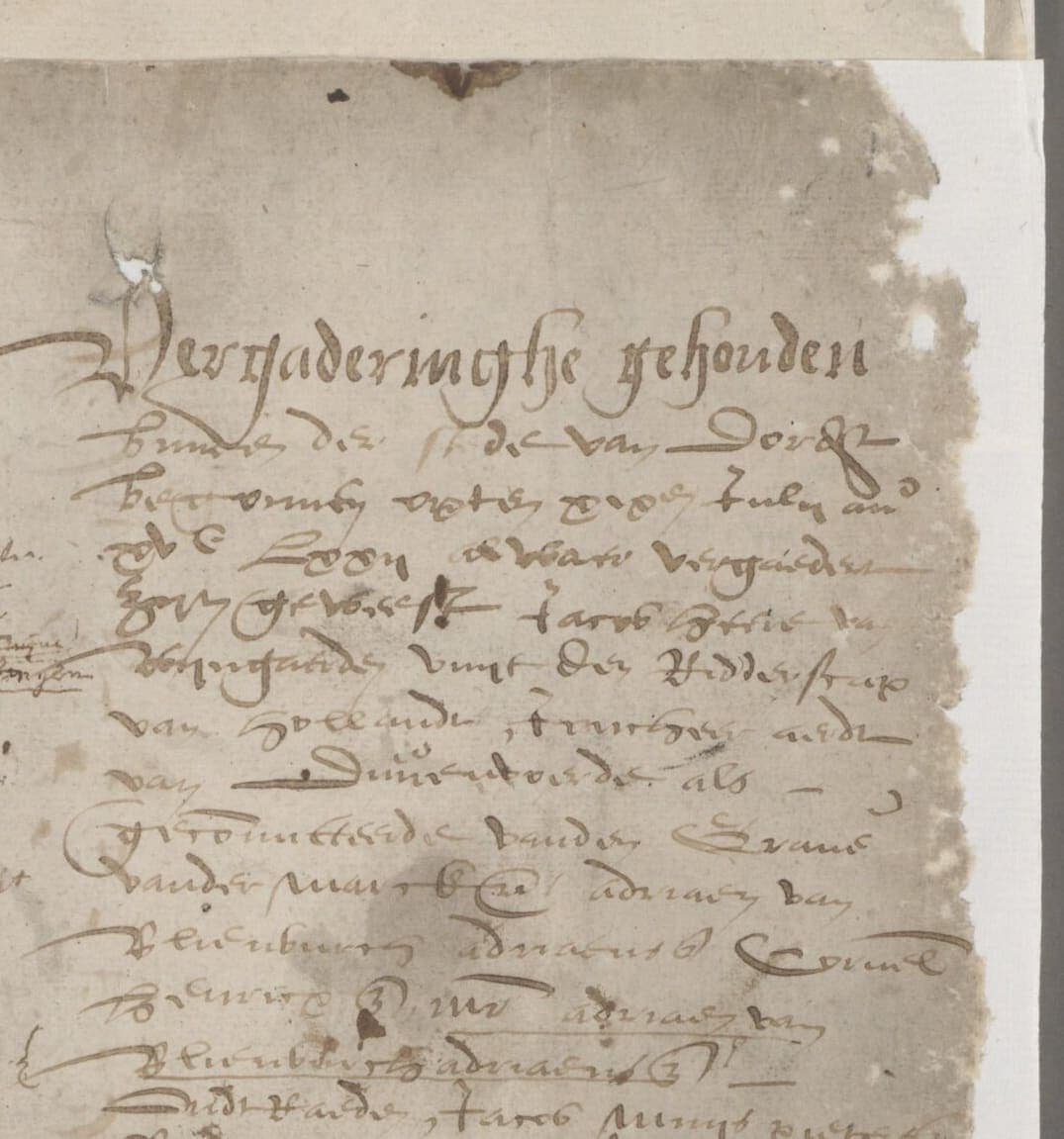
Nationaal Archief, The Hague, 3.01.04.01, inv. no. 324B, 19 July 1572 · Source · Public domain
Evidano Transcription
Vergaderinghe gehouden
binnen der stede van Dordr[echt]
begonnen opten xixen Julij an[n]o
xvc lxxij alwaer vergadert
zijn geweest Jacob heere van
wijngaerden vuijt der Ridderschap
van hollande, [illegible]
van Duvenvoorde als
gecommitteerde vanden Grave
vander marck, adriaen van
[remaining lines illegible]
Generated by Evidano’s advanced model; not yet checked against a published edition.
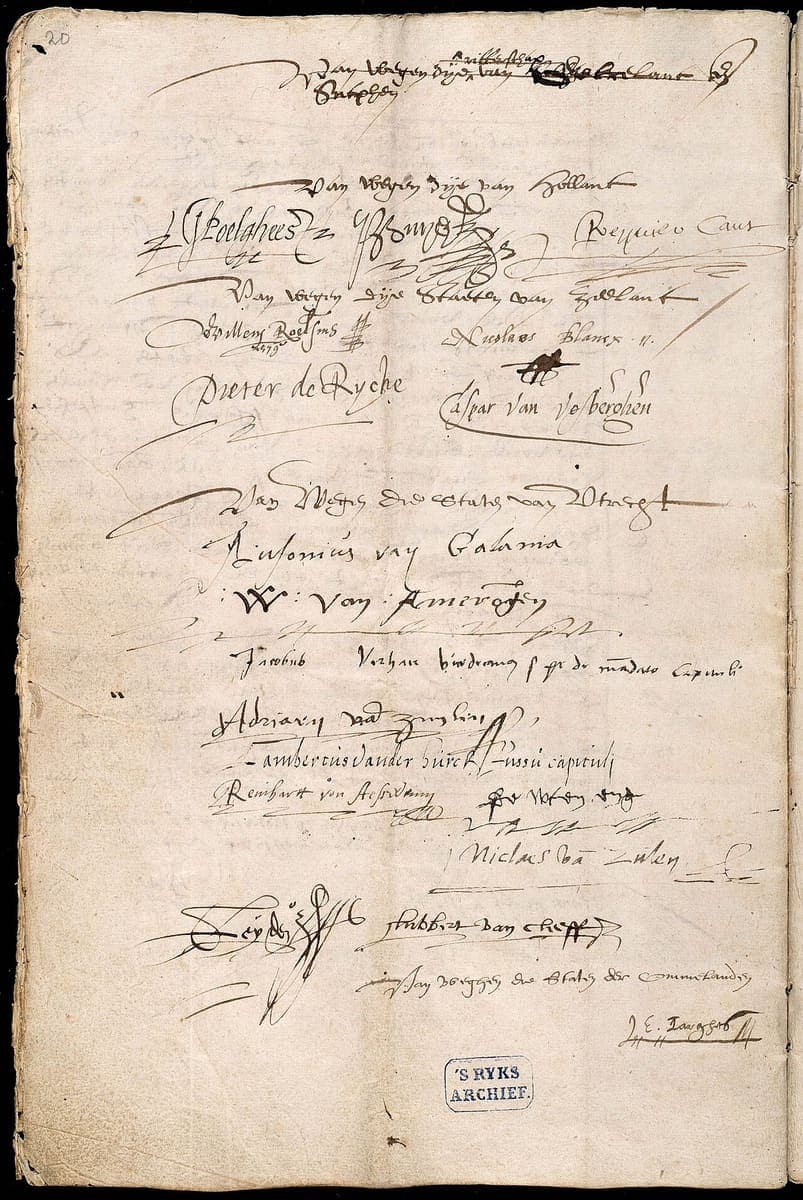
Nationaal Archief, The Hague, 1.01.19, inv. no. 2623, fol. 20, 1579 · Source · Public domain
Evidano Transcription
20
Van wegen dye van [cancelled: Gelderlant] \Ridderschap/
Zutphen
Van wegen dye van Hollant
[signature] [signature] Reynier Cant
Van wegen dye Staten van Zeelant
Willem Roelsius[?] [signature] Niclaes Blancx
Pieter de Rycke Caspar van Vosberghen
Van Wegen die Staten van Vtrecht
Antonius van Galama
W: van Amerongen
Jacobus Verhaer[?] [illegible] p[ro] de mandato capituli
Adriaen van Zuylen
Lambertus vander burch iussu capituli
Reinhart von Aeswijn [signature]
Niclas va[n] Zulen
[signature] Hubbert van Cheff[?]
Van wegen die Staten der Ommelanden
J. E. Jarges[?]
'S RYKS
ARCHIEF.
Generated by Evidano’s advanced model; not yet checked against a published edition.
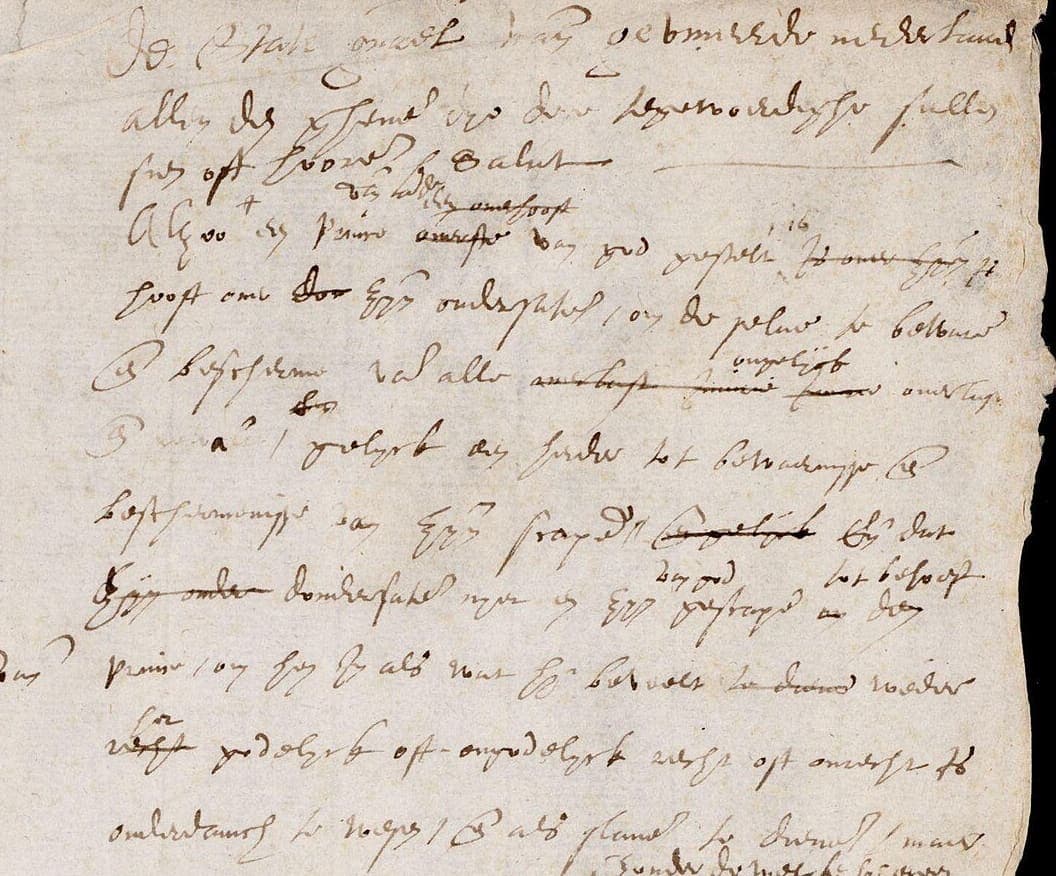
Nationaal Archief, The Hague, 1.01.01.01, inv. no. 254G, 1581 · Source · Public domain
Evidano Transcription
De Staten generael vande geunieerde nederlanden
allen den ghenen die dese jegenwoordighe sullen
sien oft hooren lesen Salut
[lines 4–11 heavily corrected, illegible]
onderdanich te wesen / ende als slaven te dienen / maer
[cut off]
Generated by Evidano’s advanced model; not yet checked against a published edition.
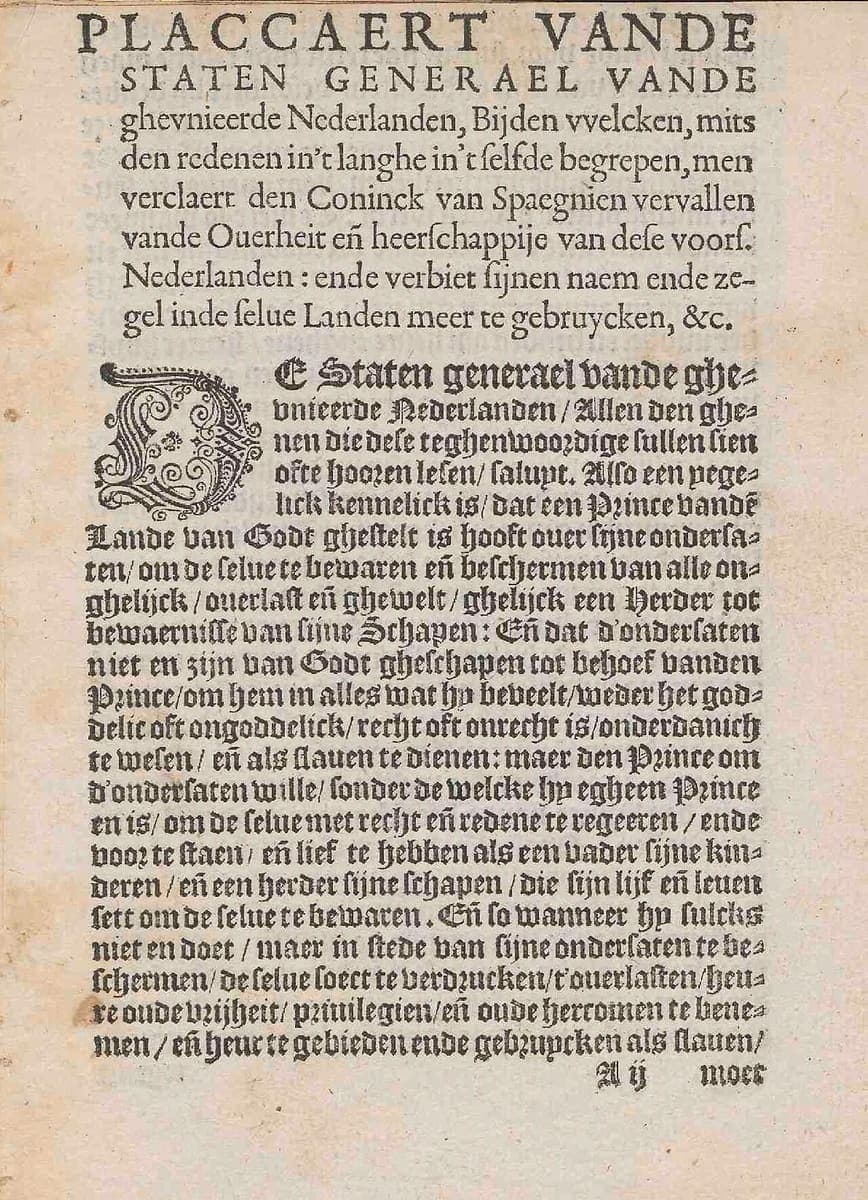
Utrecht University Library, 1874-261494, 1581 · Source · Public domain
Evidano Transcription
The whole page: the title in three blocks and the opening of the act down to the catchword. Taken from the proofread Wikisource page of this same Leiden 1581 edition; the transcriber prints the printed spellings and the vv digraph as they stand, resolves the decorated initial as D, and does not reproduce the printed line breaks within the paragraph.
PLACCAERT VANDE
STATEN GENERAEL VANDE
ghevnieerde Nederlanden, Bijden vvelcken, mits den redenen in’t langhe in’t selfde begrepen, men verclaert den Coninck van Spaegnien vervallen vande Ouerheit en heerschappije van dese voors. Nederlanden: ende verbiet sijnen naem ende zegel inde selue Landen meer te gebruycken, &c.
DE Staten generael vande gheunieerde Nederlanden. Allen dengenen die dese teghenwoordighe sullen sien ofte hooren lesen, saluyt. Also een yegelick kennelick is, dat een Prince van den lande van Godt gestelt is hooft over zijne ondersaten, om de selue te bewaren ende beschermen van alle onghelijk, overlast en ghewelt, ghelijck een herder tot bewaernisse van zijne Schapen: En dat d'ondersaten niet en sijn van Godt geschapen tot behoef van den Prince, om hem in alles wat hy beveelt, weder het goddelick oft ongoddelick, recht oft onrecht is, onderdanig te wesen en als slaven te dienen: maer den Prince om d'ondersaten wille, sonder dewelcke hy egheen Prince en is, om de selve met recht en redene te regeeren, ende voor te staen, en lief te hebben als een vader zijne kinderen, en een herder zijne schapen, die zijn lijf en leven set om deselve te bewaren. En so wanneer hy sulcks niet en doet, maer in stede van zijne ondersaten te beschermen, deselve soeckt te verdrucken, t'ouerlasten, heure oude vryheyt, privilegien en oude hercomen te benemen, en heur te gebieden ende gebruycken als slaven,
Source: Placcaert vande Staten Generael vande ghevnieerde Nederlanden (Leiden: Charles Silvius, 1581), p. 1, proofread on Wikisource (Public domain).
How the chancery of the Low Countries wrote
From the 1420s the dukes of Burgundy ruled Flanders, Brabant, Holland and Zeeland through a chancery that worked in French and, for the northern provinces, in Dutch; the Habsburg regime of Charles V and Philip II inherited its staff and its habits. The formal grade of writing is littera bastarda, an ornamented cursive with wedge-topped ascenders, pointed feet and long tapering descenders, used for engrossed charters on parchment such as the privileges granted by Mary of Burgundy in 1477. Below it lie the working hands: the minute of a resolution, the clerk’s copy in a register, the account roll, all written smaller and faster, with letters joined for whole words at a time. By 1581 an act of the States General could exist in three states at once — a heavily corrected draft, an engrossed original under seals, and a sheet printed in gothic type for the market square.
These hands reward recognition of patterns rather than of single letters. A single-compartment a, the two-shaped r after o and b, long ſ inside a word against a curled s at its end, and c and t separated only by the height of a hairline recur in fixed combinations. Minims run together, so a group of strokes is settled from the formula around it rather than from its shape. Abbreviation is legal and systematic: a bar for a suppressed n or m, superscript letters for -er, -ur and -re, voirs. and voirn. for voirscreven and voirnoemde, and a terminal flourish standing for et cetera. Numbers and dates stay Roman, with superscript endings — den XIIIIen dach in maerte, anno XVc LXXVI — and money runs in pounds, shillings and pence with the last minim of a figure written as j.
The sheet itself carries information. An engrossed charter opens with a display line of cadels, folds along a plica through which the tags of the pendant seals pass, and is endorsed on the back with a summary and archival marks; a treaty may end with two dozen subscriptions, each a name buried in a flourish. Registers keep a broad left margin for the date and a keyword, and later archivists filled that margin with their own references in nineteenth-century ink. Minutes are drafted on half the width of the paper so that the other half can hold insertions, and the reader has to follow carets, deletions and second thoughts to see what was finally agreed. French and Latin phrases surface throughout, from par le duc in a subscription to ipso jure in a sentence of forfeiture.
Why ordinary OCR struggles here
Loops that belong to the line above
The ascender of a b or l reaches up into the previous line and ends inside one of its words, while a clerk writing at speed carries the pen through six or seven letters without lifting it. Line and word segmentation is where general-purpose OCR fails first here: it splits a word at a join, or reads a descender from the line above as a letter of its own.
Formulas reduced to a stub
voirs., voirn., dvoirschreven and a bare flourish each stand for several words, and which words they stand for depends on what the clause is doing. A transcript that silently expands them hides an editorial decision; one that keeps them unmarked is unsearchable. Both policies are legitimate, but they have to be applied consistently across a whole cartulary.
Roman numerals, regnal dates and money columns
A date written XIIIIen dach in maerte anno XVc LXXVI may fall in 1576 or 1577 depending on whether the year was reckoned from Easter, and an account column mixes Roman figures, superscript endings and the final j. One misread stroke moves a payment by a decimal place or a document by a year.
Drafts, endorsements and later annotation
A minute carries deletions, interlinear additions and instructions in more than one hand; the dorse of a charter carries endorsements written centuries apart; a register margin carries an archivist’s pencil. Flattening all of that into a single stream of text destroys exactly the evidence a historian came for.
Who works with this material
Editors of charter collections
Anyone building an oorkondenboek or a cartulary edition needs a first transcript that preserves the abbreviations, the dating clause and the subscriptions, and that flags the endorsement separately, because the regest and the apparatus are written from exactly those elements.
Legal and constitutional historians
Privileges, ordinances and placards are read for their clauses. A transcript that keeps clause numbering, paragraph marks and the order of the articles lets a reader trace how one text was recycled into the next — the 1477 privileges into the arguments of the 1570s, and those into the acts of the States General.
Archives running volunteer transcription
Dutch and Flemish archives put scans of registers and charters in front of the public and check what comes back. A machine-made first pass shortens the job to correction, provided it marks its own doubtful readings instead of quietly inventing a plausible word.
Urban and economic historians
Town accounts and toll registers are worth reading only if the figures survive the transcript. Roman numerals, superscript endings and the pounds-shillings-pence columns have to come out as they were written, with the totals kept beside the entries they sum.
Getting the best transcription
Name the issuing body and the document type
Tell the model whether it is looking at a ducal charter, a minute of the States, a register copy or a printed placard. The formulas differ, and knowing which set to expect settles most of the ambiguous minim groups before they become guesses.
Fix one abbreviation policy for the whole series
Decide whether voirs. and the nasal bar are expanded in square brackets, expanded silently, or left as written, and state it in the prompt. Applied to every folio of a register the result can be converted later; applied piecemeal it cannot.
Ask for numerals twice
Request the Roman figures as written and, in a separate field, an arabic reading of dates and sums. That keeps the diplomatic text intact while giving you something sortable, and it makes a misread numeral visible as a disagreement between the two.
Test on a corrected minute first
Run a draft with deletions and interlinear insertions before you run the clean engrossments. If the struck-through words and the additions come back labelled and in the right places, a fair copy will hold no surprises.
Further reading on this hand
The palaeography guides the in-app selector points to for this domain, if you want to check a transcription against the standard references.
- Introduction to Dutch Paleography
This Brigham Young University guide introduces the historical scripts and record types encountered in Dutch-language research. It provides access to alphabet forms, handwriting examples, genealogical vocabulary, and practical reading exercises. The material emphasizes variation among writers and periods and supports comparison of connected letters, abbreviations, and recurring documentary formulas. It is useful for late medieval and sixteenth-century chancery records that combine Dutch with broader northern European Gothic conventions.
Frequently asked questions
- Does it cope with both fifteenth-century bâtarde and later sixteenth-century cursive?
- Yes, and the two often appear in one archive box. The formal bâtarde of an engrossment and the fast cursive of a minute share their letterforms; what changes is the speed, the amount of joining and the abbreviation load, and you can say in the prompt which you are looking at.
- What happens with the French and Latin inside a Dutch document?
- They are transcribed in place and can be labelled by language, so that a subscription such as par le duc, a Latin sentence of forfeiture, or a French clause copied from a Burgundian original stays legible as what it is rather than being forced into Dutch spelling.
- Can the dorsal endorsement and the marginal notes be kept apart from the act?
- Yes. Endorsements, register margins and later archival annotations are returned as separate blocks with their positions noted, so a nineteenth-century pencil reference is never mixed into a sixteenth-century clause.
- How is a date like den XIIIIen dach in maerte anno XVc LXXVI treated?
- The figures are kept as written. If you ask for a converted date the reading is given alongside, with a note where the style of the year matters — in Holland the year often began at Easter, so a March date can belong to either of two modern years.
- Are printed placards handled as well as the manuscripts?
- They are. Sixteenth-century gothic type has its own traps — the vv digraph for w, long ſ, tildes over vowels, catchwords and quire signatures at the foot — and these can be transcribed as printed or normalised, whichever suits the edition you are building.
Related scripts and pages
Transcribe your charters, registers and placards
Upload a scan, choose Burgundian and Habsburg Dutch Chancery Hands, and start with one corrected minute before you run the register.