
French · c. 1350–1500
Turn fifteenth-century French cursive into checkable text
After about 1350 the pen stopped being lifted. Letters run into one another, ascenders loop back over the line, final s and x trail into flourishes that may or may not stand for an abbreviation, and a clerk writing a court register at speed will fit twelve words into the space a book scribe gave to four. Evidano reads these charters, registers and letters line by line, and keeps the marginal notes, the sums and the chancery formulas where they belong.
Sample pages
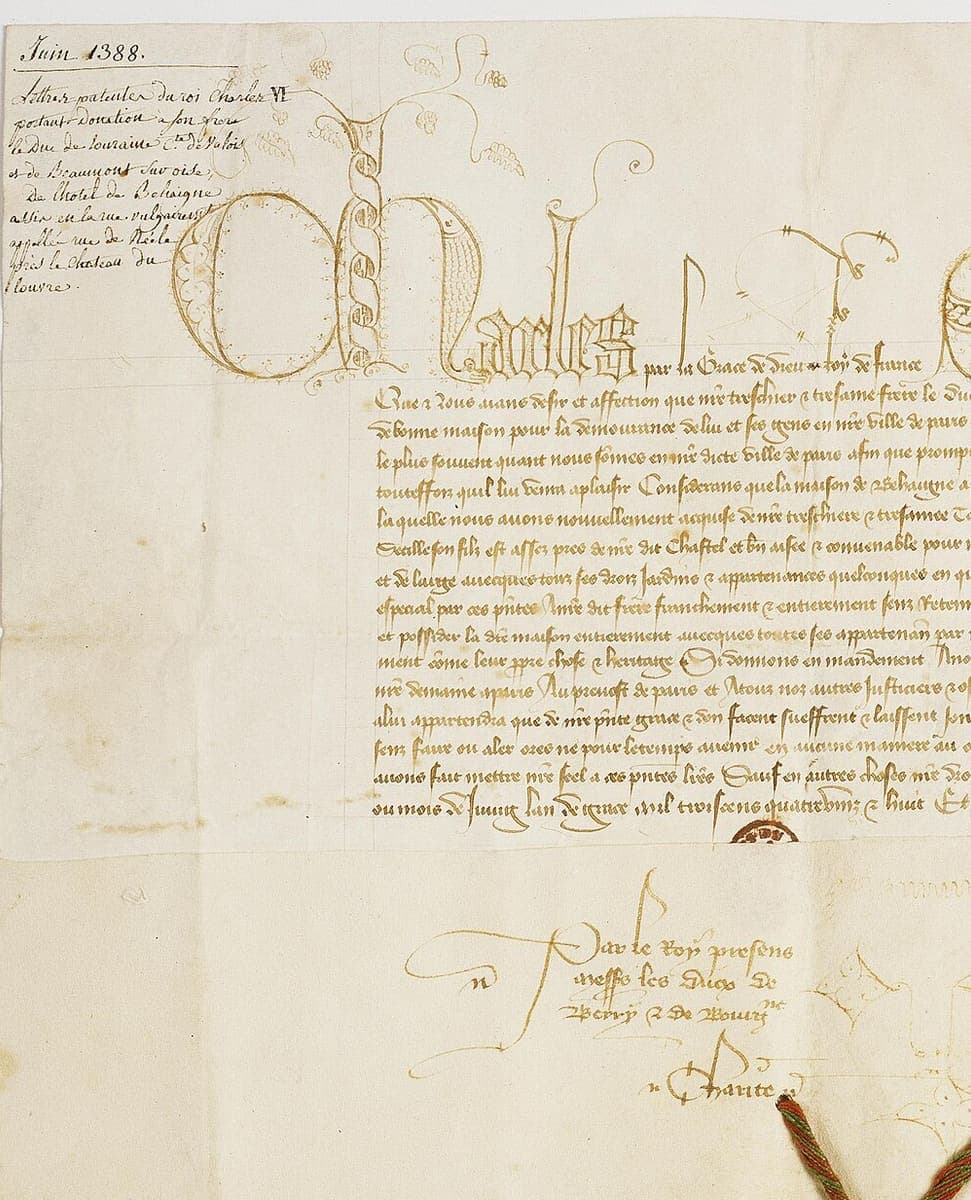
Archives nationales (France), K 532 B, no. 17, June 1388 · Source · Public domain · Archives nationales (France), via the Wikimédia France cooperation project
Evidano Transcription
The whole act, in the transcription made by the Archives nationales and validated on French Wikisource. Abbreviations are expanded without brackets, u/v and i/j follow modern usage, capitals and punctuation are editorial, and the text is printed as one paragraph, as here. The image shows the left-hand portion of the sheet; the chancery mentions written on the fold are transcribed separately in the edition.
Charles par la grace de Dieu roy de France. Savoir faisons à tous presens et à venir que nous aians desir et affection que nostre tres chier et tres amé frere le duc de Tourainne, conte de Valoys et de Beaumont sur Oise, soit pourveuz de bonne maison pour la demourance de lui et ses gens en nostre ville de Paris, qui soit en bon lieu et pres de nostre chastel du Louvre ou nous nous tenons le plus souvent quant nous sommes en nostre dicte ville de Paris, afin que promptement et aisieement il puisse venir devers nous et retourner en son hostel toutes foiz qu’il lui venra à plaisir, considerans que la maison de Behaigne assise en ladicte ville en la rue vulgalment nommee la rue de Neelle, et laquelle nous avons nouvellement acquise de nostre tres chiere et tres amee tante la royne et de nostre tres chier et tres amé cousin le roy de Jherusalem et de Secille son filz, est assez pres de nostre dit chastel et bien aisee et convenable pour nostre dit frere, avons icelle maison ainsi comme elle se comporte de lonc et de large avecques touz ses droiz, jardins et appartenances quelconques en quelque lieu qu’ilz se extendent et eslargissent, donné et donnons de grace especial par ces presentes à nostre dit frere franchement et entierement, senz retenir aucune chose de la dicte maison ne des dictes appartenances, à tenir, avoir et possider la dicte maison entierement avecques toutes ses appartenances par nostre dit frere, ses hoirs, successeurs et ayans cause à tousjours et perpetuelment comme leur propre chose et heritage, si donnons en mandement à noz amez et feaulx gens de noz comptes et conseilliers sur le fait de nostre demaine à Paris, au prevost de Paris et à touz noz autres justiciers et officiers ou à leurs lieuxtenens, presens et à venir, et à chascun d’eulx si come à lui appartendra, que de nostre presente grace et don facent, sueffrent et laissent joir et user paisiblement nostre dit frere, ses hoirs, successeurs et aians cause, senz faire ou aller ores ne pour le temps à venir en aucune maniere au contraire. Et pour ce que ce soit ferme chose et estable à tousjours, nous avons fait mettre nostre seel à ces presentes lettres, sauf en autres choses nostre droit et l’autrui en toutes. Donné à la noble maison de Saint Oyn ou mois de juing, l’an de grace mil trois cens quatre vinz et huit, et le huitiesme de nostre regne.
Source: Archives nationales, transcription of K 532 B no. 17 (1388), validated text on French Wikisource (CC BY-SA 4.0).
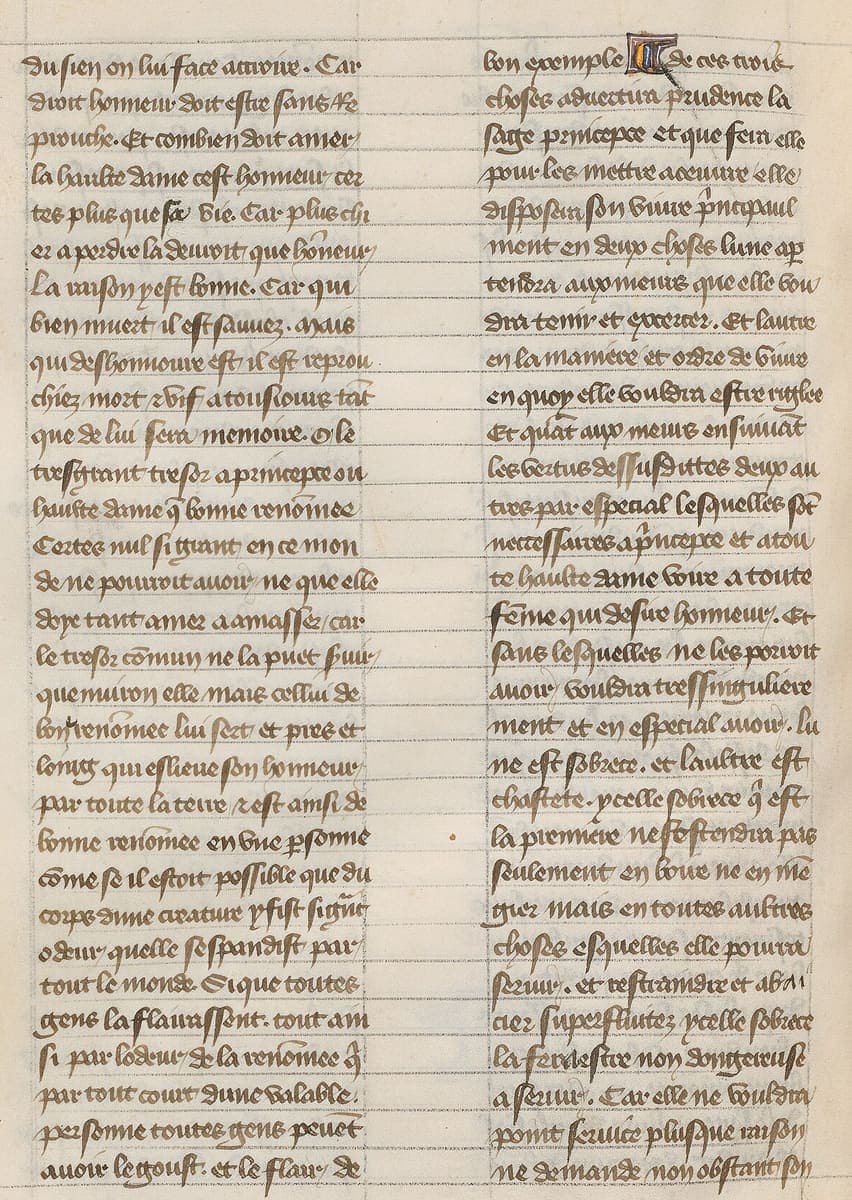
Boston Public Library, Rare Books Department, c. 1405–1415 · Source · Public domain · Boston Public Library via Digital Commonwealth and the Digital Public Library of America
Evidano Transcription
du sien on lui face attrait[?]. Car
droit honneur doit estre sans re
prouche. Et combien doit amer
la haulte dame cest honneur cer
tes plus que sa vie. Car plus chi
er a perdre la deuroit que honeur
La raison y est bonne. Car qui
bien muert il est sauuez. Mais
qui deshonnoure est il est reprou
chiez mort & vif a tousiours ta[n]t
que de lui sera memoire. O le
tresgrant tresor a princesse ou
haulte dame q[ue] bonne renomee
Certes nul si grant en ce mon
de ne pourroit auoir ne que elle
doye tant amer a amasser car
le tresor co[m]mun ne la puet suiu[?]
que enuiron elle mais cellui de
bone renomee lui sert et pres et
loings qui eslieue son honneur
par toute la terre / cest ainsi de
bonne renomee en vne p[er]sonne
co[m]me se il estoit possible que du
corps dune creature yssist singu
odeur quelle sespandist par
tout le monde. Sique toutes
gens la flaurassent. tout ain
si par lodeur de la renomee q[ui]
par tout court dune valable.
personne toutes gens peuet
auoir le goust. et le flaur de
bon exemple ¶ De ces trois
choses aduertira prudence la
sage princesse et que fera elle
pour les mettre a euure elle
disposera son viure p[ri]ncipal
ment en deux choses lune ap
tendra aux meurs que elle vou
dra tenir et excercer. Et lautre
en la maniere et ordre de viure
en quoy elle vouldra estre riglee
Et qua[n]t aux meurs ensuia[n]t
les vertus dessus dittes deux au
tres par especial lesquelles so[n]t
neccessaires a p[ri]ncesse et a tou
te haulte dame voire a toute
feme qui desire honneur. Et
sans lesquelles ne les porroit
auoir vouldra tressinguliere
ment et en especial auoir. lu
ne est sobrete. et laultre est
chastete. ycelle sobrete q[ui] est
la premiere ne sestendra pas
seulement en boire ne en me
gier mais en toutes aultres
choses esquelles elle pourra
seruir. et restraindre et abai
cier superfluitez ycelle sobrete
la fera estre non dongereuse
a seruir. Car elle ne vouldra
point seruice plus que raison
ne demande non obstant son
Generated by Evidano’s advanced model; not yet checked against a published edition.
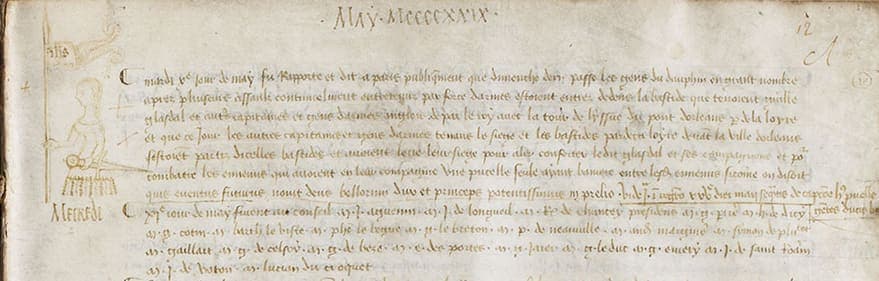
Archives nationales (France), AE II 447 (X1a 1481, f. 12), 10 May 1429 · Source · Public domain
Evidano Transcription
The first entry on the page, for 10 May 1429, as printed by Quicherat among the testimonies of fifteenth-century chroniclers. Abbreviations are expanded, accents and punctuation are the editor’s, and the closing sentence in Latin is the greffier’s own aside. The cross-reference that Fauquembergue added later is given by Quicherat in a footnote and is not included here; the entries lower down the page are not covered.
Mardy Xe jour de may, fut rapporté et dit à Paris publiquement, que dimanche derrenier passé, les gens du dauphin en grant nombre, aprez pluiseurs assaulz continuelment entretenuz par force d’armes, estoient entrez dedens la bastide que tenoient Guillaume Glasdal et autres capitaines et gens d’armes anglois de par le roy, avec la tour de l’yssue du pont d’Orléans par delà Loyre ; et que ce jour, les autres capitaines et gens d’armes tenans le siège et les bastides par deçà Loyre, devant la ville d’Orléans, s’estoient partiz dicelles bastides, et avoient levé leur siège pour aller conforter ledit Glasdal et ses compagnons, et pour combatre les ennemis qui avoient en leur compagnie une pucelle, seule ayant banière entre lesditz ennemis, si comme on disoit. Quis eventus fuerit, novit Deus bellorum dux et princeps potentissimus in prœlio.
Source: Jules Quicherat (ed.), Procès de condamnation et de réhabilitation de Jeanne d’Arc, tome IV (Paris, 1847), Clément de Fauquemberque, pp. 451–452, via Internet Archive (Public domain).
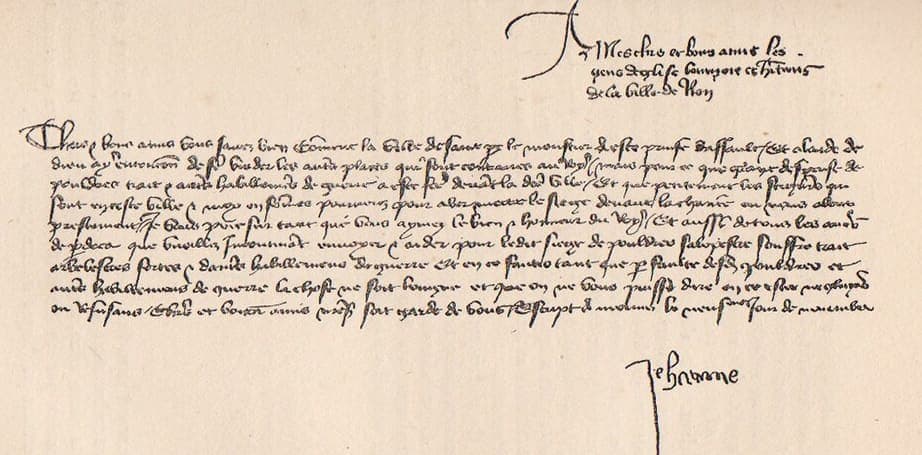
Archives municipales de Riom, 9 November 1429 · Source · Public domain · Facsimile from C. de Maleissye, Les Lettres de Jehanne d’Arc (Paris, 1911)
Evidano Transcription
The whole letter, the signature line and the address written on the back, in Quicherat’s edition of the original at Riom. Abbreviations are expanded, accents and punctuation are supplied by the editor, and the three parts are given here in the order the edition prints them.
Chers et bons amis, vous savez bien comment la ville de Saint-Pierre le Moustier a esté prinse d’assault ; et, à l’aide de Dieu, ay entencion de faire vuider les autres places qui sont contraires au roy ; mais pour ce que grant despense de pouldres, trait et autres habillemens de guerre a esté faicte devant ladicte ville, et que petitement les seigneurs qui sont en ceste ville et moy en sommes pourveuz pour aler mectre le siège devant La Charité, où nous alons présentement : je vous prie sur tant que vous aymez le bien et honneur du roy et aussi de tous les autres de par deçà, que vueillez incontinant envoyer et aider pour ledit siège, de pouldres, salpestre, souffre, trait, arbelestres fortes et d’autres habillemens de guerre. Et en ce faictes tant que, par faulte desdictes pouldres et autres habillemens de guerre, la chose ne soit longue, et que on ne vous puisse dire en ce estre négligens ou refusans. Chiers et bons amis, Nostre Sire soit garde de vous. Escript à Molins, le neufviesme jour de novembre.
Signé : Jehanne.
Sur l’adresse : A mes chers et bons amis, les gens d’église, bourgois et habitans de la ville de Rion.
Source: Jules Quicherat (ed.), Procès de condamnation et de réhabilitation de Jeanne d’Arc, tome V (Paris, 1849), Lettres, actes et autres pièces détachées, no. XX, pp. 147–148, via Internet Archive (Public domain).
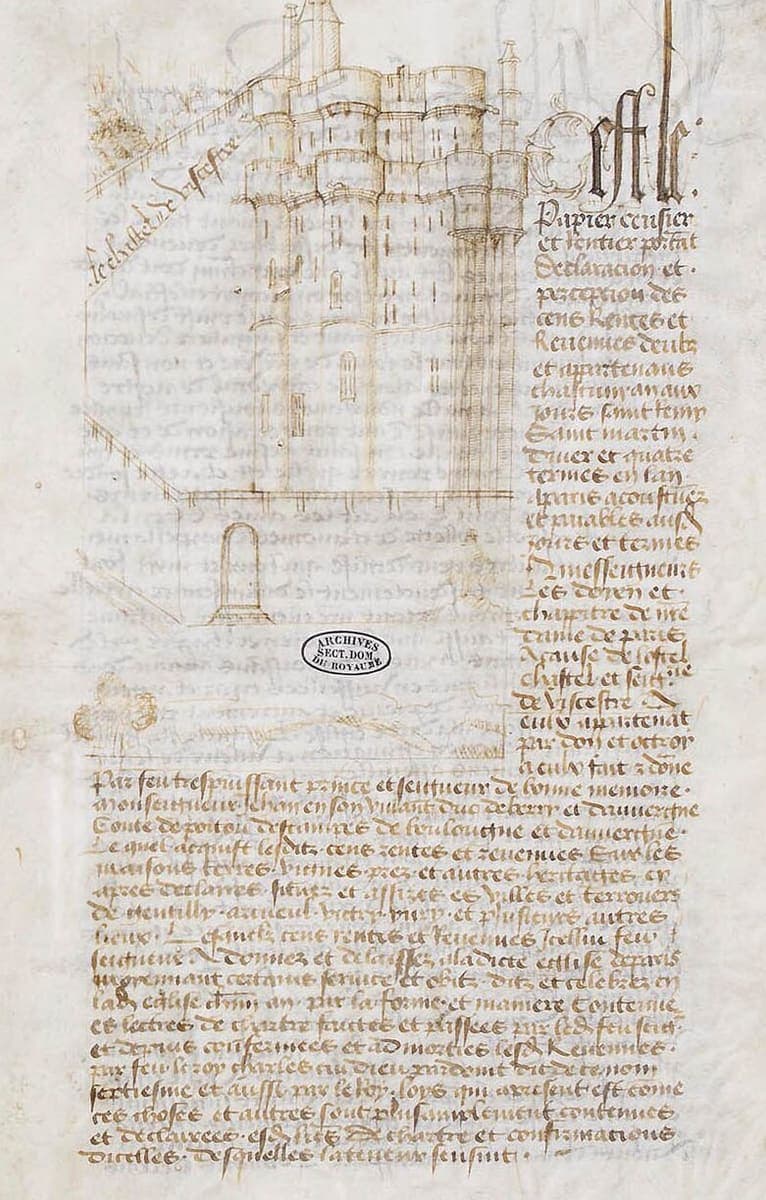
Archives nationales (France), AE II 493, 1474 · Source · Public domain · Archives nationales (France), via the Wikimédia France cooperation project
Evidano Transcription
le chaſtel de biceſtre
C eſt le
Papier cenſier
et rentier p[or]tant
declaracion et
p[er]cepcion des
cens Rentes et
Reuenues deubz
et ap[ar]tenans
chaſcun an aux
Jours ſaint remy
Saint martin
diuer et quatre
termes en lan
A p[ar]is acouſtumez
et paiables auſd[iz]
Jours et termes
A meſſeigneurs
Les doyen et
chappitre de n[ot]re
dame de p[ar]is
A cauſe de loſtel
chaſtel et ſeign[eur]ie
de biceſtre A
eulx ap[ar]tenant
par don et octroy
A eulx fait & done
[stamp]
Par feu treſpuiſſant p[ri]nce et ſeigneur de bonne memoire
monſeigneur Jehan en ſon viuant duc de berry et dauuergne
Conte de poitou deſtampes de boulongne et dauuergne
Lequel acquiſt leſditz cens rentes et reuenues Sur les
maiſons terres vignes prez et autres heritaiges cy
apres declarees ſituez et aſſizes es villes et terrouers
de gentilly arcueil vitry iury et pluſieurs autres
lieux. leſquelz cens rentes et reuenues Icellui feu
ſeigneur A donnez et delaiſſez a ladicte egliſe de paris
moyennant certains ſeruice et obit dit et celebrez en
lad[icte] egliſe chaſcun an par la forme et maniere contenue
es lettres de chartre faictes et paſſees par led[it] feu ſeign[eur]
et depuis confermees et admorties leſd[ictes] Reuenues
par feu le roy charles cui dieu p[ar]doint de ce nom
ſeptieſme et auſſi par le Roy loys qui a preſent eſt come
ces choſes et autres ſont pluſamplement contenues
et declarees es d[ic]tes l[ett]res de chartre et confirmacions
dicelles. Deſquelles la teneur ſenſuit.
Generated by Evidano’s advanced model; not yet checked against a published edition.
Bâtarde, chancery cursive and the clerk’s fast hand
Two families share this period. Lettre bâtarde is the calligraphic compromise that Burgundian and Parisian workshops used for luxury books: Gothic bodies, but with looped l, b, h and k, a single-compartment a, a pointed f and long ſ that both descend below the line, and a final s curled back like a figure 2. Beside it runs the documentary cursive of the chancery, the Parlement, the notaries and the accountants — the same letters written fast, with the loops flattened, the minims reduced to a wave and the last letter of a word pulled out into a stroke that has to be read as either a flourish or an abbreviation for -us, -is or -ment.
Documents have a fixed shape, and knowing it does half the reading. Royal letters patent open with the king’s name in tall ornamental letters, give the address and the disposition in one long sentence, and close with a date formula and, on the folded edge below the text, the chancery mentions: Par le roy, the name of the clerk, a registration note from the chambre des comptes, a Visa in the corner. Registers are ruled into entries opened by a pilcrow, with the day of the week and a catchword written in the margin; censiers and terriers set names and rents in columns with sums in roman numerals, l., s. and d. for livres, sous and deniers, and abbreviations for measures and feast-day terms.
Spelling is not yet fixed and the scribes abbreviate at will. Superscript letters supply syllables (nre for nostre, qͥ for qui), a bar over a vowel drops a nasal, ꝑ covers par and per, and formulaic phrases are cut hard: p̃ns for presens, lred for lettres, gce for grace. Numbers are roman with a superscript ordinal (XIᵃ, IIIIˣˣ for eighty), dates are written out as saints’ days or as l’an de grace mil quatre cens…, and personal names are often left in a Latin case ending in an otherwise French sentence.
Why ordinary OCR struggles here
Flourishes that may or may not be letters
A clerk finishing a word pulls the last stroke out into a curl. Sometimes it is decoration, sometimes it stands for -us, -is or a final -e. Reading it wrongly turns nostres into nostre or invents a plural, and no amount of image quality settles it: only the formula and the sense do.
Formulas that swallow whole words
Chancery French compresses its stock phrases beyond recognition — lred for lettres, p̃ns for presens, ppetuelment for perpetuelment. An engine that has not seen the formulary reads them as nonsense words and then autocorrects them into something worse.
Sums, measures and dates in roman numerals
Accounts and censiers are full of numerals with superscript ordinals, IIIIˣˣ for eighty, and l. s. d. for the money of account, mixed with feast-day dates. Getting a figure wrong is not a spelling slip; it changes the record.
Marginal apparatus and show-through
Registers carry day names, catchwords and later cross-references in the margin, and thin fifteenth-century paper lets the next page show through. Both confuse layout analysis, which either merges the margin into the text or reads the ghost strokes as ink.
Who works with this material
Archivists publishing charter collections
Series of royal, seigneurial and municipal acts are catalogued item by item. A transcription that keeps the chancery mentions on the fold, the date formula and the sealing clause gives a cataloguer everything an analytical notice needs.
Genealogists working in French local archives
Before parish registers, families appear in censiers, terriers and notarial acts. Names in these documents are abbreviated and inflected, so a reading that flags every expansion is worth more than a confident guess.
Economic and social historians
Rent rolls, accounts and tax assessments are only usable as data once the names, holdings and sums are separated. A structured transcription that keeps columns apart turns a photographed register into a table you can total.
Editors of late medieval literary texts
Bâtarde books were produced fast and in numbers, and their copies differ. Working from a transcription of each witness rather than from a single printed edition is how the circulation of a text is reconstructed.
Getting the best transcription
Tell the model what kind of document it is
Letters patent, a register entry, a missive and a censier have different layouts and different formulas. Naming the genre in the prompt lets the model expect the address, the date clause or the column of sums instead of discovering them halfway down.
Give it the names and places in advance
Proper names carry the abbreviations that are hardest to guess. A short list of the persons, offices and places you expect on the sheet — Behaigne, Neelle, La Charité, the chapter of Notre-Dame — resolves most of the ambiguous strokes before they arise.
Ask for numerals to be left as written
Request roman numerals in their manuscript form, with the surrounding points and superscripts, and a separate arabic reading if you want one. Silent conversion hides transcription errors in exactly the places where they matter most.
Test on the fold and the margin
Run the first pass on a sheet with chancery mentions below the text or with marginal day names, and check that they come out labelled rather than spliced into the body. Once that holds, a long run of similar documents needs only spot checks.
Further reading on this hand
The palaeography guides the in-app selector points to for this domain, if you want to check a transcription against the standard references.
- French Renaissance Paleography
This Newberry Library project offers digitized French manuscripts, expert transcriptions, and exercises spanning 1300 to 1700. Its fifteenth-century documents include formal and cursive hands that illustrate the diversity of late medieval French writing. Users can compare manuscript images with transcriptions while studying letterforms, abbreviations, punctuation, word division, and document context. This combination is particularly useful for reading bâtarde and related chancery or notarial cursives.
Frequently asked questions
- Can it tell lettre bâtarde in a book from the same clerk’s fast cursive?
- They are the same alphabet at different speeds, and the model is told which to expect. A calligraphic bâtarde page keeps its loops and its regular spacing, while a register entry has to be read through flattened minims and joined words; naming the document type in the prompt sets the right expectations.
- How are the chancery mentions on the fold handled?
- Par le roy, the clerk’s name, the registration note of the chambre des comptes and the Visa are transcribed as separate fields with their position on the sheet recorded, because their placement is what tells you how the act was issued and enrolled.
- What happens to money and measures?
- Sums can be kept exactly as written, with l., s. and d. and any superscript ordinals, and a parallel arabic value produced alongside. Keeping both means a reviewer can check a total without going back to the image.
- Does the ghost of the next page confuse it?
- Show-through on thin paper is common in fifteenth-century registers and is treated as a background feature rather than as ink. Where a stroke is genuinely ambiguous the reading is flagged so a reviewer can look at the verso.
- Can a signature be transcribed and identified as autograph?
- A signature is transcribed as a signature and marked as such. Whether it is autograph is a judgement for the historian, but the transcription records the letters, their position and the fact that the hand differs from the body of the document.
Related scripts and pages
Read your fifteenth-century French documents
Upload a charter, a register opening or a letter, choose French Bâtarde and Cursive Documentary Hands, and check the first sheet before you send the box.