
Dutch · c. 1550–1700
Read seventeenth-century Dutch paperwork
In a fast Dutch secretary hand e collapses into c, r into v, and long ſ differs from f only by half a crossbar, while the sum in the margin is written ƒ 33-15-0 with a ditto mark standing in for the month. Evidano transcribes notarial acts, merchant papers, company charters and private letters from the Republic, keeps the money columns beside the entries they belong to, and marks where the writer switches into a rounder Latin script for a foreign name.
Sample pages
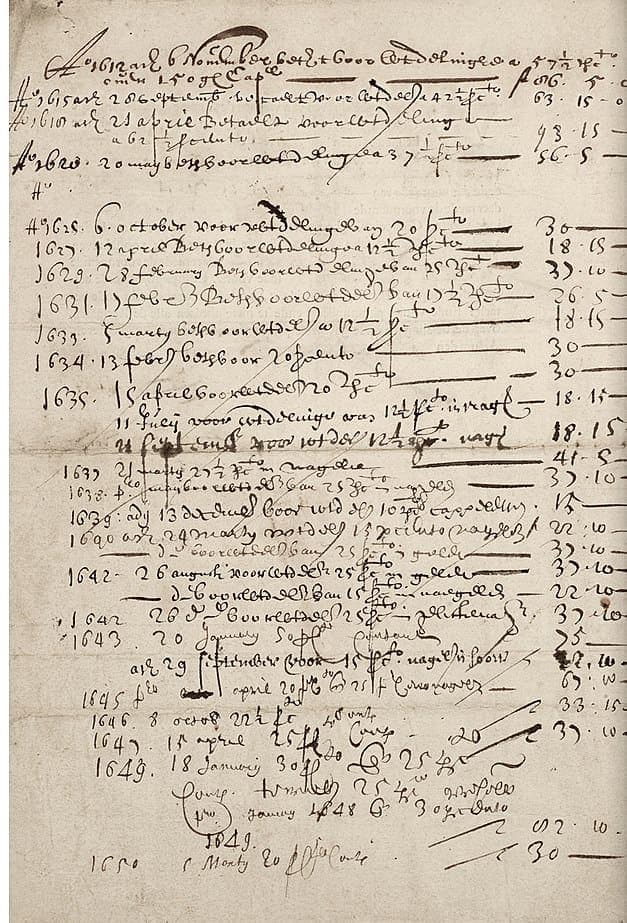
Westfries Archief, Hoorn, 1606, with endorsements to 1650 · Source · Public domain
Evidano Transcription
| Entry | Amount |
|---|---|
| A[nn]o 1612 adi 6 November betaelt voor wtdeelinge a 57 1/2 p[ro]cento ende 150 gl Cap[itae]l | f 86 . 5 . 0 |
| A[nn]o 1615 adi 28 september betaelt voor wtdeelinge 42 1/2 p[ro]cento | 63 . 15 . 0 |
| A[nn]o 1618[?] adi 21 april betaelt voor wtdeelinge a 62 1/2 p[ro]cento | 93 . 15 |
| A[nn]o 1620 . 20 may betaelt voor wtdeelinge a 37 1/2 p[ro]cento | 56 . 5 |
| A[nn]o | |
| A[nn]o 1625 . 6 . october voor wtdeelinge van 20 p[ro]cento | 30 |
| 1627 . 12 april betaelt voor wtdeelinge a 12 1/2 p[ro]cento | 18 . 15 |
| 1629 . 28 february betaelt voor wtdeelinge van 25 p[ro]cento | 37 . 10 |
| 1631 . 17 febr[uari] betaelt voor wtdeel[inge] van 17 1/2 p[ro]cento | 26 . 5 |
| 1633 . 5[?] marty betaelt voor wtdeel[inge] a 12 1/2 p[ro]cento | 18 . 15 |
| 1634 . 13 febr[uari] betaelt voor 20 p[ro]cento | 30 |
| 1635 . 15 april voor wtdeel[inge] 20 p[ro]cento | 30 |
| 11 July voor wtdeelinge van 12 1/2 p[ro]cento in nagel[en] | 18 . 15 |
| [illegible] voor wtdeel[inge] 12 1/2 p[ro]cento nagel[en] | 18 . 15 |
| 1637 [?] marty 27 1/2 p[ro]cento in nagelen | 41 . 5 |
| 1638 . [?] may voor wtdeel[inge] van 25 p[ro]cento in nagelen | 37 . 10 |
| 1639 : adij 13 december voor wtdeel[inge] 10 p[ro]cento [?] | 15 |
| 1640 adij 24 marty wtdeel[inge] 15 p[ro]cento nagelen[?] | 22 . 10 |
| d[it]o voor wtdeel[inge] van 25 p[ro]cento in foelie[?] | 37 . 10 |
| 1642 . 26 augusti voor wtdeel[inge] 25 p[ro]cento in foelie[?] | 37 . 10 |
| d[it]o voor wtdeel[inge] van 15 p[ro]cento in nagelen | 22 . 10 |
| 1642 26 d[it]o voor wtdeel[inge] 25 p[ro]cento [?] | 37 . 10 |
| 1643 . 20 January 50 p[ro]cento contant | 75 |
| adij 29 september voor 15 p[ro]cento nagelen[?] foelie[?] | 22 . 10 |
| 1645 [?] april 20 p[ro]cento [?] 25 p[ro]cento [?] | 67 . 10 |
| 1646 . 8 octob[er] 22 1/2 p[ro]cento cont[ant] | 33 . 15 |
| 1647 . 15 april 25 p[ro]cento Comp[agnie][?] | 37 . 10 |
| 1649[?] . 18 January 30 p[ro]cento [?] 25 p[ro]cento; Comp[agnie][?] [illegible] 25 p[ro]cento [?]; p[ro] January 1648 [?] 30 p[ro]cento d[it]o; 1649 | 112 . 10 |
| 1650 [?] marty 20 p[ro]cento [?] | 30 |
Generated by Evidano’s advanced model; not yet checked against a published edition.
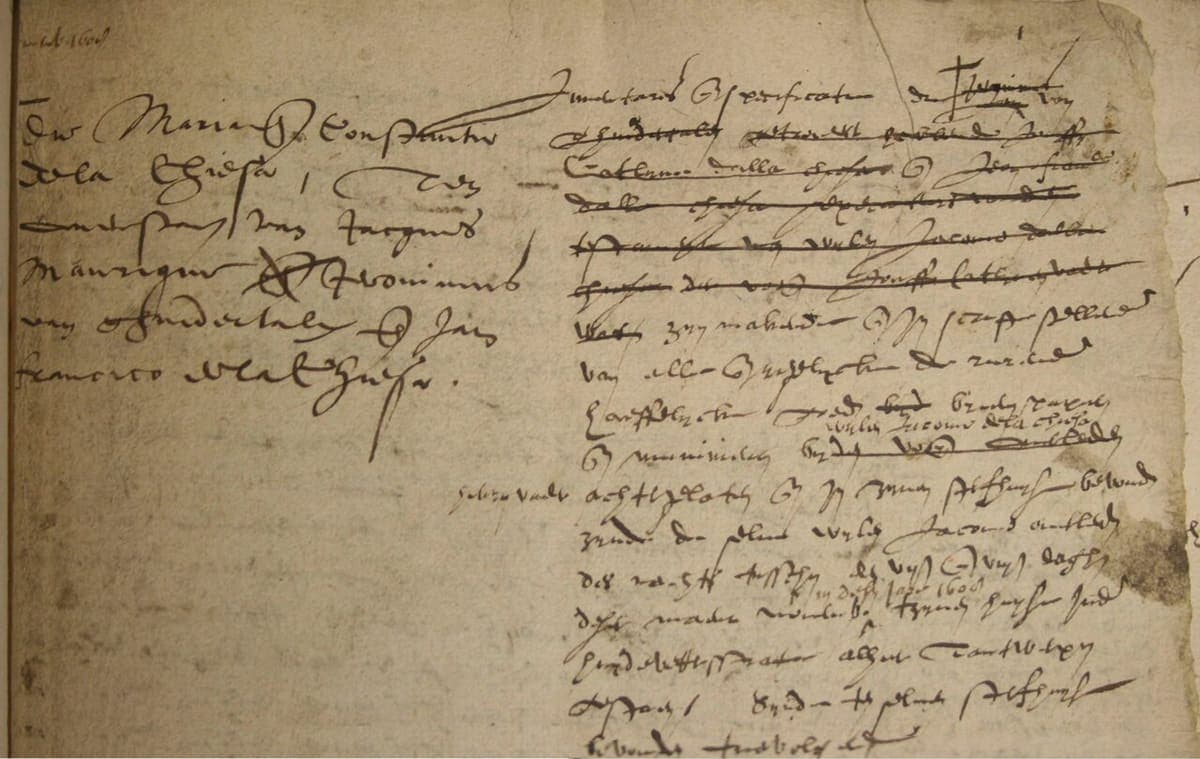
FelixArchief, Antwerp, Notariaat Antwerpen, N1487, November 1608 · Source · Public domain
Evidano Transcription
The whole of the first fragment, marginal heading and body, from the proofread Wikisource page. Letters the transcriber supplied for abbreviation marks stand in square brackets, words the notary struck out are given here between ‹ ›, and […] marks where the fragment breaks off; the transcription keeps the notary’s spelling and his lack of capitals.
[Nov]emb. 1608
Inventaris ende specificatie
die Maria ende Constantie de la Chiesa, ten overstaen van Jacques Maurique ‹ende› Jeronimus van Ghindertalen ende Jan Francico de la Chiesa.
[doorgehaalde tekst]
zijn makende ende in scrift stellende van alle ende iegelycke de rurende, haeffelycke goed[en], ‹brd› brieven, papieren ende munimenten by ‹den voorz overledene› wylen Jacomo de la Chiesa, heuren vader, acht[er]gelaten ende in zynen sterfhuys bevond[en], zynde de selve wylen Jacomo ov[er]leden des nachts tusschen den viien ende viijen daghen deser maent novemb[er] in desen jare 1608 tzijnen huyse ind[e] Huydevettersstrate, alhier tantwerpen gestaen, zijnde ten selven sterfhuys bevonden tnavolgende
[…]
Source: FelixArchief, Notariaat Antwerpen, N1487, transcription proofread on Wikisource (CC0 1.0).
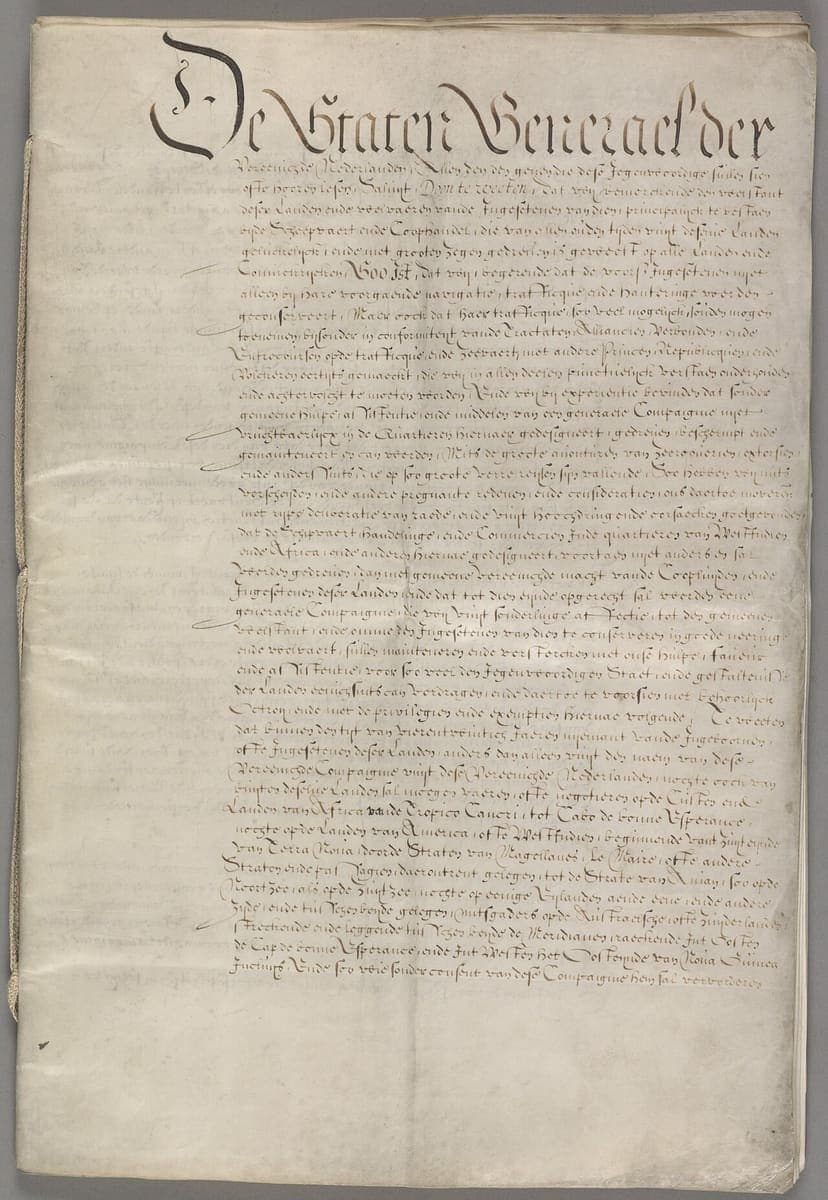
Nationaal Archief, The Hague, 1.05.01.01, inv. no. 13, 3 June 1621 · Source · Public domain
Evidano Transcription
The forty-one lines of the page, from the Nationaal Archief transcription published on the Wikimedia Commons file page. Line breaks are the manuscript’s, marked in the original transcription with a slash; letters supplied for the clerk’s contractions are given in round brackets, as voors(eijde); spelling and capitals are the clerk’s own, including the repeated den in the second line.
De Staten Generael der
Vereenichde Nederlanden, Allen den den genen die dese jegenwoordige sullen sien
ofte hooren lesen, Saluyt. Doen te weeten, dat wy bemerckende den welstant
deser Landen ende welvaeren vande Ingesetenen van dien, principalyck te bestaen
bijde Scheepvaert ende Coophandel, die van allen ouden tijden uuyt deselve Landen
geluckelyck, ende met grooten Zegen gedreven is geweest op alle Landen ende
Coninckrijcken. Soo Ist, dat wij, begerende dat de voors(eijde) Ingesetenen nijet
alleen by hare voorgaende navigatie, trafficque ende hanteringe werden
geconserveert. Maer oock dat haer trafficque, soo veel mogelyck, souden mogen
toenemen, bysonder in conformiteyt vande Tractaten, Alliancien, Verbonden, ende
Entrecoursen opde trafficque, ende Zeevaert, met andere Princen, Republicquen, ende
Volckeren eertijts gemaeckt, die wy in allen deesen punctuelyck verstaen onderhouden,
ende achtervolcht te moeten worden. Ende wy bij experientie bevinden dat sonder
gemeene hulpe, assistentie, ende middelen van een generaele Compaignie nijet
vruchtbaerlijcx in de Quartieren hiernaer gedesigneert, gedreven, beschermpt ende
gemainteneert en can werden. Mits de groote avonturen van Zeerooverien, extorsien,
ende anderssints, die op soo groote verre reysen sijn vallende. Soo hebben wy mits
verscheijden, ende andere pregnante redenen, ende consideratien, ons daertoe moveren(de)
met rijpe deliberatie van raede, ende uuijt hoochdringende oorsaecken goetbevonden,
dat de Schipvaert, handelinge, ende Commercien Inde quartieren van WestIndien
ende Africa, ende anderen hiernae gedesigneert, voortaen nijet anders en sal
werden gedreven, dan met gemeene vereenichde macht vande Coopluyden, ende
Ingesetenen deser Landen, ende dat tot dien eijnde opgerecht sal werden eene
generaele Compaignie, die wy uuijt sonderlinge affectie, tot den gemeenen
welstant, ende omme den Ingesetenen van dien te conserveren in goede neeringe
ende welvaert, sullen mainteneren ende verstercken met onse hulpe, faveur
ende assistentie, voor soo veel den jegenwoordigen Staet, ende gestaltenisse
der Landen eenichsints can verdragen, ende exemptien hiernae volgende. Te weeten
dat binnen den tijt van vierentwintich jaeren nijemant vande Ingeboornen,
ofte Ingesetenen deser Landen, anders dan alleen uuijt den naem van dese
Vereenichde Compaignie uuijt dese Vereenichde Nederlanden, nochte oock van
buijten deselve Landen sal moegen vaeren, ofte negotieren opde Custen ende
Landen van Africa vande Tropico Cancri, tot Cabo de bonne Esperanca,
nochte opde Landen van America, ofte WestIndien, beginnende vant Zuyteijnde
van Terra Nova, doorde Straten van Magellanes, Le Maire, ofte andere
Straten ende passagien, daerontrent gelegen, tot de Strate van Anian, soo opde
Noortzee, als opde Zuytzee, nochte op eenige Eylanden aende eene, ende andere
Zijde, ende tusschen beyde gelegen, mitsgaders opde Austraelsche, ofte Zuyderlanden
streckende ende leggende tusschen beyde de Meridianen, raeckende Int Oosten
de Cap de bonne Esperance, ende Int Westen het Oosteynde van Nova Guinea
Incluys. Ende soo wie sonder consent van dese Compaignie hem sal vervorderen
Source: Nationaal Archief transcription of the WIC charter, first page, on the Wikimedia Commons file page (CC BY-SA 4.0).
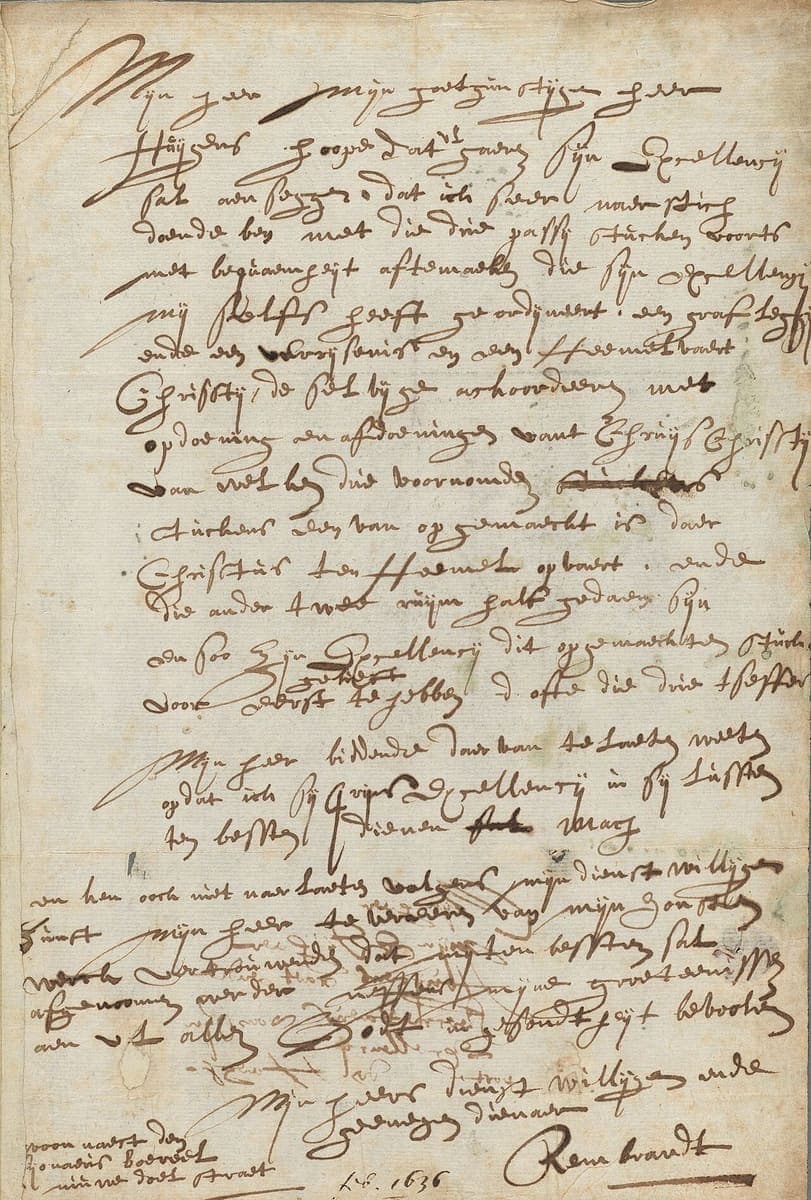
Houghton Library, Harvard University, MS Eng 870 (14), February 1636 · Source · Public domain
Evidano Transcription
The letter as printed in Hofstede de Groot’s corpus of Rembrandt documents, no. 47, with his line breaks; his section numbers § 1–§ 5 are omitted here, and three words that the Internet Archive scan of the 1906 volume broke apart (ackoorderen, dienstwillygen, vertrouwende) have been closed up against the manuscript. The address written on the outside of the folded sheet is not part of the page shown.
Myn heer myn goetgunstijge heer Huygens hoope
dat UE. gaerne syn Excellensy sal aenseggen dat ick seer
naerstigh doende ben met die drie passy stucken voorts met
bequaemheyt af te maeken die syn Excellensy my selfs heeft
geordyneert, een graf legging ende een verrysenis en een
Hemelvaert Christy. de selvyge ackoorderen met opdoening
en afdoeninge vant chruys Christij. van welcken drie
voornoemden stuckens een van opgemaeckt is daer Christus ten
Hemel opvaert ende die ander twee ruym half gedaen syn
en soo syn Excellensy dit opgemaeckte stuck voor eerst
gelieft te hebben dan ofte die drie 't seffens.
Myn heer biddende daer van te laeten weeten op dat ick
sy pryns: Excellensy in sy lussten ten besten dienen mag.
en ken oock niet naer laeten volgens myn dienstwillygen
Kunst myn heer te vereeren van myn jongste werck vertrouwende
dat my ten beste sal afgenomen werden neffens myne
groetenissen aen Ul. allen Godt in gesontheyt bevoolen.
myn heer dienst willygen
ende geneegen dienaer
Rembrandt.
woon naest den
Lyonaeus boereel
nieuwe doel straet
Source: C. Hofstede de Groot, Die Urkunden über Rembrandt (1575–1721) (The Hague, 1906), no. 47, via Internet Archive (Public domain).
The hands of a paper republic
The seventeenth-century Netherlands wrote more per head than any state in Europe, and most of it survives: notarial protocols recording contracts, freight, marriages and quarrels; letters between merchants and their factors; ledgers, share registers and bills of exchange; resolutions of town councils, chambers and the States. The everyday script is a Dutch form of the Gothic cursive that the rest of northern Europe also used — sloping, tightly looped, with a small body height and enormous capitals — written with a quill cut fine enough to run for a whole clause without lifting. Alongside it the same writers used a rounder humanist hand for Latin, for the names of foreign correspondents and often for their own signature, so two scripts frequently share one line.
The letters that trip a reader are the ones drawn with the same stroke. Open e and c are separated only by the size of the loop; r and v both end in a short upstroke; long ſ has no crossbar at all, or a stub on the left, where f carries a full one; the pair ij is written as two undotted minims and shades into y. Word endings are contracted rather than abbreviated: voorsz. and voorn. for the aforesaid, comp.te for comparerende, a swung line over a vowel for a missing n. Amounts are given in guilders, stuivers and penningen, with the guilder mark ƒ, fractions written as superscripts, and a ditto or a pair of commas repeating whatever stood on the line above.
Layout is part of the record. A notarial minute puts the names of the parties and the nature of the act in the left margin and the body to the right, with the notary’s own deletions running through whole clauses. A merchant’s ledger sets the date in one column, the entry in the middle and the sum at the right, ruled and totalled. Printed forms — a receipt, a share certificate, a bill of exchange — leave gaps that a clerk fills in a different, freer hand, and the back of such a form can carry decades of later endorsements in a dozen hands. Letters are written on a folded sheet with a wide margin, signed with a paraph, and addressed on the outside.
Why ordinary OCR struggles here
Letters drawn with the same stroke
A model trained on print has no way of separating e from c, r from v, or long ſ from f in a hand where each is a single quick movement, and no way of deciding between ij and y. The distinctions are learned from the words a Dutch clerk actually writes, not from the shapes on the page.
Two scripts sharing a line
A notary writes his Dutch in Gothic cursive and the name of an Italian merchant, a ship or a Latin formula in a round humanist hand, sometimes mid-sentence. A transcript that does not mark the switch loses a signal that tells you what the writer considered foreign.
Money, fractions and ditto marks
A column of guilders, stuivers and penningen only means something if each figure stays with its entry and the ditto marks are resolved to what they repeat. Generic OCR reflows columns into prose, silently drops the ƒ and turns a superscript fraction into a stray digit.
Additions made years apart
The back of a share certificate or the margin of a protocol accumulates entries written over forty years by different clerks with different inks. They belong to the document but not to its text, and a useful transcript keeps them as a dated series rather than folding them into the original act.
Who works with this material
Genealogists in the notarial archives
Dutch notarial protocols name servants, sailors, widows and creditors who appear nowhere else. What a researcher needs from a transcript is the names, dates, places and sums exactly as written, with a note where a surname could be read two ways, so that the entry can be matched against baptisms and burials.
Economic and maritime historians
Freight contracts, bottomry bonds, share registers and dividend endorsements only become data once the figures are attached to the right dates and parties. A transcript that preserves the columns can be turned into a table without a second pass over the manuscript.
Art historians and provenance researchers
Estate inventories and painters’ contracts are the backbone of provenance work. The description of a picture, the room it hung in and the valuation beside it have to survive together, and the notary’s deletions often show a valuation being revised.
Archives running mass transcription programmes
City archives are digitising notarial series by the metre and asking volunteers to index them. A first machine pass that flags its own uncertain readings turns the volunteers’ work from typing into checking, which is where their expertise actually pays.
Getting the best transcription
Feed it the boilerplate
Tell the model which formula the document follows — a notarial compareerde, a bill of exchange, a company charter, a merchant’s covering letter. Once the recurring clauses are expected, the remaining ambiguity concentrates in the names and figures, which is where a human should be looking anyway.
Say what to do with the second script
Ask for words written in the rounder Latin hand to be marked. Foreign personal names, ship names, Latin tags and often the signature are written that way, and having them flagged saves a separate pass when you build an index of people and vessels.
Keep tables as tables
For ledgers and endorsements, ask for one row per entry with date, description and amount in separate fields, and state whether ditto marks should be expanded to the value they repeat or left as they stand. Guilders, stuivers and penningen should be kept as three fields rather than converted.
Try a page that argues with itself
Run a notarial minute with deletions and a marginal heading before a fair copy. If the struck-out clause comes back labelled as deleted and the margin stays out of the body, the clean pages of the protocol will need little correction.
Further reading on this hand
The palaeography guides the in-app selector points to for this domain, if you want to check a transcription against the standard references.
- Wat staat daer? Uitleg
This Dutch archival project supplies practical rules for reading and transcribing historical manuscripts. Its guidance discusses punctuation, abbreviations, line-end division, and the special relationship between handwritten y and ij. Exercises from Dutch archival collections demonstrate the variability of early modern cursive and recurring administrative or commercial vocabulary. The resource is particularly useful for seventeenth-century records where fast connected writing coexists with structured financial information.
Frequently asked questions
- How does it decide between ij and y?
- From the word, and from the writer’s own habit across the document, since a single clerk is usually consistent even when his neighbours are not. Where the form is genuinely ambiguous the transcript can flag it, which matters for surnames such as Rijk and Ryck that a search will not match to each other.
- Can it keep guilders, stuivers and penningen apart?
- Yes. A sum written ƒ 33-15-0 is returned with its three parts intact rather than as a decimal number, and fractions written as superscripts are preserved. Conversion to a single figure is a separate step you can ask for once the reading is checked.
- What about the ditto marks in a column of endorsements?
- They can be expanded to whatever they repeat, or kept as marks with a note of the value they stand for. For a run of dividend entries the second is usually safer, because the reader can then see how much of the column was actually written out.
- Are additions made decades later kept separate from the original act?
- They are returned as their own block, in order, with the position on the sheet recorded. On a share certificate this keeps the 1606 subscription apart from the payments entered against it down to 1650, which were written by half a dozen different bookkeepers.
- Does it know the notarial abbreviations?
- The common ones — voorsz., voorn., comp.te, ondergeschreven, t’ selve — are recognised and can be expanded in brackets or left as written. Unusual contractions are transcribed as they appear and flagged rather than guessed at, so nothing is silently invented in a legal text.
Related scripts and pages
Transcribe your seventeenth-century Dutch documents
Upload a notarial act, a ledger opening or a letter and see the Dutch Republic’s secretary hand come back as checkable text.